1Institute for systemic consulting, Wiesloch (Germany)
www.isb-w.de
Communication models
The content on this slide is licensed under a Creative Commons Attribution 3.0 License. Creative Commons Namensnennung 3.0 Deutschland Lizenz.
to watch on youtube, see details below
2Institute for systemic consulting, Wiesloch (Germany)
www.isb-w.de
The cultural encounter model
of communication
The content on this slide is licensed under a Creative Commons Attribution 3.0 License. Creative Commons Namensnennung 3.0 Deutschland Lizenz.
3
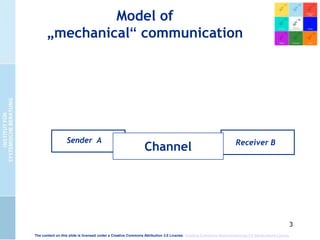
Model of
„mechanical“ communication
Sender A Receiver B
Channel
The content on this slide is licensed under a Creative Commons Attribution 3.0 License. Creative Commons Namensnennung 3.0 Deutschland Lizenz.
4
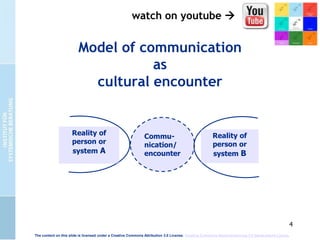
Model of communication
as
cultural encounter
Commu-
nication/
encounter
Reality of
person or
system A
Reality of
person or
system B
The content on this slide is licensed under a Creative Commons Attribution 3.0 License. Creative Commons Namensnennung 3.0 Deutschland Lizenz.
watch on youtube 
5
Implications of the cultural
encounter model
1. describes communication as encounter of cultures
(personal, professional, regional, etc.)
2. does not assume, that mutual understanding is normal
3. each communicator involved is predominantly
orientated to his/her own reality
4. necessary to study the realities of the sender and of
the recipient
5. assumes, that creating shared reality is a necessary
extra effort
The content on this slide is licensed under a Creative Commons Attribution 3.0 License. Creative Commons Namensnennung 3.0 Deutschland Lizenz.
6
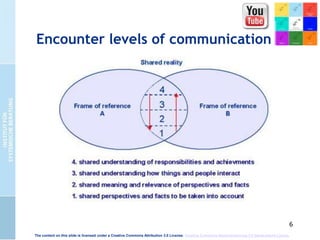
Encounter levels of communication
The content on this slide is licensed under a Creative Commons Attribution 3.0 License. Creative Commons Namensnennung 3.0 Deutschland Lizenz.
7
Roots and transformations
1. based on Schiff et al.1975 (discount levels)
2. problems usually appear on level 4 but are
due to mismatching on level 1-3
3. changes in Schiffs terminology in order to
describe relationships between equals
4. shows different levels of shared frame of
references, which build up into shared
realities
The content on this slide is licensed under a Creative Commons Attribution 3.0 License. Creative Commons Namensnennung 3.0 Deutschland Lizenz.
8
Transformations of Cathexis-
concepts by Bernd Schmid
• Discount  + account + recount
• Redefine  + define + codefine
• Discount levels 
levels of matching realities
• Symbiosis  enlargements of horizons
(e.g. organizations) 
responsibility–dialogs + -culture
The content on this slide is licensed under a Creative Commons Attribution 3.0 License. Creative Commons Namensnennung 3.0 Deutschland Lizenz.
9
Based on Schiff et. al.
Cathexis reader
• frame of reference: a meta program
which integrates all ego-states and
their interaction
• the ego-states activate frames of
reference and frames of references
activate ego-states and interactions
The content on this slide is licensed under a Creative Commons Attribution 3.0 License. Creative Commons Namensnennung 3.0 Deutschland Lizenz.
10
Transformed
• Frame of reference/culture:
Metaprogram which organizes roles and
plays.
• Professional roles activate frame of
references and frame of references
activate roles and the interplay of
roles.
The content on this slide is licensed under a Creative Commons Attribution 3.0 License. Creative Commons Namensnennung 3.0 Deutschland Lizenz.
11
Encounter of realities
• essential communicative competence:
clarifiing and creating frames of
references
• regulating consciously attention on
clients and also on professional steps to
encounter of realities
• internal and external creating of reality
and establishing a shared reality
The content on this slide is licensed under a Creative Commons Attribution 3.0 License. Creative Commons Namensnennung 3.0 Deutschland Lizenz.
12Institute for systemic consulting, Wiesloch (Germany)
www.isb-w.de
The dialog-model of
communication
The content on this slide is licensed under a Creative Commons Attribution 3.0 License. Creative Commons Namensnennung 3.0 Deutschland Lizenz.
13
Dialog-model of communication
The content on this slide is licensed under a Creative Commons Attribution 3.0 License. Creative Commons Namensnennung 3.0 Deutschland Lizenz.
14
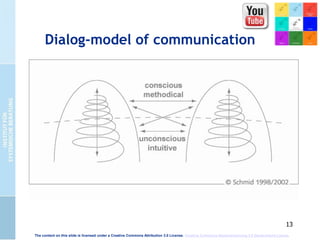
The dialog-model of communication
1. refers to the intuition concepts of Berne, Jung and
Erickson,
2. shows, how methodical and intuitive levels of
communication together contribute to co-creative
realities,
3. professional competence and organizational culture
depend on focussed dialogs between these spheres.
4. Analytical and methodological processes on the
surface in dialog with
intuitive, creative, meaningful background forces
set the stage for personal and professional self-
guidance and for performance and vitality in
complex organizations.
The content on this slide is licensed under a Creative Commons Attribution 3.0 License. Creative Commons Namensnennung 3.0 Deutschland Lizenz.
15
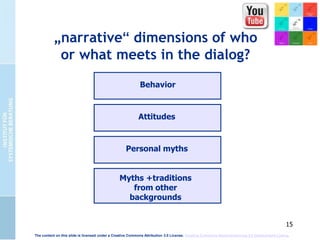
„narrative“ dimensions of who
or what meets in the dialog?
Behavior
Attitudes
Personal myths
Myths +traditions
from other
backgrounds
The content on this slide is licensed under a Creative Commons Attribution 3.0 License. Creative Commons Namensnennung 3.0 Deutschland Lizenz.
16
Foreground > Background are
observers categories
1. What is considered as foreground / in which
context?
2. clinical TA: psychological and developmental
background (motivation, reenacting, biography)
3. organizational work: needs more dimensions of
reality like organizational
roles, structures, market dynamics, technical
and economical criteria in shaping processes (
content and context )
4. others: meeting of society forces of all kind
(e.g. milieu)
The content on this slide is licensed under a Creative Commons Attribution 3.0 License. Creative Commons Namensnennung 3.0 Deutschland Lizenz.
17
The challenge
1. not habitually bringing background to the
foreground
2. create and take care of useful foreground
communication
3. in accordance and/or dialog with helpful
backgrounds
4. sensible for background forces at work
5. leave room for what is creating itself
intuitively
6. meta-communication if necessary
The content on this slide is licensed under a Creative Commons Attribution 3.0 License. Creative Commons Namensnennung 3.0 Deutschland Lizenz.

2 communication models - Bernd Schmid (Oxford lectures)

  • 1.
    1Institute for systemicconsulting, Wiesloch (Germany) www.isb-w.de Communication models The content on this slide is licensed under a Creative Commons Attribution 3.0 License. Creative Commons Namensnennung 3.0 Deutschland Lizenz. to watch on youtube, see details below
  • 2.
    2Institute for systemicconsulting, Wiesloch (Germany) www.isb-w.de The cultural encounter model of communication The content on this slide is licensed under a Creative Commons Attribution 3.0 License. Creative Commons Namensnennung 3.0 Deutschland Lizenz.
  • 3.
    3 Model of „mechanical“ communication SenderA Receiver B Channel The content on this slide is licensed under a Creative Commons Attribution 3.0 License. Creative Commons Namensnennung 3.0 Deutschland Lizenz.
  • 4.
    4 Model of communication as culturalencounter Commu- nication/ encounter Reality of person or system A Reality of person or system B The content on this slide is licensed under a Creative Commons Attribution 3.0 License. Creative Commons Namensnennung 3.0 Deutschland Lizenz. watch on youtube 
  • 5.
    5 Implications of thecultural encounter model 1. describes communication as encounter of cultures (personal, professional, regional, etc.) 2. does not assume, that mutual understanding is normal 3. each communicator involved is predominantly orientated to his/her own reality 4. necessary to study the realities of the sender and of the recipient 5. assumes, that creating shared reality is a necessary extra effort The content on this slide is licensed under a Creative Commons Attribution 3.0 License. Creative Commons Namensnennung 3.0 Deutschland Lizenz.
  • 6.
    6 Encounter levels ofcommunication The content on this slide is licensed under a Creative Commons Attribution 3.0 License. Creative Commons Namensnennung 3.0 Deutschland Lizenz.
  • 7.
    7 Roots and transformations 1.based on Schiff et al.1975 (discount levels) 2. problems usually appear on level 4 but are due to mismatching on level 1-3 3. changes in Schiffs terminology in order to describe relationships between equals 4. shows different levels of shared frame of references, which build up into shared realities The content on this slide is licensed under a Creative Commons Attribution 3.0 License. Creative Commons Namensnennung 3.0 Deutschland Lizenz.
  • 8.
    8 Transformations of Cathexis- conceptsby Bernd Schmid • Discount  + account + recount • Redefine  + define + codefine • Discount levels  levels of matching realities • Symbiosis  enlargements of horizons (e.g. organizations)  responsibility–dialogs + -culture The content on this slide is licensed under a Creative Commons Attribution 3.0 License. Creative Commons Namensnennung 3.0 Deutschland Lizenz.
  • 9.
    9 Based on Schiffet. al. Cathexis reader • frame of reference: a meta program which integrates all ego-states and their interaction • the ego-states activate frames of reference and frames of references activate ego-states and interactions The content on this slide is licensed under a Creative Commons Attribution 3.0 License. Creative Commons Namensnennung 3.0 Deutschland Lizenz.
  • 10.
    10 Transformed • Frame ofreference/culture: Metaprogram which organizes roles and plays. • Professional roles activate frame of references and frame of references activate roles and the interplay of roles. The content on this slide is licensed under a Creative Commons Attribution 3.0 License. Creative Commons Namensnennung 3.0 Deutschland Lizenz.
  • 11.
    11 Encounter of realities •essential communicative competence: clarifiing and creating frames of references • regulating consciously attention on clients and also on professional steps to encounter of realities • internal and external creating of reality and establishing a shared reality The content on this slide is licensed under a Creative Commons Attribution 3.0 License. Creative Commons Namensnennung 3.0 Deutschland Lizenz.
  • 12.
    12Institute for systemicconsulting, Wiesloch (Germany) www.isb-w.de The dialog-model of communication The content on this slide is licensed under a Creative Commons Attribution 3.0 License. Creative Commons Namensnennung 3.0 Deutschland Lizenz.
  • 13.
    13 Dialog-model of communication Thecontent on this slide is licensed under a Creative Commons Attribution 3.0 License. Creative Commons Namensnennung 3.0 Deutschland Lizenz.
  • 14.
    14 The dialog-model ofcommunication 1. refers to the intuition concepts of Berne, Jung and Erickson, 2. shows, how methodical and intuitive levels of communication together contribute to co-creative realities, 3. professional competence and organizational culture depend on focussed dialogs between these spheres. 4. Analytical and methodological processes on the surface in dialog with intuitive, creative, meaningful background forces set the stage for personal and professional self- guidance and for performance and vitality in complex organizations. The content on this slide is licensed under a Creative Commons Attribution 3.0 License. Creative Commons Namensnennung 3.0 Deutschland Lizenz.
  • 15.
    15 „narrative“ dimensions ofwho or what meets in the dialog? Behavior Attitudes Personal myths Myths +traditions from other backgrounds The content on this slide is licensed under a Creative Commons Attribution 3.0 License. Creative Commons Namensnennung 3.0 Deutschland Lizenz.
  • 16.
    16 Foreground > Backgroundare observers categories 1. What is considered as foreground / in which context? 2. clinical TA: psychological and developmental background (motivation, reenacting, biography) 3. organizational work: needs more dimensions of reality like organizational roles, structures, market dynamics, technical and economical criteria in shaping processes ( content and context ) 4. others: meeting of society forces of all kind (e.g. milieu) The content on this slide is licensed under a Creative Commons Attribution 3.0 License. Creative Commons Namensnennung 3.0 Deutschland Lizenz.
  • 17.
    17 The challenge 1. nothabitually bringing background to the foreground 2. create and take care of useful foreground communication 3. in accordance and/or dialog with helpful backgrounds 4. sensible for background forces at work 5. leave room for what is creating itself intuitively 6. meta-communication if necessary The content on this slide is licensed under a Creative Commons Attribution 3.0 License. Creative Commons Namensnennung 3.0 Deutschland Lizenz.