Copyright © 2010 John Wiley & Sons, Inc. 15-1
Refers to the creation, or reinvention, of a business itself.
Whereas innovation is typically seen in the form of a new
product or service offering, a business model
innovation results in an entirely different type of company
that competes not only on the value proposition of its
offerings, but aligns its profit formula, resources and
processes to enhance that value proposition, capture
new market segments and alienate competitors.
Wikipedia
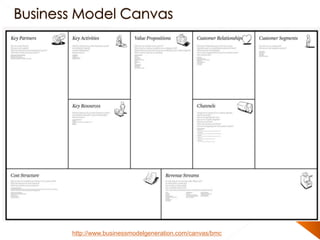
It is how you make money and includes your:
 Value proposition (including market segments)
 Revenue (and costs)
 Partnerships (and own resources)
 Supply chain (including distribution channels)
 Activities (including services and value add)
 Customers (including relationships)
http://www.youtube.com/watch?v=QoAOzMTLP5s
http://www.businessmodelgeneration.com/canvas/bmc
 Increase value proposition, or attack new market
segments
 Increase revenues, or reduce costs
 Develop strategic partnerships, or enhance extant
resources
 Leverage supply chain, or distributor, relationships
 Improve current activities, create new value for
customers
 Sell more to existing customers, find new customers
or develop new ways to interact with customers
 Your business model is how you (or your competitors)
do business.
 You can adapt your business model to create a
competitive advantage that offers enhanced value to
your customers that your competitors can not
replicate.
 Business model innovation is one of the most
promising ways for new entrants to achieve market
share by taking advantage of existing companies
rigidities.
 Provide newness
 Enhance performance
 Offer customization
 Help getting the job done
 Build status (brand/design)
 Reduce purchase price
 Reduce operating costs
 Reduce risk
 Improve accessibility / reliability
 Increase convenience / usability
What value do we deliver to the customer?
Which one of your customers problems are you
helping to solve?
What bundles of products/services are you
offering to each customer segments?
What customer needs are you satisfying?
Customers segmented on different needs/attributes:
 Mass Market (market not distinguished) vs. Niche
Market (all elements of BM are tailored for segment)
 Segmented: Additional segmentation within an
existing customer segment (i.e. age/income).
 Diversify: Multiple unrelated customer segments
(each with different needs and characteristics).
 Multi-Sided Platform/Market: Serve mutually
dependent customer segments (brokering).
For whom are you creating value?
Who are your most important or most promising
customers?
Ways to generate revenue:
Asset Sale – Selling ownership rights
to physical good. (e.g., Wal-Mart)
Usage Fee – Charge fees for use of
a service (e.g., UPS)
Subscription Fees - Revenue generated by selling a
continuous service. (e.g., Netflix)
Lending/Leasing/Renting – Giving exclusive right to an
asset for a particular period of time. (e.g., Car Leasing)
Licensing - Charge for the use of a intellectual property
Brokerage Fees - Revenue generated from an
intermediate service between 2 parties. (e.g., Realtor
commission)
Advertising - Charge fees for product advertising (e.g.
Google Adwords)
For what value are your customers
paying?
For what do they currently pay?
How are they currently paying?
How would they prefer to pay?
How much does each revenue stream
contribute to overall revenue?
Economic consequences of operational structure
Classes of Business Structures:
 Cost-Driven - Focuses on minimizing costs (e.g., SouthWest)
 Value-Driven - Focus on differentiation (e.g., Rolex)
Characteristics of Cost Structures:
 Fixed Costs - Costs are unchanged across different
applications. i.e. salary, rent
Variable Costs - These costs vary depending on the amount
of production of goods or services
 Economies of Scale - Costs go down as the amount of
good are ordered or produced
 Economies of Scope - Costs go down due to incorporating
other businesses which have a direct relation to the original
product
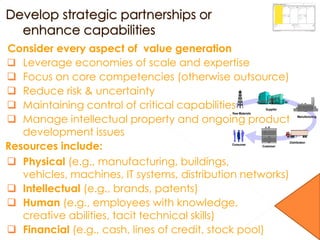
Consider every aspect of value generation
 Leverage economies of scale and expertise
 Focus on core competencies (otherwise outsource)
 Reduce risk & uncertainty
 Maintaining control of critical capabilities
 Manage intellectual property and ongoing product
development issues
Resources include:
 Physical (e.g., manufacturing, buildings,
vehicles, machines, IT systems, distribution networks)
 Intellectual (e.g., brands, patents)
 Human (e.g., employees with knowledge,
creative abilities, tacit technical skills)
 Financial (e.g., cash, lines of credit, stock pool)
Variety of options and relationships that compete or
complement:
Own channels
Direct
Sales Force
Web Sales
Indirect
Store Front
Partner channels
Indirect
Partner Stores
Wholesalers
OEM
Stand alone
Integrated
 Change revenue model to reduce initial cost
 Make it easier for customers to trial product
 Use channel partners relationship to sell
product
 Change who pays for product/service use
 Leverage supplier technology, or brand
 Make it easier to measure performance of
technology to help justify acquisition
 Use thought leaders to enhance brand or
reputation
New ways to build valuable customer relationships:
Personal Assistance: Assistance through employee-
customer interaction during sales, after sales, or both.
Dedicated Personal Assistance: Dedicated sales
representatives (most intimate and hands-on.
Self Service: Indirect interaction between company and
clients (provides tools for customers to self serve).
Automated Services: Self service w/ personalization
based on preferences.
Communities: Allows direct interaction among clients &
company.
Co-creation: Personal relationship created through
customer’s direct input in the products/services.
 Changing your business model can create a
competitive advantage your competitors can not
replicate.
 A review of the various aspects of your Business
Model may help you identify ways to grow your
business, and offers a way of acquiring market share
from existing companies constrained by their
rigidities.
Thank you

Innovators alliance webinar 2 (no video)

  • 1.
    Copyright © 2010John Wiley & Sons, Inc. 15-1
  • 2.
    Refers to thecreation, or reinvention, of a business itself. Whereas innovation is typically seen in the form of a new product or service offering, a business model innovation results in an entirely different type of company that competes not only on the value proposition of its offerings, but aligns its profit formula, resources and processes to enhance that value proposition, capture new market segments and alienate competitors. Wikipedia
  • 3.
    It is howyou make money and includes your:  Value proposition (including market segments)  Revenue (and costs)  Partnerships (and own resources)  Supply chain (including distribution channels)  Activities (including services and value add)  Customers (including relationships)
  • 4.
  • 5.
  • 6.
     Increase valueproposition, or attack new market segments  Increase revenues, or reduce costs  Develop strategic partnerships, or enhance extant resources  Leverage supply chain, or distributor, relationships  Improve current activities, create new value for customers  Sell more to existing customers, find new customers or develop new ways to interact with customers
  • 7.
     Your businessmodel is how you (or your competitors) do business.  You can adapt your business model to create a competitive advantage that offers enhanced value to your customers that your competitors can not replicate.  Business model innovation is one of the most promising ways for new entrants to achieve market share by taking advantage of existing companies rigidities.
  • 8.
     Provide newness Enhance performance  Offer customization  Help getting the job done  Build status (brand/design)  Reduce purchase price  Reduce operating costs  Reduce risk  Improve accessibility / reliability  Increase convenience / usability What value do we deliver to the customer? Which one of your customers problems are you helping to solve? What bundles of products/services are you offering to each customer segments? What customer needs are you satisfying?
  • 9.
    Customers segmented ondifferent needs/attributes:  Mass Market (market not distinguished) vs. Niche Market (all elements of BM are tailored for segment)  Segmented: Additional segmentation within an existing customer segment (i.e. age/income).  Diversify: Multiple unrelated customer segments (each with different needs and characteristics).  Multi-Sided Platform/Market: Serve mutually dependent customer segments (brokering). For whom are you creating value? Who are your most important or most promising customers?
  • 10.
    Ways to generaterevenue: Asset Sale – Selling ownership rights to physical good. (e.g., Wal-Mart) Usage Fee – Charge fees for use of a service (e.g., UPS) Subscription Fees - Revenue generated by selling a continuous service. (e.g., Netflix) Lending/Leasing/Renting – Giving exclusive right to an asset for a particular period of time. (e.g., Car Leasing) Licensing - Charge for the use of a intellectual property Brokerage Fees - Revenue generated from an intermediate service between 2 parties. (e.g., Realtor commission) Advertising - Charge fees for product advertising (e.g. Google Adwords) For what value are your customers paying? For what do they currently pay? How are they currently paying? How would they prefer to pay? How much does each revenue stream contribute to overall revenue?
  • 11.
    Economic consequences ofoperational structure Classes of Business Structures:  Cost-Driven - Focuses on minimizing costs (e.g., SouthWest)  Value-Driven - Focus on differentiation (e.g., Rolex) Characteristics of Cost Structures:  Fixed Costs - Costs are unchanged across different applications. i.e. salary, rent Variable Costs - These costs vary depending on the amount of production of goods or services  Economies of Scale - Costs go down as the amount of good are ordered or produced  Economies of Scope - Costs go down due to incorporating other businesses which have a direct relation to the original product
  • 12.
    Consider every aspectof value generation  Leverage economies of scale and expertise  Focus on core competencies (otherwise outsource)  Reduce risk & uncertainty  Maintaining control of critical capabilities  Manage intellectual property and ongoing product development issues Resources include:  Physical (e.g., manufacturing, buildings, vehicles, machines, IT systems, distribution networks)  Intellectual (e.g., brands, patents)  Human (e.g., employees with knowledge, creative abilities, tacit technical skills)  Financial (e.g., cash, lines of credit, stock pool)
  • 13.
    Variety of optionsand relationships that compete or complement: Own channels Direct Sales Force Web Sales Indirect Store Front Partner channels Indirect Partner Stores Wholesalers OEM Stand alone Integrated
  • 14.
     Change revenuemodel to reduce initial cost  Make it easier for customers to trial product  Use channel partners relationship to sell product  Change who pays for product/service use  Leverage supplier technology, or brand  Make it easier to measure performance of technology to help justify acquisition  Use thought leaders to enhance brand or reputation
  • 15.
    New ways tobuild valuable customer relationships: Personal Assistance: Assistance through employee- customer interaction during sales, after sales, or both. Dedicated Personal Assistance: Dedicated sales representatives (most intimate and hands-on. Self Service: Indirect interaction between company and clients (provides tools for customers to self serve). Automated Services: Self service w/ personalization based on preferences. Communities: Allows direct interaction among clients & company. Co-creation: Personal relationship created through customer’s direct input in the products/services.
  • 16.
     Changing yourbusiness model can create a competitive advantage your competitors can not replicate.  A review of the various aspects of your Business Model may help you identify ways to grow your business, and offers a way of acquiring market share from existing companies constrained by their rigidities. Thank you