Definition of Competitiveness
Objective of a business is to make a profit.
Profit based on providing value to customers.
How can a business assure value to customers?
A good competitor knows:
Which products and services it offers.
Who its customers are.
Who its competitors are.
Competitive Advantage
To assure positioning for profit, a company must
maintain competitive advantage.
Methods that are achievable and sustainable.
Work smarter.
Assess whether Information Systems are
appropriate to gaining a competitive advantage?
Focus on three primary inputs: HR , Capital,
Technology.
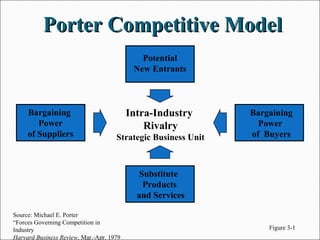
The Porter Competitive
Model
Used to understand and evaluate the
structure of an industry’s business
environment and the threats of
competition to a specific company.
Primary and Supporting
Strategies
Differentiation Strategy (Primary)
Low Cost Strategy (Primary)
Innovation (Supporting)
Growth (Supporting)
Alliance (Supporting)
Awareness of competitive forces can
help a company stake out a position
in its industry that is less vulnerable
to attack.
Michael E. Porter
Competitive Strategy
Porter Competitive ModelPorter Competitive Model
Intra-Industry
Rivalry
Strategic Business Unit
Bargaining
Power
of Buyers
Bargaining
Power
of Suppliers
Substitute
Products
and Services
Potential
New Entrants
Figure 3-1
Source: Michael E. Porter
“Forces Governing Competition in
Industry
Harvard Business Review, Mar.-Apr. 1979
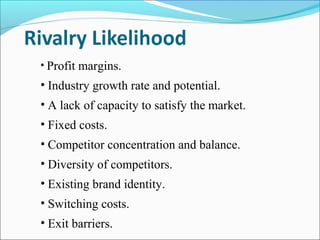
• Profit margins.
• Industry growth rate and potential.
• A lack of capacity to satisfy the market.
• Fixed costs.
• Competitor concentration and balance.
• Diversity of competitors.
• Existing brand identity.
• Switching costs.
• Exit barriers.
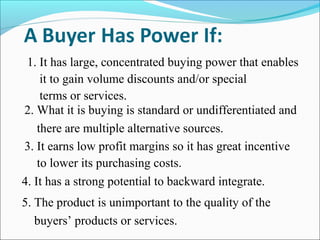
1. It has large, concentrated buying power that enables
it to gain volume discounts and/or special
terms or services.
2. What it is buying is standard or undifferentiated and
there are multiple alternative sources.
3. It earns low profit margins so it has great incentive
to lower its purchasing costs.
4. It has a strong potential to backward integrate.
5. The product is unimportant to the quality of the
buyers’ products or services.
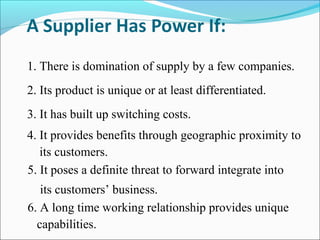
1. There is domination of supply by a few companies.
2. Its product is unique or at least differentiated.
3. It has built up switching costs.
4. It provides benefits through geographic proximity to
its customers.
5. It poses a definite threat to forward integrate into
its customers’ business.
6. A long time working relationship provides unique
capabilities.
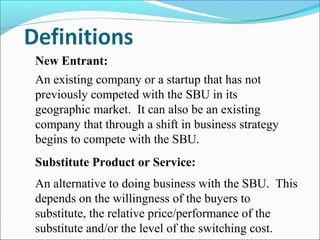
New Entrant:
An existing company or a startup that has not
previously competed with the SBU in its
geographic market. It can also be an existing
company that through a shift in business strategy
begins to compete with the SBU.
Substitute Product or Service:
An alternative to doing business with the SBU. This
depends on the willingness of the buyers to
substitute, the relative price/performance of the
substitute and/or the level of the switching cost.
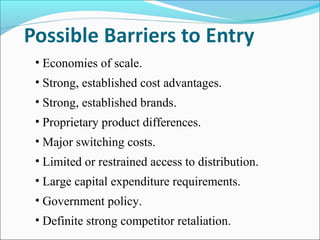
• Economies of scale.
• Strong, established cost advantages.
• Strong, established brands.
• Proprietary product differences.
• Major switching costs.
• Limited or restrained access to distribution.
• Large capital expenditure requirements.
• Government policy.
• Definite strong competitor retaliation.
• Buyer propensity to substitute.
• Relative price/performance of substitutes.
• Switching costs.
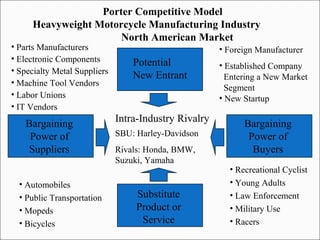
Porter Competitive Model
Heavyweight Motorcycle Manufacturing Industry
North American Market
Bargaining
Power of
Buyers
• Recreational Cyclist
• Young Adults
• Law Enforcement
• Military Use
• Racers
Potential
New Entrant
Substitute
Product or
Service
Intra-Industry Rivalry
SBU: Harley-Davidson
Rivals: Honda, BMW,
Suzuki, Yamaha
• Foreign Manufacturer
• Established Company
Entering a New Market
Segment
• New Startup
• Parts Manufacturers
• Electronic Components
• Specialty Metal Suppliers
• Machine Tool Vendors
• Labor Unions
• IT Vendors
Bargaining
Power of
Suppliers
• Automobiles
• Public Transportation
• Mopeds
• Bicycles
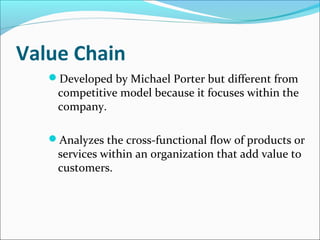
Value Chain
Developed by Michael Porter but different from
competitive model because it focuses within the
company.
Analyzes the cross-functional flow of products or
services within an organization that add value to
customers.
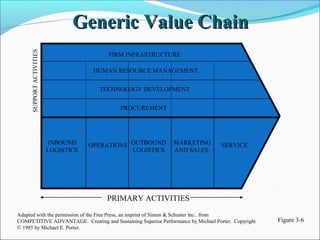
Generic Value ChainGeneric Value Chain
INBOUND
LOGISTICS
OPERATIONS OUTBOUND
LOGISTICS
MARKETING
AND SALES
SERVICE
PRIMARY ACTIVITIES
PROCUREMENT
TECHNOLOGY DEVELOPMENT
HUMAN RESOURCE MANAGEMENT
FIRM INFRASTRUCTURE
SUPPORTACTIVITIES
Figure 3-6
Adapted with the permission of the Free Press, an imprint of Simon & Schuster Inc.. from
COMPETITIVE ADVANTAGE: Creating and Sustaining Superior Performance by Michael Porter. Copyright
© 1985 by Michael E. Porter.

Competitive advantage

  • 2.
    Definition of Competitiveness Objectiveof a business is to make a profit. Profit based on providing value to customers. How can a business assure value to customers? A good competitor knows: Which products and services it offers. Who its customers are. Who its competitors are.
  • 3.
    Competitive Advantage To assurepositioning for profit, a company must maintain competitive advantage. Methods that are achievable and sustainable. Work smarter. Assess whether Information Systems are appropriate to gaining a competitive advantage? Focus on three primary inputs: HR , Capital, Technology.
  • 4.
    The Porter Competitive Model Usedto understand and evaluate the structure of an industry’s business environment and the threats of competition to a specific company.
  • 5.
    Primary and Supporting Strategies DifferentiationStrategy (Primary) Low Cost Strategy (Primary) Innovation (Supporting) Growth (Supporting) Alliance (Supporting)
  • 6.
    Awareness of competitiveforces can help a company stake out a position in its industry that is less vulnerable to attack. Michael E. Porter Competitive Strategy
  • 7.
    Porter Competitive ModelPorterCompetitive Model Intra-Industry Rivalry Strategic Business Unit Bargaining Power of Buyers Bargaining Power of Suppliers Substitute Products and Services Potential New Entrants Figure 3-1 Source: Michael E. Porter “Forces Governing Competition in Industry Harvard Business Review, Mar.-Apr. 1979
  • 8.
    • Profit margins. •Industry growth rate and potential. • A lack of capacity to satisfy the market. • Fixed costs. • Competitor concentration and balance. • Diversity of competitors. • Existing brand identity. • Switching costs. • Exit barriers.
  • 9.
    1. It haslarge, concentrated buying power that enables it to gain volume discounts and/or special terms or services. 2. What it is buying is standard or undifferentiated and there are multiple alternative sources. 3. It earns low profit margins so it has great incentive to lower its purchasing costs. 4. It has a strong potential to backward integrate. 5. The product is unimportant to the quality of the buyers’ products or services.
  • 10.
    1. There isdomination of supply by a few companies. 2. Its product is unique or at least differentiated. 3. It has built up switching costs. 4. It provides benefits through geographic proximity to its customers. 5. It poses a definite threat to forward integrate into its customers’ business. 6. A long time working relationship provides unique capabilities.
  • 11.
    New Entrant: An existingcompany or a startup that has not previously competed with the SBU in its geographic market. It can also be an existing company that through a shift in business strategy begins to compete with the SBU. Substitute Product or Service: An alternative to doing business with the SBU. This depends on the willingness of the buyers to substitute, the relative price/performance of the substitute and/or the level of the switching cost.
  • 12.
    • Economies ofscale. • Strong, established cost advantages. • Strong, established brands. • Proprietary product differences. • Major switching costs. • Limited or restrained access to distribution. • Large capital expenditure requirements. • Government policy. • Definite strong competitor retaliation.
  • 13.
    • Buyer propensityto substitute. • Relative price/performance of substitutes. • Switching costs.
  • 14.
    Porter Competitive Model HeavyweightMotorcycle Manufacturing Industry North American Market Bargaining Power of Buyers • Recreational Cyclist • Young Adults • Law Enforcement • Military Use • Racers Potential New Entrant Substitute Product or Service Intra-Industry Rivalry SBU: Harley-Davidson Rivals: Honda, BMW, Suzuki, Yamaha • Foreign Manufacturer • Established Company Entering a New Market Segment • New Startup • Parts Manufacturers • Electronic Components • Specialty Metal Suppliers • Machine Tool Vendors • Labor Unions • IT Vendors Bargaining Power of Suppliers • Automobiles • Public Transportation • Mopeds • Bicycles
  • 15.
    Value Chain Developed byMichael Porter but different from competitive model because it focuses within the company. Analyzes the cross-functional flow of products or services within an organization that add value to customers.
  • 16.
    Generic Value ChainGenericValue Chain INBOUND LOGISTICS OPERATIONS OUTBOUND LOGISTICS MARKETING AND SALES SERVICE PRIMARY ACTIVITIES PROCUREMENT TECHNOLOGY DEVELOPMENT HUMAN RESOURCE MANAGEMENT FIRM INFRASTRUCTURE SUPPORTACTIVITIES Figure 3-6 Adapted with the permission of the Free Press, an imprint of Simon & Schuster Inc.. from COMPETITIVE ADVANTAGE: Creating and Sustaining Superior Performance by Michael Porter. Copyright © 1985 by Michael E. Porter.