Copyright © 2010 John Wiley & Sons, Inc. 15-1
 Why is the marketing of technology
innovation different from traditional
marketing?
 The two components of innovation
marketing – diffusion and adoption
 How do different types of customers adopt
at different rates?
 Based on these frameworks, how do I
develop a marketing plan to stimulate
customer adoption of new solutions?
22
 Innovation is the creation of new and better:
 effective products,
 processes,
 services,
 technologies, or
 business models
That are accepted by markets, governments, and
society
Not the same as invention or improvement
3
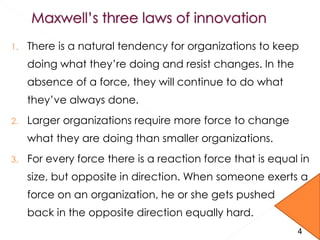
1. There is a natural tendency for organizations to keep
doing what they’re doing and resist changes. In the
absence of a force, they will continue to do what
they’ve always done.
2. Larger organizations require more force to change
what they are doing than smaller organizations.
3. For every force there is a reaction force that is equal in
size, but opposite in direction. When someone exerts a
force on an organization, he or she gets pushed
back in the opposite direction equally hard.
4
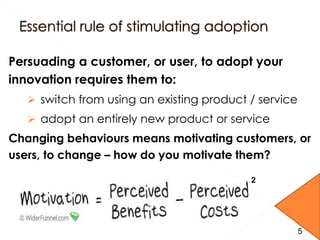
Persuading a customer, or user, to adopt your
innovation requires them to:
 switch from using an existing product / service
 adopt an entirely new product or service
Changing behaviours means motivating customers, or
users, to change – how do you motivate them?
2
5
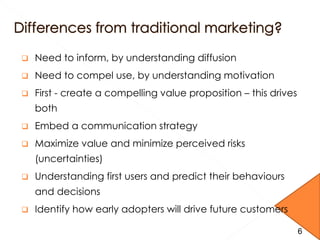
 Need to inform, by understanding diffusion
 Need to compel use, by understanding motivation
 First - create a compelling value proposition – this drives
both
 Embed a communication strategy
 Maximize value and minimize perceived risks
(uncertainties)
 Understanding first users and predict their behaviours
and decisions
 Identify how early adopters will drive future customers
6
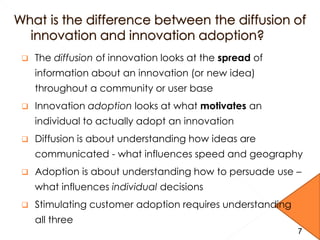
 The diffusion of innovation looks at the spread of
information about an innovation (or new idea)
throughout a community or user base
 Innovation adoption looks at what motivates an
individual to actually adopt an innovation
 Diffusion is about understanding how ideas are
communicated - what influences speed and geography
 Adoption is about understanding how to persuade use –
what influences individual decisions
 Stimulating customer adoption requires understanding
all three
7
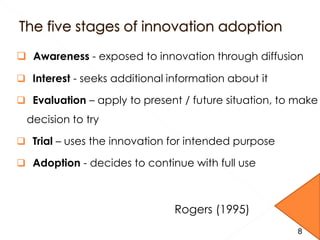
8
 Awareness - exposed to innovation through diffusion
 Interest - seeks additional information about it
 Evaluation – apply to present / future situation, to make
decision to try
 Trial – uses the innovation for intended purpose
 Adoption - decides to continue with full use
Rogers (1995)
8
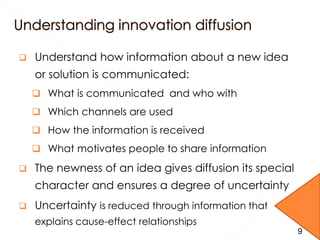
 Understand how information about a new idea
or solution is communicated:
 What is communicated and who with
 Which channels are used
 How the information is received
 What motivates people to share information
 The newness of an idea gives diffusion its special
character and ensures a degree of uncertainty
 Uncertainty is reduced through information that
explains cause-effect relationships
9
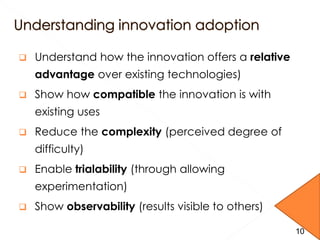
 Understand how the innovation offers a relative
advantage over existing technologies)
 Show how compatible the innovation is with
existing uses
 Reduce the complexity (perceived degree of
difficulty)
 Enable trialability (through allowing
experimentation)
 Show observability (results visible to others)
10
11
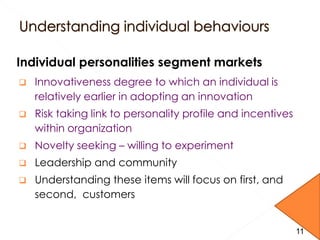
Individual personalities segment markets
 Innovativeness degree to which an individual is
relatively earlier in adopting an innovation
 Risk taking link to personality profile and incentives
within organization
 Novelty seeking – willing to experiment
 Leadership and community
 Understanding these items will focus on first, and
second, customers
11
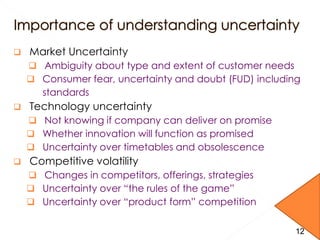
 Market Uncertainty
 Ambiguity about type and extent of customer needs
 Consumer fear, uncertainty and doubt (FUD) including
standards
 Technology uncertainty
 Not knowing if company can deliver on promise
 Whether innovation will function as promised
 Uncertainty over timetables and obsolescence
 Competitive volatility
 Changes in competitors, offerings, strategies
 Uncertainty over “the rules of the game”
 Uncertainty over “product form” competition
12
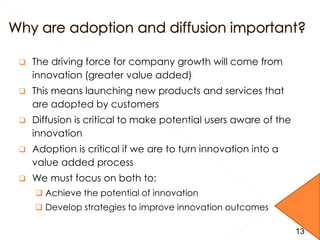
 The driving force for company growth will come from
innovation (greater value added)
 This means launching new products and services that
are adopted by customers
 Diffusion is critical to make potential users aware of the
innovation
 Adoption is critical if we are to turn innovation into a
value added process
 We must focus on both to:
 Achieve the potential of innovation
 Develop strategies to improve innovation outcomes
13
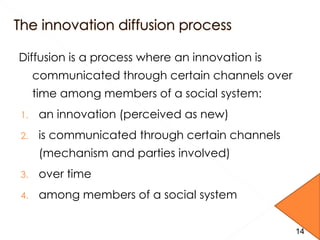
Diffusion is a process where an innovation is
communicated through certain channels over
time among members of a social system:
1. an innovation (perceived as new)
2. is communicated through certain channels
(mechanism and parties involved)
3. over time
4. among members of a social system
14
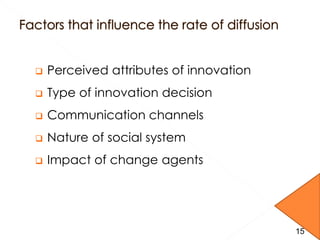
 Perceived attributes of innovation
 Type of innovation decision
 Communication channels
 Nature of social system
 Impact of change agents
15
16
 Benefits
 Impact on performance
 Impact on utility
 Impact on reputation
 Costs
 Initial costs
 Long-term costs
 Increased risks (uncertainties)
This is linked to the value proposition
16
17
 Two factors influence the decision
 Whether the decision is made freely and
implemented voluntarily.
 Who makes the decision (where in the organization)
 Three types of innovation decision
 Optional Innovation-Decision made by an individual
who is in some way distinguished from others.
 Collective Innovation-Decision made collectively by
all participants.
 Authority Innovation-Decision made for the entire
social system by individuals in positions of influence
or power.
17
 Means by which messages get from one individual to
another
 Nature of the information-exchange relation
determines the conditions under which source will/will
not transmit innovation to receiver and transfer effect
 Individuals do not evaluate innovations on the basis of
a scientific assessment of its consequences – rather
depend on subjective peer assessment.
 Understanding how innovation information is dispersed
is critical to success
1818
 The culture of the organization
 The external pressure that drives innovation
 Communication activities
 Community leadership
 The network (Metcalfe) effect
 Effect of role models and opinion leaders
19
 Most innovative member of a system
perceived as deviant from social system
 Those that influence change are not
always who you expect
 In the world of technological innovation,
these opinion leaders may be in a variety
of places, from institutions, to social
bloggers
16-
20Copyright © 2010 John Wiley & Sons, Inc. 20
2121
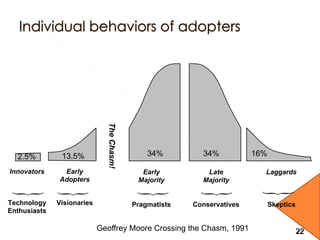
Innovators
Technology
Enthusiasts
Early
Adopters
Visionaries
Late
Majority
Conservatives
Early
Majority
Pragmatists
Laggards
Skeptics
{
{
{
{
{
TheChasm!
34% 34% 16%2.5% 13.5%
2222Geoffrey Moore Crossing the Chasm, 1991
 Innovators appreciate technology for its own sake
 Motivated by idea of being a change agent
 Will tolerate initial glitches
 Will develop make-shift solutions
 Willing to alpha/beta test and work with technical
personnel in compensation with lower pricing
 Early Adopters revolutionize their industry
 Attracted by high-risk/high-reward projects
 Not necessarily very price sensitive
 Demand customized solutions and intensive tech
support
 Opinion leaders, change agents
2323
 Early majority comfortable with evolutionary changes
 Risk aversion to disruptions in their operations
 Want proven applications, reliable service
 Seek the convenient “whole product” design
 Buy only with a reference from a trusted colleague
 Late majority are risk averse, technology shy
 Very price sensitive
 Require completely pre-assembled, bullet-proof
(reliable performance) solutions
 Motivated by need to keep up with competitors
 Rely on single, trusted advisor
2424
 Gap between Visionaries and Pragmatists
 Visionary market saturated, mainstream not ready to buy
 Visionary marketing not effective with pragmatists
 Limit to number of visionaries than can be handled
 Consequences for marketing to pragmatists
 Assume responsibility for complete, end-to-end solution
 Customer services vital (seeking the useful applications)
 Focus on best solution possible (rather than best possible
solution)
 Simplify complex product features 2525
 Relative advantage
 Understand customer perception of cost/benefit
 Compatibility
 Educate customers to overcome concerns and
embed migration path
 Complexity
 Simplify the user experience to facilitate use
 Trialability
 Design products that are standalone/ easy to trial
 Observability/visibility
 Identify how to demonstrate performance 2626
 Build a communication strategy (initial and
secondary)
 Foster chasm crossing
 Provide compelling reasons for adoption, - overcome
FUD through educating users about benefits and use
 Understand who is likely to be an early adopter and
how they differ from the mainstream market
 Choose initial market segment wisely
 Focus on understanding the adoption decision
2727
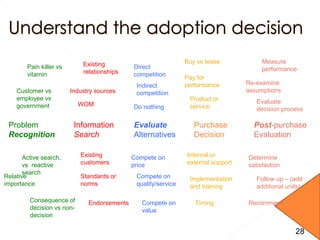
Problem
Recognition
Information
Search
Evaluate
Alternatives
Purchase
Decision
Post-purchase
Evaluation
Pain killer vs
vitamin
Customer vs
employee vs
government
Active search,
vs reactive
search
Relative
importance
Consequence of
decision vs non-
decision
Existing
relationships
Industry sources
WOM
Existing
customers
Standards or
norms
Endorsements
Direct
competition
Indirect
competition
Do nothing
Compete on
price
Compete on
value
Compete on
quality/service
Buy vs lease
Pay for
performance
Product or
service
Internal or
external support
Implementation
and training
Timing
Measure
performance
Re-examine
assumptions
Evaluate
decision process
Determine
satisfaction
Follow up – (add
additional units)
Recommend
28
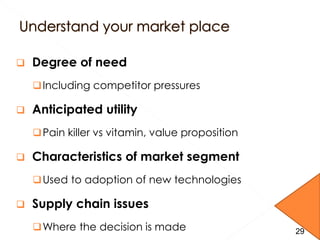
 Degree of need
Including competitor pressures
 Anticipated utility
Pain killer vs vitamin, value proposition
 Characteristics of market segment
Used to adoption of new technologies
 Supply chain issues
Where the decision is made 2929
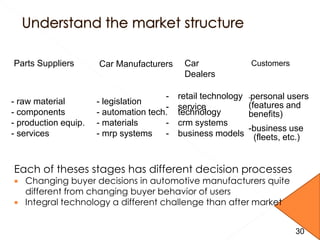
Parts Suppliers Car Manufacturers Car
Dealers
Customers
- raw material
- components
- production equip.
- services
-personal users
(features and
benefits)
-business use
(fleets, etc.)
- legislation
- automation tech.
- materials
- mrp systems
- retail technology
- service
technology
- crm systems
- business models
Each of theses stages has different decision processes
 Changing buyer decisions in automotive manufacturers quite
different from changing buyer behavior of users
 Integral technology a different challenge than after market
30
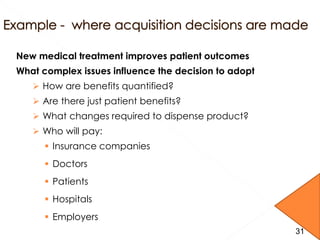
New medical treatment improves patient outcomes
What complex issues influence the decision to adopt
 How are benefits quantified?
 Are there just patient benefits?
 What changes required to dispense product?
 Who will pay:
 Insurance companies
 Doctors
 Patients
 Hospitals
 Employers
3131
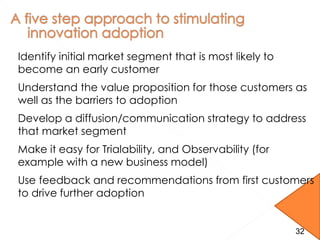
Identify initial market segment that is most likely to
become an early customer
Understand the value proposition for those customers as
well as the barriers to adoption
Develop a diffusion/communication strategy to address
that market segment
Make it easy for Trialability, and Observability (for
example with a new business model)
Use feedback and recommendations from first customers
to drive further adoption
32
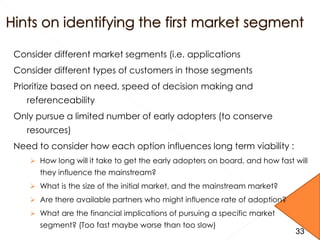
Consider different market segments (i.e. applications
Consider different types of customers in those segments
Prioritize based on need, speed of decision making and
referenceability
Only pursue a limited number of early adopters (to conserve
resources)
Need to consider how each option influences long term viability :
 How long will it take to get the early adopters on board, and how fast will
they influence the mainstream?
 What is the size of the initial market, and the mainstream market?
 Are there available partners who might influence rate of adoption?
 What are the financial implications of pursuing a specific market
segment? (Too fast maybe worse than too slow)
3333
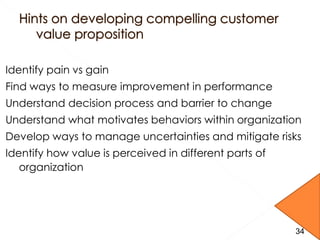
Identify pain vs gain
Find ways to measure improvement in performance
Understand decision process and barrier to change
Understand what motivates behaviors within organization
Develop ways to manage uncertainties and mitigate risks
Identify how value is perceived in different parts of
organization
3434
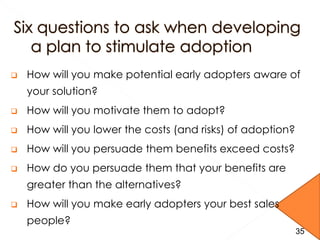
 How will you make potential early adopters aware of
your solution?
 How will you motivate them to adopt?
 How will you lower the costs (and risks) of adoption?
 How will you persuade them benefits exceed costs?
 How do you persuade them that your benefits are
greater than the alternatives?
 How will you make early adopters your best sales
people?
3535
The challenges of stimulating adoption are quite different
from traditional marketing
Need to understand:
 Diffusion of information
 Adoption decisions
Recognize that different market segments look for
different reasons to adopt
Be prepared to change and adapt your strategy, if the
first one does not work, or when you enter a new
segment
Thank you
36

Innovatiors alliance webinar three

  • 1.
    Copyright © 2010John Wiley & Sons, Inc. 15-1
  • 2.
     Why isthe marketing of technology innovation different from traditional marketing?  The two components of innovation marketing – diffusion and adoption  How do different types of customers adopt at different rates?  Based on these frameworks, how do I develop a marketing plan to stimulate customer adoption of new solutions? 22
  • 3.
     Innovation isthe creation of new and better:  effective products,  processes,  services,  technologies, or  business models That are accepted by markets, governments, and society Not the same as invention or improvement 3
  • 4.
    1. There isa natural tendency for organizations to keep doing what they’re doing and resist changes. In the absence of a force, they will continue to do what they’ve always done. 2. Larger organizations require more force to change what they are doing than smaller organizations. 3. For every force there is a reaction force that is equal in size, but opposite in direction. When someone exerts a force on an organization, he or she gets pushed back in the opposite direction equally hard. 4
  • 5.
    Persuading a customer,or user, to adopt your innovation requires them to:  switch from using an existing product / service  adopt an entirely new product or service Changing behaviours means motivating customers, or users, to change – how do you motivate them? 2 5
  • 6.
     Need toinform, by understanding diffusion  Need to compel use, by understanding motivation  First - create a compelling value proposition – this drives both  Embed a communication strategy  Maximize value and minimize perceived risks (uncertainties)  Understanding first users and predict their behaviours and decisions  Identify how early adopters will drive future customers 6
  • 7.
     The diffusionof innovation looks at the spread of information about an innovation (or new idea) throughout a community or user base  Innovation adoption looks at what motivates an individual to actually adopt an innovation  Diffusion is about understanding how ideas are communicated - what influences speed and geography  Adoption is about understanding how to persuade use – what influences individual decisions  Stimulating customer adoption requires understanding all three 7
  • 8.
    8  Awareness -exposed to innovation through diffusion  Interest - seeks additional information about it  Evaluation – apply to present / future situation, to make decision to try  Trial – uses the innovation for intended purpose  Adoption - decides to continue with full use Rogers (1995) 8
  • 9.
     Understand howinformation about a new idea or solution is communicated:  What is communicated and who with  Which channels are used  How the information is received  What motivates people to share information  The newness of an idea gives diffusion its special character and ensures a degree of uncertainty  Uncertainty is reduced through information that explains cause-effect relationships 9
  • 10.
     Understand howthe innovation offers a relative advantage over existing technologies)  Show how compatible the innovation is with existing uses  Reduce the complexity (perceived degree of difficulty)  Enable trialability (through allowing experimentation)  Show observability (results visible to others) 10
  • 11.
    11 Individual personalities segmentmarkets  Innovativeness degree to which an individual is relatively earlier in adopting an innovation  Risk taking link to personality profile and incentives within organization  Novelty seeking – willing to experiment  Leadership and community  Understanding these items will focus on first, and second, customers 11
  • 12.
     Market Uncertainty Ambiguity about type and extent of customer needs  Consumer fear, uncertainty and doubt (FUD) including standards  Technology uncertainty  Not knowing if company can deliver on promise  Whether innovation will function as promised  Uncertainty over timetables and obsolescence  Competitive volatility  Changes in competitors, offerings, strategies  Uncertainty over “the rules of the game”  Uncertainty over “product form” competition 12
  • 13.
     The drivingforce for company growth will come from innovation (greater value added)  This means launching new products and services that are adopted by customers  Diffusion is critical to make potential users aware of the innovation  Adoption is critical if we are to turn innovation into a value added process  We must focus on both to:  Achieve the potential of innovation  Develop strategies to improve innovation outcomes 13
  • 14.
    Diffusion is aprocess where an innovation is communicated through certain channels over time among members of a social system: 1. an innovation (perceived as new) 2. is communicated through certain channels (mechanism and parties involved) 3. over time 4. among members of a social system 14
  • 15.
     Perceived attributesof innovation  Type of innovation decision  Communication channels  Nature of social system  Impact of change agents 15
  • 16.
    16  Benefits  Impacton performance  Impact on utility  Impact on reputation  Costs  Initial costs  Long-term costs  Increased risks (uncertainties) This is linked to the value proposition 16
  • 17.
    17  Two factorsinfluence the decision  Whether the decision is made freely and implemented voluntarily.  Who makes the decision (where in the organization)  Three types of innovation decision  Optional Innovation-Decision made by an individual who is in some way distinguished from others.  Collective Innovation-Decision made collectively by all participants.  Authority Innovation-Decision made for the entire social system by individuals in positions of influence or power. 17
  • 18.
     Means bywhich messages get from one individual to another  Nature of the information-exchange relation determines the conditions under which source will/will not transmit innovation to receiver and transfer effect  Individuals do not evaluate innovations on the basis of a scientific assessment of its consequences – rather depend on subjective peer assessment.  Understanding how innovation information is dispersed is critical to success 1818
  • 19.
     The cultureof the organization  The external pressure that drives innovation  Communication activities  Community leadership  The network (Metcalfe) effect  Effect of role models and opinion leaders 19
  • 20.
     Most innovativemember of a system perceived as deviant from social system  Those that influence change are not always who you expect  In the world of technological innovation, these opinion leaders may be in a variety of places, from institutions, to social bloggers 16- 20Copyright © 2010 John Wiley & Sons, Inc. 20
  • 21.
  • 22.
  • 23.
     Innovators appreciatetechnology for its own sake  Motivated by idea of being a change agent  Will tolerate initial glitches  Will develop make-shift solutions  Willing to alpha/beta test and work with technical personnel in compensation with lower pricing  Early Adopters revolutionize their industry  Attracted by high-risk/high-reward projects  Not necessarily very price sensitive  Demand customized solutions and intensive tech support  Opinion leaders, change agents 2323
  • 24.
     Early majoritycomfortable with evolutionary changes  Risk aversion to disruptions in their operations  Want proven applications, reliable service  Seek the convenient “whole product” design  Buy only with a reference from a trusted colleague  Late majority are risk averse, technology shy  Very price sensitive  Require completely pre-assembled, bullet-proof (reliable performance) solutions  Motivated by need to keep up with competitors  Rely on single, trusted advisor 2424
  • 25.
     Gap betweenVisionaries and Pragmatists  Visionary market saturated, mainstream not ready to buy  Visionary marketing not effective with pragmatists  Limit to number of visionaries than can be handled  Consequences for marketing to pragmatists  Assume responsibility for complete, end-to-end solution  Customer services vital (seeking the useful applications)  Focus on best solution possible (rather than best possible solution)  Simplify complex product features 2525
  • 26.
     Relative advantage Understand customer perception of cost/benefit  Compatibility  Educate customers to overcome concerns and embed migration path  Complexity  Simplify the user experience to facilitate use  Trialability  Design products that are standalone/ easy to trial  Observability/visibility  Identify how to demonstrate performance 2626
  • 27.
     Build acommunication strategy (initial and secondary)  Foster chasm crossing  Provide compelling reasons for adoption, - overcome FUD through educating users about benefits and use  Understand who is likely to be an early adopter and how they differ from the mainstream market  Choose initial market segment wisely  Focus on understanding the adoption decision 2727
  • 28.
    Problem Recognition Information Search Evaluate Alternatives Purchase Decision Post-purchase Evaluation Pain killer vs vitamin Customervs employee vs government Active search, vs reactive search Relative importance Consequence of decision vs non- decision Existing relationships Industry sources WOM Existing customers Standards or norms Endorsements Direct competition Indirect competition Do nothing Compete on price Compete on value Compete on quality/service Buy vs lease Pay for performance Product or service Internal or external support Implementation and training Timing Measure performance Re-examine assumptions Evaluate decision process Determine satisfaction Follow up – (add additional units) Recommend 28
  • 29.
     Degree ofneed Including competitor pressures  Anticipated utility Pain killer vs vitamin, value proposition  Characteristics of market segment Used to adoption of new technologies  Supply chain issues Where the decision is made 2929
  • 30.
    Parts Suppliers CarManufacturers Car Dealers Customers - raw material - components - production equip. - services -personal users (features and benefits) -business use (fleets, etc.) - legislation - automation tech. - materials - mrp systems - retail technology - service technology - crm systems - business models Each of theses stages has different decision processes  Changing buyer decisions in automotive manufacturers quite different from changing buyer behavior of users  Integral technology a different challenge than after market 30
  • 31.
    New medical treatmentimproves patient outcomes What complex issues influence the decision to adopt  How are benefits quantified?  Are there just patient benefits?  What changes required to dispense product?  Who will pay:  Insurance companies  Doctors  Patients  Hospitals  Employers 3131
  • 32.
    Identify initial marketsegment that is most likely to become an early customer Understand the value proposition for those customers as well as the barriers to adoption Develop a diffusion/communication strategy to address that market segment Make it easy for Trialability, and Observability (for example with a new business model) Use feedback and recommendations from first customers to drive further adoption 32
  • 33.
    Consider different marketsegments (i.e. applications Consider different types of customers in those segments Prioritize based on need, speed of decision making and referenceability Only pursue a limited number of early adopters (to conserve resources) Need to consider how each option influences long term viability :  How long will it take to get the early adopters on board, and how fast will they influence the mainstream?  What is the size of the initial market, and the mainstream market?  Are there available partners who might influence rate of adoption?  What are the financial implications of pursuing a specific market segment? (Too fast maybe worse than too slow) 3333
  • 34.
    Identify pain vsgain Find ways to measure improvement in performance Understand decision process and barrier to change Understand what motivates behaviors within organization Develop ways to manage uncertainties and mitigate risks Identify how value is perceived in different parts of organization 3434
  • 35.
     How willyou make potential early adopters aware of your solution?  How will you motivate them to adopt?  How will you lower the costs (and risks) of adoption?  How will you persuade them benefits exceed costs?  How do you persuade them that your benefits are greater than the alternatives?  How will you make early adopters your best sales people? 3535
  • 36.
    The challenges ofstimulating adoption are quite different from traditional marketing Need to understand:  Diffusion of information  Adoption decisions Recognize that different market segments look for different reasons to adopt Be prepared to change and adapt your strategy, if the first one does not work, or when you enter a new segment Thank you 36