IMPROVING YOUR
INNOVATION QUOTIENT
Dr. Andrew Maxwell,
Canadian Innovation Centre
Lassonde Engineering, York University
WHAT STOPS US INNOVATING?
• We don’t fully understand what innovation is
• We design our organizations to stifle innovation
• It means stopping what we are good at
It’s easy to come up with new ideas; the hard part is letting go of what worked for you
two years ago, but will soon be out of date. Roger von Oech
SHARING MY INSIGHTS
• Explain why innovating is difficult
• Help you identify your innovation barriers
• And remove them…. tomorrow
Innovation is serendipity, so you don't know what people will make. Tim
Berners-Lee
WHAT, WHY, WHEN & HOW
What is an Innovation Quotient?
Why you might want one?
When can you improve it?
How much does it cost?
It isn't the incompetent who destroy an organization. The incompetent never get in a
position to destroy it. It is those who achieved something and want to rest upon their
achievements who are forever clogging things up. F.M. Young
DR ANDREW MAXWELL
• Engineer/MBA/Large technology co’s, 4 startups
• U of T/U of W/ Temple University/York University
• CIC/Innovators Alliance/IRI/IRAP/VentureWell
• Innovation Cartography, Journey and Compass
You have all the reason in the world to achieve your grandest dreams. Imagination plus
innovation equals realization. Denis Waitley
DEFINING INNOVATION
Any project that is:
•New to your organization (not just improvement)
•Has an uncertain outcome (involves risk)
•New products/services (and business models)
•Changing what you do (and how you make decisions)
Discovery consists of seeing what everybody has seen and thinking what nobody has
thought. Albert von Szent-Gyorgy
MEASURING INNOVATION
Common techniques for measuring innovation:
•Reputation
•Number of patents filed
•% revenue from new products/services
Measuring outcomes doesn’t help improve them
You can't manage what you can't measure Peter Drucker
CAN YOU DESIGN FOR INNOVATION?
DESIGN FOR
PERFORMANCE
• Efficiency
• Repeatability
• Predictability
DESIGN FOR
INNOVATION
• Speed
• Impact
• Uncertainty
If you always do what you always did, you will always get what you always
got. Albert Einstein
ORGANIZATIONAL AMBIDEXTERITY
PERFORMANCE (EXPLOITATION) ENGINE
• Follow rules, drive out variance/slack
• Focus on existing customer needs
• Manage/refine existing competencies
• Optimize organization for existing rules
• Make money now
If you look at history, innovation doesn't come just from giving people incentives; it
comes from creating environments where their ideas can connect. Steven
Johnson
INNOVATION (EXPLORATION) ENGINE
• Break rules, promote variance /slack
• Serve new customers with new needs
• Develop and lead new competencies
• Develop new organization + new rules
• Make money later
BALANCING INNOVATION &
PERFORMANCE
How do you?
•Keep your eye on the ball…..and on the game?
•Take risks..... mitigate risks?
•Make informed decision.....take action?
The Innovation Quotient helps measure innovation drivers
to increase innovation & change behaviours.
Great energy only comes from a correspondingly great tension of
opposites. Carl Jung
COMPONENTS OF THE
INNOVATION QUOTIENT
Strategy
Culture
Processes
Resources
Relation-
ships
Strategy – role of leadership
• New customers, products & processes
• Experimentation, risk and failure
• Establishes guidelines for other factors
• Links the five elements of the Innovation
Quotient
INNOVATION DRIVERS
Strategy
Culture
Processes
Resources
Relation-
ships
Processes and resources:
• Hiring and incentives decisions
• Managing risk/allocating resources
• Strategic decision making
• Communication
INNOVATION DRIVERS
Strategy
Culture
Processes
Resources
Relation-
ships
Relationships and culture:
• Relationships within organization
• Relationships with suppliers/customers
• Risk taking and mitigation
MEASURING YOUR
INNOVATION QUOTIENT
0
0.1
0.2
0.3
0.4
0.5
0.6
0.7
Strategy
Culture
ResourcesProcesses
Relationships
Manager
MEASURING YOUR
INNOVATION QUOTIENT
0
0.2
0.4
0.6
0.8
Strategy
Culture
ResourcesProcesses
Relationships
Manager Leader
INCREASING YOUR
INNOVATION QUOTIENT
• Strategy: Embed innovation in corporate strategy
• Processes: Review current practices for innovation
• Resources: Allocate strategic resources
• Relationships: Build and develop innovative relationships
• Culture: Align values and behaviours around innovation
The reasonable man adapts himself to the world; the unreasonable one persists in trying
to adapt the world to himself. Therefore all progress depends on the unreasonable
man. George Bernard Shaw
IMPROVING THE INNOVATION CULTURE A
BEHAVIOURAL APPROACH
Observed behaviours in innovative organization that:
• Improved collaboration
• Enhanced knowledge sharing
• Improved risk taking
• Enhanced communication
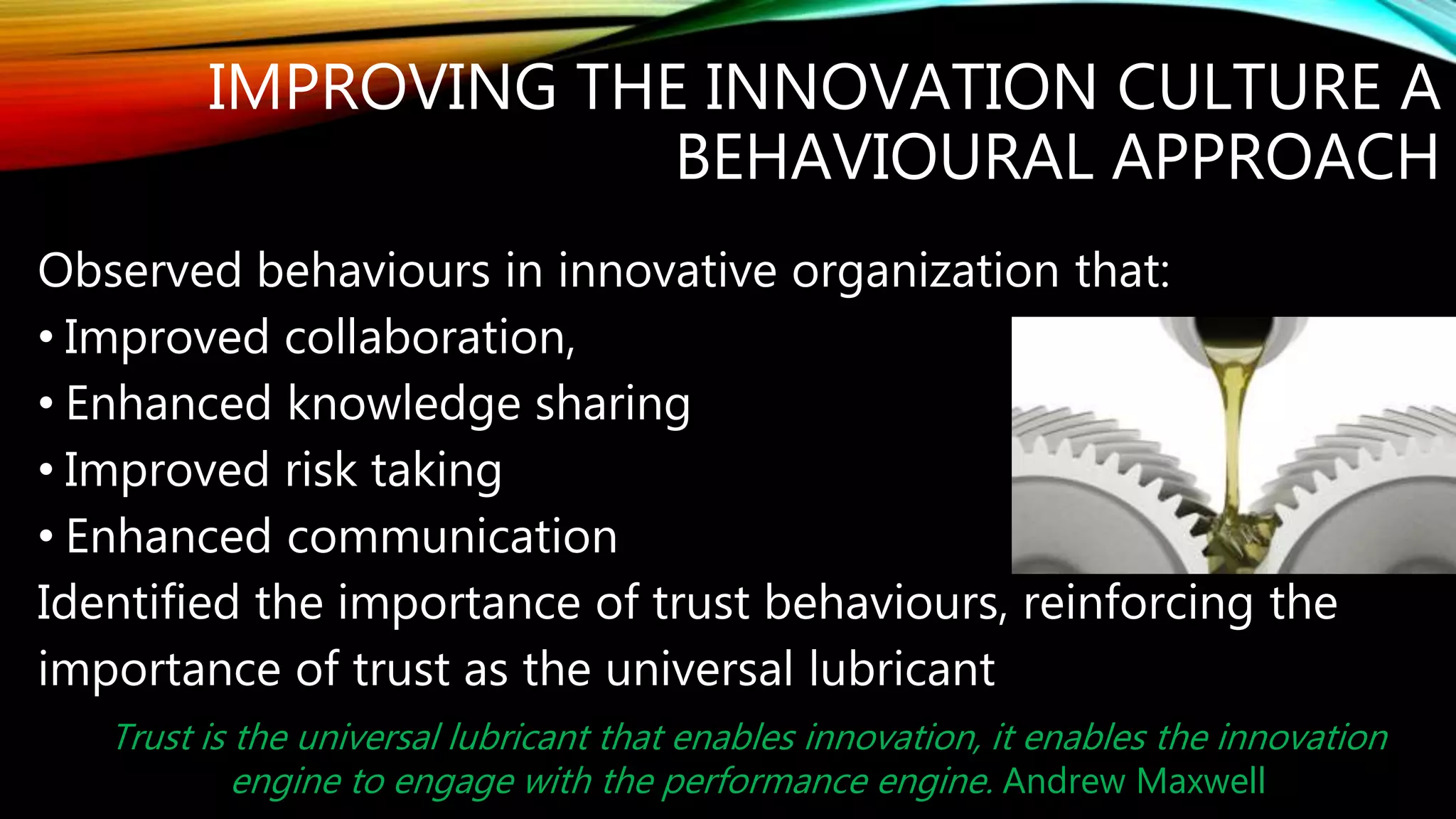
Identified the importance of trust behaviours, reinforcing the
importance of trust as the universal lubricant
Trust is the universal lubricant that enables innovation, it enables the innovation
engine to engage with the performance engine. Andrew Maxwell
INTRODUCING THE BEHAVIOURAL
TRUST FRAMEWORK (BTF)
• Moving trust from a sentiment to a behaviour
• Link specific behaviours to building, damaging or violating trust
• Helps individuals decide who to trust, and how to trust:
enabling the development of trust based relationships
• Helps build higher levels of relationship trust:
overcomes relationship risk, encourages collaboration
We identified four categories of trust behaviour:
capabilitytrusting, and communicationstrustworthy,
RELATIONSHIP TRUST is a ƒ(trust level)
Trust level is =
∫(Trust building - trust damaging) behaviours – ƒ(controls)
subject to the absence of trust violating behaviours
MEASURING INNOVATION CULTURE AS
A FUNCTION OF TRUST
Learning to collaborate is part of equipping yourself for effectiveness, problem solving, innovation
and life-long learning in an ever-changing networked economy. Don Tapscott
Trusting:
• Disclosing: Shows vulnerability by sharing confidential information
• Reliance: Willingness to be vulnerable through reliance on others
• Receptive: Demonstrates ‘coachability’ and willingness to change
BEHAVIOURAL TRUST FRAMEWORK
Trustworthiness:
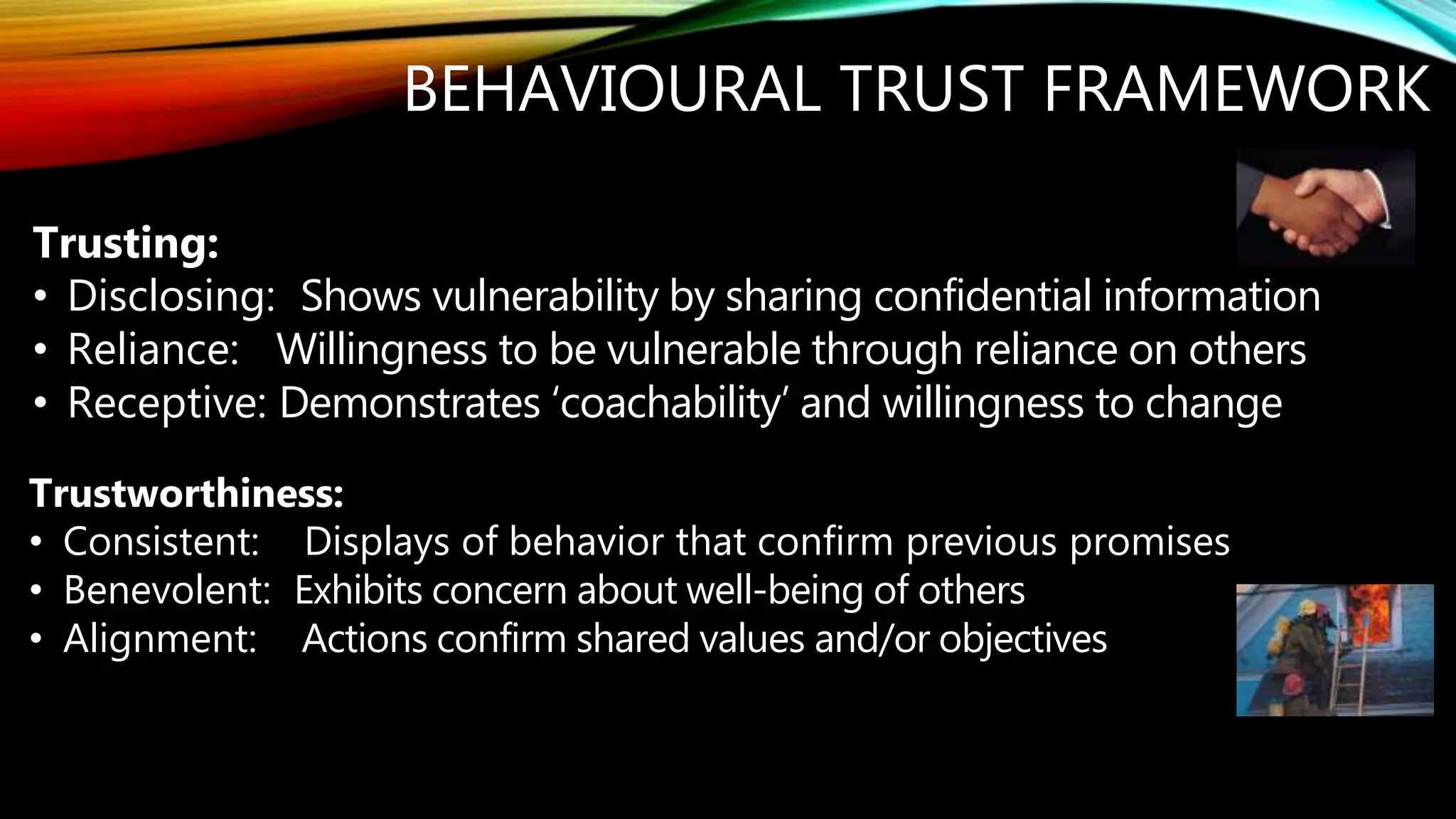
• Consistent: Displays of behavior that confirm previous promises
• Benevolent: Exhibits concern about well-being of others
• Alignment: Actions confirm shared values and/or objectives
There is no innovation and creativity without failure. Period. Brene Brown
Capability:
• Competent: Displays relevant technical and/or business ability
• Experienced: Demonstrates relevant work/training experience
• Judgment: Shows ability to make accurate / objective decisions
Communication:
• Accurate: Provides truthful and timely information
• Explanation: Explains details & consequence of information provided
• Openness: Open to new ideas or new ways of doing things
21
BEHAVIOURAL TRUST FRAMEWORK
Vision without action is merely a dream. Action without vision just passes the
time. Vision with action can change the world! Joel Arthur Barker
BEHAVIOURAL TRUST
FRAMEWORK
-7
-5
-3
-1
1
3
5
Disclosing
Reliance
Receptive
Competent
Experienced
JudgmentBenevolent
Alignment
Accurate
Explanation
Openness
Manager
BEHAVIOURAL TRUST
FRAMEWORK
-7
-5
-3
-1
1
3
5
Disclosing
Reliance
Receptive
Competent
Experienced
Judgment
Consistent
Benevolent
Alignment
Accurate
Explanation
Openness
Manager
Subordinate
• To explore team dynamics in organizations looking to increase
innovation capacity
• To identify challenges to building partnerships with new
innovation partners
• To facilitate innovation coaching and team building discussions
Evidence BTF users can identify short term actions to reduce
controls, to repair damaged trust and increase trust
APPLYING THE BEHAVIOURAL
TRUST FRAMEWORK
For a copy of this deck or the
Behavioural Trust Framework:
Andrew.Maxwell@lassonde.yorku.ca
Helen.Leighton@gmail.com
or download from
http://tinyurl.com/iquotient
BUILDING INNOVATION CAPACITY,
ONE TRUST BEHAVIOUR AT A TIME
Learning and innovation go hand in hand. The arrogance of success is to think that what
you did yesterday will be sufficient for tomorrow. William Pollard

Improving your innovation quotient

  • 1.
    IMPROVING YOUR INNOVATION QUOTIENT Dr.Andrew Maxwell, Canadian Innovation Centre Lassonde Engineering, York University
  • 2.
    WHAT STOPS USINNOVATING? • We don’t fully understand what innovation is • We design our organizations to stifle innovation • It means stopping what we are good at It’s easy to come up with new ideas; the hard part is letting go of what worked for you two years ago, but will soon be out of date. Roger von Oech
  • 3.
    SHARING MY INSIGHTS •Explain why innovating is difficult • Help you identify your innovation barriers • And remove them…. tomorrow Innovation is serendipity, so you don't know what people will make. Tim Berners-Lee
  • 4.
    WHAT, WHY, WHEN& HOW What is an Innovation Quotient? Why you might want one? When can you improve it? How much does it cost? It isn't the incompetent who destroy an organization. The incompetent never get in a position to destroy it. It is those who achieved something and want to rest upon their achievements who are forever clogging things up. F.M. Young
  • 5.
    DR ANDREW MAXWELL •Engineer/MBA/Large technology co’s, 4 startups • U of T/U of W/ Temple University/York University • CIC/Innovators Alliance/IRI/IRAP/VentureWell • Innovation Cartography, Journey and Compass You have all the reason in the world to achieve your grandest dreams. Imagination plus innovation equals realization. Denis Waitley
  • 6.
    DEFINING INNOVATION Any projectthat is: •New to your organization (not just improvement) •Has an uncertain outcome (involves risk) •New products/services (and business models) •Changing what you do (and how you make decisions) Discovery consists of seeing what everybody has seen and thinking what nobody has thought. Albert von Szent-Gyorgy
  • 7.
    MEASURING INNOVATION Common techniquesfor measuring innovation: •Reputation •Number of patents filed •% revenue from new products/services Measuring outcomes doesn’t help improve them You can't manage what you can't measure Peter Drucker
  • 8.
    CAN YOU DESIGNFOR INNOVATION? DESIGN FOR PERFORMANCE • Efficiency • Repeatability • Predictability DESIGN FOR INNOVATION • Speed • Impact • Uncertainty If you always do what you always did, you will always get what you always got. Albert Einstein
  • 9.
    ORGANIZATIONAL AMBIDEXTERITY PERFORMANCE (EXPLOITATION)ENGINE • Follow rules, drive out variance/slack • Focus on existing customer needs • Manage/refine existing competencies • Optimize organization for existing rules • Make money now If you look at history, innovation doesn't come just from giving people incentives; it comes from creating environments where their ideas can connect. Steven Johnson INNOVATION (EXPLORATION) ENGINE • Break rules, promote variance /slack • Serve new customers with new needs • Develop and lead new competencies • Develop new organization + new rules • Make money later
  • 10.
    BALANCING INNOVATION & PERFORMANCE Howdo you? •Keep your eye on the ball…..and on the game? •Take risks..... mitigate risks? •Make informed decision.....take action? The Innovation Quotient helps measure innovation drivers to increase innovation & change behaviours. Great energy only comes from a correspondingly great tension of opposites. Carl Jung
  • 11.
    COMPONENTS OF THE INNOVATIONQUOTIENT Strategy Culture Processes Resources Relation- ships Strategy – role of leadership • New customers, products & processes • Experimentation, risk and failure • Establishes guidelines for other factors • Links the five elements of the Innovation Quotient
  • 12.
    INNOVATION DRIVERS Strategy Culture Processes Resources Relation- ships Processes andresources: • Hiring and incentives decisions • Managing risk/allocating resources • Strategic decision making • Communication
  • 13.
    INNOVATION DRIVERS Strategy Culture Processes Resources Relation- ships Relationships andculture: • Relationships within organization • Relationships with suppliers/customers • Risk taking and mitigation
  • 14.
  • 15.
  • 16.
    INCREASING YOUR INNOVATION QUOTIENT •Strategy: Embed innovation in corporate strategy • Processes: Review current practices for innovation • Resources: Allocate strategic resources • Relationships: Build and develop innovative relationships • Culture: Align values and behaviours around innovation The reasonable man adapts himself to the world; the unreasonable one persists in trying to adapt the world to himself. Therefore all progress depends on the unreasonable man. George Bernard Shaw
  • 17.
    IMPROVING THE INNOVATIONCULTURE A BEHAVIOURAL APPROACH Observed behaviours in innovative organization that: • Improved collaboration • Enhanced knowledge sharing • Improved risk taking • Enhanced communication Identified the importance of trust behaviours, reinforcing the importance of trust as the universal lubricant Trust is the universal lubricant that enables innovation, it enables the innovation engine to engage with the performance engine. Andrew Maxwell
  • 18.
    INTRODUCING THE BEHAVIOURAL TRUSTFRAMEWORK (BTF) • Moving trust from a sentiment to a behaviour • Link specific behaviours to building, damaging or violating trust • Helps individuals decide who to trust, and how to trust: enabling the development of trust based relationships • Helps build higher levels of relationship trust: overcomes relationship risk, encourages collaboration We identified four categories of trust behaviour: capabilitytrusting, and communicationstrustworthy,
  • 19.
    RELATIONSHIP TRUST isa ƒ(trust level) Trust level is = ∫(Trust building - trust damaging) behaviours – ƒ(controls) subject to the absence of trust violating behaviours MEASURING INNOVATION CULTURE AS A FUNCTION OF TRUST Learning to collaborate is part of equipping yourself for effectiveness, problem solving, innovation and life-long learning in an ever-changing networked economy. Don Tapscott
  • 20.
    Trusting: • Disclosing: Showsvulnerability by sharing confidential information • Reliance: Willingness to be vulnerable through reliance on others • Receptive: Demonstrates ‘coachability’ and willingness to change BEHAVIOURAL TRUST FRAMEWORK Trustworthiness: • Consistent: Displays of behavior that confirm previous promises • Benevolent: Exhibits concern about well-being of others • Alignment: Actions confirm shared values and/or objectives There is no innovation and creativity without failure. Period. Brene Brown
  • 21.
    Capability: • Competent: Displaysrelevant technical and/or business ability • Experienced: Demonstrates relevant work/training experience • Judgment: Shows ability to make accurate / objective decisions Communication: • Accurate: Provides truthful and timely information • Explanation: Explains details & consequence of information provided • Openness: Open to new ideas or new ways of doing things 21 BEHAVIOURAL TRUST FRAMEWORK Vision without action is merely a dream. Action without vision just passes the time. Vision with action can change the world! Joel Arthur Barker
  • 22.
  • 23.
  • 24.
    • To exploreteam dynamics in organizations looking to increase innovation capacity • To identify challenges to building partnerships with new innovation partners • To facilitate innovation coaching and team building discussions Evidence BTF users can identify short term actions to reduce controls, to repair damaged trust and increase trust APPLYING THE BEHAVIOURAL TRUST FRAMEWORK
  • 25.
    For a copyof this deck or the Behavioural Trust Framework: Andrew.Maxwell@lassonde.yorku.ca Helen.Leighton@gmail.com or download from http://tinyurl.com/iquotient BUILDING INNOVATION CAPACITY, ONE TRUST BEHAVIOUR AT A TIME Learning and innovation go hand in hand. The arrogance of success is to think that what you did yesterday will be sufficient for tomorrow. William Pollard

Editor's Notes

  • #5 "It isn't the incompetent who destroy an organization. The incompetent never get in a position to destroy it. It is those who achieved something and want to rest upon their achievements who are forever clogging things up. — F. M. Young
  • #7 But your organization is designed for improvement, not innovation, and an improvement culture stifles innovation
  • #8 What works in one context may not work in another A Man in a Balloon A man in a hot air balloon realized he was lost. He reduced altitude and spotted a man below. He descended a bit more and shouted, "Excuse me, can you help me? I promised a friend I would meet him an hour ago, but I don't know where I am." The man below replied, "You are in a hot air balloon hovering approximately 30 feet above the ground. You are between 40 and 41 degrees north latitude and between 59 and 60 degrees west longitude." "You must be an engineer," said the balloonist. "I am," replied the man, "How did you know?" "Well," answered the balloonist, "everything you told me is technically correct, but I have no idea what to make of your information, and the fact is I am still lost. Frankly, you've not been much help so far." The man below responded, "You must be a manager." "I am," replied the balloonist, "but how did you know." "Well," said the man, "you don't know where you are or where you are going. You have risen to where you are due to a large quantity of hot air. You made a promise that you have no idea how to keep, and you expect me to solve your problem. The fact is, you are in exactly the same position you were in before we met, but now, somehow, it's my fault."
  • #17 Ability to rely on others
  • #19 Ability to rely on others
  • #20 Collaboration is an essential ingredient for innovation Trust is a necessary pre-condition for effective collaboration In the absence of Trust, we develop proxies for Trust: Any mechanism which seeks to control behaviour is a proxy for trust (examples: employment contracts, performance reviews, annual budgeting processes, rigid organizational structures and reporting relationships, over-applied lean methodology, outcome-based objective setting) The higher the Trust Level, the lower the need for controls The higher the Trust Level, the greater the level of collaboration, which results in a higher level of innovation
  • #21 Speak to behaviours in each dimension – can build, damage or violate trust
  • #22 Speak to behaviours in each dimension – can build, damage or violate trust