Module 2
Teaching & Learning Approaches
Prepared by Saira imran
Objective
Analyze the benefits and limitations of each approach
Design and implement effective lesson plans using different
approaches
Define and explain various teaching and learning approaches
Create a supportive and inclusive learning environment
Teaching Approches
Teaching approaches are tailored based on the skill level of
students, emphasizing the importance of adapting
instructional strategies to meet the diverse needs of learners.
Different teaching and learning approches can be used, the
educator must be carefully select the suitable methods for
the stated learning objectives and outcomes .
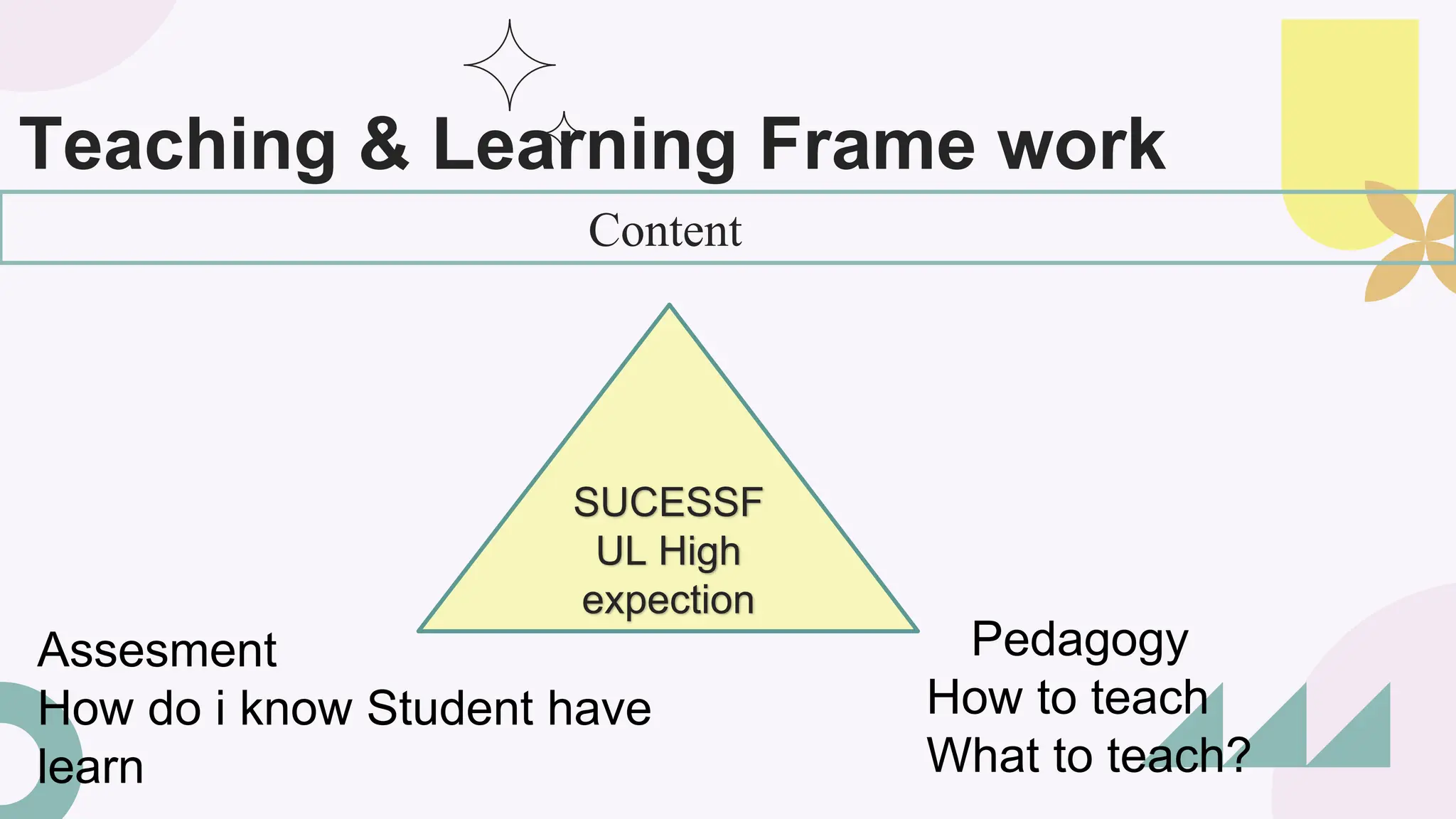
Teaching & Learning Frame work
Content
SUCESSF
UL High
expection
Assesment
How do i know Student have
learn
Pedagogy
How to teach
What to teach?
Cont.......
Effective teaching strategies include:
 Instructional methods
 Assessment and evaluation techniques
 Classroom management approaches . Learning style
accommodations
 Technology integration .
 Differentiation techniques
 Learning environment design
 Student engagement strategies
ACTIVE LERNING
Engagement
Reflection
Application
ACTIVE LERNING
Active learning is an educational approach that engages
students in the learning process, encouraging them to take
an active role in their own learning.
.
Characteristics of active learning
 Student-centered
 Hands-on
 Collaborative
 Inquiry-based:
 Feedback-rich
 Flexible.
ACTIVE LERNING EXAMPLE
 Think-pair-share
 Group discussions
 Problem-solving
activities
 Science experiments
 Project-based learning
 Debates
 Role-playing
 Simulations
 Gamefication
 Service-learning
Activity Base Learning (ABL)
 Activity Base Learning (ABL) is an educational approach that
focuses on hands-on activities and experiments to learn
concepts and skills.
AL
 1. Problem-Based
Learning (PBL): Students
solve real-world problems
to learn math concepts.
 2. Flipped Classroom:
Students watch lectures at
home and work on
activities in class.
A BL
 1. Direct Instruction: Teacher
explicitly teaches math
concepts and students
practice.
 2. Mastery Learning: Students
work on math problems until
they achieve mastery.
AL
 3. Think-Pair-Share:
Students collaborate in
pairs to solve math
problems.
 4. Project-Based Learning
(PBL): Students work on
projects that integrate
math concepts.
A BL
 3. Spaced Repetition:
Students review math
concepts at increasingly
longer intervals.
 4. Microlearning: Students
learn math concepts in
short, focused lessons.
Student-Centered
 Project-Based Learning
(PBL)
 Personalized Learning
 Inquiry-Based Learning
 Experiential Learning
 Problem-Based Learning
(PBL)
 Constructivist Learning
Teacher-Centered
 Flipped Classroom
 Differentiated Instruction
 Formative Assessment
Technology-Integrated
 Blended Learning
 Gamification
 Technology Integration
Collaborative
 Collaborative Learning
 Project-Based Learning
(PBL)
 Problem-Based
Learning (PBL)
Active Base learning
 KWL (Know, Want to know, Learned): Activating prior knowledge,
setting learning goals, and reflecting on learning.
 Think-Pair-Share: Collaborative learning strategy to promote peer-to-
peer learning.
 Graphic Organizers: Visual tools to organize and connect ideas.
 Self-Assessment: Students reflect on their own learning to identify
strengths and areas for improvement.
Active Base learning
 Differentiated Instruction: Tailoring instruction to meet diverse
learning needs.
 Formative Assessments: Regular monitoring of student progress.
 Summative Assessments: Evaluating student learning at the end of a
lesson or unit.
 Exit Tickets: Brief assessments to check student understanding at the
end of a lesson.
Flipped class room learning
 - Students learn basic concepts at home through
pre-recorded videos, readings, or assignments (
asynchronous learning ).
- Class time is used for interactive activities,
discussions, group work, and hands-on learning (
synchronous learning ).
Nano /Micro Learning
bite sized learning
information or skills are broken down into learning
capsules.
stimulus trigger concept
Nano /Micro Learning
Benefits of Nano Learning
improve productivity
increase attension level
Reduced cognitive overload
Improved retention
Time-efficient
PBL Vs BLL
 constructivism
 Active learners
 teacher mentor
 small group collabration
 revision cycle +self evaluation
 steps of project (exp,col,con,moin)
Similarities
PBL Vs BLL
Project base learning
 constructivism
 done by small group
 set boundries
 collaboration
Differencess
Problem base learning
 cognitivism & meta
cognivitivism
 recieved ,ongoing ,stored
retrive
 done by individually
Differentiated learning
A strategy in which all students have the same learning
goals, but teachers vary their teaching methods in order to
meet the individual needs of the students and vary the
complexity of the tasks and the learning supports for each
student and its allow to students to take different pathway
through the learning .
strategies for differentiated learning
 Assessment
 Flexible Grouping
 Universal Design for Learning
(UDL):
 Offer choices and menus to
cater to different learners.
 Use technology to support
differentiated instruction.
 Continuously assess and
adjust instruction to meet the
changing needs of students.
 Address the diverse cultural
and linguistic backgrounds
of students.
HOME WORK TIME
To create an engaging and effective
flip learning lesson that promotes
student-centered learning and active
participation.
MOVIE TIME
CREDITS: This presentation template was created by
Slidesgo, and includes icons by Flaticon, infographics &
images by Freepik and content by Sandra Medina
Thanks!
CREDITS: This presentation template was created by
Slidesgo, and includes icons by Flaticon, infographics &
images by Freepik and content by Sandra Medina

Teaching Approaches and methodology tool

  • 2.
    Module 2 Teaching &Learning Approaches Prepared by Saira imran
  • 3.
    Objective Analyze the benefitsand limitations of each approach Design and implement effective lesson plans using different approaches Define and explain various teaching and learning approaches Define and explain various teaching and learning approaches Create a supportive and inclusive learning environment
  • 4.
    Teaching Approches Teaching approachesare tailored based on the skill level of students, emphasizing the importance of adapting instructional strategies to meet the diverse needs of learners. Different teaching and learning approches can be used, the educator must be carefully select the suitable methods for the stated learning objectives and outcomes .
  • 5.
    Teaching & LearningFrame work Content SUCESSF UL High expection Assesment How do i know Student have learn Pedagogy How to teach What to teach?
  • 6.
    Cont....... Effective teaching strategiesinclude:  Instructional methods  Assessment and evaluation techniques  Classroom management approaches . Learning style accommodations  Technology integration .  Differentiation techniques  Learning environment design  Student engagement strategies
  • 7.
  • 8.
    ACTIVE LERNING Active learningis an educational approach that engages students in the learning process, encouraging them to take an active role in their own learning.
  • 9.
    . Characteristics of activelearning  Student-centered  Hands-on  Collaborative  Inquiry-based:  Feedback-rich  Flexible.
  • 10.
    ACTIVE LERNING EXAMPLE Think-pair-share  Group discussions  Problem-solving activities  Science experiments  Project-based learning  Debates  Role-playing  Simulations  Gamefication  Service-learning
  • 11.
    Activity Base Learning(ABL)  Activity Base Learning (ABL) is an educational approach that focuses on hands-on activities and experiments to learn concepts and skills.
  • 13.
    AL  1. Problem-Based Learning(PBL): Students solve real-world problems to learn math concepts.  2. Flipped Classroom: Students watch lectures at home and work on activities in class. A BL  1. Direct Instruction: Teacher explicitly teaches math concepts and students practice.  2. Mastery Learning: Students work on math problems until they achieve mastery.
  • 14.
    AL  3. Think-Pair-Share: Studentscollaborate in pairs to solve math problems.  4. Project-Based Learning (PBL): Students work on projects that integrate math concepts. A BL  3. Spaced Repetition: Students review math concepts at increasingly longer intervals.  4. Microlearning: Students learn math concepts in short, focused lessons.
  • 15.
    Student-Centered  Project-Based Learning (PBL) Personalized Learning  Inquiry-Based Learning  Experiential Learning  Problem-Based Learning (PBL)  Constructivist Learning Teacher-Centered  Flipped Classroom  Differentiated Instruction  Formative Assessment
  • 16.
    Technology-Integrated  Blended Learning Gamification  Technology Integration Collaborative  Collaborative Learning  Project-Based Learning (PBL)  Problem-Based Learning (PBL)
  • 17.
    Active Base learning KWL (Know, Want to know, Learned): Activating prior knowledge, setting learning goals, and reflecting on learning.  Think-Pair-Share: Collaborative learning strategy to promote peer-to- peer learning.  Graphic Organizers: Visual tools to organize and connect ideas.  Self-Assessment: Students reflect on their own learning to identify strengths and areas for improvement.
  • 18.
    Active Base learning Differentiated Instruction: Tailoring instruction to meet diverse learning needs.  Formative Assessments: Regular monitoring of student progress.  Summative Assessments: Evaluating student learning at the end of a lesson or unit.  Exit Tickets: Brief assessments to check student understanding at the end of a lesson.
  • 20.
    Flipped class roomlearning  - Students learn basic concepts at home through pre-recorded videos, readings, or assignments ( asynchronous learning ). - Class time is used for interactive activities, discussions, group work, and hands-on learning ( synchronous learning ).
  • 21.
    Nano /Micro Learning bitesized learning information or skills are broken down into learning capsules. stimulus trigger concept
  • 22.
    Nano /Micro Learning Benefitsof Nano Learning improve productivity increase attension level Reduced cognitive overload Improved retention Time-efficient
  • 23.
    PBL Vs BLL constructivism  Active learners  teacher mentor  small group collabration  revision cycle +self evaluation  steps of project (exp,col,con,moin) Similarities
  • 24.
    PBL Vs BLL Projectbase learning  constructivism  done by small group  set boundries  collaboration Differencess Problem base learning  cognitivism & meta cognivitivism  recieved ,ongoing ,stored retrive  done by individually
  • 26.
    Differentiated learning A strategyin which all students have the same learning goals, but teachers vary their teaching methods in order to meet the individual needs of the students and vary the complexity of the tasks and the learning supports for each student and its allow to students to take different pathway through the learning .
  • 27.
    strategies for differentiatedlearning  Assessment  Flexible Grouping  Universal Design for Learning (UDL):  Offer choices and menus to cater to different learners.  Use technology to support differentiated instruction.  Continuously assess and adjust instruction to meet the changing needs of students.  Address the diverse cultural and linguistic backgrounds of students.
  • 28.
    HOME WORK TIME Tocreate an engaging and effective flip learning lesson that promotes student-centered learning and active participation.
  • 29.
  • 30.
    CREDITS: This presentationtemplate was created by Slidesgo, and includes icons by Flaticon, infographics & images by Freepik and content by Sandra Medina Thanks!
  • 31.
    CREDITS: This presentationtemplate was created by Slidesgo, and includes icons by Flaticon, infographics & images by Freepik and content by Sandra Medina