KITL

Innovations in
Textiles for
โ€œFootprintโ€
Reduction
20th December 2013

Dr. Sanjiv Kamat

1
KITL

Kothari InfoTech Limited

Since 2001, from Surat, India to provide Solutions for Digital Printing on various
substrates
Inks Division: Water based high density Charuโ„ข inks and Dishaโ„ข pre-coatings for
Textile substrates(Cotton ,Viscose, Linen, Silk, Wool, Nylon and Polyester)
Textile Machinery Division: Sales and after sales service for โ€œIchinoseโ€ printing
machines(both conventional and digital)
โ€œRimslowโ€ Loopager for Inkjet textile printing. โ€œDTG Digitalโ€ for garment printing.
โ€œDigiEyeโ€ for non contact colour measurement and QC
Software: Print Proโ„ข, world class software, for Colour Separation, Colour Correction,
Device calibration, Half-toning, Large image data handling, Digital Imaging, Textile
coloration, Image composing and Printing. These applications are targeted towards ,
label printing as well as Wide/Large format digital printing for graphic arts,
photography, and Textiles(fabric and garments).
20th December 2013

Dr. Sanjiv Kamat

2
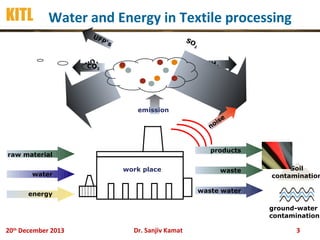
KITL Water and Energy in Textile processing
UF
P

SO

โ€˜s

2

NO x
CO2

CH4

emission
e
is
no

products

raw material
water

work place

waste

Soil
contamination

waste water

energy

ground-water
contamination

20th December 2013

Dr. Sanjiv Kamat

3
KITL

Carbon Footprint

A Carbon Footprint is a measure of
the impact human activities have
on the environment in terms of the
amount of green house gases
produced, measured in units of
carbon dioxide

20th December 2013

Dr. Sanjiv Kamat

4
KITL

Global warming

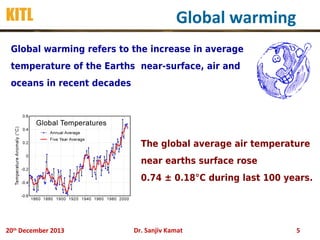
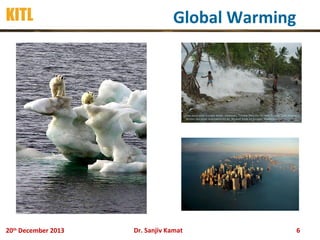
Global warming refers to the increase in average
temperature of the Earths near-surface, air and
oceans in recent decades

The global average air temperature
near earths surface rose
0.74 ยฑ 0.18ยฐC during last 100 years.

20th December 2013

Dr. Sanjiv Kamat

5
KITL

20th December 2013

Global Warming

Dr. Sanjiv Kamat

6
KITL

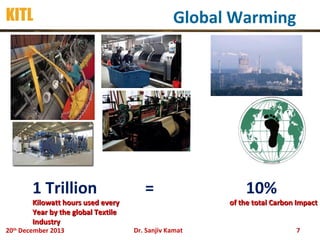
1 Trillion

Kilowatt hours used every
Year by the global Textile
Industry

20th December 2013

Global Warming

=
Dr. Sanjiv Kamat

10%

of the total Carbon Impact
7
KITL

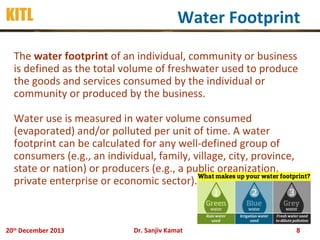
Water Footprint

Theย water footprintย of an individual, community or business
is defined as the total volume of freshwater used to produce
the goods and services consumed by the individual or
community or produced by the business.
Water use is measured in water volume consumed
(evaporated) and/or polluted per unit of time. A water
footprint can be calculated for any well-defined group of
consumers (e.g., an individual, family, village, city, province,
state or nation) or producers (e.g., a public organization,
private enterprise or economic sector).

20th December 2013

Dr. Sanjiv Kamat

8
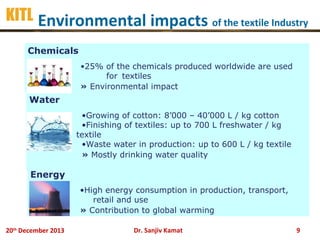
KITL Environmental impacts of the textile Industry
Chemicals
โ€ข25% of the chemicals produced worldwide are used
for textiles
ยป Environmental impact

Water
โ€ขGrowing of cotton: 8โ€™000 โ€“ 40โ€™000 L / kg cotton
โ€ขFinishing of textiles: up to 700 L freshwater / kg
textile
โ€ขWaste water in production: up to 600 L / kg textile
ยป Mostly drinking water quality

Energy
โ€ขHigh energy consumption in production, transport,
retail and use
ยป Contribution to global warming
20th December 2013

Dr. Sanjiv Kamat

9
KITL

Definition of a Pollutant

Pollutant is a substance
present in the wrong place
at the wrong time and in
the wrong quantity
20th December 2013

Dr. Sanjiv Kamat

10
KITL

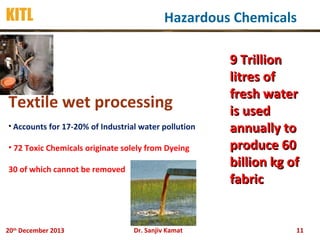
Hazardous Chemicals

Textile wet processing
โ€ข Accounts for 17-20% of Industrial water pollution

โ€ข 72 Toxic Chemicals originate solely from Dyeing
30 of which cannot be removed

20th December 2013

Dr. Sanjiv Kamat

9 Trillion
litres of
fresh water
is used
annually to
produce 60
billion kg of
fabric

11
KITL

20th December 2013

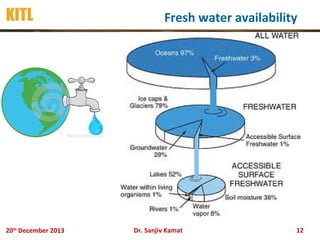
Fresh water availability

Dr. Sanjiv Kamat

12
KITL

20th December 2013

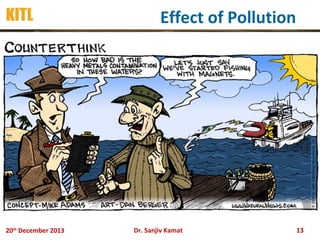
Effect of Pollution

Dr. Sanjiv Kamat

13
Definition

KITL

โ€œInventionโ€ can be defined as the creation of a
product or introduction of a process for the first time.
โ€œInnovationโ€ on the other hand, occurs if someone
improves on or makes a significant contribution to an
existing product, process or service.

20th December 2013

Dr. Sanjiv Kamat

14
KITL

Shaping Innovations

1.ย Institutions โ€“ which are often neglected but are where the
innovations happen.
2.ย Markets โ€“ where the demand and the finance comes from
and
3.ย Technologies โ€“ย which go hand in hand with innovations
โ€œInnovation is about the smart application of knowledge to
solve problems more imaginatively than we have in the
past.โ€

20th December 2013

Dr. Sanjiv Kamat

15
KITL

Change Agents
Ecology
Legislation
Cost
New Substrate
New Process
Speed for economics
Fashion and advertisement
Productivity constraint
Sustainability

20th December 2013

Dr. Sanjiv Kamat

16
KITL

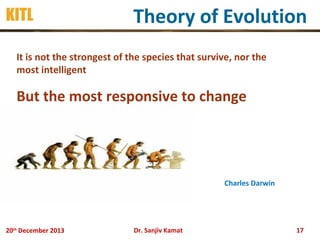
Theory of Evolution

It is not the strongest of the species that survive, nor the
most intelligent

But the most responsive to change

Charles Darwin

20th December 2013

Dr. Sanjiv Kamat

17
KITL

Innovations pertaining to

โ€ข Products and processes
โ€ข Water Consumption
โ€ข Sustainable Fibres
โ€ข Coloration without dyes

20th December 2013

Dr. Sanjiv Kamat

18
KITL

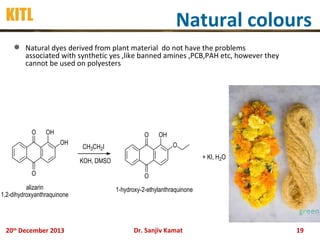
Natural colours

๏ฌ Natural dyes derived from plant material do not have the problems
associated with synthetic yes ,like banned amines ,PCB,PAH etc, however they
cannot be used on polyesters

O

OH

O
OH

OH
O

CH3CH2I

+ KI, H2O

KOH, DMSO
O
alizarin
1,2-dihydroxyanthraquinone

20th December 2013

O
1-hydroxy-2-ethylanthraquinone

Dr. Sanjiv Kamat

19
KITL
โ€ข

Colours
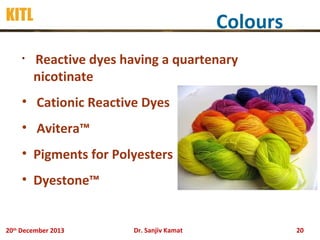
Reactive dyes having a quartenary
nicotinate

โ€ข Cationic Reactive Dyes
โ€ข Aviteraโ„ข
โ€ข Pigments for Polyesters
โ€ข Dyestoneโ„ข

20th December 2013

Dr. Sanjiv Kamat

20
KITL

Auxiliaries

โ€ข Use of Sugars in Sulphur dyeing
โ€ขPre-treatment of cellulose with cationic,
nucleophilic polymers to enable reactive dyeing at
neutral pH without electrolyte addition
โ€ขEnzymes for polyester and also for imparting
hydrophilicity oligomer removal
20th December 2013

Dr. Sanjiv Kamat

21
Processes

KITL
Fabric
E controlโ„ข, Pad-Sizeoxโ„ข
Garments
A blend of โ€œcolorโ€ and โ€œsoftenerโ€
Enzyme with tint

Provides ONE STEP stone-wash and tinting effect, abrasion,
surface polishing, de-pilling, and body softness on Indigo denim
garments.

Enzymatic single bath desizing-bleaching-dyeing
process for cotton fabrics

20th December 2013

Dr. Sanjiv Kamat

22
KITL

20th December 2013

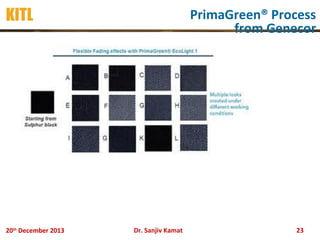
PrimaGreenยฎ Process
from Genecor

Dr. Sanjiv Kamat

23
KITL

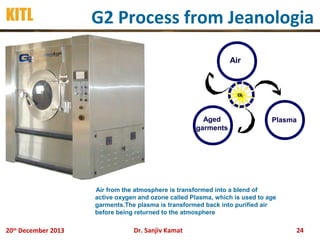
G2 Process from Jeanologia
Air

Aged
garments

Plasma

Air from the atmosphere is transformed into a blend of
active oxygen and ozone called Plasma, which is used to age
garments.The plasma is transformed back into purified air
before being returned to the atmosphere

20th December 2013

Dr. Sanjiv Kamat

24
KITL

20th December 2013

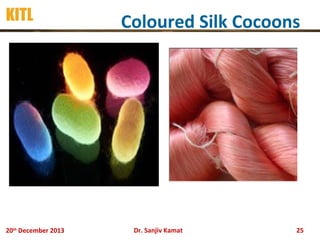
Coloured Silk Cocoons

Dr. Sanjiv Kamat

25
KITL

20th December 2013

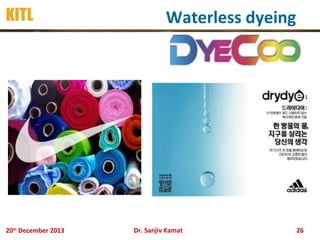
Waterless dyeing

Dr. Sanjiv Kamat

26
KITL

20th December 2013

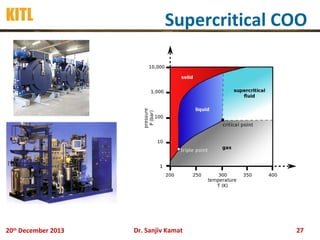
Supercritical COO

Dr. Sanjiv Kamat

27
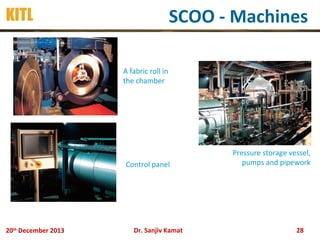
SCOO - Machines

KITL

A fabric roll in
the chamber

Control panel

20th December 2013

Dr. Sanjiv Kamat

Pressure storage vessel,
pumps and pipework

28
KITL

20th December 2013

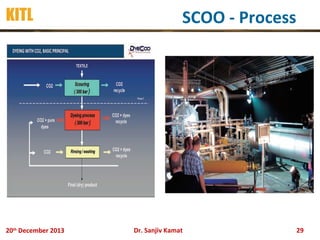
SCOO - Process

Dr. Sanjiv Kamat

29
Process

KITL

20th December 2013

Dr. Sanjiv Kamat

30
Process

KITL

20th December 2013

Dr. Sanjiv Kamat

31
KITL

20th December 2013

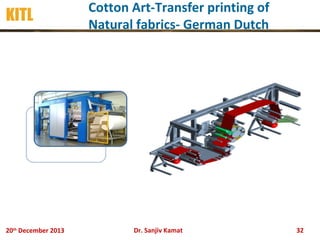
Cotton Art-Transfer printing of
Natural fabrics- German Dutch

Dr. Sanjiv Kamat

32
KITL

20th December 2013

Ink Jet Printing

Dr. Sanjiv Kamat

33
KITL

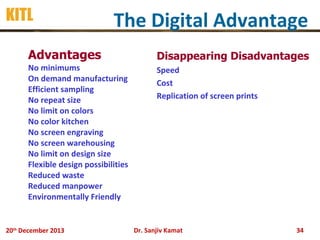
The Digital Advantage

โ€ข Advantages

โ€ข Disappearing Disadvantages

โ€ข
โ€ข
โ€ข
โ€ข
โ€ข
โ€ข
โ€ข
โ€ข
โ€ข
โ€ข
โ€ข
โ€ข
โ€ข

โ€ข Speed
โ€ข Cost
โ€ข Replication of screen prints

No minimums
On demand manufacturing
Efficient sampling
No repeat size
No limit on colors
No color kitchen
No screen engraving
No screen warehousing
No limit on design size
Flexible design possibilities
Reduced waste
Reduced manpower
Environmentally Friendly

20th December 2013

Dr. Sanjiv Kamat

34
Printers

KITL

Durst

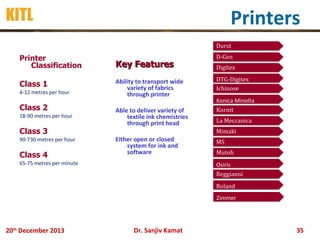
Printer
Classification

Class 1
4-12 metres per hour

Class 2
18-90 metres per hour

Class 3
90-730 metres per hour

Class 4

Key Features
Ability to transport wide
variety of fabrics
through printer
Able to deliver variety of
textile ink chemistries
through print head

D-Gen
Digitex
DTG-Digitex
Ichinose
Konica Minolta
Kornit
La Meccanica
Mimaki

Either open or closed
system for ink and
software

65-75 metres per minute

MS
Mutoh
Osiris
Reggianni
Roland
Zimmer

20th December 2013

Dr. Sanjiv Kamat

35
KITL

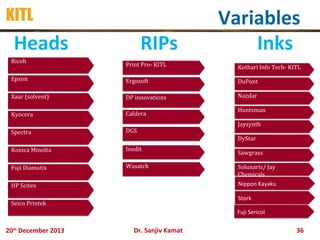
Heads
Ricoh

RIPs

Variables
Inks

Print Pro- KITL

Kothari Info Tech- KITL

Epson

Ergosoft

DuPont

Xaar (solvent)

DP innovations

Nazdar

Kyocera

Caldera

Spectra

DGS

Konica Minolta

Inedit

Fuji Diamatix

Wasatch

Huntsman
Jaysynth
DyStar
Sawgrass
Solunaris/ Jay
Chemicals
Nippon Kayaku

HP Scitex

Stork

Seico Printek

Fuji Sericol

20th December 2013

Dr. Sanjiv Kamat

36
KITL

20th December 2013

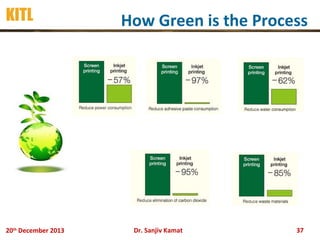
How Green is the Process

Dr. Sanjiv Kamat

37
KITL

Washing Processes

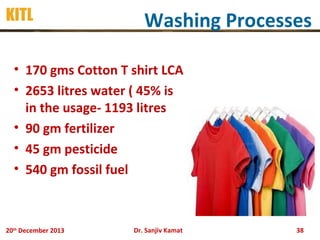
โ€ข 170 gms Cotton T shirt LCA
โ€ข 2653 litres water ( 45% is
in the usage- 1193 litres
โ€ข 90 gm fertilizer
โ€ข 45 gm pesticide
โ€ข 540 gm fossil fuel

20th December 2013

Dr. Sanjiv Kamat

38
KITL

Washing of garments

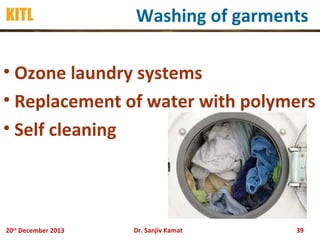
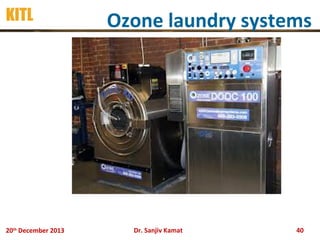
โ€ข Ozone laundry systems
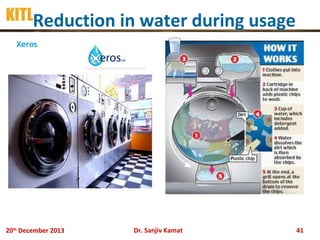
โ€ข Replacement of water with polymers
โ€ข Self cleaning

20th December 2013

Dr. Sanjiv Kamat

39
KITL

20th December 2013

Ozone laundry systems

Dr. Sanjiv Kamat

40
KITLReduction in water during usage
Xeros

20th December 2013

Dr. Sanjiv Kamat

41
KITL

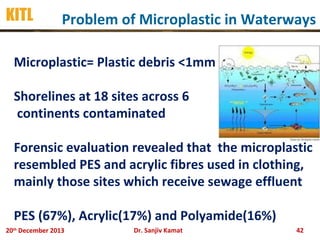
Problem of Microplastic in Waterways

Microplastic= Plastic debris <1mm
Shorelines at 18 sites across 6
continents contaminated
Forensic evaluation revealed that the microplastic
resembled PES and acrylic fibres used in clothing,
mainly those sites which receive sewage effluent
PES (67%), Acrylic(17%) and Polyamide(16%)
20th December 2013

Dr. Sanjiv Kamat

42
KITL

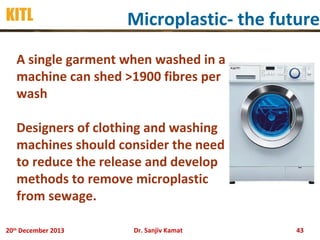
Microplastic- the future

A single garment when washed in a
machine can shed >1900 fibres per
wash
Designers of clothing and washing
machines should consider the need
to reduce the release and develop
methods to remove microplastic
from sewage.
20th December 2013

Dr. Sanjiv Kamat

43
KITL

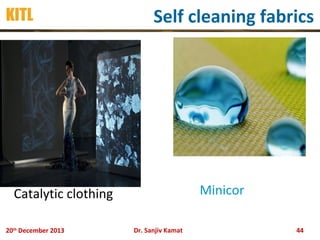
Self cleaning fabrics

Minicor

Catalytic clothing
20th December 2013

Dr. Sanjiv Kamat

44
KITL

20th December 2013

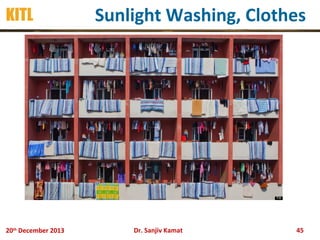
Sunlight Washing, Clothes

Dr. Sanjiv Kamat

45
KITL

Fibres

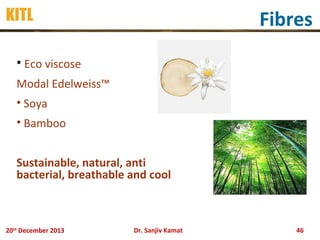
โ€ข Eco viscose
Modal Edelweissโ„ข
โ€ข Soya
โ€ข Bamboo
Sustainable, natural, anti
bacterial, breathable and cool

20th December 2013

Dr. Sanjiv Kamat

46
KITL

Fibres
โ€ข PLA, Ingeoยฎ, Soronaยฎ

โ€ข >Moooยฎ

20th December 2013

Dr. Sanjiv Kamat

47
KITL

Eco Friendly Garments

โ€ข
โ€ข
โ€ข
โ€ข

Organic Cotton farming requires 25% less water than traditional cotton.
Bamboo: No pesticides required and the fabric is soft to touch
Lycoell: Solvent is recovered/recycled. It is an alternate to Rayon.
Ingeo: This is a man-made fiber by converting corn into a polymer to
make bio- degradable material. It is breathable and has insulation
properties of high-performing synthetic material. Requires 68% less
energy than polyester and is biodegradable.
โ€ข Hemp: A pound of hemp fiber needs a fraction of water needed for a
pound of cotton. It does not require pesticides.
โ€ข Soy: Soy fabrics use a by-product of Soy Products, namely Soy Milk,
Soybean Oil to create a material with a feel and look similar to silk.

20th December 2013

Dr. Sanjiv Kamat

48
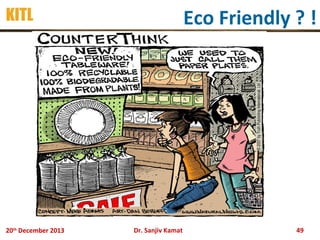
Eco Friendly ? !

KITL

20th December 2013

Dr. Sanjiv Kamat

49
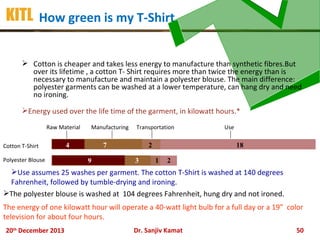
KITL How green is my T-Shirt
๏ƒ˜ Cotton is cheaper and takes less energy to manufacture than synthetic fibres.But
over its lifetime , a cotton T- Shirt requires more than twice the energy than is
necessary to manufacture and maintain a polyester blouse. The main difference:
polyester garments can be washed at a lower temperature, can hang dry and need
no ironing.
๏ƒ˜Energy used over the life time of the garment, in kilowatt hours.*
Raw Material
Cotton T-Shirt
Polyester Blouse

Manufacturing

4

Transportation

7
9

2
3

Use

18
1

2

๏ƒ˜Use assumes 25 washes per garment. The cotton T-Shirt is washed at 140 degrees
Fahrenheit, followed by tumble-drying and ironing.
๏ƒ˜The polyester blouse is washed at 104 degrees Fahrenheit, hung dry and not ironed.
The energy of one kilowatt hour will operate a 40-watt light bulb for a full day or a 19โ€ color
television for about four hours.
20th December 2013

Dr. Sanjiv Kamat

50
KITL
Fermentation Fashion Microbe garments

20th December 2013

Dr. Sanjiv Kamat

51
KITL

20th December 2013

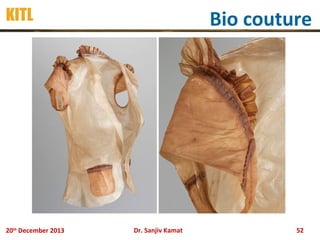
Bio couture

Dr. Sanjiv Kamat

52
KITL

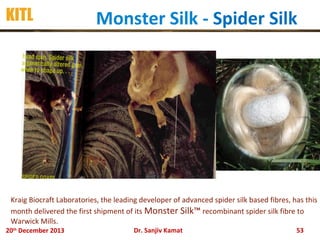
Monster Silk - Spider Silk

Kraig Biocraft Laboratories, the leading developer of advanced spider silk based fibres, has this
month delivered the first shipment of its Monster Silkโ„ข recombinant spider silk fibre to
Warwick Mills.
20th December 2013

Dr. Sanjiv Kamat

53
KITL

20th December 2013

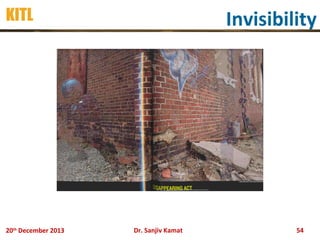
Invisibility

Dr. Sanjiv Kamat

54
KITL

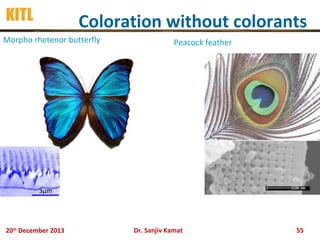
Coloration without colorants

Morpho rhetenor butterfly

Peacock feather

3ยตm

20th December 2013

Dr. Sanjiv Kamat

55
KITL

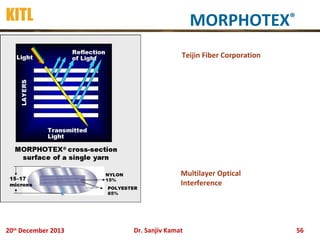
MORPHOTEXยฎ
Teijin Fiber Corporation

Multilayer Optical
Interference

20th December 2013

Dr. Sanjiv Kamat

56
KITL

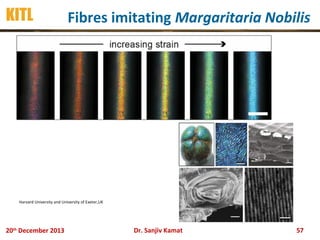
Fibres imitating Margaritaria Nobilis

Harvard University and University of Exeter,UK

20th December 2013

Dr. Sanjiv Kamat

57
KITL

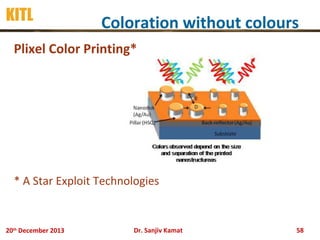
Coloration without colours

Plixel Color Printing*

* A Star Exploit Technologies

20th December 2013

Dr. Sanjiv Kamat

58
KITL

Dangers of Prediction

โ€œI think there is a world market for maybe five
Computersโ€ Thomas Watson, Chairman of IBM, 1943
โ€œComputers in the future may weigh no more
than 1.5 tonnesโ€ Popular Mechanics, 1949
โ€œThere is no reason anyone would want a
computer in their homeโ€ Ken Olson, Present, Chairman and
Founder of Digital Equipment Corp, 1977

โ€œ640k [of RAM] ought to be enough for
anybodyโ€ Bill Gates, Chairman of Microsoft,1981
20th December 2013

Dr. Sanjiv Kamat

59
KITL

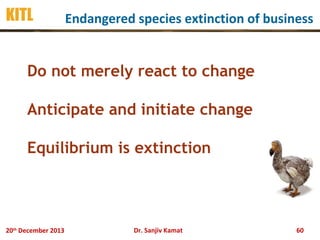
Endangered species extinction of business

Do not merely react to change
Anticipate and initiate change
Equilibrium is extinction

20th December 2013

Dr. Sanjiv Kamat

60
KITL

20th December 2013

Dr. Sanjiv Kamat

61
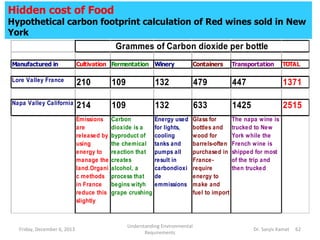
Hidden cost of Food

Hypothetical carbon footprint calculation of Red wines sold in New
York

Grammes of Carbon dioxide per bottle
Manufactured in

Cultivation Fermentation Winery

Containers

Transportation

TOTAL

Lore Valley France

210

109

132

479

447

1371

Napa Valley California

214

109

132

633

1425

2515

Emissions
are
released by
using
energy to
manage the
land.Organi
c methods
in France
reduce this
slightly

Carbon
dioxide is a
byproduct of
the chemical
reaction that
creates
alcohol, a
process that
begins wityh
grape crushing

Energy used
for lights,
cooling
tanks and
pumps all
result in
carbondioxi
de
emmissions

Glass for
bottles and
wood for
barrels-often
purchased in
Francerequire
energy to
make and
fuel to import

The napa wine is
trucked to New
York while the
French wine is
shipped for most
of the trip and
then trucked

Friday, December 6, 2013

Understanding Environmental
Requirements

Dr. Sanjiv Kamat

62

Innovations in textiles for footprint reduction

  • 1.
  • 2.
    KITL Kothari InfoTech Limited Since2001, from Surat, India to provide Solutions for Digital Printing on various substrates Inks Division: Water based high density Charuโ„ข inks and Dishaโ„ข pre-coatings for Textile substrates(Cotton ,Viscose, Linen, Silk, Wool, Nylon and Polyester) Textile Machinery Division: Sales and after sales service for โ€œIchinoseโ€ printing machines(both conventional and digital) โ€œRimslowโ€ Loopager for Inkjet textile printing. โ€œDTG Digitalโ€ for garment printing. โ€œDigiEyeโ€ for non contact colour measurement and QC Software: Print Proโ„ข, world class software, for Colour Separation, Colour Correction, Device calibration, Half-toning, Large image data handling, Digital Imaging, Textile coloration, Image composing and Printing. These applications are targeted towards , label printing as well as Wide/Large format digital printing for graphic arts, photography, and Textiles(fabric and garments). 20th December 2013 Dr. Sanjiv Kamat 2
  • 3.
    KITL Water andEnergy in Textile processing UF P SO โ€˜s 2 NO x CO2 CH4 emission e is no products raw material water work place waste Soil contamination waste water energy ground-water contamination 20th December 2013 Dr. Sanjiv Kamat 3
  • 4.
    KITL Carbon Footprint A CarbonFootprint is a measure of the impact human activities have on the environment in terms of the amount of green house gases produced, measured in units of carbon dioxide 20th December 2013 Dr. Sanjiv Kamat 4
  • 5.
    KITL Global warming Global warmingrefers to the increase in average temperature of the Earths near-surface, air and oceans in recent decades The global average air temperature near earths surface rose 0.74 ยฑ 0.18ยฐC during last 100 years. 20th December 2013 Dr. Sanjiv Kamat 5
  • 6.
    KITL 20th December 2013 GlobalWarming Dr. Sanjiv Kamat 6
  • 7.
    KITL 1 Trillion Kilowatt hoursused every Year by the global Textile Industry 20th December 2013 Global Warming = Dr. Sanjiv Kamat 10% of the total Carbon Impact 7
  • 8.
    KITL Water Footprint Theย water footprintย ofan individual, community or business is defined as the total volume of freshwater used to produce the goods and services consumed by the individual or community or produced by the business. Water use is measured in water volume consumed (evaporated) and/or polluted per unit of time. A water footprint can be calculated for any well-defined group of consumers (e.g., an individual, family, village, city, province, state or nation) or producers (e.g., a public organization, private enterprise or economic sector). 20th December 2013 Dr. Sanjiv Kamat 8
  • 9.
    KITL Environmental impactsof the textile Industry Chemicals โ€ข25% of the chemicals produced worldwide are used for textiles ยป Environmental impact Water โ€ขGrowing of cotton: 8โ€™000 โ€“ 40โ€™000 L / kg cotton โ€ขFinishing of textiles: up to 700 L freshwater / kg textile โ€ขWaste water in production: up to 600 L / kg textile ยป Mostly drinking water quality Energy โ€ขHigh energy consumption in production, transport, retail and use ยป Contribution to global warming 20th December 2013 Dr. Sanjiv Kamat 9
  • 10.
    KITL Definition of aPollutant Pollutant is a substance present in the wrong place at the wrong time and in the wrong quantity 20th December 2013 Dr. Sanjiv Kamat 10
  • 11.
    KITL Hazardous Chemicals Textile wetprocessing โ€ข Accounts for 17-20% of Industrial water pollution โ€ข 72 Toxic Chemicals originate solely from Dyeing 30 of which cannot be removed 20th December 2013 Dr. Sanjiv Kamat 9 Trillion litres of fresh water is used annually to produce 60 billion kg of fabric 11
  • 12.
    KITL 20th December 2013 Freshwater availability Dr. Sanjiv Kamat 12
  • 13.
    KITL 20th December 2013 Effectof Pollution Dr. Sanjiv Kamat 13
  • 14.
    Definition KITL โ€œInventionโ€ can bedefined as the creation of a product or introduction of a process for the first time. โ€œInnovationโ€ on the other hand, occurs if someone improves on or makes a significant contribution to an existing product, process or service. 20th December 2013 Dr. Sanjiv Kamat 14
  • 15.
    KITL Shaping Innovations 1.ย Institutions โ€“which are often neglected but are where the innovations happen. 2.ย Markets โ€“ where the demand and the finance comes from and 3.ย Technologies โ€“ย which go hand in hand with innovations โ€œInnovation is about the smart application of knowledge to solve problems more imaginatively than we have in the past.โ€ 20th December 2013 Dr. Sanjiv Kamat 15
  • 16.
    KITL Change Agents Ecology Legislation Cost New Substrate NewProcess Speed for economics Fashion and advertisement Productivity constraint Sustainability 20th December 2013 Dr. Sanjiv Kamat 16
  • 17.
    KITL Theory of Evolution Itis not the strongest of the species that survive, nor the most intelligent But the most responsive to change Charles Darwin 20th December 2013 Dr. Sanjiv Kamat 17
  • 18.
    KITL Innovations pertaining to โ€ขProducts and processes โ€ข Water Consumption โ€ข Sustainable Fibres โ€ข Coloration without dyes 20th December 2013 Dr. Sanjiv Kamat 18
  • 19.
    KITL Natural colours ๏ฌ Naturaldyes derived from plant material do not have the problems associated with synthetic yes ,like banned amines ,PCB,PAH etc, however they cannot be used on polyesters O OH O OH OH O CH3CH2I + KI, H2O KOH, DMSO O alizarin 1,2-dihydroxyanthraquinone 20th December 2013 O 1-hydroxy-2-ethylanthraquinone Dr. Sanjiv Kamat 19
  • 20.
    KITL โ€ข Colours Reactive dyes havinga quartenary nicotinate โ€ข Cationic Reactive Dyes โ€ข Aviteraโ„ข โ€ข Pigments for Polyesters โ€ข Dyestoneโ„ข 20th December 2013 Dr. Sanjiv Kamat 20
  • 21.
    KITL Auxiliaries โ€ข Use ofSugars in Sulphur dyeing โ€ขPre-treatment of cellulose with cationic, nucleophilic polymers to enable reactive dyeing at neutral pH without electrolyte addition โ€ขEnzymes for polyester and also for imparting hydrophilicity oligomer removal 20th December 2013 Dr. Sanjiv Kamat 21
  • 22.
    Processes KITL Fabric E controlโ„ข, Pad-Sizeoxโ„ข Garments Ablend of โ€œcolorโ€ and โ€œsoftenerโ€ Enzyme with tint Provides ONE STEP stone-wash and tinting effect, abrasion, surface polishing, de-pilling, and body softness on Indigo denim garments. Enzymatic single bath desizing-bleaching-dyeing process for cotton fabrics 20th December 2013 Dr. Sanjiv Kamat 22
  • 23.
    KITL 20th December 2013 PrimaGreenยฎProcess from Genecor Dr. Sanjiv Kamat 23
  • 24.
    KITL G2 Process fromJeanologia Air Aged garments Plasma Air from the atmosphere is transformed into a blend of active oxygen and ozone called Plasma, which is used to age garments.The plasma is transformed back into purified air before being returned to the atmosphere 20th December 2013 Dr. Sanjiv Kamat 24
  • 25.
    KITL 20th December 2013 ColouredSilk Cocoons Dr. Sanjiv Kamat 25
  • 26.
    KITL 20th December 2013 Waterlessdyeing Dr. Sanjiv Kamat 26
  • 27.
  • 28.
    SCOO - Machines KITL Afabric roll in the chamber Control panel 20th December 2013 Dr. Sanjiv Kamat Pressure storage vessel, pumps and pipework 28
  • 29.
    KITL 20th December 2013 SCOO- Process Dr. Sanjiv Kamat 29
  • 30.
  • 31.
  • 32.
    KITL 20th December 2013 CottonArt-Transfer printing of Natural fabrics- German Dutch Dr. Sanjiv Kamat 32
  • 33.
    KITL 20th December 2013 InkJet Printing Dr. Sanjiv Kamat 33
  • 34.
    KITL The Digital Advantage โ€ขAdvantages โ€ข Disappearing Disadvantages โ€ข โ€ข โ€ข โ€ข โ€ข โ€ข โ€ข โ€ข โ€ข โ€ข โ€ข โ€ข โ€ข โ€ข Speed โ€ข Cost โ€ข Replication of screen prints No minimums On demand manufacturing Efficient sampling No repeat size No limit on colors No color kitchen No screen engraving No screen warehousing No limit on design size Flexible design possibilities Reduced waste Reduced manpower Environmentally Friendly 20th December 2013 Dr. Sanjiv Kamat 34
  • 35.
    Printers KITL Durst Printer Classification Class 1 4-12 metresper hour Class 2 18-90 metres per hour Class 3 90-730 metres per hour Class 4 Key Features Ability to transport wide variety of fabrics through printer Able to deliver variety of textile ink chemistries through print head D-Gen Digitex DTG-Digitex Ichinose Konica Minolta Kornit La Meccanica Mimaki Either open or closed system for ink and software 65-75 metres per minute MS Mutoh Osiris Reggianni Roland Zimmer 20th December 2013 Dr. Sanjiv Kamat 35
  • 36.
    KITL Heads Ricoh RIPs Variables Inks Print Pro- KITL KothariInfo Tech- KITL Epson Ergosoft DuPont Xaar (solvent) DP innovations Nazdar Kyocera Caldera Spectra DGS Konica Minolta Inedit Fuji Diamatix Wasatch Huntsman Jaysynth DyStar Sawgrass Solunaris/ Jay Chemicals Nippon Kayaku HP Scitex Stork Seico Printek Fuji Sericol 20th December 2013 Dr. Sanjiv Kamat 36
  • 37.
    KITL 20th December 2013 HowGreen is the Process Dr. Sanjiv Kamat 37
  • 38.
    KITL Washing Processes โ€ข 170gms Cotton T shirt LCA โ€ข 2653 litres water ( 45% is in the usage- 1193 litres โ€ข 90 gm fertilizer โ€ข 45 gm pesticide โ€ข 540 gm fossil fuel 20th December 2013 Dr. Sanjiv Kamat 38
  • 39.
    KITL Washing of garments โ€ขOzone laundry systems โ€ข Replacement of water with polymers โ€ข Self cleaning 20th December 2013 Dr. Sanjiv Kamat 39
  • 40.
    KITL 20th December 2013 Ozonelaundry systems Dr. Sanjiv Kamat 40
  • 41.
    KITLReduction in waterduring usage Xeros 20th December 2013 Dr. Sanjiv Kamat 41
  • 42.
    KITL Problem of Microplasticin Waterways Microplastic= Plastic debris <1mm Shorelines at 18 sites across 6 continents contaminated Forensic evaluation revealed that the microplastic resembled PES and acrylic fibres used in clothing, mainly those sites which receive sewage effluent PES (67%), Acrylic(17%) and Polyamide(16%) 20th December 2013 Dr. Sanjiv Kamat 42
  • 43.
    KITL Microplastic- the future Asingle garment when washed in a machine can shed >1900 fibres per wash Designers of clothing and washing machines should consider the need to reduce the release and develop methods to remove microplastic from sewage. 20th December 2013 Dr. Sanjiv Kamat 43
  • 44.
    KITL Self cleaning fabrics Minicor Catalyticclothing 20th December 2013 Dr. Sanjiv Kamat 44
  • 45.
    KITL 20th December 2013 SunlightWashing, Clothes Dr. Sanjiv Kamat 45
  • 46.
    KITL Fibres โ€ข Eco viscose ModalEdelweissโ„ข โ€ข Soya โ€ข Bamboo Sustainable, natural, anti bacterial, breathable and cool 20th December 2013 Dr. Sanjiv Kamat 46
  • 47.
    KITL Fibres โ€ข PLA, Ingeoยฎ,Soronaยฎ โ€ข >Moooยฎ 20th December 2013 Dr. Sanjiv Kamat 47
  • 48.
    KITL Eco Friendly Garments โ€ข โ€ข โ€ข โ€ข OrganicCotton farming requires 25% less water than traditional cotton. Bamboo: No pesticides required and the fabric is soft to touch Lycoell: Solvent is recovered/recycled. It is an alternate to Rayon. Ingeo: This is a man-made fiber by converting corn into a polymer to make bio- degradable material. It is breathable and has insulation properties of high-performing synthetic material. Requires 68% less energy than polyester and is biodegradable. โ€ข Hemp: A pound of hemp fiber needs a fraction of water needed for a pound of cotton. It does not require pesticides. โ€ข Soy: Soy fabrics use a by-product of Soy Products, namely Soy Milk, Soybean Oil to create a material with a feel and look similar to silk. 20th December 2013 Dr. Sanjiv Kamat 48
  • 49.
    Eco Friendly ?! KITL 20th December 2013 Dr. Sanjiv Kamat 49
  • 50.
    KITL How greenis my T-Shirt ๏ƒ˜ Cotton is cheaper and takes less energy to manufacture than synthetic fibres.But over its lifetime , a cotton T- Shirt requires more than twice the energy than is necessary to manufacture and maintain a polyester blouse. The main difference: polyester garments can be washed at a lower temperature, can hang dry and need no ironing. ๏ƒ˜Energy used over the life time of the garment, in kilowatt hours.* Raw Material Cotton T-Shirt Polyester Blouse Manufacturing 4 Transportation 7 9 2 3 Use 18 1 2 ๏ƒ˜Use assumes 25 washes per garment. The cotton T-Shirt is washed at 140 degrees Fahrenheit, followed by tumble-drying and ironing. ๏ƒ˜The polyester blouse is washed at 104 degrees Fahrenheit, hung dry and not ironed. The energy of one kilowatt hour will operate a 40-watt light bulb for a full day or a 19โ€ color television for about four hours. 20th December 2013 Dr. Sanjiv Kamat 50
  • 51.
    KITL Fermentation Fashion Microbegarments 20th December 2013 Dr. Sanjiv Kamat 51
  • 52.
    KITL 20th December 2013 Biocouture Dr. Sanjiv Kamat 52
  • 53.
    KITL Monster Silk -Spider Silk Kraig Biocraft Laboratories, the leading developer of advanced spider silk based fibres, has this month delivered the first shipment of its Monster Silkโ„ข recombinant spider silk fibre to Warwick Mills. 20th December 2013 Dr. Sanjiv Kamat 53
  • 54.
  • 55.
    KITL Coloration without colorants Morphorhetenor butterfly Peacock feather 3ยตm 20th December 2013 Dr. Sanjiv Kamat 55
  • 56.
    KITL MORPHOTEXยฎ Teijin Fiber Corporation MultilayerOptical Interference 20th December 2013 Dr. Sanjiv Kamat 56
  • 57.
    KITL Fibres imitating MargaritariaNobilis Harvard University and University of Exeter,UK 20th December 2013 Dr. Sanjiv Kamat 57
  • 58.
    KITL Coloration without colours PlixelColor Printing* * A Star Exploit Technologies 20th December 2013 Dr. Sanjiv Kamat 58
  • 59.
    KITL Dangers of Prediction โ€œIthink there is a world market for maybe five Computersโ€ Thomas Watson, Chairman of IBM, 1943 โ€œComputers in the future may weigh no more than 1.5 tonnesโ€ Popular Mechanics, 1949 โ€œThere is no reason anyone would want a computer in their homeโ€ Ken Olson, Present, Chairman and Founder of Digital Equipment Corp, 1977 โ€œ640k [of RAM] ought to be enough for anybodyโ€ Bill Gates, Chairman of Microsoft,1981 20th December 2013 Dr. Sanjiv Kamat 59
  • 60.
    KITL Endangered species extinctionof business Do not merely react to change Anticipate and initiate change Equilibrium is extinction 20th December 2013 Dr. Sanjiv Kamat 60
  • 61.
  • 62.
    Hidden cost ofFood Hypothetical carbon footprint calculation of Red wines sold in New York Grammes of Carbon dioxide per bottle Manufactured in Cultivation Fermentation Winery Containers Transportation TOTAL Lore Valley France 210 109 132 479 447 1371 Napa Valley California 214 109 132 633 1425 2515 Emissions are released by using energy to manage the land.Organi c methods in France reduce this slightly Carbon dioxide is a byproduct of the chemical reaction that creates alcohol, a process that begins wityh grape crushing Energy used for lights, cooling tanks and pumps all result in carbondioxi de emmissions Glass for bottles and wood for barrels-often purchased in Francerequire energy to make and fuel to import The napa wine is trucked to New York while the French wine is shipped for most of the trip and then trucked Friday, December 6, 2013 Understanding Environmental Requirements Dr. Sanjiv Kamat 62