Click to add text
January 2014 Dr. Sanjiv Kamat 1
Advances in Pigment
Printing of Textiles
January 2014 Dr. Sanjiv Kamat 2
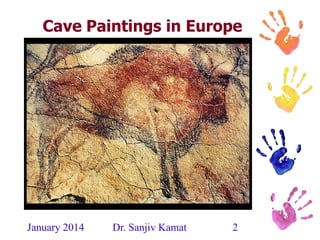
Cave Paintings in Europe
January 2014 Dr. Sanjiv Kamat 3
Pigment Dispersions –
Historical developments
• Over 3000 years old with mineral pigments and natural
polymers as binders and thickeners(starch glue)
• 1920's- Organic Pigment dispersions
• 1930's – Emulsion co-polymerisation
• 1937 – Pigment paste based on water in oil emulsion
• 1950 – Oil in water systems
• 1960 – Aqueous self cross-linking dispersions as binders
• 1990's – Ecological improvements(emissions)
• 2000's – Digital Printing
January 2014 Dr. Sanjiv Kamat 4
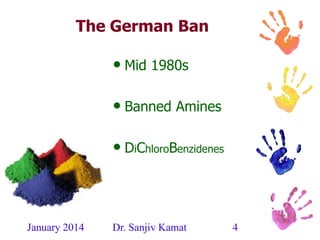
The German Ban
• Mid 1980s
• Banned Amines
• DiChloroBenzidenes
January 2014 Dr. Sanjiv Kamat 5
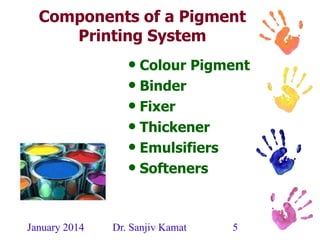
Components of a Pigment
Printing System
• Colour Pigment
• Binder
• Fixer
• Thickener
• Emulsifiers
• Softeners
January 2014 Dr. Sanjiv Kamat 6
Components of Pigment dispersion
• Pigment Powder (25-45%)
• Water
• Auxiliaries
– Emulsifiers,Dispersing agents (5-15%)
– Co-solvents(5-10%)
– Preservatives (<1%)
– Antifoam (<0.1%)
January 2014 Dr. Sanjiv Kamat 7
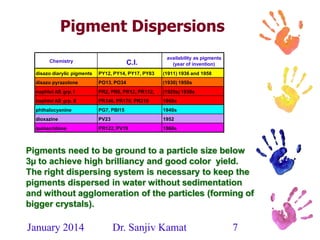
Pigment Dispersions
Pigments need to be ground to a particle size below
3µ to achieve high brilliancy and good color yield.
The right dispersing system is necessary to keep the
pigments dispersed in water without sedimentation
and without agglomeration of the particles (forming of
bigger crystals).
Chemistry C.I.
availability as pigments
(year of invention)
disazo diarylic pigments PY12, PY14, PY17, PY83 (1911) 1936 and 1958
disazo pyrazolone PO13, PO34 (1930) 1950s
naphtol AS grp. I PR2, PR8, PR12, PR112, (1920s) 1930s
naphtol AS grp. II PR146, PR170, PR210 1960s
phthalocyanine PG7, PBl15 1940s
dioxazine PV23 1952
quinacridone PR122, PV19 1960s
January 2014 Dr. Sanjiv Kamat 8
For Pigment dispersions, following need to
be within Limits
• Banned Amines
• PAH
• PCB
• COC
• Dioxines
• Heavy Metals
• Formaldehyde/
Preservatives
• APEO
January 2014 Dr. Sanjiv Kamat 9
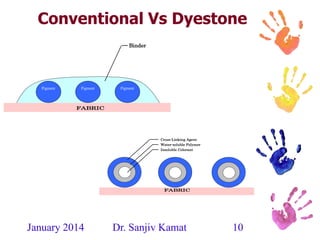
Dyestone Colorants
"Dyestone® X Color" is neither pigment nor
dyestuff, but a patented new generation of
textile colorants that fully utilize micro-
encapsulating technology.
Matsui International's insoluble colors are
finely ground at the Nano-level and coated
with a water-soluble polymer on the surface
level and can be applied onto almost any kind
of textile substrate (cotton, polyester, nylon,
rayon, etc.) by both printing & pad-dyeing
process.
January 2014 Dr. Sanjiv Kamat 10
Conventional Vs Dyestone
Pigment Pigment Pigment
Binder
FABRIC
Cross-Linking Agent
Water-soluble Polymer
Insoluble Colorant
FABRIC
January 2014 Dr. Sanjiv Kamat 11
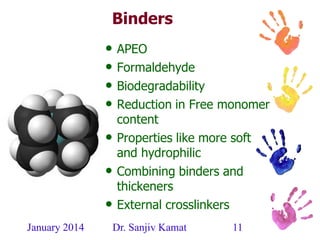
Binders
• APEO
• Formaldehyde
• Biodegradability
• Reduction in Free monomer
content
• Properties like more soft
and hydrophilic
• Combining binders and
thickeners
• External crosslinkers
January 2014 Dr. Sanjiv Kamat 12
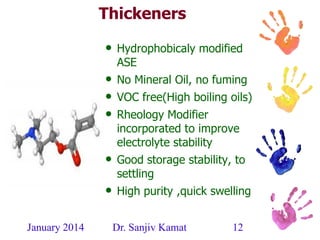
Thickeners
• Hydrophobicaly modified
ASE
• No Mineral Oil, no fuming
• VOC free(High boiling oils)
• Rheology Modifier
incorporated to improve
electrolyte stability
• Good storage stability, to
settling
• High purity ,quick swelling
January 2014 Dr. Sanjiv Kamat 13
Developments in Fixing Agents
 Melamine resin fixing agent / contains
HCHO, higher etherification, thus:
- reduced HCHO content
- less HCHO emission during drying and
fixation
- reduced HCHO content on the fabric
- less reactivity
 Isocyanate fixing agent / HCHO-free
-cold fixing / not blocked / shelf life /
high reactivity
- hot fixing / blocked
January 2014 Dr. Sanjiv Kamat 14
Summary
Besides the ever present demands for more economical products
and processes and the demand from retailers to close the gap
between pigment and dyestuff printing regarding end-user
properties the main challenges for pigment printing will be
the dramatically increase of ecological demands.
Binders: Apeo,formaldehyde free
reduction of rest-monomer content
biodegradability
Pigments: amine, RSL free
AOX free
restrictive use of presrvatives
Thickeners: oil free, VOC free
biodegradability
Auxiliaries: formaldehyde free
restrictive use of preservatives
January 2014 Dr. Sanjiv Kamat 15
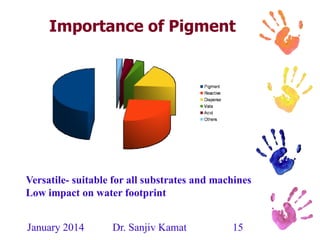
Importance of Pigment
Versatile- suitable for all substrates and machines
Low impact on water footprint
January 2014 Dr. Sanjiv Kamat 16

Advances in pigment printing

  • 1.
    Click to addtext January 2014 Dr. Sanjiv Kamat 1 Advances in Pigment Printing of Textiles
  • 2.
    January 2014 Dr.Sanjiv Kamat 2 Cave Paintings in Europe
  • 3.
    January 2014 Dr.Sanjiv Kamat 3 Pigment Dispersions – Historical developments • Over 3000 years old with mineral pigments and natural polymers as binders and thickeners(starch glue) • 1920's- Organic Pigment dispersions • 1930's – Emulsion co-polymerisation • 1937 – Pigment paste based on water in oil emulsion • 1950 – Oil in water systems • 1960 – Aqueous self cross-linking dispersions as binders • 1990's – Ecological improvements(emissions) • 2000's – Digital Printing
  • 4.
    January 2014 Dr.Sanjiv Kamat 4 The German Ban • Mid 1980s • Banned Amines • DiChloroBenzidenes
  • 5.
    January 2014 Dr.Sanjiv Kamat 5 Components of a Pigment Printing System • Colour Pigment • Binder • Fixer • Thickener • Emulsifiers • Softeners
  • 6.
    January 2014 Dr.Sanjiv Kamat 6 Components of Pigment dispersion • Pigment Powder (25-45%) • Water • Auxiliaries – Emulsifiers,Dispersing agents (5-15%) – Co-solvents(5-10%) – Preservatives (<1%) – Antifoam (<0.1%)
  • 7.
    January 2014 Dr.Sanjiv Kamat 7 Pigment Dispersions Pigments need to be ground to a particle size below 3µ to achieve high brilliancy and good color yield. The right dispersing system is necessary to keep the pigments dispersed in water without sedimentation and without agglomeration of the particles (forming of bigger crystals). Chemistry C.I. availability as pigments (year of invention) disazo diarylic pigments PY12, PY14, PY17, PY83 (1911) 1936 and 1958 disazo pyrazolone PO13, PO34 (1930) 1950s naphtol AS grp. I PR2, PR8, PR12, PR112, (1920s) 1930s naphtol AS grp. II PR146, PR170, PR210 1960s phthalocyanine PG7, PBl15 1940s dioxazine PV23 1952 quinacridone PR122, PV19 1960s
  • 8.
    January 2014 Dr.Sanjiv Kamat 8 For Pigment dispersions, following need to be within Limits • Banned Amines • PAH • PCB • COC • Dioxines • Heavy Metals • Formaldehyde/ Preservatives • APEO
  • 9.
    January 2014 Dr.Sanjiv Kamat 9 Dyestone Colorants "Dyestone® X Color" is neither pigment nor dyestuff, but a patented new generation of textile colorants that fully utilize micro- encapsulating technology. Matsui International's insoluble colors are finely ground at the Nano-level and coated with a water-soluble polymer on the surface level and can be applied onto almost any kind of textile substrate (cotton, polyester, nylon, rayon, etc.) by both printing & pad-dyeing process.
  • 10.
    January 2014 Dr.Sanjiv Kamat 10 Conventional Vs Dyestone Pigment Pigment Pigment Binder FABRIC Cross-Linking Agent Water-soluble Polymer Insoluble Colorant FABRIC
  • 11.
    January 2014 Dr.Sanjiv Kamat 11 Binders • APEO • Formaldehyde • Biodegradability • Reduction in Free monomer content • Properties like more soft and hydrophilic • Combining binders and thickeners • External crosslinkers
  • 12.
    January 2014 Dr.Sanjiv Kamat 12 Thickeners • Hydrophobicaly modified ASE • No Mineral Oil, no fuming • VOC free(High boiling oils) • Rheology Modifier incorporated to improve electrolyte stability • Good storage stability, to settling • High purity ,quick swelling
  • 13.
    January 2014 Dr.Sanjiv Kamat 13 Developments in Fixing Agents  Melamine resin fixing agent / contains HCHO, higher etherification, thus: - reduced HCHO content - less HCHO emission during drying and fixation - reduced HCHO content on the fabric - less reactivity  Isocyanate fixing agent / HCHO-free -cold fixing / not blocked / shelf life / high reactivity - hot fixing / blocked
  • 14.
    January 2014 Dr.Sanjiv Kamat 14 Summary Besides the ever present demands for more economical products and processes and the demand from retailers to close the gap between pigment and dyestuff printing regarding end-user properties the main challenges for pigment printing will be the dramatically increase of ecological demands. Binders: Apeo,formaldehyde free reduction of rest-monomer content biodegradability Pigments: amine, RSL free AOX free restrictive use of presrvatives Thickeners: oil free, VOC free biodegradability Auxiliaries: formaldehyde free restrictive use of preservatives
  • 15.
    January 2014 Dr.Sanjiv Kamat 15 Importance of Pigment Versatile- suitable for all substrates and machines Low impact on water footprint
  • 16.
    January 2014 Dr.Sanjiv Kamat 16