Planning for our Success
Applying the lessons learned from global technology innovation projects
Classrooms around the world are transforming
Is your classroom evolving with technology in education?
Are you using technology to enhance student learning?
Change can be scary, but it can bring rewards
Would you like to see your students more engaged?
Would you like to see students take more ownership of their
learning?
Mobile Learning
YOU
can make a difference!
Taking advantage of mobile
devices in the classroom can
increase engagement,
collaboration and student
motivation.
Mobile learning initiative at Lamar
We have to plan for our initiative’s success by learning from
others that have implemented similar initiatives.
Mobile learning is happening all across the world.
We must move forward to stay relevant and provide our
student’s the skills they need to be successful.
Mobile Learning: Innovation we need
“Innovation should be considered a value at university, a characteristic that sets it
apart from the rest. In this sense, innovation with mobile devices requires the
establishment of communications channels and opportunities for thought,
reflection, and collaboration to foster the effective and efficient engagement of
the teaching staff, management board and students.”
The Impact of Digital Mobile Devices in Higher Education, 2015
How do we plan for success?
Look to mobile initiatives in global contexts and discover:
What worked?
What could have been done better?
How do we apply these lessons learned?
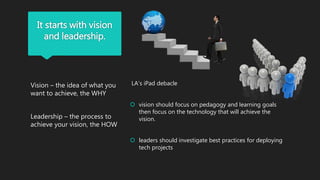
It starts with vision
and leadership.
LA’s iPad debacle
 vision should focus on pedagogy and learning goals
then focus on the technology that will achieve the
vision.
 leaders should investigate best practices for deploying
tech projects
Vision – the idea of what you
want to achieve, the WHY
Leadership – the process to
achieve your vision, the HOW
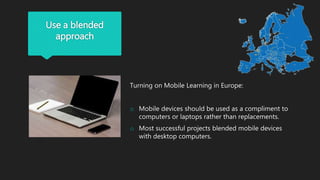
Use a blended
approach
Turning on Mobile Learning in Europe:
o Mobile devices should be used as a compliment to
computers or laptops rather than replacements.
o Most successful projects blended mobile devices
with desktop computers.
Better policies for
mobile use in
classrooms
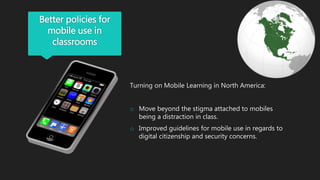
Turning on Mobile Learning in North America:
o Move beyond the stigma attached to mobiles
being a distraction in class.
o Improved guidelines for mobile use in regards to
digital citizenship and security concerns.
Robust professional
development and
tech support
A focus on pedagogical
strategies for implementing
mobile learning.
Adoption is an ongoing
process.
o Teacher readiness
o Level of ICT skills
o Placement of pedagogical guides
o Peer tutoring, creation of a Personal Learning
Community
o Availability of technical support for devices and
infrastructure
o Success models
Personal Learning Community
Sandy Schuck writes, in Mobile Learning in Higher Education: Mobilizing staff to use technologies
in their teaching, about how PLCs can provide support for educators by bringing people together
with a shared goal and a desire to grow and develop professionally.
Key success factors:
 Used the process of action learning – learning by setting goals and acting to attain them.
 Members should have a common interest and have stakes in investigating mobile learning.
 Development of Mobile Pedagogical Framework which considers the characteristics of
learning with mobile technologies and how those can be used for effective teaching.
 Working in a supportive community enhances experience and outcomes.
Monitoring and
Evaluation
Continuous monitoring and
evaluation will ensure
improvement and
sustainability.
o Focus group discussions to attain participant and
faculty opinions and attitudes about the mobile
learning initiative (eSkwela, Phillipines, 2009)
o Surveys and reports that relay feedback
What’s so special about
mobile learning?
Imagine learning taking place anywhere, anytime inside or outside of school, in the work
place, out in the field, never-ending.
-ICT in Innovative Schools: Case Studies of Change and Impact, n.d.
It can help us to create
seamless and continuous
educational opportunities to
support lifelong learning in all
contexts.
The Bottom Line
“According to UNESCO’s report on mobile learning in North America, it involves
more than merely incorporating new technology into current pedagogical
strategies; it requires an instructional paradigm shift that promises to
fundamentally change the way students learn.”
-- S. Jhoanna Robledo, Mobile Devices for Learning: What you need to know,
2012.
I hope to apply these
lessons learned for
success of our mobile
learning initiative
WHY?
At Lamar University, we believe in cultivating sophisticated learners that will thrive in today’s
society and in the future by empowering them with life-long learning skills.
Our shared persistence and
influence will determine the
scope of our success and
ensure sustainability of mobile
learning at Lamar.
Let’s DO this!
References
Chambers, B. (2014, August 28). L.A. cancels iPads-in-the-schools program: a failure of vision, not
technology. Retrieved from http://www.macworld.com/article/2599988/lausd-ipad-cancellation-is-
a-failure-of-vision-not-technology.html
Eden Dahlstrom, with D. Christopher Brooks, Susan Grajek, and Jamie Reeves. ECAR Study of Students
and Information Technology, 2015. Research report. Louisville, CO: ECAR, December 2015.
Edutopia.org, & Robledo, S. J. (2012). Mobile Devices for Learning: What You Need to Know (available
in Spanish). Retrieved from http://www.edutopia.org/mobile-devices-learning-resource-guide
Fritschi, J., & Wolf, M.A. (2012). Turning on Mobile Learning in North America: Illustrative Initiatives
and Policy Implications (Working paper). Retrieved from United Nations Educational, Scientific and
Cultural Organization (UNESCO) website:
http://www.unesco.org/new/en/unesco/themes/icts/m4ed/mobile-learning-
resources/unescomobilelearningseries/
References
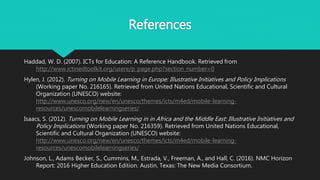
Haddad, W. D. (2007). ICTs for Education: A Reference Handbook. Retrieved from
http://www.ictinedtoolkit.org/usere/p_page.php?section_number=0
Hylen, J. (2012). Turning on Mobile Learning in Europe: Illustrative Initiatives and Policy Implications
(Working paper No. 216165). Retrieved from United Nations Educational, Scientific and Cultural
Organization (UNESCO) website:
http://www.unesco.org/new/en/unesco/themes/icts/m4ed/mobile-learning-
resources/unescomobilelearningseries/
Isaacs, S. (2012). Turning on Mobile Learning in in Africa and the Middle East: Illustrative Initiatives and
Policy Implications (Working paper No. 216359). Retrieved from United Nations Educational,
Scientific and Cultural Organization (UNESCO) website:
http://www.unesco.org/new/en/unesco/themes/icts/m4ed/mobile-learning-
resources/unescomobilelearningseries/
Johnson, L., Adams Becker, S., Cummins, M., Estrada, V., Freeman, A., and Hall, C. (2016). NMC Horizon
Report: 2016 Higher Education Edition. Austin, Texas: The New Media Consortium.
References
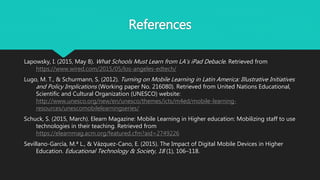
Lapowsky, I. (2015, May 8). What Schools Must Learn from LA’s iPad Debacle. Retrieved from
https://www.wired.com/2015/05/los-angeles-edtech/
Lugo, M. T., & Schurmann, S. (2012). Turning on Mobile Learning in Latin America: Illustrative Initiatives
and Policy Implications (Working paper No. 216080). Retrieved from United Nations Educational,
Scientific and Cultural Organization (UNESCO) website:
http://www.unesco.org/new/en/unesco/themes/icts/m4ed/mobile-learning-
resources/unescomobilelearningseries/
Schuck, S. (2015, March). Elearn Magazine: Mobile Learning in Higher education: Mobilizing staff to use
technologies in their teaching. Retrieved from
https://elearnmag.acm.org/featured.cfm?aid=2749226
Sevillano-García, M.ª L., & Vázquez-Cano, E. (2015). The Impact of Digital Mobile Devices in Higher
Education. Educational Technology & Society, 18 (1), 106–118.
References
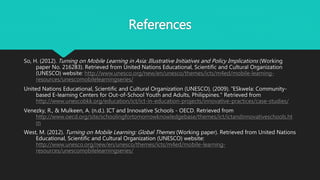
So, H. (2012). Turning on Mobile Learning in Asia: Illustrative Initiatives and Policy Implications (Working
paper No. 216283). Retrieved from United Nations Educational, Scientific and Cultural Organization
(UNESCO) website: http://www.unesco.org/new/en/unesco/themes/icts/m4ed/mobile-learning-
resources/unescomobilelearningseries/
United Nations Educational, Scientific and Cultural Organization (UNESCO). (2009). "ESkwela: Community-
based E-learning Centers for Out-of-School Youth and Adults, Philippines." Retrieved from
http://www.unescobkk.org/education/ict/ict-in-education-projects/innovative-practices/case-studies/
Venezky, R., & Mulkeen, A. (n.d.). ICT and Innovative Schools - OECD. Retrieved from
http://www.oecd.org/site/schoolingfortomorrowknowledgebase/themes/ict/ictandinnovativeschools.ht
m
West, M. (2012). Turning on Mobile Learning: Global Themes (Working paper). Retrieved from United Nations
Educational, Scientific and Cultural Organization (UNESCO) website:
http://www.unesco.org/new/en/unesco/themes/icts/m4ed/mobile-learning-
resources/unescomobilelearningseries/

Planning for our Success

  • 1.
    Planning for ourSuccess Applying the lessons learned from global technology innovation projects
  • 2.
    Classrooms around theworld are transforming Is your classroom evolving with technology in education? Are you using technology to enhance student learning?
  • 3.
    Change can bescary, but it can bring rewards Would you like to see your students more engaged? Would you like to see students take more ownership of their learning?
  • 4.
    Mobile Learning YOU can makea difference! Taking advantage of mobile devices in the classroom can increase engagement, collaboration and student motivation.
  • 5.
    Mobile learning initiativeat Lamar We have to plan for our initiative’s success by learning from others that have implemented similar initiatives. Mobile learning is happening all across the world. We must move forward to stay relevant and provide our student’s the skills they need to be successful.
  • 6.
    Mobile Learning: Innovationwe need “Innovation should be considered a value at university, a characteristic that sets it apart from the rest. In this sense, innovation with mobile devices requires the establishment of communications channels and opportunities for thought, reflection, and collaboration to foster the effective and efficient engagement of the teaching staff, management board and students.” The Impact of Digital Mobile Devices in Higher Education, 2015
  • 7.
    How do weplan for success? Look to mobile initiatives in global contexts and discover: What worked? What could have been done better? How do we apply these lessons learned?
  • 8.
    It starts withvision and leadership. LA’s iPad debacle  vision should focus on pedagogy and learning goals then focus on the technology that will achieve the vision.  leaders should investigate best practices for deploying tech projects Vision – the idea of what you want to achieve, the WHY Leadership – the process to achieve your vision, the HOW
  • 9.
    Use a blended approach Turningon Mobile Learning in Europe: o Mobile devices should be used as a compliment to computers or laptops rather than replacements. o Most successful projects blended mobile devices with desktop computers.
  • 10.
    Better policies for mobileuse in classrooms Turning on Mobile Learning in North America: o Move beyond the stigma attached to mobiles being a distraction in class. o Improved guidelines for mobile use in regards to digital citizenship and security concerns.
  • 11.
    Robust professional development and techsupport A focus on pedagogical strategies for implementing mobile learning. Adoption is an ongoing process. o Teacher readiness o Level of ICT skills o Placement of pedagogical guides o Peer tutoring, creation of a Personal Learning Community o Availability of technical support for devices and infrastructure o Success models
  • 12.
    Personal Learning Community SandySchuck writes, in Mobile Learning in Higher Education: Mobilizing staff to use technologies in their teaching, about how PLCs can provide support for educators by bringing people together with a shared goal and a desire to grow and develop professionally. Key success factors:  Used the process of action learning – learning by setting goals and acting to attain them.  Members should have a common interest and have stakes in investigating mobile learning.  Development of Mobile Pedagogical Framework which considers the characteristics of learning with mobile technologies and how those can be used for effective teaching.  Working in a supportive community enhances experience and outcomes.
  • 13.
    Monitoring and Evaluation Continuous monitoringand evaluation will ensure improvement and sustainability. o Focus group discussions to attain participant and faculty opinions and attitudes about the mobile learning initiative (eSkwela, Phillipines, 2009) o Surveys and reports that relay feedback
  • 14.
    What’s so specialabout mobile learning? Imagine learning taking place anywhere, anytime inside or outside of school, in the work place, out in the field, never-ending. -ICT in Innovative Schools: Case Studies of Change and Impact, n.d. It can help us to create seamless and continuous educational opportunities to support lifelong learning in all contexts.
  • 15.
    The Bottom Line “Accordingto UNESCO’s report on mobile learning in North America, it involves more than merely incorporating new technology into current pedagogical strategies; it requires an instructional paradigm shift that promises to fundamentally change the way students learn.” -- S. Jhoanna Robledo, Mobile Devices for Learning: What you need to know, 2012.
  • 16.
    I hope toapply these lessons learned for success of our mobile learning initiative WHY? At Lamar University, we believe in cultivating sophisticated learners that will thrive in today’s society and in the future by empowering them with life-long learning skills. Our shared persistence and influence will determine the scope of our success and ensure sustainability of mobile learning at Lamar. Let’s DO this!
  • 17.
    References Chambers, B. (2014,August 28). L.A. cancels iPads-in-the-schools program: a failure of vision, not technology. Retrieved from http://www.macworld.com/article/2599988/lausd-ipad-cancellation-is- a-failure-of-vision-not-technology.html Eden Dahlstrom, with D. Christopher Brooks, Susan Grajek, and Jamie Reeves. ECAR Study of Students and Information Technology, 2015. Research report. Louisville, CO: ECAR, December 2015. Edutopia.org, & Robledo, S. J. (2012). Mobile Devices for Learning: What You Need to Know (available in Spanish). Retrieved from http://www.edutopia.org/mobile-devices-learning-resource-guide Fritschi, J., & Wolf, M.A. (2012). Turning on Mobile Learning in North America: Illustrative Initiatives and Policy Implications (Working paper). Retrieved from United Nations Educational, Scientific and Cultural Organization (UNESCO) website: http://www.unesco.org/new/en/unesco/themes/icts/m4ed/mobile-learning- resources/unescomobilelearningseries/
  • 18.
    References Haddad, W. D.(2007). ICTs for Education: A Reference Handbook. Retrieved from http://www.ictinedtoolkit.org/usere/p_page.php?section_number=0 Hylen, J. (2012). Turning on Mobile Learning in Europe: Illustrative Initiatives and Policy Implications (Working paper No. 216165). Retrieved from United Nations Educational, Scientific and Cultural Organization (UNESCO) website: http://www.unesco.org/new/en/unesco/themes/icts/m4ed/mobile-learning- resources/unescomobilelearningseries/ Isaacs, S. (2012). Turning on Mobile Learning in in Africa and the Middle East: Illustrative Initiatives and Policy Implications (Working paper No. 216359). Retrieved from United Nations Educational, Scientific and Cultural Organization (UNESCO) website: http://www.unesco.org/new/en/unesco/themes/icts/m4ed/mobile-learning- resources/unescomobilelearningseries/ Johnson, L., Adams Becker, S., Cummins, M., Estrada, V., Freeman, A., and Hall, C. (2016). NMC Horizon Report: 2016 Higher Education Edition. Austin, Texas: The New Media Consortium.
  • 19.
    References Lapowsky, I. (2015,May 8). What Schools Must Learn from LA’s iPad Debacle. Retrieved from https://www.wired.com/2015/05/los-angeles-edtech/ Lugo, M. T., & Schurmann, S. (2012). Turning on Mobile Learning in Latin America: Illustrative Initiatives and Policy Implications (Working paper No. 216080). Retrieved from United Nations Educational, Scientific and Cultural Organization (UNESCO) website: http://www.unesco.org/new/en/unesco/themes/icts/m4ed/mobile-learning- resources/unescomobilelearningseries/ Schuck, S. (2015, March). Elearn Magazine: Mobile Learning in Higher education: Mobilizing staff to use technologies in their teaching. Retrieved from https://elearnmag.acm.org/featured.cfm?aid=2749226 Sevillano-García, M.ª L., & Vázquez-Cano, E. (2015). The Impact of Digital Mobile Devices in Higher Education. Educational Technology & Society, 18 (1), 106–118.
  • 20.
    References So, H. (2012).Turning on Mobile Learning in Asia: Illustrative Initiatives and Policy Implications (Working paper No. 216283). Retrieved from United Nations Educational, Scientific and Cultural Organization (UNESCO) website: http://www.unesco.org/new/en/unesco/themes/icts/m4ed/mobile-learning- resources/unescomobilelearningseries/ United Nations Educational, Scientific and Cultural Organization (UNESCO). (2009). "ESkwela: Community- based E-learning Centers for Out-of-School Youth and Adults, Philippines." Retrieved from http://www.unescobkk.org/education/ict/ict-in-education-projects/innovative-practices/case-studies/ Venezky, R., & Mulkeen, A. (n.d.). ICT and Innovative Schools - OECD. Retrieved from http://www.oecd.org/site/schoolingfortomorrowknowledgebase/themes/ict/ictandinnovativeschools.ht m West, M. (2012). Turning on Mobile Learning: Global Themes (Working paper). Retrieved from United Nations Educational, Scientific and Cultural Organization (UNESCO) website: http://www.unesco.org/new/en/unesco/themes/icts/m4ed/mobile-learning- resources/unescomobilelearningseries/