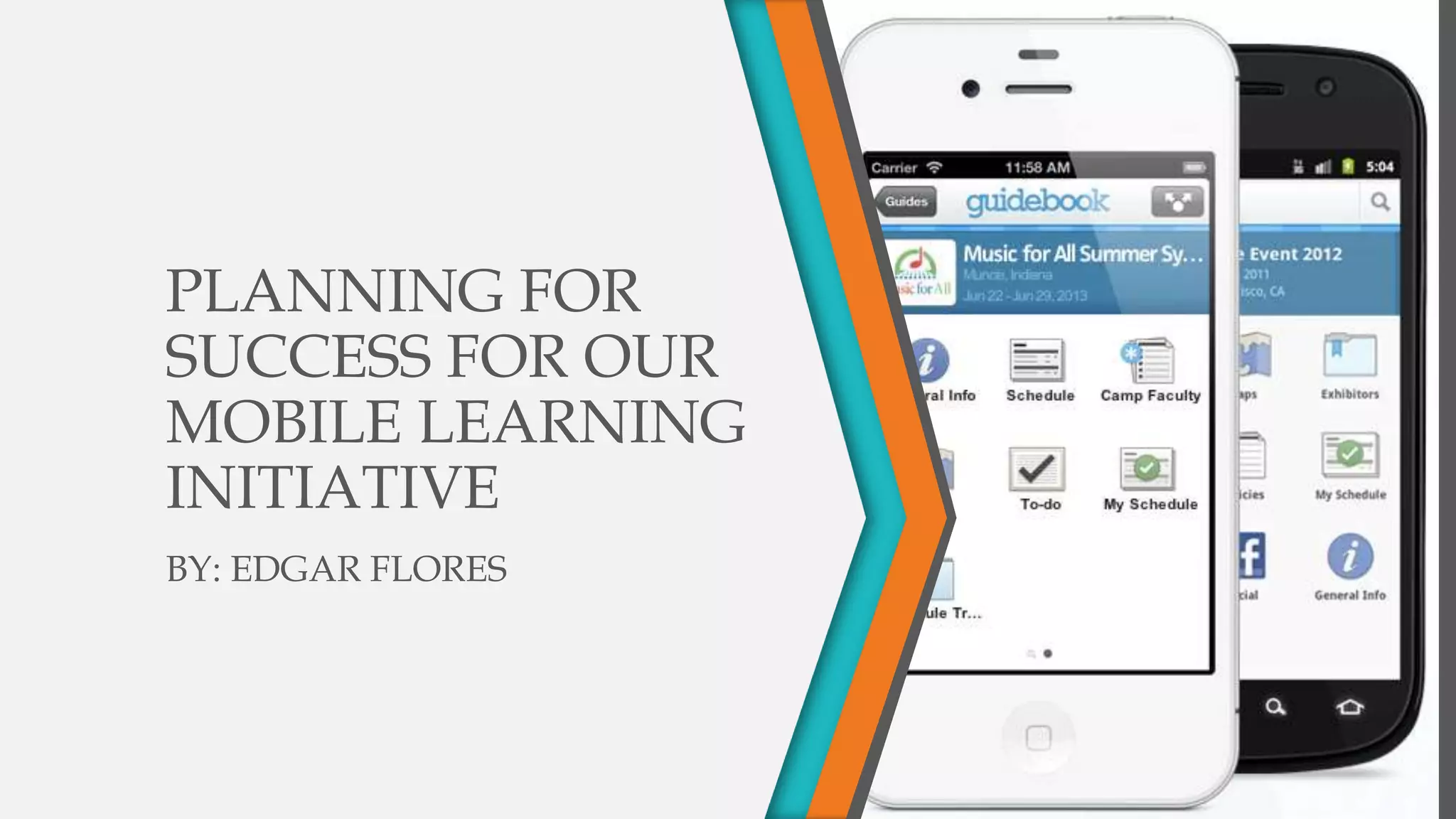
PLANNING FOR
SUCCESS FOR OUR
MOBILE LEARNING
INITIATIVE
BY: EDGAR FLORES
Transformation In Education Is All Over The World
• Your school has effectively integrated technology in the
classrooms?
• If yes, how does it improve student learning?
Ask yourself whether:
Let’s Embrace Mobile Learning
• Bring mobile learning into the classroom
• Promote collaboration
• Enhance student learning
Our Mobile Learning Initiative
• The plan is there; it is actually for embracing change
• We need to get on the same page with the rest of the world
• Otherwise, change will get rid of us!
• Our students are our future, for a long time, learning has been
boring and it’s time to make it entertaining
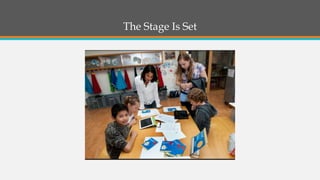
The Stage Is Set
Innovation In The Classroom
• Mobile learning is part of smart education that is student-centered
• There is need to crossover from traditional methodologies
• There will be more improved student attention
How Do We Plan The Road to Success?
• Simply look at other experiences from global initiatives
Determine:
• What worked?
• What didn’t work?
• How can the process be improved?
• How do we incorporate the experience in our program?
Success Requires Vision and Leadership
Lesson From The L.A’s iPad Debacle
• Vision: This is the preview of where we want to be?
• Leadership: The element that guides the process of achieving that
vision.
• Therefore:
• Our vision should be clear to everybody, we should have that clear
picture of where we want to be in 10 years.
• The leaders should focus on the best practices that will deliver us to
our vision.
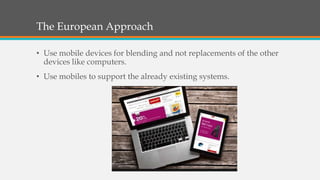
The European Approach
• Use mobile devices for blending and not replacements of the other
devices like computers.
• Use mobiles to support the already existing systems.
North America’s Policy Device Use In Classrooms
• The common conception is that mobile devices are distractive.
• The truth is that they increase attention.
• Promote privacy and security.
• Encourage digital citizenship.
Create A Robust Professional Development
Program
• Make clear strategies for implementing mobile learning.
• Train teachers.
• Use pedagogical approaches.
• Create PLC.
• Provide technical support.
• Give enough period for training.
• Develop a success model.
Schools As Learning Communities
• Improve schools by developing professional learning communities.
• From a grade-level teaching team, to the school committee, to high
school department, entire school district, a state department of
education, a national professional organization and so on.
• PLC is all the people who have interest in improved education.
Monitoring, Auditing and Evaluation
• For process improvement and sustainability, monitoring and
auditing is necessary.
• The different groups should meet regularly, share their reviews
about program progress.
• Recommend changes and opportunities for improvements.
• Feedback through reviews.
The Need For Mobile Learning
• Easy to access primary sources.
• Collaboration
• It is a paradigm shift from old things and ways to new and better
things.
• Learning can be done anywhere anytime.
• Education should be continuous and mobile learning will make it
smooth and enjoyable.
The Bottom Line
• It all about aligning our education with the dynamic world.
• We cannot live in a new world and continue to practice the old
things.
• Therefore, mobile learning is a new platform, which will improve
learning and make education smart.
Our Commitment
• All the learned experiences will be very useful in implementing the
new mobile learning initiative.
• Our commitment will determine how far this project will go.
• We know where we want to be.
• We understand that, we need to equip our students and help them
thrive in this challenging environment by giving them smart
education and empowering them with technological skills that they
will use throughout their life-time.
References
• A. Shonola, S., S. Joy, M., S. Oyelere, S., & Suhonen, J. (2016). The
Impact of Mobile Devices for Learning in Higher Education
Institutions: Nigerian Universities Case Study. IJMECS, 8(8), 43-50.
http://dx.doi.org/10.5815/ijmecs.2016.08.06
• Blume, H. (2015). L.A. school district demands iPad refund from
Apple. Latimes.com. Retrieved 15 October 2016, from
http://www.latimes.com/local/lanow/la-me-In-ipad-curriculum-
refund-20150415-story.html
• Chambers, B. (2014). L.A. cancels iPads-in-the-schools program: a
failure of vision, not technology. Macworld. Retrieved 15 October
2016, from http://www.macworld.com/article/2599988/lauds-
ipad-cancellation-is-a-failure-of-vision-not-technology.html
References
• Fritschi, J. & Wolf, M. (2016). TURNING ON MOBILE LEARNING IN
NORTH AMERICA> Illustrative initiatives and Policy Implications,
(2227-5029). Retrieved from:
http://www.unesco.org/new/en/unesco/themes/icts/m4ed/
• Gikas, J. & Grant, M. (2013). Mobile computing devices in higher
education: Student perspectives on learning with cellphones,
smartphones & social media. The Internet And Higher Education, 19, 18-
26. http://dx.doi.org/10.1016/j.iheduc.2013.06.002
• Hylen, J. (2012). TURNING ON MOBILE LEARNING IN EUROPE>
Illustrative Initiatives and Policy Implications, (2227-5029). Retrieved
from
http://www.unesco.org/new/en/unesco/themes/icts/m4ed/mobile-
learning-resources/unescomobilelearningseries/
References
• Lapowsky, I. (2015). What Schools Must Learn From LA’s iPad
Debacle. WIRED. Retrieved 15 October 2016, from
https://www.wired.com/2015/05/los-angeles-edtech/
• Little, B. (2011). The Rising Popularity of Mobile Learning Southern
Europe. Elearn, 2011(3), 7.
http://dx.doi.org/10.1145/1966297.1966304
• Lugo, M. & Schurmann, S. (2012). TURNING ON MOBILE
LEARNING> Illustrative Initiatives and Policy Implications IN
LATIN AMERICA, 216080(2227-5029). Retrieved from
http://www.unesco.org/new/en/unesco/themes/icts/m4ed/mo
bile-learning-resources/unescomobilelearningseries/
References
• Parslow, G. (2014). Commentary: Educational technology for the
next five years: The NMC horizon report. Biochemistry And
Molecular Biology Education, 42(3), 274-274.
http://dx.doi.org/10.1002/bmb.20790
• SCHUCK, S. (2015). Mobile learning in Higher education:
Mobilizing staff to use technologies in their teaching. Retrieved 16
October 2016, from https://elearnmag.acm.org/featured-
cfm?aid=2749226
• So, H. (2012). TURNING ON MOBILE LEARNING> Illustrative
Initiatives and Policy Implications, (2227-5029). Retrieved from
http://www.unesco.org/new/en/unesco/themes/icts/m4ed/

Mobile Learning Initiative

  • 1.
    PLANNING FOR SUCCESS FOROUR MOBILE LEARNING INITIATIVE BY: EDGAR FLORES
  • 2.
    Transformation In EducationIs All Over The World • Your school has effectively integrated technology in the classrooms? • If yes, how does it improve student learning? Ask yourself whether:
  • 3.
    Let’s Embrace MobileLearning • Bring mobile learning into the classroom • Promote collaboration • Enhance student learning
  • 4.
    Our Mobile LearningInitiative • The plan is there; it is actually for embracing change • We need to get on the same page with the rest of the world • Otherwise, change will get rid of us! • Our students are our future, for a long time, learning has been boring and it’s time to make it entertaining
  • 5.
  • 6.
    Innovation In TheClassroom • Mobile learning is part of smart education that is student-centered • There is need to crossover from traditional methodologies • There will be more improved student attention
  • 7.
    How Do WePlan The Road to Success? • Simply look at other experiences from global initiatives Determine: • What worked? • What didn’t work? • How can the process be improved? • How do we incorporate the experience in our program?
  • 8.
  • 9.
    Lesson From TheL.A’s iPad Debacle • Vision: This is the preview of where we want to be? • Leadership: The element that guides the process of achieving that vision. • Therefore: • Our vision should be clear to everybody, we should have that clear picture of where we want to be in 10 years. • The leaders should focus on the best practices that will deliver us to our vision.
  • 10.
    The European Approach •Use mobile devices for blending and not replacements of the other devices like computers. • Use mobiles to support the already existing systems.
  • 11.
    North America’s PolicyDevice Use In Classrooms • The common conception is that mobile devices are distractive. • The truth is that they increase attention. • Promote privacy and security. • Encourage digital citizenship.
  • 12.
    Create A RobustProfessional Development Program • Make clear strategies for implementing mobile learning. • Train teachers. • Use pedagogical approaches. • Create PLC. • Provide technical support. • Give enough period for training. • Develop a success model.
  • 13.
    Schools As LearningCommunities • Improve schools by developing professional learning communities. • From a grade-level teaching team, to the school committee, to high school department, entire school district, a state department of education, a national professional organization and so on. • PLC is all the people who have interest in improved education.
  • 14.
    Monitoring, Auditing andEvaluation • For process improvement and sustainability, monitoring and auditing is necessary. • The different groups should meet regularly, share their reviews about program progress. • Recommend changes and opportunities for improvements. • Feedback through reviews.
  • 15.
    The Need ForMobile Learning • Easy to access primary sources. • Collaboration • It is a paradigm shift from old things and ways to new and better things. • Learning can be done anywhere anytime. • Education should be continuous and mobile learning will make it smooth and enjoyable.
  • 16.
    The Bottom Line •It all about aligning our education with the dynamic world. • We cannot live in a new world and continue to practice the old things. • Therefore, mobile learning is a new platform, which will improve learning and make education smart.
  • 17.
    Our Commitment • Allthe learned experiences will be very useful in implementing the new mobile learning initiative. • Our commitment will determine how far this project will go. • We know where we want to be. • We understand that, we need to equip our students and help them thrive in this challenging environment by giving them smart education and empowering them with technological skills that they will use throughout their life-time.
  • 18.
    References • A. Shonola,S., S. Joy, M., S. Oyelere, S., & Suhonen, J. (2016). The Impact of Mobile Devices for Learning in Higher Education Institutions: Nigerian Universities Case Study. IJMECS, 8(8), 43-50. http://dx.doi.org/10.5815/ijmecs.2016.08.06 • Blume, H. (2015). L.A. school district demands iPad refund from Apple. Latimes.com. Retrieved 15 October 2016, from http://www.latimes.com/local/lanow/la-me-In-ipad-curriculum- refund-20150415-story.html • Chambers, B. (2014). L.A. cancels iPads-in-the-schools program: a failure of vision, not technology. Macworld. Retrieved 15 October 2016, from http://www.macworld.com/article/2599988/lauds- ipad-cancellation-is-a-failure-of-vision-not-technology.html
  • 19.
    References • Fritschi, J.& Wolf, M. (2016). TURNING ON MOBILE LEARNING IN NORTH AMERICA> Illustrative initiatives and Policy Implications, (2227-5029). Retrieved from: http://www.unesco.org/new/en/unesco/themes/icts/m4ed/ • Gikas, J. & Grant, M. (2013). Mobile computing devices in higher education: Student perspectives on learning with cellphones, smartphones & social media. The Internet And Higher Education, 19, 18- 26. http://dx.doi.org/10.1016/j.iheduc.2013.06.002 • Hylen, J. (2012). TURNING ON MOBILE LEARNING IN EUROPE> Illustrative Initiatives and Policy Implications, (2227-5029). Retrieved from http://www.unesco.org/new/en/unesco/themes/icts/m4ed/mobile- learning-resources/unescomobilelearningseries/
  • 20.
    References • Lapowsky, I.(2015). What Schools Must Learn From LA’s iPad Debacle. WIRED. Retrieved 15 October 2016, from https://www.wired.com/2015/05/los-angeles-edtech/ • Little, B. (2011). The Rising Popularity of Mobile Learning Southern Europe. Elearn, 2011(3), 7. http://dx.doi.org/10.1145/1966297.1966304 • Lugo, M. & Schurmann, S. (2012). TURNING ON MOBILE LEARNING> Illustrative Initiatives and Policy Implications IN LATIN AMERICA, 216080(2227-5029). Retrieved from http://www.unesco.org/new/en/unesco/themes/icts/m4ed/mo bile-learning-resources/unescomobilelearningseries/
  • 21.
    References • Parslow, G.(2014). Commentary: Educational technology for the next five years: The NMC horizon report. Biochemistry And Molecular Biology Education, 42(3), 274-274. http://dx.doi.org/10.1002/bmb.20790 • SCHUCK, S. (2015). Mobile learning in Higher education: Mobilizing staff to use technologies in their teaching. Retrieved 16 October 2016, from https://elearnmag.acm.org/featured- cfm?aid=2749226 • So, H. (2012). TURNING ON MOBILE LEARNING> Illustrative Initiatives and Policy Implications, (2227-5029). Retrieved from http://www.unesco.org/new/en/unesco/themes/icts/m4ed/