


Teacher Technology Change:
How Knowledge, Confidence,
Beliefs, and Culture Intersect
Peggy A. Ertmer
&
Anne T. Ottenbreit-Leftwich
Technology Integration for 21 "-
Century Learners
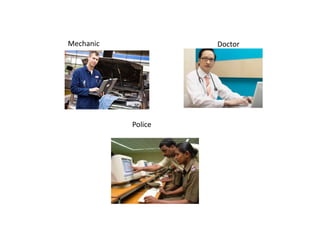
Professionals of the 21st century think and act
differently than those of previous centuries, due
at least in part to the radically different
tools they use to perform their jobs
Police
DoctorMechanic
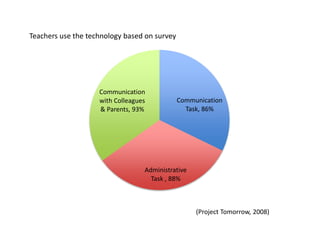
Communication
Task, 86%
Administrative
Task , 88%
Communication
with Colleagues
& Parents, 93%
Teachers use the technology based on survey
(Project Tomorrow, 2008)
we have yet not achieved high levels of effective
technology use, either in the United States or internationally
(Kozma, 2003; Mueller, Wood, Willoughby, Ross, & Specht, 2008; Smeets, 2005;
Tondeur, van Braak, & Valcke, 2007a)
it typically is not used to support the kinds of
instruction(e.g., student- centered) believed to be most
powerful for facilitating student learning (Cuban, Kirkpatrick, & Peck;
2001)
Issues
Issues cont..
uses still tend to be "low- level" (Maddux 8c Johnson,
2006; Russell, Bebell, O'Dwyer, 8c O'Connor, 2003)- that is, those
that support traditional, teacher-directed
instruction (e.g., using PowerPoint to present a
lesson, searching the Web for information
resources) or that focus on the development of
students' technical skills (Tondeur, van Braak, & Valcke, 2007b)
Why change is important?
teachers' mindsets must change to include the idea
that "teaching is not effective without the appropriate
use of information and communication technologies
(ICT) resources to facilitate student learning."
teachers' uses of technology are rarely linked to the
student learning outcomes they are designed to
facilitate (Lawless & Pellegrino, 2007)
technology is essential to successful performance
outcomes
What are the necessary characteristics, or
qualities, that enable teachers to leverage
technology resources as meaningful
pedagogical tools?
Question
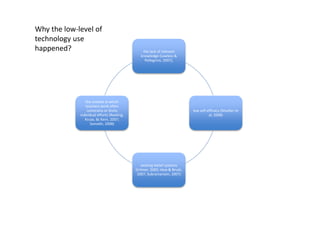
the lack of relevant
knowledge (Lawless &
Pellegrino, 2007),
low self-efficacy (Mueller et
al, 2008)
existing belief systems
(Ertmer, 2005; Hew & Brush,
2007; Subramaniam, 2007)
the context in which
teachers work often
constrains or limits
individual efforts (Roehrig,
Kruse, 8c Kern, 2007;
Somekh, 2008)
Why the low-level of
technology use
happened?
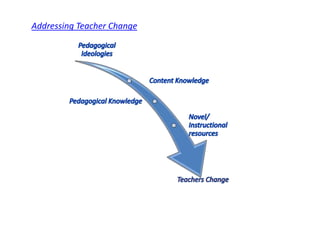
Addressing Teacher Change
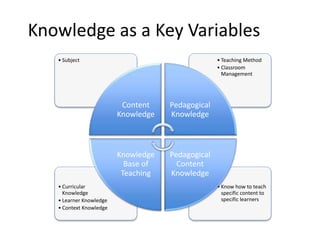
Knowledge as a Key Variables
• Know how to teach
specific content to
specific learners
• Curricular
Knowledge
• Learner Knowledge
• Context Knowledge
• Teaching Method
• Classroom
Management
• Subject
Content
Knowledge
Pedagogical
Knowledge
Pedagogical
Content
Knowledge
Knowledge
Base of
Teaching
Additional Knowledge
• Teachers need knowledge of the technology itself
• Teaching with technology requires teachers to expand their
knowledge of pedagogical practices across multiple aspects of the
planning, implementation, and evaluation processes
• To use technology to support meaningful student learning,
teachers need additional knowledge of the content they are
required to teach, the pedagogical methods that facilitate student
learning, and the specific ways in which technology can support
those methods.
Ertmer & Ottenbreit-Leftwich (2010)
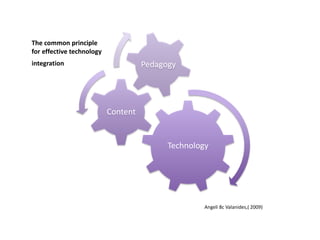
Technology
Content
Pedagogy
Angeli 8c Valanides,( 2009)
The common principle
for effective technology
integration
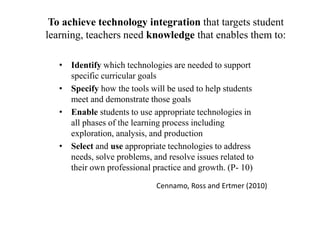
To achieve technology integration that targets student
learning, teachers need knowledge that enables them to:
• Identify which technologies are needed to support
specific curricular goals
• Specify how the tools will be used to help students
meet and demonstrate those goals
• Enable students to use appropriate technologies in
all phases of the learning process including
exploration, analysis, and production
• Select and use appropriate technologies to address
needs, solve problems, and resolve issues related to
their own professional practice and growth. (P- 10)
Cennamo, Ross and Ertmer (2010)
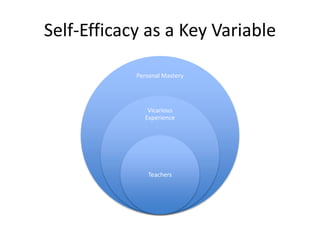
Self-Efficacy as a Key Variable
Personal Mastery
Vicarious
Experience
Teachers
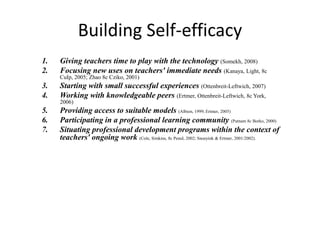
Building Self-efficacy
1. Giving teachers time to play with the technology (Somekh, 2008)
2. Focusing new uses on teachers' immediate needs (Kanaya, Light, 8c
CuIp, 2005; Zhao 8c Cziko, 2001)
3. Starting with small successful experiences (Ottenbreit-Leftwich, 2007)
4. Working with knowledgeable peers (Ertmer, Ottenbreit-Leftwich, 8c York,
2006)
5. Providing access to suitable models (Albion, 1999; Ertmer, 2005)
6. Participating in a professional learning community (Putnam 8c Borko, 2000)
7. Situating professional development programs within the context of
teachers' ongoing work (Cole, Simkins, 8c Penul, 2002; Snoeyink & Ertmer, 2001/2002).
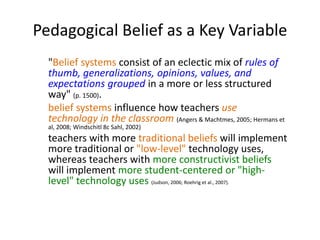
Pedagogical Belief as a Key Variable
"Belief systems consist of an eclectic mix of rules of
thumb, generalizations, opinions, values, and
expectations grouped in a more or less structured
way" (p. 1500).
belief systems influence how teachers use
technology in the classroom (Angers & Machtmes, 2005; Hermans et
al, 2008; Windschitl 8c Sahl, 2002)
teachers with more traditional beliefs will implement
more traditional or "low-level" technology uses,
whereas teachers with more constructivist beliefs
will implement more student-centered or "high-
level" technology uses (Judson, 2006; Roehrig et al., 2007).
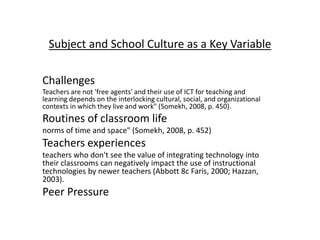
Subject and School Culture as a Key Variable
Challenges
Teachers are not 'free agents' and their use of ICT for teaching and
learning depends on the interlocking cultural, social, and organizational
contexts in which they live and work" (Somekh, 2008, p. 450).
Routines of classroom life
norms of time and space" (Somekh, 2008, p. 452)
Teachers experiences
teachers who don't see the value of integrating technology into
their classrooms can negatively impact the use of instructional
technologies by newer teachers (Abbott 8c Faris, 2000; Hazzan,
2003).
Peer Pressure
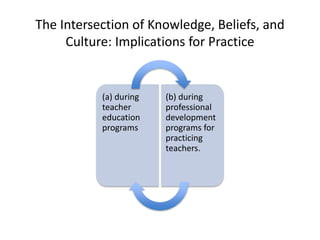
The Intersection of Knowledge, Beliefs, and
Culture: Implications for Practice
(a) during
teacher
education
programs
(b) during
professional
development
programs for
practicing
teachers.
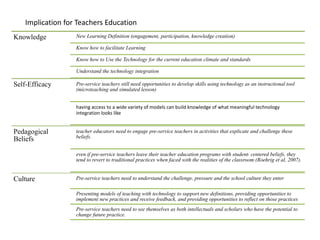
Knowledge New Learning Definition (engagement, participation, knowledge creation)
Know how to facilitate Learning
Know how to Use the Technology for the current education climate and standards
Understand the technology integration
Self-Efficacy Pre-service teachers still need opportunities to develop skills using technology as an instructional tool
(microteaching and simulated lesson)
having access to a wide variety of models can build knowledge of what meaningful technology
integration looks like
Pedagogical
Beliefs
teacher educators need to engage pre-service teachers in activities that explicate and challenge these
beliefs.
even if pre-service teachers leave their teacher education programs with student- centered beliefs, they
tend to revert to traditional practices when faced with the realities of the classroom (Roehrig et al, 2007).
Culture Pre-service teachers need to understand the challenge, pressure and the school culture they enter
Presenting models of teaching with technology to support new definitions, providing opportunities to
implement new practices and receive feedback, and providing opportunities to reflect on those practices
Pre-service teachers need to see themselves as both intellectuals and scholars who have the potential to
change future practice.
Implication for Teachers Education
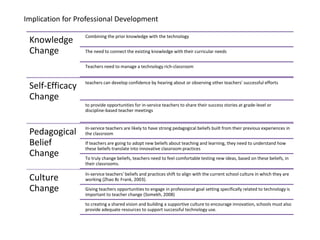
Implication for Professional Development
Knowledge
Change
Combining the prior knowledge with the technology
The need to connect the existing knowledge with their curricular needs
Teachers need to manage a technology rich-classroom
Self-Efficacy
Change
teachers can develop confidence by hearing about or observing other teachers' successful efforts
to provide opportunities for in-service teachers to share their success stories at grade-level or
discipline-based teacher meetings
Pedagogical
Belief
Change
In-service teachers are likely to have strong pedagogical beliefs built from their previous experiences in
the classroom
If teachers are going to adopt new beliefs about teaching and learning, they need to understand how
these beliefs translate into innovative classroom practices
To truly change beliefs, teachers need to feel comfortable testing new ideas, based on these beliefs, in
their classrooms.
Culture
Change
In-service teachers' beliefs and practices shift to align with the current school culture in which they are
working (Zhao 8c Frank, 2003).
Giving teachers opportunities to engage in professional goal setting specifically related to technology is
important to teacher change (Somekh, 2008)
to creating a shared vision and building a supportive culture to encourage innovation, schools must also
provide adequate resources to support successful technology use.
to be discussed..
a. How pedagogical belief
and culture influence the
use of ICT for teaching and
learning in your school?
b. ICT is like a double-
edged blade for
education, what do you
think the best strategy to
safe the negative side of
technology for students
within your school?
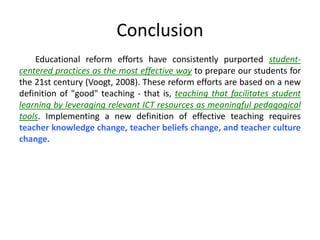
Conclusion
Educational reform efforts have consistently purported student-
centered practices as the most effective way to prepare our students for
the 21st century (Voogt, 2008). These reform efforts are based on a new
definition of "good" teaching - that is, teaching that facilitates student
learning by leveraging relevant ICT resources as meaningful pedagogical
tools. Implementing a new definition of effective teaching requires
teacher knowledge change, teacher beliefs change, and teacher culture
change.
Thank You
References
Ertmer, P. A., & Ottenbreit-Leftwich, A. T. (2010). Teacher Technology
Change: How Knowledge, Confidence, Beliefs, and Culture Intersect. Journal
of research on Technology in Education, 42(3).
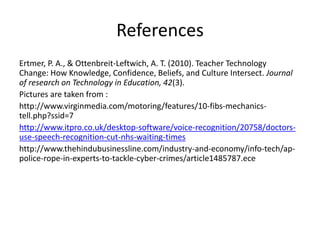
Pictures are taken from :
http://www.virginmedia.com/motoring/features/10-fibs-mechanics-
tell.php?ssid=7
http://www.itpro.co.uk/desktop-software/voice-recognition/20758/doctors-
use-speech-recognition-cut-nhs-waiting-times
http://www.thehindubusinessline.com/industry-and-economy/info-tech/ap-
police-rope-in-experts-to-tackle-cyber-crimes/article1485787.ece

Teacher Technology Change : How Knowledge, Confidence, Beliefs and Culture Intersect

  • 1.
    Teacher Technology Change: HowKnowledge, Confidence, Beliefs, and Culture Intersect Peggy A. Ertmer & Anne T. Ottenbreit-Leftwich
  • 2.
    Technology Integration for21 "- Century Learners Professionals of the 21st century think and act differently than those of previous centuries, due at least in part to the radically different tools they use to perform their jobs
  • 3.
  • 4.
    Communication Task, 86% Administrative Task ,88% Communication with Colleagues & Parents, 93% Teachers use the technology based on survey (Project Tomorrow, 2008)
  • 5.
    we have yetnot achieved high levels of effective technology use, either in the United States or internationally (Kozma, 2003; Mueller, Wood, Willoughby, Ross, & Specht, 2008; Smeets, 2005; Tondeur, van Braak, & Valcke, 2007a) it typically is not used to support the kinds of instruction(e.g., student- centered) believed to be most powerful for facilitating student learning (Cuban, Kirkpatrick, & Peck; 2001) Issues
  • 6.
    Issues cont.. uses stilltend to be "low- level" (Maddux 8c Johnson, 2006; Russell, Bebell, O'Dwyer, 8c O'Connor, 2003)- that is, those that support traditional, teacher-directed instruction (e.g., using PowerPoint to present a lesson, searching the Web for information resources) or that focus on the development of students' technical skills (Tondeur, van Braak, & Valcke, 2007b)
  • 7.
    Why change isimportant? teachers' mindsets must change to include the idea that "teaching is not effective without the appropriate use of information and communication technologies (ICT) resources to facilitate student learning." teachers' uses of technology are rarely linked to the student learning outcomes they are designed to facilitate (Lawless & Pellegrino, 2007) technology is essential to successful performance outcomes
  • 8.
    What are thenecessary characteristics, or qualities, that enable teachers to leverage technology resources as meaningful pedagogical tools? Question
  • 9.
    the lack ofrelevant knowledge (Lawless & Pellegrino, 2007), low self-efficacy (Mueller et al, 2008) existing belief systems (Ertmer, 2005; Hew & Brush, 2007; Subramaniam, 2007) the context in which teachers work often constrains or limits individual efforts (Roehrig, Kruse, 8c Kern, 2007; Somekh, 2008) Why the low-level of technology use happened?
  • 10.
  • 11.
    Knowledge as aKey Variables • Know how to teach specific content to specific learners • Curricular Knowledge • Learner Knowledge • Context Knowledge • Teaching Method • Classroom Management • Subject Content Knowledge Pedagogical Knowledge Pedagogical Content Knowledge Knowledge Base of Teaching
  • 12.
    Additional Knowledge • Teachersneed knowledge of the technology itself • Teaching with technology requires teachers to expand their knowledge of pedagogical practices across multiple aspects of the planning, implementation, and evaluation processes • To use technology to support meaningful student learning, teachers need additional knowledge of the content they are required to teach, the pedagogical methods that facilitate student learning, and the specific ways in which technology can support those methods. Ertmer & Ottenbreit-Leftwich (2010)
  • 13.
    Technology Content Pedagogy Angeli 8c Valanides,(2009) The common principle for effective technology integration
  • 14.
    To achieve technologyintegration that targets student learning, teachers need knowledge that enables them to: • Identify which technologies are needed to support specific curricular goals • Specify how the tools will be used to help students meet and demonstrate those goals • Enable students to use appropriate technologies in all phases of the learning process including exploration, analysis, and production • Select and use appropriate technologies to address needs, solve problems, and resolve issues related to their own professional practice and growth. (P- 10) Cennamo, Ross and Ertmer (2010)
  • 15.
    Self-Efficacy as aKey Variable Personal Mastery Vicarious Experience Teachers
  • 16.
    Building Self-efficacy 1. Givingteachers time to play with the technology (Somekh, 2008) 2. Focusing new uses on teachers' immediate needs (Kanaya, Light, 8c CuIp, 2005; Zhao 8c Cziko, 2001) 3. Starting with small successful experiences (Ottenbreit-Leftwich, 2007) 4. Working with knowledgeable peers (Ertmer, Ottenbreit-Leftwich, 8c York, 2006) 5. Providing access to suitable models (Albion, 1999; Ertmer, 2005) 6. Participating in a professional learning community (Putnam 8c Borko, 2000) 7. Situating professional development programs within the context of teachers' ongoing work (Cole, Simkins, 8c Penul, 2002; Snoeyink & Ertmer, 2001/2002).
  • 17.
    Pedagogical Belief asa Key Variable "Belief systems consist of an eclectic mix of rules of thumb, generalizations, opinions, values, and expectations grouped in a more or less structured way" (p. 1500). belief systems influence how teachers use technology in the classroom (Angers & Machtmes, 2005; Hermans et al, 2008; Windschitl 8c Sahl, 2002) teachers with more traditional beliefs will implement more traditional or "low-level" technology uses, whereas teachers with more constructivist beliefs will implement more student-centered or "high- level" technology uses (Judson, 2006; Roehrig et al., 2007).
  • 18.
    Subject and SchoolCulture as a Key Variable Challenges Teachers are not 'free agents' and their use of ICT for teaching and learning depends on the interlocking cultural, social, and organizational contexts in which they live and work" (Somekh, 2008, p. 450). Routines of classroom life norms of time and space" (Somekh, 2008, p. 452) Teachers experiences teachers who don't see the value of integrating technology into their classrooms can negatively impact the use of instructional technologies by newer teachers (Abbott 8c Faris, 2000; Hazzan, 2003). Peer Pressure
  • 19.
    The Intersection ofKnowledge, Beliefs, and Culture: Implications for Practice (a) during teacher education programs (b) during professional development programs for practicing teachers.
  • 20.
    Knowledge New LearningDefinition (engagement, participation, knowledge creation) Know how to facilitate Learning Know how to Use the Technology for the current education climate and standards Understand the technology integration Self-Efficacy Pre-service teachers still need opportunities to develop skills using technology as an instructional tool (microteaching and simulated lesson) having access to a wide variety of models can build knowledge of what meaningful technology integration looks like Pedagogical Beliefs teacher educators need to engage pre-service teachers in activities that explicate and challenge these beliefs. even if pre-service teachers leave their teacher education programs with student- centered beliefs, they tend to revert to traditional practices when faced with the realities of the classroom (Roehrig et al, 2007). Culture Pre-service teachers need to understand the challenge, pressure and the school culture they enter Presenting models of teaching with technology to support new definitions, providing opportunities to implement new practices and receive feedback, and providing opportunities to reflect on those practices Pre-service teachers need to see themselves as both intellectuals and scholars who have the potential to change future practice. Implication for Teachers Education
  • 21.
    Implication for ProfessionalDevelopment Knowledge Change Combining the prior knowledge with the technology The need to connect the existing knowledge with their curricular needs Teachers need to manage a technology rich-classroom Self-Efficacy Change teachers can develop confidence by hearing about or observing other teachers' successful efforts to provide opportunities for in-service teachers to share their success stories at grade-level or discipline-based teacher meetings Pedagogical Belief Change In-service teachers are likely to have strong pedagogical beliefs built from their previous experiences in the classroom If teachers are going to adopt new beliefs about teaching and learning, they need to understand how these beliefs translate into innovative classroom practices To truly change beliefs, teachers need to feel comfortable testing new ideas, based on these beliefs, in their classrooms. Culture Change In-service teachers' beliefs and practices shift to align with the current school culture in which they are working (Zhao 8c Frank, 2003). Giving teachers opportunities to engage in professional goal setting specifically related to technology is important to teacher change (Somekh, 2008) to creating a shared vision and building a supportive culture to encourage innovation, schools must also provide adequate resources to support successful technology use.
  • 22.
    to be discussed.. a.How pedagogical belief and culture influence the use of ICT for teaching and learning in your school? b. ICT is like a double- edged blade for education, what do you think the best strategy to safe the negative side of technology for students within your school?
  • 23.
    Conclusion Educational reform effortshave consistently purported student- centered practices as the most effective way to prepare our students for the 21st century (Voogt, 2008). These reform efforts are based on a new definition of "good" teaching - that is, teaching that facilitates student learning by leveraging relevant ICT resources as meaningful pedagogical tools. Implementing a new definition of effective teaching requires teacher knowledge change, teacher beliefs change, and teacher culture change.
  • 24.
  • 25.
    References Ertmer, P. A.,& Ottenbreit-Leftwich, A. T. (2010). Teacher Technology Change: How Knowledge, Confidence, Beliefs, and Culture Intersect. Journal of research on Technology in Education, 42(3). Pictures are taken from : http://www.virginmedia.com/motoring/features/10-fibs-mechanics- tell.php?ssid=7 http://www.itpro.co.uk/desktop-software/voice-recognition/20758/doctors- use-speech-recognition-cut-nhs-waiting-times http://www.thehindubusinessline.com/industry-and-economy/info-tech/ap- police-rope-in-experts-to-tackle-cyber-crimes/article1485787.ece

Editor's Notes

  • #4 Did the police officer arrest the speeding driver who had a suspended license? Did the mechanic accurately identify the problem and get the car running again? Did the doctor identify potential health concerns for the baby? Did the mechanic accurately identify the problem and get the car running again?