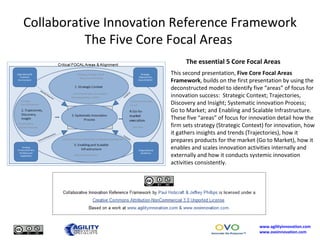
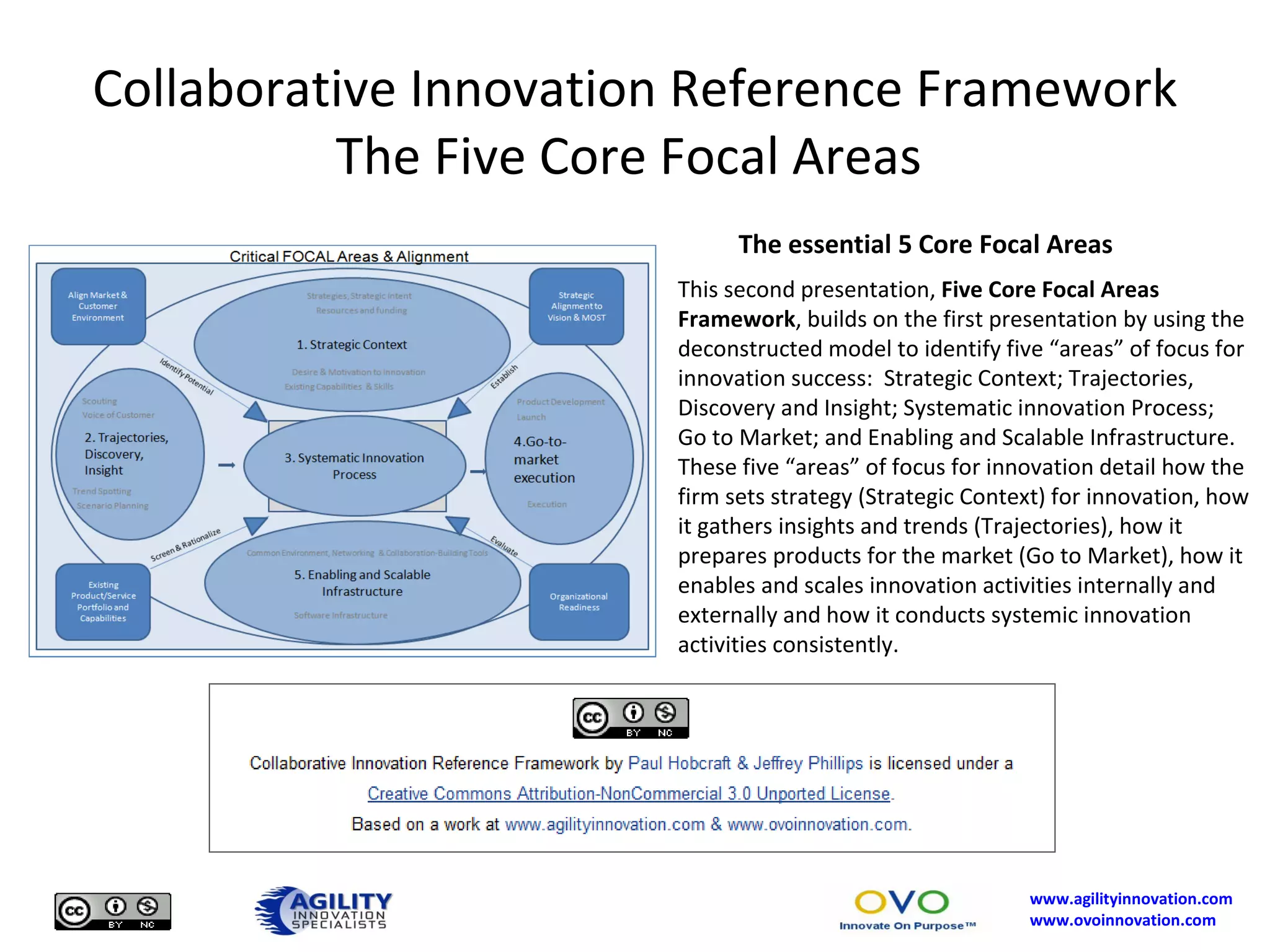
Collaborative Innovation Reference Framework The Five Core Focal Areas  The essential 5 Core Focal Areas This second presentation,  Five   Core Focal Areas Framework , builds on the first presentation by using the deconstructed model to identify five “areas” of focus for innovation success:  Strategic Context; Trajectories, Discovery and Insight; Systematic innovation Process;  Go to Market; and Enabling and Scalable Infrastructure.  These five “areas” of focus for innovation detail how the firm sets strategy (Strategic Context) for innovation, how it gathers insights and trends (Trajectories), how it prepares products for the market (Go to Market), how it enables and scales innovation activities internally and externally and how it conducts systemic innovation activities consistently.
We are interested in explaining the many facets that make up a successful innovation endeavour. It can be extremely tough to capture and explain the complexity of innovation. We would like to see an emerging reference model for innovation from this starting point. The end result is to create a common innovation model or framework that accelerates acceptance, reduces mystery, constant rework and simplifies innovation efforts.  Innovation is dynamic.  Opening this set of models allows for it to be constantly improved for all to benefit - this is our stated aim in publishing these models. We submit these suggested models as a starting point to deconstruct how innovation works and to encourage a “common” innovation model across all geographies, industries and markets.  Developing a common innovation model and approach reduces confusion and simplifies innovation work.  We believe we can remove a lot of the mystique around innovation and help accelerate its adoption and implementation by firms everywhere if we can agree on basic models and principles. We would encourage you to feel free to send commentary, corrections, additions or changes to the models or types to  Paul Hobcraft or Jeffrey Phillips .  We in turn will re-publish the model as necessary under a Creative Commons License, so that anyone who cares can use it and adopt the innovation model.  We want this to be open and a transparent process but we will retain copyright while allowing others to copy, distribute, and make some uses of their work as long as we are credited for the original creation. These are collaborative work-in-progress to achieve a common position for understanding innovation Go to the Wiki on  http://cirf.pbworks.com Our intention behind these different models of Innovation
Introduction Innovation can drive tremendous value and differentiation for a business, but is often poorly understood Our model suggests that there are five key focus areas for innovation success This presentation introduces a “holistic” model and delves into each of the five key areas
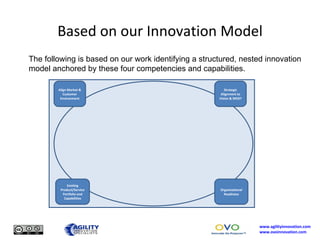
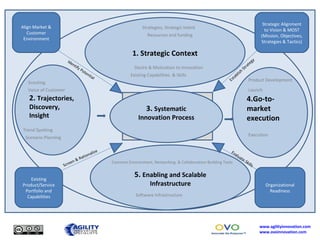
Based on our Innovation Model The following is based on our work identifying a structured, nested innovation model anchored by these four competencies and capabilities. Align Market & Customer Environment Existing Product/Service Portfolio and Capabilities Strategic Alignment to Vision & MOST Organizational Readiness
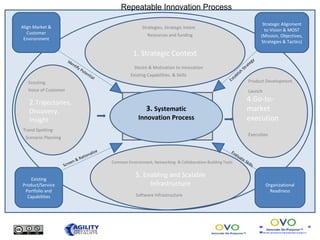
The Critical Five Innovation “areas” The five focal areas necessary to support and sustain innovation are: Strategic Context  (Strategies, Intent, Competencies and Communication) Trajectories, Discover and Insights  (Tools, Techniques, Timeframes, Trajectories) Systematic Innovation Process  (consistent, sustained methodology) Go-to-Market   execution Enabling and Scalable Infrastructure
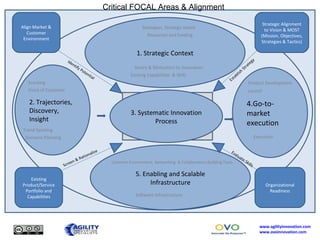
. 4.Go-to-market execution 5. Enabling and Scalable Infrastructure Common Environment, Networking  & Collaboration-Building Tools 3. Systematic Innovation Process 2. Trajectories, Discovery, Insight Identify Potential Screen & Rationalize 1. Strategic Context Desire & Motivation to Innovation Existing Capabilities  & Skills Strategies, Strategic Intent Resources and funding Trend Spotting Scenario Planning Product Development Launch Execution Software Infrastructure Scouting Voice of Customer Align Market & Customer Environment Existing Product/Service Portfolio and Capabilities Organizational Readiness Critical FOCAL Areas & Alignment Establish Strategy  Evaluate Skills Strategic Alignment to Vision & MOST (Mission, Objectives, Strategies & Tactics)
Drilling into each “area” All of these factors play an important role in fostering and sustaining innovation Let’s take a more detailed look at each area and the role it plays in sustaining innovation.
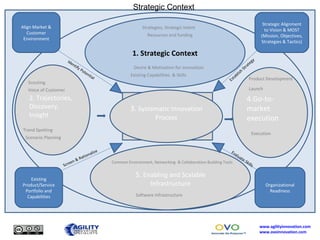
. 4.Go-to-market execution 5.  Enabling and Scalable Infrastructure Common Environment, Networking  & Collaboration-Building Tools 3.  Systematic Innovation Process 2. Trajectories, Discovery, Insight Identify Potential Screen & Rationalize 1. Strategic Context Desire & Motivation for innovation Existing Capabilities  & Skills Strategies, Strategic Intent Resources and funding Trend Spotting Scenario Planning Product Development Launch Execution Software Infrastructure Scouting Voice of Customer Strategic Context Align Market & Customer Environment Existing Product/Service Portfolio and Capabilities Organizational Readiness Establish Strategy  Evaluate Skills Strategic Alignment to Vision & MOST (Mission, Objectives, Strategies & Tactics)
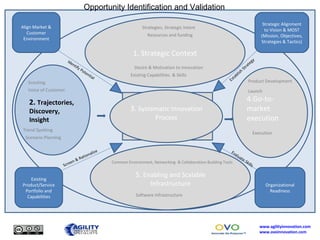
Strategic Context The first focus area sits between the two key competencies: Market Environment Strategic Alignment In this area the firm must address: What do we as a firm WANT to do? What are the firm’s strategic goals? What do our customers and prospects WANT or NEED?
Two key “musts” In order to innovate effectively, the  goals and strategies of the organization must be clearly defined and communicated .  Innovation cannot happen effectively within a vacuum. In order for our ideas to be relevant and important, we  must align clear strategies with an understanding of customer wants and needs .
The Place to Start All innovation activities and initiatives should begin with the strategies of the firm and the needs and wants of the customer in mind It’s difficult, if not impossible, to innovate effectively, if the strategic context is missing or incomplete
. 4.Go-to-market execution 5.  Enabling and Scalable Infrastructure Common Environment, Networking  & Collaboration-Building Tools 3.  Systematic Innovation Process 2.  Trajectories, Discovery, Insight Identify Potential Screen & Rationalize 1. Strategic Context Desire & Motivation to Innovation Existing Capabilities  & Skills Strategies, Strategic Intent Resources and funding Trend Spotting Scenario Planning Product Development Launch Execution Software Infrastructure Scouting Voice of Customer Opportunity Identification and Validation Align Market & Customer Environment Existing Product/Service Portfolio and Capabilities Organizational Readiness Establish Strategy  Evaluate Skills Strategic Alignment to Vision & MOST (Mission, Objectives, Strategies & Tactics)
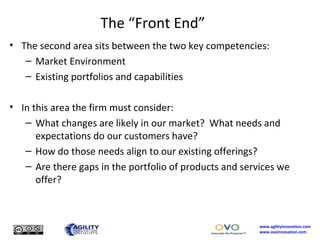
The “Front End” The second area sits between the two key competencies: Market Environment Existing portfolios and capabilities In this area the firm must consider: What changes are likely in our market?  What needs and expectations do our customers have?  How do those needs align to our existing offerings? Are there gaps in the portfolio of products and services we offer?
Two key capabilities Spotting trends and developing scenarios  based on those trends and market conditions is important. Eliciting and understanding unmet or unarticulated customer needs , especially in line with unfolding trends is paramount
Links to offerings and capabilities Once the unfolding future is understood and the wants and needs of the customers are considered, the firm can map opportunities and needs to existing products and capabilities This effort helps establish what the firm can offer, and what the firm needs to develop
. 4.Go-to-market execution 5.  Enabling and Scalable Infrastructure Common Environment, Networking  & Collaboration-Building Tools 3.  Systematic Innovation Process 2. Trajectories, Discovery, Insight Identify Potential Screen & Rationalize 1. Strategic Context Desire & Motivation to Innovation Existing Capabilities  & Skills Strategies, Strategic Intent Resources and funding Trend Spotting Scenario Planning Product Development Launch Execution Software Infrastructure Scouting Voice of Customer Repeatable Innovation Process Align Market & Customer Environment Existing Product/Service Portfolio and Capabilities Organizational Readiness Establish Strategy  Evaluate Skills Strategic Alignment to Vision & MOST (Mission, Objectives, Strategies & Tactics)
Innovation Process The third area sits in the middle of all the competencies: Strategy Market Environment Existing portfolios and capabilities Readiness In this bubble the firm addresses: How do we consistently manage ideas from generation to commercialization as a business discipline
One Sustaining Process For innovation success, a firm must define a  clear workflow from idea generation to product prototyping The firm must also  define roles and responsibilities within the process  and identify and  train the people necessary  to undertake those tasks
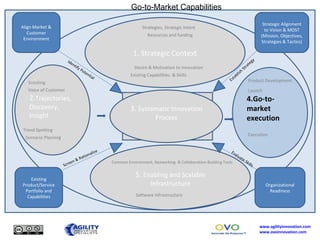
. 4.Go-to-market execution 5.  Enabling and Scalable Infrastructure Common Environment, Networking  & Collaboration-Building Tools 3.  Systematic Innovation Process 2. Trajectories, Discovery, Insight Identify Potential Screen & Rationalize 1. Strategic Context Desire & Motivation to Innovation Existing Capabilities  & Skills Strategies, Strategic Intent Resources and funding Trend Spotting Scenario Planning Product Development Launch Execution Software Infrastructure Scouting Voice of Customer Go-to-Market Capabilities Align Market & Customer Environment Existing Product/Service Portfolio and Capabilities Organizational Readiness Establish Strategy  Evaluate Skills Strategic Alignment to Vision & MOST (Mission, Objectives, Strategies & Tactics)
Go To Market The fourth area sits between two competencies: Strategic capabilities Organizational readiness In this bubble the firm addresses: How do we effectively transition ideas into commercial products and services, in light of existing portfolios, strategies and limited resources?
Tight Linkages While firms may have an excellent product development and launch capability, it must be tightly linked to the previous three areas Otherwise even good ideas will not make a transition from the innovation process to become new products and services
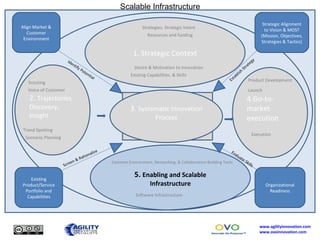
. 4.Go-to-market execution 5.  Enabling and Scalable Infrastructure Common Environment, Networking  & Collaboration-Building Tools 3.  Systematic Innovation Process 2.  Trajectories, Discovery, Insight Identify Potential Screen & Rationalize 1. Strategic Context Desire & Motivation to Innovation Existing Capabilities  & Skills Strategies, Strategic Intent Resources and funding Trend Spotting Scenario Planning Product Development Launch Execution Software Infrastructure Scouting Voice of Customer Scalable Infrastructure Align Market & Customer Environment Existing Product/Service Portfolio and Capabilities Organizational Readiness Establish Strategy  Evaluate Skills Strategic Alignment to Vision & MOST (Mission, Objectives, Strategies & Tactics)
Structure/Scale The fifth bubble sits between two competencies: Existing portfolios and capabilities Organizational readiness In this bubble the firm addresses: Can the organization effectively scale up an innovation effort and sustain it over time?
Sustaining Infrastructure While perhaps not important initially, a sustaining innovation infrastructure is important as innovation becomes a consistent process Defining and deploying the methods, training and systems necessary to support an innovation effort requires investment and new knowledge.
. 4.Go-to-market execution 5.  Enabling and Scalable Infrastructure Common Environment, Networking  & Collaboration-Building Tools 3.  Systematic Innovation Process 2.  Trajectories, Discovery, Insight Identify Potential Screen & Rationalize 1. Strategic Context Desire & Motivation to Innovation Existing Capabilities  & Skills Strategies, Strategic Intent Resources and funding Trend Spotting Scenario Planning Product Development Launch Execution Software Infrastructure Scouting Voice of Customer Align Market & Customer Environment Existing Product/Service Portfolio and Capabilities Organizational Readiness Establish Strategy  Evaluate Skills Strategic Alignment to Vision & MOST (Mission, Objectives, Strategies & Tactics)
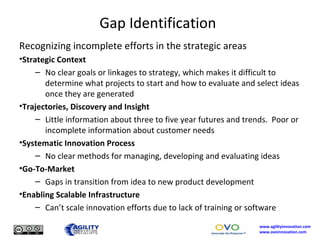
Gap Identification Recognizing incomplete efforts in the strategic areas Strategic Context No clear goals or linkages to strategy, which makes it difficult to determine what projects to start and how to evaluate and select ideas once they are generated Trajectories, Discovery and Insight Little information about three to five year futures and trends.  Poor or incomplete information about customer needs Systematic Innovation Process No clear methods for managing, developing and evaluating ideas Go-To-Market Gaps in transition from idea to new product development Enabling Scalable Infrastructure Can’t scale innovation efforts due to lack of training or software
Recap The four key competencies are necessary for innovation success: Strategic Alignment Market and Customer environment Existing capabilities and portfolios Organizational Readiness Once those are active and have been fully addressed, the five “bubbles” or focus areas should be carefully considered and built out.
Paul Hobcraft Email :  [email_address] Phone Number +65 91 751 4350 Jeffrey Philips Email:  [email_address] Phone Number +01 919-844-5644 Contact Details    Collaborative Innovation Reference Framework For Europe, Africa, Middle East & Asia For North & South America  Go to the Wiki on  http://cirf.pbworks.com

Core innovation reference framework

  • 1.
    Collaborative Innovation ReferenceFramework The Five Core Focal Areas The essential 5 Core Focal Areas This second presentation, Five Core Focal Areas Framework , builds on the first presentation by using the deconstructed model to identify five “areas” of focus for innovation success: Strategic Context; Trajectories, Discovery and Insight; Systematic innovation Process; Go to Market; and Enabling and Scalable Infrastructure. These five “areas” of focus for innovation detail how the firm sets strategy (Strategic Context) for innovation, how it gathers insights and trends (Trajectories), how it prepares products for the market (Go to Market), how it enables and scales innovation activities internally and externally and how it conducts systemic innovation activities consistently.
  • 2.
    We are interestedin explaining the many facets that make up a successful innovation endeavour. It can be extremely tough to capture and explain the complexity of innovation. We would like to see an emerging reference model for innovation from this starting point. The end result is to create a common innovation model or framework that accelerates acceptance, reduces mystery, constant rework and simplifies innovation efforts. Innovation is dynamic. Opening this set of models allows for it to be constantly improved for all to benefit - this is our stated aim in publishing these models. We submit these suggested models as a starting point to deconstruct how innovation works and to encourage a “common” innovation model across all geographies, industries and markets. Developing a common innovation model and approach reduces confusion and simplifies innovation work. We believe we can remove a lot of the mystique around innovation and help accelerate its adoption and implementation by firms everywhere if we can agree on basic models and principles. We would encourage you to feel free to send commentary, corrections, additions or changes to the models or types to Paul Hobcraft or Jeffrey Phillips . We in turn will re-publish the model as necessary under a Creative Commons License, so that anyone who cares can use it and adopt the innovation model. We want this to be open and a transparent process but we will retain copyright while allowing others to copy, distribute, and make some uses of their work as long as we are credited for the original creation. These are collaborative work-in-progress to achieve a common position for understanding innovation Go to the Wiki on http://cirf.pbworks.com Our intention behind these different models of Innovation
  • 3.
    Introduction Innovation candrive tremendous value and differentiation for a business, but is often poorly understood Our model suggests that there are five key focus areas for innovation success This presentation introduces a “holistic” model and delves into each of the five key areas
  • 4.
    Based on ourInnovation Model The following is based on our work identifying a structured, nested innovation model anchored by these four competencies and capabilities. Align Market & Customer Environment Existing Product/Service Portfolio and Capabilities Strategic Alignment to Vision & MOST Organizational Readiness
  • 5.
    The Critical FiveInnovation “areas” The five focal areas necessary to support and sustain innovation are: Strategic Context (Strategies, Intent, Competencies and Communication) Trajectories, Discover and Insights (Tools, Techniques, Timeframes, Trajectories) Systematic Innovation Process (consistent, sustained methodology) Go-to-Market execution Enabling and Scalable Infrastructure
  • 6.
    . 4.Go-to-market execution5. Enabling and Scalable Infrastructure Common Environment, Networking & Collaboration-Building Tools 3. Systematic Innovation Process 2. Trajectories, Discovery, Insight Identify Potential Screen & Rationalize 1. Strategic Context Desire & Motivation to Innovation Existing Capabilities & Skills Strategies, Strategic Intent Resources and funding Trend Spotting Scenario Planning Product Development Launch Execution Software Infrastructure Scouting Voice of Customer Align Market & Customer Environment Existing Product/Service Portfolio and Capabilities Organizational Readiness Critical FOCAL Areas & Alignment Establish Strategy Evaluate Skills Strategic Alignment to Vision & MOST (Mission, Objectives, Strategies & Tactics)
  • 7.
    Drilling into each“area” All of these factors play an important role in fostering and sustaining innovation Let’s take a more detailed look at each area and the role it plays in sustaining innovation.
  • 8.
    . 4.Go-to-market execution5. Enabling and Scalable Infrastructure Common Environment, Networking & Collaboration-Building Tools 3. Systematic Innovation Process 2. Trajectories, Discovery, Insight Identify Potential Screen & Rationalize 1. Strategic Context Desire & Motivation for innovation Existing Capabilities & Skills Strategies, Strategic Intent Resources and funding Trend Spotting Scenario Planning Product Development Launch Execution Software Infrastructure Scouting Voice of Customer Strategic Context Align Market & Customer Environment Existing Product/Service Portfolio and Capabilities Organizational Readiness Establish Strategy Evaluate Skills Strategic Alignment to Vision & MOST (Mission, Objectives, Strategies & Tactics)
  • 9.
    Strategic Context Thefirst focus area sits between the two key competencies: Market Environment Strategic Alignment In this area the firm must address: What do we as a firm WANT to do? What are the firm’s strategic goals? What do our customers and prospects WANT or NEED?
  • 10.
    Two key “musts”In order to innovate effectively, the goals and strategies of the organization must be clearly defined and communicated . Innovation cannot happen effectively within a vacuum. In order for our ideas to be relevant and important, we must align clear strategies with an understanding of customer wants and needs .
  • 11.
    The Place toStart All innovation activities and initiatives should begin with the strategies of the firm and the needs and wants of the customer in mind It’s difficult, if not impossible, to innovate effectively, if the strategic context is missing or incomplete
  • 12.
    . 4.Go-to-market execution5. Enabling and Scalable Infrastructure Common Environment, Networking & Collaboration-Building Tools 3. Systematic Innovation Process 2. Trajectories, Discovery, Insight Identify Potential Screen & Rationalize 1. Strategic Context Desire & Motivation to Innovation Existing Capabilities & Skills Strategies, Strategic Intent Resources and funding Trend Spotting Scenario Planning Product Development Launch Execution Software Infrastructure Scouting Voice of Customer Opportunity Identification and Validation Align Market & Customer Environment Existing Product/Service Portfolio and Capabilities Organizational Readiness Establish Strategy Evaluate Skills Strategic Alignment to Vision & MOST (Mission, Objectives, Strategies & Tactics)
  • 13.
    The “Front End”The second area sits between the two key competencies: Market Environment Existing portfolios and capabilities In this area the firm must consider: What changes are likely in our market? What needs and expectations do our customers have? How do those needs align to our existing offerings? Are there gaps in the portfolio of products and services we offer?
  • 14.
    Two key capabilitiesSpotting trends and developing scenarios based on those trends and market conditions is important. Eliciting and understanding unmet or unarticulated customer needs , especially in line with unfolding trends is paramount
  • 15.
    Links to offeringsand capabilities Once the unfolding future is understood and the wants and needs of the customers are considered, the firm can map opportunities and needs to existing products and capabilities This effort helps establish what the firm can offer, and what the firm needs to develop
  • 16.
    . 4.Go-to-market execution5. Enabling and Scalable Infrastructure Common Environment, Networking & Collaboration-Building Tools 3. Systematic Innovation Process 2. Trajectories, Discovery, Insight Identify Potential Screen & Rationalize 1. Strategic Context Desire & Motivation to Innovation Existing Capabilities & Skills Strategies, Strategic Intent Resources and funding Trend Spotting Scenario Planning Product Development Launch Execution Software Infrastructure Scouting Voice of Customer Repeatable Innovation Process Align Market & Customer Environment Existing Product/Service Portfolio and Capabilities Organizational Readiness Establish Strategy Evaluate Skills Strategic Alignment to Vision & MOST (Mission, Objectives, Strategies & Tactics)
  • 17.
    Innovation Process Thethird area sits in the middle of all the competencies: Strategy Market Environment Existing portfolios and capabilities Readiness In this bubble the firm addresses: How do we consistently manage ideas from generation to commercialization as a business discipline
  • 18.
    One Sustaining ProcessFor innovation success, a firm must define a clear workflow from idea generation to product prototyping The firm must also define roles and responsibilities within the process and identify and train the people necessary to undertake those tasks
  • 19.
    . 4.Go-to-market execution5. Enabling and Scalable Infrastructure Common Environment, Networking & Collaboration-Building Tools 3. Systematic Innovation Process 2. Trajectories, Discovery, Insight Identify Potential Screen & Rationalize 1. Strategic Context Desire & Motivation to Innovation Existing Capabilities & Skills Strategies, Strategic Intent Resources and funding Trend Spotting Scenario Planning Product Development Launch Execution Software Infrastructure Scouting Voice of Customer Go-to-Market Capabilities Align Market & Customer Environment Existing Product/Service Portfolio and Capabilities Organizational Readiness Establish Strategy Evaluate Skills Strategic Alignment to Vision & MOST (Mission, Objectives, Strategies & Tactics)
  • 20.
    Go To MarketThe fourth area sits between two competencies: Strategic capabilities Organizational readiness In this bubble the firm addresses: How do we effectively transition ideas into commercial products and services, in light of existing portfolios, strategies and limited resources?
  • 21.
    Tight Linkages Whilefirms may have an excellent product development and launch capability, it must be tightly linked to the previous three areas Otherwise even good ideas will not make a transition from the innovation process to become new products and services
  • 22.
    . 4.Go-to-market execution5. Enabling and Scalable Infrastructure Common Environment, Networking & Collaboration-Building Tools 3. Systematic Innovation Process 2. Trajectories, Discovery, Insight Identify Potential Screen & Rationalize 1. Strategic Context Desire & Motivation to Innovation Existing Capabilities & Skills Strategies, Strategic Intent Resources and funding Trend Spotting Scenario Planning Product Development Launch Execution Software Infrastructure Scouting Voice of Customer Scalable Infrastructure Align Market & Customer Environment Existing Product/Service Portfolio and Capabilities Organizational Readiness Establish Strategy Evaluate Skills Strategic Alignment to Vision & MOST (Mission, Objectives, Strategies & Tactics)
  • 23.
    Structure/Scale The fifthbubble sits between two competencies: Existing portfolios and capabilities Organizational readiness In this bubble the firm addresses: Can the organization effectively scale up an innovation effort and sustain it over time?
  • 24.
    Sustaining Infrastructure Whileperhaps not important initially, a sustaining innovation infrastructure is important as innovation becomes a consistent process Defining and deploying the methods, training and systems necessary to support an innovation effort requires investment and new knowledge.
  • 25.
    . 4.Go-to-market execution5. Enabling and Scalable Infrastructure Common Environment, Networking & Collaboration-Building Tools 3. Systematic Innovation Process 2. Trajectories, Discovery, Insight Identify Potential Screen & Rationalize 1. Strategic Context Desire & Motivation to Innovation Existing Capabilities & Skills Strategies, Strategic Intent Resources and funding Trend Spotting Scenario Planning Product Development Launch Execution Software Infrastructure Scouting Voice of Customer Align Market & Customer Environment Existing Product/Service Portfolio and Capabilities Organizational Readiness Establish Strategy Evaluate Skills Strategic Alignment to Vision & MOST (Mission, Objectives, Strategies & Tactics)
  • 26.
    Gap Identification Recognizingincomplete efforts in the strategic areas Strategic Context No clear goals or linkages to strategy, which makes it difficult to determine what projects to start and how to evaluate and select ideas once they are generated Trajectories, Discovery and Insight Little information about three to five year futures and trends. Poor or incomplete information about customer needs Systematic Innovation Process No clear methods for managing, developing and evaluating ideas Go-To-Market Gaps in transition from idea to new product development Enabling Scalable Infrastructure Can’t scale innovation efforts due to lack of training or software
  • 27.
    Recap The fourkey competencies are necessary for innovation success: Strategic Alignment Market and Customer environment Existing capabilities and portfolios Organizational Readiness Once those are active and have been fully addressed, the five “bubbles” or focus areas should be carefully considered and built out.
  • 28.
    Paul Hobcraft Email: [email_address] Phone Number +65 91 751 4350 Jeffrey Philips Email: [email_address] Phone Number +01 919-844-5644 Contact Details Collaborative Innovation Reference Framework For Europe, Africa, Middle East & Asia For North & South America Go to the Wiki on http://cirf.pbworks.com