© 2014 IBM Corporation
DEV-1265, Petrobras ALM:
From a Manual to an
Automated Development
Process
Marcio Azevedo
Petrobras ALM Program Manager
maraze@petrobras.com.br
Paulo Lacerda
IBM IT Specialist
placerda@br.ibm.com
1
• About Petrobras
• Our Challenges
• The Program
• Benefits Achieved
• Lessons Learned
• Next Steps
Agenda
2
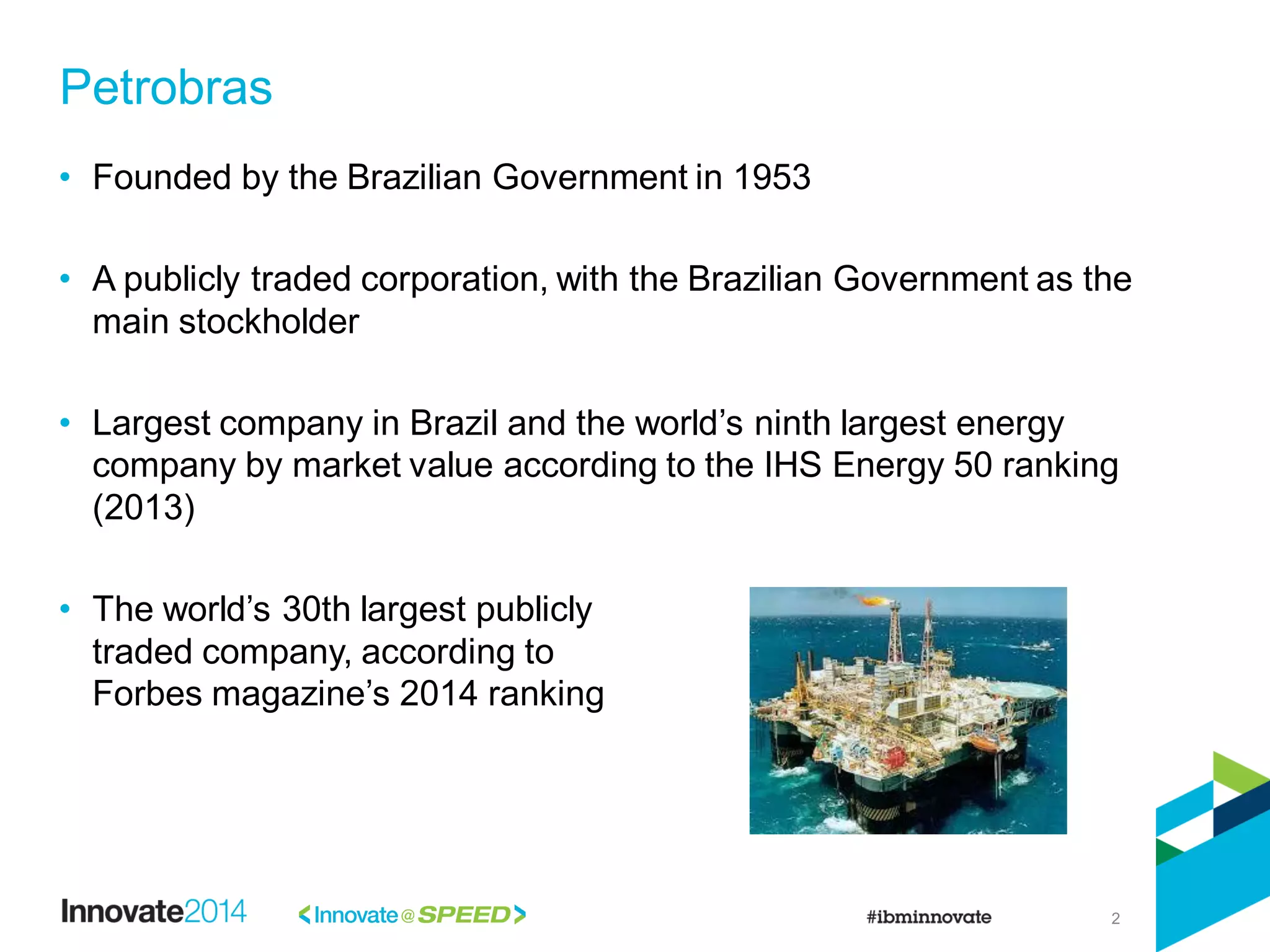
• Founded by the Brazilian Government in 1953
• A publicly traded corporation, with the Brazilian Government as the
main stockholder
• Largest company in Brazil and the world’s ninth largest energy
company by market value according to the IHS Energy 50 ranking
(2013)
• The world’s 30th largest publicly
traded company, according to
Forbes magazine’s 2014 ranking
Petrobras
3
Petrobras Information Technology and
Telecommunications Department
• People
• 3,088 Employees and around 5,000 contractors
• More than 1,000 people working with software development
• Development teams distributed geographically in seven different sites
• Systems
• More than 2,800 systems in use
• Development Platforms
• More than 30 development technologies
• Most relevant are SAP, Java and .Net
• Development Processes
• Agile, Waterfall
4
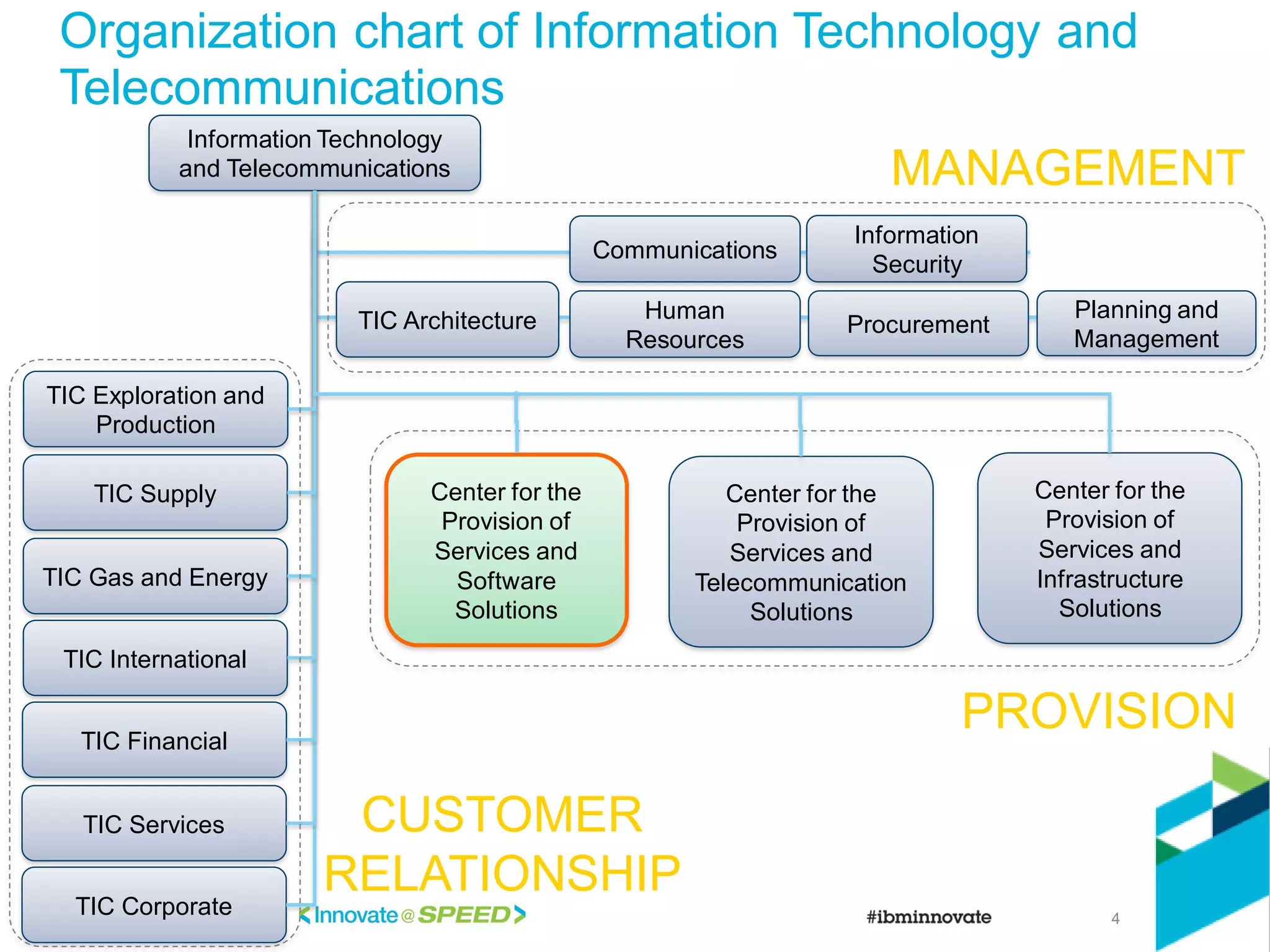
Organization chart of Information Technology and
Telecommunications
Information Technology
and Telecommunications
TIC Exploration and
Production
TIC Supply
TIC Gas and Energy
TIC International
TIC Financial
TIC Services
TIC Corporate
MANAGEMENT
PROVISION
CUSTOMER
RELATIONSHIP
Center for the
Provision of
Services and
Software
Solutions
Center for the
Provision of
Services and
Telecommunication
Solutions
Center for the
Provision of
Services and
Infrastructure
Solutions
Human
Resources
ProcurementTIC Architecture Planning and
Management
Communications
Information
Security
5
• About Petrobras
• Our Challenges
• The Program
• Benefits Achieved
• Lessons Learned
• Next Steps
Agenda
6
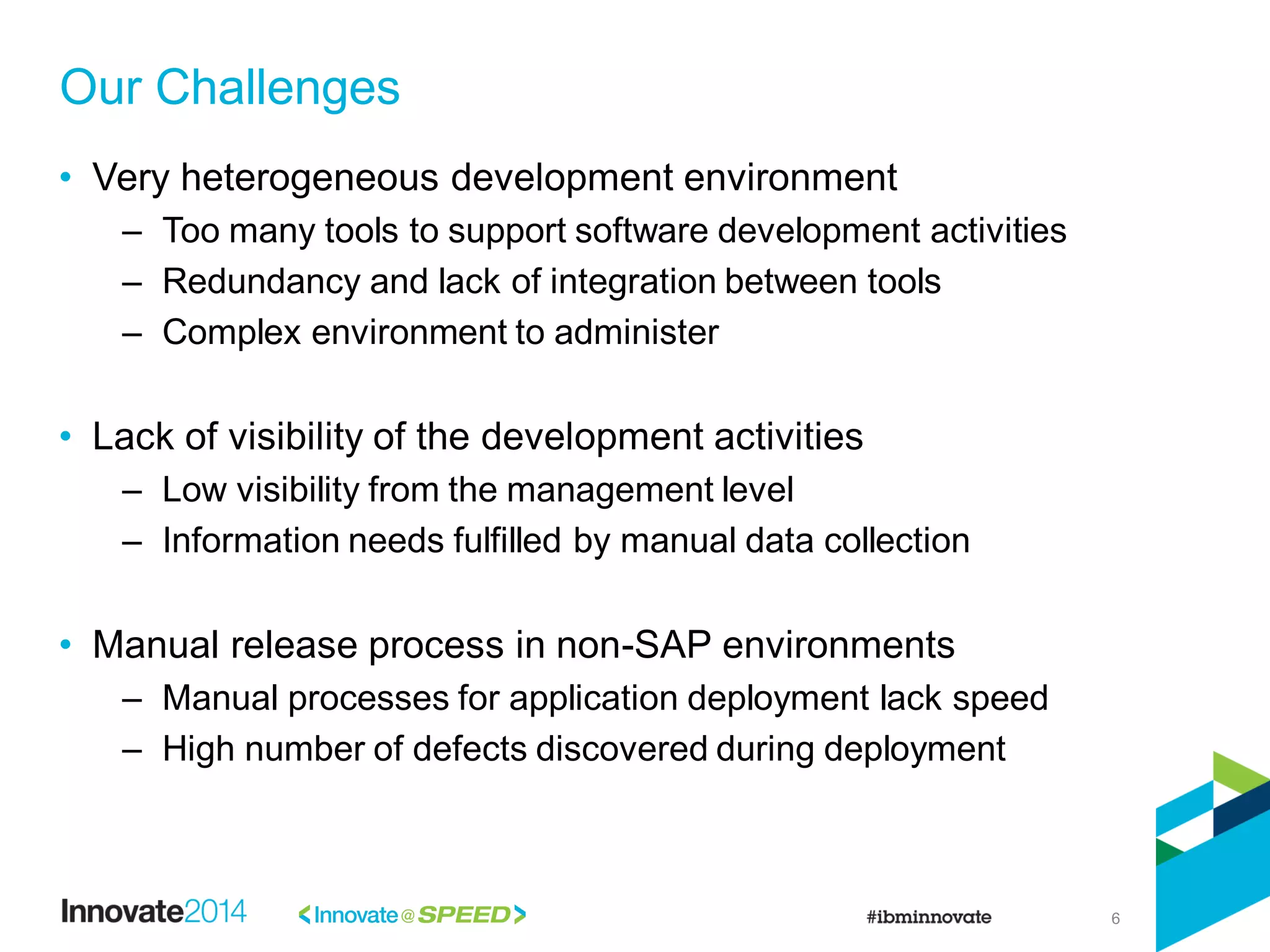
• Very heterogeneous development environment
– Too many tools to support software development activities
– Redundancy and lack of integration between tools
– Complex environment to administer
• Lack of visibility of the development activities
– Low visibility from the management level
– Information needs fulfilled by manual data collection
• Manual release process in non-SAP environments
– Manual processes for application deployment lack speed
– High number of defects discovered during deployment
Our Challenges
7
• Provide an uniform environment for software development
• Improve lifecycle traceability
• Enhance the visibility from the management level
• Improve automation in the development processes
Our Goals
8
• About Petrobras
• Our Challenges
• The Program
• Benefits Achieved
• Lessons Learned
• Next Steps
Agenda
9
• An ALM Program was initiated in the middle 2012
• Involving stakeholders from three areas:
• IT Architecture
• Software Development
• Infrastructure Operations
• A team including people from the three areas
attended Innovate and visited some customers
Petrobras ALM Program
10
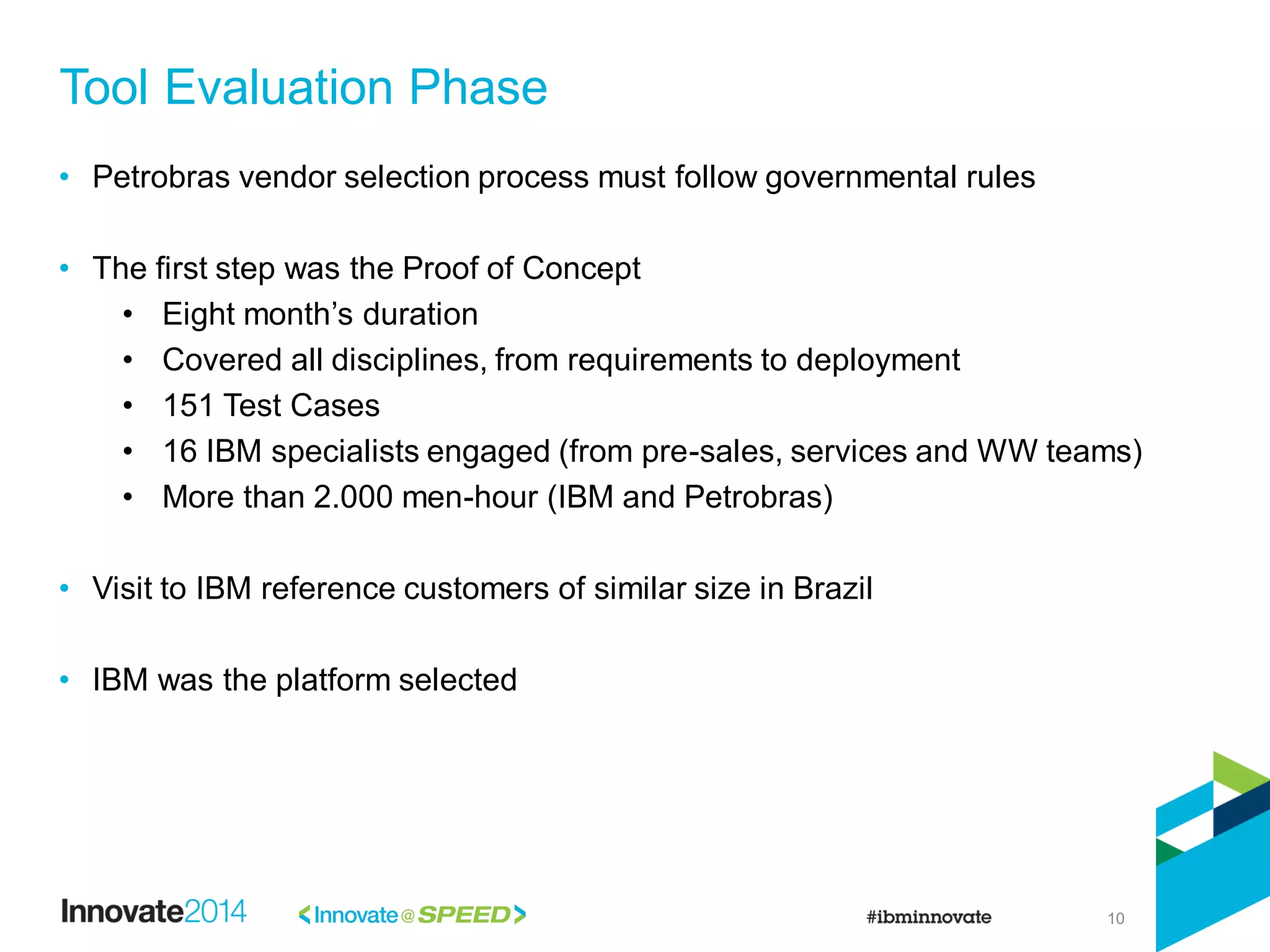
• Petrobras vendor selection process must follow governmental rules
• The first step was the Proof of Concept
• Eight month’s duration
• Covered all disciplines, from requirements to deployment
• 151 Test Cases
• 16 IBM specialists engaged (from pre-sales, services and WW teams)
• More than 2.000 men-hour (IBM and Petrobras)
• Visit to IBM reference customers of similar size in Brazil
• IBM was the platform selected
Tool Evaluation Phase
11
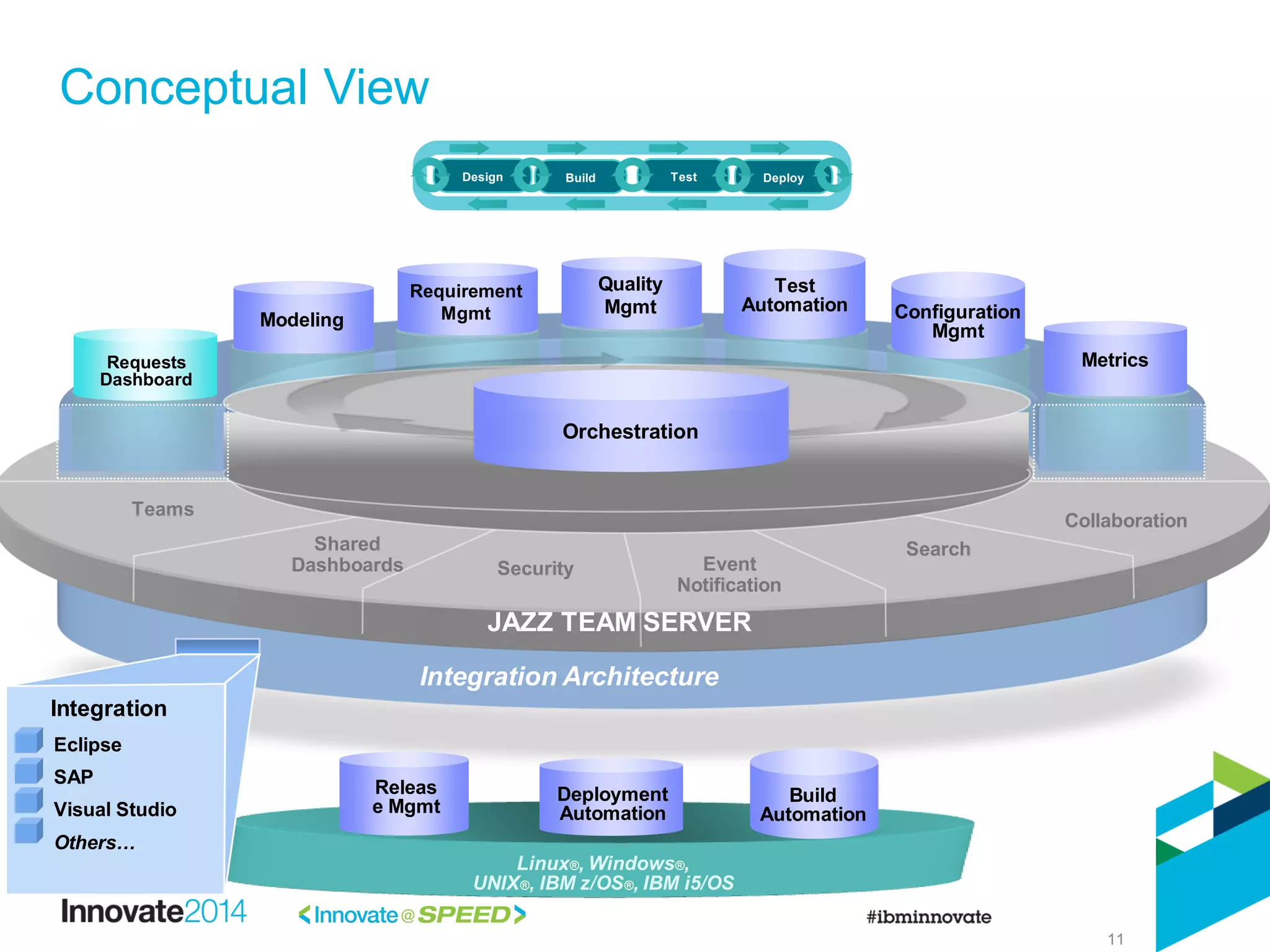
Conceptual View
Integration Architecture
JAZZ TEAM SERVER
Search
Collaboration
Teams
Event
Notification
Security
Requests
Dashboard
Design Build Test Deploy
Linux®, Windows®,
UNIX®, IBM z/OS®, IBM i5/OS
Orchestration
Metrics
Shared
Dashboards
Requirement
Mgmt
Quality
Mgmt
Test
Automation
Modeling
Releas
e Mgmt
Deployment
Automation
Build
Automation
Eclipse
SAP
Visual Studio
Others…
Integration
Configuration
Mgmt
12
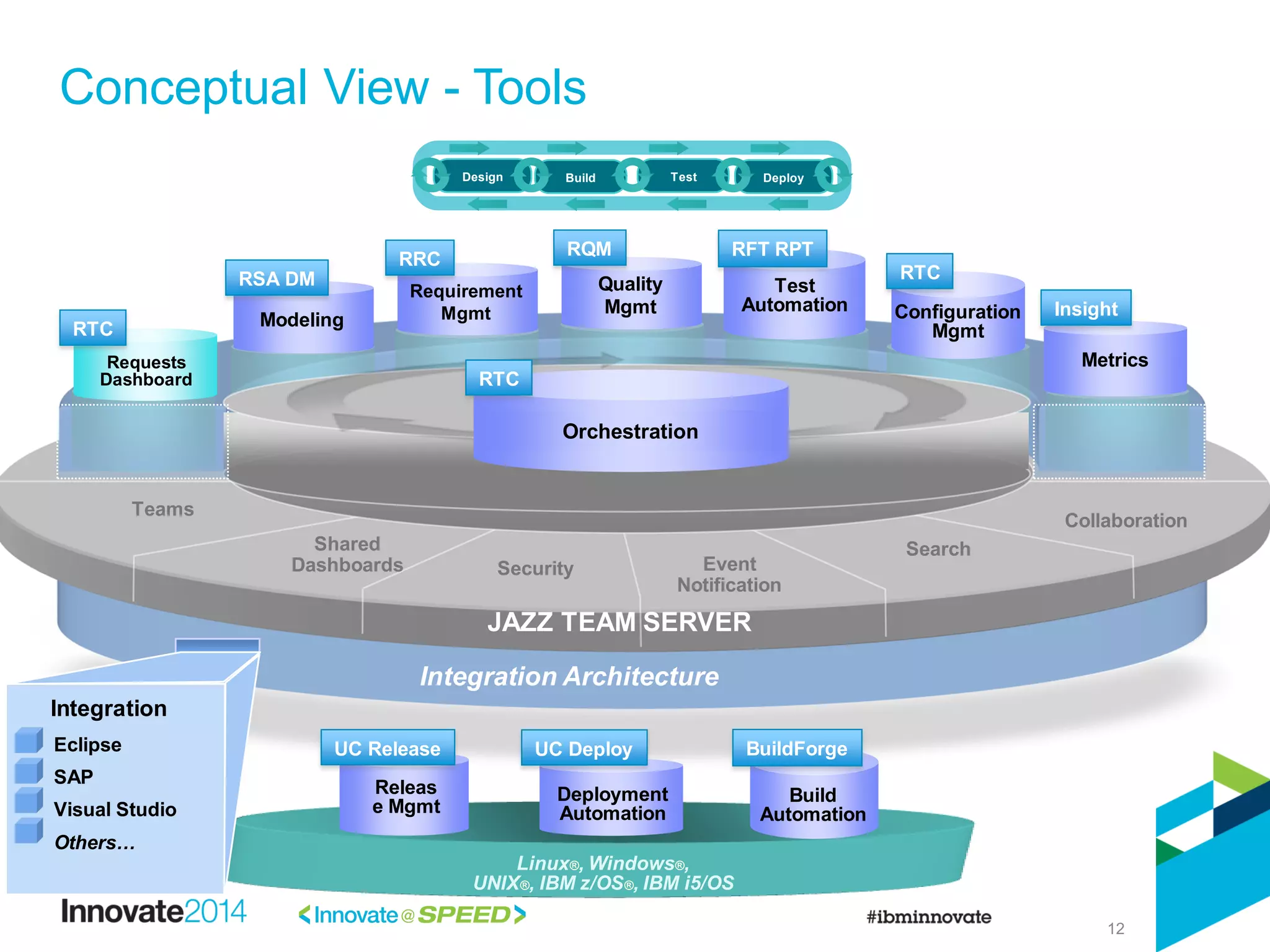
Conceptual View - Tools
Integration Architecture
JAZZ TEAM SERVER
Search
Collaboration
Teams
Event
Notification
Security
Requests
Dashboard
Design Build Test Deploy
Linux®, Windows®,
UNIX®, IBM z/OS®, IBM i5/OS
Orchestration
Metrics
Shared
Dashboards
Requirement
Mgmt
Quality
Mgmt
Test
Automation
ModelingRTC
RTC
RSA DM
RRC
RQM
Insight
Eclipse
SAP
Visual Studio
Others…
Integration
RFT RPT
Releas
e Mgmt
Deployment
Automation
Build
Automation
Configuration
Mgmt
RTC
UC Release UC Deploy BuildForge
13
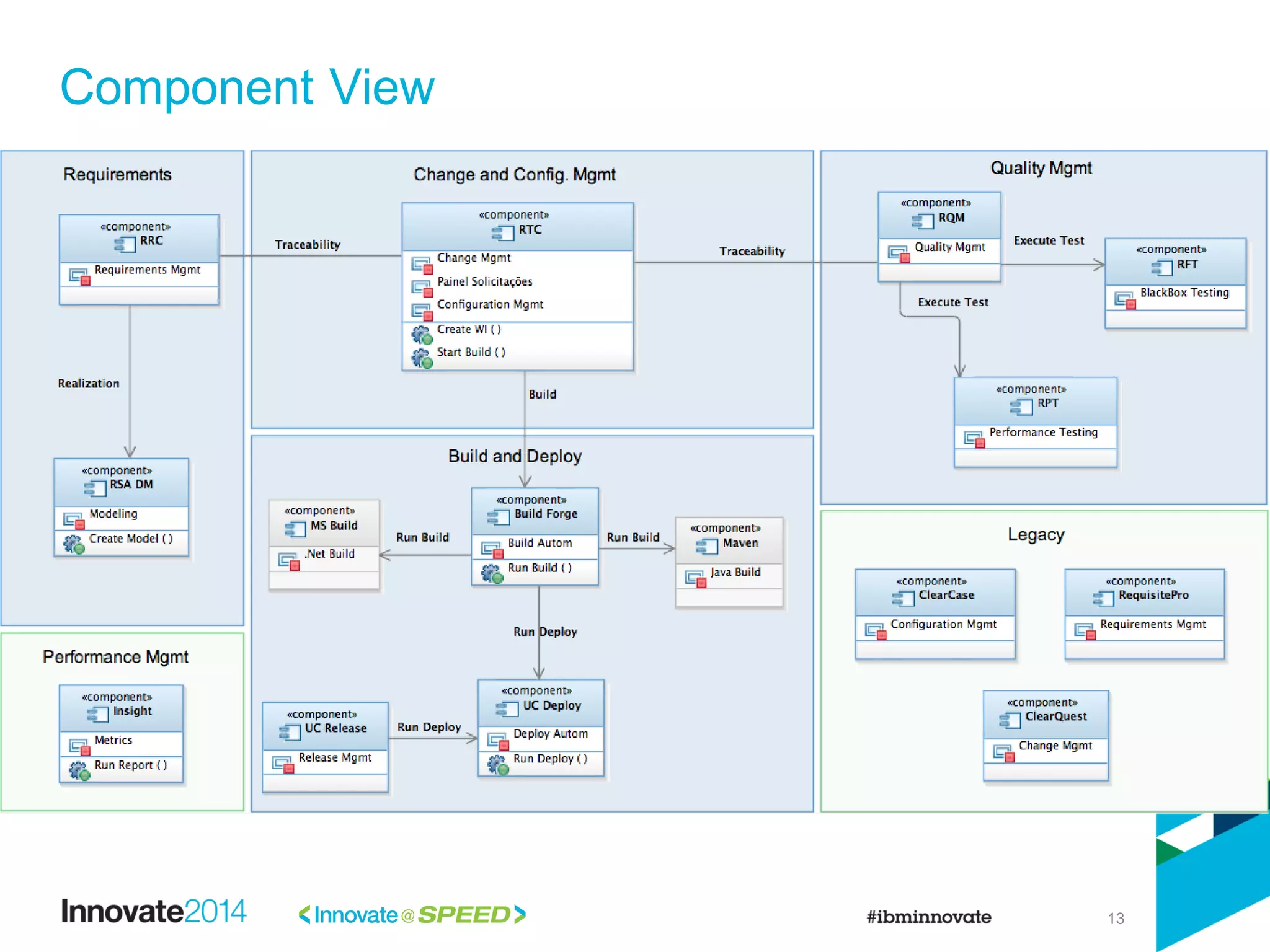
Component View
14
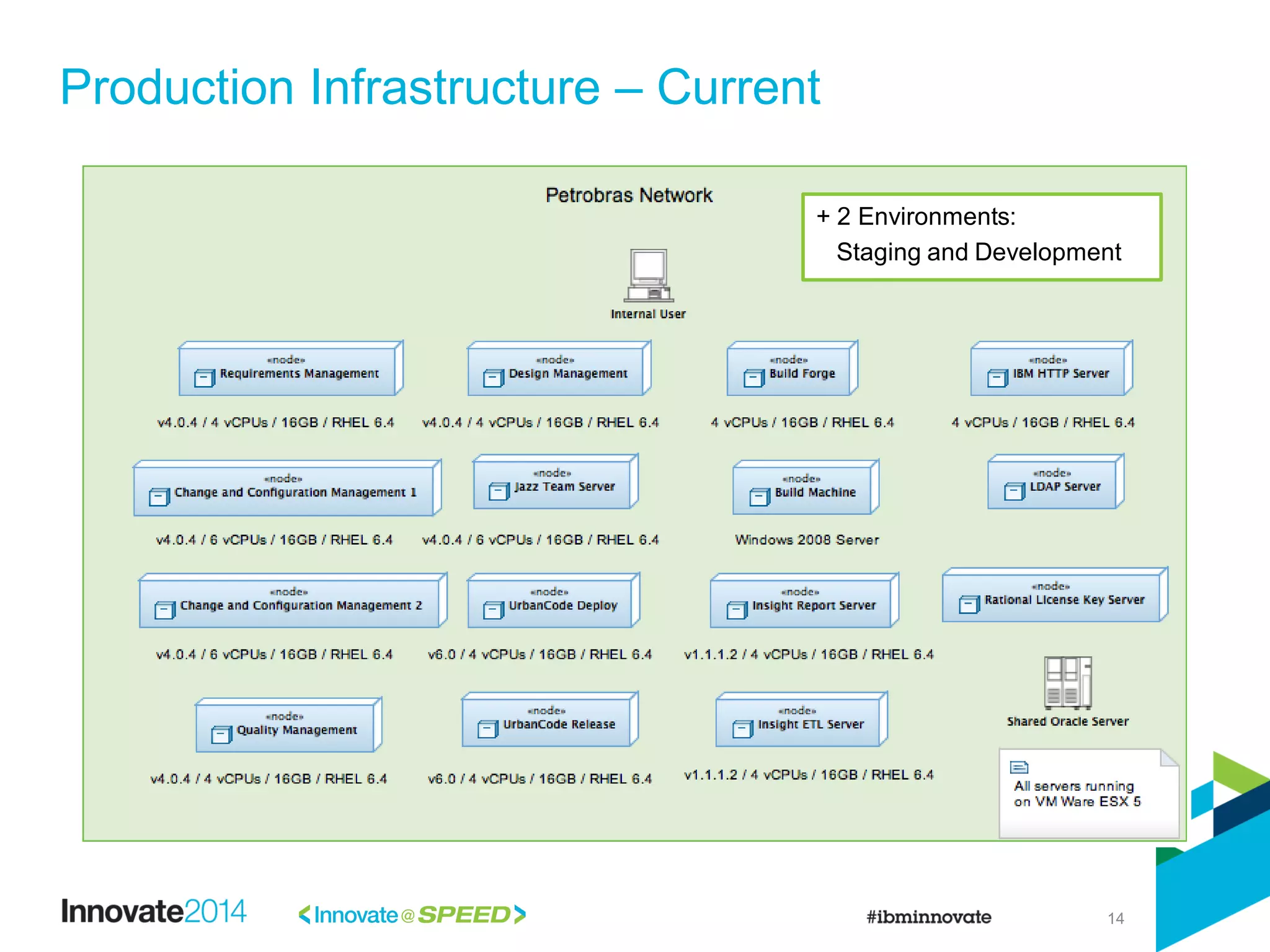
Production Infrastructure – Current
+ 2 Environments:
Staging and Development
15
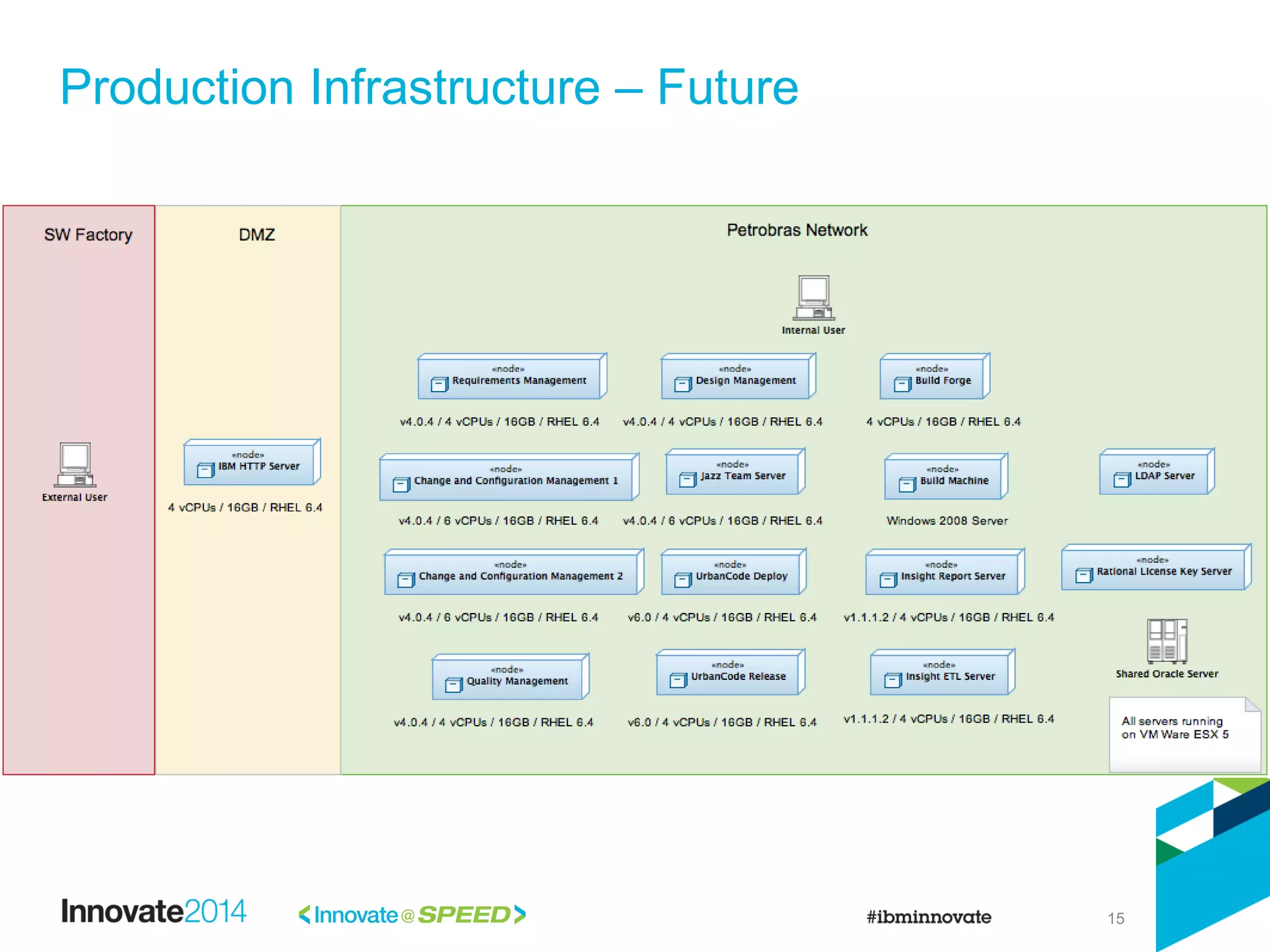
Production Infrastructure – Future
16
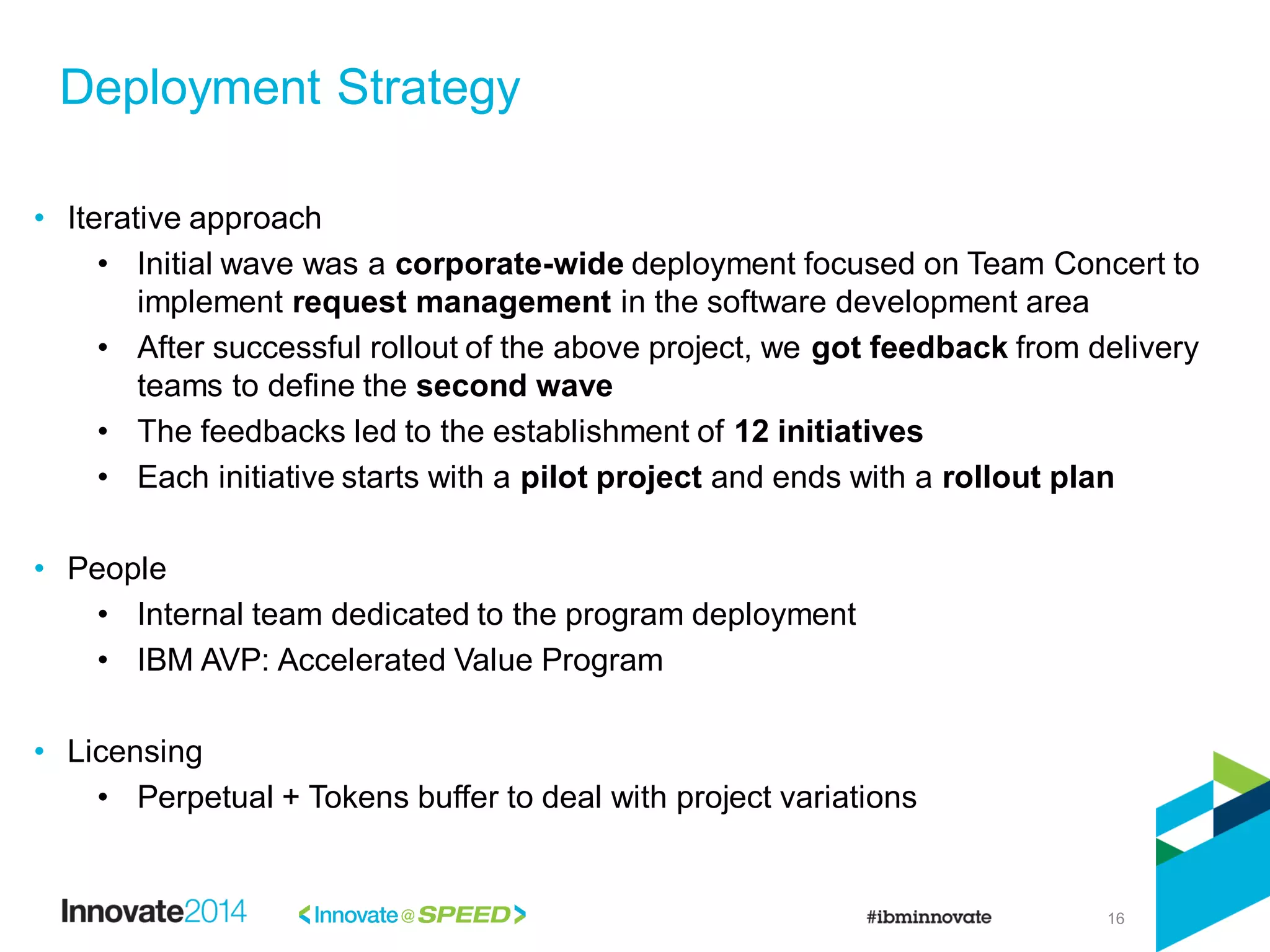
• Iterative approach
• Initial wave was a corporate-wide deployment focused on Team Concert to
implement request management in the software development area
• After successful rollout of the above project, we got feedback from delivery
teams to define the second wave
• The feedbacks led to the establishment of 12 initiatives
• Each initiative starts with a pilot project and ends with a rollout plan
• People
• Internal team dedicated to the program deployment
• IBM AVP: Accelerated Value Program
• Licensing
• Perpetual + Tokens buffer to deal with project variations
Deployment Strategy
17
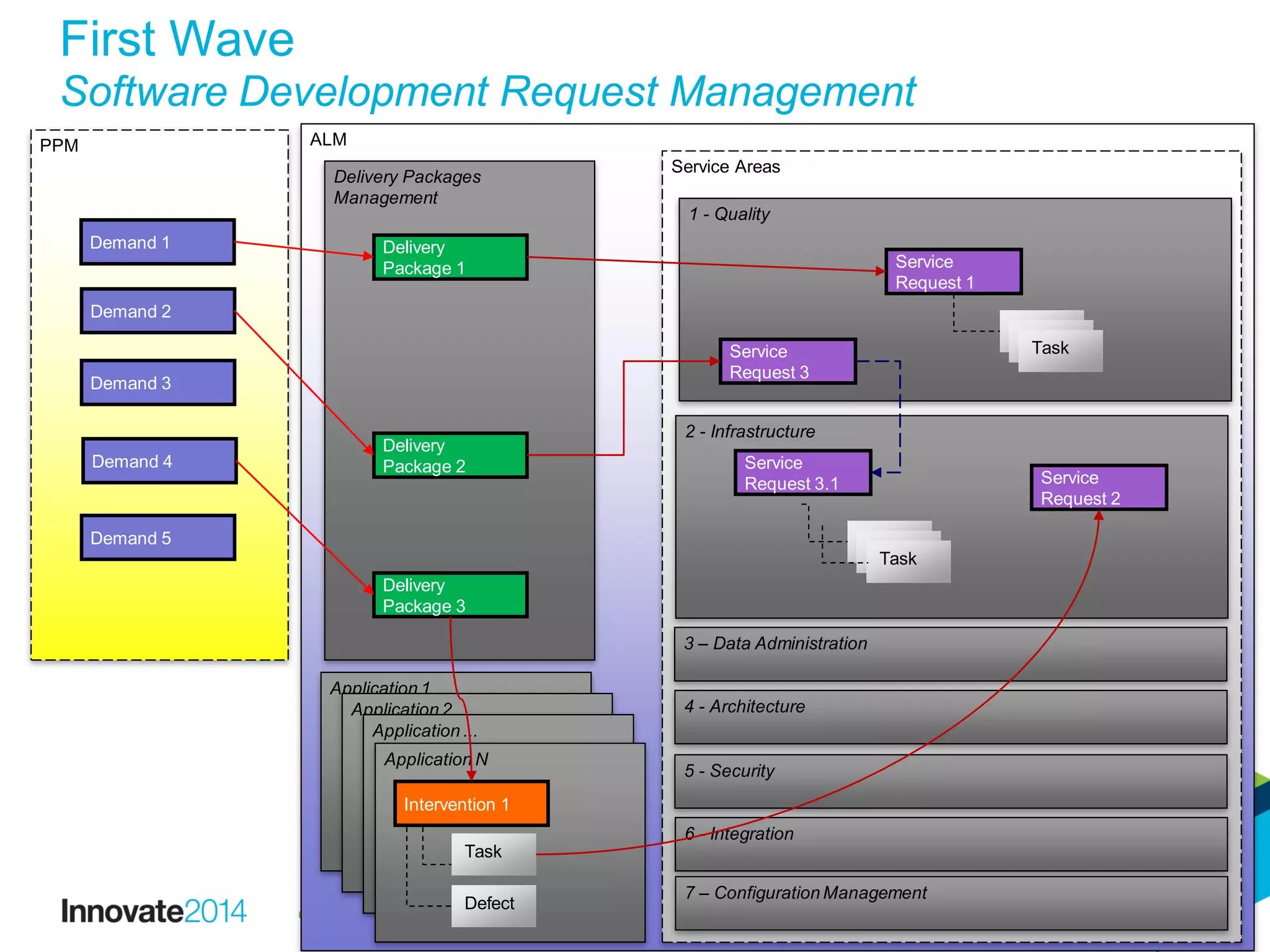
First Wave
Software Development Request Management
ALM
Service Areas
Delivery Packages
Management
Delivery
Package 1
PPM
Delivery
Package 2
Delivery
Package 3
1 - Quality
Service
Request 1
Demand 1
Demand 2
Demand 3
Demand 4
Demand 5
Service
Request 3
Tarefa
2 - Infrastructure
Tarefa
Task
Service
Request 3.1
Tarefa
Tarefa
Task
3 – Data Administration
4 - Architecture
5 - Security
6 - Integration
7 – Configuration Management
Application 1
Application 2
Application ...
Application N
Intervention 1
Task
Service
Request 2
Defect
18
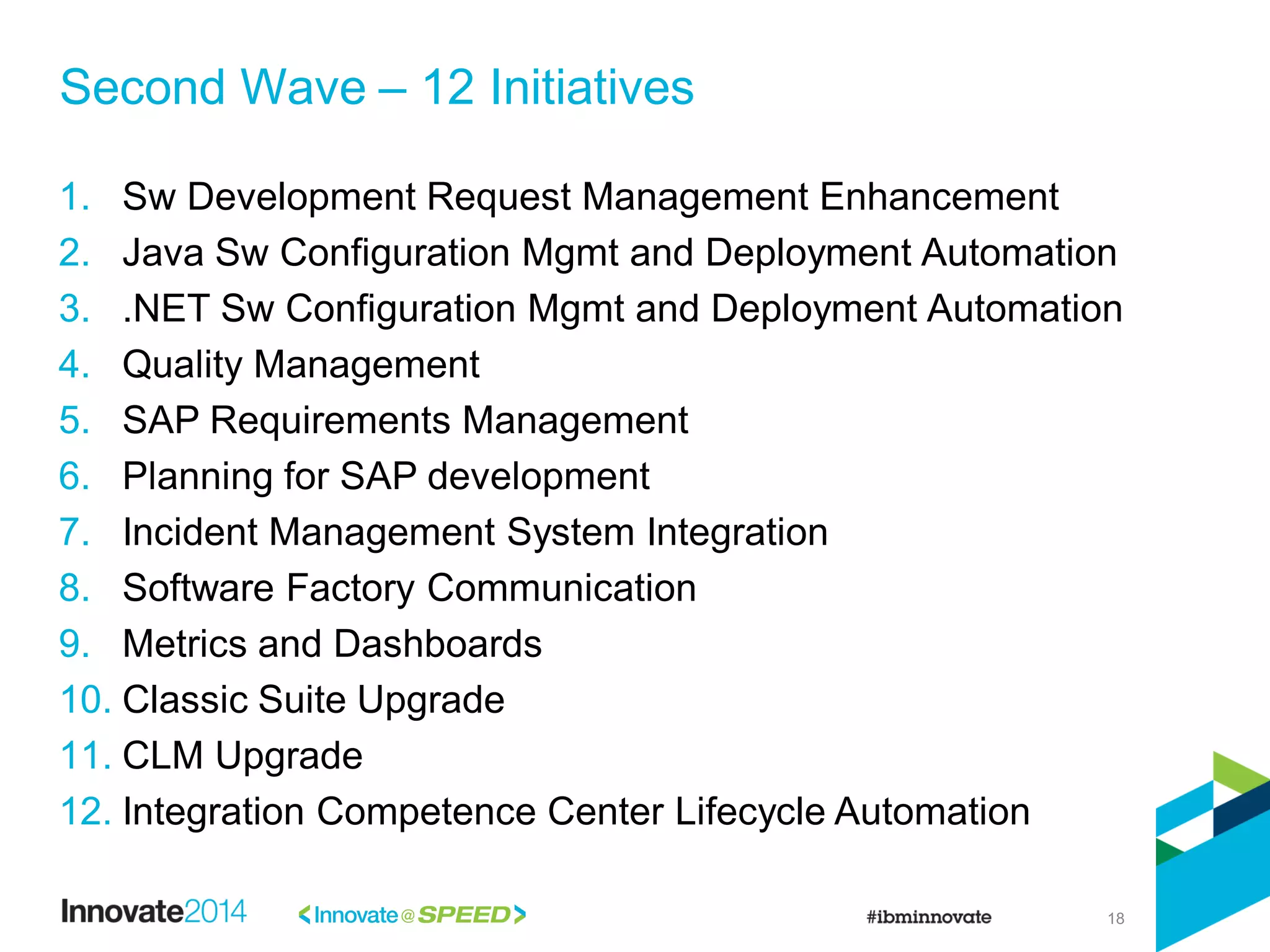
1. Sw Development Request Management Enhancement
2. Java Sw Configuration Mgmt and Deployment Automation
3. .NET Sw Configuration Mgmt and Deployment Automation
4. Quality Management
5. SAP Requirements Management
6. Planning for SAP development
7. Incident Management System Integration
8. Software Factory Communication
9. Metrics and Dashboards
10. Classic Suite Upgrade
11. CLM Upgrade
12. Integration Competence Center Lifecycle Automation
Second Wave – 12 Initiatives
19
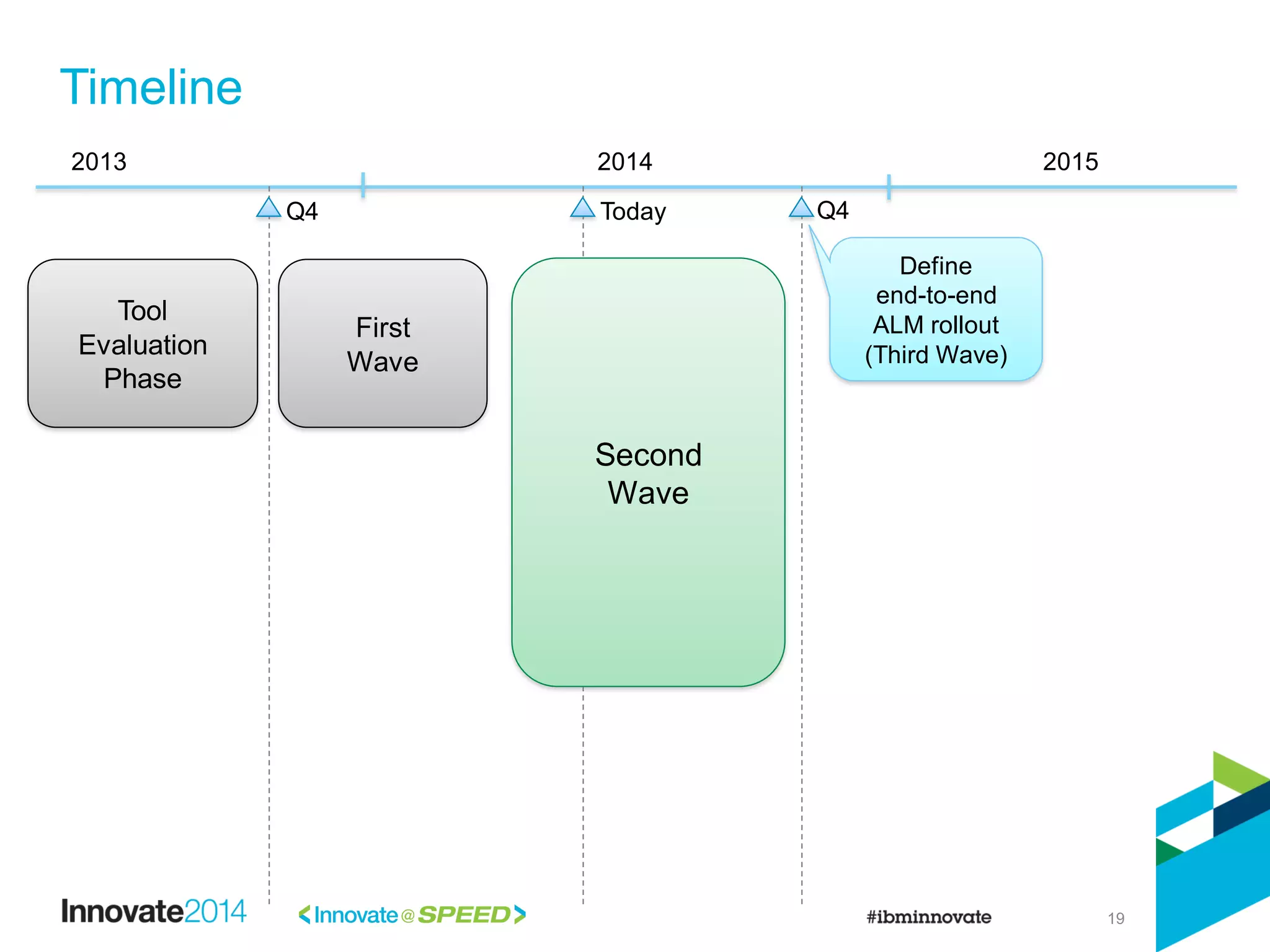
Timeline
2014 2015
Second
Wave
2013
Tool
Evaluation
Phase
First
Wave
Today
Define
end-to-end
ALM rollout
(Third Wave)
Q4Q4
20
• About Petrobras
• Our Challenges
• The Program
• Benefits Achieved
• Lessons Learned
• Next Steps
Agenda
21
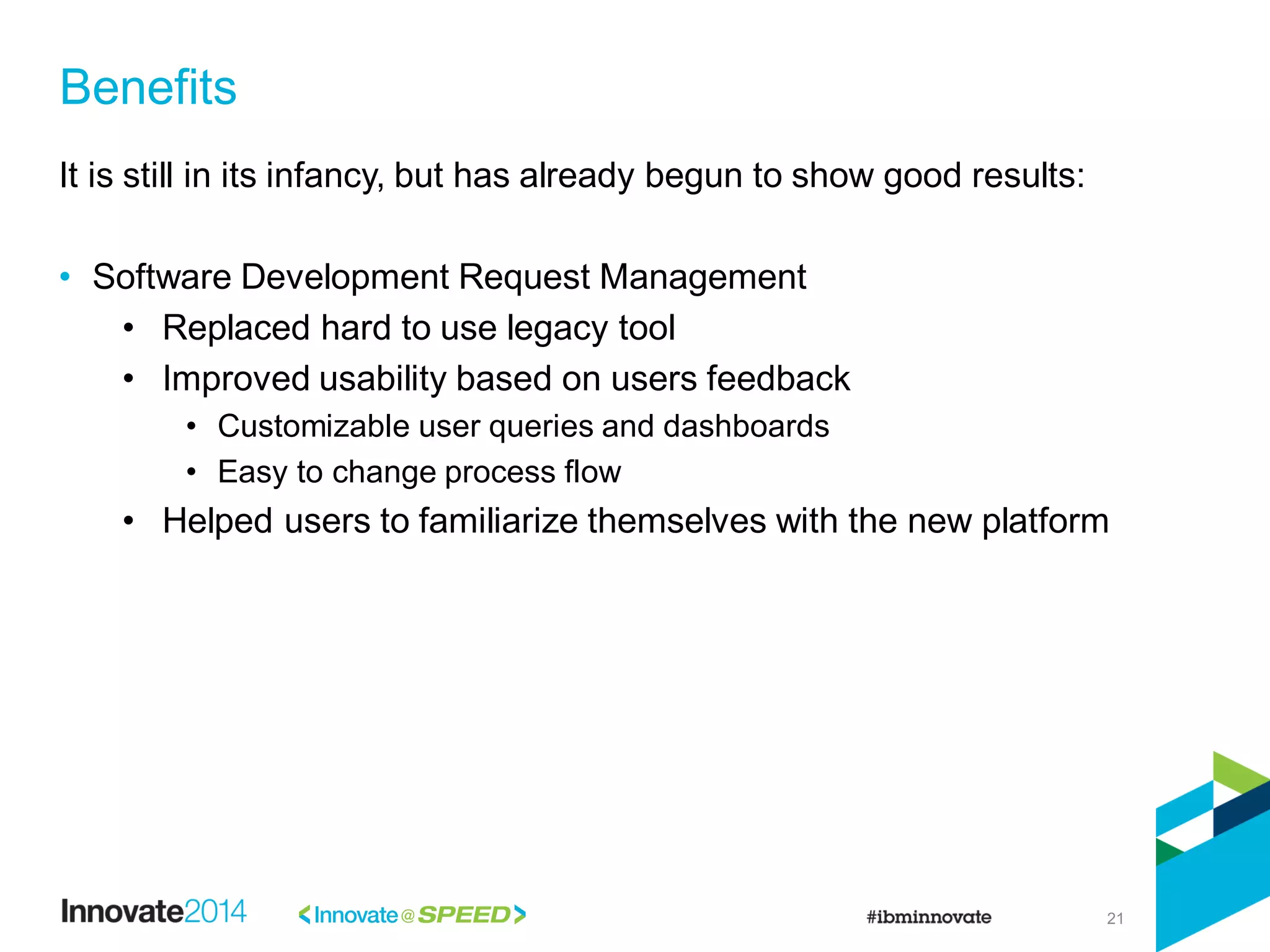
It is still in its infancy, but has already begun to show good results:
• Software Development Request Management
• Replaced hard to use legacy tool
• Improved usability based on users feedback
• Customizable user queries and dashboards
• Easy to change process flow
• Helped users to familiarize themselves with the new platform
Benefits
22
• About Petrobras
• Our Challenges
• The Program
• Benefits Achieved
• Lessons Learned
• Next Steps
Agenda
23
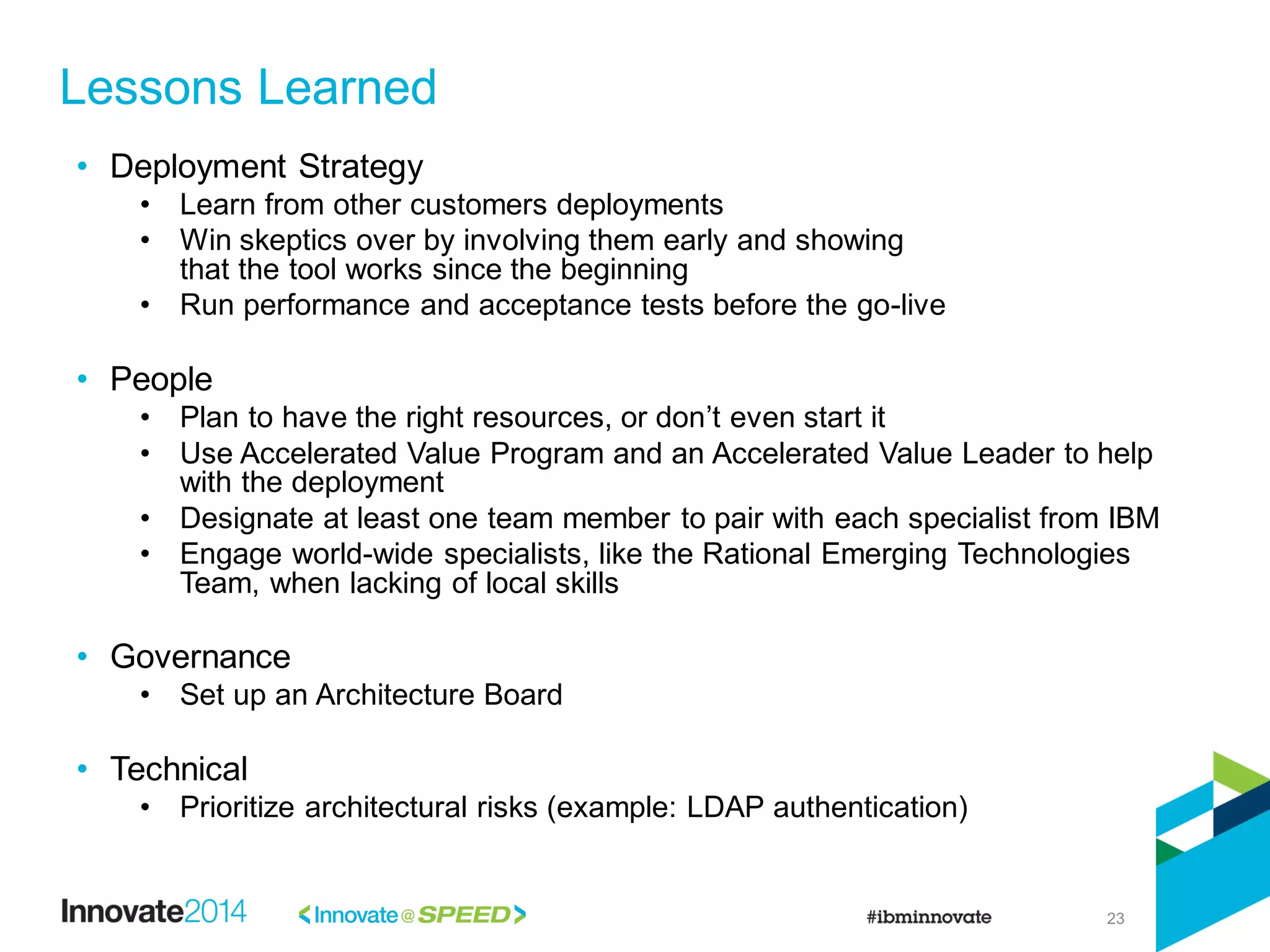
• Deployment Strategy
• Learn from other customers deployments
• Win skeptics over by involving them early and showing
that the tool works since the beginning
• Run performance and acceptance tests before the go-live
• People
• Plan to have the right resources, or don’t even start it
• Use Accelerated Value Program and an Accelerated Value Leader to help
with the deployment
• Designate at least one team member to pair with each specialist from IBM
• Engage world-wide specialists, like the Rational Emerging Technologies
Team, when lacking of local skills
• Governance
• Set up an Architecture Board
• Technical
• Prioritize architectural risks (example: LDAP authentication)
Lessons Learned
24
• About Petrobras
• Our Challenges
• The Program
• Benefits Achieved
• Lessons Learned
• Next Steps
Agenda
25
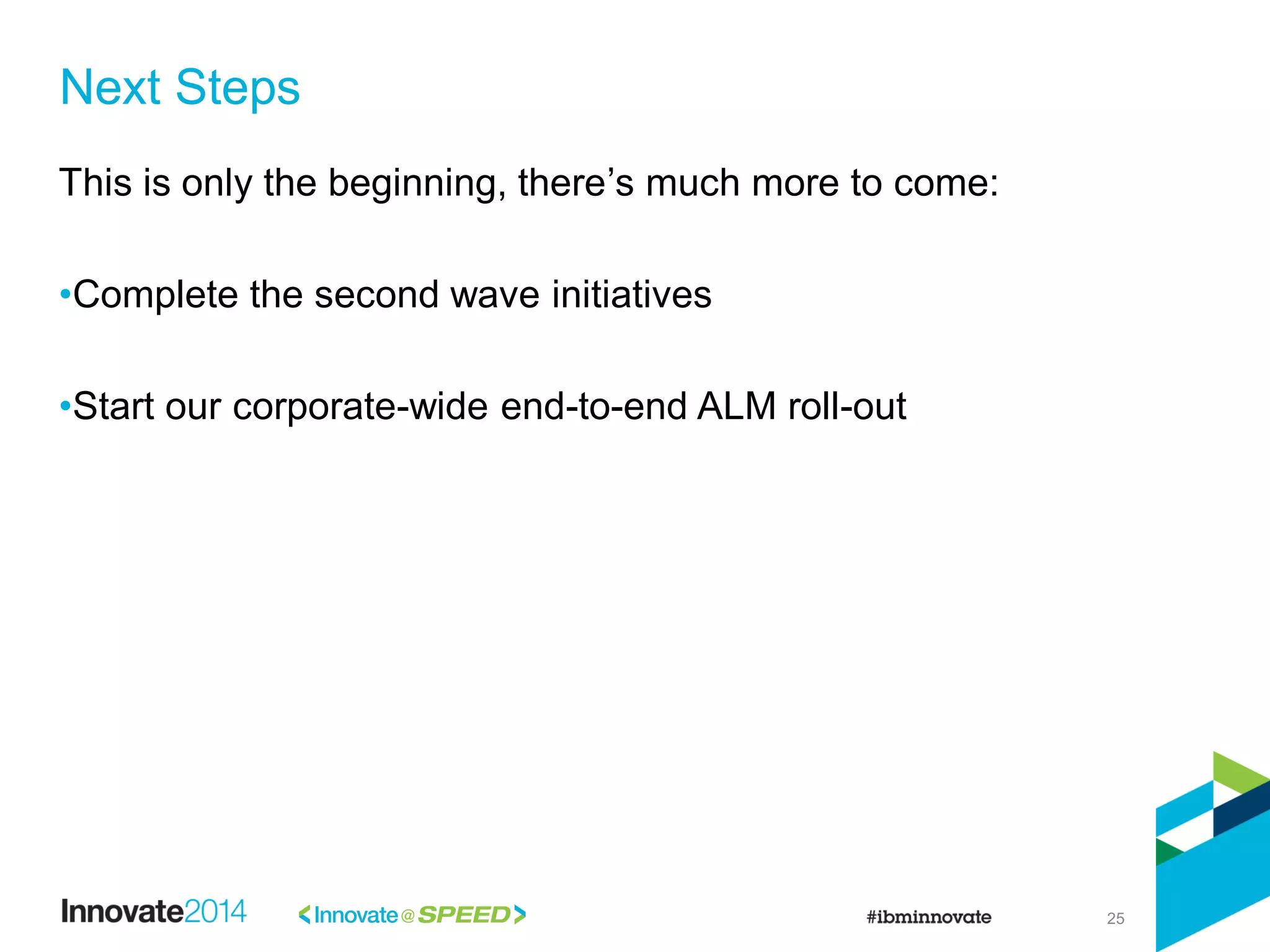
This is only the beginning, there’s much more to come:
•Complete the second wave initiatives
•Start our corporate-wide end-to-end ALM roll-out
Next Steps
Acknowledgements and Disclaimers
© Copyright IBM Corporation 2012. All rights reserved.
– U.S. Government Users Restricted Rights - Use, duplication or disclosure restricted by GSA ADP Schedule Contract
with IBM Corp.
IBM, the IBM logo, ibm.com and IBM Rational Team Concert, IBM Rational Requirements Composer, IBM Quality Manager, IBM
UrbanCode Deploy, IBM Rational Insight and IBM UrbanCode Release are trademarks or registered trademarks of International Business
Machines Corporation in the United States, other countries, or both. If these and other IBM trademarked terms are marked on their first
occurrence in this information with a trademark symbol (® or ™), these symbols indicate U.S. registered or common law trademarks
owned by IBM at the time this information was published. Such trademarks may also be registered or common law trademarks in other
countries. A current list of IBM trademarks is available on the Web at “Copyright and trademark information” at
www.ibm.com/legal/copytrade.shtml
Other company, product, or service names may be trademarks or service marks of others.
Availability. References in this presentation to IBM products, programs, or services do not imply that they will be available in all
countries in which IBM operates.
The workshops, sessions and materials have been prepared by IBM or the session speakers and reflect their own views. They are
provided for informational purposes only, and are neither intended to, nor shall have the effect of being, legal or other guidance or advice
to any participant. While efforts were made to verify the completeness and accuracy of the information contained in this presentation, it is
provided AS-IS without warranty of any kind, express or implied. IBM shall not be responsible for any damages arising out of the use of,
or otherwise related to, this presentation or any other materials. Nothing contained in this presentation is intended to, nor shall have the
effect of, creating any warranties or representations from IBM or its suppliers or licensors, or altering the terms and conditions of the
applicable license agreement governing the use of IBM software.
All customer examples described are presented as illustrations of how those customers have used IBM products and the results they may
have achieved. Actual environmental costs and performance characteristics may vary by customer. Nothing contained in these
materials is intended to, nor shall have the effect of, stating or implying that any activities undertaken by you will result in any specific
sales, revenue growth or other results.
Thank You!
Your Feedback is Important!
Access the Innovate agenda tool to complete your
session surveys from your smartphone, laptop or
conference kiosk.

Innovate2014 dev 1265

  • 1.
    © 2014 IBMCorporation DEV-1265, Petrobras ALM: From a Manual to an Automated Development Process Marcio Azevedo Petrobras ALM Program Manager maraze@petrobras.com.br Paulo Lacerda IBM IT Specialist placerda@br.ibm.com
  • 2.
    1 • About Petrobras •Our Challenges • The Program • Benefits Achieved • Lessons Learned • Next Steps Agenda
  • 3.
    2 • Founded bythe Brazilian Government in 1953 • A publicly traded corporation, with the Brazilian Government as the main stockholder • Largest company in Brazil and the world’s ninth largest energy company by market value according to the IHS Energy 50 ranking (2013) • The world’s 30th largest publicly traded company, according to Forbes magazine’s 2014 ranking Petrobras
  • 4.
    3 Petrobras Information Technologyand Telecommunications Department • People • 3,088 Employees and around 5,000 contractors • More than 1,000 people working with software development • Development teams distributed geographically in seven different sites • Systems • More than 2,800 systems in use • Development Platforms • More than 30 development technologies • Most relevant are SAP, Java and .Net • Development Processes • Agile, Waterfall
  • 5.
    4 Organization chart ofInformation Technology and Telecommunications Information Technology and Telecommunications TIC Exploration and Production TIC Supply TIC Gas and Energy TIC International TIC Financial TIC Services TIC Corporate MANAGEMENT PROVISION CUSTOMER RELATIONSHIP Center for the Provision of Services and Software Solutions Center for the Provision of Services and Telecommunication Solutions Center for the Provision of Services and Infrastructure Solutions Human Resources ProcurementTIC Architecture Planning and Management Communications Information Security
  • 6.
    5 • About Petrobras •Our Challenges • The Program • Benefits Achieved • Lessons Learned • Next Steps Agenda
  • 7.
    6 • Very heterogeneousdevelopment environment – Too many tools to support software development activities – Redundancy and lack of integration between tools – Complex environment to administer • Lack of visibility of the development activities – Low visibility from the management level – Information needs fulfilled by manual data collection • Manual release process in non-SAP environments – Manual processes for application deployment lack speed – High number of defects discovered during deployment Our Challenges
  • 8.
    7 • Provide anuniform environment for software development • Improve lifecycle traceability • Enhance the visibility from the management level • Improve automation in the development processes Our Goals
  • 9.
    8 • About Petrobras •Our Challenges • The Program • Benefits Achieved • Lessons Learned • Next Steps Agenda
  • 10.
    9 • An ALMProgram was initiated in the middle 2012 • Involving stakeholders from three areas: • IT Architecture • Software Development • Infrastructure Operations • A team including people from the three areas attended Innovate and visited some customers Petrobras ALM Program
  • 11.
    10 • Petrobras vendorselection process must follow governmental rules • The first step was the Proof of Concept • Eight month’s duration • Covered all disciplines, from requirements to deployment • 151 Test Cases • 16 IBM specialists engaged (from pre-sales, services and WW teams) • More than 2.000 men-hour (IBM and Petrobras) • Visit to IBM reference customers of similar size in Brazil • IBM was the platform selected Tool Evaluation Phase
  • 12.
    11 Conceptual View Integration Architecture JAZZTEAM SERVER Search Collaboration Teams Event Notification Security Requests Dashboard Design Build Test Deploy Linux®, Windows®, UNIX®, IBM z/OS®, IBM i5/OS Orchestration Metrics Shared Dashboards Requirement Mgmt Quality Mgmt Test Automation Modeling Releas e Mgmt Deployment Automation Build Automation Eclipse SAP Visual Studio Others… Integration Configuration Mgmt
  • 13.
    12 Conceptual View -Tools Integration Architecture JAZZ TEAM SERVER Search Collaboration Teams Event Notification Security Requests Dashboard Design Build Test Deploy Linux®, Windows®, UNIX®, IBM z/OS®, IBM i5/OS Orchestration Metrics Shared Dashboards Requirement Mgmt Quality Mgmt Test Automation ModelingRTC RTC RSA DM RRC RQM Insight Eclipse SAP Visual Studio Others… Integration RFT RPT Releas e Mgmt Deployment Automation Build Automation Configuration Mgmt RTC UC Release UC Deploy BuildForge
  • 14.
  • 15.
    14 Production Infrastructure –Current + 2 Environments: Staging and Development
  • 16.
  • 17.
    16 • Iterative approach •Initial wave was a corporate-wide deployment focused on Team Concert to implement request management in the software development area • After successful rollout of the above project, we got feedback from delivery teams to define the second wave • The feedbacks led to the establishment of 12 initiatives • Each initiative starts with a pilot project and ends with a rollout plan • People • Internal team dedicated to the program deployment • IBM AVP: Accelerated Value Program • Licensing • Perpetual + Tokens buffer to deal with project variations Deployment Strategy
  • 18.
    17 First Wave Software DevelopmentRequest Management ALM Service Areas Delivery Packages Management Delivery Package 1 PPM Delivery Package 2 Delivery Package 3 1 - Quality Service Request 1 Demand 1 Demand 2 Demand 3 Demand 4 Demand 5 Service Request 3 Tarefa 2 - Infrastructure Tarefa Task Service Request 3.1 Tarefa Tarefa Task 3 – Data Administration 4 - Architecture 5 - Security 6 - Integration 7 – Configuration Management Application 1 Application 2 Application ... Application N Intervention 1 Task Service Request 2 Defect
  • 19.
    18 1. Sw DevelopmentRequest Management Enhancement 2. Java Sw Configuration Mgmt and Deployment Automation 3. .NET Sw Configuration Mgmt and Deployment Automation 4. Quality Management 5. SAP Requirements Management 6. Planning for SAP development 7. Incident Management System Integration 8. Software Factory Communication 9. Metrics and Dashboards 10. Classic Suite Upgrade 11. CLM Upgrade 12. Integration Competence Center Lifecycle Automation Second Wave – 12 Initiatives
  • 20.
  • 21.
    20 • About Petrobras •Our Challenges • The Program • Benefits Achieved • Lessons Learned • Next Steps Agenda
  • 22.
    21 It is stillin its infancy, but has already begun to show good results: • Software Development Request Management • Replaced hard to use legacy tool • Improved usability based on users feedback • Customizable user queries and dashboards • Easy to change process flow • Helped users to familiarize themselves with the new platform Benefits
  • 23.
    22 • About Petrobras •Our Challenges • The Program • Benefits Achieved • Lessons Learned • Next Steps Agenda
  • 24.
    23 • Deployment Strategy •Learn from other customers deployments • Win skeptics over by involving them early and showing that the tool works since the beginning • Run performance and acceptance tests before the go-live • People • Plan to have the right resources, or don’t even start it • Use Accelerated Value Program and an Accelerated Value Leader to help with the deployment • Designate at least one team member to pair with each specialist from IBM • Engage world-wide specialists, like the Rational Emerging Technologies Team, when lacking of local skills • Governance • Set up an Architecture Board • Technical • Prioritize architectural risks (example: LDAP authentication) Lessons Learned
  • 25.
    24 • About Petrobras •Our Challenges • The Program • Benefits Achieved • Lessons Learned • Next Steps Agenda
  • 26.
    25 This is onlythe beginning, there’s much more to come: •Complete the second wave initiatives •Start our corporate-wide end-to-end ALM roll-out Next Steps
  • 27.
    Acknowledgements and Disclaimers ©Copyright IBM Corporation 2012. All rights reserved. – U.S. Government Users Restricted Rights - Use, duplication or disclosure restricted by GSA ADP Schedule Contract with IBM Corp. IBM, the IBM logo, ibm.com and IBM Rational Team Concert, IBM Rational Requirements Composer, IBM Quality Manager, IBM UrbanCode Deploy, IBM Rational Insight and IBM UrbanCode Release are trademarks or registered trademarks of International Business Machines Corporation in the United States, other countries, or both. If these and other IBM trademarked terms are marked on their first occurrence in this information with a trademark symbol (® or ™), these symbols indicate U.S. registered or common law trademarks owned by IBM at the time this information was published. Such trademarks may also be registered or common law trademarks in other countries. A current list of IBM trademarks is available on the Web at “Copyright and trademark information” at www.ibm.com/legal/copytrade.shtml Other company, product, or service names may be trademarks or service marks of others. Availability. References in this presentation to IBM products, programs, or services do not imply that they will be available in all countries in which IBM operates. The workshops, sessions and materials have been prepared by IBM or the session speakers and reflect their own views. They are provided for informational purposes only, and are neither intended to, nor shall have the effect of being, legal or other guidance or advice to any participant. While efforts were made to verify the completeness and accuracy of the information contained in this presentation, it is provided AS-IS without warranty of any kind, express or implied. IBM shall not be responsible for any damages arising out of the use of, or otherwise related to, this presentation or any other materials. Nothing contained in this presentation is intended to, nor shall have the effect of, creating any warranties or representations from IBM or its suppliers or licensors, or altering the terms and conditions of the applicable license agreement governing the use of IBM software. All customer examples described are presented as illustrations of how those customers have used IBM products and the results they may have achieved. Actual environmental costs and performance characteristics may vary by customer. Nothing contained in these materials is intended to, nor shall have the effect of, stating or implying that any activities undertaken by you will result in any specific sales, revenue growth or other results.
  • 28.
    Thank You! Your Feedbackis Important! Access the Innovate agenda tool to complete your session surveys from your smartphone, laptop or conference kiosk.