HUMAN FLOURISHING AS
REFLECTED IN PROGRESS
AND DEVELOPMENT
HUMAN FLOURISHING
• AN EFFORT TO ACHIEVE SELF ACTUALIZATION AND FULFILLMENT
WITHIN THE CONTEXT OF A LARGER COMMUNITY OF INDIVIDUALS
, EACH WITH THE RIGHT TO PURSUE HIS OR HER OWN SUCH AS
EFFORTS.
• INVOLVES THE RATIONAL USE OF ONE’S INDIVIDUAL HUMAN
POTENTIALITIES, INCLUDING TALENTS, ABILITIES AND VIRTUES IN THE
PURSUIT OF HIS FREELY AND RATIONALLY CHOSEN VALUES AND
GOALS.
QUESTION: HOW DO WE KNOW WE ARE PROGRESSING?
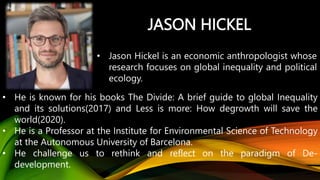
JASON HICKEL
• Jason Hickel is an economic anthropologist whose
research focuses on global inequality and political
ecology.
• He is known for his books The Divide: A brief guide to global Inequality
and its solutions(2017) and Less is more: How degrowth will save the
world(2020).
• He is a Professor at the Institute for Environmental Science of Technology
at the Autonomous University of Barcelona.
• He challenge us to rethink and reflect on the paradigm of De-
development.
ACCORDING TO JASON HICKEL, THE CONCEPT OF
DEVELOPMENT:
• Forget ‘developing’ poor countries, it’s time to
‘de-develop’ rich countries.
• Instead of pushing poor countries to “catch up”
with rich one, we should getting rich countries
to ‘catch down’.
The Sustainable Development groups are about to offer
a fresh plan for how to save the world.
More progressive types tell us that we need to shift
some of the yields of growth from the richer segments
to the population to poorer ones, evening things out a
bit. Neither approach is adequate.
70% of people in middle and high income countries
believe overconsumption is putting our planet at risk.
Either we slow down voluntarily or climate change will do it for
us. We can’t go on ignoring the laws of nature. But rethinking
our theory of progress is not only an ecological imperative, it is
is also a development one. If we do not act soon, all our hard-
won gains against poverty will evaporate, as food systems
collapse and mass famine re-emerges to an extent not seen
since the 19th century.

Human Flourishing as Reflected in Progress and Development.pptx

  • 1.
    HUMAN FLOURISHING AS REFLECTEDIN PROGRESS AND DEVELOPMENT
  • 2.
    HUMAN FLOURISHING • ANEFFORT TO ACHIEVE SELF ACTUALIZATION AND FULFILLMENT WITHIN THE CONTEXT OF A LARGER COMMUNITY OF INDIVIDUALS , EACH WITH THE RIGHT TO PURSUE HIS OR HER OWN SUCH AS EFFORTS. • INVOLVES THE RATIONAL USE OF ONE’S INDIVIDUAL HUMAN POTENTIALITIES, INCLUDING TALENTS, ABILITIES AND VIRTUES IN THE PURSUIT OF HIS FREELY AND RATIONALLY CHOSEN VALUES AND GOALS. QUESTION: HOW DO WE KNOW WE ARE PROGRESSING?
  • 3.
    JASON HICKEL • JasonHickel is an economic anthropologist whose research focuses on global inequality and political ecology. • He is known for his books The Divide: A brief guide to global Inequality and its solutions(2017) and Less is more: How degrowth will save the world(2020). • He is a Professor at the Institute for Environmental Science of Technology at the Autonomous University of Barcelona. • He challenge us to rethink and reflect on the paradigm of De- development.
  • 4.
    ACCORDING TO JASONHICKEL, THE CONCEPT OF DEVELOPMENT: • Forget ‘developing’ poor countries, it’s time to ‘de-develop’ rich countries. • Instead of pushing poor countries to “catch up” with rich one, we should getting rich countries to ‘catch down’.
  • 5.
    The Sustainable Developmentgroups are about to offer a fresh plan for how to save the world. More progressive types tell us that we need to shift some of the yields of growth from the richer segments to the population to poorer ones, evening things out a bit. Neither approach is adequate. 70% of people in middle and high income countries believe overconsumption is putting our planet at risk.
  • 6.
    Either we slowdown voluntarily or climate change will do it for us. We can’t go on ignoring the laws of nature. But rethinking our theory of progress is not only an ecological imperative, it is is also a development one. If we do not act soon, all our hard- won gains against poverty will evaporate, as food systems collapse and mass famine re-emerges to an extent not seen since the 19th century.