












COMPATIBILITY
By : HIND SALMAN AL-SUBGH
Supervisor : MAHER AL-QUAIMI

University of Dammam
College of Applied Medical Science
Respiratory Care Department

Page 1
OUTLINES
•Compound vs Mixture
•Compatibility
•Category of respiratory medications
•Physiological effects
•Some of the Most Common drugs in
respiratory therapy
•What should we mix + Studies
•Cases

Page 2
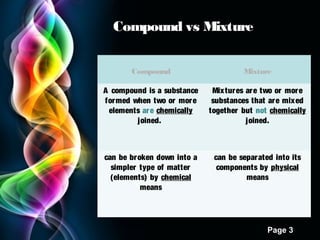
Compound vs Mixture
Compound

Mixture

A compound is a substance
for med when two or mor e
elements ar e chemically
joined.

Mix tures ar e two or more
substances that are mix ed
together but not chemically
joined.

can be broken down into a
simpler type of matter
(elements) by chemical
means

can be separated into its
components by physical
means

Page 3
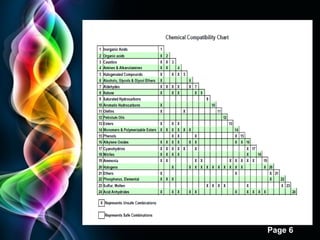
compatibility

CHAMICAL

MEDICAL

Page 4
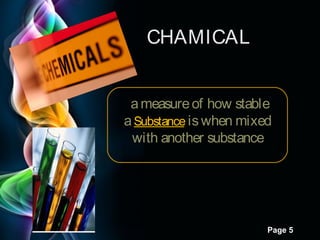
CHAMICAL
 a measure of how stable
a Substance is when mixed
with another substance

Page 5
Page 6
MEDICAL
Two or mor e dr ugs can be
administer ed at the same time
without pr oducing undesir ed side
effects or without canceling or
affecting the ther apeutic effects of
the other s.

Page 7
The Category of
Respiratory Medications
Prescription drugs and medicines for
conditions and diseases relating to the lungs
and/or breathing are :
•Antihistamines
•Antitussives
•Bronchodilators
•Decongestants
•Expectorants

Page 8
Antihistamines
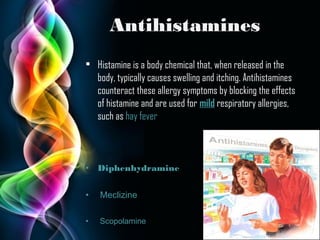
• Histamine is a body chemical that, when released in the
body, typically causes swelling and itching. Antihistamines
counteract these allergy symptoms by blocking the effects
of histamine and are used for mild respiratory allergies,
such as hay fever

•

Diphenhydramine

•

Meclizine

•

Scopolamine

Page 9
Antitussives
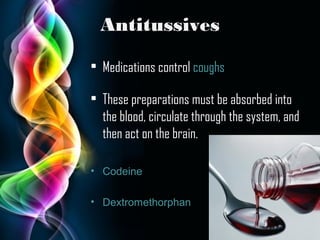
• Medications control coughs
• These preparations must be absorbed into
the blood, circulate through the system, and
then act on the brain.
• Codeine
• Dextromethorphan
Page 10
Expectorants
• used to change a dry nonproductive cough
into a productive one
• Mucolytics

Page 11
Decongestants
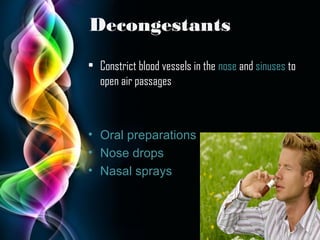
• Constrict blood vessels in the nose and sinuses to
open air passages

• Oral preparations
• Nose drops
• Nasal sprays

Page 12
Bronchodilators
• Agents that open airways in the lungs and medications
that relax smooth-muscle tissue (such as that found in the
lungs) are used to improve breathing
• Sympathomimetic
• Anticholinergic
• Corticosteroids
• Mast Cell Stabilizers
Page 13
Physiological effects
•

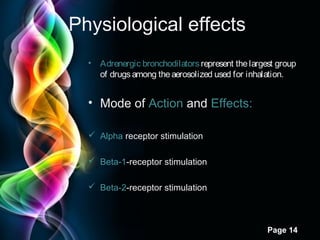
Adrenergic bronchodilators represent the largest group
of drugs among the aerosolized used for inhalation.

• Mode of Action and Effects:
 Alpha receptor stimulation
 Beta-1-receptor stimulation
 Beta-2-receptor stimulation

Page 14
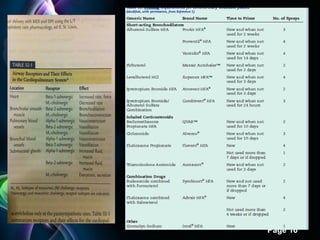
Sympathomimetic
Beta-Agonists
Short acting
Long acting
Epinephrine
Racemic epinephrine

SABA
Ventolin
Proventil

LABA
Formoterol
Salmeterol
Page 15
Page 16
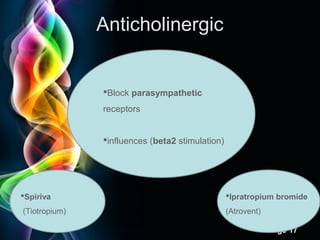
Anticholinergic

Block parasympathetic
receptors
influences (beta2 stimulation)

Spiriva

Ipratropium bromide

(Tiotropium)

(Atrovent)
Page 17
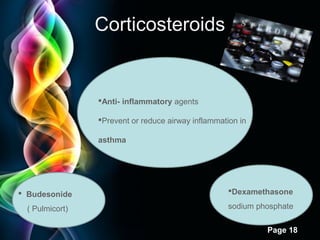
Corticosteroids

Anti- inflammatory agents
Prevent or reduce airway inflammation in
asthma

 Budesonide
( Pulmicort)

Dexamethasone
sodium phosphate
Page 18
Some of Most Common used drugs in
respiratory therapy

Page 19
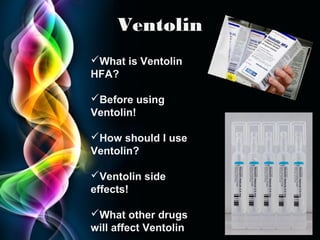
Ventolin
What is Ventolin
HFA?
Before using
Ventolin!
How should I use
Ventolin?
Ventolin side
effects!
What other drugs
will affect Ventolin?

Page 20
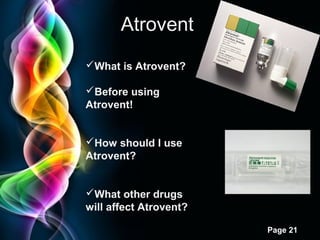
Atrovent
What is Atrovent?
Before using
Atrovent!
How should I use
Atrovent?
What other drugs
will affect Atrovent?
Page 21
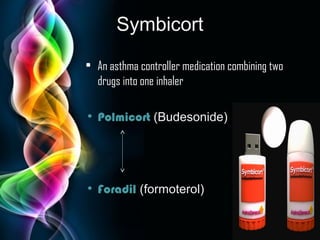
Symbicort
• An asthma controller medication combining two
drugs into one inhaler
• Polmicort (Budesonide)

• Foradil (formoterol)
Page 22
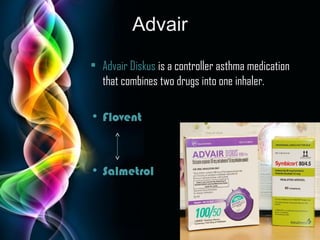
Advair
• Advair Diskus is a controller asthma medication
that combines two drugs into one inhaler. 
• Flovent

• Salmetrol

Page 23
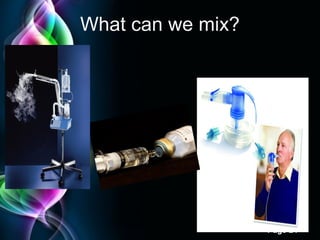
What can we mix?

Page 24
Studies
• Physical and chemical compatibility is one consideration
when determining the appropriateness of mixing
medications for nebulization.
• Several studies have investigated the compatibility of
nebulizer solutions, including antibiotics and bronchodilators.
• Studies of the efficacy and safety of mixing
nebulizer medications have been limited, and few inhalation
solutions are approved by (FDA) to be mixed.
Page 25
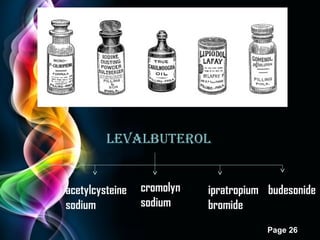
levalbuterol

acetylcysteine
sodium

cromolyn
sodium

ipratropium budesonide
bromide
Page 26
Page 27
cases
Cases

Page 28
RT has administered an aerosol TX of albuterol to
67-year-old COPD pt.
CC/ acute exacerbation & SOB
When the RT returns to the pt. informs him that he began to
feel very shaky and nervous , beginning about 30 min after
the TX. He also noticed a tremor when he held his water
cup.His HR during the earlier TX. Was 84 beats/min. After
the RT did the assessment every thing was normal and stable
although the auscultation reveals mild wheezing and mild
tremor is apparent when he holds his hand out. He states that
he is now feeling better and the ‘ shakiness’ has subsided a
bit.
Page 29
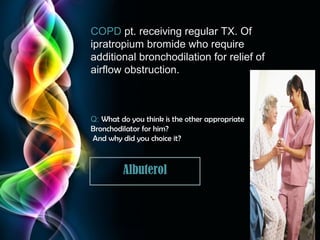
COPD pt. receiving regular TX. Of
ipratropium bromide who require
additional bronchodilation for relief of
airflow obstruction.

Q: What do you think is the other appropriate
Bronchodilator for him?
And why did you choice it?

Albuterol

Page 30
21-year male Pt. came to the ER
with a sever allergic reaction of
seafoods he was gasping for air.

Q : what would be the appropriate Tx. For him ?

Epinephrine injection

Page 31
Proventil
Corticosteroid
Flovent

Salmetrol

Foradil
Atrovent

Pulmicort

Page 32
HFA referring to…?
Propellant
“Hydrofluoroalkane”

Page 33
Can you tell us about your
experience in the 1st clinical practice
and what did you feel at that time
and how did you improve your self?!

Page 34
THaNK YOU
all

Page 35
Resources
-EGAN’S FUNDAMENTALS OF
RESPIRATORY CARE(TEXTBOOK)
HTTP://WWW.CDC.GOV/

HTTP://WWW.RCJOURNAL.COM/CPGS/INDEX.CFM
HTTP://WWW.DRUGS.COM/

Page 36

Inhaled aerosol compatibility

Editor's Notes

  • #3 Compound vs Mixture Compatibility Category of respiratory medications Most Common use drugs in respiratory therapy Physiological effects What should we mix Cases
  • #4 -The smallest unit of a chemical element that has the properties of that element is called an atom. -Elements are substances that cannot be separated into simpler substances
  • #6 If substances mix and do not change they are considered compatible. If substances mix and change or do not mix at all they are considered incompatible
  • #9 Whether your respiratory problem is as minor as a cough or as serious as an asthma attack, the drug that will most likely be prescribed for you will fall under the category of respiratory medications
  • #12 ). Expectorants are supposed to increase the amount of mucus that is produced, but drinking extra water or using a vaporizer or humidifier is probably more effective at increasing mucus production
  • #15 .alfa:vasoconstraction &vasopresser Beta1:increased HR &myocardial contractility Beta2:relaxes bronchial smooth muscle,stimulates mucociliary activity,inhebitory on inflammatory mediater.
  • #16 Racemic epinephrine: strong beta-adrenergic vasoconstricting effect or reduce airway swelling after extubation,control bleeding during endoscopy.
  • #23 Symbicort is an asthma controller medication combining two drugs into one inhaler. inhaled steroiddecreasing irritation and inflammation.+long-acting beta agonist relieves bronchoconstriction= Pulmicort (budesonide)+Foradil (formoterol) Easier than taking each component medicine separately Increases your compliance Allows for lower doses of total inhaled corticosteroid, which may minimize potential side effects
  • #24 Fluticasone (Flovent) +Salmeterol (Serevent) The LABA widens your lung airways and the inhaled steroid decreases and prevents airway inflammation
  • #27 http://www.rcjournal.com/contents/12.08/12.08.1716.pdf
  • #28 Dornase alfa hydrolyzes the DNA present in sputum/mucus of cystic fibrosispatients and reduces viscosity in the lungs, promoting improved clearance of secretions. 
  • #33 Salmeterol (Serevent) Fluticasone (Flovent)  Flovent, Foradil (formoterol)