10/02/16 1
Intravascular
MicroBolometer
Catheter
Ashkan Emadi,MD
Said Siadaty,MD
Ward Casscells,MD
James T. Willerson,MD
Morteza Naghavi,MD
Th e Un i v er si t y o f Texas-H o u st o n
H eal t h Sc i en c e Cen t er
Texas Heart Institute
10/02/16 2
Introduction to Infrared
Technology
• Infrared detectors and detector arrays are used
in many fields of applications today.
• Many of these are based on passive detection
of thermally emitted electromagnetic
radiations as described by the Planck’s law.
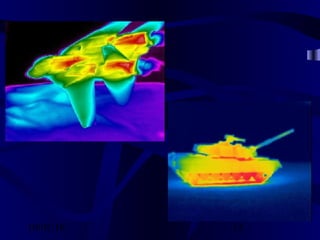
• In this way it is possible to image objects in
darkness, or carry out contactless temperature
measurement.
10/02/16 3
Blackbody & Blackbody Radiation
• Central to radiation thermometry is the
concept of the blackbody. The
blackbody concept is important
because it shows that radiant power
depends on temperature.
• Kirchhoff defined a blackbody as a
surface that neither reflects nor
transmits, but absorbs all incident
radiation, independent of direction and
wavelength.
10/02/16 4
•  In addition to absorbing all incident
radiation, a blackbody is a perfect radiating
body. To describe the emitting capabilities of a
surface in comparison to a blackbody, Kirchoff
defined emissivity of a real surface as the ratio
of the thermal radiation emitted by a surface at
a given temperature to that of a blackbody at the
same temperature and for the same spectral and
directional conditions.
• Boltzmann showed that the radiation emitted
by a blackbody is proportional to the fourth
power of the absolute temperature of the
surface.
10/02/16 5
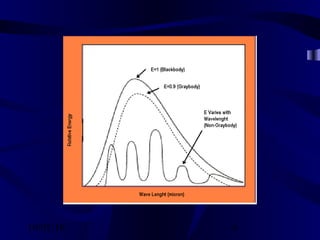
• Almost all of the real objects and surfaces
have emissivities less than 1. Objects with
an emissivity less than one are named
graybodies. Most organic objects are
graybodies, with an emissivity between
0.90 and 0.95.
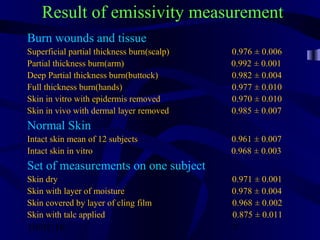
• Boylan A. et al reported that emissivities of
burn wound tissues were in the range 0.976-
0.992, greater than those of intact skin by
0.01-0.03.
• We speculate plaque emissivity is similar to
wound lesions.
                                                                         
10/02/16 6
10/02/16 7
Result of emissivity measurement
Burn wounds and tissue
Superficial partial thickness burn(scalp) 0.976 ± 0.006
Partial thickness burn(arm) 0.992 ± 0.001
Deep Partial thickness burn(buttock) 0.982 ± 0.004
Full thickness burn(hands) 0.977 ± 0.010
Skin in vitro with epidermis removed 0.970 ± 0.010
Skin in vivo with dermal layer removed 0.985 ± 0.007
Normal Skin
Intact skin mean of 12 subjects 0.961 ± 0.007
Intact skin in vitro 0.968 ± 0.003
Set of measurements on one subject
Skin dry 0.971 ± 0.001
Skin with layer of moisture 0.978 ± 0.004
Skin covered by layer of cling film 0.968 ± 0.002
Skin with talc applied 0.875 ± 0.011
10/02/16 8
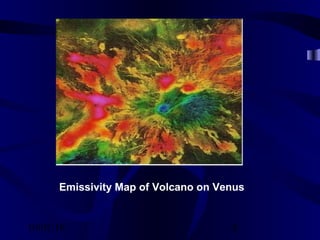
Emissivity Map of Volcano on Venus
10/02/16 9
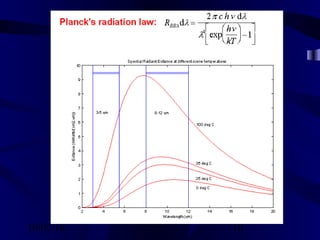
Planck’s Radiation Law
Planck's distribution shows that as
wavelength varies, emitted radiation
varies continuously. As temperature
increases, the total amount of energy
emitted increases and the peak of the
curve shifts to the left, or toward the
shorter wavelengths.
10/02/16 10
10/02/16 11
Planck’s radiation law states that
every object at a temperature above
absolute zero emits
electromagnetic radiation.
The higher the temperature the
higher is the emitted intensity.
The wavelength of maximum
intensity decreases when the
temperature increases.
10/02/16 12
Trends in Application &
Marketing of Infrared Detectors
 It is notable, that from a global perspective, for
many years all the major breakthroughs in infrared
technology, and the major purchases of infrared
equipment, have been funded by a military
sponsor. Consequently, the technology has been
developed with the military use in mind, and the
emphasis been on high performance IR systems,
predominantly cooled photon detectors.
10/02/16 13
10/02/16 14
However, the main future trend will most
certainly be to reexamine one of the strengths
of infrared technology i. e. its suitability to
applications outside the military sector, and
meeting the needs of the civil customer.
The civil sector can accept a lower
performance, but the price per unit must be
kept low, and the equipment user friendly.
The medium performance, uncooled
thermal detector technology is certainly
suitable for this.
10/02/16 15
A potentially important
civilian market for
uncooled infrared detector
arrays is :
10/02/16 16
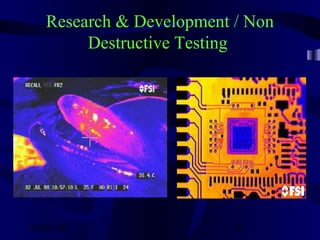
Research & Development / Non
Destructive Testing
10/02/16 17
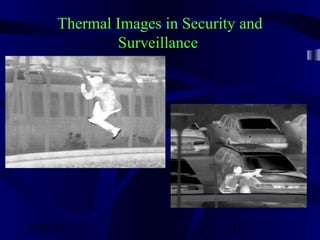
Thermal Images in Security and
Surveillance
10/02/16 18
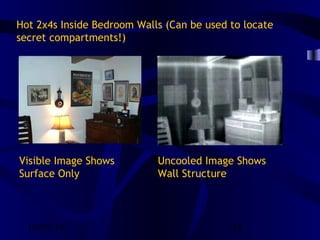
Hot 2x4s Inside Bedroom Walls (Can be used to locate
secret compartments!)
Visible Image Shows
Surface Only
Uncooled Image Shows
Wall Structure
10/02/16 19
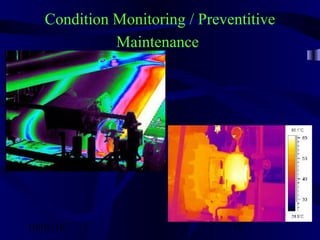
Condition Monitoring / Preventitive
Maintenance
10/02/16 20
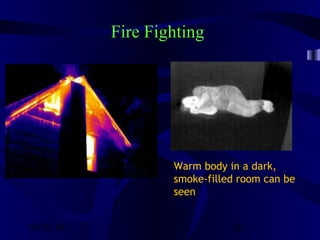
Fire Fighting
Warm body in a dark,
smoke-filled room can be
seen
10/02/16 21
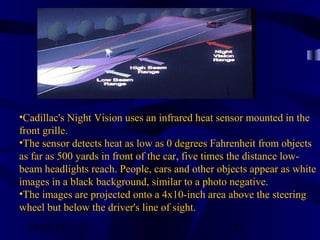
General Motors says it will be the first automaker to offer
night vision technology when its 2000 model Cadillac
DeVille goes on sale next year.
10/02/16 22
•Cadillac's Night Vision uses an infrared heat sensor mounted in the
front grille.
•The sensor detects heat as low as 0 degrees Fahrenheit from objects
as far as 500 yards in front of the car, five times the distance low-
beam headlights reach. People, cars and other objects appear as white
images in a black background, similar to a photo negative.
•The images are projected onto a 4x10-inch area above the steering
wheel but below the driver's line of sight.
10/02/16 23
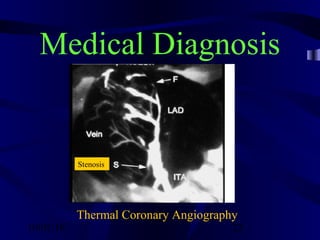
Medical Diagnosis
Thermal Coronary Angiography
Stenosis
10/02/16 24
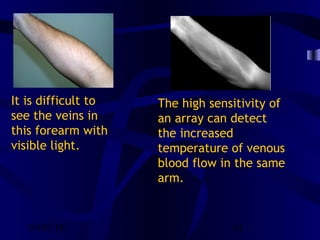
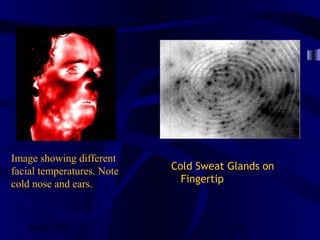
It is difficult to
see the veins in
this forearm with
visible light.
The high sensitivity of
an array can detect
the increased
temperature of venous
blood flow in the same
arm.
10/02/16 25
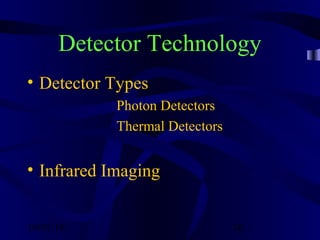
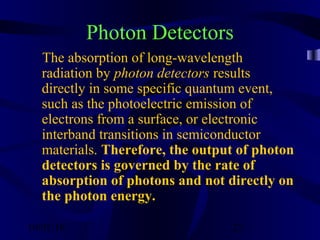
Image showing different
facial temperatures. Note
cold nose and ears.
                                                    
Cold Sweat Glands on
Fingertip
10/02/16 26
Detector Technology
• Detector Types
Photon Detectors
Thermal Detectors
• Infrared Imaging
10/02/16 27
Photon Detectors
The absorption of long-wavelength
radiation by photon detectors results
directly in some specific quantum event,
such as the photoelectric emission of
electrons from a surface, or electronic
interband transitions in semiconductor
materials. Therefore, the output of photon
detectors is governed by the rate of
absorption of photons and not directly on
the photon energy.
10/02/16 28
Photon detectors normally require cooling
down to cryogenic temperatures in order to
get rid of excessive dark current, but in
return their general performance is higher,
with larger detectivities and smaller
response times. In most cases photon
detectors need to be cooled to cryogenic
temperatures, i. e. down to 77 K (liquid
nitrogen) or 4 K (liquid helium). Quantum
Well Infrared Photodetector (QWIP) Arrays
is a type of photon detector.
10/02/16 29
Background Limited Infrared
Photodetector (BLIP)
• The current from an infrared detector may be
subdivided into two parts: photocurrent and dark
current. The photocurrent is the useful response of
the detector, whereas the dark current is an
undesired part.
• Photocurrent results from absorption of infrared
photons in the detector. These photons create
charge carriers which can be collected as a
photocurrent.
10/02/16 30
Dark current is by definition present even if the
detector is not illuminated. The origin of dark
current is usually thermal excitation of charge
carriers, a process that competes with
photoexcitation. Due to the thermal origin, dark
current depends on the detector temperature. The
most efficient way of getting rid of dark current is
to cool down the detector to a temperature where
the photocurrent becomes the dominant one.
However, since cooling is expensive, during the
detector design phase, every action should be
taken to minimize dark current and maximize
photocurrent.
10/02/16 31
• When photocurrent dominates over dark current
the detector is said to be background limited or
BLIP (Background Limited Infrared
Photodetector). Background here means the high
temperature (not cooled) surroundings or scene
(including imaged objects) within the detector
field of view. The background scene emits
infrared photons sensed by the detector giving rise
to a photocurrent.
• Usually BLIP temperature is defined as the
temperature where the photocurrent is ten times as
large as the dark current.
10/02/16 32
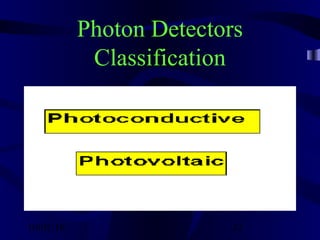
Photon Detectors
Classification
10/02/16 33
Photoconductive Detectors
The function of photoconductive detectors are
based on the photogeneration of charge carriers
(electrons, holes or electron-hole pairs). These
charge carriers increase the conductivity of the
device material. Detector materials possible to
utilize for photoconductive detectors are:
*indium antimonide (InSb)
*quantum well infrared photodetector (QWIP)
*mercury cadmium telluride (mercad, MCT)
*lead sulfide (PbS)
*lead selenide (PbSe)
10/02/16 34
Photovoltaic Detectors
Photovoltaic devices require an internal potential
barrier with a built-in electric field in order to
separate photo-generated electron-hole pair.
Whereas the current-voltage characteristics of
photoconductive devices are symmetric with
respect to the polarity of the applied voltage,
photovoltaic devices exhibit rectifying behavior.
Examples of photovoltaic infrared detector types
are:
*indium antimonide (InSb)
*mercury cadmium telluride (MCT)
*platinum silicide (PtSi) - silicon Schottky barrier
10/02/16 35
Thermal Detector Arrays
In contrast to photon detectors, the operation of
thermal detectors depends on a two-step
process.
1. The absorption of infrared radiation in these
detectors raises the temperature of the device,
2. which in turn changes some temperature-
dependent parameter such as electrical
conductivity.
Thermal detectors may be thermopile
(Seebeck effect), Golay cell detectors,
pyroelectric detectors, or bolometer.
10/02/16 36
Bolometer
• A resistive bolometer contains a
resistive material, whose resistivity
changes with temperature.
• To achieve high sensitivity the
Temperature Coefficient of the
Resistivity (TCR) should be as large as
possible and the Noise resulting from
contacts and the material itself should
be low.
10/02/16 37
Resistive Materials in Bolometer
Resistive materials could be metals such as
platinum, or semiconductors (thermistors).
Metals usually have low noise but have low
temperature coefficients (about 0.2 %/K),
semiconductors have high temperature
coefficients (1-4 %/K) but are prone to be
more noisy. Semiconductors used for
infrared detectors are,e. g., polycrystalline
silicon, or vanadium oxide.
10/02/16 38
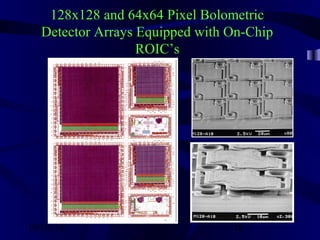
128x128 and 64x64 Pixel Bolometric
Detector Arrays Equipped with On-Chip
ROIC’s
10/02/16 39
ROIC
The electronic chip used to
multiplex or read out the signals
from the detector elements are
usually called readout integrated
circuit (ROIC) or (analogue)
multiplexer.
10/02/16 40
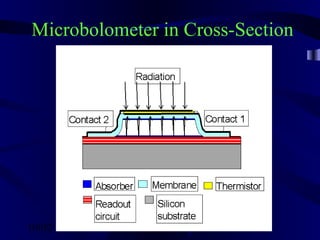
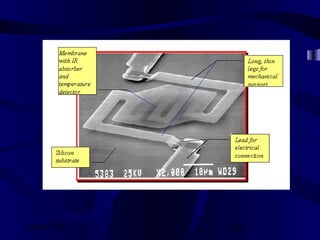
Microbolometer in Cross-Section
10/02/16 41
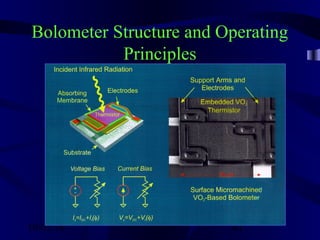
Bolometer Structure and Operating
Principles
10/02/16 42
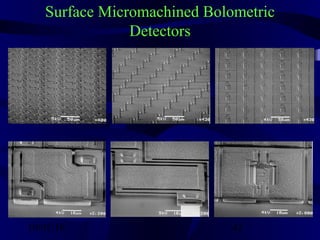
Surface Micromachined Bolometric
Detectors
10/02/16 43
Surface Micromachining
is used for the fabrication of the
detector elements, consisting of thin
bridge structures or membranes
10/02/16 44
10/02/16 45
NETD
NETD is an abbreviation for Noise
Equivalent Temperature Difference
and is a measure of the smallest
object temperature difference
possible to detect by an IR camera.
10/02/16 46
Thermal Detector specification
The requirement on detector arrays
comprising the detectors integrated
with readout electronics is a
temperature resolution (NETD)
< 100 mK, for a camera optics
f-number = 1 and 50 Hz frame rate.
10/02/16 47
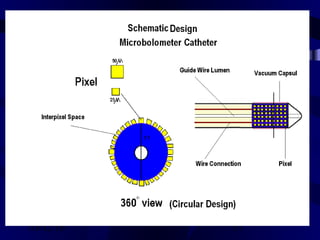
Vacuum Encapsulation
The major requirement for achieving high
sensitivity is an efficient thermal insulation
between the detector element and the
substrate. This necessitates vacuum
encapsulation of the detector. Next in
importance is a sensitive means of
temperature detection. Semiconductor based
layers (thermistors) with large temperature
coefficient, and pyroelectric materials, are
good choices.
10/02/16 48
Advantage & Disadvantage of Thermal
Detectors
• The major advantage of thermal detectors is that
they can operate at room temperature (Uncooled
Detector).
• The sensitivity is lower and the response time
longer than for photon detectors. This makes
thermal detectors suitable for focal plane array
(FPA) operation, where the latter two properties
are less critical.
10/02/16 49
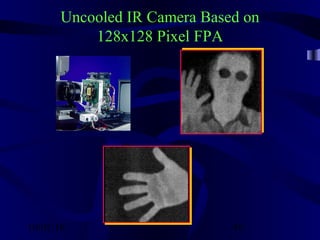
Uncooled IR Camera Based on
128x128 Pixel FPA
10/02/16 50
Infrared Imaging
• There are two basic types of infrared imaging
systems: mechanical scanning systems and
systems based on detector arrays without
scanner.
• A mechanical scanner utilizes one or more
moving mirrors to sample the object plane
sequentially in a row-wise manner and project
these onto the detector . The advantage is that
only one single detector is needed. The drawbacks
are that high precision and thus expensive opto-
mechanical parts are needed, and the detector
response time has to be short.
10/02/16 51
Infrared Imaging
Detector arrays operated as focal plane arrays
(FPA) (or staring arrays) are located in the focal
plane of a camera system, and are thus replacing
the film of a conventional camera for visible light.
The advantage is that no moving mechanical parts
are needed and that the detector sensitivity can be
low and the detector slow.The drawback is that the
detector array is more complicated to fabricate.
However, with the ascent of rational methods for
semiconductor fabrication, economy will be
advantageous, provided that production volumes
are large. The general trend is that infrared camera
systems will be based on FPAs, except for special
applications.
10/02/16 52
Infrared Imaging
• The spatial resolution of the image is determined
by the number of pixels of the detector array.
• Common formats for commercial infrared
detectors are 320x240 pixels (320 columns, 240
rows), and 640x480. The latter format (or
something close to it), which is nearly the
resolution obtained by standard TV, will probably
become commercially available in the next few
years.
10/02/16 53
Detector arrays are more complicated to
fabricate, since besides the detector
elements with the function of responding to
radiation, electronic circuitry is needed to
multiplex all the detector signals to one or
a few output leads in a serial manner. The
output from the array is either in analogue
or digital form.
10/02/16 54
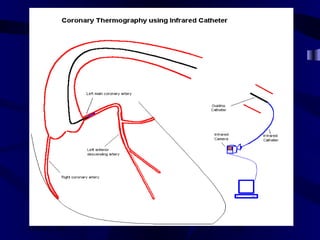
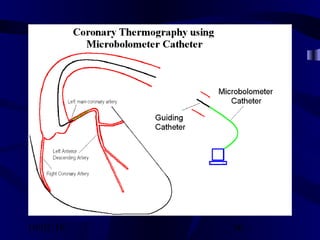
Our Proposal
Intravascular
Microbolometer
Catheter
10/02/16 55
10/02/16 56
10/02/16 57
10/02/16 58
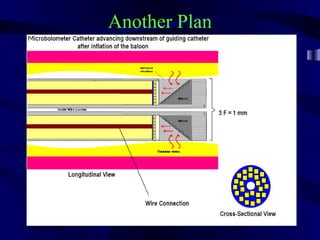
Another Plan
10/02/16 59
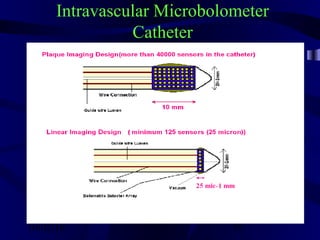
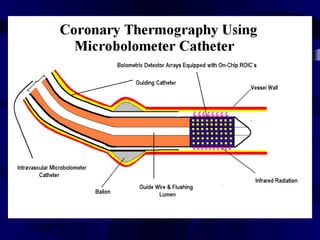
Intravascular Microbolometer
Catheter
10/02/16 60
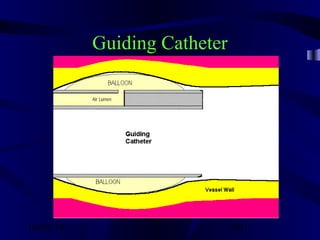
Guiding Catheter
10/02/16 61
10/02/16 62
10/02/16 63
10/02/16 64
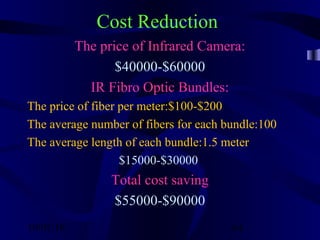
Cost Reduction
The price of Infrared Camera:
$40000-$60000
IR Fibro Optic Bundles:
The price of fiber per meter:$100-$200
The average number of fibers for each bundle:100
The average length of each bundle:1.5 meter
$15000-$30000
Total cost saving
$55000-$90000
10/02/16 65
Comparison between Fibro Optic Camera &
Microbolometer Catheter
10/02/16 66
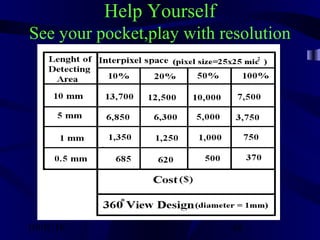
Cost-Effectiveness of different Options
1. Plaque Imaging Model(10 mm option)
Cost:
Area of each Pixel = 25 x 25 =625 µ²
Detecting Area= [10 x (2 x 3.14 x (½)] = 31.4 x 10⁶µ²
Interpixels Area = 10% of each pixel area
Net Detecting Area=28.26 x 10⁶µ²
The Number of Pixels = 45670 ~ 45500 spots
(It is far more than enough because each fiber optic
bundle can visualize 100 spots of the plaque)
Advantages: Instantaneous Viewing of the Plaque
Drawback: High Cost, Inflexibility
(Minimal Bending Radius)
10/02/16 67
Cost-Effectiveness of Different options
2. Linear Imaging Model(1 mm)
Cost:
Area of each Pixel = 25 x 25 =625 µ²
Detecting Area = [1 x (2 x 3.14 x (½)] = 3.14 x 10⁶µ²
Interpixels Area = 10% of each pixel area
Net Detecting Area = 2.826 x 10⁶µ²
The Number of Pixels =4560 ~ 4500
Advantages:Low Cost, Flexible
Drawback:Needs software for the image
reconstruction
10/02/16 68
Help Yourself
See your pocket,play with resolution
10/02/16 69
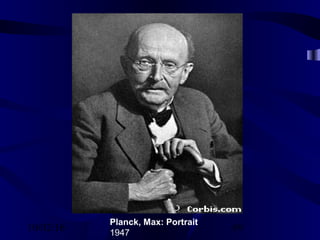
Planck, Max: Portrait
1947

080 intravascular micro bolometer catheter

  • 1.
    10/02/16 1 Intravascular MicroBolometer Catheter Ashkan Emadi,MD SaidSiadaty,MD Ward Casscells,MD James T. Willerson,MD Morteza Naghavi,MD Th e Un i v er si t y o f Texas-H o u st o n H eal t h Sc i en c e Cen t er Texas Heart Institute
  • 2.
    10/02/16 2 Introduction toInfrared Technology • Infrared detectors and detector arrays are used in many fields of applications today. • Many of these are based on passive detection of thermally emitted electromagnetic radiations as described by the Planck’s law. • In this way it is possible to image objects in darkness, or carry out contactless temperature measurement.
  • 3.
    10/02/16 3 Blackbody &Blackbody Radiation • Central to radiation thermometry is the concept of the blackbody. The blackbody concept is important because it shows that radiant power depends on temperature. • Kirchhoff defined a blackbody as a surface that neither reflects nor transmits, but absorbs all incident radiation, independent of direction and wavelength.
  • 4.
    10/02/16 4 •  In additionto absorbing all incident radiation, a blackbody is a perfect radiating body. To describe the emitting capabilities of a surface in comparison to a blackbody, Kirchoff defined emissivity of a real surface as the ratio of the thermal radiation emitted by a surface at a given temperature to that of a blackbody at the same temperature and for the same spectral and directional conditions. • Boltzmann showed that the radiation emitted by a blackbody is proportional to the fourth power of the absolute temperature of the surface.
  • 5.
    10/02/16 5 • Almostall of the real objects and surfaces have emissivities less than 1. Objects with an emissivity less than one are named graybodies. Most organic objects are graybodies, with an emissivity between 0.90 and 0.95. • Boylan A. et al reported that emissivities of burn wound tissues were in the range 0.976- 0.992, greater than those of intact skin by 0.01-0.03. • We speculate plaque emissivity is similar to wound lesions.                                                                          
  • 6.
  • 7.
    10/02/16 7 Result ofemissivity measurement Burn wounds and tissue Superficial partial thickness burn(scalp) 0.976 ± 0.006 Partial thickness burn(arm) 0.992 ± 0.001 Deep Partial thickness burn(buttock) 0.982 ± 0.004 Full thickness burn(hands) 0.977 ± 0.010 Skin in vitro with epidermis removed 0.970 ± 0.010 Skin in vivo with dermal layer removed 0.985 ± 0.007 Normal Skin Intact skin mean of 12 subjects 0.961 ± 0.007 Intact skin in vitro 0.968 ± 0.003 Set of measurements on one subject Skin dry 0.971 ± 0.001 Skin with layer of moisture 0.978 ± 0.004 Skin covered by layer of cling film 0.968 ± 0.002 Skin with talc applied 0.875 ± 0.011
  • 8.
    10/02/16 8 Emissivity Mapof Volcano on Venus
  • 9.
    10/02/16 9 Planck’s RadiationLaw Planck's distribution shows that as wavelength varies, emitted radiation varies continuously. As temperature increases, the total amount of energy emitted increases and the peak of the curve shifts to the left, or toward the shorter wavelengths.
  • 10.
  • 11.
    10/02/16 11 Planck’s radiationlaw states that every object at a temperature above absolute zero emits electromagnetic radiation. The higher the temperature the higher is the emitted intensity. The wavelength of maximum intensity decreases when the temperature increases.
  • 12.
    10/02/16 12 Trends inApplication & Marketing of Infrared Detectors  It is notable, that from a global perspective, for many years all the major breakthroughs in infrared technology, and the major purchases of infrared equipment, have been funded by a military sponsor. Consequently, the technology has been developed with the military use in mind, and the emphasis been on high performance IR systems, predominantly cooled photon detectors.
  • 13.
  • 14.
    10/02/16 14 However, themain future trend will most certainly be to reexamine one of the strengths of infrared technology i. e. its suitability to applications outside the military sector, and meeting the needs of the civil customer. The civil sector can accept a lower performance, but the price per unit must be kept low, and the equipment user friendly. The medium performance, uncooled thermal detector technology is certainly suitable for this.
  • 15.
    10/02/16 15 A potentiallyimportant civilian market for uncooled infrared detector arrays is :
  • 16.
    10/02/16 16 Research &Development / Non Destructive Testing
  • 17.
    10/02/16 17 Thermal Imagesin Security and Surveillance
  • 18.
    10/02/16 18 Hot 2x4sInside Bedroom Walls (Can be used to locate secret compartments!) Visible Image Shows Surface Only Uncooled Image Shows Wall Structure
  • 19.
    10/02/16 19 Condition Monitoring/ Preventitive Maintenance
  • 20.
    10/02/16 20 Fire Fighting Warmbody in a dark, smoke-filled room can be seen
  • 21.
    10/02/16 21 General Motorssays it will be the first automaker to offer night vision technology when its 2000 model Cadillac DeVille goes on sale next year.
  • 22.
    10/02/16 22 •Cadillac's NightVision uses an infrared heat sensor mounted in the front grille. •The sensor detects heat as low as 0 degrees Fahrenheit from objects as far as 500 yards in front of the car, five times the distance low- beam headlights reach. People, cars and other objects appear as white images in a black background, similar to a photo negative. •The images are projected onto a 4x10-inch area above the steering wheel but below the driver's line of sight.
  • 23.
    10/02/16 23 Medical Diagnosis ThermalCoronary Angiography Stenosis
  • 24.
    10/02/16 24 It isdifficult to see the veins in this forearm with visible light. The high sensitivity of an array can detect the increased temperature of venous blood flow in the same arm.
  • 25.
    10/02/16 25 Image showingdifferent facial temperatures. Note cold nose and ears.                                                      Cold Sweat Glands on Fingertip
  • 26.
    10/02/16 26 Detector Technology •Detector Types Photon Detectors Thermal Detectors • Infrared Imaging
  • 27.
    10/02/16 27 Photon Detectors Theabsorption of long-wavelength radiation by photon detectors results directly in some specific quantum event, such as the photoelectric emission of electrons from a surface, or electronic interband transitions in semiconductor materials. Therefore, the output of photon detectors is governed by the rate of absorption of photons and not directly on the photon energy.
  • 28.
    10/02/16 28 Photon detectorsnormally require cooling down to cryogenic temperatures in order to get rid of excessive dark current, but in return their general performance is higher, with larger detectivities and smaller response times. In most cases photon detectors need to be cooled to cryogenic temperatures, i. e. down to 77 K (liquid nitrogen) or 4 K (liquid helium). Quantum Well Infrared Photodetector (QWIP) Arrays is a type of photon detector.
  • 29.
    10/02/16 29 Background LimitedInfrared Photodetector (BLIP) • The current from an infrared detector may be subdivided into two parts: photocurrent and dark current. The photocurrent is the useful response of the detector, whereas the dark current is an undesired part. • Photocurrent results from absorption of infrared photons in the detector. These photons create charge carriers which can be collected as a photocurrent.
  • 30.
    10/02/16 30 Dark currentis by definition present even if the detector is not illuminated. The origin of dark current is usually thermal excitation of charge carriers, a process that competes with photoexcitation. Due to the thermal origin, dark current depends on the detector temperature. The most efficient way of getting rid of dark current is to cool down the detector to a temperature where the photocurrent becomes the dominant one. However, since cooling is expensive, during the detector design phase, every action should be taken to minimize dark current and maximize photocurrent.
  • 31.
    10/02/16 31 • Whenphotocurrent dominates over dark current the detector is said to be background limited or BLIP (Background Limited Infrared Photodetector). Background here means the high temperature (not cooled) surroundings or scene (including imaged objects) within the detector field of view. The background scene emits infrared photons sensed by the detector giving rise to a photocurrent. • Usually BLIP temperature is defined as the temperature where the photocurrent is ten times as large as the dark current.
  • 32.
  • 33.
    10/02/16 33 Photoconductive Detectors Thefunction of photoconductive detectors are based on the photogeneration of charge carriers (electrons, holes or electron-hole pairs). These charge carriers increase the conductivity of the device material. Detector materials possible to utilize for photoconductive detectors are: *indium antimonide (InSb) *quantum well infrared photodetector (QWIP) *mercury cadmium telluride (mercad, MCT) *lead sulfide (PbS) *lead selenide (PbSe)
  • 34.
    10/02/16 34 Photovoltaic Detectors Photovoltaicdevices require an internal potential barrier with a built-in electric field in order to separate photo-generated electron-hole pair. Whereas the current-voltage characteristics of photoconductive devices are symmetric with respect to the polarity of the applied voltage, photovoltaic devices exhibit rectifying behavior. Examples of photovoltaic infrared detector types are: *indium antimonide (InSb) *mercury cadmium telluride (MCT) *platinum silicide (PtSi) - silicon Schottky barrier
  • 35.
    10/02/16 35 Thermal DetectorArrays In contrast to photon detectors, the operation of thermal detectors depends on a two-step process. 1. The absorption of infrared radiation in these detectors raises the temperature of the device, 2. which in turn changes some temperature- dependent parameter such as electrical conductivity. Thermal detectors may be thermopile (Seebeck effect), Golay cell detectors, pyroelectric detectors, or bolometer.
  • 36.
    10/02/16 36 Bolometer • Aresistive bolometer contains a resistive material, whose resistivity changes with temperature. • To achieve high sensitivity the Temperature Coefficient of the Resistivity (TCR) should be as large as possible and the Noise resulting from contacts and the material itself should be low.
  • 37.
    10/02/16 37 Resistive Materialsin Bolometer Resistive materials could be metals such as platinum, or semiconductors (thermistors). Metals usually have low noise but have low temperature coefficients (about 0.2 %/K), semiconductors have high temperature coefficients (1-4 %/K) but are prone to be more noisy. Semiconductors used for infrared detectors are,e. g., polycrystalline silicon, or vanadium oxide.
  • 38.
    10/02/16 38 128x128 and64x64 Pixel Bolometric Detector Arrays Equipped with On-Chip ROIC’s
  • 39.
    10/02/16 39 ROIC The electronicchip used to multiplex or read out the signals from the detector elements are usually called readout integrated circuit (ROIC) or (analogue) multiplexer.
  • 40.
  • 41.
    10/02/16 41 Bolometer Structureand Operating Principles
  • 42.
  • 43.
    10/02/16 43 Surface Micromachining isused for the fabrication of the detector elements, consisting of thin bridge structures or membranes
  • 44.
  • 45.
    10/02/16 45 NETD NETD isan abbreviation for Noise Equivalent Temperature Difference and is a measure of the smallest object temperature difference possible to detect by an IR camera.
  • 46.
    10/02/16 46 Thermal Detectorspecification The requirement on detector arrays comprising the detectors integrated with readout electronics is a temperature resolution (NETD) < 100 mK, for a camera optics f-number = 1 and 50 Hz frame rate.
  • 47.
    10/02/16 47 Vacuum Encapsulation Themajor requirement for achieving high sensitivity is an efficient thermal insulation between the detector element and the substrate. This necessitates vacuum encapsulation of the detector. Next in importance is a sensitive means of temperature detection. Semiconductor based layers (thermistors) with large temperature coefficient, and pyroelectric materials, are good choices.
  • 48.
    10/02/16 48 Advantage &Disadvantage of Thermal Detectors • The major advantage of thermal detectors is that they can operate at room temperature (Uncooled Detector). • The sensitivity is lower and the response time longer than for photon detectors. This makes thermal detectors suitable for focal plane array (FPA) operation, where the latter two properties are less critical.
  • 49.
    10/02/16 49 Uncooled IRCamera Based on 128x128 Pixel FPA
  • 50.
    10/02/16 50 Infrared Imaging •There are two basic types of infrared imaging systems: mechanical scanning systems and systems based on detector arrays without scanner. • A mechanical scanner utilizes one or more moving mirrors to sample the object plane sequentially in a row-wise manner and project these onto the detector . The advantage is that only one single detector is needed. The drawbacks are that high precision and thus expensive opto- mechanical parts are needed, and the detector response time has to be short.
  • 51.
    10/02/16 51 Infrared Imaging Detectorarrays operated as focal plane arrays (FPA) (or staring arrays) are located in the focal plane of a camera system, and are thus replacing the film of a conventional camera for visible light. The advantage is that no moving mechanical parts are needed and that the detector sensitivity can be low and the detector slow.The drawback is that the detector array is more complicated to fabricate. However, with the ascent of rational methods for semiconductor fabrication, economy will be advantageous, provided that production volumes are large. The general trend is that infrared camera systems will be based on FPAs, except for special applications.
  • 52.
    10/02/16 52 Infrared Imaging •The spatial resolution of the image is determined by the number of pixels of the detector array. • Common formats for commercial infrared detectors are 320x240 pixels (320 columns, 240 rows), and 640x480. The latter format (or something close to it), which is nearly the resolution obtained by standard TV, will probably become commercially available in the next few years.
  • 53.
    10/02/16 53 Detector arraysare more complicated to fabricate, since besides the detector elements with the function of responding to radiation, electronic circuitry is needed to multiplex all the detector signals to one or a few output leads in a serial manner. The output from the array is either in analogue or digital form.
  • 54.
  • 55.
  • 56.
  • 57.
  • 58.
  • 59.
  • 60.
  • 61.
  • 62.
  • 63.
  • 64.
    10/02/16 64 Cost Reduction Theprice of Infrared Camera: $40000-$60000 IR Fibro Optic Bundles: The price of fiber per meter:$100-$200 The average number of fibers for each bundle:100 The average length of each bundle:1.5 meter $15000-$30000 Total cost saving $55000-$90000
  • 65.
    10/02/16 65 Comparison betweenFibro Optic Camera & Microbolometer Catheter
  • 66.
    10/02/16 66 Cost-Effectiveness ofdifferent Options 1. Plaque Imaging Model(10 mm option) Cost: Area of each Pixel = 25 x 25 =625 µ² Detecting Area= [10 x (2 x 3.14 x (½)] = 31.4 x 10⁶µ² Interpixels Area = 10% of each pixel area Net Detecting Area=28.26 x 10⁶µ² The Number of Pixels = 45670 ~ 45500 spots (It is far more than enough because each fiber optic bundle can visualize 100 spots of the plaque) Advantages: Instantaneous Viewing of the Plaque Drawback: High Cost, Inflexibility (Minimal Bending Radius)
  • 67.
    10/02/16 67 Cost-Effectiveness ofDifferent options 2. Linear Imaging Model(1 mm) Cost: Area of each Pixel = 25 x 25 =625 µ² Detecting Area = [1 x (2 x 3.14 x (½)] = 3.14 x 10⁶µ² Interpixels Area = 10% of each pixel area Net Detecting Area = 2.826 x 10⁶µ² The Number of Pixels =4560 ~ 4500 Advantages:Low Cost, Flexible Drawback:Needs software for the image reconstruction
  • 68.
    10/02/16 68 Help Yourself Seeyour pocket,play with resolution
  • 69.