An Infrared technologyhas a wide variety of wireless applications mostly in
object sensing and remote controls.
In the electromagnetic spectrum, the infrared portion divided into three
regions: near infrared region, mid infrared region and far infrared region.
I
I
I
I
I
I
I
I
3.
What is anIR Sensor?
IR sensor is an electronic device, that emits the light in order to sense some
object of the surroundings. An IR sensor can measure the heat of an object as
well as detects the motion. Usually, in the infrared spectrum, all the objects
radiate some form of thermal radiation. These types of radiations are invisible to
our eyes, but infrared sensor can detect these radiations.
The emitter is simply an IR LED (Light Emitting Diode) and the detector is simply
an IR photodiode . Photodiode is sensitive to IR light of the same wavelength
which is emitted by the IR LED. When IR light falls on the photodiode, the
resistances and the output voltages will change in proportion to the magnitude of
the IR light received.
I
I
I
I
I
I
I
I
I
4.
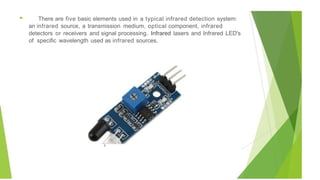
► There arefive basic elements used in a typical infrared detection system:
an infrared source, a transmission medium, optical component, infrared
detectors or receivers and signal processing. Infrared lasers and Infrared LED's
of specific wavelength used as infrared sources.
'
5.
Types of IRSensor
There are two types of IR sensors are available and they are,
► Active Infrared Sensor
Active infrared sensors consist of two elements: infrared source and infrared
detector. Infrared sources include the LED or infrared laser diode. Infrared
detectors include photodiodes or phototransistors. The energy emitted by the
infrared source is reflected by an object and falls on the infrared detector.
► Passive Infrared Sensor
Passive infrared sensors are basically Infrared detectors. Passive infrared sensors
do not use any infrared source and detector. They are of two types: quantum and
thermal. Thermal infrared sensors use infrared energy as the source of heat.
I
I
I
I
I
I
I
I
I
6.
IR Sensor Working
Principle
Thereare different types of infrared transmitters depending on their
wavelengths, output power and response time. An IR sensor consists of an IR
LED and an IR Photodiode, together they are called as PhotoCoupler or
OptoCoupler.
► IR Transmitter or IR LED
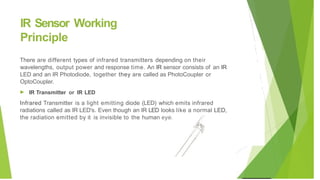
Infrared Transmitter is a light emitting diode (LED) which emits infrared
radiations called as IR LED's. Even though an IR LED looks like a normal LED,
the radiation emitted by it is invisible to the human eye.
I
I
I
I
I
I
I
I
I
7.
► IR Receiveror Photodiode
Infrared receivers or infrared sensors detect the radiation from an IR transmitter.
IR receivers come in the form of photodiodes and phototransistors. Infrared
Photodiodes are different from normal photo diodes as they detect only infrared
radiation.
Different types of IR receivers exist based on the wavelength, voltage, package,
etc. When used in an infrared transmitter - receiver combination, the
wavelength of the receiver should match with that of the transmitter.
8.
► The emitteris an IR LED and the detector is an IR photodiode. The IR
photodiode is sensitive to the IR light emitted by an IR LED. The photo-diode's
resistance and output voltage change in proportion to the IR light received.
This is the underlying working principle of the IR sensor.
► When the IR transmitter emits radiation, it reaches the object and some of
the radiation reflects back to the IR receiver. Based on the intensity of
the reception by the IR receiver, the output of the sensor defines.
IR
LED
IR light
IR
Sensor Object
Photo
diode
Reflected IR light
9.
Applications of IRSensor
► Night Vision Devices
► Radiation Thermometers
► Infrared Tracking
► IR Imaging Devices
Read more at Robu.in
I
I
I
I
I
I
I
I