INFRARED RADIATION

       A short history
         What is it?
Application of infrared rays in
           our life
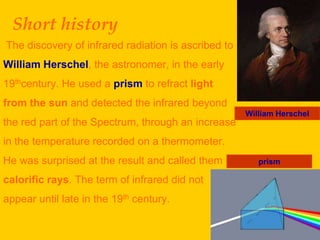
Short history
The discovery of infrared radiation is ascribed to
William Herschel, the astronomer, in the early
19thcentury. He used a prism to refract light
from the sun and detected the infrared beyond
                                                     William Herschel
the red part of the Spectrum, through an increase
in the temperature recorded on a thermometer.
He was surprised at the result and called them          prism

calorific rays. The term of infrared did not
appear until late in the 19th century.
What is the
   infrared
  radiation?

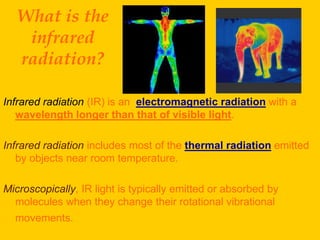
Infrared radiation (IR) is an electromagnetic radiation with a
   wavelength longer than that of visible light.

Infrared radiation includes most of the thermal radiation emitted
   by objects near room temperature.

Microscopically, IR light is typically emitted or absorbed by
  molecules when they change their rotational vibrational
  movements.
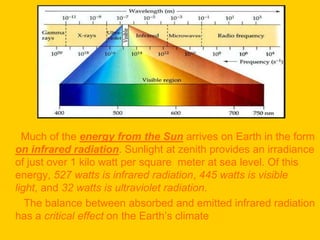
Much of the energy from the Sun arrives on Earth in the form
on infrared radiation. Sunlight at zenith provides an irradiance
of just over 1 kilo watt per square meter at sea level. Of this
energy, 527 watts is infrared radiation, 445 watts is visible
light, and 32 watts is ultraviolet radiation.
   The balance between absorbed and emitted infrared radiation
has a critical effect on the Earth’s climate
Practical
application
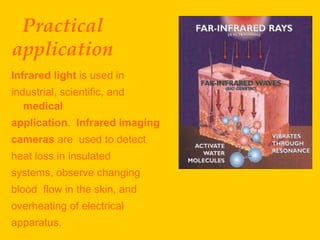
Infrared light is used in
industrial, scientific, and
   medical
application. Infrared imaging
cameras are used to detect
heat loss in insulated
systems, observe changing
blood flow in the skin, and
overheating of electrical
apparatus.
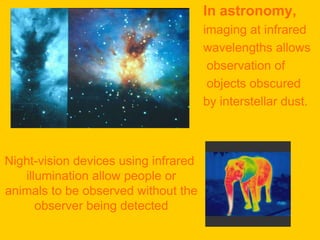
In astronomy,
                                      imaging at infrared
                                      wavelengths allows
                                       observation of
                                       objects obscured
                                      by interstellar dust.


Night-vision devices using infrared
   illumination allow people or
animals to be observed without the
      observer being detected
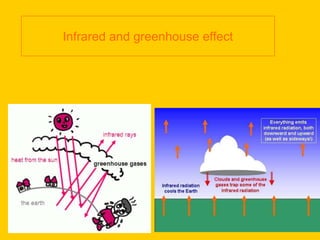
The Earth as infrared emitter
 The Earth’s surface and the clouds absorb
  visible and invisible radiation from the Sun
 and re-emit much of the energy as infrared
back to the atmosphere. Certain substances
   in the atmosphere, chiefly cloud droplets
  and water vapor, but also carbon dioxide,
 methane, nitrous oxide, absorb this infrared
   and re-radiate it in all directions including
 back to Earth. Thus the greenhouse effect
   keeps the atmosphere and surface much
 warmer than if the infrared absorbers were
          absent from the atmosphere.
Infrared and greenhouse effect
Curiosities
• Some animals (snakes, owls) can see
  infrared rays. This ability helps them to find
  food faster.
• Infrared rays act deeply in our tissues. That’s
  why they are used as a method for losing
  weight. It is known as the most non-evasive
  therapy even for treating cancer.

Infrared radiation

  • 1.
    INFRARED RADIATION A short history What is it? Application of infrared rays in our life
  • 2.
    Short history The discoveryof infrared radiation is ascribed to William Herschel, the astronomer, in the early 19thcentury. He used a prism to refract light from the sun and detected the infrared beyond William Herschel the red part of the Spectrum, through an increase in the temperature recorded on a thermometer. He was surprised at the result and called them prism calorific rays. The term of infrared did not appear until late in the 19th century.
  • 3.
    What is the infrared radiation? Infrared radiation (IR) is an electromagnetic radiation with a wavelength longer than that of visible light. Infrared radiation includes most of the thermal radiation emitted by objects near room temperature. Microscopically, IR light is typically emitted or absorbed by molecules when they change their rotational vibrational movements.
  • 4.
    Much of theenergy from the Sun arrives on Earth in the form on infrared radiation. Sunlight at zenith provides an irradiance of just over 1 kilo watt per square meter at sea level. Of this energy, 527 watts is infrared radiation, 445 watts is visible light, and 32 watts is ultraviolet radiation. The balance between absorbed and emitted infrared radiation has a critical effect on the Earth’s climate
  • 5.
    Practical application Infrared light isused in industrial, scientific, and medical application. Infrared imaging cameras are used to detect heat loss in insulated systems, observe changing blood flow in the skin, and overheating of electrical apparatus.
  • 6.
    In astronomy, imaging at infrared wavelengths allows observation of objects obscured by interstellar dust. Night-vision devices using infrared illumination allow people or animals to be observed without the observer being detected
  • 7.
    The Earth asinfrared emitter The Earth’s surface and the clouds absorb visible and invisible radiation from the Sun and re-emit much of the energy as infrared back to the atmosphere. Certain substances in the atmosphere, chiefly cloud droplets and water vapor, but also carbon dioxide, methane, nitrous oxide, absorb this infrared and re-radiate it in all directions including back to Earth. Thus the greenhouse effect keeps the atmosphere and surface much warmer than if the infrared absorbers were absent from the atmosphere.
  • 8.
  • 9.
    Curiosities • Some animals(snakes, owls) can see infrared rays. This ability helps them to find food faster. • Infrared rays act deeply in our tissues. That’s why they are used as a method for losing weight. It is known as the most non-evasive therapy even for treating cancer.