INTRODUCTION TO INFORMATION SYSTEMS
8/9/2014 kanishgeorge@gmail.com 1
MIS
Management Information Systems
8/9/2014 kanishgeorge@gmail.com 2
*
LOGO
Management Information System
 Management
 Art of knowing what you want to do and then seeing
that it is done in the best and the cheapest way.
(Taylor)
 Functions: Planning, Organising, Staffing, Directing,
Controlling.
 Decision making is the fundamental Task.
Job of MIS is to facilitate decision making.
8/9/2014 kanishgeorge@gmail.com 3
Management Information System
 Information
 Data
 Information:
 Data have been put in to a meaningful and useful context is
information.
 Processed data.
 Corrects/ Confirms previous information.
 Has a surprise element/ news value.
8/9/2014 kanishgeorge@gmail.com 4
Management Information System
 System
 Set of elements joined together for a common objective.
 Subsystem is part of system.
 All systems are part of larger systems.
 Divisions, departments, functions, units etc. of
organisation.
 Concept of Synergism – Integration of subsystems
through information interchange.
8/9/2014 kanishgeorge@gmail.com 5
 A system that aids management in making, carrying
out and controlling Decisions. [Jerome Kanter]
 An integrated user-machine system for providing
information to support operations, management, and
decision making functions of an organisation.
[Davis and Olson]
8/9/2014 kanishgeorge@gmail.com 6
Management Information System
Objective
 Decision Support System (DSS)
 To Provide information for decision making on
Planning, initiating, organizing and controlling the
operations of subsystems of the firm.
 To provide a synergistic organisation in the process.
 To Determine and provide what managers needs to
know as efficiently, effectively and economically as
possible.
 To facilitate accomplishment of objectives, and
prevent failure to reach objectives.
8/9/2014 kanishgeorge@gmail.com 7
Objectives
 Operational Control.
 Managerial Control.
 Strategic Planning.
 To help in decision making.
 To ensure co-ordination.
 To Save time and ensure economy.
 To ensure reliability and quality of work.
 To integrate systems.
 To avoid redundancy.
 To establish uniform procedures.
 To fix responsibility
 To improve services
8/9/2014 kanishgeorge@gmail.com 8
System Approach
 1960s.
 Synergism- sum of the parts is greater than the whole.
 Information system should be designed based on
synergy of subsystems.
 The approach of building information systems is
system approach.
8/9/2014 kanishgeorge@gmail.com 9
Relevance of System approach
 The increased complexity of business
 Increased complexity of management
8/9/2014 kanishgeorge@gmail.com 10
Increased complexity of business, because...
 The Technological revolution
 Research and development
 Product changes
 Information explosion
8/9/2014 kanishgeorge@gmail.com 11
Increased complexity of Management, because...
 The theory of information feedback system
 Decision making
 Management Science
 Electronic computer
8/9/2014 kanishgeorge@gmail.com 12
Features of a System
 Objective
 Components or Elements
 Entity
 Relationship
 Interdependence
 Structure
 Inputs
 Processing of Inputs
 Outputs
 Interactions
 Common Objective
8/9/2014 kanishgeorge@gmail.com 13
Types of Systems
 Conceptual and Empirical
 Natural and Artificial
 Social and Machine
 Open and Closed
 Adaptive and Non Adaptive
 Probabilistic and Deterministic
 Permanent and Temporary
 Stationary and Non stationary
 Subsystems and Super systems
8/9/2014 kanishgeorge@gmail.com 14
System View of Business
 Manufacturing System:
 A group of people, machines and facilities, work to
produce a specified number and types of products by
operating on products specifications, schedules, raw
materials, and electrical power converted to mechanical
power.
 Management Information system:
 A group of people and data processing equipments
select, store, process an retrieve data to reduce the
uncertainty in decision making.
8/9/2014 kanishgeorge@gmail.com 15
 Business Organisation System:
 A group of people gathers and processes material and
informational resources toward a set of common goals
including an economic profit of the business by
performing financing, design, production and
marketing.
8/9/2014 kanishgeorge@gmail.com 16
MIS organisation within the
company
 Location of MIS in the organisation structure
 Common- under VP of Finance
 MIS reporting to President
8/9/2014 kanishgeorge@gmail.com 17
Organisation within the MIS
function
 Steering committee
 MIS Manager
 Sales Manager
 Production Manager
 Finance Manager
 Design
 Project team composed of representatives from
functional areas plus technical system people
8/9/2014 kanishgeorge@gmail.com 18
Management, Organisational Theory and System
Approach
 Management existing from the beginning of society
 Management of social groups
 With development of science and Technology,
management gained importance
 Started investigating management process
 Companies attempt structuring organizations
 Structuring function performed by managers.
8/9/2014 kanishgeorge@gmail.com 19
Management, Organisational Theory and System
Approach
 Manager influences organisation to work cooperatively
 As organisation grow, complexities also grow
 Industrial Revolution
 Manager must be satisfied with Information Flow
 MIS designed on the basis of management tasks,
management principle, Managers’ style and behaviour
and organisational structure and behaviour
8/9/2014 kanishgeorge@gmail.com 20
Development of Organisational Theory
 Management theory deals with theories of how to
achieve organisational objective
 Relatively older
 Organisation theory concerned with structure of
interpersonal relationship and views organisation as a
mechanism for promoting human collaboration
 New discipline
 Based on Bureaucratic model by Max Weber
8/9/2014 kanishgeorge@gmail.com 21
Organisational Theory
 More Prevalent models of organisation theory:
 Classical Process Theory
 Bureaucracy Theory
 Behaviorial Theory
 Decision Theory
 Social Systems Theory
 System Theory
8/9/2014 kanishgeorge@gmail.com 22
Classical Process Theory
 Contributors:
 Fayol
 Taylor
 L.Gullick and Urwick
 Mooney
 1930s
 Mooney with Book “Principles of Organisation”
 Process of Managing ‘POSDCORB’
 Clear Lines of Authority
 Specialisation of Labour
 Unity of Command
 Span of Control
 Clear separation of Line and Staff
8/9/2014 kanishgeorge@gmail.com 23
Classical Process Theory [Contd..]
 Given the objective to be accomplished, determine the
work to be done, group the work into logical units,
define positions and accountability.
 Form Organisation chart with position description of
duties.
 Work will be done if everyone follows organisation
structure
 Assumed:
 Workers are logical and perform as expected
 Workers prefer to have their job limits clearly defined
8/9/2014 kanishgeorge@gmail.com 24
Merits of Classical Theories First theories
 Provided framework for
later
 Made aware of basic
organisational problems
 Many principles are valid
even today
 Provides for education
and training of
management
kanishgeorge@gmail.com 2509-08-2014
Demerits of Classical Theories
 Organisations were stable
and simple.
 Employees were viewed as
tools.
 Focus on jobs rather than
people.
 Monetary rewards were
more important.
 Initiative and creativity
were ignored.
 Principles are not
applicable universally.
kanishgeorge@gmail.com 2609-08-2014
Bureaucratic Management/
Bureaucracy Theory
 Bureaucracy!
 How an entire
organisation should
operate!
 Designing the ideal type
of organisation.
 Most efficient form for a
complex organisation
 Max Weber
kanishgeorge@gmail.com 2709-09-2013
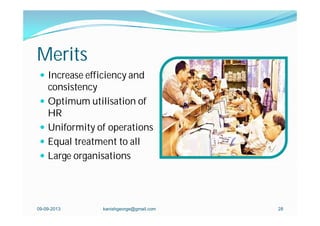
Merits
 Increase efficiency and
consistency
 Optimum utilisation of
HR
 Uniformity of operations
 Equal treatment to all
 Large organisations
kanishgeorge@gmail.com 2809-09-2013
Demerits
 Rigid Rules & Procedures
 Slow Decisions
 Limit personal skills
 No informal
organisations
 Difficult in control and
co-operation
 Protecting authority
rather than increasing
productivity
kanishgeorge@gmail.com 2909-09-2013
Behaviour approach
• No positive response for Scientific Management
• Modification to classical theory (Neo-classical)
• Organisation is a social system and human factor is most
important.
• Importance of human relations and human value
• The ways in which the managers interact with the society.
• Leadership/ human resource approach/ organisational
behaviour approach
• Interdisciplinary approach
• Motivation, leadership, communication, group dynamics…
• Emphasis on participative decision making
10-09-2013 kanishgeorge@gmail.com 30
Behaviorial Theory
 Hawthorne Experiments (1927-
1932)
 Hawthorne effect — workers’
attitudes toward their managers
affect the level of workers’
performance than technical and
Physical environment.
 Elton Mayo
 F.J Roethlisberger
8/9/2014 kanishgeorge@gmail.com 31
Decision Theory
 Management is essentially decision making.
 The members of organisation are decision makers and
problem solvers.
 The importance of members are determined by the
importance of their decisions.
 Quality of decisions affect the organisational
effectiveness.
 MIS, process and techniques are subject matter of
study.
11-08-2014kanishgeorge@gmail.com
32
Contributors and criticisms
 Herbert Simon
 Chester Barnard
 James March
 Richard Cyert
 Forrester
 Limited scope.
 No total view of Management
11-09-2013kanishgeorge@gmail.com
33
Vilfredo Pareto
Chester Barnard
An organisation is essentially a cultural system composed
of people who work in co-operation.
For achieving organisational goals, a co-operative system
can be developed by understanding the behaviour of
people in groups.
Relationships exist among the external as well as internal
environment of the organisation.
For effective management efforts should be made for
establishing harmony between the goals of the
organisation and the various groups therein.
Social systems approach
10-09-2013 kanishgeorge@gmail.com 34
 System is combination of parts, subsystems.
 Subsystems are mutually related to each other.
 Interdependent subsystems and synergy.
 System has boundary- to relate with environment.
 Closed system and open system.
 System transforms inputs into outputs.
 Developed by Kenneth Boulding, R.A Johnson, Rosen
Zweig…
System Theory of Organisation
and Management
23-09-2013 www.facebook.com/kanishgeorge35
 Social system
 Open system
 Adaptive system
 Dynamic System
 Probabilistic System, not deterministic
 Multidimensional system
 Multivariable system
Management as a system
23-09-2013 www.facebook.com/kanishgeorge36
 Theoretical and vague.
 Lacks universality.
 Not specifying interactions and
interdependencies.
Criticisms
23-09-2013
www.faceb
ook.com/k
anishgeorg
e37
Management and
Organisational Behaviour
 Managing HR is difficult
 Structuring
 Organising
 Workers participation
 Productivity affected by Motivation, Managerial
leadership, Organisational behaviour, Govt regulation,
Innovation, Technology etc.
8/9/2014 kanishgeorge@gmail.com 38
Motivation
 Behaviour of people
 All people are equal, but some are more equal than
others.
 Behavioural differences
 Physical differences
 Mental capabilities
 Life experiences
 Culture
 Behaviour changes over time
8/9/2014 kanishgeorge@gmail.com 39
kanishgeorge@gmail.com
Definition of motivation:
* The driving force within individuals by which they
attempt to achieve some goal in order to fulfill some
needs or expectation.
* The degree to which an individual wants to choose
in certain behavior.
Motivation is…
Complex
Psychological
Physical
Unique to each and every person
Context sensitive
Not fully understood
Basic model of motivation
Needs or
expectations
Result in Drive force
(Behavior or
Action)
To Achieve
Desired Goals
Which Providesfulfillments
Feedback
Needs models of Motivation
 Needs are motivators.
 Satisfied needs are not.
 Incentives to achieve needs.
 Hierarchy of Needs – A.H Maslow
 Two Factor Theory- Herzberg
 Achievement model- McClelland
8/9/2014 kanishgeorge@gmail.com 43
Need Hierarchy
 According to Maslow, human behavior is related
to his needs. It is adjusted as per the nature of
needs to be satisfied.
 Maslow identified five types / sets of human
need arranged in a hierarchy of their importance
and priority :
1. Physiological Needs
2. Security / Safety Needs
3. Social /Love Needs
4. Esteem Needs
5. Self-actualization Needs
8/9/2014 kanishgeorge@gmail.com 44
8/9/2014 kanishgeorge@gmail.com 45
 *Lower order ( External ) : Physiological and safety
needs
 *Higher order ( Internal ) : Social, Esteem, and Self-
actualization
 Individual must satisfy lower-level needs before they
can satisfy higher order needs.
 Motivating a person depends on knowing at what level
that a person is on the hierarchy.
8/9/2014 kanishgeorge@gmail.com 46
Herzberg’s two factor theory
 Job satisfaction and job dissatisfaction are created by different
factors.
Hygiene factors- Extrinsic ( Environmental ) factors that
create job dissatisfaction.
Motivation Factors- Intrinsic ( Psychological ) factors that
create job satisfaction.
 Attempted to explain why job satisfaction does not result in
increased performance
 The opposite of satisfaction is not dissatisfaction but
rather no satisfaction.
8/9/2014 kanishgeorge@gmail.com 47
8/9/2014 kanishgeorge@gmail.com 48
Hygiene factors avoid
job dissatisfaction
• Company policy &
administration
• Supervision
• Interpersonal relations
• Working conditions
• Salary
• Status
• Security
• Achievement
• Achievement recognition
• Work itself
• Responsibility
• Advancement
• Growth
Motivation factors
increase job satisfaction
McClelland’s Need Theory
Need for Achievement
The desire to excel and
succeed
kanishgeorge@gmail.com
McClelland’s Need Theory
Need for Affiliation –
The desire for interpersonal
relationship
kanishgeorge@gmail.com
McClelland’s Need Theory
Need for Power –
The need to influence the
behavior of others.
kanishgeorge@gmail.com
Expectancy Models of Motivation
• Victor H Vroom, Lyman Porter and Edward Lawler.
• Motivation depends on strength of an individual’s
desire for a set of goals.
The theory states that individuals have different sets of
goals and can be motivated if they believe that:
1. There is a positive correlation between efforts and
performance.
2. Favorable performance will result in a desirable
reward.
3. The reward will satisfy an important need
8/9/2014 kanishgeorge@gmail.com 52
Motivation
Expectancy
• The belief that higher or increased
work effort will result to better
performance or completion of a task.
Instrumentality
• The perception of the person that if
he or she /person performs well, a
desired outcome will result from it.
Valence
• This refers to the person’s emotional
orientation to the value of the outcome or
rewards that were brought about by the
person’s effort to the performance shown.
What the management should do?
• The management must know what
supervision, trainings or resources the
employees need.
• The management must ensure that promises
of rewards are fulfilled and that the
employees are made aware of that.
• The management must know the employees
value.
Management, Information and the
System Approach
• Tasks of management
– Match the capabilities of institution to various
needs of the environment.
– Establish work environment and allocation of
resources for maximum productivity.
– Manage responsibilities to stakeholders
8/9/2014 kanishgeorge@gmail.com 59
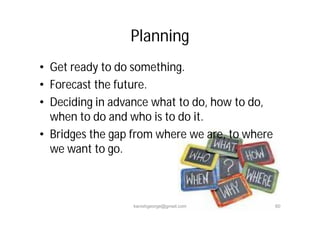
• Get ready to do something.
• Forecast the future.
• Deciding in advance what to do, how to do,
when to do and who is to do it.
• Bridges the gap from where we are, to where
we want to go.
Planning
kanishgeorge@gmail.com 60
• Intellectual process
• Planning is an integrated process
• Planning is Continuous
• Selective process
• Dynamic process
• Focused on objectives
• Primacy of planning
• Planning is Pervasive
• Future oriented
• Planning leads to efficiency
• Makes control effective
features
kanishgeorge@gmail.com 61
• Without plans actions are producing chaos.
• To achieve organisational objectives.
• Growing complexities and competitions.
• Rapid social, economic and political changes.
• Social Responsibilities.
• Uncertainties caused by business cycle.
• Scarcity of resources.
• Increasing govt. control.
• R&D activities.
Is it necessary?!
kanishgeorge@gmail.com 62
• Corporate level Plans /Strategic/ Long term
plans
• Department level plans/ Tactical/ short term
plans
kanishgeorge@gmail.com 63
Types of Plans
Steps
• Analyse the environment
• Identify company strengths and weaknesses
• Consider personal values of top management
• Identify opportunities and risks
• Define product/market scope
• Define the competitive edge
• Establish objectives and measures of
performance
• Determine deployment of resources
8/9/2014 kanishgeorge@gmail.com 64
Information and Planning
• Environmental Information
– Political and governmental
– Demographic and social trend
– Economic Trend
– Technological Environment
– Factors of production
• Competitive information
– Industry demand
– Firm demand
– Competition
• Internal Information
– Sales forecast
– Financial plan
– Supply factors
– policies
8/9/2014 kanishgeorge@gmail.com 65
Organising
• Process of identifying and grouping the work to
be performed, defining and delegating
responsibility and authority and establishing
relationships for the purpose of enabling people
to work most effectively together in
accomplishing objectives. – Luis A. Allen.
• It is grouping of activities necessary to attain
enterprise objectives and assignment of each
group to a manager, with authority necessary to
supervise it.- Koontz and O’Donnell.
Process of Organising
• Identification of activities
• Division of work
• Grouping of activities
• Assigning activities
• Defining authority and responsibility
• Co-ordination
Importance
• Facilitates administration.
• Facilitates growth and diversification.
• Ensures optimum use of human resources.
• Stimulates creativity.
• Facilitates stability of enterprise.
• Ensures optimum use of resources.
• Effective control.
• Avoids duplication of work.
Information and Organising
• Organisation structure is human
anatomy and information is nervous
system.
• Each organisation entity is an
information system with the
components of input, processor and
output.
• Each is connected to others through
information and communication
channels
• Each organisational entity becomes
a decision point.
8/9/2014 kanishgeorge@gmail.com 69
• Organisation must be
designed around
information flow
• Information needed for
planning and
implementation of
organising.
• Information needed to
manage change
8/9/2014 kanishgeorge@gmail.com 70
Staffing
• Process of obtaining and maintaining capable
and competent people to fill all positions from
top management to operative level.
• Process of acquiring, developing, appraising,
remunerating and retaining people so that
right type of people are available at right
positions and at right time in the organisation.
kanishgeorge@gmail.com 7101-10-2013
Importance
• Filling organisational positions
• Developing competencies
• Retaining personnel
• Making other functions effective
• Increasing the productivity
• Builds sound organisation
• Activates organisation
• Ensures effective utilisation of HR
kanishgeorge@gmail.com 7201-10-2013
Directing
• Direction consists of the process and
techniques utilized in issuing instructions and
making certain that operations are carried as
originally planned.
8/9/2014 kanishgeorge@gmail.com 73
Directing involves…..
• Telling people what is to be done
and explaining how to do it.
• Issuing instructions and orders to
subordinates.
• Inspiring them to contribute
towards the achievement of
objectives,
• Supervising their activities;
• Providing leadership and
motivation
ELEMENTS OF DIRECTION
• Communication
• Leading
• Motivation
• Supervision
• Coordination
Controlling
• Evaluating the actual performance and if
necessary, taking corrective actions so that the
performance is in accordance with planned
performance.
• End function.
• Continuous process.
• Closely related with planning.
• Forward looking process.
• Pervasive function.
22-10-2013 kanishgeorge@gmail.com 76
Pre-requisites of control system
• Planning.
• Action.
• Delegation of authority.
• Flow of information.
22-10-2013 kanishgeorge@gmail.com 77
Process of Control
• Establishing of standards.
• Measurement of actual performance.
• Comparing the actual performance with the
standards.
• Taking corrective actions.
• Feedback.
22-10-2013 kanishgeorge@gmail.com 78
8/9/2014 kanishgeorge@gmail.com 79
System Theory & System Approach
• Organisations being a system are complex
entities with multiple relationships.
• System is composed of many subsystems and
relationships existing among them.
• System explained as a whole. It is more than
sum of its parts (holism/synergism)
• System and subsystems form a hierarchal
structure.
25/09/2014 www.kanishgeorge.blogspot.in 80
• The parts of the system constitute an
indissoluble whole, so that no part can be
altered without affecting other parts.
• The subsystem should work toward the goal of
their higher system and not pursue their own
objectives.
• The nature and functions of the part are
derived from its position in the whole.
• Behaviour of the part is regulated by the
whole to part relationships
25/09/2014 www.kanishgeorge.blogspot.in 81
Thank You!
www.kanishgeorge.blogspot.in
8/9/2014 kanishgeorge@gmail.com 82

Management Information System for BCA

  • 1.
    INTRODUCTION TO INFORMATIONSYSTEMS 8/9/2014 kanishgeorge@gmail.com 1
  • 2.
  • 3.
    * LOGO Management Information System Management  Art of knowing what you want to do and then seeing that it is done in the best and the cheapest way. (Taylor)  Functions: Planning, Organising, Staffing, Directing, Controlling.  Decision making is the fundamental Task. Job of MIS is to facilitate decision making. 8/9/2014 kanishgeorge@gmail.com 3
  • 4.
    Management Information System Information  Data  Information:  Data have been put in to a meaningful and useful context is information.  Processed data.  Corrects/ Confirms previous information.  Has a surprise element/ news value. 8/9/2014 kanishgeorge@gmail.com 4
  • 5.
    Management Information System System  Set of elements joined together for a common objective.  Subsystem is part of system.  All systems are part of larger systems.  Divisions, departments, functions, units etc. of organisation.  Concept of Synergism – Integration of subsystems through information interchange. 8/9/2014 kanishgeorge@gmail.com 5
  • 6.
     A systemthat aids management in making, carrying out and controlling Decisions. [Jerome Kanter]  An integrated user-machine system for providing information to support operations, management, and decision making functions of an organisation. [Davis and Olson] 8/9/2014 kanishgeorge@gmail.com 6 Management Information System
  • 7.
    Objective  Decision SupportSystem (DSS)  To Provide information for decision making on Planning, initiating, organizing and controlling the operations of subsystems of the firm.  To provide a synergistic organisation in the process.  To Determine and provide what managers needs to know as efficiently, effectively and economically as possible.  To facilitate accomplishment of objectives, and prevent failure to reach objectives. 8/9/2014 kanishgeorge@gmail.com 7
  • 8.
    Objectives  Operational Control. Managerial Control.  Strategic Planning.  To help in decision making.  To ensure co-ordination.  To Save time and ensure economy.  To ensure reliability and quality of work.  To integrate systems.  To avoid redundancy.  To establish uniform procedures.  To fix responsibility  To improve services 8/9/2014 kanishgeorge@gmail.com 8
  • 9.
    System Approach  1960s. Synergism- sum of the parts is greater than the whole.  Information system should be designed based on synergy of subsystems.  The approach of building information systems is system approach. 8/9/2014 kanishgeorge@gmail.com 9
  • 10.
    Relevance of Systemapproach  The increased complexity of business  Increased complexity of management 8/9/2014 kanishgeorge@gmail.com 10
  • 11.
    Increased complexity ofbusiness, because...  The Technological revolution  Research and development  Product changes  Information explosion 8/9/2014 kanishgeorge@gmail.com 11
  • 12.
    Increased complexity ofManagement, because...  The theory of information feedback system  Decision making  Management Science  Electronic computer 8/9/2014 kanishgeorge@gmail.com 12
  • 13.
    Features of aSystem  Objective  Components or Elements  Entity  Relationship  Interdependence  Structure  Inputs  Processing of Inputs  Outputs  Interactions  Common Objective 8/9/2014 kanishgeorge@gmail.com 13
  • 14.
    Types of Systems Conceptual and Empirical  Natural and Artificial  Social and Machine  Open and Closed  Adaptive and Non Adaptive  Probabilistic and Deterministic  Permanent and Temporary  Stationary and Non stationary  Subsystems and Super systems 8/9/2014 kanishgeorge@gmail.com 14
  • 15.
    System View ofBusiness  Manufacturing System:  A group of people, machines and facilities, work to produce a specified number and types of products by operating on products specifications, schedules, raw materials, and electrical power converted to mechanical power.  Management Information system:  A group of people and data processing equipments select, store, process an retrieve data to reduce the uncertainty in decision making. 8/9/2014 kanishgeorge@gmail.com 15
  • 16.
     Business OrganisationSystem:  A group of people gathers and processes material and informational resources toward a set of common goals including an economic profit of the business by performing financing, design, production and marketing. 8/9/2014 kanishgeorge@gmail.com 16
  • 17.
    MIS organisation withinthe company  Location of MIS in the organisation structure  Common- under VP of Finance  MIS reporting to President 8/9/2014 kanishgeorge@gmail.com 17
  • 18.
    Organisation within theMIS function  Steering committee  MIS Manager  Sales Manager  Production Manager  Finance Manager  Design  Project team composed of representatives from functional areas plus technical system people 8/9/2014 kanishgeorge@gmail.com 18
  • 19.
    Management, Organisational Theoryand System Approach  Management existing from the beginning of society  Management of social groups  With development of science and Technology, management gained importance  Started investigating management process  Companies attempt structuring organizations  Structuring function performed by managers. 8/9/2014 kanishgeorge@gmail.com 19
  • 20.
    Management, Organisational Theoryand System Approach  Manager influences organisation to work cooperatively  As organisation grow, complexities also grow  Industrial Revolution  Manager must be satisfied with Information Flow  MIS designed on the basis of management tasks, management principle, Managers’ style and behaviour and organisational structure and behaviour 8/9/2014 kanishgeorge@gmail.com 20
  • 21.
    Development of OrganisationalTheory  Management theory deals with theories of how to achieve organisational objective  Relatively older  Organisation theory concerned with structure of interpersonal relationship and views organisation as a mechanism for promoting human collaboration  New discipline  Based on Bureaucratic model by Max Weber 8/9/2014 kanishgeorge@gmail.com 21
  • 22.
    Organisational Theory  MorePrevalent models of organisation theory:  Classical Process Theory  Bureaucracy Theory  Behaviorial Theory  Decision Theory  Social Systems Theory  System Theory 8/9/2014 kanishgeorge@gmail.com 22
  • 23.
    Classical Process Theory Contributors:  Fayol  Taylor  L.Gullick and Urwick  Mooney  1930s  Mooney with Book “Principles of Organisation”  Process of Managing ‘POSDCORB’  Clear Lines of Authority  Specialisation of Labour  Unity of Command  Span of Control  Clear separation of Line and Staff 8/9/2014 kanishgeorge@gmail.com 23
  • 24.
    Classical Process Theory[Contd..]  Given the objective to be accomplished, determine the work to be done, group the work into logical units, define positions and accountability.  Form Organisation chart with position description of duties.  Work will be done if everyone follows organisation structure  Assumed:  Workers are logical and perform as expected  Workers prefer to have their job limits clearly defined 8/9/2014 kanishgeorge@gmail.com 24
  • 25.
    Merits of ClassicalTheories First theories  Provided framework for later  Made aware of basic organisational problems  Many principles are valid even today  Provides for education and training of management kanishgeorge@gmail.com 2509-08-2014
  • 26.
    Demerits of ClassicalTheories  Organisations were stable and simple.  Employees were viewed as tools.  Focus on jobs rather than people.  Monetary rewards were more important.  Initiative and creativity were ignored.  Principles are not applicable universally. kanishgeorge@gmail.com 2609-08-2014
  • 27.
    Bureaucratic Management/ Bureaucracy Theory Bureaucracy!  How an entire organisation should operate!  Designing the ideal type of organisation.  Most efficient form for a complex organisation  Max Weber kanishgeorge@gmail.com 2709-09-2013
  • 28.
    Merits  Increase efficiencyand consistency  Optimum utilisation of HR  Uniformity of operations  Equal treatment to all  Large organisations kanishgeorge@gmail.com 2809-09-2013
  • 29.
    Demerits  Rigid Rules& Procedures  Slow Decisions  Limit personal skills  No informal organisations  Difficult in control and co-operation  Protecting authority rather than increasing productivity kanishgeorge@gmail.com 2909-09-2013
  • 30.
    Behaviour approach • Nopositive response for Scientific Management • Modification to classical theory (Neo-classical) • Organisation is a social system and human factor is most important. • Importance of human relations and human value • The ways in which the managers interact with the society. • Leadership/ human resource approach/ organisational behaviour approach • Interdisciplinary approach • Motivation, leadership, communication, group dynamics… • Emphasis on participative decision making 10-09-2013 kanishgeorge@gmail.com 30
  • 31.
    Behaviorial Theory  HawthorneExperiments (1927- 1932)  Hawthorne effect — workers’ attitudes toward their managers affect the level of workers’ performance than technical and Physical environment.  Elton Mayo  F.J Roethlisberger 8/9/2014 kanishgeorge@gmail.com 31
  • 32.
    Decision Theory  Managementis essentially decision making.  The members of organisation are decision makers and problem solvers.  The importance of members are determined by the importance of their decisions.  Quality of decisions affect the organisational effectiveness.  MIS, process and techniques are subject matter of study. 11-08-2014kanishgeorge@gmail.com 32
  • 33.
    Contributors and criticisms Herbert Simon  Chester Barnard  James March  Richard Cyert  Forrester  Limited scope.  No total view of Management 11-09-2013kanishgeorge@gmail.com 33
  • 34.
    Vilfredo Pareto Chester Barnard Anorganisation is essentially a cultural system composed of people who work in co-operation. For achieving organisational goals, a co-operative system can be developed by understanding the behaviour of people in groups. Relationships exist among the external as well as internal environment of the organisation. For effective management efforts should be made for establishing harmony between the goals of the organisation and the various groups therein. Social systems approach 10-09-2013 kanishgeorge@gmail.com 34
  • 35.
     System iscombination of parts, subsystems.  Subsystems are mutually related to each other.  Interdependent subsystems and synergy.  System has boundary- to relate with environment.  Closed system and open system.  System transforms inputs into outputs.  Developed by Kenneth Boulding, R.A Johnson, Rosen Zweig… System Theory of Organisation and Management 23-09-2013 www.facebook.com/kanishgeorge35
  • 36.
     Social system Open system  Adaptive system  Dynamic System  Probabilistic System, not deterministic  Multidimensional system  Multivariable system Management as a system 23-09-2013 www.facebook.com/kanishgeorge36
  • 37.
     Theoretical andvague.  Lacks universality.  Not specifying interactions and interdependencies. Criticisms 23-09-2013 www.faceb ook.com/k anishgeorg e37
  • 38.
    Management and Organisational Behaviour Managing HR is difficult  Structuring  Organising  Workers participation  Productivity affected by Motivation, Managerial leadership, Organisational behaviour, Govt regulation, Innovation, Technology etc. 8/9/2014 kanishgeorge@gmail.com 38
  • 39.
    Motivation  Behaviour ofpeople  All people are equal, but some are more equal than others.  Behavioural differences  Physical differences  Mental capabilities  Life experiences  Culture  Behaviour changes over time 8/9/2014 kanishgeorge@gmail.com 39
  • 40.
    kanishgeorge@gmail.com Definition of motivation: *The driving force within individuals by which they attempt to achieve some goal in order to fulfill some needs or expectation. * The degree to which an individual wants to choose in certain behavior.
  • 41.
    Motivation is… Complex Psychological Physical Unique toeach and every person Context sensitive Not fully understood
  • 42.
    Basic model ofmotivation Needs or expectations Result in Drive force (Behavior or Action) To Achieve Desired Goals Which Providesfulfillments Feedback
  • 43.
    Needs models ofMotivation  Needs are motivators.  Satisfied needs are not.  Incentives to achieve needs.  Hierarchy of Needs – A.H Maslow  Two Factor Theory- Herzberg  Achievement model- McClelland 8/9/2014 kanishgeorge@gmail.com 43
  • 44.
    Need Hierarchy  Accordingto Maslow, human behavior is related to his needs. It is adjusted as per the nature of needs to be satisfied.  Maslow identified five types / sets of human need arranged in a hierarchy of their importance and priority : 1. Physiological Needs 2. Security / Safety Needs 3. Social /Love Needs 4. Esteem Needs 5. Self-actualization Needs 8/9/2014 kanishgeorge@gmail.com 44
  • 45.
  • 46.
     *Lower order( External ) : Physiological and safety needs  *Higher order ( Internal ) : Social, Esteem, and Self- actualization  Individual must satisfy lower-level needs before they can satisfy higher order needs.  Motivating a person depends on knowing at what level that a person is on the hierarchy. 8/9/2014 kanishgeorge@gmail.com 46
  • 47.
    Herzberg’s two factortheory  Job satisfaction and job dissatisfaction are created by different factors. Hygiene factors- Extrinsic ( Environmental ) factors that create job dissatisfaction. Motivation Factors- Intrinsic ( Psychological ) factors that create job satisfaction.  Attempted to explain why job satisfaction does not result in increased performance  The opposite of satisfaction is not dissatisfaction but rather no satisfaction. 8/9/2014 kanishgeorge@gmail.com 47
  • 48.
    8/9/2014 kanishgeorge@gmail.com 48 Hygienefactors avoid job dissatisfaction • Company policy & administration • Supervision • Interpersonal relations • Working conditions • Salary • Status • Security • Achievement • Achievement recognition • Work itself • Responsibility • Advancement • Growth Motivation factors increase job satisfaction
  • 49.
    McClelland’s Need Theory Needfor Achievement The desire to excel and succeed kanishgeorge@gmail.com
  • 50.
    McClelland’s Need Theory Needfor Affiliation – The desire for interpersonal relationship kanishgeorge@gmail.com
  • 51.
    McClelland’s Need Theory Needfor Power – The need to influence the behavior of others. kanishgeorge@gmail.com
  • 52.
    Expectancy Models ofMotivation • Victor H Vroom, Lyman Porter and Edward Lawler. • Motivation depends on strength of an individual’s desire for a set of goals. The theory states that individuals have different sets of goals and can be motivated if they believe that: 1. There is a positive correlation between efforts and performance. 2. Favorable performance will result in a desirable reward. 3. The reward will satisfy an important need 8/9/2014 kanishgeorge@gmail.com 52
  • 53.
  • 54.
    Expectancy • The beliefthat higher or increased work effort will result to better performance or completion of a task.
  • 55.
    Instrumentality • The perceptionof the person that if he or she /person performs well, a desired outcome will result from it.
  • 56.
    Valence • This refersto the person’s emotional orientation to the value of the outcome or rewards that were brought about by the person’s effort to the performance shown.
  • 57.
    What the managementshould do? • The management must know what supervision, trainings or resources the employees need. • The management must ensure that promises of rewards are fulfilled and that the employees are made aware of that. • The management must know the employees value.
  • 59.
    Management, Information andthe System Approach • Tasks of management – Match the capabilities of institution to various needs of the environment. – Establish work environment and allocation of resources for maximum productivity. – Manage responsibilities to stakeholders 8/9/2014 kanishgeorge@gmail.com 59
  • 60.
    • Get readyto do something. • Forecast the future. • Deciding in advance what to do, how to do, when to do and who is to do it. • Bridges the gap from where we are, to where we want to go. Planning kanishgeorge@gmail.com 60
  • 61.
    • Intellectual process •Planning is an integrated process • Planning is Continuous • Selective process • Dynamic process • Focused on objectives • Primacy of planning • Planning is Pervasive • Future oriented • Planning leads to efficiency • Makes control effective features kanishgeorge@gmail.com 61
  • 62.
    • Without plansactions are producing chaos. • To achieve organisational objectives. • Growing complexities and competitions. • Rapid social, economic and political changes. • Social Responsibilities. • Uncertainties caused by business cycle. • Scarcity of resources. • Increasing govt. control. • R&D activities. Is it necessary?! kanishgeorge@gmail.com 62
  • 63.
    • Corporate levelPlans /Strategic/ Long term plans • Department level plans/ Tactical/ short term plans kanishgeorge@gmail.com 63 Types of Plans
  • 64.
    Steps • Analyse theenvironment • Identify company strengths and weaknesses • Consider personal values of top management • Identify opportunities and risks • Define product/market scope • Define the competitive edge • Establish objectives and measures of performance • Determine deployment of resources 8/9/2014 kanishgeorge@gmail.com 64
  • 65.
    Information and Planning •Environmental Information – Political and governmental – Demographic and social trend – Economic Trend – Technological Environment – Factors of production • Competitive information – Industry demand – Firm demand – Competition • Internal Information – Sales forecast – Financial plan – Supply factors – policies 8/9/2014 kanishgeorge@gmail.com 65
  • 66.
    Organising • Process ofidentifying and grouping the work to be performed, defining and delegating responsibility and authority and establishing relationships for the purpose of enabling people to work most effectively together in accomplishing objectives. – Luis A. Allen. • It is grouping of activities necessary to attain enterprise objectives and assignment of each group to a manager, with authority necessary to supervise it.- Koontz and O’Donnell.
  • 67.
    Process of Organising •Identification of activities • Division of work • Grouping of activities • Assigning activities • Defining authority and responsibility • Co-ordination
  • 68.
    Importance • Facilitates administration. •Facilitates growth and diversification. • Ensures optimum use of human resources. • Stimulates creativity. • Facilitates stability of enterprise. • Ensures optimum use of resources. • Effective control. • Avoids duplication of work.
  • 69.
    Information and Organising •Organisation structure is human anatomy and information is nervous system. • Each organisation entity is an information system with the components of input, processor and output. • Each is connected to others through information and communication channels • Each organisational entity becomes a decision point. 8/9/2014 kanishgeorge@gmail.com 69
  • 70.
    • Organisation mustbe designed around information flow • Information needed for planning and implementation of organising. • Information needed to manage change 8/9/2014 kanishgeorge@gmail.com 70
  • 71.
    Staffing • Process ofobtaining and maintaining capable and competent people to fill all positions from top management to operative level. • Process of acquiring, developing, appraising, remunerating and retaining people so that right type of people are available at right positions and at right time in the organisation. kanishgeorge@gmail.com 7101-10-2013
  • 72.
    Importance • Filling organisationalpositions • Developing competencies • Retaining personnel • Making other functions effective • Increasing the productivity • Builds sound organisation • Activates organisation • Ensures effective utilisation of HR kanishgeorge@gmail.com 7201-10-2013
  • 73.
    Directing • Direction consistsof the process and techniques utilized in issuing instructions and making certain that operations are carried as originally planned. 8/9/2014 kanishgeorge@gmail.com 73
  • 74.
    Directing involves….. • Tellingpeople what is to be done and explaining how to do it. • Issuing instructions and orders to subordinates. • Inspiring them to contribute towards the achievement of objectives, • Supervising their activities; • Providing leadership and motivation
  • 75.
    ELEMENTS OF DIRECTION •Communication • Leading • Motivation • Supervision • Coordination
  • 76.
    Controlling • Evaluating theactual performance and if necessary, taking corrective actions so that the performance is in accordance with planned performance. • End function. • Continuous process. • Closely related with planning. • Forward looking process. • Pervasive function. 22-10-2013 kanishgeorge@gmail.com 76
  • 77.
    Pre-requisites of controlsystem • Planning. • Action. • Delegation of authority. • Flow of information. 22-10-2013 kanishgeorge@gmail.com 77
  • 78.
    Process of Control •Establishing of standards. • Measurement of actual performance. • Comparing the actual performance with the standards. • Taking corrective actions. • Feedback. 22-10-2013 kanishgeorge@gmail.com 78
  • 79.
  • 80.
    System Theory &System Approach • Organisations being a system are complex entities with multiple relationships. • System is composed of many subsystems and relationships existing among them. • System explained as a whole. It is more than sum of its parts (holism/synergism) • System and subsystems form a hierarchal structure. 25/09/2014 www.kanishgeorge.blogspot.in 80
  • 81.
    • The partsof the system constitute an indissoluble whole, so that no part can be altered without affecting other parts. • The subsystem should work toward the goal of their higher system and not pursue their own objectives. • The nature and functions of the part are derived from its position in the whole. • Behaviour of the part is regulated by the whole to part relationships 25/09/2014 www.kanishgeorge.blogspot.in 81
  • 82.