Information Systems, Organizations, and Strategy
Chapter 3
VIDEO CASES
Case 1: National Basketball Association: Competing on Global
Delivery with Akamai OS Streaming
Case 2: IT and Geo-Mapping Help a Small Business Succeed
(2009)
Case 3: Materials Handling Equipment Corp: Enterprise
Systems Drive Corporate Strategy for a Small Business
Instructional Video 1 SAP BusinessOne ERP: From Orders to
Final Delivery and Payment
*
3.*
Copyright © 2016 Pearson Education, Inc.
Management Information Systems
Chapter 3: Information Systems, Organizations, and Strategy
Which features of organizations do managers need to know
about to build and use information systems successfully?What is
the impact of information systems on organizations?How do
Porter’s competitive forces model, the value chain model,
synergies, core competencies, and network economics help
companies develop competitive strategies using information
systems?What are the challenges posed by strategic information
systems and how should they be addressed?
Learning Objectives
You could ask students to recall some concepts from the
previous chapters that might help managers build and use
information systems successfully. Answers could include what
business processes the company performs, the size of the
company, or the organization of the information systems
function.
*
3.*
Copyright © 2016 Pearson Education, Inc.
Management Information Systems
Chapter 3: Information Systems, Organizations, and Strategy
Problem: No online presence, powerful competitors, variable
inventory
Solution
s: Develop online sales processExperiment with flash
salesDemonstrates IT’s central role in defining competitive
strategy
Should T.J. Maxx Sell Online?
*
3.*
Copyright © 2016 Pearson Education, Inc.
Management Information Systems
Chapter 3: Information Systems, Organizations, and Strategy
Information technology and organizations influence each
otherRelationship influenced by
organization’sStructureBusiness
processesPoliticsCultureEnvironment Management decisions
Features of Organizations
This concept was briefly discussed in Chapter 1. Figure 1-2 and
1-3 as well as the figure on the next slide, 3-1, display this
interdependent relationship graphically.
*
3.*
Copyright © 2016 Pearson Education, Inc.
Management Information Systems
Chapter 3: Information Systems, Organizations, and Strategy
This complex two-way relationship is mediated by many
factors, not the least of which are the decisions made—or not
made—by managers. Other factors mediating the relationship
include the organizational culture, structure, politics, business
processes, and environment.
FIGURE 3-1
THE TWO-WAY RELATIONSHIP BETWEEN
ORGANIZATIONS AND INFORMATION TECHNOLOGY
Ask students to explain how each factor might affect the
relationship between organizations and information technology.
Emphasize to students that the relationship between these two
and its effects on the future of a business are difficult to
predict. For example, very few people could have predicted the
prominence of e-mail and instant messaging in business
communication 15 years ago.
*
3.*
Copyright © 2016 Pearson Education, Inc.
Management Information Systems
Chapter 3: Information Systems, Organizations, and Strategy
What is an organization?Technical definition: Formal social
structure that processes resources from environment to produce
outputsA formal legal entity with internal rules and procedures,
as well as a social structureBehavioral definition: A collection
of rights, privileges, obligations, and responsibilities that is
delicately balanced over a period of time through conflict and
conflict resolution
Features of Organizations
Which of the two definitions do students find more accurate and
why? It is important to consider both definitions rather than
exclusively use one at the expense of the other. The two
definitions are complementary.
*
3.*
Copyright © 2016 Pearson Education, Inc.
Management Information Systems
Chapter 3: Information Systems, Organizations, and Strategy
In the microeconomic definition of organizations, capital and
labor (the primary production factors provided by the
environment) are transformed by the firm through the
production process into products and services (outputs to the
environment). The products and services are consumed by the
environment, which supplies additional capital and labor as
inputs in the feedback loop.
FIGURE 3-2
THE TECHNICAL MICROECONOMIC DEFINITION OF THE
ORGANIZATION
Ask students what are the inputs from the environment? What
do organizations output (goods and services). In this view, the
organization or business firm is rather easily changed, and
malleable. The organization is a collection of parts, like a
machine, that can be rearranged as needed. There are no humans
in this model, or if there are, they are assumed to be relatively
simple.
*
3.*
Copyright © 2016 Pearson Education, Inc.
Management Information Systems
Chapter 3: Information Systems, Organizations, and Strategy
THE BEHAVIORAL VIEW OF ORGANIZATIONS
The behavioral view of organizations emphasizes group
relationships, values, and structures.
FIGURE 3-3
In this view, the business firm is a little more difficult to
change rapidly or on command because it is a very complex
machine populated with human beings. Firms operate with an
existing hierarchy, job definitions, business rules, legal
contracts, procedures, and processes. Efficient organizations
become very good at these elements of business. Changing these
elements takes more time.
*
3.*
Copyright © 2016 Pearson Education, Inc.
Management Information Systems
Chapter 3: Information Systems, Organizations, and Strategy
Features of organizationsUse of hierarchical
structureAccountability, authority in system of impartial
decision makingAdherence to principle of efficiencyRoutines
and business processes Organizational politics, culture,
environments, and structures
Features of Organizations
You could ask students to envision what would happen to an
organization that did not use a hierarchical structure (would
anything get done?), did not adhere to the principle of
efficiency (would they provide any good or service worth using
at an affordable price?), and so on.
*
3.*
Copyright © 2016 Pearson Education, Inc.
Management Information Systems
Chapter 3: Information Systems, Organizations, and Strategy
Routines and business processes
Routines (standard operating procedures)Precise rules,
procedures, and practices developed to cope with virtually all
expected situations
Business processes: Collections of routines
Business firm: Collection of business processes
Features of Organizations
You could ask students to describe examples of situations where
a business they have interacted with has had a well-understood
set of routines. One such example is at the doctor’s office,
where the receptionist, nurses, and doctors all have a defined
set of routines. Ask students to think about and describe
routines they performed on their jobs.
*
3.*
Copyright © 2016 Pearson Education, Inc.
Management Information Systems
Chapter 3: Information Systems, Organizations, and Strategy
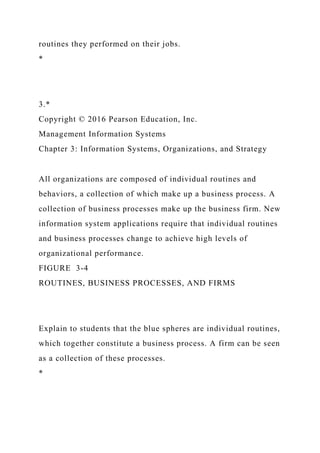
All organizations are composed of individual routines and
behaviors, a collection of which make up a business process. A
collection of business processes make up the business firm. New
information system applications require that individual routines
and business processes change to achieve high levels of
organizational performance.
FIGURE 3-4
ROUTINES, BUSINESS PROCESSES, AND FIRMS
Explain to students that the blue spheres are individual routines,
which together constitute a business process. A firm can be seen
as a collection of these processes.
*
3.*
Copyright © 2016 Pearson Education, Inc.
Management Information Systems
Chapter 3: Information Systems, Organizations, and Strategy
Organizational politics:
Divergent viewpoints lead to political struggle, competition,
and conflict.
Political resistance greatly hampers organizational change.
Features of Organizations
You could ask students to describe examples where
organizational politics might hamper a firm’s ability to succeed,
or examples where effectively managed organizational politics
helps a company to undergo a smoother transition or make more
intelligent decisions. Ask students to describe their personal
experiences with “organizational politics.”
*
3.*
Copyright © 2016 Pearson Education, Inc.
Management Information Systems
Chapter 3: Information Systems, Organizations, and Strategy
Organizational culture:
Encompasses set of assumptions that define goal and
productWhat products the organization should produceHow and
where it should be producedFor whom the products should be
produced
May be powerful unifying force as well as restraint on change
Features of Organizations
Culture may seem like a pretty abstract idea to many students.
On the other hand, students with work experiences will easily
be able to describe the cultures of firms where they have
worked. Ask students to describe organizational cultures they
have experienced while on the job, or other areas of their lives.
What kind of organizational culture do students prefer and why?
Ask students to describe different kinds of cultures and what
types of firms are more likely to have them.
*
3.*
Copyright © 2016 Pearson Education, Inc.
Management Information Systems
Chapter 3: Information Systems, Organizations, and Strategy
Organizational environments:
Organizations and environments have a reciprocal relationship.
Organizations are open to, and dependent on, the social and
physical environment.
Organizations can influence their environments.
Environments generally change faster than organizations.
Information systems can be instrument of environmental
scanning, act as a lens.
Features of Organizations
Explain that environmental scanning involves searching for and
determining external changes that may require an organizational
response. The current economic climate represents an example
of external change that requires sweeping organizational
responses to ensure survival.
*
3.*
Copyright © 2016 Pearson Education, Inc.
Management Information Systems
Chapter 3: Information Systems, Organizations, and Strategy
Environments shape what organizations can do, but
organizations can influence their environments and decide to
change environments altogether. Information technology plays a
critical role in helping organizations perceive environmental
change and in helping organizations act on their environment.
FIGURE 3-5
ENVIRONMENTS AND ORGANIZATIONS HAVE A
RECIPROCAL RELATIONSHIP
This graphic further establishes information systems as the
“lens” of the firm, observing external factors and filtering
information back in to the firm. To some extent, organizations
“see” only what their systems will let them see. If systems are
poorly built, they may blind managers to difficulties and
problems.
*
3.*
Copyright © 2016 Pearson Education, Inc.
Management Information Systems
Chapter 3: Information Systems, Organizations, and Strategy
Disruptive technologiesTechnology that brings about sweeping
change to businesses, industries, marketsExamples: personal
computers, word processing software, the Internet, the
PageRank algorithmFirst movers and fast followersFirst
movers—inventors of disruptive technologiesFast followers—
firms with the size and resources to capitalize on that
technology
Features of Organizations
Ensure that students understand that the PageRank algorithm is
the underlying technology behind Google search. Ask students
if they can give examples of any first movers that invented a
disruptive technology, yet failed to last (examples might include
the Altair personal computer, the Netscape Navigator Internet
browser, etc.).
*
3.*
Copyright © 2016 Pearson Education, Inc.
Management Information Systems
Chapter 3: Information Systems, Organizations, and Strategy
Five basic kinds of organizational structureEntrepreneurial:
Small start-up businessMachine bureaucracy: Midsize
manufacturing firmDivisionalized bureaucracy: Fortune 500
firmsProfessional bureaucracy: Law firms, school systems,
hospitalsAdhocracy: Consulting firms
Features of Organizations
Do students agree with the classification of these types of
organizational structure? Can they come up with examples for
each type of organization?
*
3.*
Copyright © 2016 Pearson Education, Inc.
Management Information Systems
Chapter 3: Information Systems, Organizations, and Strategy
Other organizational featuresGoalsCoercive, utilitarian,
normative, and so onConstituenciesLeadership
stylesTasksSurrounding environments
Features of Organizations
Ask students to give some examples of each organizational
feature listed above. For example, different organizations
(prisons, businesses, colleges) have different types of goals
(coercive, utilitarian, normative, respectively).
*
3.*
Copyright © 2016 Pearson Education, Inc.
Management Information Systems
Chapter 3: Information Systems, Organizations, and Strategy
Economic impactsIT changes relative costs of capital and the
costs of information. Information systems technology is a factor
of production, like capital and labor.IT affects the cost and
quality of information and changes economics of
information.Information technology helps firms contract in size
because it can reduce transaction costs (the cost of participating
in markets)Outsourcing
The Impact of Information Systems on Organizations
IT figures to replace the function of more middle managers as
time passes, as well as reduce the need for other forms of
capital (buildings, machinery). Ensure that students understand
what is meant by “economics of information” and why
outsourcing is a possibility due to IT.
*
3.*
Copyright © 2016 Pearson Education, Inc.
Management Information Systems
Chapter 3: Information Systems, Organizations, and Strategy
Transaction cost theoryFirms seek to economize on transaction
costs (the costs of participating in markets).Vertical integration,
hiring more employees, buying suppliers and distributorsIT
lowers market transaction costs for firm, making it worthwhile
for firms to transact with other firms rather than grow the
number of employees.
The Impact of Information Systems on Organizations
Explain that using the market can be expensive. If you depend
on the market, rather than hiring employees, you will need to
search for talent, research the quality of providers and workers,
write contracts for work to be performed, monitor the work, and
so forth. When participation in markets is expensive, firms
would rather hire employees to accomplish their work. But the
Internet makes it less expensive to use the marketplace. With
the Internet, firms find it more cost effective to use the
marketplace and contract for work in a market, rather than hire
employees. Ask your students why the Internet can make
participating in markets less expensive than before.
*
3.*
Copyright © 2016 Pearson Education, Inc.
Management Information Systems
Chapter 3: Information Systems, Organizations, and Strategy
Agency theory: Firm is nexus of contracts among self-interested
parties requiring supervision.Firms experience agency costs (the
cost of managing and supervising) which rise as firm grows.IT
can reduce agency costs, making it possible for firms to grow
without adding to the costs of supervising, and without adding
employees.
The Impact of Information Systems on Organizations
By characterizing employees as independent agents requiring
constant supervision, agency theory underscores a key reason
that costs increase as firms grow in size and scope—the need to
expend more effort managing their employees.
*
3.*
Copyright © 2016 Pearson Education, Inc.
Management Information Systems
Chapter 3: Information Systems, Organizations, and Strategy
Organizational and behavioral impactsIT flattens
organizationsDecision making is pushed to lower levels.Fewer
managers are needed (IT enables faster decision making and
increases span of control).Postindustrial
organizationsOrganizations flatten because in postindustrial
societies, authority increasingly relies on knowledge and
competence rather than formal positions.
The Impact of Information Systems on Organizations
Ask students to explain what is meant by authority relying on
knowledge and competence rather than formal positions. Why
might this “flatten” the organization? The idea here is that with
sufficient IT, competent workers will be able to accomplish
more on their own than they would under a more hierarchical
arrangement.
*
3.*
Copyright © 2016 Pearson Education, Inc.
Management Information Systems
Chapter 3: Information Systems, Organizations, and Strategy
Information systems can reduce the number of levels in an
organization by providing managers with information to
supervise larger numbers of workers and by giving lower-level
employees more decision-making authority.
FIGURE 3-6
FLATTENING ORGANIZATIONS
Ask students to explain some of the benefits of the flattened
organization as opposed to the more complicated hierarchy in
the top of the diagram. Information travels through fewer levels
to its intended recipients; there are fewer managers, so agency
costs are smaller, and firms can act faster (less decision delay).
*
3.*
Copyright © 2016 Pearson Education, Inc.
Management Information Systems
Chapter 3: Information Systems, Organizations, and Strategy
Organizational resistance to changeInformation systems become
bound up in organizational politics because they influence
access to a key resource—information.Information systems
potentially change an organization’s structure, culture, politics,
and work.Most common reason for failure of large projects is
due to organizational and political resistance to change.
The Impact of Information Systems on Organizations
Explain what is meant by changes in culture and politics of the
firm. For example, workers may resist changes that disrupt their
routines. Also explain to students that as important as technical
understanding of information systems may be for potential
managers, it is equally important to understand the people and
organizational structures and customs affected by information
systems.
*
3.*
Copyright © 2016 Pearson Education, Inc.
Management Information Systems
Chapter 3: Information Systems, Organizations, and Strategy
Implementing information systems has consequences for task
arrangements, structures, and people. According to this model,
to implement change, all four components must be changed
simultaneously.
FIGURE 3-7
ORGANIZATIONAL RESISTANCE TO
INFORMATION SYSTEM INNOVATIONS
The circle shape in the figure represents the mutual relationship
among the concepts shown.
*
3.*
Copyright © 2016 Pearson Education, Inc.
Management Information Systems
Chapter 3: Information Systems, Organizations, and Strategy
The Internet and organizationsThe Internet increases the
accessibility, storage, and distribution of information and
knowledge for organizations.The Internet can greatly lower
transaction and agency costs.Example: Large firm delivers
internal manuals to employees via a corporate Web site, saving
millions of dollars in distribution costs
The Impact of Information Systems on Organizations
The Internet should also have a flattening effect on many
organizations. Can students describe any businesses that have
become more efficient and flat thanks to successful
incorporation of the Internet in their operations? Some older
students may remember the “bad old days” when seven or more
levels of management needed to decide even simple issues in a
typical firm. Many Fortune 1000 firms are still like this.
*
3.*
Copyright © 2016 Pearson Education, Inc.
Management Information Systems
Chapter 3: Information Systems, Organizations, and Strategy
Organizational factors in planning a new
system:EnvironmentStructureHierarchy, specialization,
routines, business processesCulture and politicsType of
organization and style of leadership Main interest groups
affected by system; attitudes of end usersTasks, decisions, and
business processes the system will assist
The Impact of Information Systems on Organizations
Ask students to consider the results of an information system
implemented without properly considering each of the above
factors. For example, an information system designed without
an understanding of the company’s culture and politics is likely
to be unpopular, perhaps forcing employees to drastically
deviate from their previous routines.
*
3.*
Copyright © 2016 Pearson Education, Inc.
Management Information Systems
Chapter 3: Information Systems, Organizations, and Strategy
Why do some firms become leaders in their industry? Michael
Porter’s competitive forces modelProvides general view of firm,
its competitors, and environmentFive competitive forces shape
fate of firm:
Traditional competitors
New market entrants
Substitute products and services
Customers
Suppliers
Using Information Systems to Develop Competitive Strategies
Porter’s competitive forces model is intended to explain why
some firms do better than others. Do students believe that this
model captures this idea effectively? Which factor is most
important to a firm’s success? You can make a list of five well-
known firms on the blackboard or screen and ask students, for
each firm, which do they think are the most important
competitive forces.
*
3.*
Copyright © 2016 Pearson Education, Inc.
Management Information Systems
Chapter 3: Information Systems, Organizations, and Strategy
In Porter’s competitive forces model, the strategic position of
the firm and its strategies are determined not only by
competition with its traditional direct competitors but also by
four other forces in the industry’s environment: new market
entrants, substitute products, customers, and suppliers.
FIGURE 3-8
PORTER’S COMPETITIVE FORCES MODEL
Notice that in the graphic, competitors are represented
differently than the other four competitive forces influencing a
firm. Why do students think this is the case? One answer might
be that competitors are firms in the same industry and are under
similar pressures as other firms in the industry.
*
3.*
Copyright © 2016 Pearson Education, Inc.
Management Information Systems
Chapter 3: Information Systems, Organizations, and Strategy
Traditional competitorsAll firms share market space with
competitors who are continuously devising new products,
services, efficiencies, and switching costs.New market entrants
Some industries have high barriers to entry, for example,
computer chip business.New companies have new equipment,
younger workers, but little brand recognition.
Using Information Systems to Develop Competitive Strategies
Ask students to name different industries and describe the
benefits and drawbacks of being a new market entrant in each
industry.
*
3.*
Copyright © 2016 Pearson Education, Inc.
Management Information Systems
Chapter 3: Information Systems, Organizations, and Strategy
Substitute products and servicesSubstitutes customers might use
if your prices become too high, for example, iTunes substitutes
for CDsCustomers Can customers easily switch to competitor's
products? Can they force businesses to compete on price alone
in transparent marketplace?SuppliersMarket power of suppliers
when firm cannot raise prices as fast as suppliers
Using Information Systems to Develop Competitive Strategies
Ask students to name different businesses and describe whether
or not customers have great control over the business or vice
versa, or whether substitute products are a large or insignificant
threat to the success of the business.
*
3.*
Copyright © 2016 Pearson Education, Inc.
Management Information Systems
Chapter 3: Information Systems, Organizations, and Strategy
Four generic strategies for dealing with competitive forces,
enabled by using IT:Low-cost leadership Product
differentiationFocus on market nicheStrengthen customer and
supplier intimacy
Using Information Systems to Develop Competitive Strategies
Here you can make a list of five well-known firms and then
analyze with students the major thrust of their strategy.
Walmart is a good example to start with because of its emphasis
on low-cost leadership.
*
3.*
Copyright © 2016 Pearson Education, Inc.
Management Information Systems
Chapter 3: Information Systems, Organizations, and Strategy
Low-cost leadershipProduce products and services at a lower
price than competitors Example: Walmart’s efficient customer
response systemProduct differentiationEnable new products or
services, greatly change customer convenience and
experienceExample: Google, Nike, AppleMass customization
Using Information Systems to Develop Competitive Strategies
Do students believe it is possible both to design information
systems that focus both on low-cost leadership and product
differentiation? Some may say it is with sufficient planning and
innovation; perhaps a new product is even cheaper to produce
than older ones. Some may say that the investment in innovation
required for product differentiation precludes that firm from
maintaining low-cost leadership.
*
3.*
Copyright © 2016 Pearson Education, Inc.
Management Information Systems
Chapter 3: Information Systems, Organizations, and Strategy
Read the Interactive Session and discuss the following
questions
Interactive Session: Technology
Evaluate Nike using the competitive forces and value chain
models.What competitive strategies is Nike pursuing? How is
information technology related to these strategies?In what sense
is Nike a “technology company”? Explain your answer.How
much of an edge does Nike have over its competitors? Explain
your answer.
Nike Becomes a Technology Company
*
3.*
Copyright © 2016 Pearson Education, Inc.
Management Information Systems
Chapter 3: Information Systems, Organizations, and Strategy
Focus on market nicheUse information systems to enable a
focused strategy on a single market niche; specializeExample:
Hilton Hotels’ OnQ system Strengthen customer and supplier
intimacyUse information systems to develop strong ties and
loyalty with customers and suppliersIncrease switching
costsExample: Netflix, Amazon
Using Information Systems to Develop Competitive Strategies
You could ask students to provide other examples from their
own experience of companies that exemplify strong focus on
market niche as well as excellent customer and supplier
intimacy.
*
3.*
Copyright © 2016 Pearson Education, Inc.
Management Information Systems
Chapter 3: Information Systems, Organizations, and Strategy
Read the Interactive Session and discuss the following
questions
Interactive Session: Organizations
Describe the kinds of data being analyzed by the companies in
this case.How is this fine-grained data analysis improving
operations and decision making in the companies described in
this case? What business strategies are being supported?Are
there any disadvantages to mining customer data? Explain your
answer.How do you feel about airlines mining your inflight
data? Is this any different from companies mining your credit
card purchases or Web surfing?
Identifying Market Niches in the Age of Big Data
3.*
Copyright © 2016 Pearson Education, Inc.
Management Information Systems
Chapter 3: Information Systems, Organizations, and Strategy
The Internet’s impact on competitive advantageTransformation
or threat to some industriesExamples: travel agency, printed
encyclopedia, mediaCompetitive forces still at work, but rivalry
more intenseUniversal standards allow new rivals, entrants to
marketNew opportunities for building brands and loyal
customer bases
Using Information Systems to Develop Competitive Strategies
Do students believe it is easier or harder to gain a competitive
advantage via the Internet as opposed to more traditional
means? Table 3-5 describes the impact of the Internet on
various competitive forces.
*
3.*
Copyright © 2016 Pearson Education, Inc.
Management Information Systems
Chapter 3: Information Systems, Organizations, and Strategy
Value chain modelFirm as series of activities that add value to
products or servicesHighlights activities where competitive
strategies can best be appliedPrimary activities vs. support
activitiesAt each stage, determine how information systems can
improve operational efficiency and improve customer and
supplier intimacyUtilize benchmarking, industry best practices
Using Information Systems to Develop Competitive Strategies
How does the value chain model differ from the Porter model?
(It offers more specific detail about what exactly to do to
achieve competitive advantages.) How do primary activities
differ from support activities?
*
3.*
Copyright © 2016 Pearson Education, Inc.
Management Information Systems
Chapter 3: Information Systems, Organizations, and Strategy
This figure provides examples of systems for both primary and
support activities of a firm and of its value partners that can add
a margin of value to a firm's products or services.
FIGURE 3-9
THE VALUE CHAIN MODEL
Emphasize the relationship between the primary and support
activities of this firm and explain how information systems are
critical to the success of each activity.
*
3.*
Copyright © 2016 Pearson Education, Inc.
Management Information Systems
Chapter 3: Information Systems, Organizations, and Strategy
Value web: Collection of independent firms using highly
synchronized IT to coordinate value chains to produce product
or service collectivelyMore customer driven, less linear
operation than traditional value chain
Using Information Systems to Develop Competitive Strategies
Explain that a value web extends beyond the boundaries of an
individual firm and represents the coordination of value chains
across multiple independent firms. A value web is flexible and
adapts to changes in supply and demand and changing market
conditions.
*
3.*
Copyright © 2016 Pearson Education, Inc.
Management Information Systems
Chapter 3: Information Systems, Organizations, and Strategy
The value web is a networked system that can synchronize the
value chains of business partners within an industry to respond
rapidly to changes in supply and demand.
FIGURE 3-10
THE VALUE WEB
Ask students why a model like the one displayed in the figure
might be more likely to adapt quickly to changes in supply and
demand. Also emphasize the networking among the different
segments of the value web.
*
3.*
Copyright © 2016 Pearson Education, Inc.
Management Information Systems
Chapter 3: Information Systems, Organizations, and Strategy
Information systems can improve overall performance of
business units by promoting synergies and core
competenciesSynergiesWhen output of some units used as
inputs to others, or organizations pool markets and
expertiseExample: merger of Bank of NY and JPMorgan
ChasePurchase of YouTube by Google
Using Information Systems to Develop Competitive Strategies
Explain that information technology’s role in promoting
synergy is often tying together operations of disparate business
units so that they can act as a whole. Why might this lead to
reduced costs and increased efficiency?
*
3.*
Copyright © 2016 Pearson Education, Inc.
Management Information Systems
Chapter 3: Information Systems, Organizations, and Strategy
Core competenciesActivity for which firm is world-class
leaderRelies on knowledge, experience, and sharing this across
business unitsExample: Procter & Gamble’s intranet and
directory of subject matter experts
Using Information Systems to Develop Competitive Strategies
Can students name any other notable examples of core
competencies among firms? (Google: search, Microsoft: office
productivity software; Intel processors, and so on)
*
3.*
Copyright © 2016 Pearson Education, Inc.
Management Information Systems
Chapter 3: Information Systems, Organizations, and Strategy
Network-based strategiesTake advantage of firm’s abilities to
network with one anotherInclude use of:Network
economicsVirtual company modelBusiness ecosystems
Using Information Systems to Develop Competitive Strategies
Examples of firms that use this type of strategy to achieve an
advantage are eBay and iVillage. Many other companies are
following suit in using a network-based strategy—can students
name any? eBay, iVillage, and social networking firms such as
Facebook, are based on networks of millions of users. These
companies have used the Web and Internet communication tools
to build communities. The more people who join these
communities, the more benefit members receive.
*
3.*
Copyright © 2016 Pearson Education, Inc.
Management Information Systems
Chapter 3: Information Systems, Organizations, and Strategy
Traditional economics: Law of diminishing returnsThe more any
given resource is applied to production, the lower the marginal
gain in output, until a point is reached where the additional
inputs produce no additional outputsNetwork
economics:Marginal cost of adding new participant almost zero,
with much greater marginal gainValue of community grows with
sizeValue of software grows as installed customer base grows
Using Information Systems to Develop Competitive Strategies
Explain the difference between these two schools of economics.
What aspect of network economics allows value to continue to
increase with the size of the community?
*
3.*
Copyright © 2016 Pearson Education, Inc.
Management Information Systems
Chapter 3: Information Systems, Organizations, and Strategy
Virtual company strategyVirtual company uses networks to ally
with other companies to create and distribute products without
being limited by traditional organizational boundaries or
physical locationsExample: Li & Fung manages production,
shipment of garments for major fashion companies, outsourcing
all work to more than 7,500 suppliers
Using Information Systems to Develop Competitive Strategies
Explain to students that companies like this are “virtual”
because they do not actually own any factories, machines, or
other similar infrastructure. Instead, they offer a series of
services, aided by information systems and uninhibited by
geographical boundaries.
*
3.*
Copyright © 2016 Pearson Education, Inc.
Management Information Systems
Chapter 3: Information Systems, Organizations, and Strategy
Business ecosystemsIndustry sets of firms providing related
services and productsMicrosoft platform used by thousands of
firmsWalmart’s order entry and inventory managementKeystone
firms: Dominate ecosystem and create platform used by other
firmsNiche firms: Rely on platform developed by keystone
firmIndividual firms can consider how IT will help them
become profitable niche players in larger ecosystems
Using Information Systems to Develop Competitive Strategies
Can students see the similarities between business ecosystems
and value webs? Can they appreciate the key difference (that
business ecosystems extend across industries as opposed to just
firms within the same industry)?
*
3.*
Copyright © 2016 Pearson Education, Inc.
Management Information Systems
Chapter 3: Information Systems, Organizations, and Strategy
The digital firm era requires a more dynamic view of the
boundaries among industries, firms, customers, and suppliers,
with competition occurring among industry sets in a business
ecosystem. In the ecosystem model, multiple industries work
together to deliver value to the customer. IT plays an important
role in enabling a dense network of interactions among the
participating firms.
FIGURE 3-11
AN ECOSYSTEM STRATEGIC MODEL
Emphasize how important IT is in bringing disparate industries
together to deliver value to the customer. What are the
challenges of coordinating the flow of information across, for
example, four different industries, as shown in the figure?
*
3.*
Copyright © 2016 Pearson Education, Inc.
Management Information Systems
Chapter 3: Information Systems, Organizations, and Strategy
Sustaining competitive advantageCompetitors can retaliate and
copy strategic systemsSystems may become tools for
survivalAligning IT with business objectivesPerforming
strategic systems analysisStructure of industryFirm value
chainsManaging strategic transitionsAdopting strategic systems
requires changes in business goals, relationships with customers
and suppliers, and business processes
Using Information Systems to Develop Competitive Strategies
Emphasize the importance and difficulty of aligning information
technology with the business. What does this phrase mean? It
seems pretty simple. Why do so many companies fail at this
critical task? Can students think of any other important
questions that management should ask about their company
before designing their IT systems? What is a solution for the
fact that many competitive advantages can be copied? This fact
highlights the importance of continuous innovation in order to
stay ahead.
*
3.*
Copyright © 2016 Pearson Education, Inc.
Management Information Systems
Chapter 3: Information Systems, Organizations, and Strategy
Global E-business and Collaboration
Chapter 2
VIDEO CASES
Case 1: Walmart’s Retail Link Supply Chain
Case 2: Salesforce.com: The Emerging Social Enterprise
Case 3: How FedEx Works: Inside the Memphis Hub
Instructional Video 1: U.S. Foodservice Grows Market with
Oracle CRM on Demand
*
2.*
Copyright © 2016 Pearson Education, Inc.
Management Information Systems
Chapter 2: Global E-business and Collaboration
What are business processes? How are they related to
information systems?How do systems serve the different
management groups in a business and how do systems that link
the enterprise improve organizational performance?Why are
systems for collaboration and social business so important and
what technologies do they use?What is the role of the
information systems function in a business?
Learning Objectives
This chapter is designed to provide students a quick overview of
the kinds of systems found in a typical corporation. Some of the
concepts were introduced in Chapter 1. You could ask students
to recall and describe the different levels of management in a
business, intranets, and business processes using information
from the previous chapter. Some are new—such as enterprise
wide systems.
*
2.*
Copyright © 2016 Pearson Education, Inc.
Management Information Systems
Chapter 2: Global E-business and Collaboration
Problem: Need to improve employee collaboration and
knowledge sharing; outdated knowledge on intranet

Information Systems, Organizations, and StrategyChapter .docx

  • 1.
    Information Systems, Organizations,and Strategy Chapter 3 VIDEO CASES Case 1: National Basketball Association: Competing on Global Delivery with Akamai OS Streaming Case 2: IT and Geo-Mapping Help a Small Business Succeed (2009) Case 3: Materials Handling Equipment Corp: Enterprise Systems Drive Corporate Strategy for a Small Business Instructional Video 1 SAP BusinessOne ERP: From Orders to Final Delivery and Payment * 3.* Copyright © 2016 Pearson Education, Inc. Management Information Systems Chapter 3: Information Systems, Organizations, and Strategy Which features of organizations do managers need to know about to build and use information systems successfully?What is the impact of information systems on organizations?How do Porter’s competitive forces model, the value chain model, synergies, core competencies, and network economics help companies develop competitive strategies using information systems?What are the challenges posed by strategic information systems and how should they be addressed? Learning Objectives
  • 2.
    You could askstudents to recall some concepts from the previous chapters that might help managers build and use information systems successfully. Answers could include what business processes the company performs, the size of the company, or the organization of the information systems function. * 3.* Copyright © 2016 Pearson Education, Inc. Management Information Systems Chapter 3: Information Systems, Organizations, and Strategy Problem: No online presence, powerful competitors, variable inventory Solution s: Develop online sales processExperiment with flash salesDemonstrates IT’s central role in defining competitive strategy Should T.J. Maxx Sell Online? *
  • 3.
    3.* Copyright © 2016Pearson Education, Inc. Management Information Systems Chapter 3: Information Systems, Organizations, and Strategy Information technology and organizations influence each otherRelationship influenced by organization’sStructureBusiness processesPoliticsCultureEnvironment Management decisions Features of Organizations This concept was briefly discussed in Chapter 1. Figure 1-2 and 1-3 as well as the figure on the next slide, 3-1, display this interdependent relationship graphically. * 3.* Copyright © 2016 Pearson Education, Inc. Management Information Systems Chapter 3: Information Systems, Organizations, and Strategy This complex two-way relationship is mediated by many factors, not the least of which are the decisions made—or not
  • 4.
    made—by managers. Otherfactors mediating the relationship include the organizational culture, structure, politics, business processes, and environment. FIGURE 3-1 THE TWO-WAY RELATIONSHIP BETWEEN ORGANIZATIONS AND INFORMATION TECHNOLOGY Ask students to explain how each factor might affect the relationship between organizations and information technology. Emphasize to students that the relationship between these two and its effects on the future of a business are difficult to predict. For example, very few people could have predicted the prominence of e-mail and instant messaging in business communication 15 years ago. * 3.* Copyright © 2016 Pearson Education, Inc. Management Information Systems Chapter 3: Information Systems, Organizations, and Strategy What is an organization?Technical definition: Formal social structure that processes resources from environment to produce outputsA formal legal entity with internal rules and procedures,
  • 5.
    as well asa social structureBehavioral definition: A collection of rights, privileges, obligations, and responsibilities that is delicately balanced over a period of time through conflict and conflict resolution Features of Organizations Which of the two definitions do students find more accurate and why? It is important to consider both definitions rather than exclusively use one at the expense of the other. The two definitions are complementary. * 3.* Copyright © 2016 Pearson Education, Inc. Management Information Systems Chapter 3: Information Systems, Organizations, and Strategy In the microeconomic definition of organizations, capital and labor (the primary production factors provided by the environment) are transformed by the firm through the production process into products and services (outputs to the environment). The products and services are consumed by the environment, which supplies additional capital and labor as
  • 6.
    inputs in thefeedback loop. FIGURE 3-2 THE TECHNICAL MICROECONOMIC DEFINITION OF THE ORGANIZATION Ask students what are the inputs from the environment? What do organizations output (goods and services). In this view, the organization or business firm is rather easily changed, and malleable. The organization is a collection of parts, like a machine, that can be rearranged as needed. There are no humans in this model, or if there are, they are assumed to be relatively simple. * 3.* Copyright © 2016 Pearson Education, Inc. Management Information Systems Chapter 3: Information Systems, Organizations, and Strategy THE BEHAVIORAL VIEW OF ORGANIZATIONS The behavioral view of organizations emphasizes group relationships, values, and structures. FIGURE 3-3
  • 7.
    In this view,the business firm is a little more difficult to change rapidly or on command because it is a very complex machine populated with human beings. Firms operate with an existing hierarchy, job definitions, business rules, legal contracts, procedures, and processes. Efficient organizations become very good at these elements of business. Changing these elements takes more time. * 3.* Copyright © 2016 Pearson Education, Inc. Management Information Systems Chapter 3: Information Systems, Organizations, and Strategy Features of organizationsUse of hierarchical structureAccountability, authority in system of impartial decision makingAdherence to principle of efficiencyRoutines and business processes Organizational politics, culture, environments, and structures Features of Organizations You could ask students to envision what would happen to an
  • 8.
    organization that didnot use a hierarchical structure (would anything get done?), did not adhere to the principle of efficiency (would they provide any good or service worth using at an affordable price?), and so on. * 3.* Copyright © 2016 Pearson Education, Inc. Management Information Systems Chapter 3: Information Systems, Organizations, and Strategy Routines and business processes Routines (standard operating procedures)Precise rules, procedures, and practices developed to cope with virtually all expected situations Business processes: Collections of routines Business firm: Collection of business processes Features of Organizations You could ask students to describe examples of situations where a business they have interacted with has had a well-understood set of routines. One such example is at the doctor’s office, where the receptionist, nurses, and doctors all have a defined set of routines. Ask students to think about and describe
  • 9.
    routines they performedon their jobs. * 3.* Copyright © 2016 Pearson Education, Inc. Management Information Systems Chapter 3: Information Systems, Organizations, and Strategy All organizations are composed of individual routines and behaviors, a collection of which make up a business process. A collection of business processes make up the business firm. New information system applications require that individual routines and business processes change to achieve high levels of organizational performance. FIGURE 3-4 ROUTINES, BUSINESS PROCESSES, AND FIRMS Explain to students that the blue spheres are individual routines, which together constitute a business process. A firm can be seen as a collection of these processes. *
  • 10.
    3.* Copyright © 2016Pearson Education, Inc. Management Information Systems Chapter 3: Information Systems, Organizations, and Strategy Organizational politics: Divergent viewpoints lead to political struggle, competition, and conflict. Political resistance greatly hampers organizational change. Features of Organizations You could ask students to describe examples where organizational politics might hamper a firm’s ability to succeed, or examples where effectively managed organizational politics helps a company to undergo a smoother transition or make more intelligent decisions. Ask students to describe their personal experiences with “organizational politics.” * 3.* Copyright © 2016 Pearson Education, Inc. Management Information Systems Chapter 3: Information Systems, Organizations, and Strategy Organizational culture:
  • 11.
    Encompasses set ofassumptions that define goal and productWhat products the organization should produceHow and where it should be producedFor whom the products should be produced May be powerful unifying force as well as restraint on change Features of Organizations Culture may seem like a pretty abstract idea to many students. On the other hand, students with work experiences will easily be able to describe the cultures of firms where they have worked. Ask students to describe organizational cultures they have experienced while on the job, or other areas of their lives. What kind of organizational culture do students prefer and why? Ask students to describe different kinds of cultures and what types of firms are more likely to have them. * 3.* Copyright © 2016 Pearson Education, Inc. Management Information Systems Chapter 3: Information Systems, Organizations, and Strategy Organizational environments: Organizations and environments have a reciprocal relationship.
  • 12.
    Organizations are opento, and dependent on, the social and physical environment. Organizations can influence their environments. Environments generally change faster than organizations. Information systems can be instrument of environmental scanning, act as a lens. Features of Organizations Explain that environmental scanning involves searching for and determining external changes that may require an organizational response. The current economic climate represents an example of external change that requires sweeping organizational responses to ensure survival. * 3.* Copyright © 2016 Pearson Education, Inc. Management Information Systems Chapter 3: Information Systems, Organizations, and Strategy Environments shape what organizations can do, but organizations can influence their environments and decide to change environments altogether. Information technology plays a
  • 13.
    critical role inhelping organizations perceive environmental change and in helping organizations act on their environment. FIGURE 3-5 ENVIRONMENTS AND ORGANIZATIONS HAVE A RECIPROCAL RELATIONSHIP This graphic further establishes information systems as the “lens” of the firm, observing external factors and filtering information back in to the firm. To some extent, organizations “see” only what their systems will let them see. If systems are poorly built, they may blind managers to difficulties and problems. * 3.* Copyright © 2016 Pearson Education, Inc. Management Information Systems Chapter 3: Information Systems, Organizations, and Strategy Disruptive technologiesTechnology that brings about sweeping change to businesses, industries, marketsExamples: personal computers, word processing software, the Internet, the PageRank algorithmFirst movers and fast followersFirst movers—inventors of disruptive technologiesFast followers—
  • 14.
    firms with thesize and resources to capitalize on that technology Features of Organizations Ensure that students understand that the PageRank algorithm is the underlying technology behind Google search. Ask students if they can give examples of any first movers that invented a disruptive technology, yet failed to last (examples might include the Altair personal computer, the Netscape Navigator Internet browser, etc.). * 3.* Copyright © 2016 Pearson Education, Inc. Management Information Systems Chapter 3: Information Systems, Organizations, and Strategy Five basic kinds of organizational structureEntrepreneurial: Small start-up businessMachine bureaucracy: Midsize manufacturing firmDivisionalized bureaucracy: Fortune 500 firmsProfessional bureaucracy: Law firms, school systems, hospitalsAdhocracy: Consulting firms Features of Organizations
  • 15.
    Do students agreewith the classification of these types of organizational structure? Can they come up with examples for each type of organization? * 3.* Copyright © 2016 Pearson Education, Inc. Management Information Systems Chapter 3: Information Systems, Organizations, and Strategy Other organizational featuresGoalsCoercive, utilitarian, normative, and so onConstituenciesLeadership stylesTasksSurrounding environments Features of Organizations Ask students to give some examples of each organizational feature listed above. For example, different organizations (prisons, businesses, colleges) have different types of goals (coercive, utilitarian, normative, respectively). * 3.*
  • 16.
    Copyright © 2016Pearson Education, Inc. Management Information Systems Chapter 3: Information Systems, Organizations, and Strategy Economic impactsIT changes relative costs of capital and the costs of information. Information systems technology is a factor of production, like capital and labor.IT affects the cost and quality of information and changes economics of information.Information technology helps firms contract in size because it can reduce transaction costs (the cost of participating in markets)Outsourcing The Impact of Information Systems on Organizations IT figures to replace the function of more middle managers as time passes, as well as reduce the need for other forms of capital (buildings, machinery). Ensure that students understand what is meant by “economics of information” and why outsourcing is a possibility due to IT. * 3.* Copyright © 2016 Pearson Education, Inc. Management Information Systems Chapter 3: Information Systems, Organizations, and Strategy
  • 17.
    Transaction cost theoryFirmsseek to economize on transaction costs (the costs of participating in markets).Vertical integration, hiring more employees, buying suppliers and distributorsIT lowers market transaction costs for firm, making it worthwhile for firms to transact with other firms rather than grow the number of employees. The Impact of Information Systems on Organizations Explain that using the market can be expensive. If you depend on the market, rather than hiring employees, you will need to search for talent, research the quality of providers and workers, write contracts for work to be performed, monitor the work, and so forth. When participation in markets is expensive, firms would rather hire employees to accomplish their work. But the Internet makes it less expensive to use the marketplace. With the Internet, firms find it more cost effective to use the marketplace and contract for work in a market, rather than hire employees. Ask your students why the Internet can make participating in markets less expensive than before. * 3.*
  • 18.
    Copyright © 2016Pearson Education, Inc. Management Information Systems Chapter 3: Information Systems, Organizations, and Strategy Agency theory: Firm is nexus of contracts among self-interested parties requiring supervision.Firms experience agency costs (the cost of managing and supervising) which rise as firm grows.IT can reduce agency costs, making it possible for firms to grow without adding to the costs of supervising, and without adding employees. The Impact of Information Systems on Organizations By characterizing employees as independent agents requiring constant supervision, agency theory underscores a key reason that costs increase as firms grow in size and scope—the need to expend more effort managing their employees. * 3.* Copyright © 2016 Pearson Education, Inc. Management Information Systems Chapter 3: Information Systems, Organizations, and Strategy Organizational and behavioral impactsIT flattens organizationsDecision making is pushed to lower levels.Fewer
  • 19.
    managers are needed(IT enables faster decision making and increases span of control).Postindustrial organizationsOrganizations flatten because in postindustrial societies, authority increasingly relies on knowledge and competence rather than formal positions. The Impact of Information Systems on Organizations Ask students to explain what is meant by authority relying on knowledge and competence rather than formal positions. Why might this “flatten” the organization? The idea here is that with sufficient IT, competent workers will be able to accomplish more on their own than they would under a more hierarchical arrangement. * 3.* Copyright © 2016 Pearson Education, Inc. Management Information Systems Chapter 3: Information Systems, Organizations, and Strategy Information systems can reduce the number of levels in an organization by providing managers with information to supervise larger numbers of workers and by giving lower-level
  • 20.
    employees more decision-makingauthority. FIGURE 3-6 FLATTENING ORGANIZATIONS Ask students to explain some of the benefits of the flattened organization as opposed to the more complicated hierarchy in the top of the diagram. Information travels through fewer levels to its intended recipients; there are fewer managers, so agency costs are smaller, and firms can act faster (less decision delay). * 3.* Copyright © 2016 Pearson Education, Inc. Management Information Systems Chapter 3: Information Systems, Organizations, and Strategy Organizational resistance to changeInformation systems become bound up in organizational politics because they influence access to a key resource—information.Information systems potentially change an organization’s structure, culture, politics, and work.Most common reason for failure of large projects is due to organizational and political resistance to change. The Impact of Information Systems on Organizations
  • 21.
    Explain what ismeant by changes in culture and politics of the firm. For example, workers may resist changes that disrupt their routines. Also explain to students that as important as technical understanding of information systems may be for potential managers, it is equally important to understand the people and organizational structures and customs affected by information systems. * 3.* Copyright © 2016 Pearson Education, Inc. Management Information Systems Chapter 3: Information Systems, Organizations, and Strategy Implementing information systems has consequences for task arrangements, structures, and people. According to this model, to implement change, all four components must be changed simultaneously. FIGURE 3-7 ORGANIZATIONAL RESISTANCE TO INFORMATION SYSTEM INNOVATIONS
  • 22.
    The circle shapein the figure represents the mutual relationship among the concepts shown. * 3.* Copyright © 2016 Pearson Education, Inc. Management Information Systems Chapter 3: Information Systems, Organizations, and Strategy The Internet and organizationsThe Internet increases the accessibility, storage, and distribution of information and knowledge for organizations.The Internet can greatly lower transaction and agency costs.Example: Large firm delivers internal manuals to employees via a corporate Web site, saving millions of dollars in distribution costs The Impact of Information Systems on Organizations The Internet should also have a flattening effect on many organizations. Can students describe any businesses that have become more efficient and flat thanks to successful incorporation of the Internet in their operations? Some older students may remember the “bad old days” when seven or more levels of management needed to decide even simple issues in a
  • 23.
    typical firm. ManyFortune 1000 firms are still like this. * 3.* Copyright © 2016 Pearson Education, Inc. Management Information Systems Chapter 3: Information Systems, Organizations, and Strategy Organizational factors in planning a new system:EnvironmentStructureHierarchy, specialization, routines, business processesCulture and politicsType of organization and style of leadership Main interest groups affected by system; attitudes of end usersTasks, decisions, and business processes the system will assist The Impact of Information Systems on Organizations Ask students to consider the results of an information system implemented without properly considering each of the above factors. For example, an information system designed without an understanding of the company’s culture and politics is likely to be unpopular, perhaps forcing employees to drastically deviate from their previous routines. *
  • 24.
    3.* Copyright © 2016Pearson Education, Inc. Management Information Systems Chapter 3: Information Systems, Organizations, and Strategy Why do some firms become leaders in their industry? Michael Porter’s competitive forces modelProvides general view of firm, its competitors, and environmentFive competitive forces shape fate of firm: Traditional competitors New market entrants Substitute products and services Customers Suppliers Using Information Systems to Develop Competitive Strategies Porter’s competitive forces model is intended to explain why some firms do better than others. Do students believe that this model captures this idea effectively? Which factor is most important to a firm’s success? You can make a list of five well- known firms on the blackboard or screen and ask students, for each firm, which do they think are the most important competitive forces. *
  • 25.
    3.* Copyright © 2016Pearson Education, Inc. Management Information Systems Chapter 3: Information Systems, Organizations, and Strategy In Porter’s competitive forces model, the strategic position of the firm and its strategies are determined not only by competition with its traditional direct competitors but also by four other forces in the industry’s environment: new market entrants, substitute products, customers, and suppliers. FIGURE 3-8 PORTER’S COMPETITIVE FORCES MODEL Notice that in the graphic, competitors are represented differently than the other four competitive forces influencing a firm. Why do students think this is the case? One answer might be that competitors are firms in the same industry and are under similar pressures as other firms in the industry. * 3.*
  • 26.
    Copyright © 2016Pearson Education, Inc. Management Information Systems Chapter 3: Information Systems, Organizations, and Strategy Traditional competitorsAll firms share market space with competitors who are continuously devising new products, services, efficiencies, and switching costs.New market entrants Some industries have high barriers to entry, for example, computer chip business.New companies have new equipment, younger workers, but little brand recognition. Using Information Systems to Develop Competitive Strategies Ask students to name different industries and describe the benefits and drawbacks of being a new market entrant in each industry. * 3.* Copyright © 2016 Pearson Education, Inc. Management Information Systems Chapter 3: Information Systems, Organizations, and Strategy Substitute products and servicesSubstitutes customers might use if your prices become too high, for example, iTunes substitutes for CDsCustomers Can customers easily switch to competitor's
  • 27.
    products? Can theyforce businesses to compete on price alone in transparent marketplace?SuppliersMarket power of suppliers when firm cannot raise prices as fast as suppliers Using Information Systems to Develop Competitive Strategies Ask students to name different businesses and describe whether or not customers have great control over the business or vice versa, or whether substitute products are a large or insignificant threat to the success of the business. * 3.* Copyright © 2016 Pearson Education, Inc. Management Information Systems Chapter 3: Information Systems, Organizations, and Strategy Four generic strategies for dealing with competitive forces, enabled by using IT:Low-cost leadership Product differentiationFocus on market nicheStrengthen customer and supplier intimacy Using Information Systems to Develop Competitive Strategies Here you can make a list of five well-known firms and then
  • 28.
    analyze with studentsthe major thrust of their strategy. Walmart is a good example to start with because of its emphasis on low-cost leadership. * 3.* Copyright © 2016 Pearson Education, Inc. Management Information Systems Chapter 3: Information Systems, Organizations, and Strategy Low-cost leadershipProduce products and services at a lower price than competitors Example: Walmart’s efficient customer response systemProduct differentiationEnable new products or services, greatly change customer convenience and experienceExample: Google, Nike, AppleMass customization Using Information Systems to Develop Competitive Strategies Do students believe it is possible both to design information systems that focus both on low-cost leadership and product differentiation? Some may say it is with sufficient planning and innovation; perhaps a new product is even cheaper to produce than older ones. Some may say that the investment in innovation required for product differentiation precludes that firm from maintaining low-cost leadership.
  • 29.
    * 3.* Copyright © 2016Pearson Education, Inc. Management Information Systems Chapter 3: Information Systems, Organizations, and Strategy Read the Interactive Session and discuss the following questions Interactive Session: Technology Evaluate Nike using the competitive forces and value chain models.What competitive strategies is Nike pursuing? How is information technology related to these strategies?In what sense is Nike a “technology company”? Explain your answer.How much of an edge does Nike have over its competitors? Explain your answer. Nike Becomes a Technology Company * 3.*
  • 30.
    Copyright © 2016Pearson Education, Inc. Management Information Systems Chapter 3: Information Systems, Organizations, and Strategy Focus on market nicheUse information systems to enable a focused strategy on a single market niche; specializeExample: Hilton Hotels’ OnQ system Strengthen customer and supplier intimacyUse information systems to develop strong ties and loyalty with customers and suppliersIncrease switching costsExample: Netflix, Amazon Using Information Systems to Develop Competitive Strategies You could ask students to provide other examples from their own experience of companies that exemplify strong focus on market niche as well as excellent customer and supplier intimacy. * 3.* Copyright © 2016 Pearson Education, Inc. Management Information Systems Chapter 3: Information Systems, Organizations, and Strategy Read the Interactive Session and discuss the following questions
  • 31.
    Interactive Session: Organizations Describethe kinds of data being analyzed by the companies in this case.How is this fine-grained data analysis improving operations and decision making in the companies described in this case? What business strategies are being supported?Are there any disadvantages to mining customer data? Explain your answer.How do you feel about airlines mining your inflight data? Is this any different from companies mining your credit card purchases or Web surfing? Identifying Market Niches in the Age of Big Data 3.* Copyright © 2016 Pearson Education, Inc. Management Information Systems Chapter 3: Information Systems, Organizations, and Strategy The Internet’s impact on competitive advantageTransformation or threat to some industriesExamples: travel agency, printed encyclopedia, mediaCompetitive forces still at work, but rivalry more intenseUniversal standards allow new rivals, entrants to marketNew opportunities for building brands and loyal customer bases Using Information Systems to Develop Competitive Strategies
  • 32.
    Do students believeit is easier or harder to gain a competitive advantage via the Internet as opposed to more traditional means? Table 3-5 describes the impact of the Internet on various competitive forces. * 3.* Copyright © 2016 Pearson Education, Inc. Management Information Systems Chapter 3: Information Systems, Organizations, and Strategy Value chain modelFirm as series of activities that add value to products or servicesHighlights activities where competitive strategies can best be appliedPrimary activities vs. support activitiesAt each stage, determine how information systems can improve operational efficiency and improve customer and supplier intimacyUtilize benchmarking, industry best practices Using Information Systems to Develop Competitive Strategies How does the value chain model differ from the Porter model? (It offers more specific detail about what exactly to do to achieve competitive advantages.) How do primary activities differ from support activities? *
  • 33.
    3.* Copyright © 2016Pearson Education, Inc. Management Information Systems Chapter 3: Information Systems, Organizations, and Strategy This figure provides examples of systems for both primary and support activities of a firm and of its value partners that can add a margin of value to a firm's products or services. FIGURE 3-9 THE VALUE CHAIN MODEL Emphasize the relationship between the primary and support activities of this firm and explain how information systems are critical to the success of each activity. * 3.* Copyright © 2016 Pearson Education, Inc. Management Information Systems Chapter 3: Information Systems, Organizations, and Strategy Value web: Collection of independent firms using highly
  • 34.
    synchronized IT tocoordinate value chains to produce product or service collectivelyMore customer driven, less linear operation than traditional value chain Using Information Systems to Develop Competitive Strategies Explain that a value web extends beyond the boundaries of an individual firm and represents the coordination of value chains across multiple independent firms. A value web is flexible and adapts to changes in supply and demand and changing market conditions. * 3.* Copyright © 2016 Pearson Education, Inc. Management Information Systems Chapter 3: Information Systems, Organizations, and Strategy The value web is a networked system that can synchronize the value chains of business partners within an industry to respond rapidly to changes in supply and demand. FIGURE 3-10 THE VALUE WEB
  • 35.
    Ask students whya model like the one displayed in the figure might be more likely to adapt quickly to changes in supply and demand. Also emphasize the networking among the different segments of the value web. * 3.* Copyright © 2016 Pearson Education, Inc. Management Information Systems Chapter 3: Information Systems, Organizations, and Strategy Information systems can improve overall performance of business units by promoting synergies and core competenciesSynergiesWhen output of some units used as inputs to others, or organizations pool markets and expertiseExample: merger of Bank of NY and JPMorgan ChasePurchase of YouTube by Google Using Information Systems to Develop Competitive Strategies Explain that information technology’s role in promoting synergy is often tying together operations of disparate business units so that they can act as a whole. Why might this lead to reduced costs and increased efficiency?
  • 36.
    * 3.* Copyright © 2016Pearson Education, Inc. Management Information Systems Chapter 3: Information Systems, Organizations, and Strategy Core competenciesActivity for which firm is world-class leaderRelies on knowledge, experience, and sharing this across business unitsExample: Procter & Gamble’s intranet and directory of subject matter experts Using Information Systems to Develop Competitive Strategies Can students name any other notable examples of core competencies among firms? (Google: search, Microsoft: office productivity software; Intel processors, and so on) * 3.* Copyright © 2016 Pearson Education, Inc. Management Information Systems Chapter 3: Information Systems, Organizations, and Strategy
  • 37.
    Network-based strategiesTake advantageof firm’s abilities to network with one anotherInclude use of:Network economicsVirtual company modelBusiness ecosystems Using Information Systems to Develop Competitive Strategies Examples of firms that use this type of strategy to achieve an advantage are eBay and iVillage. Many other companies are following suit in using a network-based strategy—can students name any? eBay, iVillage, and social networking firms such as Facebook, are based on networks of millions of users. These companies have used the Web and Internet communication tools to build communities. The more people who join these communities, the more benefit members receive. * 3.* Copyright © 2016 Pearson Education, Inc. Management Information Systems Chapter 3: Information Systems, Organizations, and Strategy Traditional economics: Law of diminishing returnsThe more any given resource is applied to production, the lower the marginal gain in output, until a point is reached where the additional inputs produce no additional outputsNetwork
  • 38.
    economics:Marginal cost ofadding new participant almost zero, with much greater marginal gainValue of community grows with sizeValue of software grows as installed customer base grows Using Information Systems to Develop Competitive Strategies Explain the difference between these two schools of economics. What aspect of network economics allows value to continue to increase with the size of the community? * 3.* Copyright © 2016 Pearson Education, Inc. Management Information Systems Chapter 3: Information Systems, Organizations, and Strategy Virtual company strategyVirtual company uses networks to ally with other companies to create and distribute products without being limited by traditional organizational boundaries or physical locationsExample: Li & Fung manages production, shipment of garments for major fashion companies, outsourcing all work to more than 7,500 suppliers Using Information Systems to Develop Competitive Strategies
  • 39.
    Explain to studentsthat companies like this are “virtual” because they do not actually own any factories, machines, or other similar infrastructure. Instead, they offer a series of services, aided by information systems and uninhibited by geographical boundaries. * 3.* Copyright © 2016 Pearson Education, Inc. Management Information Systems Chapter 3: Information Systems, Organizations, and Strategy Business ecosystemsIndustry sets of firms providing related services and productsMicrosoft platform used by thousands of firmsWalmart’s order entry and inventory managementKeystone firms: Dominate ecosystem and create platform used by other firmsNiche firms: Rely on platform developed by keystone firmIndividual firms can consider how IT will help them become profitable niche players in larger ecosystems Using Information Systems to Develop Competitive Strategies Can students see the similarities between business ecosystems and value webs? Can they appreciate the key difference (that business ecosystems extend across industries as opposed to just
  • 40.
    firms within thesame industry)? * 3.* Copyright © 2016 Pearson Education, Inc. Management Information Systems Chapter 3: Information Systems, Organizations, and Strategy The digital firm era requires a more dynamic view of the boundaries among industries, firms, customers, and suppliers, with competition occurring among industry sets in a business ecosystem. In the ecosystem model, multiple industries work together to deliver value to the customer. IT plays an important role in enabling a dense network of interactions among the participating firms. FIGURE 3-11 AN ECOSYSTEM STRATEGIC MODEL Emphasize how important IT is in bringing disparate industries together to deliver value to the customer. What are the challenges of coordinating the flow of information across, for example, four different industries, as shown in the figure? *
  • 41.
    3.* Copyright © 2016Pearson Education, Inc. Management Information Systems Chapter 3: Information Systems, Organizations, and Strategy Sustaining competitive advantageCompetitors can retaliate and copy strategic systemsSystems may become tools for survivalAligning IT with business objectivesPerforming strategic systems analysisStructure of industryFirm value chainsManaging strategic transitionsAdopting strategic systems requires changes in business goals, relationships with customers and suppliers, and business processes Using Information Systems to Develop Competitive Strategies Emphasize the importance and difficulty of aligning information technology with the business. What does this phrase mean? It seems pretty simple. Why do so many companies fail at this critical task? Can students think of any other important questions that management should ask about their company before designing their IT systems? What is a solution for the fact that many competitive advantages can be copied? This fact highlights the importance of continuous innovation in order to stay ahead.
  • 42.
    * 3.* Copyright © 2016Pearson Education, Inc. Management Information Systems Chapter 3: Information Systems, Organizations, and Strategy Global E-business and Collaboration Chapter 2 VIDEO CASES Case 1: Walmart’s Retail Link Supply Chain Case 2: Salesforce.com: The Emerging Social Enterprise Case 3: How FedEx Works: Inside the Memphis Hub Instructional Video 1: U.S. Foodservice Grows Market with Oracle CRM on Demand *
  • 43.
    2.* Copyright © 2016Pearson Education, Inc. Management Information Systems Chapter 2: Global E-business and Collaboration What are business processes? How are they related to information systems?How do systems serve the different management groups in a business and how do systems that link the enterprise improve organizational performance?Why are systems for collaboration and social business so important and what technologies do they use?What is the role of the information systems function in a business? Learning Objectives This chapter is designed to provide students a quick overview of the kinds of systems found in a typical corporation. Some of the concepts were introduced in Chapter 1. You could ask students to recall and describe the different levels of management in a business, intranets, and business processes using information from the previous chapter. Some are new—such as enterprise wide systems. *
  • 44.
    2.* Copyright © 2016Pearson Education, Inc. Management Information Systems Chapter 2: Global E-business and Collaboration Problem: Need to improve employee collaboration and knowledge sharing; outdated knowledge on intranet