CORPORATE SOCIAL RESPONSIBILITY
CSR EXPLAINED
Many other names are used to refer to CSR such as socially responsible business, responsible
business conduct, responsible entrepreneurship, corporate citizenship, corporate accountability or
corporate sustainability.
CSR is the continuing commitment by businesses to behave ethically & contribute to economic
development while improving the quality of life of the workforce & their families, local
communities and the society at large.
WHAT IS CSR
CSR is an extended model of corporate governance based on the fiduciary duties owed to all the
firm's shareholders.
CSR is about how companies manage the business processes to produce an overall positive impact
on the society.
CSR is the responsibility of corporations to go above and beyond what the law requires them to do.
CSR is the responsibility of corporations to contribute to a better society and cleaner environment.
MILLENNIUM DEVELOPMENT GOALS AT THE
HEART OF CSR
Eradicate extreme poverty and hunger.
Achieve universal Primary education.
Promote gender equality and empower women.
Reduce child mortality.
Improve maternal health.
Combat HIV/ AIDS, Malaria & other fatal diseases.
Ensure environmental sustainability.
Develop a global partnership.
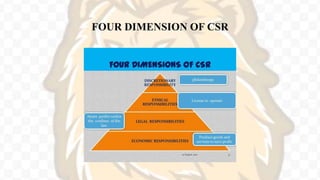
FOUR DIMENSION OF CSR
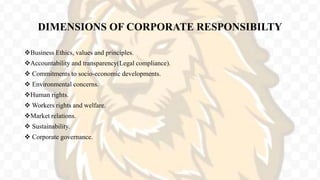
DIMENSIONS OF CORPORATE RESPONSIBILTY
Business Ethics, values and principles.
Accountability and transparency(Legal compliance).
 Commitments to socio-economic developments.
 Environmental concerns.
Human rights.
 Workers rights and welfare.
Market relations.
 Sustainability.
 Corporate governance.
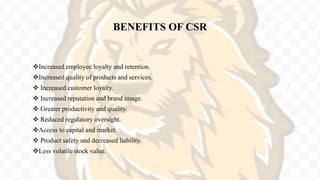
BENEFITS OF CSR
Increased employee loyalty and retention.
Increased quality of products and services.
 Increased customer loyalty.
 Increased reputation and brand image.
 Greater productivity and quality.
 Reduced regulatory oversight.
Access to capital and market.
 Product safety and decreased liability.
Less volatile stock value.
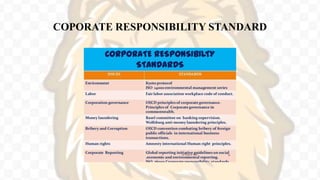
COPORATE RESPONSIBILITY STANDARD
BUSINESS IMPACT OF CSR
 Shareholder value(Changes in stock price and dividend).
Revenue(Changes in revenues due to change in market share and new markets).
 Operational efficiency. Access to debt and equity capital.
 Customer attraction and retention.
 Creation of brand value and reputation.
 Human capital.
 Risk management.
 Innovation.
 License to operate.
DRIVING FORCES BEHIND CSR
Globalization.
 Power & Influence of business corporations.
Growing access to education and information.
 Growing awareness of environmental issues.
 Spread of corporate scandals and public distrust.
TYPES OF CSR
According to Geoffrey Lantos:
3 main types of CSR.
Ethical CSR: It's about the responsibility to avoid harms or social injuries.
Altruistic CSR: Contributing to the common good at the possible expenses of the business for
altruistic ,humanitarian or philanthropic causes.
Strategic CSR: It's about firm's social welfare responsibilities that benefit both the corporation and
stakeholders.
BUSINESS ETHICS VS CSR
Ethics concerns individual actions that can be assessed as right or wrong with reference to moral
principles whereas CSR is about the organization's obligation to all stakeholders and not just
shareholders.
CSR is about tangible corporate practices while business ethics is more about the values driving
business decisions.
SOCIAL RESPONSIBILITIES CORPORATIONS
Labor rights Slave, forced,child labor,non-discrimination, equal opportunities,minimum
wages,health & safety.
Right to work Protection training /guidance.
Against unjustified dismissals, vocational
Right to hold opinions Freedom of expression, thought,conscience and religion.
Right to Privacy: Drug testing, Personal information, Surveillance etc.
ENVIRONMENTAL RESPONSIBILITIES OF
CORPORATIONS
UN convention on biodiversity:
Use and handling of genetically modified organisms.
 Greenhouse gas emissions and global warming.
 Soil & water contamination.
Treatment and reduction of waste water.
 Eco-efficiency.
 Recycling and reuse of materials.
 Protection of forest resources.
GREEN STRATEGIES FOR CSR
Green Buildings: The LEED certification by the US Green building Council has caused the growth
of green building movement.
 Emphasis on green manufacturing in order to reduce the emissions of green
house gases and environmental pollutions.
 Green products initiatives in order to reduce the toxic chemicals.
 Product stewardship encourages everyone in the value chain to contribute to product sustainability
from producers to regulators to retailers to consumers thereby achieving zero waste and sustainable
production.
CSR TOWARDS ENERGY EFFICIENCY,
EMISSIONS REDUCTION & BIODIVERSITY
CONSERVATION
Innovation in alternative transportation such as hybrid vehicles and electric vehicles by companies
like Toyota, Nissan, Honda and Tesla Motors in order to curb the greenhouse gas emissions and
reduce the environmental hazards.
Many companies like IBM,Staples and BP are purchasing Renewable Energy Credits (RECS) in
order to support the clean energy projects.
 Companies such as Ben & Jerry, IKEA, The Body Shop are promoting Biodiversity conservation,
sustainable forestry initiative, organic farming and fair trade in order to balance the need for both
business growth, sustaining and preserving the depleting natural resources.
CONCLUSION
CSR is the heart and soul of modern corporations and is an important standard for
corporate governance.
CSR is an indispensable mechanism for both increased corporate accountability,
profitability and environmental sustainability.
CSR is the pole star for modern corporations in order to maintain the integrity of moral
fabrics both inside and outside the corporation while conducting socially responsible
business.
Corporate social responsibility

Corporate social responsibility

  • 1.
  • 2.
    CSR EXPLAINED Many othernames are used to refer to CSR such as socially responsible business, responsible business conduct, responsible entrepreneurship, corporate citizenship, corporate accountability or corporate sustainability. CSR is the continuing commitment by businesses to behave ethically & contribute to economic development while improving the quality of life of the workforce & their families, local communities and the society at large.
  • 3.
    WHAT IS CSR CSRis an extended model of corporate governance based on the fiduciary duties owed to all the firm's shareholders. CSR is about how companies manage the business processes to produce an overall positive impact on the society. CSR is the responsibility of corporations to go above and beyond what the law requires them to do. CSR is the responsibility of corporations to contribute to a better society and cleaner environment.
  • 4.
    MILLENNIUM DEVELOPMENT GOALSAT THE HEART OF CSR Eradicate extreme poverty and hunger. Achieve universal Primary education. Promote gender equality and empower women. Reduce child mortality. Improve maternal health. Combat HIV/ AIDS, Malaria & other fatal diseases. Ensure environmental sustainability. Develop a global partnership.
  • 5.
  • 6.
    DIMENSIONS OF CORPORATERESPONSIBILTY Business Ethics, values and principles. Accountability and transparency(Legal compliance).  Commitments to socio-economic developments.  Environmental concerns. Human rights.  Workers rights and welfare. Market relations.  Sustainability.  Corporate governance.
  • 7.
    BENEFITS OF CSR Increasedemployee loyalty and retention. Increased quality of products and services.  Increased customer loyalty.  Increased reputation and brand image.  Greater productivity and quality.  Reduced regulatory oversight. Access to capital and market.  Product safety and decreased liability. Less volatile stock value.
  • 8.
  • 9.
    BUSINESS IMPACT OFCSR  Shareholder value(Changes in stock price and dividend). Revenue(Changes in revenues due to change in market share and new markets).  Operational efficiency. Access to debt and equity capital.  Customer attraction and retention.  Creation of brand value and reputation.  Human capital.  Risk management.  Innovation.  License to operate.
  • 10.
    DRIVING FORCES BEHINDCSR Globalization.  Power & Influence of business corporations. Growing access to education and information.  Growing awareness of environmental issues.  Spread of corporate scandals and public distrust.
  • 11.
    TYPES OF CSR Accordingto Geoffrey Lantos: 3 main types of CSR. Ethical CSR: It's about the responsibility to avoid harms or social injuries. Altruistic CSR: Contributing to the common good at the possible expenses of the business for altruistic ,humanitarian or philanthropic causes. Strategic CSR: It's about firm's social welfare responsibilities that benefit both the corporation and stakeholders.
  • 12.
    BUSINESS ETHICS VSCSR Ethics concerns individual actions that can be assessed as right or wrong with reference to moral principles whereas CSR is about the organization's obligation to all stakeholders and not just shareholders. CSR is about tangible corporate practices while business ethics is more about the values driving business decisions.
  • 13.
    SOCIAL RESPONSIBILITIES CORPORATIONS Laborrights Slave, forced,child labor,non-discrimination, equal opportunities,minimum wages,health & safety. Right to work Protection training /guidance. Against unjustified dismissals, vocational Right to hold opinions Freedom of expression, thought,conscience and religion. Right to Privacy: Drug testing, Personal information, Surveillance etc.
  • 14.
    ENVIRONMENTAL RESPONSIBILITIES OF CORPORATIONS UNconvention on biodiversity: Use and handling of genetically modified organisms.  Greenhouse gas emissions and global warming.  Soil & water contamination. Treatment and reduction of waste water.  Eco-efficiency.  Recycling and reuse of materials.  Protection of forest resources.
  • 15.
    GREEN STRATEGIES FORCSR Green Buildings: The LEED certification by the US Green building Council has caused the growth of green building movement.  Emphasis on green manufacturing in order to reduce the emissions of green house gases and environmental pollutions.  Green products initiatives in order to reduce the toxic chemicals.  Product stewardship encourages everyone in the value chain to contribute to product sustainability from producers to regulators to retailers to consumers thereby achieving zero waste and sustainable production.
  • 16.
    CSR TOWARDS ENERGYEFFICIENCY, EMISSIONS REDUCTION & BIODIVERSITY CONSERVATION Innovation in alternative transportation such as hybrid vehicles and electric vehicles by companies like Toyota, Nissan, Honda and Tesla Motors in order to curb the greenhouse gas emissions and reduce the environmental hazards. Many companies like IBM,Staples and BP are purchasing Renewable Energy Credits (RECS) in order to support the clean energy projects.  Companies such as Ben & Jerry, IKEA, The Body Shop are promoting Biodiversity conservation, sustainable forestry initiative, organic farming and fair trade in order to balance the need for both business growth, sustaining and preserving the depleting natural resources.
  • 17.
    CONCLUSION CSR is theheart and soul of modern corporations and is an important standard for corporate governance. CSR is an indispensable mechanism for both increased corporate accountability, profitability and environmental sustainability. CSR is the pole star for modern corporations in order to maintain the integrity of moral fabrics both inside and outside the corporation while conducting socially responsible business.