Chapter 5
Initiating and Planning Systems
Development Projects
2Chapter 5
Learning Objectives
 Describe the steps involved in the project
initiation and planning process.
 Explain the need for and the contents of a
Project Scope Statement and Baseline Project
Plan.
 List and describe various methods for assessing
project feasibility.
 Describe the differences between tangible and
intangible benefits and costs and between one-
time vs. recurring benefits and costs.
3Chapter 5
Learning Objectives (Cont.)
 Perform cost-benefit analysis and describe what
is meant by the time value of money, present
value, discount rate, net present value, return
on investment, and break-even analysis.
 Describe the general rules for evaluating
technical risks associated with a systems
development project.
 Describe the activities and participant roles
within a structured walkthrough.
4Chapter 5
Initiating and Planning Systems
Development Projects
 What must be considered when making the
decision on the division between project initiation
and planning (PIP) and analysis?
 How much effort should be expended on the PIP
process?
 Who is responsible for performing the PIP process?
 Why is PIP such a challenging activity?
5Chapter 5
The Process of Initiating and
Planning IS Development Projects
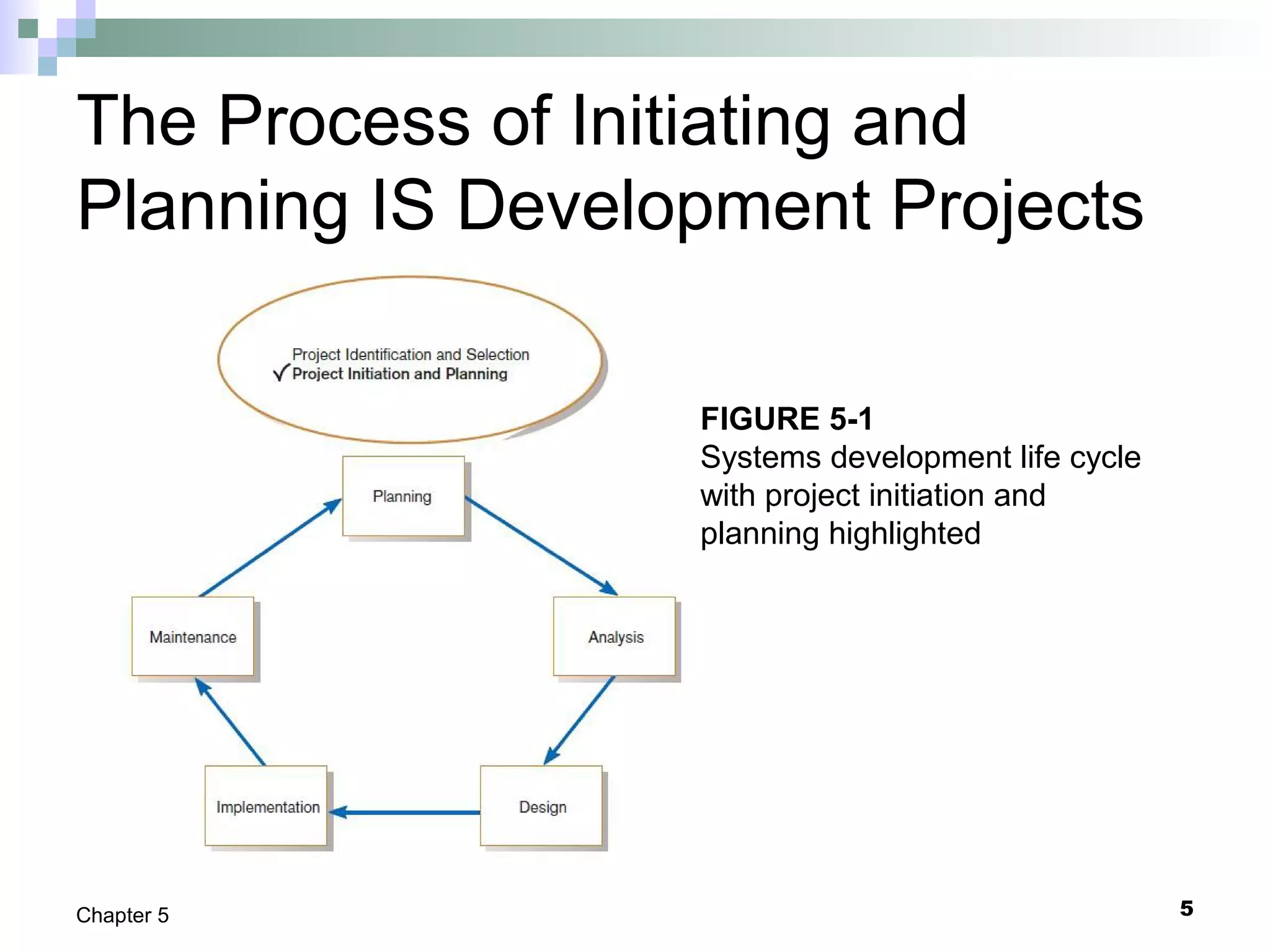
FIGURE 5-1
Systems development life cycle
with project initiation and
planning highlighted
6Chapter 5
The Process of Initiating and Planning IS
Development Projects (Cont.)
 Project initiation focuses on activities
designed to assist in organizing a team to
conduct project planning.
7Chapter 5
The Process of Initiating and Planning IS
Development Projects (Cont.)
 Establishing the Project Initiation Team.
 Establishing a Relationship with the Customer.
 Establishing the Project Initiation Plan.
 Establishing Management Procedures.
 Establishing the Project Management
Environment and Project Workbook.
 Developing the Project Charter.
8Chapter 5
The Process of Initiating and Planning IS
Development Projects (Cont.)
 The key activity of project initiation is the
development of the project charter.
 A short document that is prepared for both internal
and external stakeholders
 Provides a high-level overview of the project
 Useful communication tool that helps to assure that
the organizations and other stakeholders understand
the initiation of a project
9Chapter 5
The Process of Initiating and Planning IS
Development Projects (Cont.)
 A project charter typically contains:
 Project title and date of authorization
 Project manager name and contact information
 Customer name and contact information
 Project start and completion dates
 Key stakeholders, project role, and responsibilities
 Project objectives and description
 Key assumptions or approach
 Signature section for key stakeholders
10Chapter 5
The Process of Initiating and Planning IS
Development Projects (Cont.)
 The key activity of project planning is the
process of defining clear, discrete
activities and the work needed to complete
each activity within a single project.
 The objective of the project planning
process is the development of a Baseline
Project Plan (BPP) and the Project Scope
Statement (PSS).
11Chapter 5
Elements of Project Planning
 Describe project scope, alternatives,
feasibility.
 Divide project into tasks.
 Estimate resource requirements and
create resource plan.
 Develop preliminary schedule.
 Develop communication plan.
12Chapter 5
Elements of Project Planning (Cont.)
 Determine standards and procedures.
 Identify and assess risk.
 Create preliminary budget.
 Develop a statement of work.
 Set baseline project plan.
13Chapter 5
Deliverables and Outcomes
 Business Case
Justification for an information system
Presented in terms of the tangible and
intangible economic benefits and costs
(economic feasibility)
The technical and organizational feasibility of
the proposed system
14Chapter 5
Deliverables and Outcomes (Cont.)
 Baseline Project Plan (BPP)
A major outcome and deliverable from the PIP
phase
Contains the best estimate of a project’s
scope, benefits, costs, risks, and resource
requirements
15Chapter 5
Deliverables and Outcomes (Cont.)
 Project Scope Statement (PSS)
A document prepared for the customer
Describes what the project will deliver
Outlines at a high level all work required to
complete the project
16Chapter 5
Assessing Project Feasibility
1. Economic
2. Technical
3. Operational
4. Scheduling
5. Legal and contractual
6. Political
17Chapter 5
Assessing Project Feasibility (Cont.)
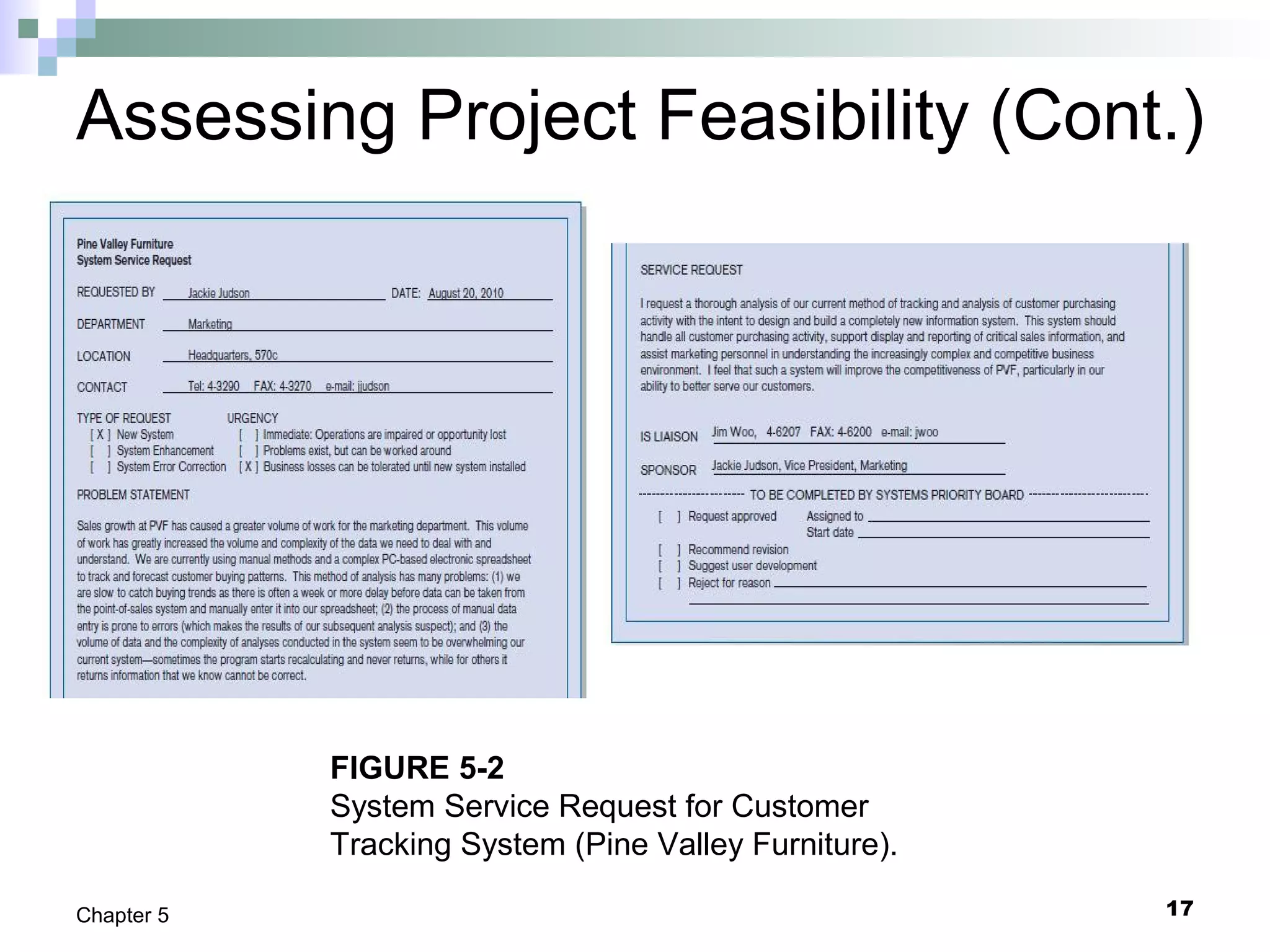
FIGURE 5-2
System Service Request for Customer
Tracking System (Pine Valley Furniture).
18Chapter 5
1. Assessing economic feasibility
 Economic feasibility is a process of
identifying the financial benefits and costs
associated with a development project
Often referred to as a cost-benefit analysis
Project is reviewed after each SDLC phase in
order to decide whether to continue, redirect,
or kill a project
19Chapter 5
Determining Project Benefits
 Tangible benefits refer to items that can
be measured in dollars and with certainty.
 Examples include:
reduced personnel expenses,
lower transaction costs, or
higher profit margins.
20Chapter 5
Determining Project Benefits (Cont.)
 Most tangible benefits will fit within the following
categories:
 Cost reduction and avoidance
 Error reduction
 Increased flexibility
 Increased speed of activity
 Improvement of management planning and control
 Opening new markets and increasing sales
opportunities
21Chapter 5
Determining Project Benefits (Cont.)
 Intangible benefits are benefits derived from
the creation of an information system that cannot
be easily measured in dollars or with certainty.
 May have direct organizational benefits, such as the
improvement of employee morale.
 May have broader societal implications, such as the
reduction of waste creation or resource consumption.
22Chapter 5
Determining Project Costs
 Tangible cost: a cost associated with an
information system that can be measured
in dollars and with certainty
 IS development tangible costs include:
Hardware costs,
Labor costs, or
Operational costs including employee training
and building renovations.
23Chapter 5
Determining Project Costs (Cont.)
 Intangible cost: a cost associated with an
information system that cannot be easily
measured in terms of dollars or with
certainty
 Intangible costs can include:
Loss of customer goodwill,
Employee morale, or
Operational inefficiency.
24Chapter 5
Determining Project Costs (Cont.)
 Procurement
 Consulting, equipment, site preparation, capital,
management time
 Start-up
 Operating systems, communications installation,
personnel hiring, organizational disruption
 Project-related
 Application software, software modification,
personnel overhead, training, data analysis,
documentation
 Operating
 System maintenance, user training and support
25Chapter 5
Determining Project Costs (Cont.)
 One-time cost: a cost associated with project
start-up and development or system start-up
 These costs encompass activities such as:
 Systems development,
 New hardware and software purchases,
 User training,
 Site preparation, and
 Data or system conversion.
26Chapter 5
Determining Project Costs (Cont.)
 Recurring cost: a cost resulting from the
ongoing evolution and use of a system
 Examples of these costs include:
 Application software maintenance,
 Incremental data storage expenses,
 Incremental communications,
 New software and hardware leases, and
 Supplies and other expenses (i.e. paper, forms, data
center personnel).
27Chapter 5
The Time Value of Money
 Net Present Value (NPV)
Use discount rate to determine present
value of cash outlays and receipts
 Return on Investment (ROI)
Ratio of cash receipts to cash outlays
 Break-Even Analysis (BEA)
Amount of time required for cumulative
cash flow to equal initial and ongoing
investment
The process of comparing present cash outlays
to future expected returns.
28Chapter 5
The Time Value of Money
 Time value of money (TVM): the concept
that money available today is worth more
than the same amount tomorrow
 Discount rate: the rate of return used to
compute the present value of future cash
flows (the cost of capital).
 Present value: the current value of a
future cash flow
29Chapter 5
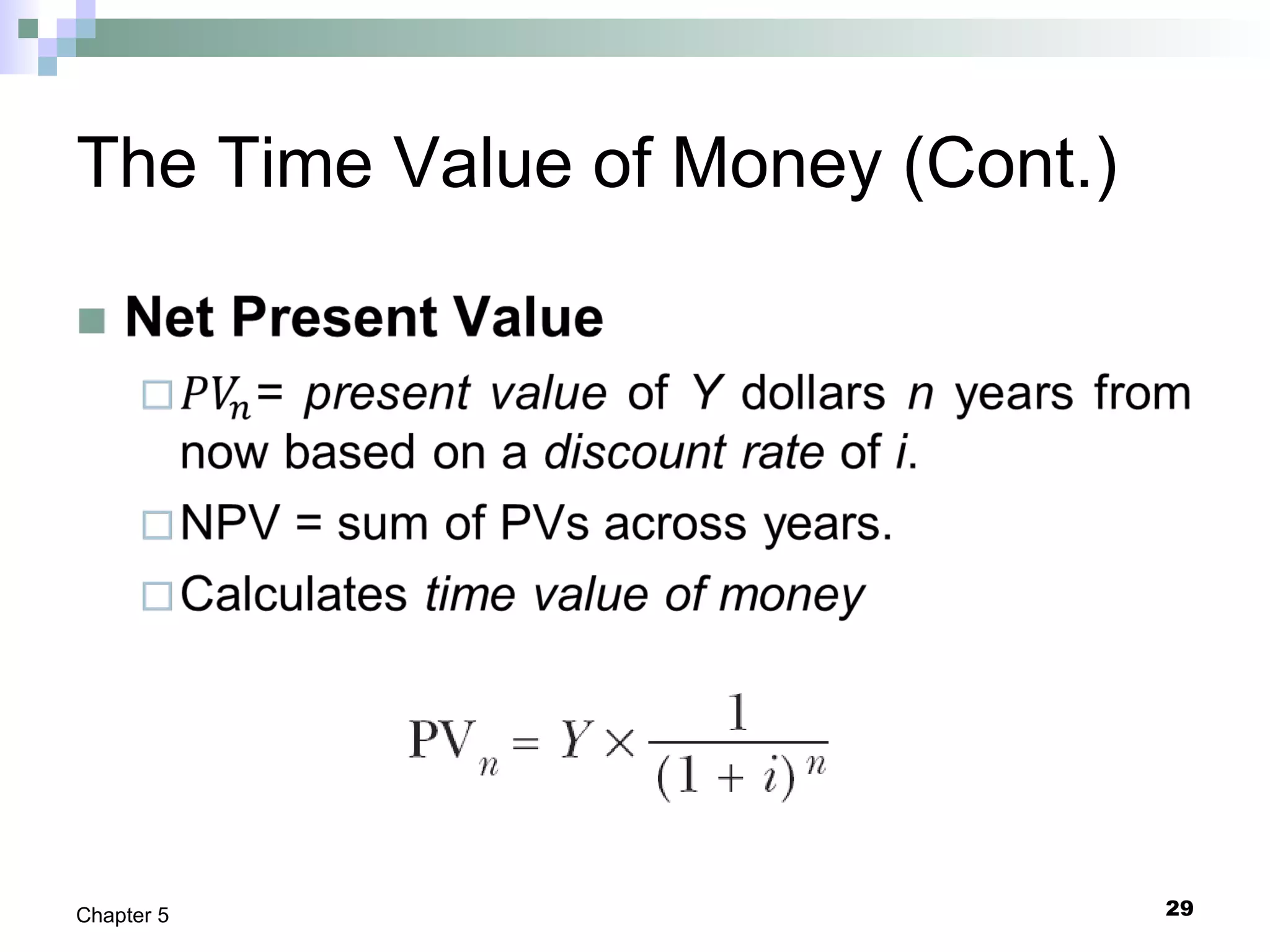
The Time Value of Money (Cont.)
30Chapter 5
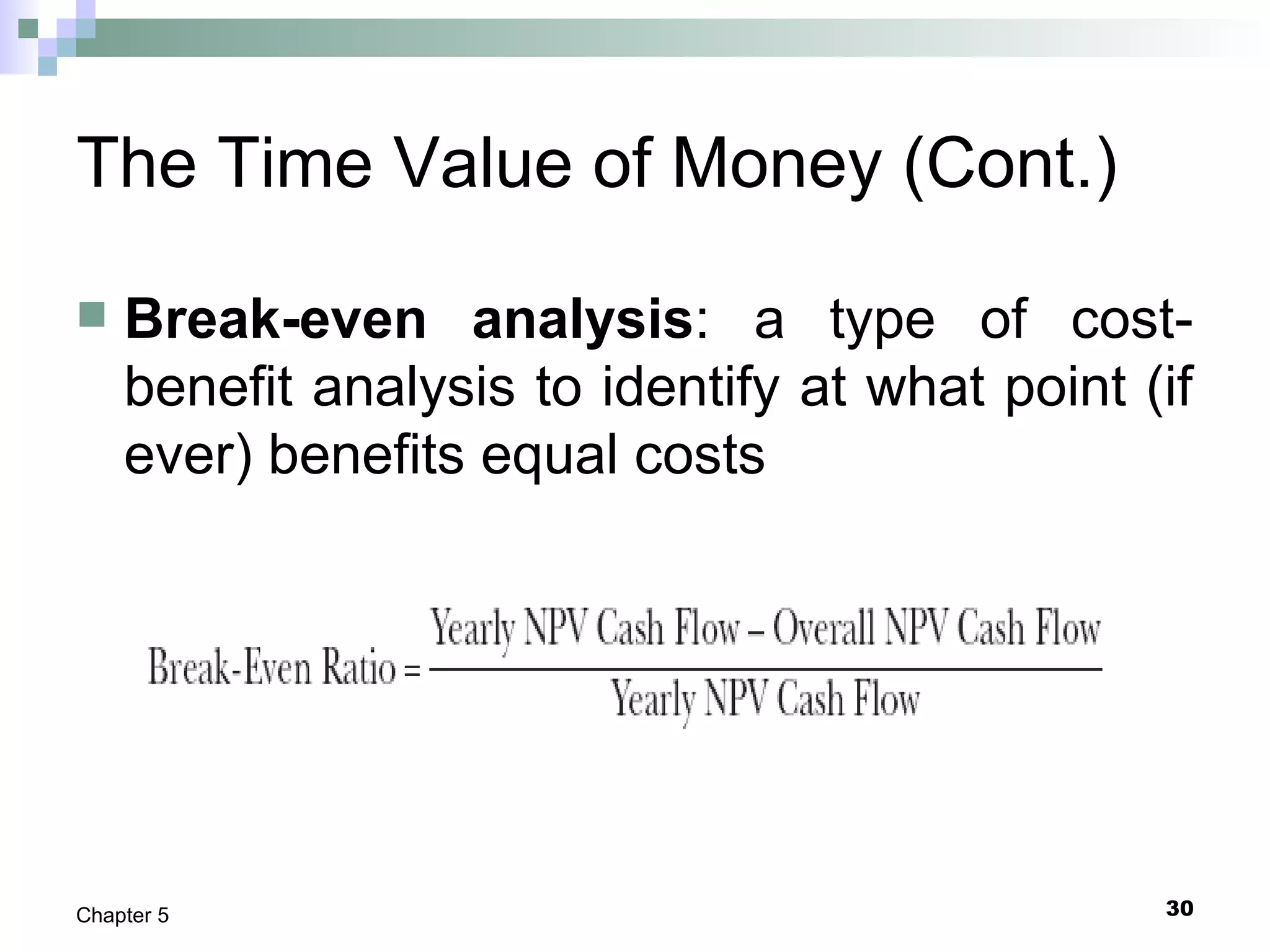
The Time Value of Money (Cont.)
 Break-even analysis: a type of cost-
benefit analysis to identify at what point (if
ever) benefits equal costs
31Chapter 5
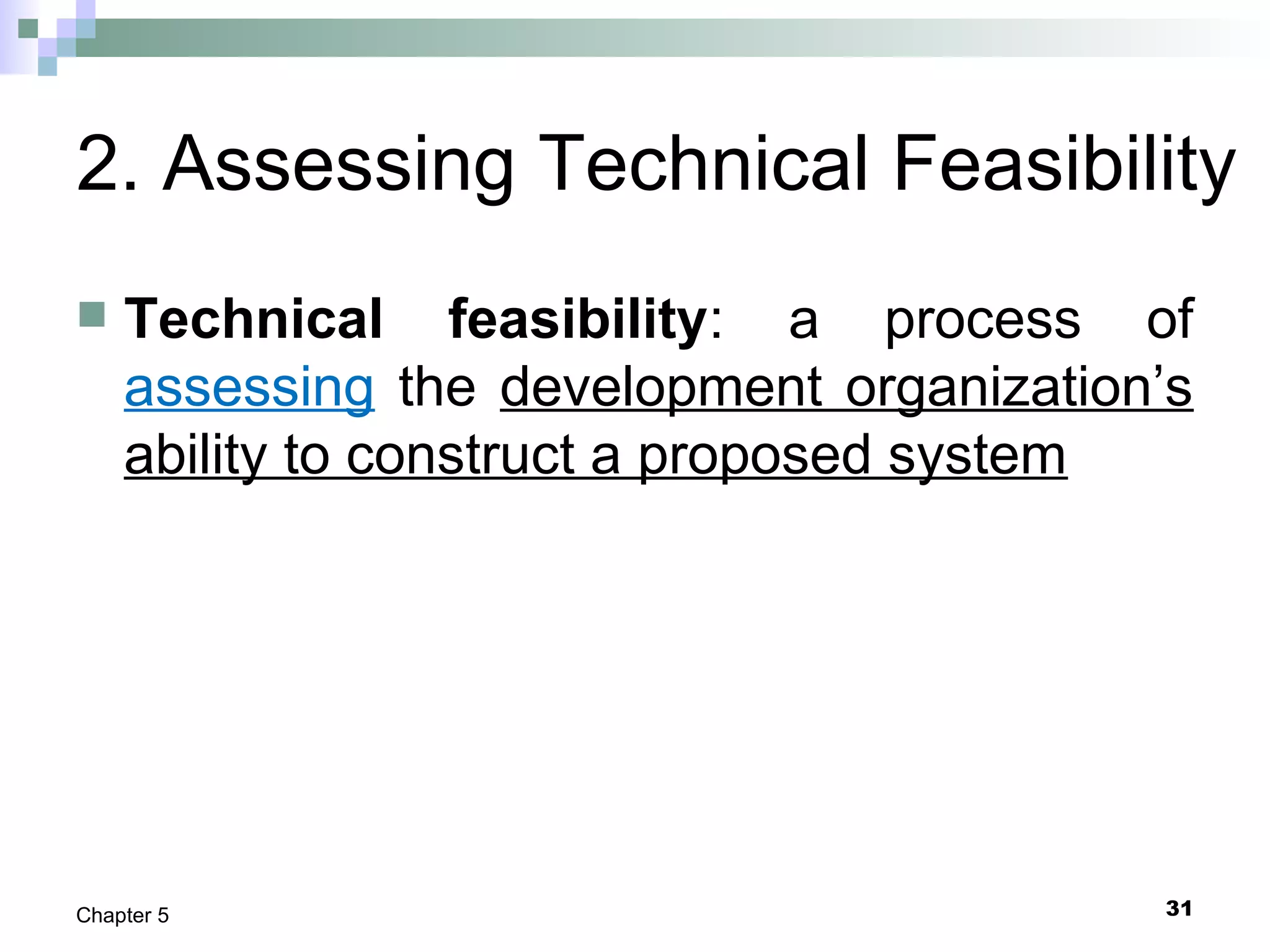
2. Assessing Technical Feasibility
 Technical feasibility: a process of
assessing the development organization’s
ability to construct a proposed system
32Chapter 5
Assessing Technical Feasibility
(Cont.)
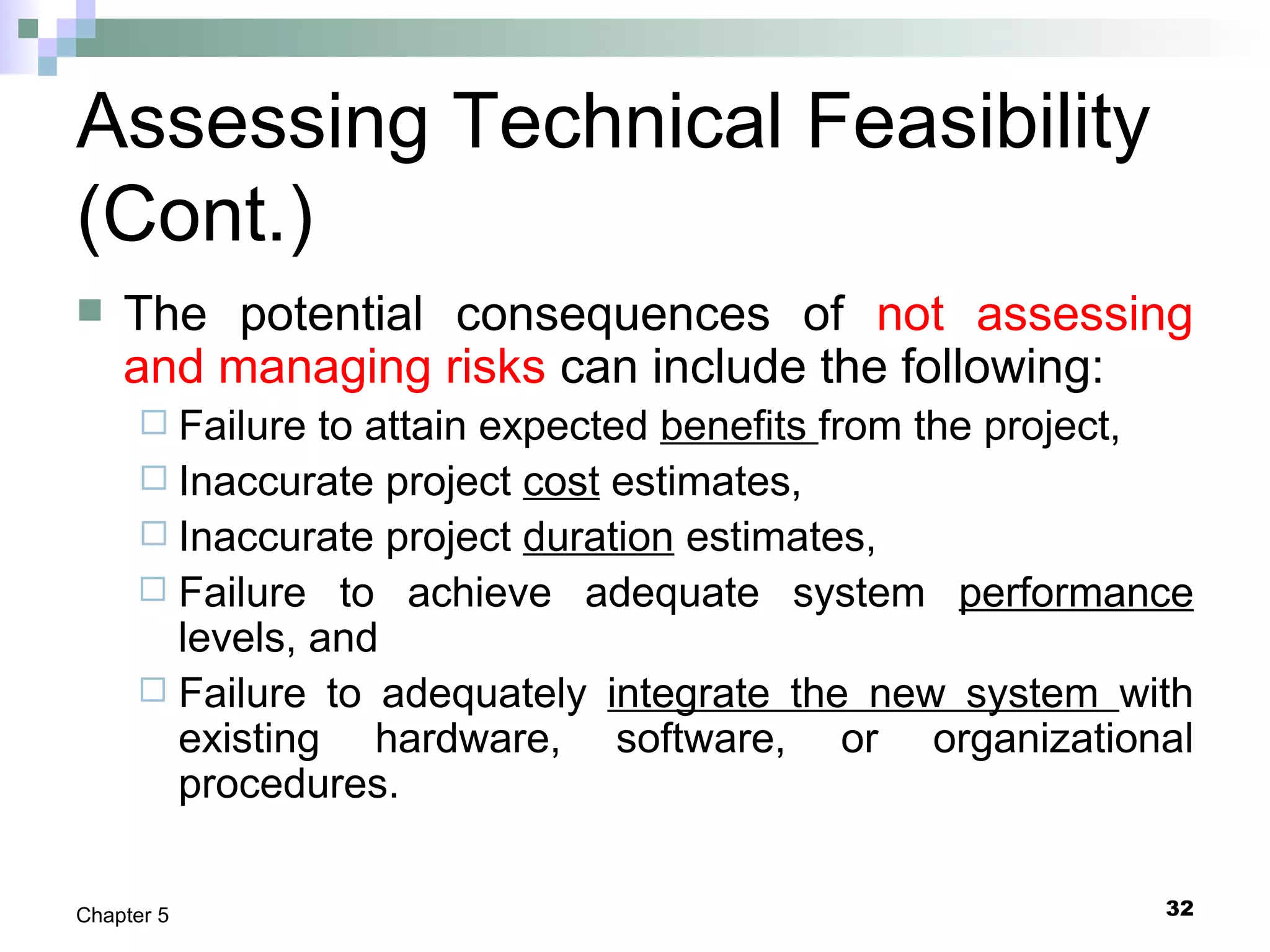
 The potential consequences of not assessing
and managing risks can include the following:
 Failure to attain expected benefits from the project,
 Inaccurate project cost estimates,
 Inaccurate project duration estimates,
 Failure to achieve adequate system performance
levels, and
 Failure to adequately integrate the new system with
existing hardware, software, or organizational
procedures.
33Chapter 5
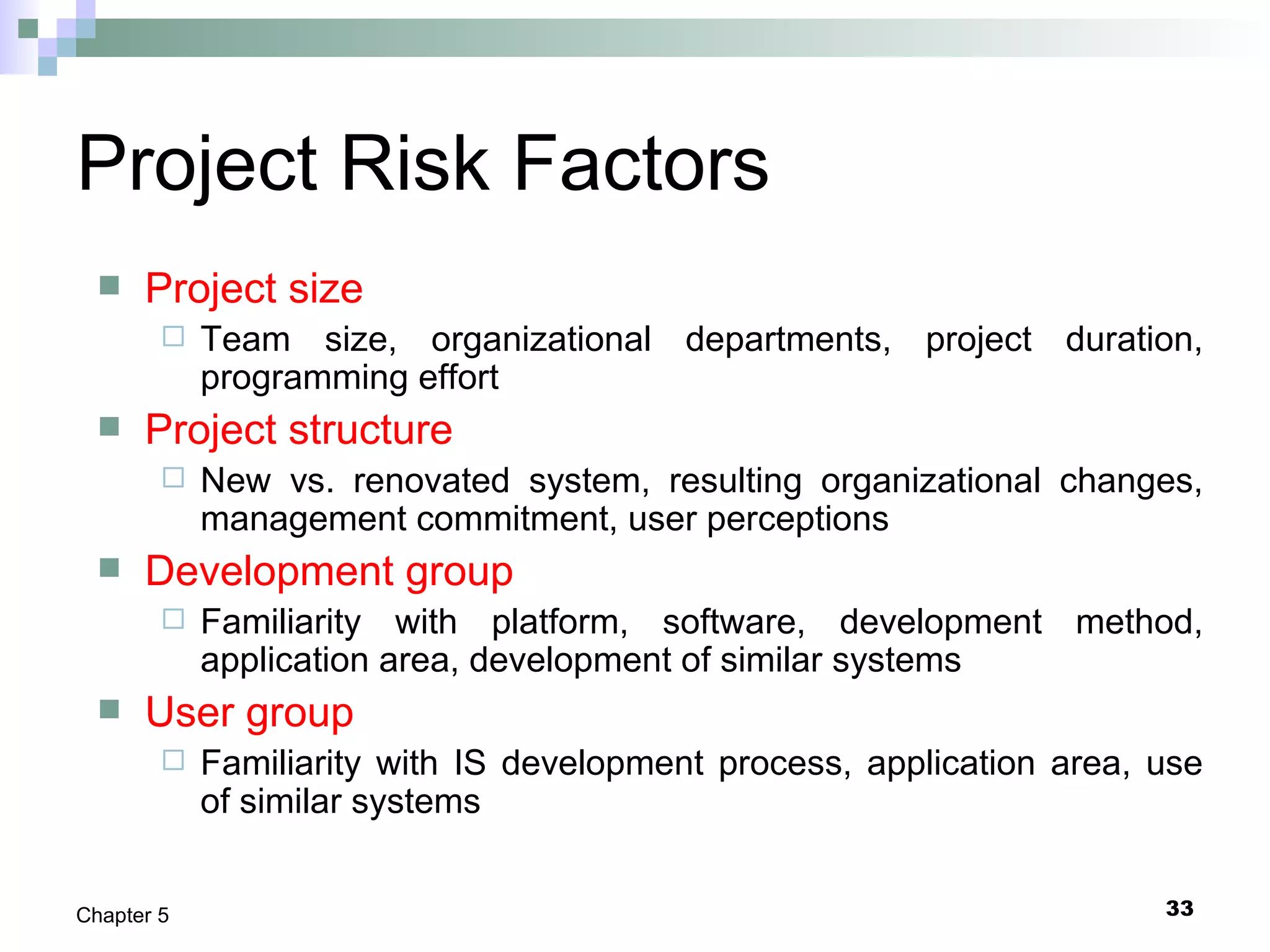
Project Risk Factors
 Project size
 Team size, organizational departments, project duration,
programming effort
 Project structure
 New vs. renovated system, resulting organizational changes,
management commitment, user perceptions
 Development group
 Familiarity with platform, software, development method,
application area, development of similar systems
 User group
 Familiarity with IS development process, application area, use
of similar systems
34Chapter 5
Assessing Technical Feasibility (Cont.)
 Risk can be managed on a project by:
Changing the project plan to avoid risky factors.
Assigning project team members to carefully
manage the risky aspects.
Setting up monitoring methods to determine
whether or not potential risk is, in fact,
materializing.
35Chapter 5
Assessing Technical Feasibility
(Cont.)
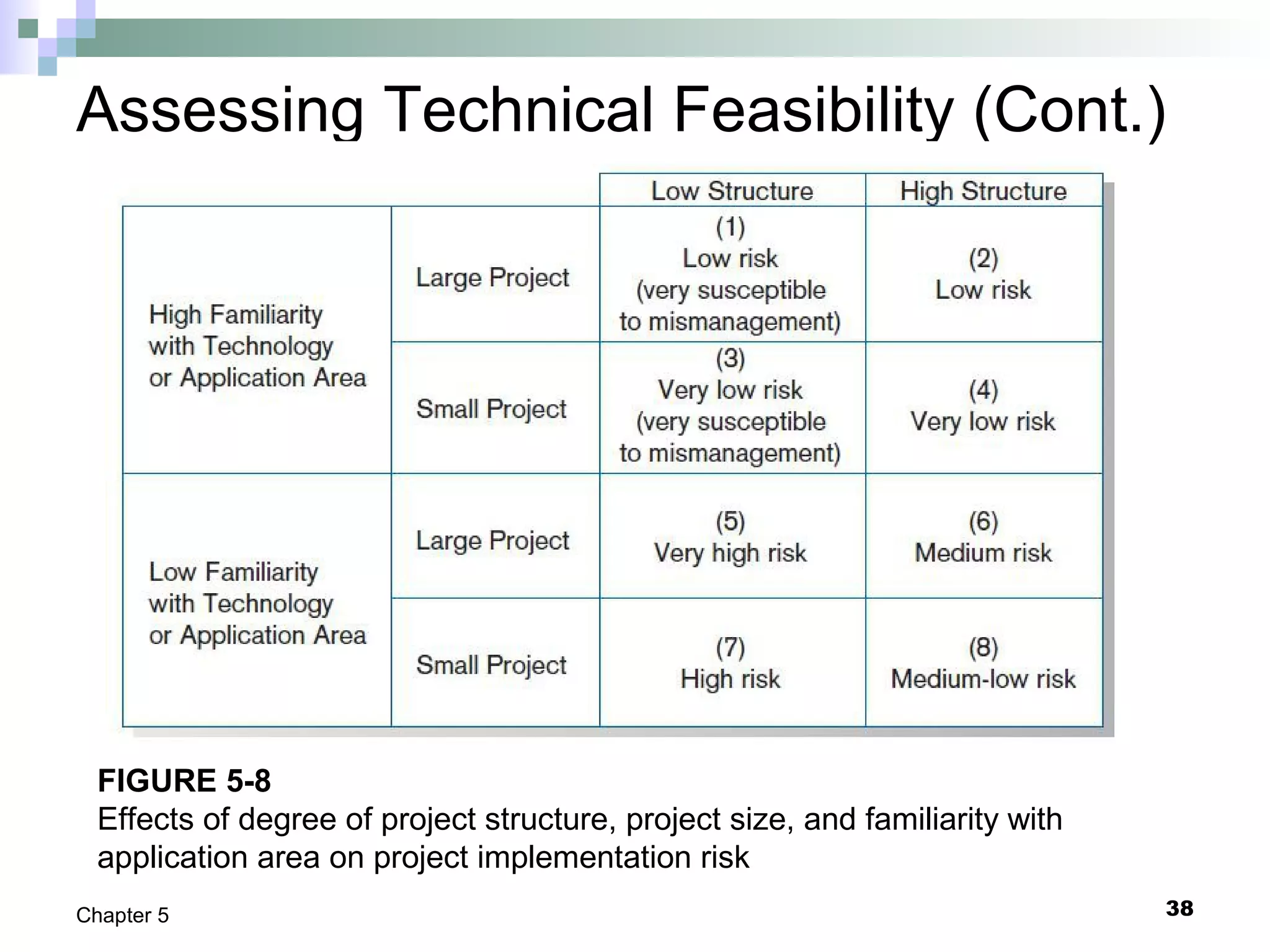
 The four primary factors associated with the
amount of technical risk on a given project are:
 Project size,
 Project structure,
 The development group’s experience with the
application and technology area, and
 The user group’s experience with systems
development projects and the application area.
36Chapter 5
Assessing Technical Feasibility
(Cont.)
 Four general rules viewed as technical risk
assessments:
Larger projects are riskier than smaller
projects.
A system in which the requirements are easily
obtained and highly structured will be less
risky than one in which requirements are
messy, ill structured, ill defined, or subject to
the judgment of an individual.
37Chapter 5
Assessing Technical Feasibility
(Cont.)
The development of a system employing
commonly used or standard technology will be
less risky than one employing novel or
nonstandard technology.
A project is less risky when the user group is
familiar with the systems development process
and application area than if user group is
unfamiliar.
38Chapter 5
Assessing Technical Feasibility (Cont.)
FIGURE 5-8
Effects of degree of project structure, project size, and familiarity with
application area on project implementation risk
39Chapter 5
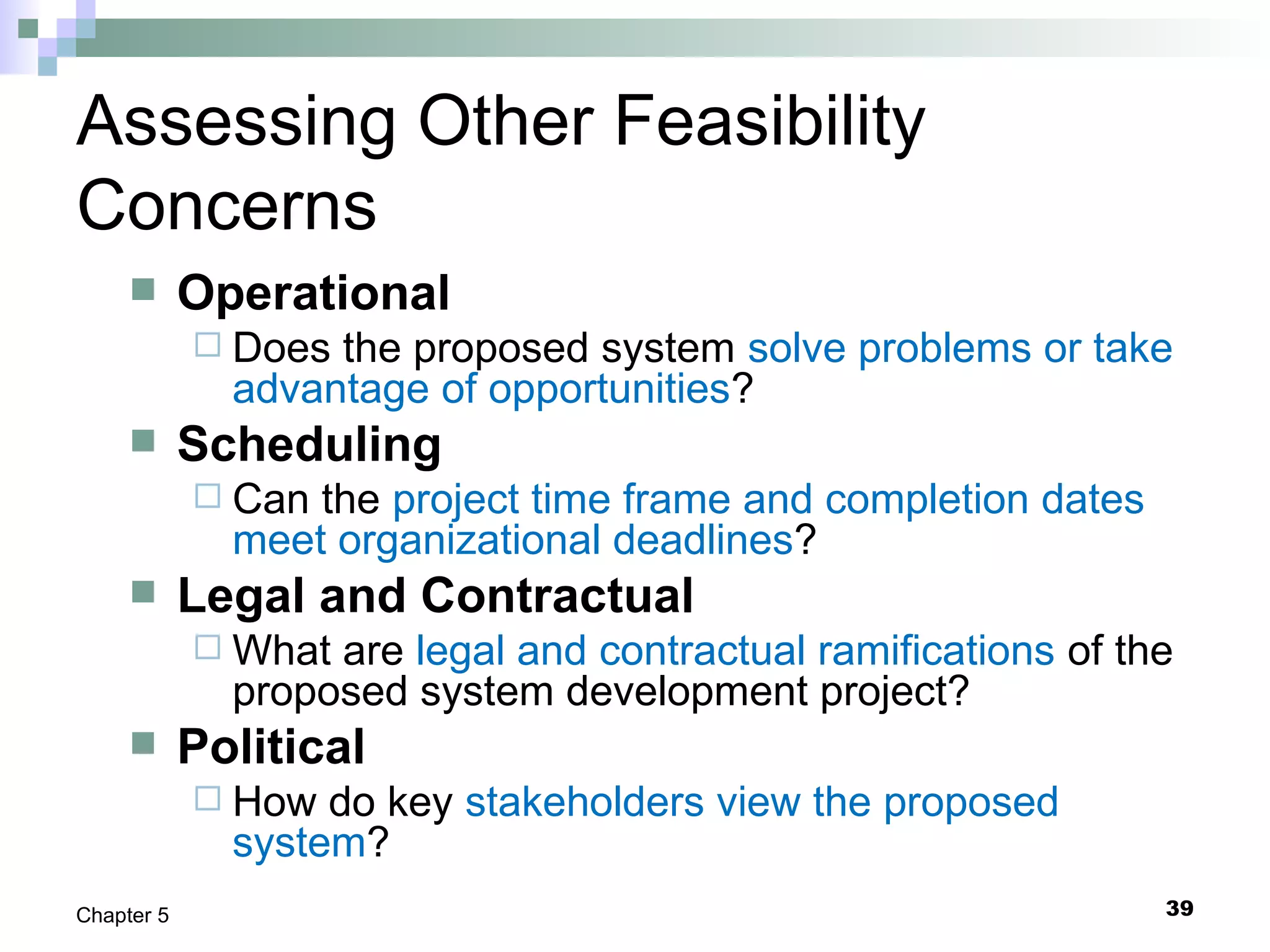
Assessing Other Feasibility
Concerns
 Operational
 Does the proposed system solve problems or take
advantage of opportunities?
 Scheduling
 Can the project time frame and completion dates
meet organizational deadlines?
 Legal and Contractual
 What are legal and contractual ramifications of the
proposed system development project?
 Political
 How do key stakeholders view the proposed
system?
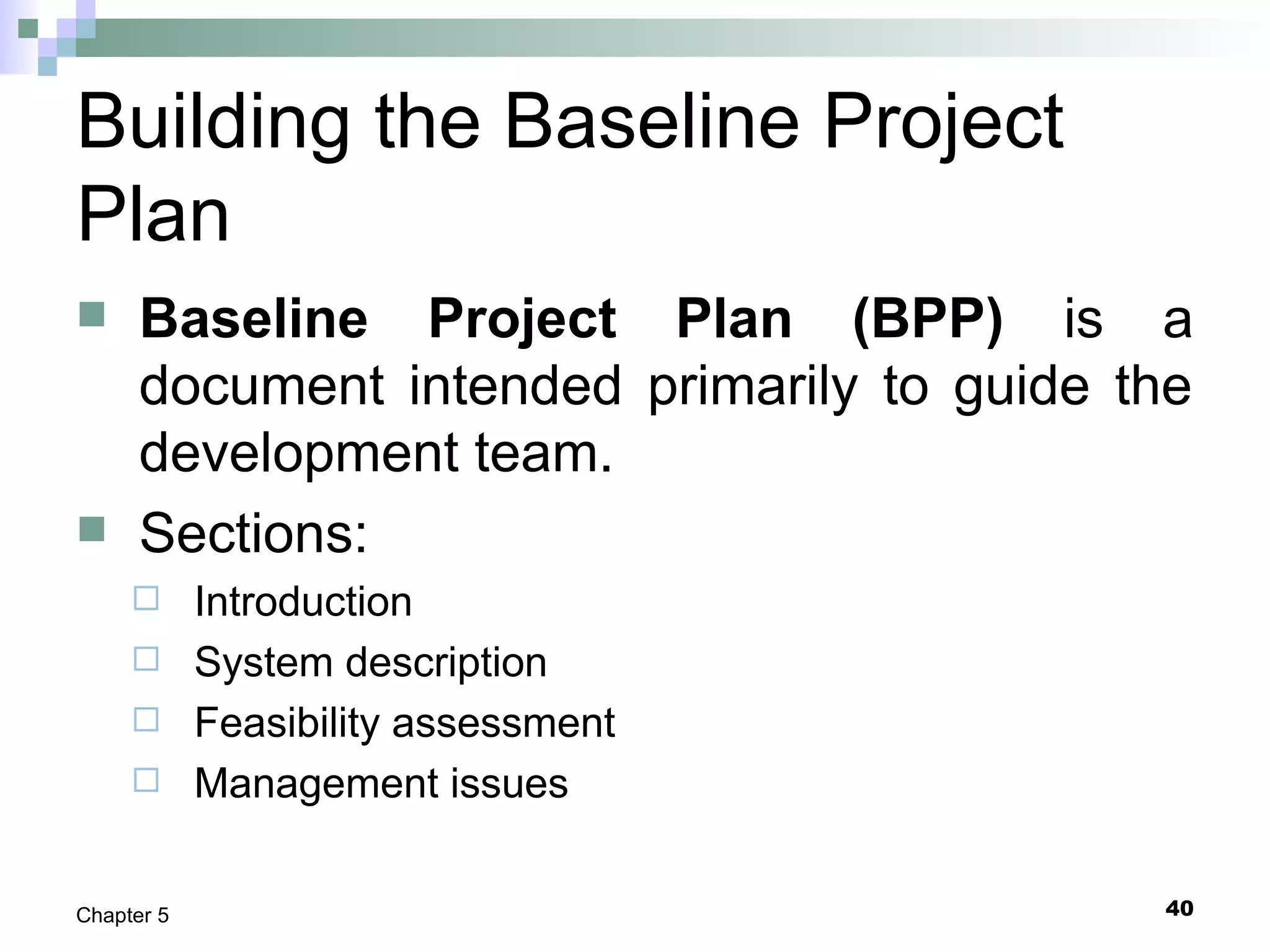
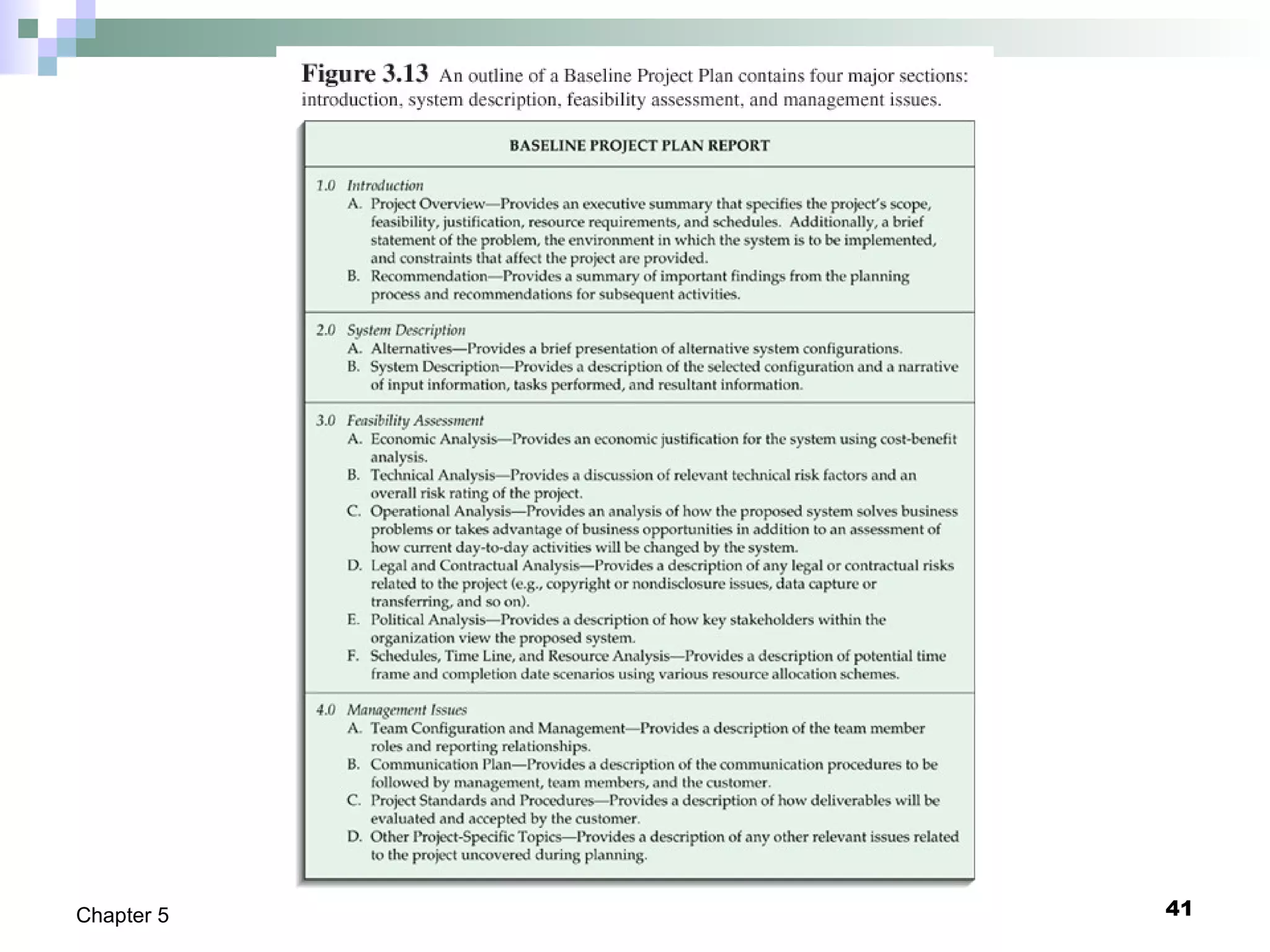
Building the Baseline Project
Plan
 Baseline Project Plan (BPP) is a
document intended primarily to guide the
development team.
 Sections:
 Introduction
 System description
 Feasibility assessment
 Management issues
40Chapter 5
41Chapter 5
Building the Baseline Project
Plan (Cont.)
 Project Scope Statement (PSS) is part of the
BPP introduction.
 Sections:
 Problem statement
 Project objectives
 Project description
 Business benefits
 Deliverables
 Expected duration
42Chapter 5
43Chapter 5
Factors in Determining Scope
 Organizational units affected by new
system
 Current systems that will interact with or
change because of new system
 People who are affected by new system
 Range of potential system capabilities
44Chapter 5
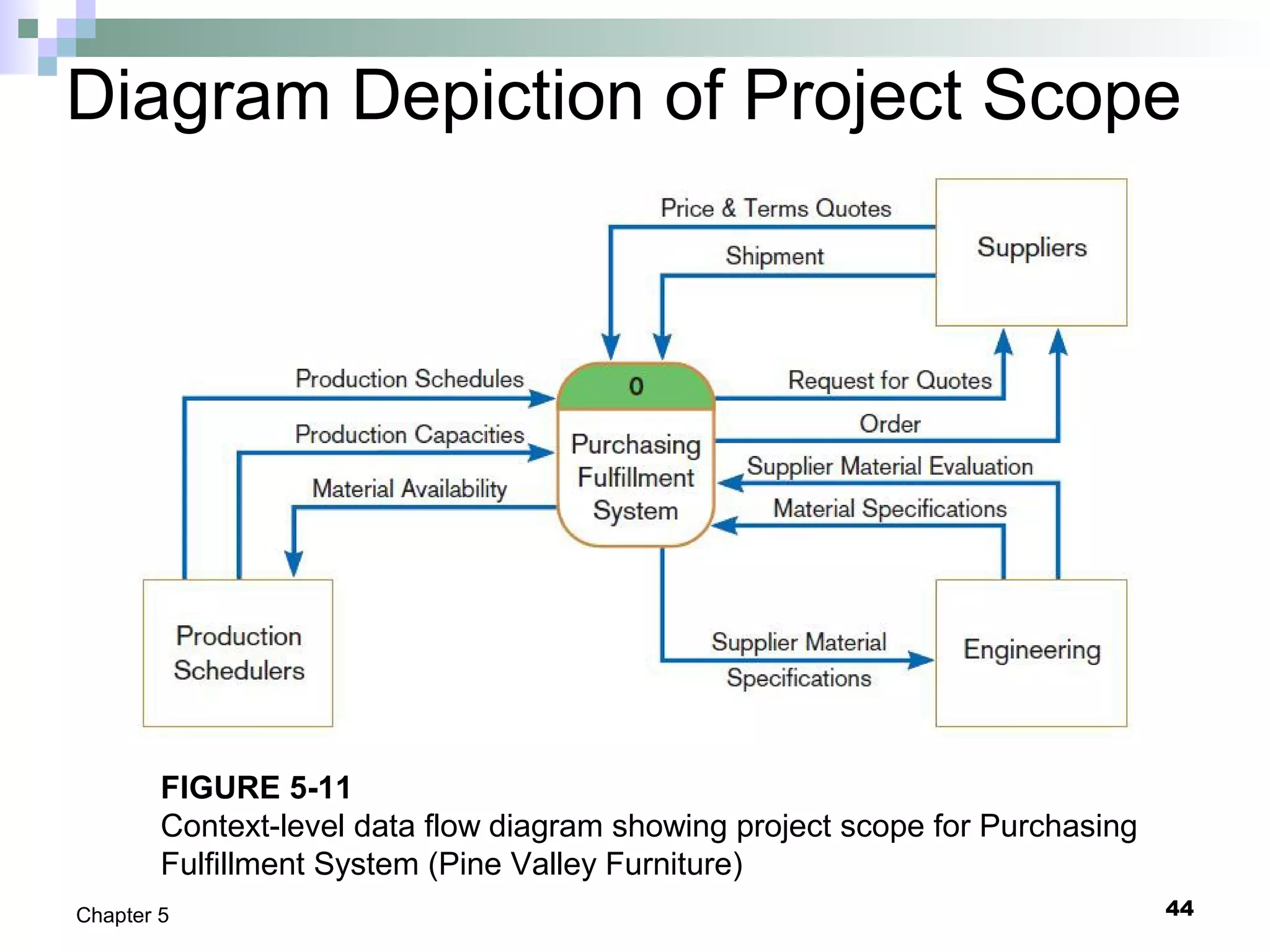
Diagram Depiction of Project Scope
FIGURE 5-11
Context-level data flow diagram showing project scope for Purchasing
Fulfillment System (Pine Valley Furniture)
Building the Baseline Project
Plan (Cont.)
 System description section outlines possible
alternative solutions.
 Feasibility assessment section outlines issues
related to project costs and benefits, technical
difficulties, and other such concerns.
 Management issues section outlines a number
of managerial concerns related to the project.
45Chapter 5
Reviewing the Baseline Project
Plan
 Objectives
Assure conformity to organizational standards
All parties agree to continue with project
3.463.46
47Chapter 5
Reviewing the Baseline Project
Plan
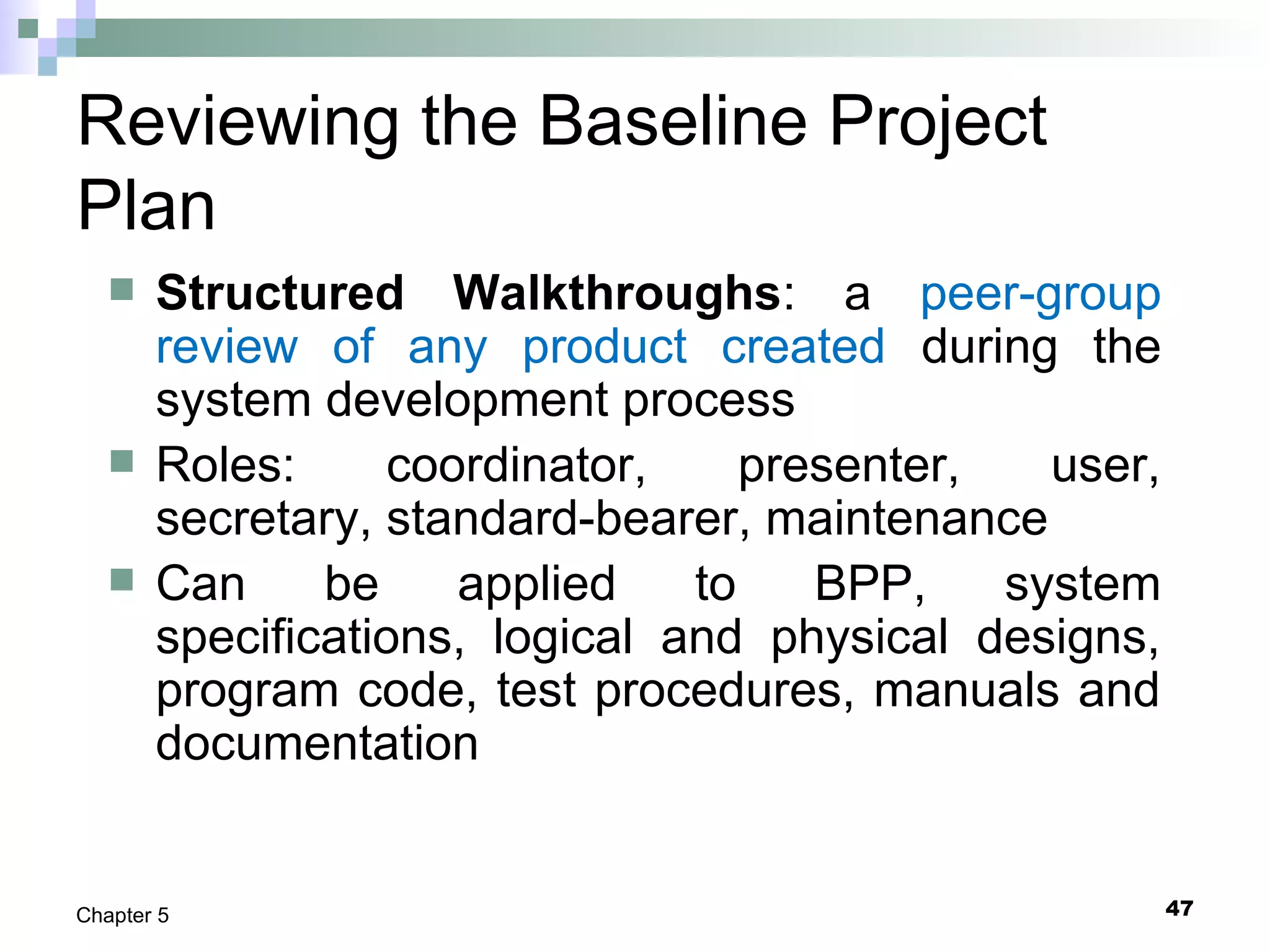
 Structured Walkthroughs: a peer-group
review of any product created during the
system development process
 Roles: coordinator, presenter, user,
secretary, standard-bearer, maintenance
 Can be applied to BPP, system
specifications, logical and physical designs,
program code, test procedures, manuals and
documentation
Reviewing the Baseline Project
Plan
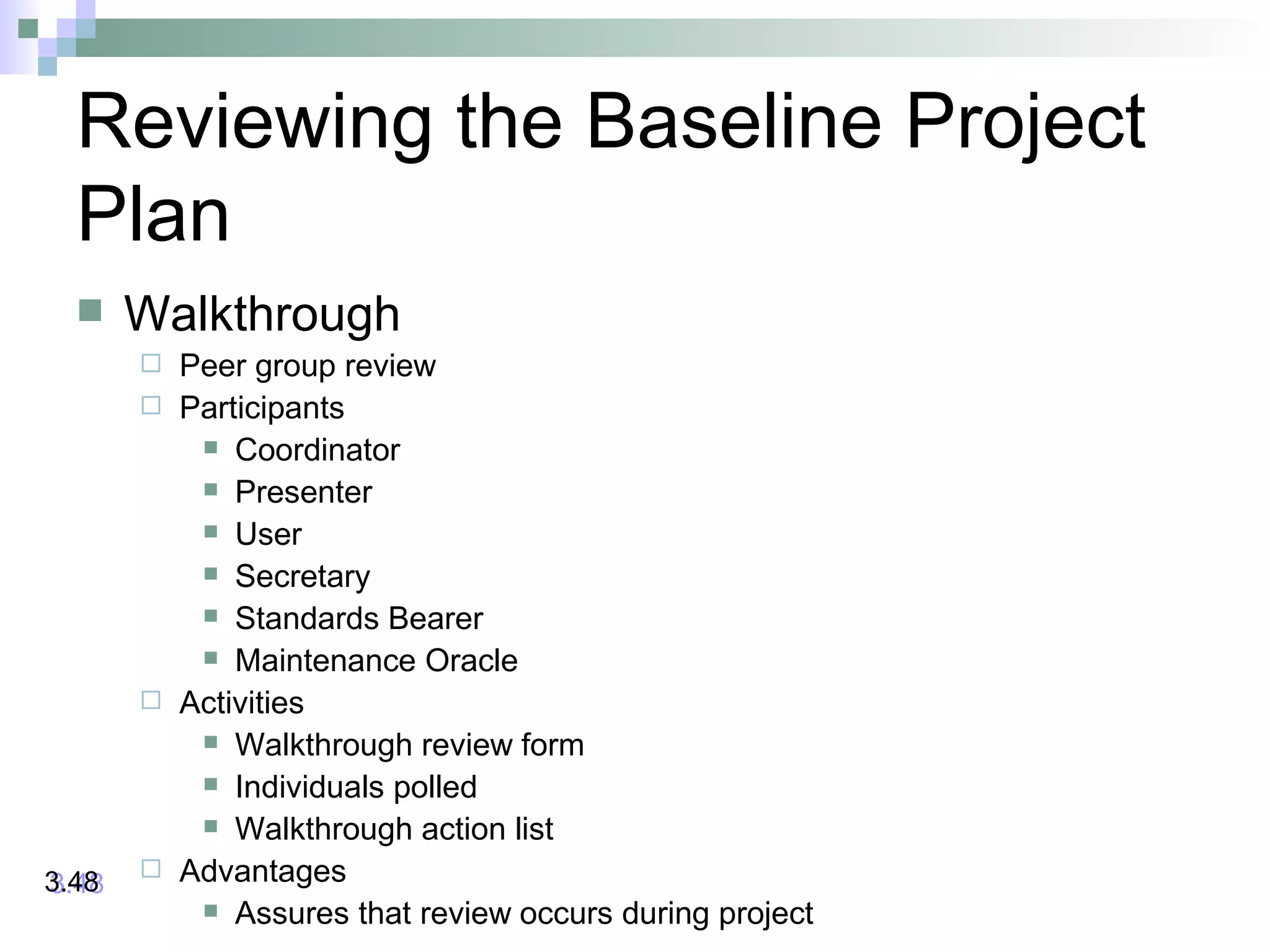
 Walkthrough
 Peer group review
 Participants
 Coordinator
 Presenter
 User
 Secretary
 Standards Bearer
 Maintenance Oracle
 Activities
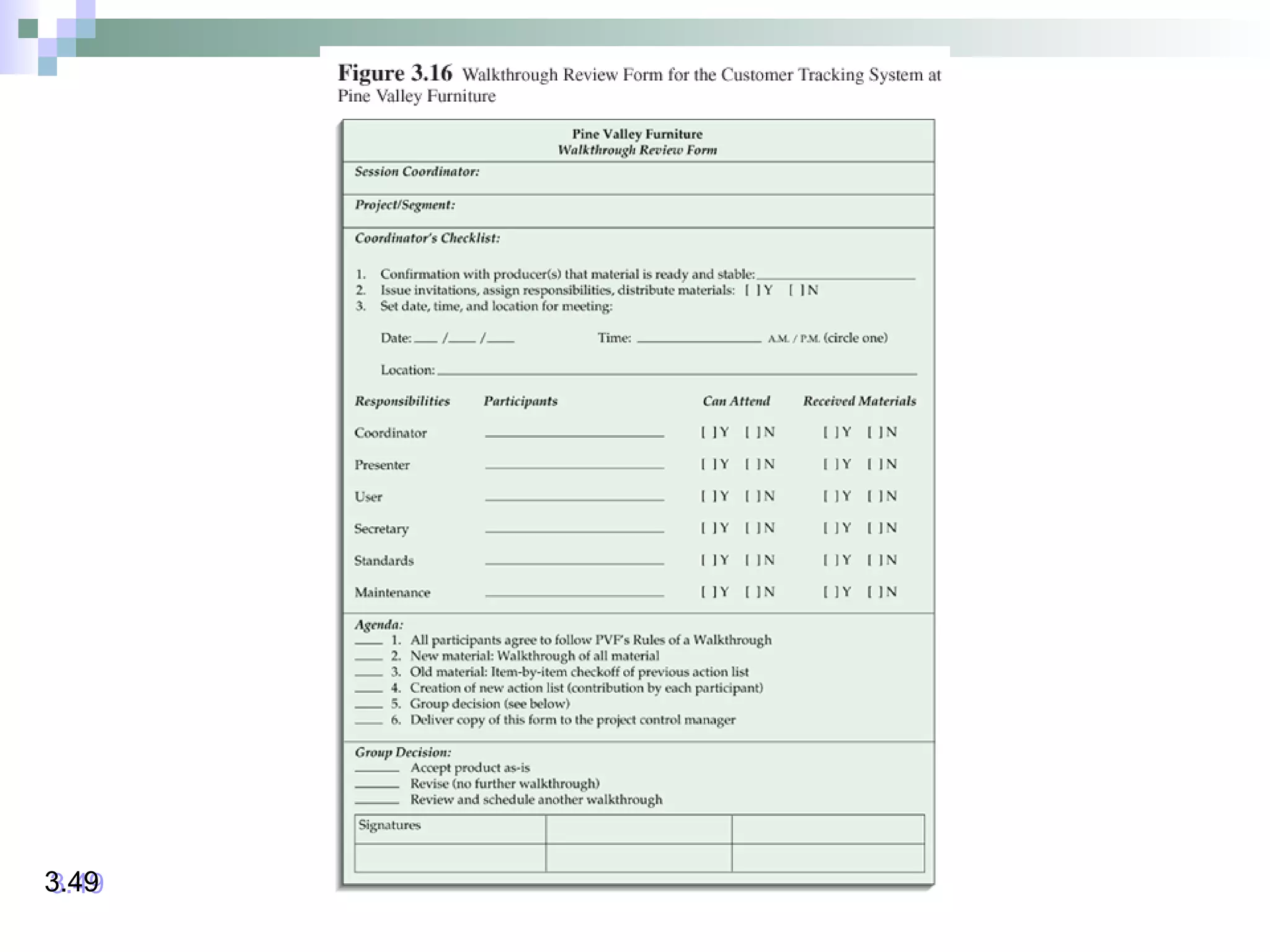
 Walkthrough review form
 Individuals polled
 Walkthrough action list
 Advantages
 Assures that review occurs during project
3.483.48
3.493.49
3.503.50
Thanks

Chapter 5

  • 1.
    Chapter 5 Initiating andPlanning Systems Development Projects
  • 2.
    2Chapter 5 Learning Objectives Describe the steps involved in the project initiation and planning process.  Explain the need for and the contents of a Project Scope Statement and Baseline Project Plan.  List and describe various methods for assessing project feasibility.  Describe the differences between tangible and intangible benefits and costs and between one- time vs. recurring benefits and costs.
  • 3.
    3Chapter 5 Learning Objectives(Cont.)  Perform cost-benefit analysis and describe what is meant by the time value of money, present value, discount rate, net present value, return on investment, and break-even analysis.  Describe the general rules for evaluating technical risks associated with a systems development project.  Describe the activities and participant roles within a structured walkthrough.
  • 4.
    4Chapter 5 Initiating andPlanning Systems Development Projects  What must be considered when making the decision on the division between project initiation and planning (PIP) and analysis?  How much effort should be expended on the PIP process?  Who is responsible for performing the PIP process?  Why is PIP such a challenging activity?
  • 5.
    5Chapter 5 The Processof Initiating and Planning IS Development Projects FIGURE 5-1 Systems development life cycle with project initiation and planning highlighted
  • 6.
    6Chapter 5 The Processof Initiating and Planning IS Development Projects (Cont.)  Project initiation focuses on activities designed to assist in organizing a team to conduct project planning.
  • 7.
    7Chapter 5 The Processof Initiating and Planning IS Development Projects (Cont.)  Establishing the Project Initiation Team.  Establishing a Relationship with the Customer.  Establishing the Project Initiation Plan.  Establishing Management Procedures.  Establishing the Project Management Environment and Project Workbook.  Developing the Project Charter.
  • 8.
    8Chapter 5 The Processof Initiating and Planning IS Development Projects (Cont.)  The key activity of project initiation is the development of the project charter.  A short document that is prepared for both internal and external stakeholders  Provides a high-level overview of the project  Useful communication tool that helps to assure that the organizations and other stakeholders understand the initiation of a project
  • 9.
    9Chapter 5 The Processof Initiating and Planning IS Development Projects (Cont.)  A project charter typically contains:  Project title and date of authorization  Project manager name and contact information  Customer name and contact information  Project start and completion dates  Key stakeholders, project role, and responsibilities  Project objectives and description  Key assumptions or approach  Signature section for key stakeholders
  • 10.
    10Chapter 5 The Processof Initiating and Planning IS Development Projects (Cont.)  The key activity of project planning is the process of defining clear, discrete activities and the work needed to complete each activity within a single project.  The objective of the project planning process is the development of a Baseline Project Plan (BPP) and the Project Scope Statement (PSS).
  • 11.
    11Chapter 5 Elements ofProject Planning  Describe project scope, alternatives, feasibility.  Divide project into tasks.  Estimate resource requirements and create resource plan.  Develop preliminary schedule.  Develop communication plan.
  • 12.
    12Chapter 5 Elements ofProject Planning (Cont.)  Determine standards and procedures.  Identify and assess risk.  Create preliminary budget.  Develop a statement of work.  Set baseline project plan.
  • 13.
    13Chapter 5 Deliverables andOutcomes  Business Case Justification for an information system Presented in terms of the tangible and intangible economic benefits and costs (economic feasibility) The technical and organizational feasibility of the proposed system
  • 14.
    14Chapter 5 Deliverables andOutcomes (Cont.)  Baseline Project Plan (BPP) A major outcome and deliverable from the PIP phase Contains the best estimate of a project’s scope, benefits, costs, risks, and resource requirements
  • 15.
    15Chapter 5 Deliverables andOutcomes (Cont.)  Project Scope Statement (PSS) A document prepared for the customer Describes what the project will deliver Outlines at a high level all work required to complete the project
  • 16.
    16Chapter 5 Assessing ProjectFeasibility 1. Economic 2. Technical 3. Operational 4. Scheduling 5. Legal and contractual 6. Political
  • 17.
    17Chapter 5 Assessing ProjectFeasibility (Cont.) FIGURE 5-2 System Service Request for Customer Tracking System (Pine Valley Furniture).
  • 18.
    18Chapter 5 1. Assessingeconomic feasibility  Economic feasibility is a process of identifying the financial benefits and costs associated with a development project Often referred to as a cost-benefit analysis Project is reviewed after each SDLC phase in order to decide whether to continue, redirect, or kill a project
  • 19.
    19Chapter 5 Determining ProjectBenefits  Tangible benefits refer to items that can be measured in dollars and with certainty.  Examples include: reduced personnel expenses, lower transaction costs, or higher profit margins.
  • 20.
    20Chapter 5 Determining ProjectBenefits (Cont.)  Most tangible benefits will fit within the following categories:  Cost reduction and avoidance  Error reduction  Increased flexibility  Increased speed of activity  Improvement of management planning and control  Opening new markets and increasing sales opportunities
  • 21.
    21Chapter 5 Determining ProjectBenefits (Cont.)  Intangible benefits are benefits derived from the creation of an information system that cannot be easily measured in dollars or with certainty.  May have direct organizational benefits, such as the improvement of employee morale.  May have broader societal implications, such as the reduction of waste creation or resource consumption.
  • 22.
    22Chapter 5 Determining ProjectCosts  Tangible cost: a cost associated with an information system that can be measured in dollars and with certainty  IS development tangible costs include: Hardware costs, Labor costs, or Operational costs including employee training and building renovations.
  • 23.
    23Chapter 5 Determining ProjectCosts (Cont.)  Intangible cost: a cost associated with an information system that cannot be easily measured in terms of dollars or with certainty  Intangible costs can include: Loss of customer goodwill, Employee morale, or Operational inefficiency.
  • 24.
    24Chapter 5 Determining ProjectCosts (Cont.)  Procurement  Consulting, equipment, site preparation, capital, management time  Start-up  Operating systems, communications installation, personnel hiring, organizational disruption  Project-related  Application software, software modification, personnel overhead, training, data analysis, documentation  Operating  System maintenance, user training and support
  • 25.
    25Chapter 5 Determining ProjectCosts (Cont.)  One-time cost: a cost associated with project start-up and development or system start-up  These costs encompass activities such as:  Systems development,  New hardware and software purchases,  User training,  Site preparation, and  Data or system conversion.
  • 26.
    26Chapter 5 Determining ProjectCosts (Cont.)  Recurring cost: a cost resulting from the ongoing evolution and use of a system  Examples of these costs include:  Application software maintenance,  Incremental data storage expenses,  Incremental communications,  New software and hardware leases, and  Supplies and other expenses (i.e. paper, forms, data center personnel).
  • 27.
    27Chapter 5 The TimeValue of Money  Net Present Value (NPV) Use discount rate to determine present value of cash outlays and receipts  Return on Investment (ROI) Ratio of cash receipts to cash outlays  Break-Even Analysis (BEA) Amount of time required for cumulative cash flow to equal initial and ongoing investment The process of comparing present cash outlays to future expected returns.
  • 28.
    28Chapter 5 The TimeValue of Money  Time value of money (TVM): the concept that money available today is worth more than the same amount tomorrow  Discount rate: the rate of return used to compute the present value of future cash flows (the cost of capital).  Present value: the current value of a future cash flow
  • 29.
    29Chapter 5 The TimeValue of Money (Cont.)
  • 30.
    30Chapter 5 The TimeValue of Money (Cont.)  Break-even analysis: a type of cost- benefit analysis to identify at what point (if ever) benefits equal costs
  • 31.
    31Chapter 5 2. AssessingTechnical Feasibility  Technical feasibility: a process of assessing the development organization’s ability to construct a proposed system
  • 32.
    32Chapter 5 Assessing TechnicalFeasibility (Cont.)  The potential consequences of not assessing and managing risks can include the following:  Failure to attain expected benefits from the project,  Inaccurate project cost estimates,  Inaccurate project duration estimates,  Failure to achieve adequate system performance levels, and  Failure to adequately integrate the new system with existing hardware, software, or organizational procedures.
  • 33.
    33Chapter 5 Project RiskFactors  Project size  Team size, organizational departments, project duration, programming effort  Project structure  New vs. renovated system, resulting organizational changes, management commitment, user perceptions  Development group  Familiarity with platform, software, development method, application area, development of similar systems  User group  Familiarity with IS development process, application area, use of similar systems
  • 34.
    34Chapter 5 Assessing TechnicalFeasibility (Cont.)  Risk can be managed on a project by: Changing the project plan to avoid risky factors. Assigning project team members to carefully manage the risky aspects. Setting up monitoring methods to determine whether or not potential risk is, in fact, materializing.
  • 35.
    35Chapter 5 Assessing TechnicalFeasibility (Cont.)  The four primary factors associated with the amount of technical risk on a given project are:  Project size,  Project structure,  The development group’s experience with the application and technology area, and  The user group’s experience with systems development projects and the application area.
  • 36.
    36Chapter 5 Assessing TechnicalFeasibility (Cont.)  Four general rules viewed as technical risk assessments: Larger projects are riskier than smaller projects. A system in which the requirements are easily obtained and highly structured will be less risky than one in which requirements are messy, ill structured, ill defined, or subject to the judgment of an individual.
  • 37.
    37Chapter 5 Assessing TechnicalFeasibility (Cont.) The development of a system employing commonly used or standard technology will be less risky than one employing novel or nonstandard technology. A project is less risky when the user group is familiar with the systems development process and application area than if user group is unfamiliar.
  • 38.
    38Chapter 5 Assessing TechnicalFeasibility (Cont.) FIGURE 5-8 Effects of degree of project structure, project size, and familiarity with application area on project implementation risk
  • 39.
    39Chapter 5 Assessing OtherFeasibility Concerns  Operational  Does the proposed system solve problems or take advantage of opportunities?  Scheduling  Can the project time frame and completion dates meet organizational deadlines?  Legal and Contractual  What are legal and contractual ramifications of the proposed system development project?  Political  How do key stakeholders view the proposed system?
  • 40.
    Building the BaselineProject Plan  Baseline Project Plan (BPP) is a document intended primarily to guide the development team.  Sections:  Introduction  System description  Feasibility assessment  Management issues 40Chapter 5
  • 41.
  • 42.
    Building the BaselineProject Plan (Cont.)  Project Scope Statement (PSS) is part of the BPP introduction.  Sections:  Problem statement  Project objectives  Project description  Business benefits  Deliverables  Expected duration 42Chapter 5
  • 43.
    43Chapter 5 Factors inDetermining Scope  Organizational units affected by new system  Current systems that will interact with or change because of new system  People who are affected by new system  Range of potential system capabilities
  • 44.
    44Chapter 5 Diagram Depictionof Project Scope FIGURE 5-11 Context-level data flow diagram showing project scope for Purchasing Fulfillment System (Pine Valley Furniture)
  • 45.
    Building the BaselineProject Plan (Cont.)  System description section outlines possible alternative solutions.  Feasibility assessment section outlines issues related to project costs and benefits, technical difficulties, and other such concerns.  Management issues section outlines a number of managerial concerns related to the project. 45Chapter 5
  • 46.
    Reviewing the BaselineProject Plan  Objectives Assure conformity to organizational standards All parties agree to continue with project 3.463.46
  • 47.
    47Chapter 5 Reviewing theBaseline Project Plan  Structured Walkthroughs: a peer-group review of any product created during the system development process  Roles: coordinator, presenter, user, secretary, standard-bearer, maintenance  Can be applied to BPP, system specifications, logical and physical designs, program code, test procedures, manuals and documentation
  • 48.
    Reviewing the BaselineProject Plan  Walkthrough  Peer group review  Participants  Coordinator  Presenter  User  Secretary  Standards Bearer  Maintenance Oracle  Activities  Walkthrough review form  Individuals polled  Walkthrough action list  Advantages  Assures that review occurs during project 3.483.48
  • 49.
  • 50.