Information Security For Small Businessby Julius Clark Sr.,  MBA, CISSP, CISA
About MeBDPA History2010-2012	Charlotte President2010-2012	National BDPA CISO2007-2009 	Charlotte President-Elect2006-2004	VP of SITES (Education)2001-2003	Charlotte  HSCC  CoordinatorEducationMBA in Information SecuritySalem International University, Salem, WVMSIS in Information SecurityUniversity of Fairfax, Fairfax, VABS in Electronic EngineeringWentworth Institute of Technology, Boston, MACertificationsCertified Information Systems Security Professional (CISSP)
Certified Information Systems Auditor (CISA)
Microsoft Certified System Engineer (MSCE).Julius Clark Sr.Location: Charlotte, NCCurrent home, been residing in Charlotte, NC for over 10 yearsHometownBoston, MaProfessionInformation Security Professional.2
AgendaInformation Security for Small Business3
Agenda  (Continued)Information Security for Small Business4
IT Security &Business Wholeness5
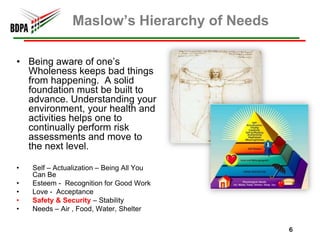
Maslow’s Hierarchy of NeedsBeing aware of one’s Wholeness keeps bad things from happening.  A solid foundation must be built to advance. Understanding your environment, your health and activities helps one to continually perform risk assessments and move to the next level.Self – Actualization – Being All You Can Be
Esteem -  Recognition for Good Work
Love -  Acceptance
Safety & Security – Stability
Needs – Air , Food, Water, Shelter6
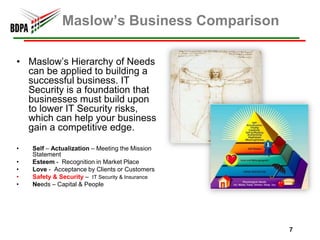
Maslow’s Business ComparisonMaslow’s Hierarchy of Needs can be applied to building a successful business. IT Security is a foundation that businesses must build upon to lower IT Security risks, which can help your business gain a competitive edge.Self – Actualization – Meeting the Mission Statement
Esteem -  Recognition in Market Place
Love -  Acceptance by Clients or Customers
Safety & Security –  IT Security & Insurance
Needs – Capital & People7
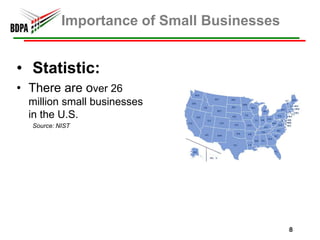
Importance of Small BusinessesStatistic:There are over 26 million small businesses in the U.S.Source: NIST8
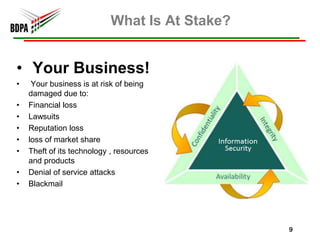
What Is At Stake?Your Business! Your business is at risk of being damaged due to:Financial loss
Lawsuits
Reputation loss
loss of market share
Theft of its technology , resources and products
Denial of service attacks
Blackmail9
What is Information Security?10
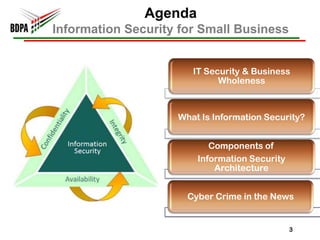
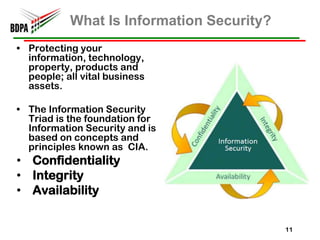
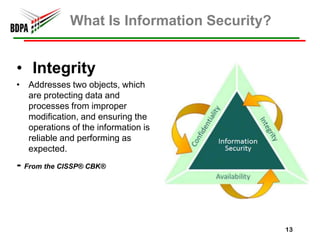
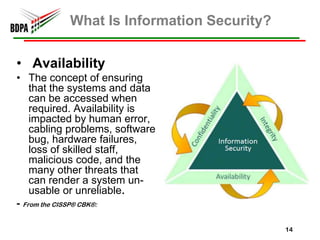
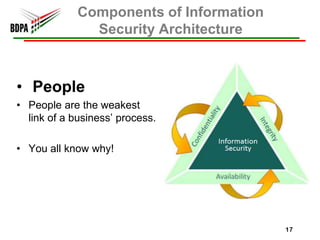
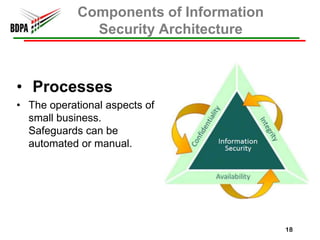
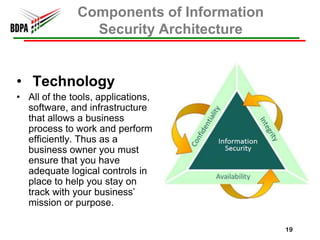
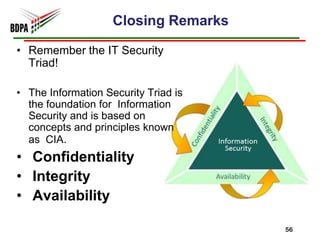
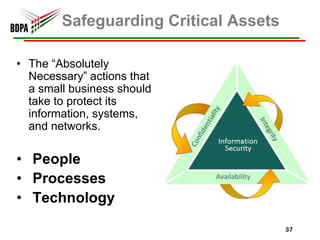
What Is Information Security?Protecting your information, technology, property, products and people; all vital business assets. The Information Security Triad is the foundation for  Information Security and is based on concepts and principles known as  CIA.Confidentiality
Integrity
Availability11
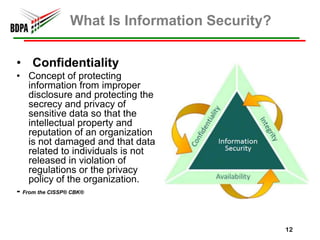
What Is Information Security?ConfidentialityConcept of protecting information from improper disclosure and protecting the secrecy and privacy of sensitive data so that the intellectual property and reputation of an organization  is not damaged and that data related to individuals is not released in violation of regulations or the privacy policy of the organization.- From the CISSP® CBK®12
What Is Information Security?IntegrityAddresses two objects, which are protecting data and processes from improper modification, and ensuring the operations of the information is reliable and performing as expected.- From the CISSP® CBK®13
What Is Information Security?AvailabilityThe concept of ensuring that the systems and data can be accessed when required. Availability is impacted by human error, cabling problems, software bug, hardware failures, loss of skilled staff, malicious code, and the many other threats that can render a system un-usable or unreliable. - From the CISSP® CBK®:14
Components of information security architecture 15
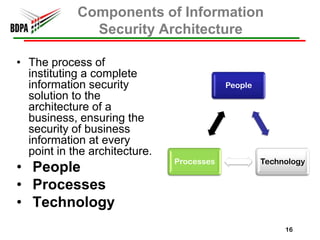
Components of Information Security ArchitectureThe process of instituting a complete information security solution to the architecture of a business, ensuring the security of business information at every point in the architecture. People
Processes
Technology16
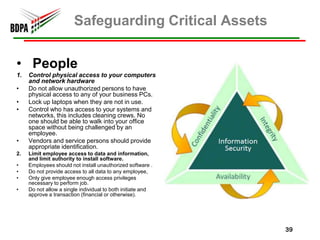
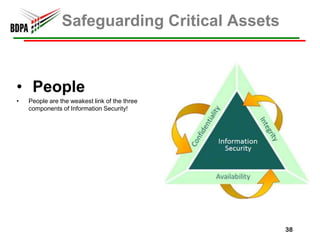
Components of Information Security ArchitecturePeoplePeople are the weakest link of a business’ process. You all know why!17
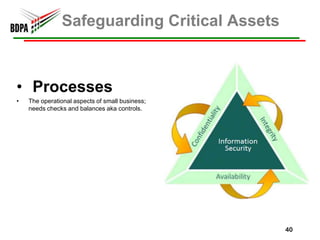
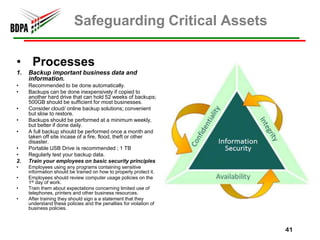
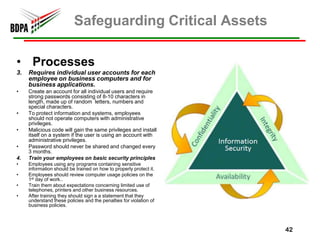
Components of Information Security ArchitectureProcessesThe operational aspects of small business. Safeguards can be automated or manual. 18
Components of Information Security ArchitectureTechnologyAll of the tools, applications, software, and infrastructure that allows a business process to work and perform efficiently. Thus as a business owner you must ensure that you have adequate logical controls in place to help you stay on track with your business’ mission or purpose.19
Cyber Crime In the news20
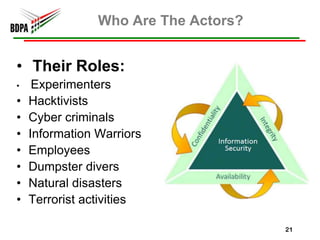
Who Are The Actors?Their Roles:Experimenters
Hacktivists
Cyber criminals
Information Warriors
Employees
Dumpster divers
Natural disasters
Terrorist activities21
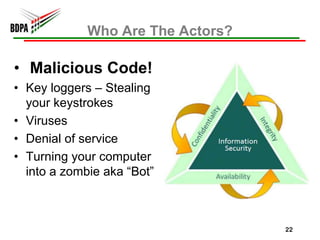
Who Are The Actors?Malicious Code!Key loggers – Stealing your keystrokes
Viruses
Denial of service
Turning your computer into a zombie aka “Bot”22
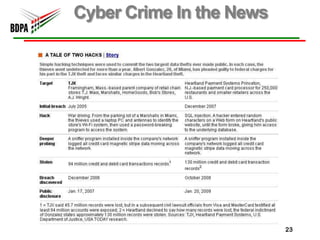
Cyber Crime In the News23
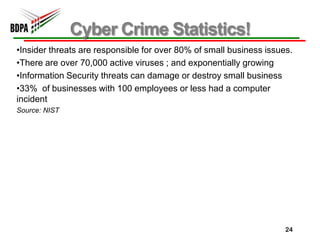
Cyber Crime Statistics!Insider threats are responsible for over 80% of small business issues.There are over 70,000 active viruses ; and exponentially growingInformation Security threats can damage or destroy small business33%  of businesses with 100 employees or less had a computer incidentSource: NIST24
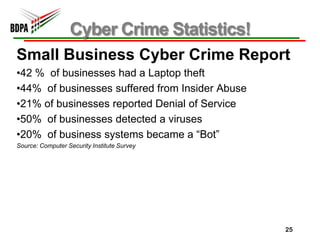
Cyber Crime Statistics!Small Business Cyber Crime Report42 %  of businesses had a Laptop theft44%  of businesses suffered from Insider Abuse21% of businesses reported Denial of Service50%  of businesses detected a viruses20%  of business systems became a “Bot”Source: Computer Security Institute Survey25
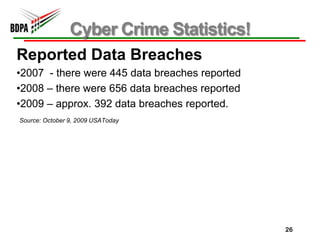
Cyber Crime Statistics!Reported Data Breaches2007  - there were 445 data breaches reported 2008 – there were 656 data breaches reported2009 – approx. 392 data breaches reported.Source: October 9, 2009 USAToday 26
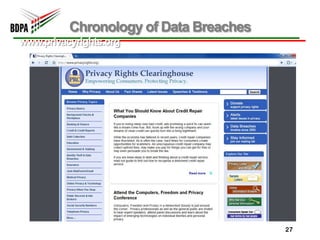
27Chronology of Data Breacheswww.privacyrights.org
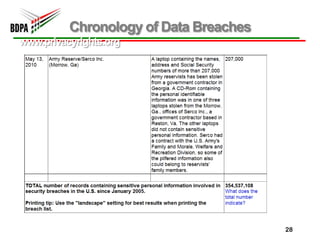
28Chronology of Data Breacheswww.privacyrights.orgThe 354,537,108 indicates the total number of records compromised

Information security for small business

  • 1.
    Information Security ForSmall Businessby Julius Clark Sr., MBA, CISSP, CISA
  • 2.
    About MeBDPA History2010-2012 CharlottePresident2010-2012 National BDPA CISO2007-2009 Charlotte President-Elect2006-2004 VP of SITES (Education)2001-2003 Charlotte HSCC CoordinatorEducationMBA in Information SecuritySalem International University, Salem, WVMSIS in Information SecurityUniversity of Fairfax, Fairfax, VABS in Electronic EngineeringWentworth Institute of Technology, Boston, MACertificationsCertified Information Systems Security Professional (CISSP)
  • 3.
  • 4.
    Microsoft Certified SystemEngineer (MSCE).Julius Clark Sr.Location: Charlotte, NCCurrent home, been residing in Charlotte, NC for over 10 yearsHometownBoston, MaProfessionInformation Security Professional.2
  • 5.
  • 6.
    Agenda (Continued)InformationSecurity for Small Business4
  • 7.
  • 8.
    Maslow’s Hierarchy ofNeedsBeing aware of one’s Wholeness keeps bad things from happening. A solid foundation must be built to advance. Understanding your environment, your health and activities helps one to continually perform risk assessments and move to the next level.Self – Actualization – Being All You Can Be
  • 9.
    Esteem - Recognition for Good Work
  • 10.
    Love - Acceptance
  • 11.
    Safety & Security– Stability
  • 12.
    Needs – Air, Food, Water, Shelter6
  • 13.
    Maslow’s Business ComparisonMaslow’sHierarchy of Needs can be applied to building a successful business. IT Security is a foundation that businesses must build upon to lower IT Security risks, which can help your business gain a competitive edge.Self – Actualization – Meeting the Mission Statement
  • 14.
    Esteem - Recognition in Market Place
  • 15.
    Love - Acceptance by Clients or Customers
  • 16.
    Safety & Security– IT Security & Insurance
  • 17.
  • 18.
    Importance of SmallBusinessesStatistic:There are over 26 million small businesses in the U.S.Source: NIST8
  • 19.
    What Is AtStake?Your Business! Your business is at risk of being damaged due to:Financial loss
  • 20.
  • 21.
  • 22.
  • 23.
    Theft of itstechnology , resources and products
  • 24.
  • 25.
  • 26.
  • 27.
    What Is InformationSecurity?Protecting your information, technology, property, products and people; all vital business assets. The Information Security Triad is the foundation for Information Security and is based on concepts and principles known as CIA.Confidentiality
  • 28.
  • 29.
  • 30.
    What Is InformationSecurity?ConfidentialityConcept of protecting information from improper disclosure and protecting the secrecy and privacy of sensitive data so that the intellectual property and reputation of an organization is not damaged and that data related to individuals is not released in violation of regulations or the privacy policy of the organization.- From the CISSP® CBK®12
  • 31.
    What Is InformationSecurity?IntegrityAddresses two objects, which are protecting data and processes from improper modification, and ensuring the operations of the information is reliable and performing as expected.- From the CISSP® CBK®13
  • 32.
    What Is InformationSecurity?AvailabilityThe concept of ensuring that the systems and data can be accessed when required. Availability is impacted by human error, cabling problems, software bug, hardware failures, loss of skilled staff, malicious code, and the many other threats that can render a system un-usable or unreliable. - From the CISSP® CBK®:14
  • 33.
    Components of informationsecurity architecture 15
  • 34.
    Components of InformationSecurity ArchitectureThe process of instituting a complete information security solution to the architecture of a business, ensuring the security of business information at every point in the architecture. People
  • 35.
  • 36.
  • 37.
    Components of InformationSecurity ArchitecturePeoplePeople are the weakest link of a business’ process. You all know why!17
  • 38.
    Components of InformationSecurity ArchitectureProcessesThe operational aspects of small business. Safeguards can be automated or manual. 18
  • 39.
    Components of InformationSecurity ArchitectureTechnologyAll of the tools, applications, software, and infrastructure that allows a business process to work and perform efficiently. Thus as a business owner you must ensure that you have adequate logical controls in place to help you stay on track with your business’ mission or purpose.19
  • 40.
    Cyber Crime Inthe news20
  • 41.
    Who Are TheActors?Their Roles:Experimenters
  • 42.
  • 43.
  • 44.
  • 45.
  • 46.
  • 47.
  • 48.
  • 49.
    Who Are TheActors?Malicious Code!Key loggers – Stealing your keystrokes
  • 50.
  • 51.
  • 52.
    Turning your computerinto a zombie aka “Bot”22
  • 53.
    Cyber Crime Inthe News23
  • 54.
    Cyber Crime Statistics!Insiderthreats are responsible for over 80% of small business issues.There are over 70,000 active viruses ; and exponentially growingInformation Security threats can damage or destroy small business33% of businesses with 100 employees or less had a computer incidentSource: NIST24
  • 55.
    Cyber Crime Statistics!SmallBusiness Cyber Crime Report42 % of businesses had a Laptop theft44% of businesses suffered from Insider Abuse21% of businesses reported Denial of Service50% of businesses detected a viruses20% of business systems became a “Bot”Source: Computer Security Institute Survey25
  • 56.
    Cyber Crime Statistics!ReportedData Breaches2007 - there were 445 data breaches reported 2008 – there were 656 data breaches reported2009 – approx. 392 data breaches reported.Source: October 9, 2009 USAToday 26
  • 57.
    27Chronology of DataBreacheswww.privacyrights.org
  • 58.
    28Chronology of DataBreacheswww.privacyrights.orgThe 354,537,108 indicates the total number of records compromised