Download to read offline
![International Journal on Cybernetics & Informatics (IJCI) Vol. 4, No. 2, April 2015
DOI: 10.5121/ijci.2015.4221 221
AUTOMATIC LOGO EXTRACTION FROM
DOCUMENT IMAGES
Umesh D. Dixit1
and M. S. Shirdhonkar2
1
Department of Electronics & Communication Engineering, B.L.D.E.A’s CET, Bijapur.
2
Department of Computer Science and Engineering, B.L.D.E.A’s CET, Bijapur.
ABSTRACT
Logo extraction plays an important role in logo based document image retrieval. Here we present a
method for automatic logo extraction from the document images that works for scanned documents
containing a logo. Proposed method uses morphological operations for logo extraction. It supports
extraction of a logo with its gray level and color information
KEYWORDS
Document image, Preprocessing, Logo extraction
1. INTRODUCTION
Logo is a graphic mark or emblem commonly used by commercial enterprises, organizations and
even individuals to aid and promote instant public recognition. Logos consists of only graphic
symbols or graphics and text indicating name of the organization. The logos can be classified as
text logo, graphical logo and mixed logos. A text logo comprises only text information, graphical
logos contain some symbols or graphics and a mixed logo includes both text and graphics. The
Figure 1 shows examples of these types of logos from University of Maryland (UMD) logo
database [1].
(a) Text logo (b) Graphic logo (c) Mixed logo
Figure 1. Types of logos from UMD logo database
The logo based document image retrieval has created a great interest among the research
community of document image processing. Logo extraction includes recognizing, detecting and
extracting a logo component from document image. However, automatic logo extraction is a
challenging task to implement logo based document image retrieval. This paper presents a
relatively faster method for automatic logo extraction from scanned documents.](https://image.slidesharecdn.com/4215ijci21-150508061415-lva1-app6892/85/A-UTOMATIC-L-OGO-E-XTRACTION-F-ROM-D-OCUMENT-I-MAGES-1-320.jpg)
![International Journal on Cybernetics & Informatics (IJCI) Vol. 4, No. 2, April 2015
222
The rest of the paper is orgainized as follows: Section 2 of this paper describes the related work,
Section 3 explains the proposed method, section 4 discuss about results and observations and
finally section 5 concludes the paper.
2. RELATED WORK
In 1997, Seiden et. al [2] presented logo detection system based on segmentation of the
document image into smaller images using a top-down XY cut algorithm. In this approach they
used connected components with sixteen features and then applied a rule based strategy for
detection of a logo component. In 2001, Hsieh and Fan [3] proposed a technique based on region
growing that segments the given input image into possible logo candidates. A logo from these
candidates is identified based on color, shape and location. The method proposed in [4] works on
feature selection principles to segment a logo. It selects suitable features such as area, deviation,
symmetry, centralization, complexity and 2-level contour representation strings automatically for
logo detection from document image.
In 2003, Pham [5] presented a method for logo detection with an assumption that the spatial
density of foreground pixels in a logo region will be more than that of non-logo regions. This
method first converts the document into a binary form consisting of foreground and background
pixels. Spatial density is then computed for each fixed size window (region) and the region that
has highest spatial density is recognized as a logo region. In 2006, Hung et. al [6] proposed a
shape-based similarity retrieval system based on database classification exploiting the contour
and interior region of a shape efficiently. Angular radial transform (ART) region feature is used
to compare the query with the candidate sets according to the priority order.
In 2007, Zhu and Doermann [7] employed multi-scale boosting strategy for logo detection and
extraction from document image. At coarse image scale they applied two-class Fisher classifier
for each connected component. A cascade of simple classifier is then employed at finer image
scale to find out a logo from possible set of logo candidates.
In 2009, Wang and Chen presented [8] logo detection method based using boundary extension of
feature rectangle. This method works on assumption that logos have white background and is
independent of shape of logos. Decision tree is used to increase logo detection rate. It reduced the
false positive from the logo candidate pool. Zhu and Doermann [9] proposed a logo-based
document image retrieval system that uses a document containing logo as a query. In logo based
document retrieval they used detected and segmented a logo by boosting a cascade of classifiers
across multiple image scales.
In 2010, Shirdhonkar and Kokare [10] employed discrete wavelet transform (DWT) for automatic
logo detection and extraction from the document images. This method computes spatial density
using the mean of the energy and standard deviation of the wavelet coefficients for extraction of a
logo.
In 2011, Hassanzadeh and Pourghassem [11] proposed a frame work for logo detection and
recognition based on spatial and structural features. It considers some specifications of logo such
as centroid coordinates and intersection of each logo’s separated part in detection process.
Separated parts of logos are merged using morphological dilation operation. A new feature based
on histogram of object occurrence in a logo image is used for recognition purpose.
In 2013, Jha et. al [12] proposed a method for watermark (logo) extraction from distorted
watermarked images. Combined discrete wavelet trans- form (DWT) and dynamic stochastic](https://image.slidesharecdn.com/4215ijci21-150508061415-lva1-app6892/85/A-UTOMATIC-L-OGO-E-XTRACTION-F-ROM-D-OCUMENT-I-MAGES-2-320.jpg)
![International Journal on Cybernetics & Informatics (IJCI) Vol. 4, No. 2, April 2015
223
resonance (DSR) are used in this method. A logo which is hided in the distorted watermarked
image is extracted in this work.
In 2014, Jha et. al [13] presented a technique that employs a dynamic stochastic resonance (DSR)
for blind watermark extraction in discrete cosine transform (DCT) domain. DSR is an iterative
process that tunes the coefficients of the possibly attacked watermarked image so that the effect
of noise is suppressed and hidden information is enhanced.
This paper presents a simple logo extraction method using morphological close and median
filtering operations.
3. PROPOSED METHODOLOGY
The Figure 2 depicts steps used for logo extraction from document image. In this method we
assume non-logo part of the document as noise and we remove the non-logo part of the document
image with the help of morphological close operation and then apply median filtering. The
different steps involved in logo extraction are gray-scale conversion, image binarization,
Morphological close, Median filtering, Logo detection and extraction from original document.
These steps are briefly explained below.
Document Image
Extracted Logo
Figure 2. Flowchart of proposed method
Image Binarization
Morphological Close
Median filtering
Draw a bounding box to find
region(Location) of the logo in
binarized image
Extract the logo region from
original image
Gray-scale Conversion](https://image.slidesharecdn.com/4215ijci21-150508061415-lva1-app6892/85/A-UTOMATIC-L-OGO-E-XTRACTION-F-ROM-D-OCUMENT-I-MAGES-3-320.jpg)
![International Journal on Cybernetics & Informatics (IJCI) Vol. 4, No. 2, April 2015
224
• Gray scale conversion and Binarization: The document image is captured using a
scanner. The scanned image of a document may be a color image or gray scale image. If
the image scanned is color image, it is first converted into gray level and then converted
into binary image using threshold level.
0 if f(x,y)<T
g(x,y) = 1 if f(x,y)>=T
Where f(x,y) is gray scale image, g(x,y) is binarized image and ‘T’ is appropriate
threshold level used for binarization.
• Morphological Closing: Morphological closing of set A by structuring element B is
denoted as A ● B and is given by equation (1).
A ● B = (A ⊕ B) ϴ B (1)
In this step we apply morphological closing operation to a binarized image. We use
square with size 10 as the structuring element. The size of the structure element square is
chosen as 10 to convert characters and other small shapes with foreground color (black)
in the document image to background color (white).
• Noise removal: This step applies median filter to remove non-logo part in the document.
Mainly it removes impulse noise from the image left after morphological close operation.
It keeps much of the logo part as it is in the document and converts remaining part of the
document into background color.
• Logo detection and extraction: Now we draw a bounding box to the output obtained
from the previous steps. This helps to find out location of a logo in the binarized image.
The coordinate points of the bounding box in the binarized image are used to extract a
logo from original gray scale/color image.
4. RESULTS AND DISCUSSION
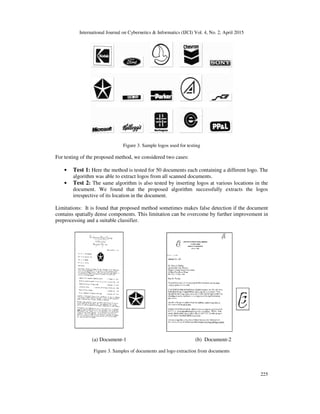
The method is tested for more than 50 logos from UMD logo database [1]. Testing is carried out
by inserting logos from the in scanned documents. Figure 3 shows some sample logos used for
testing and Figure 4 shows results of logo extraction.](https://image.slidesharecdn.com/4215ijci21-150508061415-lva1-app6892/85/A-UTOMATIC-L-OGO-E-XTRACTION-F-ROM-D-OCUMENT-I-MAGES-4-320.jpg)
![International Journal on Cybernetics & Informatics (IJCI) Vol. 4, No. 2, April 2015
226
5. CONCLUSION
This paper presents a simple logo extraction method based on morphological operations. The
method works relatively faster and efficiently with few limitations. These limitations can be
overcome by further improvement in preprocessing techniques.
REFERENCES
[1] The University of Maryland (UMD) logo database,
http://lampsrv01.umiacs.umd.edu/projdb/project.php?id=47.
[2] Seiden S., M. Dillencourt, S. Irani, R. Borrey and T. Murphy, “Logo detection in document images,”
in Proc. Int. conf. Imaging science, Sys, and Tech, pp. 446-449, (1997).
[3] Hsieh I.S. and K.C. Fan, “Multiple Classifiers for Color Flag and Trademark Image Retrieval”, IEEE
Transactions on Image Processing, 10(6): pp. 938-950, (2001).
[4] Yin P.Y and C.C. Yeh, “Content-based retrieval from trademark databases”, Pattern Recognition
Letters, 23: pp. 113-126, (2002).
[5] Pham T., “Unconstrained logo detection in document images,” Pattern recognition, 36: pp. 3023-
3025, (2003).
[6] Hung M.H., C.H. Hsieh, C.M. Kuo, “Similarity retrieval of shape images based on database
classification”, Journal Vis. Communication and Image Representation, 17: pp. 970-985, (2006).
[7] Zhu G. and D. Doermann, “Automatic document logo detection,” In conference on document analysis
and recognition, pp. 864-868, (2007).
[8] Wang H. Y. and Chen, “Logo detection in document images based on boundary extension of feature
rectangles,” IEEE computer society,10th Int'l conference on document analysis and recognition, pp.
1335-1339, (2009).
[9] Zhu, G. and D. Doermann, "Logo matching for document image retrieval", Int'l Conference on
Document Analysis and Recognition, pp. 606-610, (2009).
[10]M.S.Shirdhonkar and Manesh Kokare, “Automatic Logo Detection in Document Images”, in
proceeding of 2010 IEEE International Conference on Computational Intelligence and Computer
Research, held at TCE, Coimbatore, pp. 905-907, (2010).
[11] Sina Hassanzadeh and Hossein Pourghassem, “A Novel Logo Detection and Recognition Framework
for Separated Part Logos in Document Images”, Australian Journal of Basic and Applied Sciences,
5(9): pp. 936-946, (2011).
[12] Rajib kumar Jha, Prabir Kumar Biswas, B.N.Chattarji, “Logo extraction using combined discrete
wavelet transform and dynamic stochastic resonance”, International Journal of Image and Graphics,
Vol. 1, 2013.
[13] Rajib Kumar Jha, Rajlaxmi Chohan, Kiyoharu Aizawa, “Dynamic stochastic resonance-based
improved logo extraction in discrete cosine transform domain”, Journal of Computers and Electrical
Engineering, Vol. 40, Issue 6, pp. 1917-1929, 2014.
AUTHORS
Dr. M.S.Shirdhonkar has received B.E (CSE), M.E (CSE) from Shivaji University,
Kolhapur and his Doctorate from Swami Ramanand Teerth, Marathwada University,
Nanded, Maharashtra. He has 16 years of experience. His area of interest is Image
processing, Document image retrieval and analysis and Pattern recognition. He has
published more than 19 papers in national and international conferences and journals
Mr. Umesh D. Dixit has received B.E (E&C) and M.Tech (CSE) from Visvesvaraya
Technological University, Belagavi. He is having an experience of more than 12 years
and his area of interest include Image processing, Document image processing,
Embedded systems. Currently pursuing Ph.D under Visvesvaraya Technological
University, Belagavi, Karnataka.
.](https://image.slidesharecdn.com/4215ijci21-150508061415-lva1-app6892/85/A-UTOMATIC-L-OGO-E-XTRACTION-F-ROM-D-OCUMENT-I-MAGES-6-320.jpg)

This paper presents a method for automatic logo extraction from scanned document images, utilizing morphological operations to facilitate the extraction process. The methodology includes steps such as gray-scale conversion, binarization, morphological closing, and median filtering for effective noise removal and logo detection. The proposed method has been tested successfully on over 50 logos, showing its efficiency despite some limitations in cases of spatially dense components.


