Download to read offline
![IOSR Journal of Computer Engineering (IOSR-JCE)
e-ISSN: 2278-0661,p-ISSN: 2278-8727, Volume 17, Issue 4, Ver. II (July – Aug. 2015), PP 79-85
www.iosrjournals.org
DOI: 10.9790/0661-17427985 www.iosrjournals.org 79 | Page
Image Upscaling and Fuzzy ARTMAP Neural Network
Gagandeep Singh1
, Gulshan Goyal2
1
(Computer Science Department, Chandigarh University, India)
2
(Computer Science Department, Chandigarh University, India)
Abstract: In Image upscaling, a higher resolution image is processed from an available low resolution image.
There are numerous scenarios and applications where image upscaling is required and performed. The paper
proposes a simple image scaling algorithm and implements it with a fuzzy variant of the supervised ART neural
network, ARTMAP. The method has been compared with nearest neighbor interpolation, bilinear interpolation
and bicubic interpolation, both objectively and subjectively. The present paper is an attempt at understanding
the Adaptive Resonance Theory networks while proposing a simple linear upscaling method.
Keywords: ARTMAP, Artificial neural network, bilinear, nearest neighbor, Upscaling
I. Introduction
Digital image processing is a field of computing that deals with processing and operations on digitally
acquired images. Image processing entails various operations like enhancement, restoration, segmentation,
feature extraction etc. Image upscaling is one of the various applications of the wide field of digital image
processing. In upscaling, we aim to produce a high resolution replica of an image from the original low
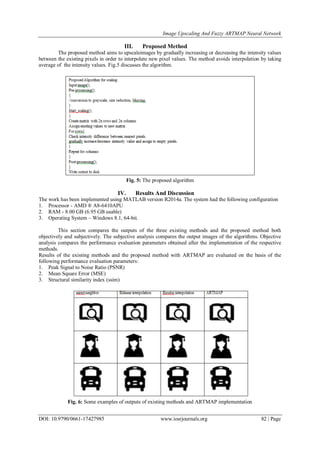
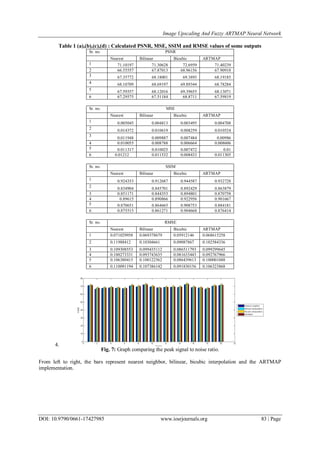
resolution image as shown in Fig. 1. The goal of image interpolation is to produce acceptable images at
different resolutions from a single low-resolution image. The actual resolution of an image is defined as the
number of pixels, but the effective resolution is a much harder quantity to define as it depends on subjective
human judgment and perception[1]. It so happens, that we quite often come across situations when we have to
deal with an image which is big enough spatially to view or observe the subject(s) comfortably or effectively. In
such situations we need to obtain a bigger image, a higher resolution image, which is easier to work with. This is
where image upscaling or up-sampling comes in. It takes a small image as input, performs some operations and
gives a bigger replica. It should be noted however, that up-sampling the image will not add any more detail to
the original image. A simple definition image is still simple definition, upscaling will only increase the spatial
resolution; not enhance the definition or detailing to the image than it already has.
Fig 1: Original image to Upscaled image
The image upscaling problem is also referred to as ‘single-image super-resolution’ problem.
1.1 Need for Image Upscaling
Scaling of images from lower resolution to a higher resolution is needed because of the following reasons:
1) It’s easier to analyze and study higher resolution images.
2) Available sensors have limitation in respect to maximum resolution[2] So we need upscaling to overcome
some of the inherent resolution limitations of low-cost imaging sensors [3]
3) To produce images of high perceptual quality and produce visually appealing results
4) To keep the text and graphics as original as possible, while avoiding noise and artifacts in the image [4]
5) To preserve the nature and texture of image while enlarging it.
6) To allow for better utilization of the growing capability of High Resolution displays (e.g., HD LCDs). [3]
1.2 Applications of Image Upscaling
Image upscaling (and more generally image interpolation) methods are implemented in a variety of
computer tools like printers, digital TV, media players, image processing packages, graphics renderers and so
on.[4]. Some application areas of image upscaling/ single image super resolution are as follows:](https://image.slidesharecdn.com/m017427985-160702061046/85/M017427985-1-320.jpg)
![IOSR Journal of Computer Engineering (IOSR-JCE)
e-ISSN: 2278-0661,p-ISSN: 2278-8727, Volume 17, Issue 4, Ver. II (July – Aug. 2015), PP 79-85
www.iosrjournals.org
DOI: 10.9790/0661-17427985 www.iosrjournals.org 79 | Page
Image Upscaling and Fuzzy ARTMAP Neural Network
Gagandeep Singh1
, Gulshan Goyal2
1
(Computer Science Department, Chandigarh University, India)
2
(Computer Science Department, Chandigarh University, India)
Abstract: In Image upscaling, a higher resolution image is processed from an available low resolution image.
There are numerous scenarios and applications where image upscaling is required and performed. The paper
proposes a simple image scaling algorithm and implements it with a fuzzy variant of the supervised ART neural
network, ARTMAP. The method has been compared with nearest neighbor interpolation, bilinear interpolation
and bicubic interpolation, both objectively and subjectively. The present paper is an attempt at understanding
the Adaptive Resonance Theory networks while proposing a simple linear upscaling method.
Keywords: ARTMAP, Artificial neural network, bilinear, nearest neighbor, Upscaling
I. Introduction
Digital image processing is a field of computing that deals with processing and operations on digitally
acquired images. Image processing entails various operations like enhancement, restoration, segmentation,
feature extraction etc. Image upscaling is one of the various applications of the wide field of digital image
processing. In upscaling, we aim to produce a high resolution replica of an image from the original low
resolution image as shown in Fig. 1. The goal of image interpolation is to produce acceptable images at
different resolutions from a single low-resolution image. The actual resolution of an image is defined as the
number of pixels, but the effective resolution is a much harder quantity to define as it depends on subjective
human judgment and perception[1]. It so happens, that we quite often come across situations when we have to
deal with an image which is big enough spatially to view or observe the subject(s) comfortably or effectively. In
such situations we need to obtain a bigger image, a higher resolution image, which is easier to work with. This is
where image upscaling or up-sampling comes in. It takes a small image as input, performs some operations and
gives a bigger replica. It should be noted however, that up-sampling the image will not add any more detail to
the original image. A simple definition image is still simple definition, upscaling will only increase the spatial
resolution; not enhance the definition or detailing to the image than it already has.
Fig 1: Original image to Upscaled image
The image upscaling problem is also referred to as ‘single-image super-resolution’ problem.
1.1 Need for Image Upscaling
Scaling of images from lower resolution to a higher resolution is needed because of the following reasons:
1) It’s easier to analyze and study higher resolution images.
2) Available sensors have limitation in respect to maximum resolution[2] So we need upscaling to overcome
some of the inherent resolution limitations of low-cost imaging sensors [3]
3) To produce images of high perceptual quality and produce visually appealing results
4) To keep the text and graphics as original as possible, while avoiding noise and artifacts in the image [4]
5) To preserve the nature and texture of image while enlarging it.
6) To allow for better utilization of the growing capability of High Resolution displays (e.g., HD LCDs). [3]
1.2 Applications of Image Upscaling
Image upscaling (and more generally image interpolation) methods are implemented in a variety of
computer tools like printers, digital TV, media players, image processing packages, graphics renderers and so
on.[4]. Some application areas of image upscaling/ single image super resolution are as follows:](https://image.slidesharecdn.com/m017427985-160702061046/75/M017427985-1-2048.jpg)
![Image Upscaling And Fuzzy ARTMAP Neural Network
DOI: 10.9790/0661-17427985 www.iosrjournals.org 80 | Page
1) Printing: To scale and print images according to canvas size while maintaining picture quality.
2) Video playback: Televisions use real time up scaling algorithms to display simple definition content on
high-resolution displays.
3) Mobile devices: To scale graphics and videos onto varying display sizes for viewing and playback.
4) Image processing packages: Image processing software use scaling for viewing and resizing the image.
[4]
5) Satellite imaging: Nowadays, satellite images are used in many applications such as geosciences studies,
astronomy, and geographical information systems. [5]
6) Computer Graphics: Computers perform screen image scaling which includes web pages, text, graphics,
game scenes etc. [6]
1.3 Methods for image upscaling
There are many ways of upscaling via image interpolation. Some methods are adaptive and some are
non-adaptive.
Linear or Non-adaptive methods: The non-adaptive methods are quicker. The non-adaptive approach applies
same operations on all the pixels of the image, without taking into account any of its characteristics.
Non-linear or Adaptive methods: The performance of conventional approaches is only acceptable for small
upscaling factors[7].The adaptive methods rely on the assumption that, in natural images, frequency
components are not all equally probable [8]. The adaptive methods perform a little better but have the downside
to being too complex and higher processing times. The adaptive methods apply operations depending upon
certain characteristics and features like presence of curves, edges, the image quality etc.
Adaptive algorithm basically uses some of the image features and improves interpolation result. Adaptive
algorithm works based on different intensity present and local structure of image. Many adaptive interpolation
algorithms have been proposed which enhance edges in images. Local gradient information can also be used to
enhance non adaptive interpolation algorithm. Normal problem with interpolation technique is blurring and
blocking artifacts. This can be solved using directional interpolation. For example, Edge directed interpolation,
NEDI (New Edge Directed Interpolation), SAI (Soft decision adaptive Interpolation).
II. Artificial Neural Networks
An artificial neural network is an information processing paradigm that is inspired by and tries to
mimic the biological nervous system. In a biological nervous system, the decision making process is facilitated
by neurons and neural pathways that fire upon stimuli and transfer the desired signal to the brain. In the same
way, the artificial neural network tries to mimic the decision making process and information transfer abilities of
the biological nervous system. In an artificial neural network the nodes represent the neurons of a nervous
system, the interconnections between neurons are imitated by the use of weights and biases over the inter-
connections among the neurons.
The artificial neural network or ANN can be a single layer network or a multiple layered network. A
single layered neural network does not have hidden layers in between the input and output layers. Usually multi-
layered neural networks are implemented and they have more than one hidden layers in between the input and
output layers. Each hidden layer is connected to others via weights. The higher the number of layers in a
network, the more complex operations can be performed by the ANN.
Fig 2: A simple neural network
N1 N2 N3
1.1 INTRODUCTION TO DIGITAL IM
Digital image processing is a field of computing
on digitally acquired images. Image processing en
restoration, segmentation, feature extraction etc. I
Hidden layer Output layer
YX
w1 w2
Input layer](https://image.slidesharecdn.com/m017427985-160702061046/85/M017427985-2-320.jpg)
![Image Upscaling And Fuzzy ARTMAP Neural Network
DOI: 10.9790/0661-17427985 www.iosrjournals.org 81 | Page
The Fig. 3 shows an example of a simple neural network. Where X is the input to the network. N1, N2,
N3 are the input, hidden and output layers of the neural network respectively. The intermediate connections
between the layers are represented by weighted connections w1 and w2.
2.1 Artmap Neural Network
ARTMAP neural network is a supervised form of ART neural network. ART neural network has an
inherently un-supervised approach to learning, which may be unsuitable for certain situations and applications.
The supervised nature of an ARTMAP network makes it more reliable and better at learning. ARTMAP is
among the family of neural networks that are capable of fast supervised, incremental learning and prediction. A
number of variants of the network are available, like distributed ARTMAP, fuzzy ARTMAP, default ARTMAP,
probabilistic ARTMAP etc.
The fuzzy ARTMAP network has integrated the fuzzy ART which enables it to process both analog
and binary-valued input patterns. This neural network is simple and has been designed with the ability to
perform supervised learning. In supervised learning mode, the sequential learning process grows the number of
recognition categories according to a problem’s complexity. [11]
Fig 3: An ARTMAP structure [9]
The Fig.3 above shows a basic ARTMAP structure, where A is the input to the network. F1, F2 are its
layers. And the ART subsystem is connected to the Map Field via weights Wab.
The Map Field determines
whether the prediction of the network is equal to what was desired by the network.
Because this neural network architecture has a small number of parameters and requires no problem-
specific system crafting or choice of initial weight values, it is also easy to use. In an ARTMAP network, an
epoch is defined as one cycle of training on an entire set of input examples [10]. The fuzzy ARTMAP algorithm
is discussed in the Fig.4 below.
Fig. 4: The fuzzy ARTMAP algorithm](https://image.slidesharecdn.com/m017427985-160702061046/85/M017427985-3-320.jpg)
![Image Upscaling And Fuzzy ARTMAP Neural Network
DOI: 10.9790/0661-17427985 www.iosrjournals.org 85 | Page
Based on the obtained values and results, we make the following conclusions. Advantages of training ARTMAP
with proposed algorithm:
Better PSNR values than nearest neighbor
Better MSE values than Nearest neighbor
Structural similarity and RMSE are also satisfactory
Even though the proposed method scores lower than bicubic interpolation during objective evaluation,
subjectively its output quality is quite good. It also deals with the too much blurring and ringing artifacts in the
images to a large extent.
References
[1]. Gonzalez, Rafael C. Digital image processing. Pearson Education India, 2009.
[2]. Purkait, P., and Chanda B., "Super resolution image reconstruction through Bregman iteration using morphologic
regularization." Image Processing, IEEE Transactions on 21.9 (2012): pp 4029-4039.
[3]. Yang, Jianchao, et al. "Coupled dictionary training for image super-resolution."Image Processing, IEEE Transactions on 21.8
(2012):pp 3467-3478.
[4]. Zhang, Haichao, Yanning Zhang, and Thomas S. Huang. "Efficient sparse representation based image super resolution via dual
dictionary learning."Multimedia and Expo (ICME), 2011 IEEE International Conference on. IEEE, 2011.
[5]. Gunturk, B. K., et al. "Demosaicking: color filter array interpolation." IEEE Signal Processing Magazine 22 (2005):pp 44-54.
[6]. Han, Dianyuan. "Comparison of Commonly Used Image Interpolation Methods."Proceedings of the 2nd International Conference
on Computer Science and Electronics Engineering. Atlantis Press, 2013.
[7]. Yang, Jianchao, et al. "Coupled dictionary training for image super-resolution."Image Processing, IEEE Transactions on 21.8
(2012): pp 3467-3478.
[8]. Giachetti, Andrea, and Nicola Asuni. "Real-time artifact-free image upscaling."Image Processing, IEEE Transactions on 20.10
(2011): pp 2760-2768.
[9]. Granger, Eric, et al. "Supervised learning of fuzzy artmap neural networks through particle swarm optimization." Journal of Pattern
Recognition Research2.1 (2007): pp 27-
[10]. Connolly, Jean-François, Eric Granger, and Robert Sabourin. "An adaptive classification system for video-based face
recognition." Information Sciences192 (2012):pp 50-70.
[11]. Taherian, Arash, and Mahdi Aliyari Sh. "Noise Resistant Identification of Human Iris Patterns Using Fuzzy ARTMAP Neural
Network." International Journal of Security and Its Applications 7.1 (2013): pp 105-118.](https://image.slidesharecdn.com/m017427985-160702061046/85/M017427985-7-320.jpg)

This document presents a method for image upscaling using a fuzzy ARTMAP neural network. It begins with an introduction to image upscaling and interpolation techniques. It then provides background on ARTMAP neural networks and fuzzy logic. The proposed method uses a linear interpolation algorithm trained with an ARTMAP network. Results show the method performs better than nearest neighbor interpolation in terms of peak signal-to-noise ratio, mean squared error, and structural similarity, though not as high as bicubic interpolation. Overall, the fuzzy ARTMAP network provides an effective way to perform image upscaling with fewer artifacts than traditional methods.


![Getting Started with Apache Spark: Big Data Made Simple [Free Meetup]](https://cdn.slidesharecdn.com/ss_thumbnails/apachesparkgettingstarted-260203175547-8361bcc3-thumbnail.jpg?width=640&height=640&fit=bounds)


