Information Retrieval:
Foundation to Web Search
Zachary G. Ives
University of Pennsylvania
CIS 455 / 555 – Internet andWeb Systems
October 12, 2024
Some slides by Berthier Ribeiro-Neto
2
Reminders & Announcements
 Midterm on 3/31, 80 minutes, closed-book
 Past midterms will be available on the web site
3
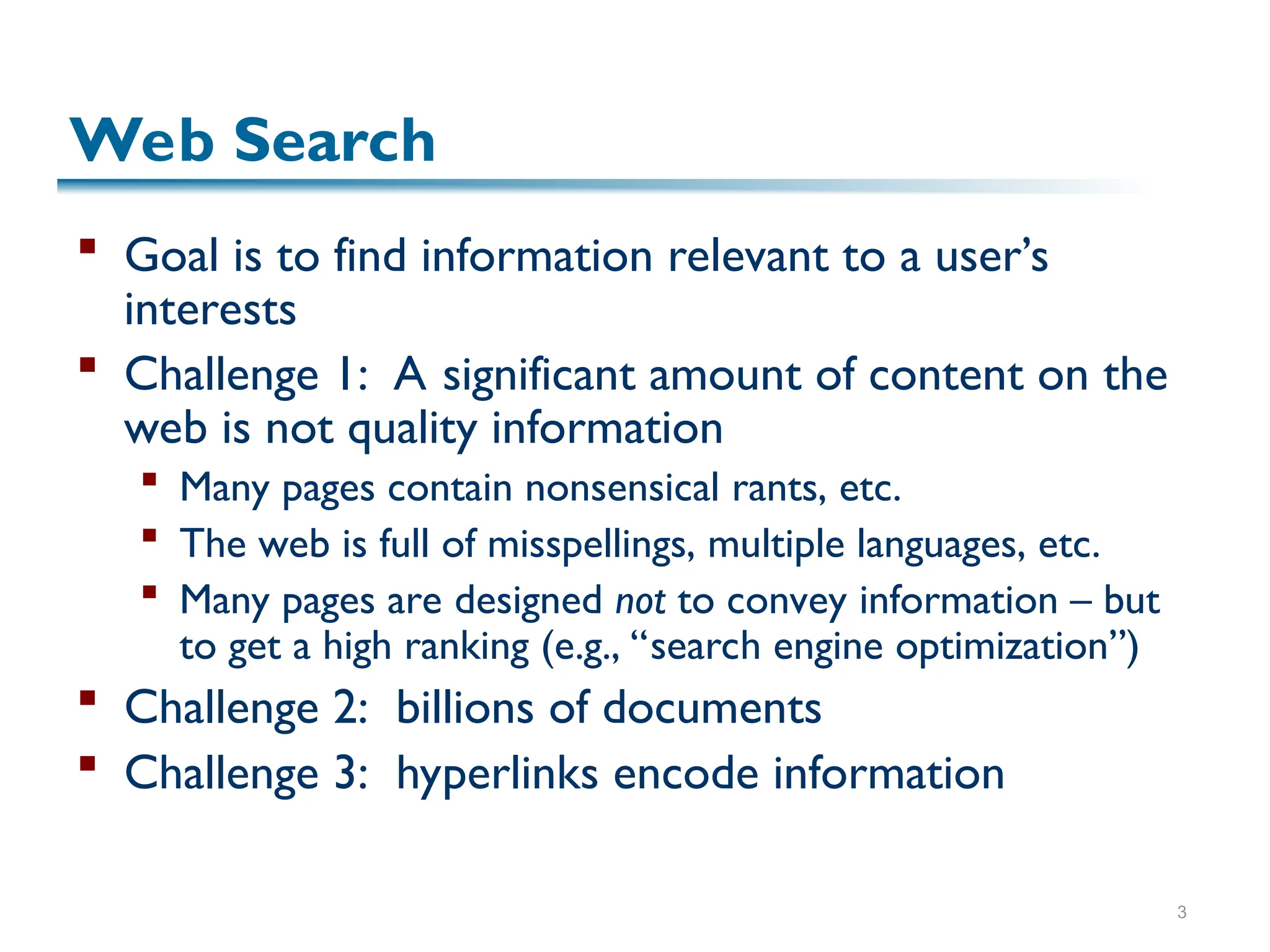
Web Search
 Goal is to find information relevant to a user’s
interests
 Challenge 1: A significant amount of content on the
web is not quality information
 Many pages contain nonsensical rants, etc.
 The web is full of misspellings, multiple languages, etc.
 Many pages are designed not to convey information – but
to get a high ranking (e.g., “search engine optimization”)
 Challenge 2: billions of documents
 Challenge 3: hyperlinks encode information
4
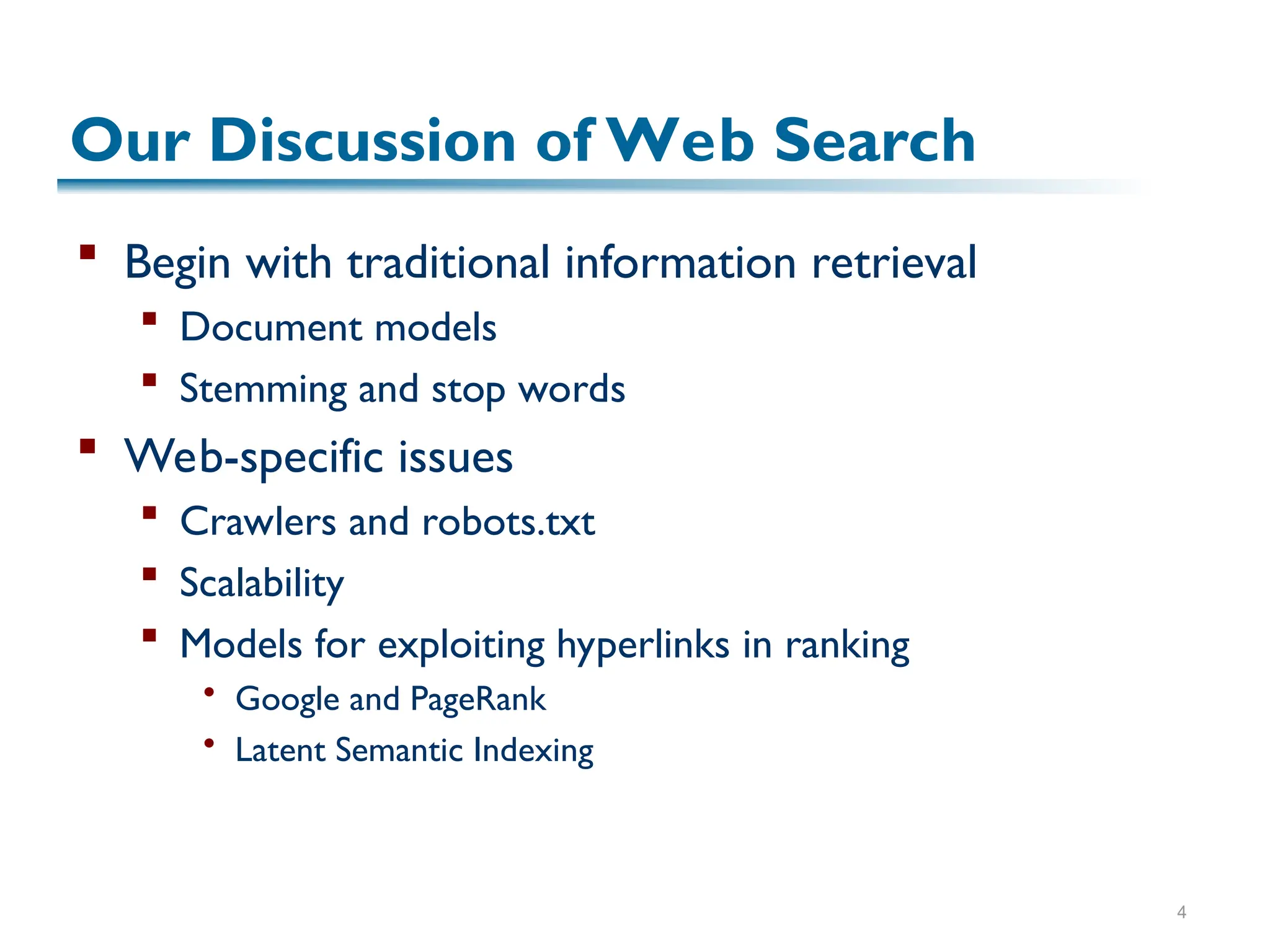
Our Discussion of Web Search
 Begin with traditional information retrieval
 Document models
 Stemming and stop words
 Web-specific issues
 Crawlers and robots.txt
 Scalability
 Models for exploiting hyperlinks in ranking
 Google and PageRank
 Latent Semantic Indexing
5
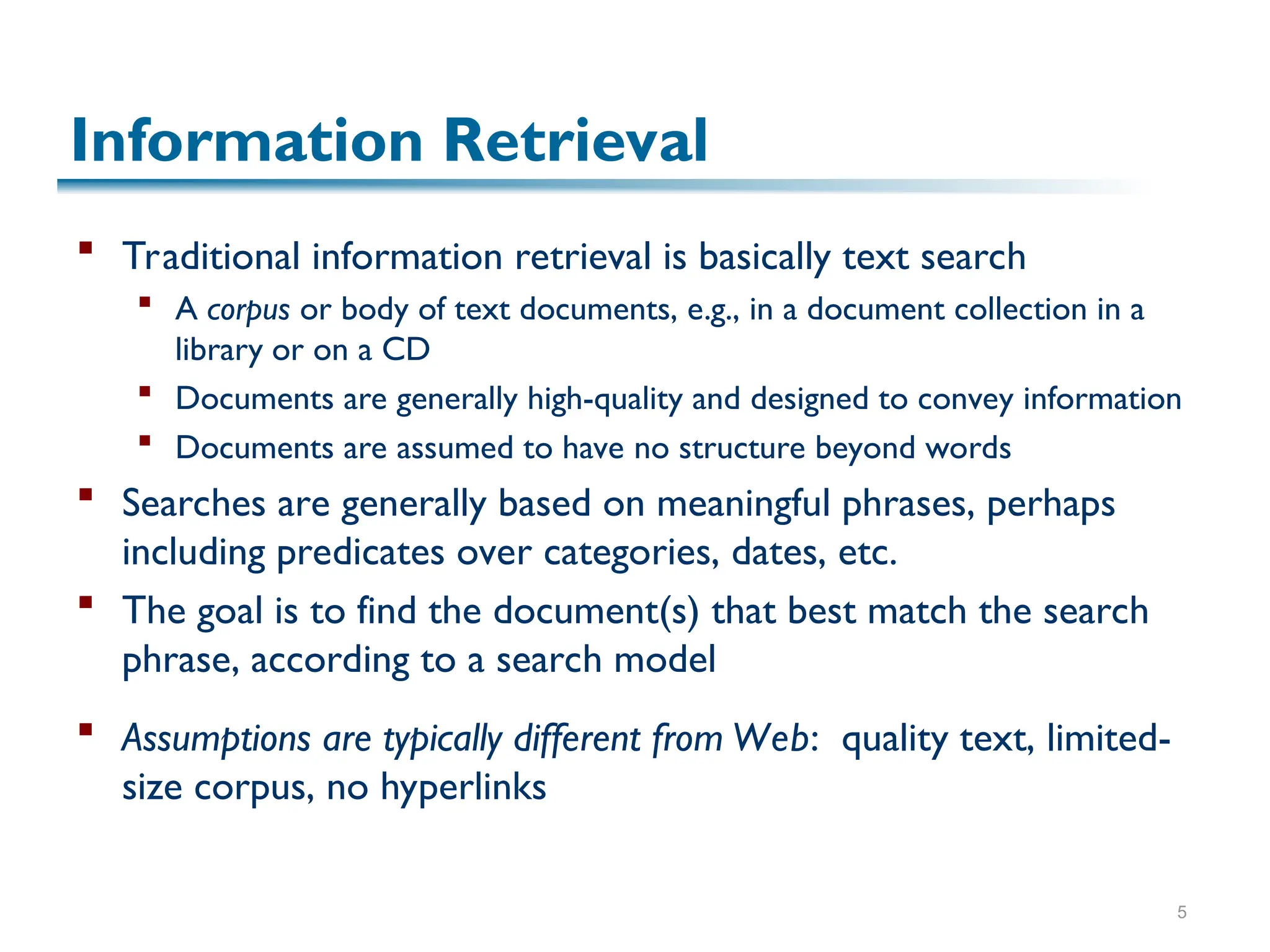
Information Retrieval
 Traditional information retrieval is basically text search
 A corpus or body of text documents, e.g., in a document collection in a
library or on a CD
 Documents are generally high-quality and designed to convey information
 Documents are assumed to have no structure beyond words
 Searches are generally based on meaningful phrases, perhaps
including predicates over categories, dates, etc.
 The goal is to find the document(s) that best match the search
phrase, according to a search model
 Assumptions are typically different from Web: quality text, limited-
size corpus, no hyperlinks
6
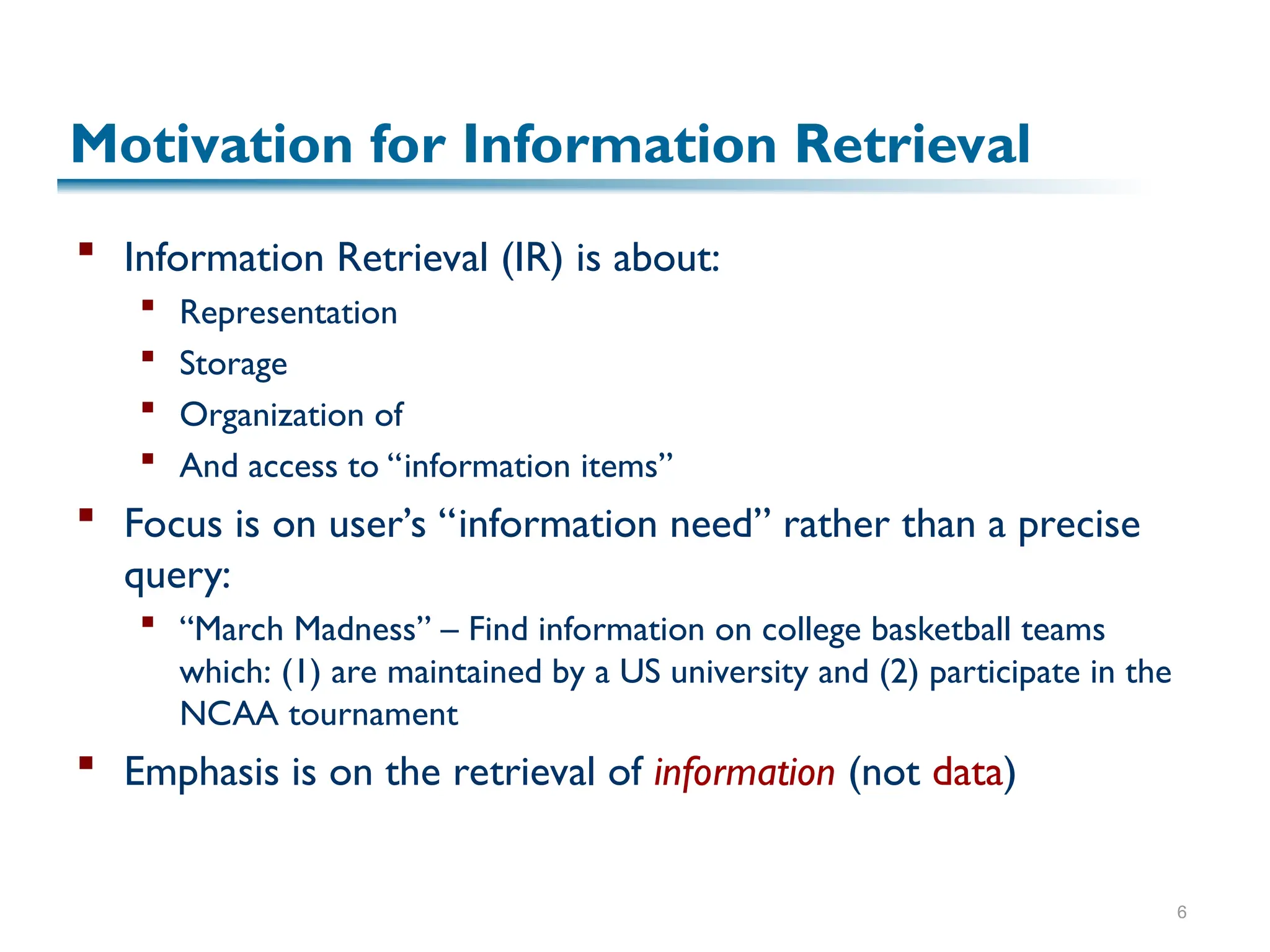
Motivation for Information Retrieval
 Information Retrieval (IR) is about:
 Representation
 Storage
 Organization of
 And access to “information items”
 Focus is on user’s “information need” rather than a precise
query:
 “March Madness” – Find information on college basketball teams
which: (1) are maintained by a US university and (2) participate in the
NCAA tournament
 Emphasis is on the retrieval of information (not data)
7
Data vs. Information Retrieval
 Data retrieval, analogous to database querying: which docs
contain a set of keywords?
 Well-defined, precise logical semantics
 A single erroneous object implies failure!
 Information retrieval:
 Information about a subject or topic
 Semantics is frequently loose; we want approximate matches
 Small errors are tolerated (and in fact inevitable)
 IR system:
 Interpret contents of information items
 Generate a ranking which reflects relevance
 Notion of relevance is most important – needs a model
8
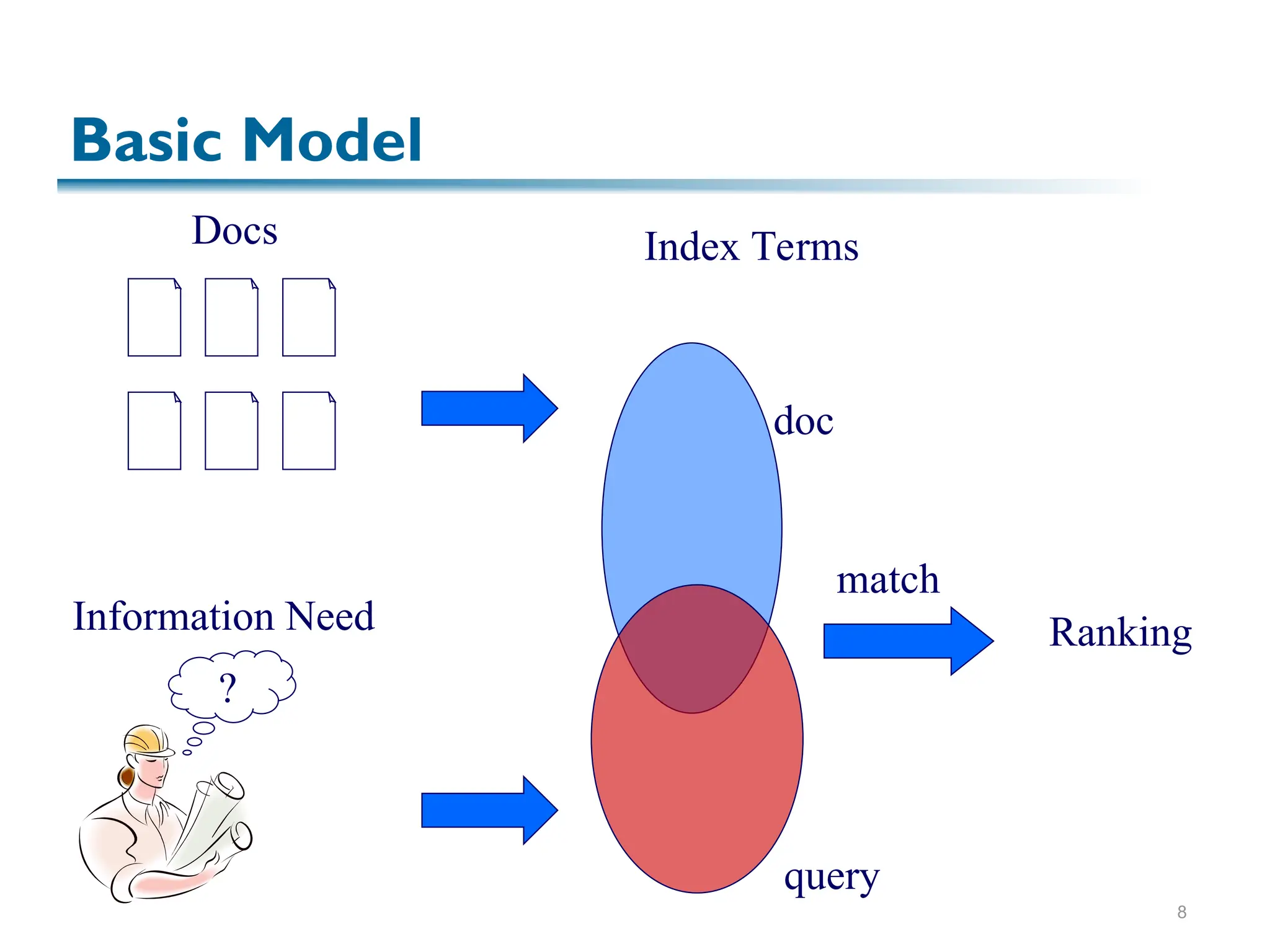
Docs
?
Information Need
Index Terms
doc
query
Ranking
match
Basic Model
9
Information Retrieval as a Field
 IR addressed many issues in the last 20 years:
 Classification and categorization of documents
 Systems and languages for searching
 User interfaces and visualization of results
 Area was seen as of narrow interest – libraries, mainly
 Sea-change event – the advent of the web:
 Universal “library”
 Free (low cost) universal access
 No central editorial board
 Many problems in finding information:
IR seen as key to finding the solutions!
10
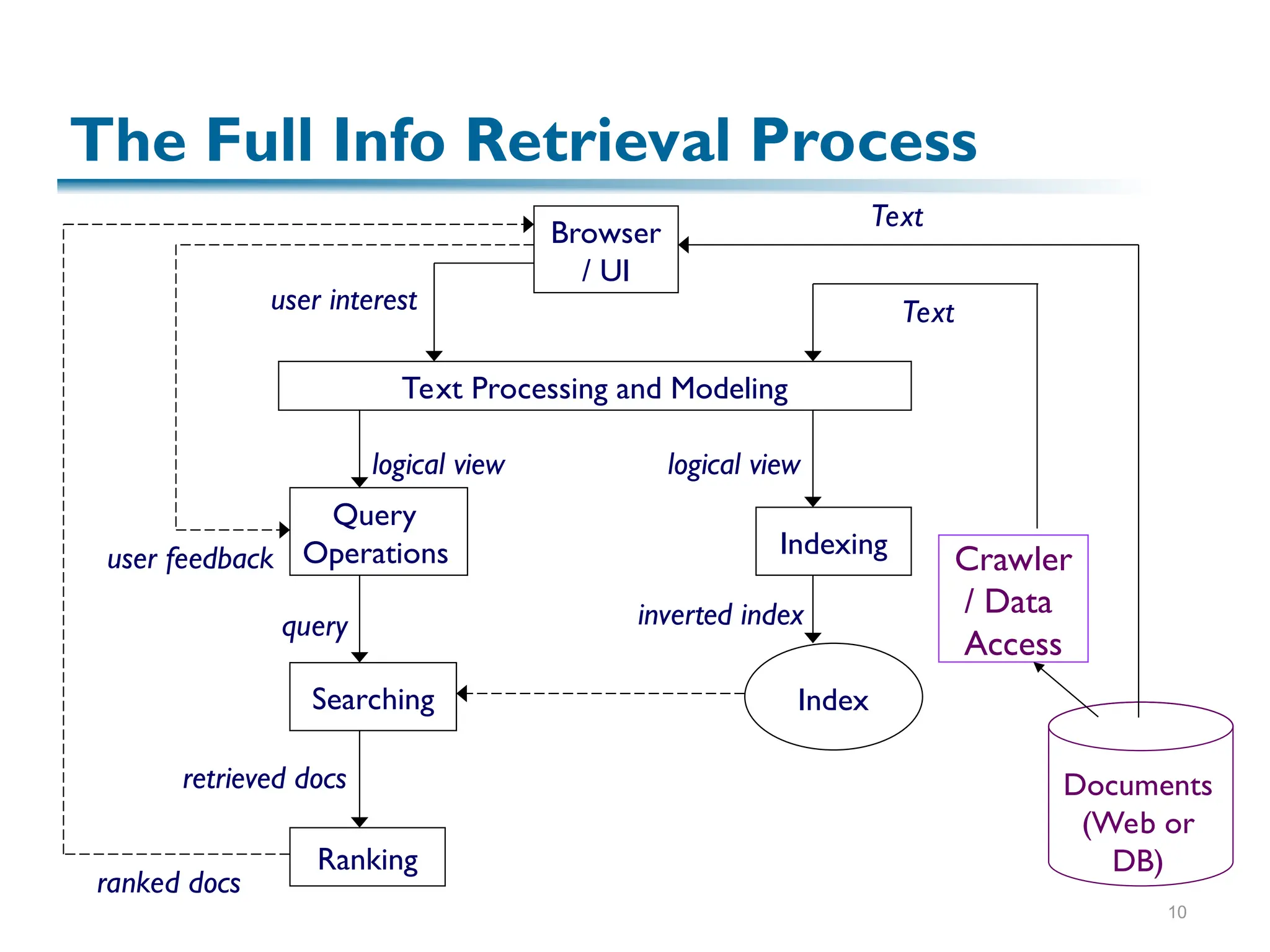
Browser
/ UI
Text Processing and Modeling
Query
Operations Indexing
Searching
Ranking
Index
Text
query
user interest
user feedback
ranked docs
retrieved docs
logical view
logical view
inverted index
Documents
(Web or
DB)
Text
The Full Info Retrieval Process
Crawler
/ Data
Access
11
Terminology
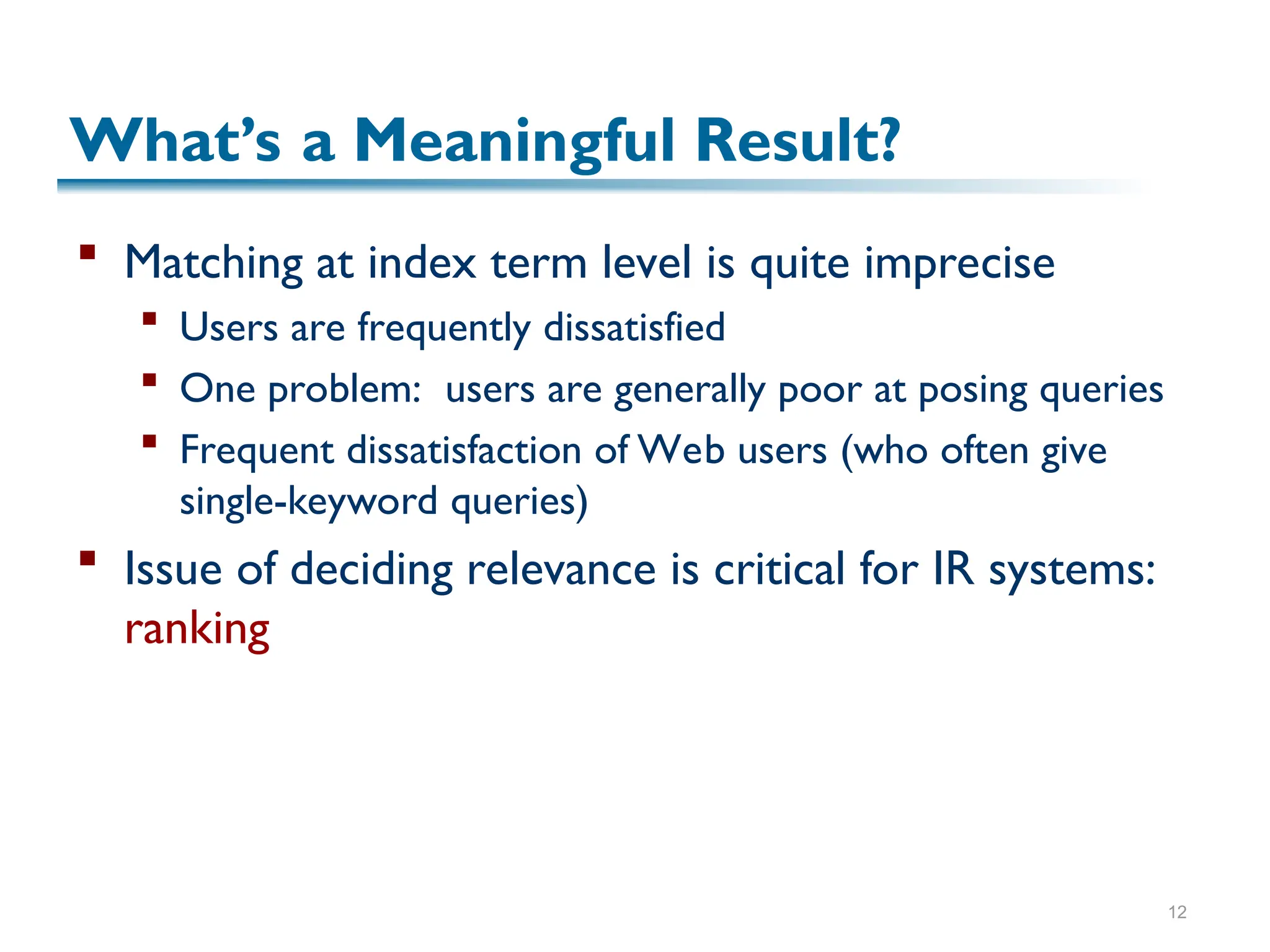
 IR systems usually adopt index terms to process
queries
 Index term:
 a keyword or group of selected words
 any word (more general)
 Stemming might be used:
 connect: connecting, connection, connections
 An inverted index is built for the chosen index
terms
12
What’s a Meaningful Result?
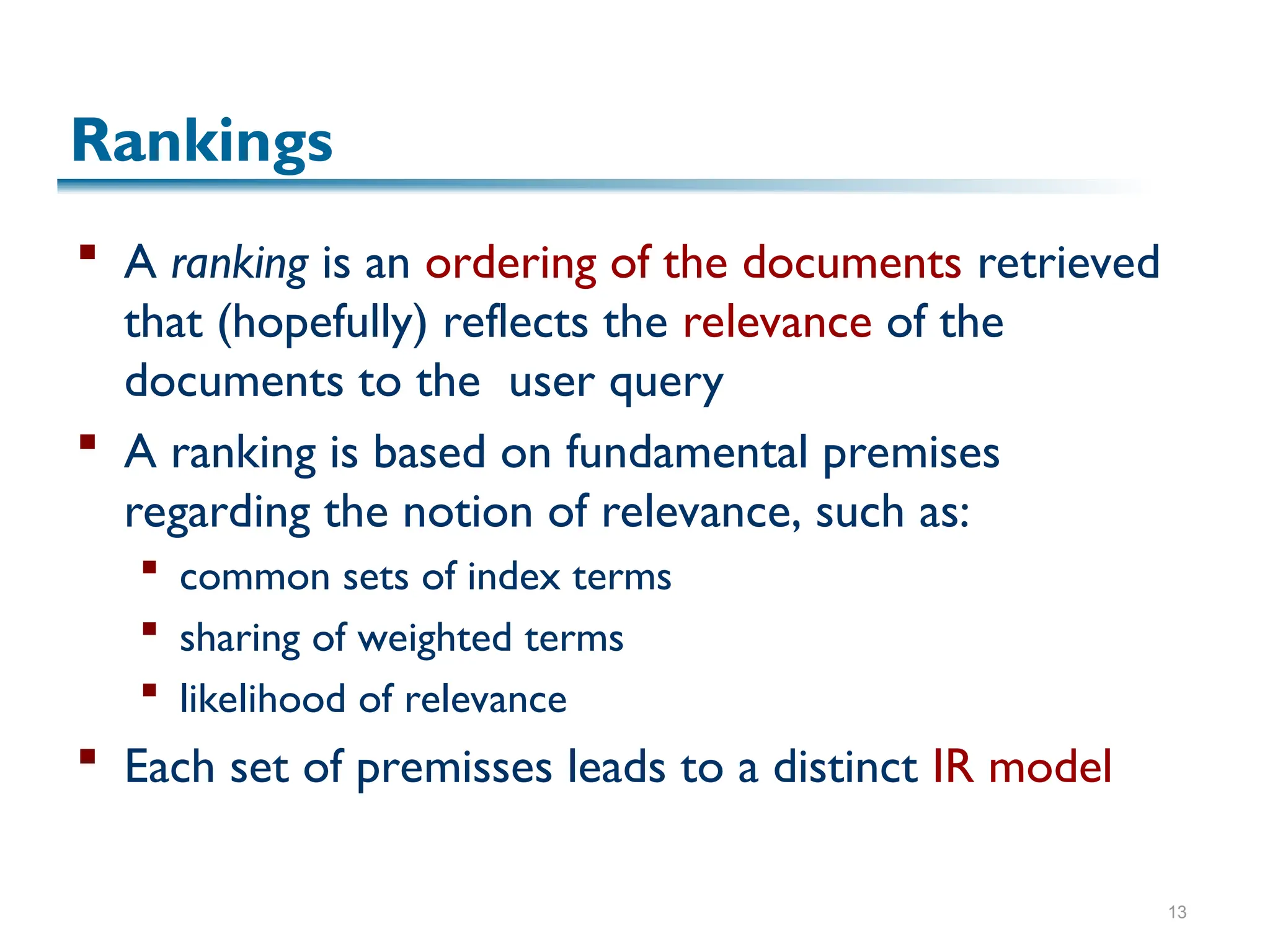
 Matching at index term level is quite imprecise
 Users are frequently dissatisfied
 One problem: users are generally poor at posing queries
 Frequent dissatisfaction of Web users (who often give
single-keyword queries)
 Issue of deciding relevance is critical for IR systems:
ranking
13
Rankings
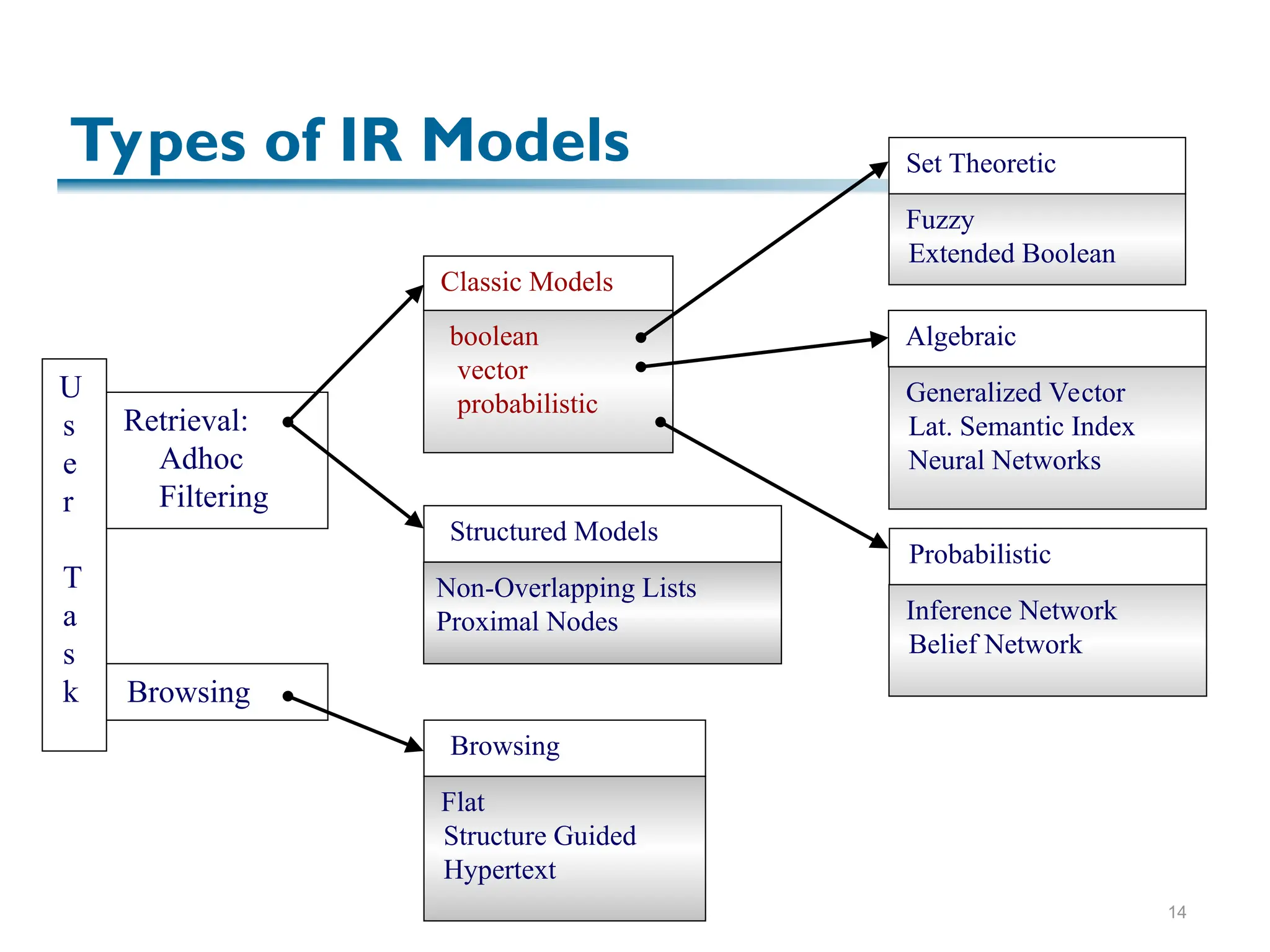
 A ranking is an ordering of the documents retrieved
that (hopefully) reflects the relevance of the
documents to the user query
 A ranking is based on fundamental premises
regarding the notion of relevance, such as:
 common sets of index terms
 sharing of weighted terms
 likelihood of relevance
 Each set of premisses leads to a distinct IR model
14
Non-Overlapping Lists
Proximal Nodes
Structured Models
Retrieval:
Adhoc
Filtering
Browsing
U
s
e
r
T
a
s
k
Classic Models
boolean
vector
probabilistic
Set Theoretic
Fuzzy
Extended Boolean
Probabilistic
Inference Network
Belief Network
Algebraic
Generalized Vector
Lat. Semantic Index
Neural Networks
Browsing
Flat
Structure Guided
Hypertext
Types of IR Models
15
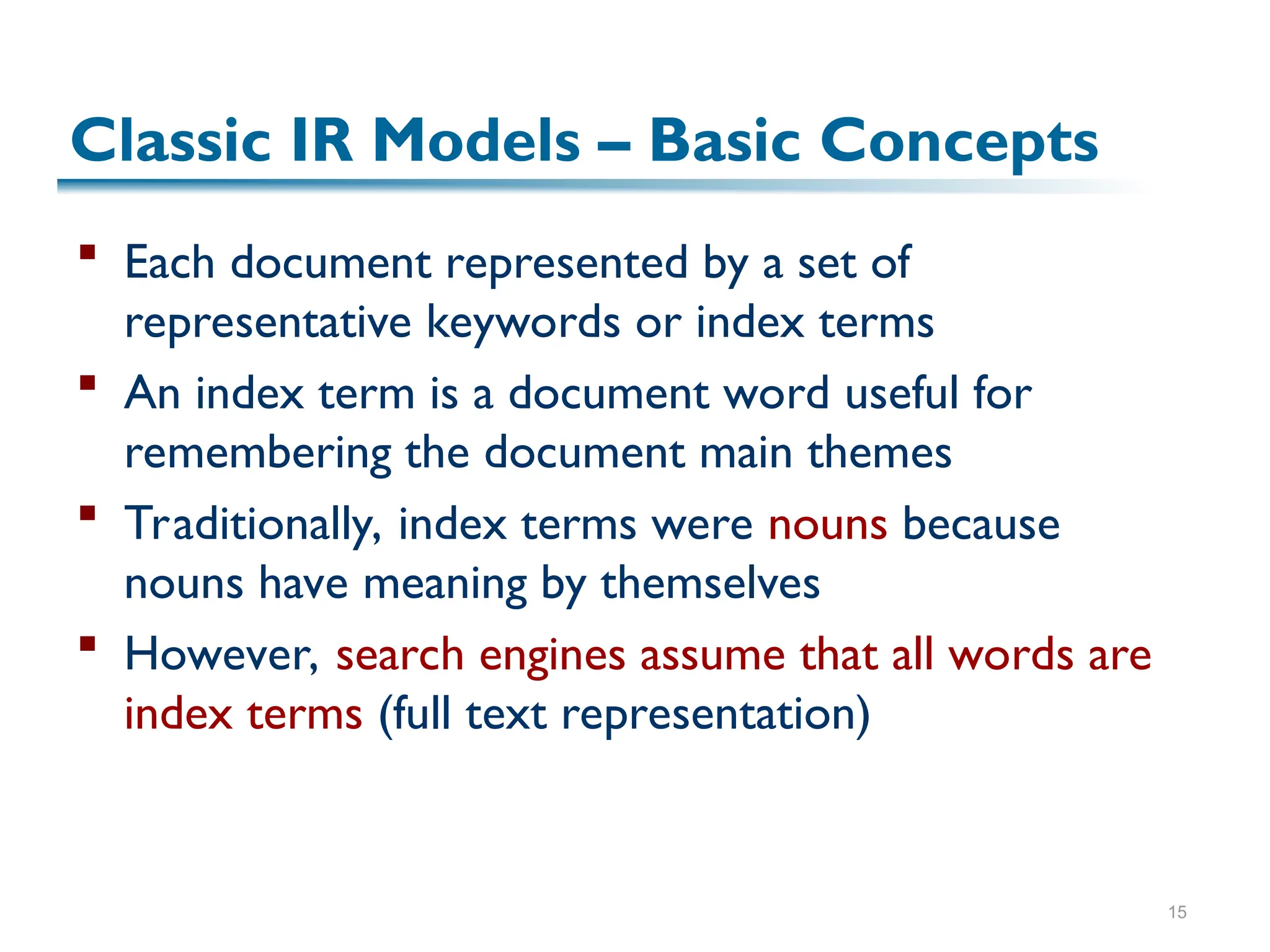
Classic IR Models – Basic Concepts
 Each document represented by a set of
representative keywords or index terms
 An index term is a document word useful for
remembering the document main themes
 Traditionally, index terms were nouns because
nouns have meaning by themselves
 However, search engines assume that all words are
index terms (full text representation)
16
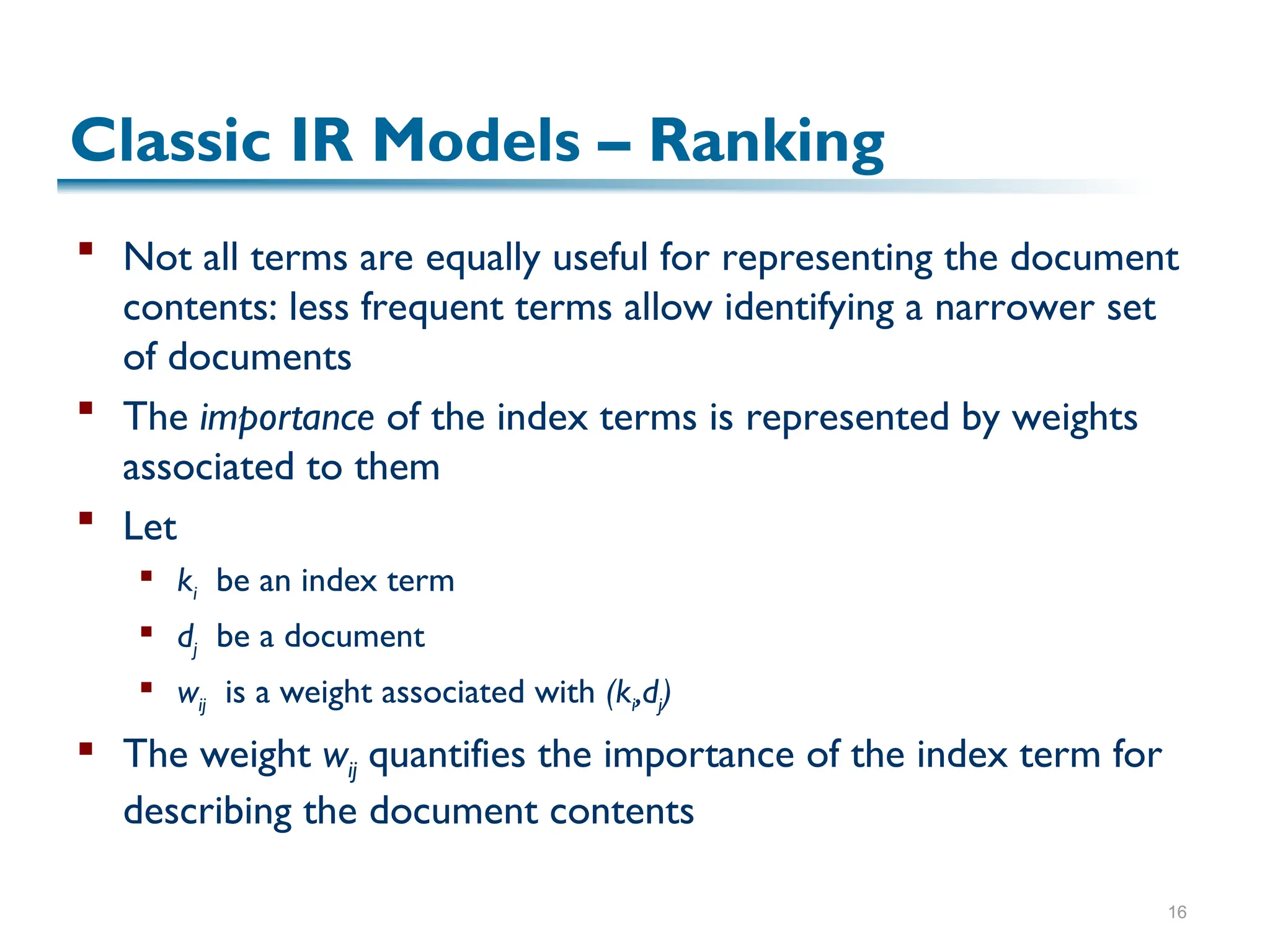
Classic IR Models – Ranking
 Not all terms are equally useful for representing the document
contents: less frequent terms allow identifying a narrower set
of documents
 The importance of the index terms is represented by weights
associated to them
 Let
 ki be an index term
 dj be a document
 wij is a weight associated with (ki,dj)
 The weight wij quantifies the importance of the index term for
describing the document contents
17
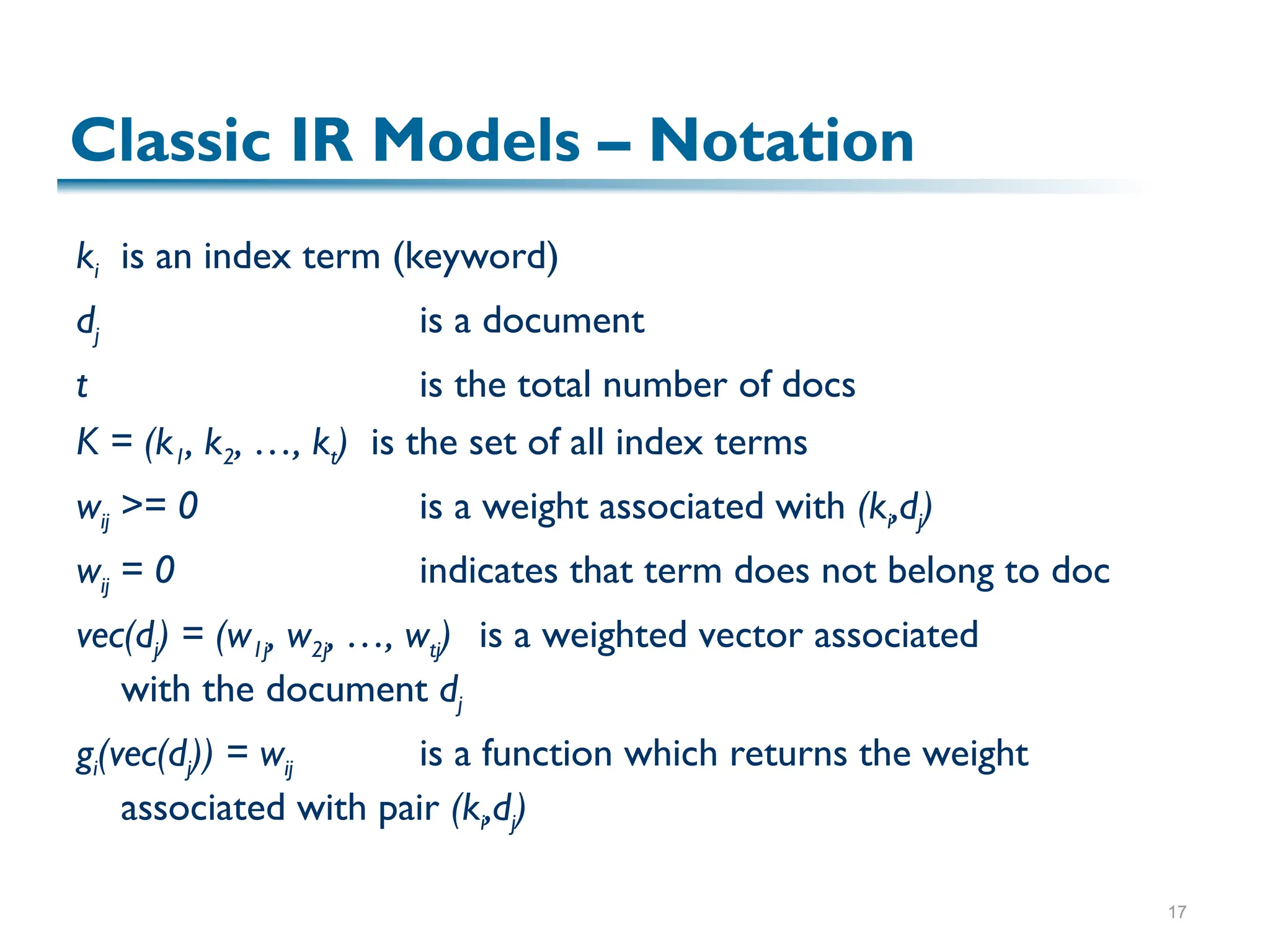
Classic IR Models – Notation
ki is an index term (keyword)
dj is a document
t is the total number of docs
K = (k1, k2, …, kt) is the set of all index terms
wij >= 0 is a weight associated with (ki,dj)
wij = 0 indicates that term does not belong to doc
vec(dj) = (w1j, w2j, …, wtj) is a weighted vector associated
with the document dj
gi(vec(dj)) = wij is a function which returns the weight
associated with pair (ki,dj)
18
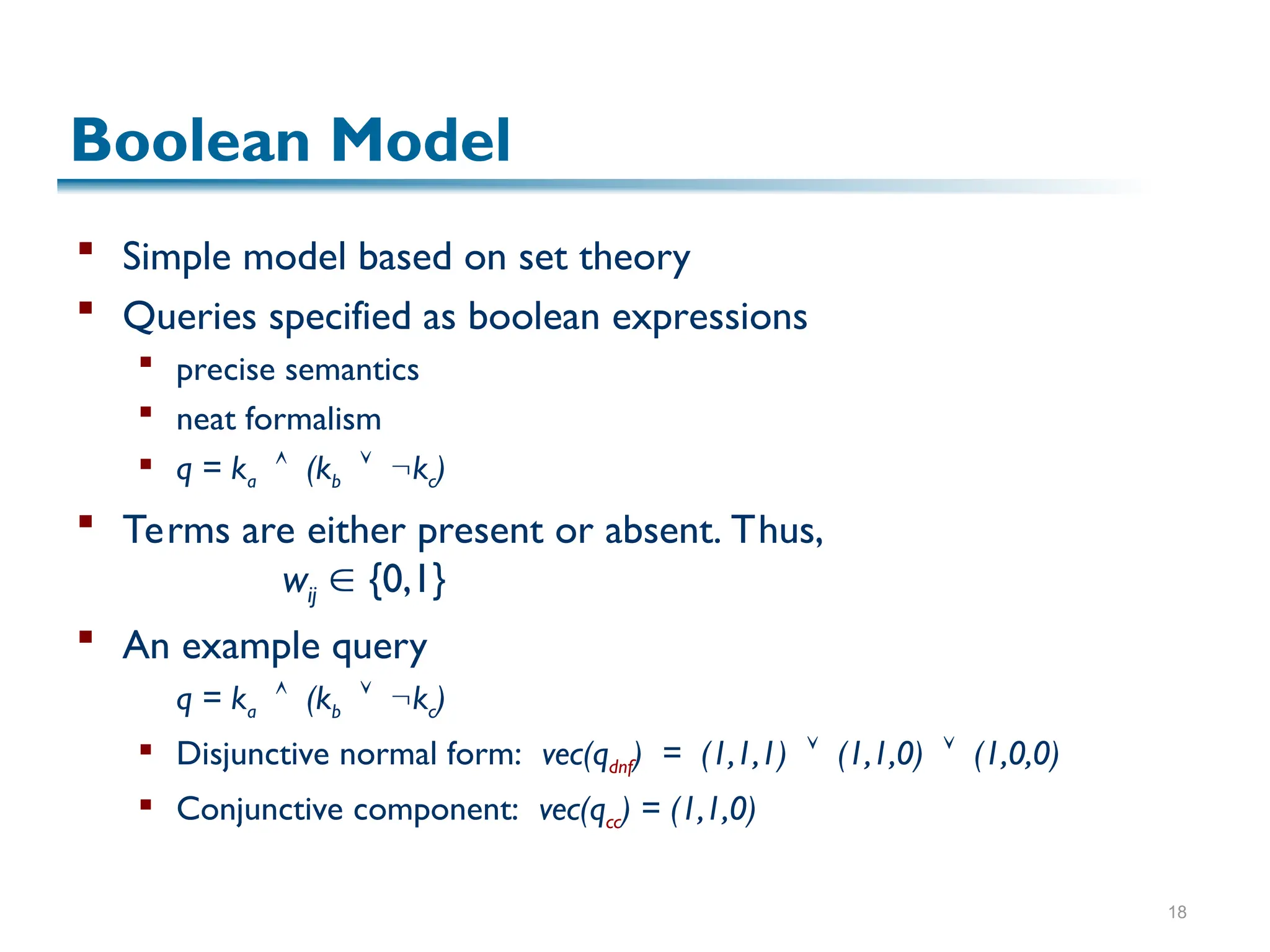
Boolean Model
 Simple model based on set theory
 Queries specified as boolean expressions
 precise semantics
 neat formalism
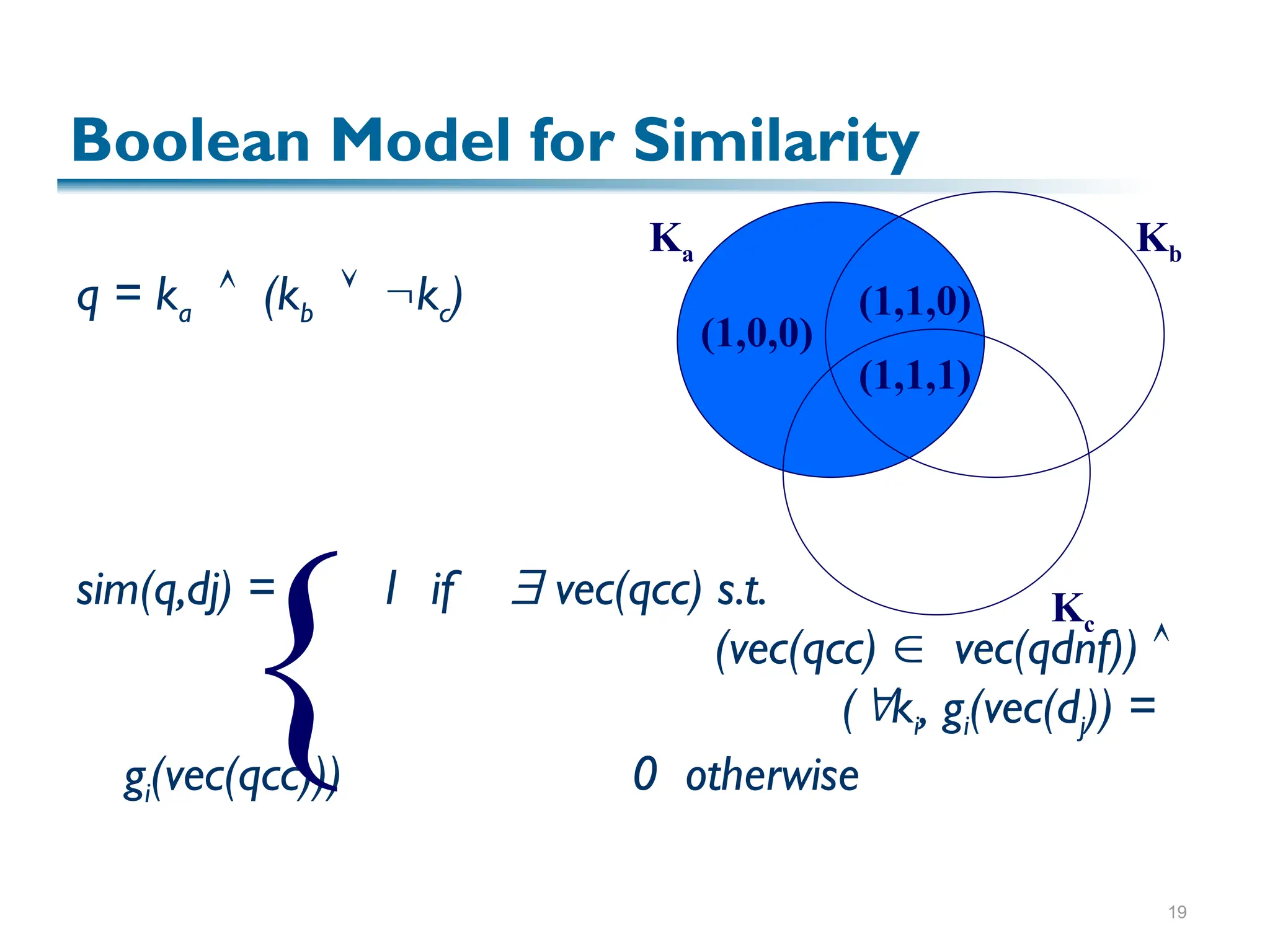
 q = ka  (kb  kc)
 Terms are either present or absent. Thus,
wij  {0,1}
 An example query
q = ka  (kb  kc)
 Disjunctive normal form: vec(qdnf) = (1,1,1)  (1,1,0)  (1,0,0)
 Conjunctive component: vec(qcc) = (1,1,0)
19
q = ka  (kb  kc)
sim(q,dj) = 1 if  vec(qcc) s.t.
(vec(qcc)  vec(qdnf)) 
(ki, gi(vec(dj)) =
gi(vec(qcc))) 0 otherwise
(1,1,1)
(1,0,0)
(1,1,0)
Ka Kb
Kc
Boolean Model for Similarity
{
20
Drawbacks of Boolean Model
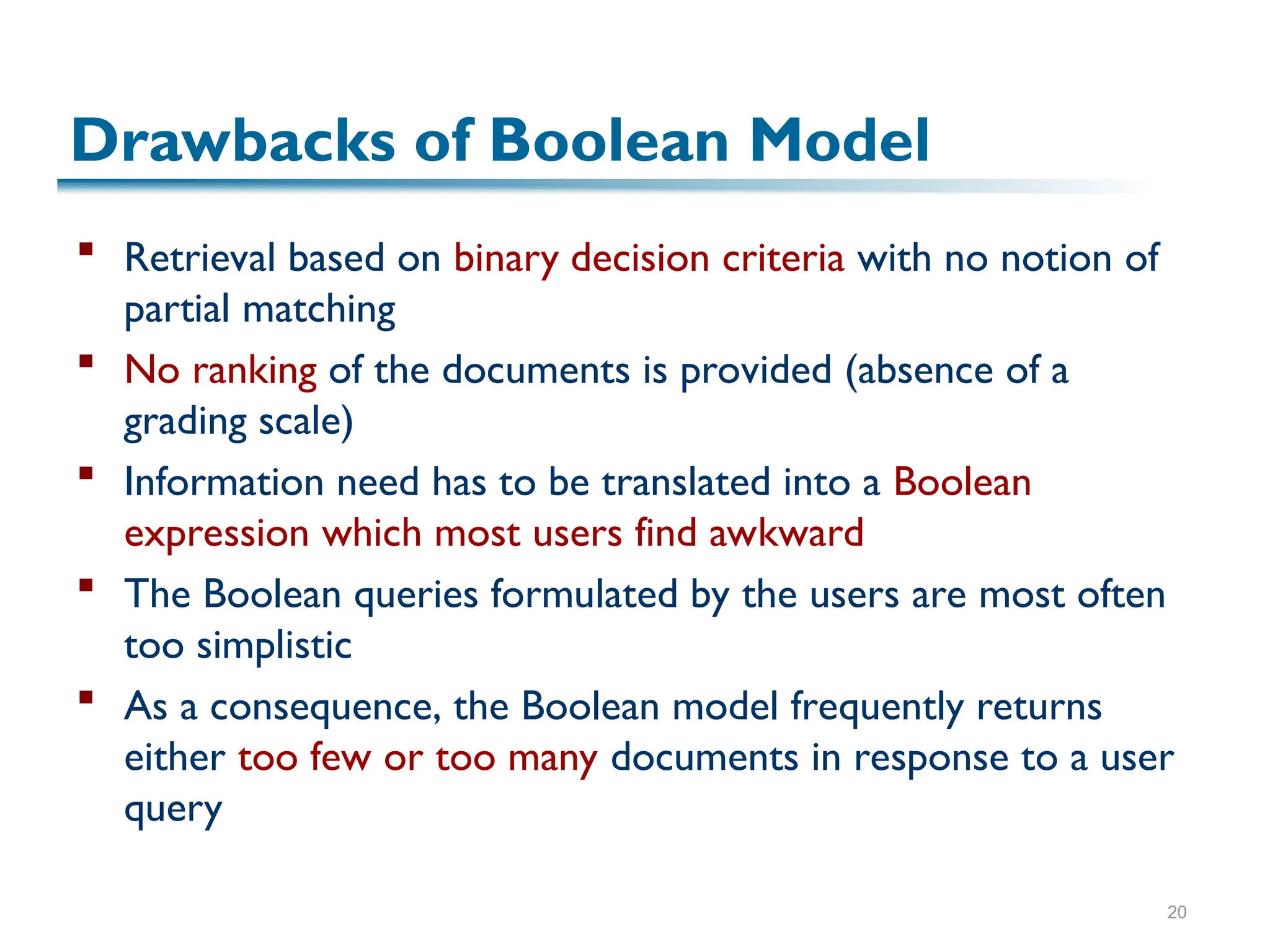
 Retrieval based on binary decision criteria with no notion of
partial matching
 No ranking of the documents is provided (absence of a
grading scale)
 Information need has to be translated into a Boolean
expression which most users find awkward
 The Boolean queries formulated by the users are most often
too simplistic
 As a consequence, the Boolean model frequently returns
either too few or too many documents in response to a user
query
21
Vector Model
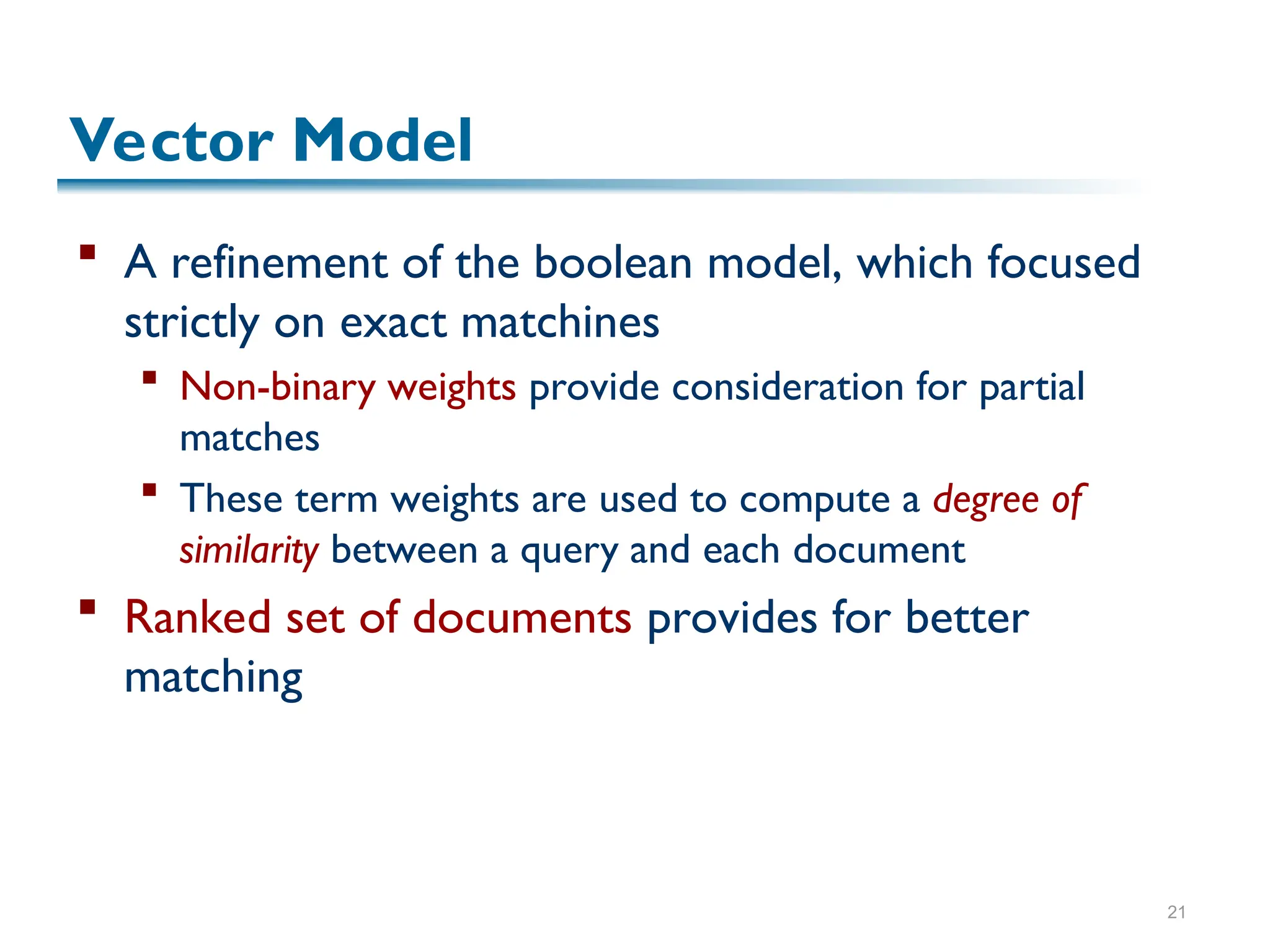
 A refinement of the boolean model, which focused
strictly on exact matchines
 Non-binary weights provide consideration for partial
matches
 These term weights are used to compute a degree of
similarity between a query and each document
 Ranked set of documents provides for better
matching
22
Vector Model
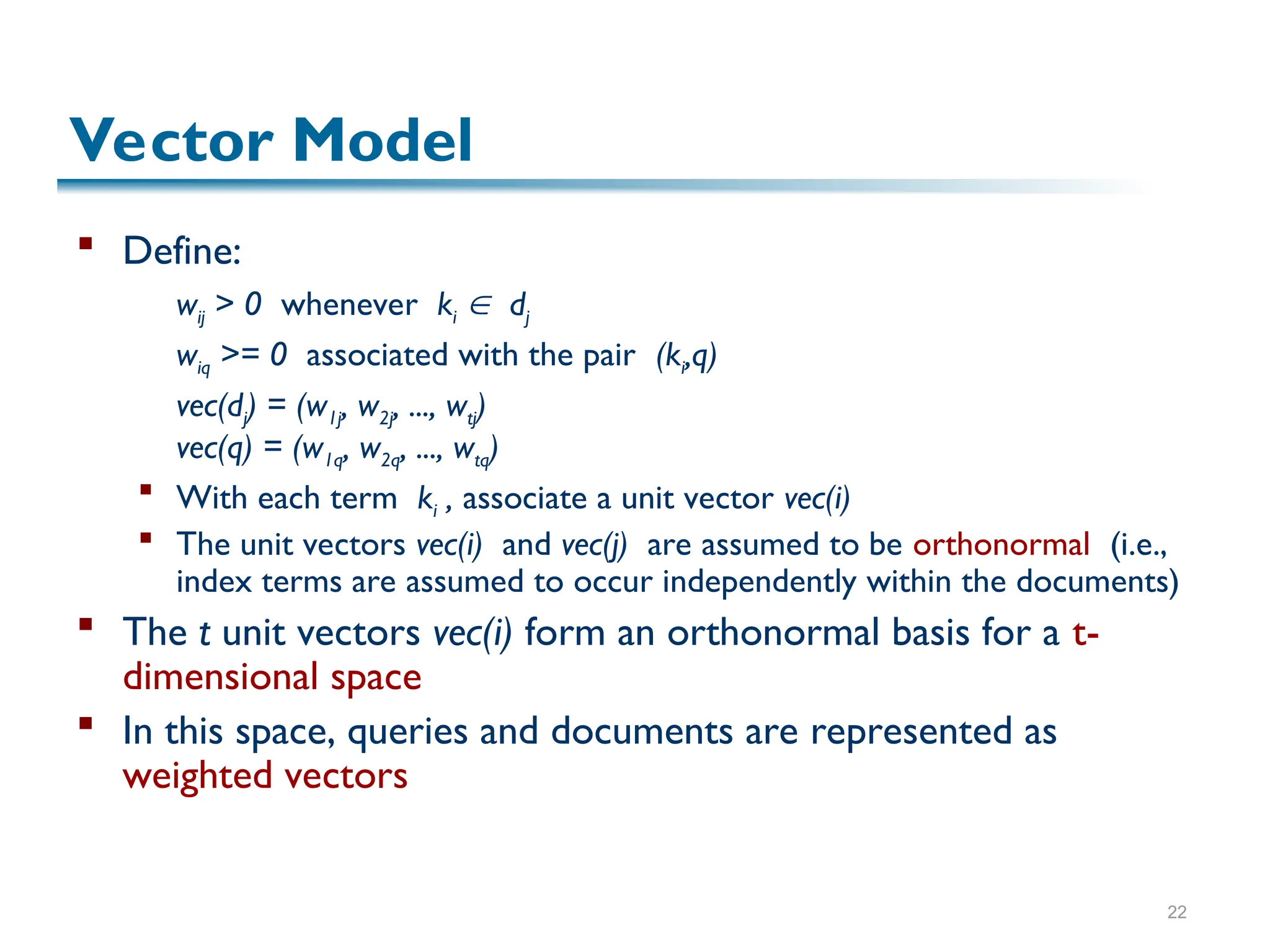
 Define:
wij > 0 whenever ki  dj
wiq >= 0 associated with the pair (ki,q)
vec(dj) = (w1j, w2j, ..., wtj)
vec(q) = (w1q, w2q, ..., wtq)
 With each term ki , associate a unit vector vec(i)
 The unit vectors vec(i) and vec(j) are assumed to be orthonormal (i.e.,
index terms are assumed to occur independently within the documents)
 The t unit vectors vec(i) form an orthonormal basis for a t-
dimensional space
 In this space, queries and documents are represented as
weighted vectors
23
Sim(q,dj) = cos()
= [vec(dj)  vec(q)] / |dj| * |q|
= [ wij * wiq] / |dj| * |q|
 Since wij > 0 and wiq > 0,
0 ≤ sim(q,dj) ≤ 1
 A document is retrieved even if it matches
the query terms only partially
i
j
dj
q

Vector Model
24
Weights in the Vector Model
Sim(q,dj) = [ wij * wiq] / |dj| * |q|
 How do we compute the weights wij and wiq?
 A good weight must take into account two effects:
 quantification of intra-document contents (similarity)
 tf factor, the term frequency within a document
 quantification of inter-documents separation
(dissimilarity)
 idf factor, the inverse document frequency
wij = tf(i,j) * idf(i)
25
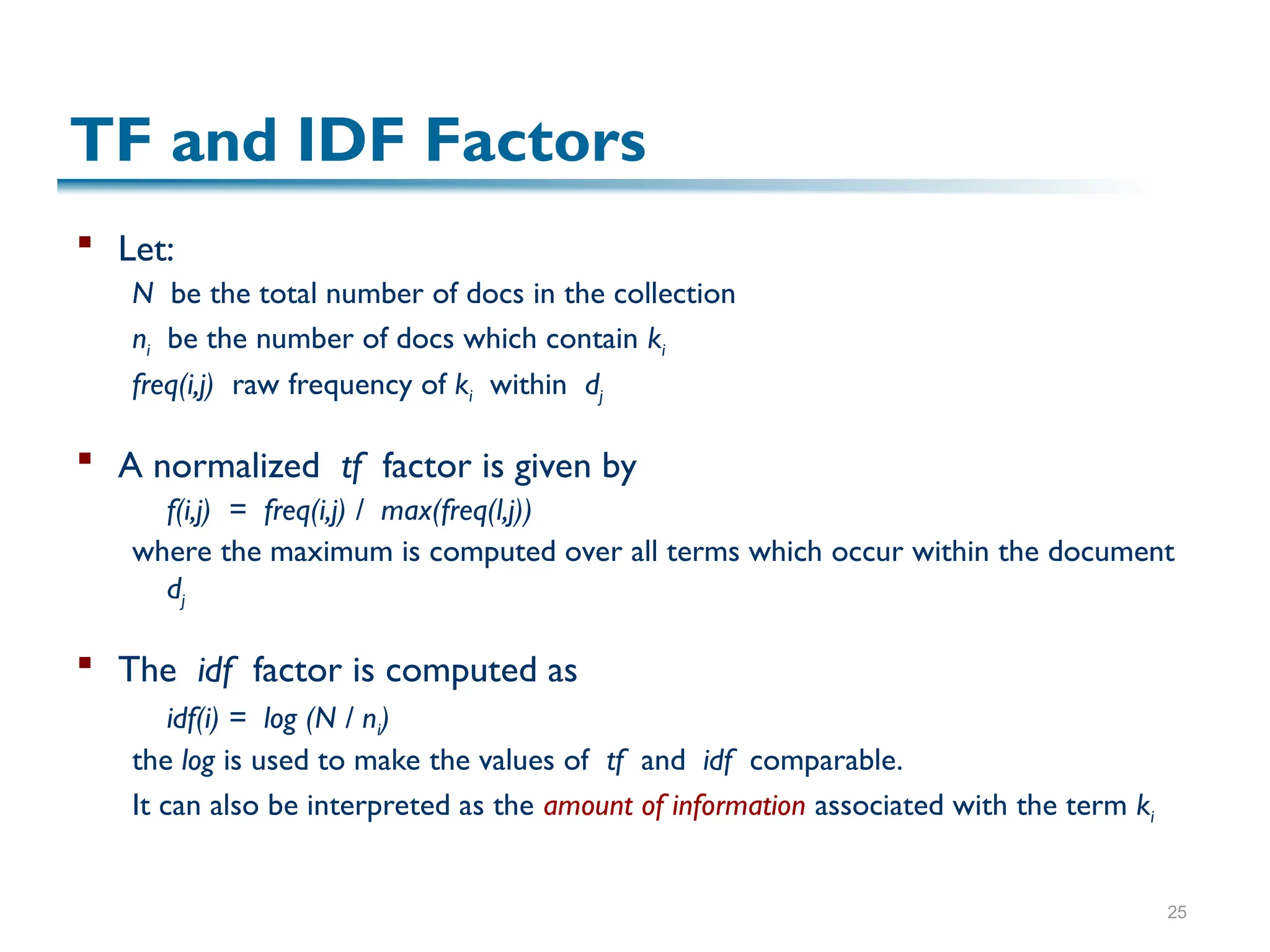
TF and IDF Factors
 Let:
N be the total number of docs in the collection
ni be the number of docs which contain ki
freq(i,j) raw frequency of ki within dj
 A normalized tf factor is given by
f(i,j) = freq(i,j) / max(freq(l,j))
where the maximum is computed over all terms which occur within the document
dj
 The idf factor is computed as
idf(i) = log (N / ni)
the log is used to make the values of tf and idf comparable.
It can also be interpreted as the amount of information associated with the term ki
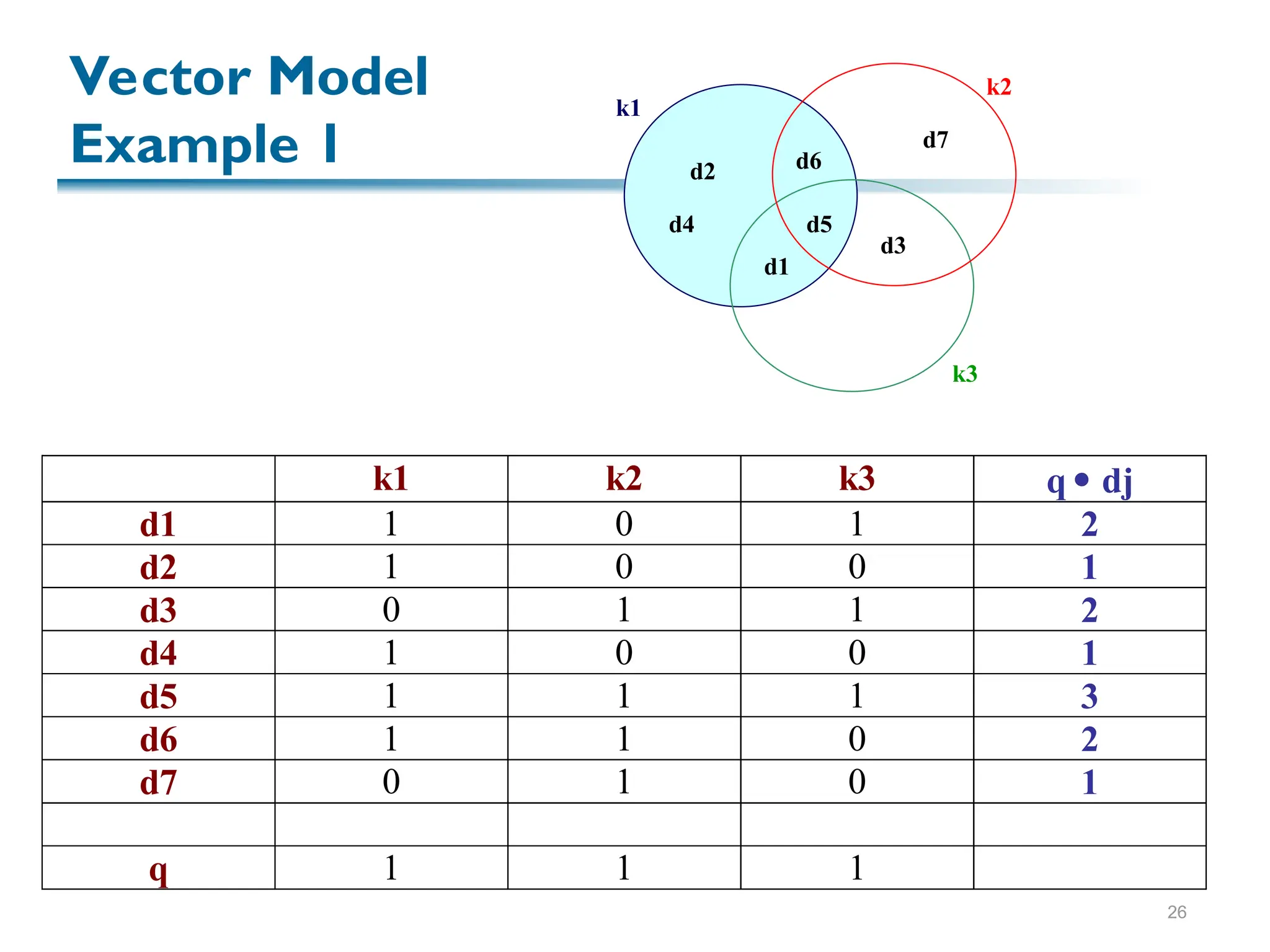
26
k1 k2 k3 q  dj
d1 1 0 1 2
d2 1 0 0 1
d3 0 1 1 2
d4 1 0 0 1
d5 1 1 1 3
d6 1 1 0 2
d7 0 1 0 1
q 1 1 1
d1
d2
d3
d4 d5
d6
d7
k1
k2
k3
Vector Model
Example 1
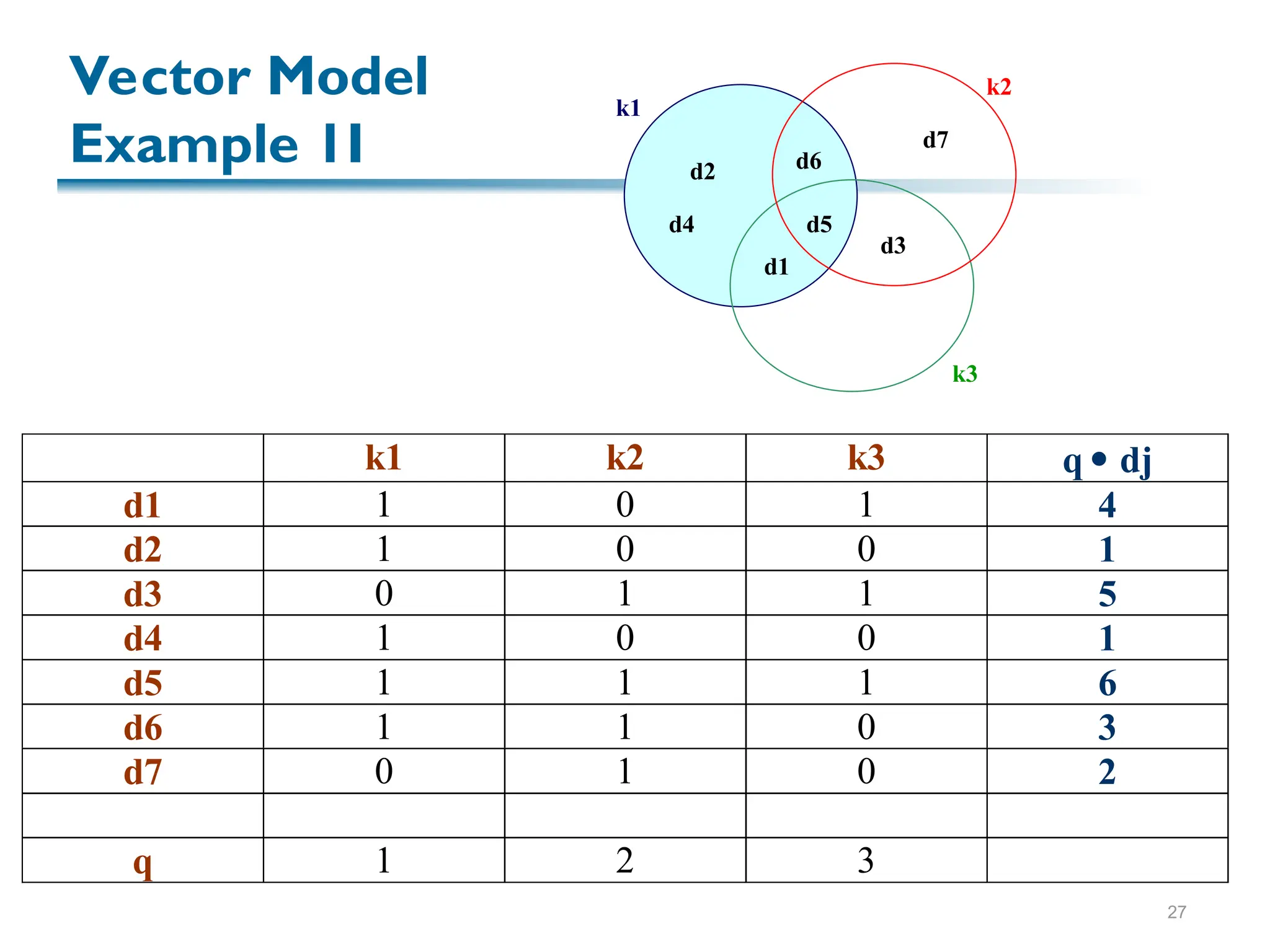
27
d1
d2
d3
d4 d5
d6
d7
k1
k2
k3
k1 k2 k3 q  dj
d1 1 0 1 4
d2 1 0 0 1
d3 0 1 1 5
d4 1 0 0 1
d5 1 1 1 6
d6 1 1 0 3
d7 0 1 0 2
q 1 2 3
Vector Model
Example 1I
28
d1
d2
d3
d4 d5
d6
d7
k1
k2
k3
k1 k2 k3 q  dj
d1 2 0 1 5
d2 1 0 0 1
d3 0 1 3 11
d4 2 0 0 2
d5 1 2 4 17
d6 1 2 0 5
d7 0 5 0 10
q 1 2 3
Vector Model
Example III
29
Vector Model, Summarized
 The best term-weighting schemes tf-idf weights:
wij = f(i,j) * log(N/ni)
 For the query term weights, a suggestion is
wiq = (0.5 + [0.5 * freq(i,q) / max(freq(l,q)]) * log(N / ni)
 This model is very good in practice:
 tf-idf works well with general collections
 Simple and fast to compute
 Vector model is usually as good as the known ranking
alternatives
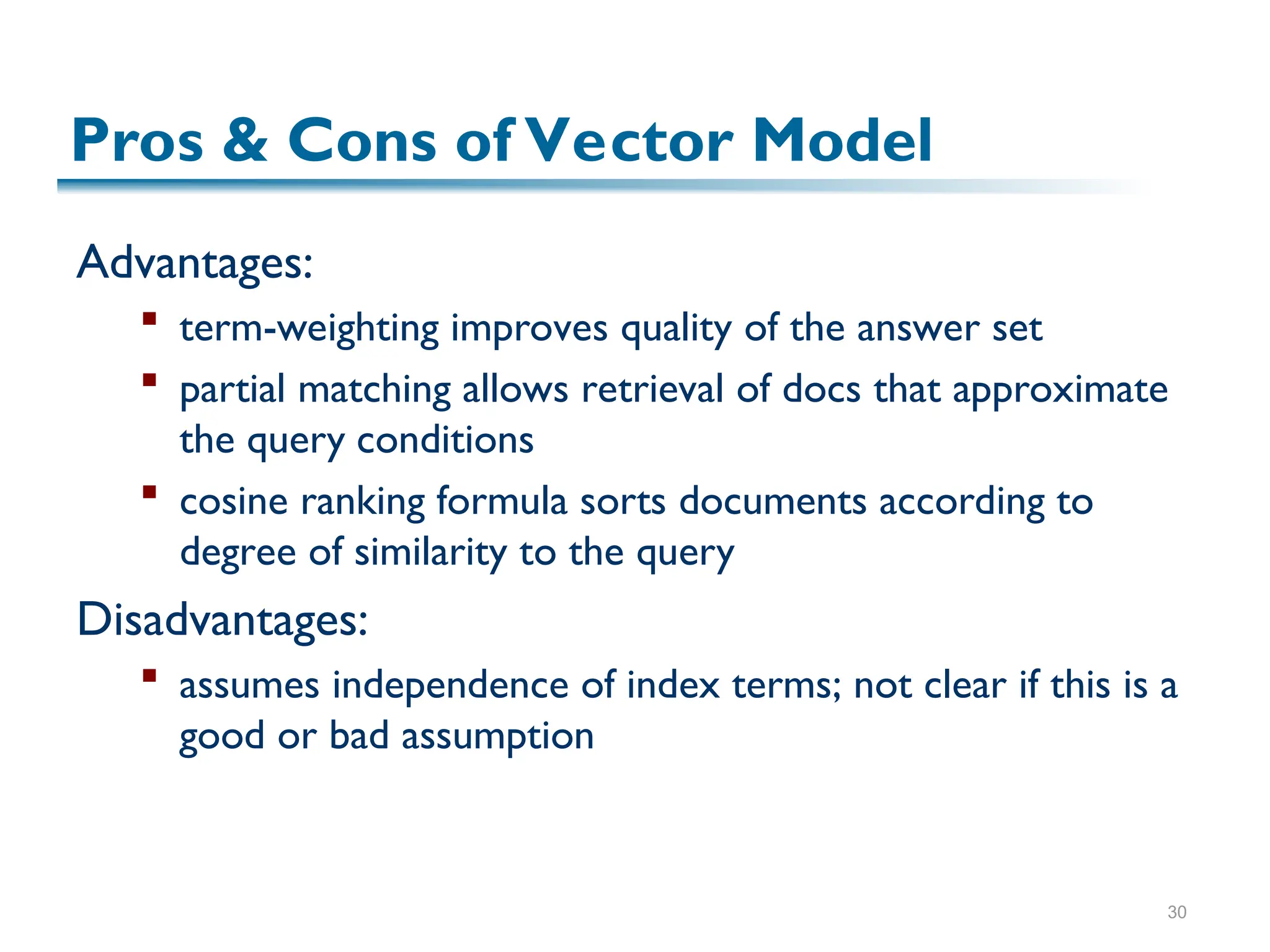
30
Advantages:
 term-weighting improves quality of the answer set
 partial matching allows retrieval of docs that approximate
the query conditions
 cosine ranking formula sorts documents according to
degree of similarity to the query
Disadvantages:
 assumes independence of index terms; not clear if this is a
good or bad assumption
Pros & Cons of Vector Model
31
Comparison of Classic Models
 Boolean model does not provide for partial
matches and is considered to be the weakest classic
model
 Some experiments indicate that the vector model
outperforms the third alternative, the probabilistic
model, in general
 Recent IR research has focused on improving probabilistic
models – but these haven’t made their way to Web search
 Generally we use a variation of the vector model in
most text search systems
Next Time: The Web
 … And in particular, PageRank!
32

Information Retrieval and Storage Systems

  • 1.
    Information Retrieval: Foundation toWeb Search Zachary G. Ives University of Pennsylvania CIS 455 / 555 – Internet andWeb Systems October 12, 2024 Some slides by Berthier Ribeiro-Neto
  • 2.
    2 Reminders & Announcements Midterm on 3/31, 80 minutes, closed-book  Past midterms will be available on the web site
  • 3.
    3 Web Search  Goalis to find information relevant to a user’s interests  Challenge 1: A significant amount of content on the web is not quality information  Many pages contain nonsensical rants, etc.  The web is full of misspellings, multiple languages, etc.  Many pages are designed not to convey information – but to get a high ranking (e.g., “search engine optimization”)  Challenge 2: billions of documents  Challenge 3: hyperlinks encode information
  • 4.
    4 Our Discussion ofWeb Search  Begin with traditional information retrieval  Document models  Stemming and stop words  Web-specific issues  Crawlers and robots.txt  Scalability  Models for exploiting hyperlinks in ranking  Google and PageRank  Latent Semantic Indexing
  • 5.
    5 Information Retrieval  Traditionalinformation retrieval is basically text search  A corpus or body of text documents, e.g., in a document collection in a library or on a CD  Documents are generally high-quality and designed to convey information  Documents are assumed to have no structure beyond words  Searches are generally based on meaningful phrases, perhaps including predicates over categories, dates, etc.  The goal is to find the document(s) that best match the search phrase, according to a search model  Assumptions are typically different from Web: quality text, limited- size corpus, no hyperlinks
  • 6.
    6 Motivation for InformationRetrieval  Information Retrieval (IR) is about:  Representation  Storage  Organization of  And access to “information items”  Focus is on user’s “information need” rather than a precise query:  “March Madness” – Find information on college basketball teams which: (1) are maintained by a US university and (2) participate in the NCAA tournament  Emphasis is on the retrieval of information (not data)
  • 7.
    7 Data vs. InformationRetrieval  Data retrieval, analogous to database querying: which docs contain a set of keywords?  Well-defined, precise logical semantics  A single erroneous object implies failure!  Information retrieval:  Information about a subject or topic  Semantics is frequently loose; we want approximate matches  Small errors are tolerated (and in fact inevitable)  IR system:  Interpret contents of information items  Generate a ranking which reflects relevance  Notion of relevance is most important – needs a model
  • 8.
  • 9.
    9 Information Retrieval asa Field  IR addressed many issues in the last 20 years:  Classification and categorization of documents  Systems and languages for searching  User interfaces and visualization of results  Area was seen as of narrow interest – libraries, mainly  Sea-change event – the advent of the web:  Universal “library”  Free (low cost) universal access  No central editorial board  Many problems in finding information: IR seen as key to finding the solutions!
  • 10.
    10 Browser / UI Text Processingand Modeling Query Operations Indexing Searching Ranking Index Text query user interest user feedback ranked docs retrieved docs logical view logical view inverted index Documents (Web or DB) Text The Full Info Retrieval Process Crawler / Data Access
  • 11.
    11 Terminology  IR systemsusually adopt index terms to process queries  Index term:  a keyword or group of selected words  any word (more general)  Stemming might be used:  connect: connecting, connection, connections  An inverted index is built for the chosen index terms
  • 12.
    12 What’s a MeaningfulResult?  Matching at index term level is quite imprecise  Users are frequently dissatisfied  One problem: users are generally poor at posing queries  Frequent dissatisfaction of Web users (who often give single-keyword queries)  Issue of deciding relevance is critical for IR systems: ranking
  • 13.
    13 Rankings  A rankingis an ordering of the documents retrieved that (hopefully) reflects the relevance of the documents to the user query  A ranking is based on fundamental premises regarding the notion of relevance, such as:  common sets of index terms  sharing of weighted terms  likelihood of relevance  Each set of premisses leads to a distinct IR model
  • 14.
    14 Non-Overlapping Lists Proximal Nodes StructuredModels Retrieval: Adhoc Filtering Browsing U s e r T a s k Classic Models boolean vector probabilistic Set Theoretic Fuzzy Extended Boolean Probabilistic Inference Network Belief Network Algebraic Generalized Vector Lat. Semantic Index Neural Networks Browsing Flat Structure Guided Hypertext Types of IR Models
  • 15.
    15 Classic IR Models– Basic Concepts  Each document represented by a set of representative keywords or index terms  An index term is a document word useful for remembering the document main themes  Traditionally, index terms were nouns because nouns have meaning by themselves  However, search engines assume that all words are index terms (full text representation)
  • 16.
    16 Classic IR Models– Ranking  Not all terms are equally useful for representing the document contents: less frequent terms allow identifying a narrower set of documents  The importance of the index terms is represented by weights associated to them  Let  ki be an index term  dj be a document  wij is a weight associated with (ki,dj)  The weight wij quantifies the importance of the index term for describing the document contents
  • 17.
    17 Classic IR Models– Notation ki is an index term (keyword) dj is a document t is the total number of docs K = (k1, k2, …, kt) is the set of all index terms wij >= 0 is a weight associated with (ki,dj) wij = 0 indicates that term does not belong to doc vec(dj) = (w1j, w2j, …, wtj) is a weighted vector associated with the document dj gi(vec(dj)) = wij is a function which returns the weight associated with pair (ki,dj)
  • 18.
    18 Boolean Model  Simplemodel based on set theory  Queries specified as boolean expressions  precise semantics  neat formalism  q = ka  (kb  kc)  Terms are either present or absent. Thus, wij  {0,1}  An example query q = ka  (kb  kc)  Disjunctive normal form: vec(qdnf) = (1,1,1)  (1,1,0)  (1,0,0)  Conjunctive component: vec(qcc) = (1,1,0)
  • 19.
    19 q = ka (kb  kc) sim(q,dj) = 1 if  vec(qcc) s.t. (vec(qcc)  vec(qdnf))  (ki, gi(vec(dj)) = gi(vec(qcc))) 0 otherwise (1,1,1) (1,0,0) (1,1,0) Ka Kb Kc Boolean Model for Similarity {
  • 20.
    20 Drawbacks of BooleanModel  Retrieval based on binary decision criteria with no notion of partial matching  No ranking of the documents is provided (absence of a grading scale)  Information need has to be translated into a Boolean expression which most users find awkward  The Boolean queries formulated by the users are most often too simplistic  As a consequence, the Boolean model frequently returns either too few or too many documents in response to a user query
  • 21.
    21 Vector Model  Arefinement of the boolean model, which focused strictly on exact matchines  Non-binary weights provide consideration for partial matches  These term weights are used to compute a degree of similarity between a query and each document  Ranked set of documents provides for better matching
  • 22.
    22 Vector Model  Define: wij> 0 whenever ki  dj wiq >= 0 associated with the pair (ki,q) vec(dj) = (w1j, w2j, ..., wtj) vec(q) = (w1q, w2q, ..., wtq)  With each term ki , associate a unit vector vec(i)  The unit vectors vec(i) and vec(j) are assumed to be orthonormal (i.e., index terms are assumed to occur independently within the documents)  The t unit vectors vec(i) form an orthonormal basis for a t- dimensional space  In this space, queries and documents are represented as weighted vectors
  • 23.
    23 Sim(q,dj) = cos() =[vec(dj)  vec(q)] / |dj| * |q| = [ wij * wiq] / |dj| * |q|  Since wij > 0 and wiq > 0, 0 ≤ sim(q,dj) ≤ 1  A document is retrieved even if it matches the query terms only partially i j dj q  Vector Model
  • 24.
    24 Weights in theVector Model Sim(q,dj) = [ wij * wiq] / |dj| * |q|  How do we compute the weights wij and wiq?  A good weight must take into account two effects:  quantification of intra-document contents (similarity)  tf factor, the term frequency within a document  quantification of inter-documents separation (dissimilarity)  idf factor, the inverse document frequency wij = tf(i,j) * idf(i)
  • 25.
    25 TF and IDFFactors  Let: N be the total number of docs in the collection ni be the number of docs which contain ki freq(i,j) raw frequency of ki within dj  A normalized tf factor is given by f(i,j) = freq(i,j) / max(freq(l,j)) where the maximum is computed over all terms which occur within the document dj  The idf factor is computed as idf(i) = log (N / ni) the log is used to make the values of tf and idf comparable. It can also be interpreted as the amount of information associated with the term ki
  • 26.
    26 k1 k2 k3q  dj d1 1 0 1 2 d2 1 0 0 1 d3 0 1 1 2 d4 1 0 0 1 d5 1 1 1 3 d6 1 1 0 2 d7 0 1 0 1 q 1 1 1 d1 d2 d3 d4 d5 d6 d7 k1 k2 k3 Vector Model Example 1
  • 27.
    27 d1 d2 d3 d4 d5 d6 d7 k1 k2 k3 k1 k2k3 q  dj d1 1 0 1 4 d2 1 0 0 1 d3 0 1 1 5 d4 1 0 0 1 d5 1 1 1 6 d6 1 1 0 3 d7 0 1 0 2 q 1 2 3 Vector Model Example 1I
  • 28.
    28 d1 d2 d3 d4 d5 d6 d7 k1 k2 k3 k1 k2k3 q  dj d1 2 0 1 5 d2 1 0 0 1 d3 0 1 3 11 d4 2 0 0 2 d5 1 2 4 17 d6 1 2 0 5 d7 0 5 0 10 q 1 2 3 Vector Model Example III
  • 29.
    29 Vector Model, Summarized The best term-weighting schemes tf-idf weights: wij = f(i,j) * log(N/ni)  For the query term weights, a suggestion is wiq = (0.5 + [0.5 * freq(i,q) / max(freq(l,q)]) * log(N / ni)  This model is very good in practice:  tf-idf works well with general collections  Simple and fast to compute  Vector model is usually as good as the known ranking alternatives
  • 30.
    30 Advantages:  term-weighting improvesquality of the answer set  partial matching allows retrieval of docs that approximate the query conditions  cosine ranking formula sorts documents according to degree of similarity to the query Disadvantages:  assumes independence of index terms; not clear if this is a good or bad assumption Pros & Cons of Vector Model
  • 31.
    31 Comparison of ClassicModels  Boolean model does not provide for partial matches and is considered to be the weakest classic model  Some experiments indicate that the vector model outperforms the third alternative, the probabilistic model, in general  Recent IR research has focused on improving probabilistic models – but these haven’t made their way to Web search  Generally we use a variation of the vector model in most text search systems
  • 32.
    Next Time: TheWeb  … And in particular, PageRank! 32