ASSESSMENT OF INFORMATION LITERACY LEARNING  LIB 601 Libraries and Learning  Fall 2009
What is assessment? Definition Assessment is the process of identifying, gathering and interpreting information about students’ learning. The central purpose of assessment is to provide information on student achievement and progress and set the direction for ongoing teaching and learning. Assessment provides information for those involved in the teaching and learning process to compare what is known and can be demonstrated against standards.
Assessment OF learning What is assessment  OF  learning? Assessment of learning involves working with the range of available evidence that enables staff and the wider assessment community to check on pupils’ progress and using this information in a number of ways.
Assessment AS learning What is assessment  AS  learning? Assessment as learning is about reflecting on evidence of learning. This is part of the cycle of assessment where pupils and staff set learning goals, share learning intentions and success criteria, and evaluate their learning through dialogue and self and peer assessment.
Assessment FOR learning What is assessment  FOR  learning? Assessment for learning focuses on the gap between where learners are in their learning, and where they need to be – the desired goal. This can be achieved through processes such as sharing criteria with learners, effective questioning and feedback.
Why assess learning? To find out if they get what we’ve tried to teach them To find out if we taught them well enough To find ways of improving our teaching
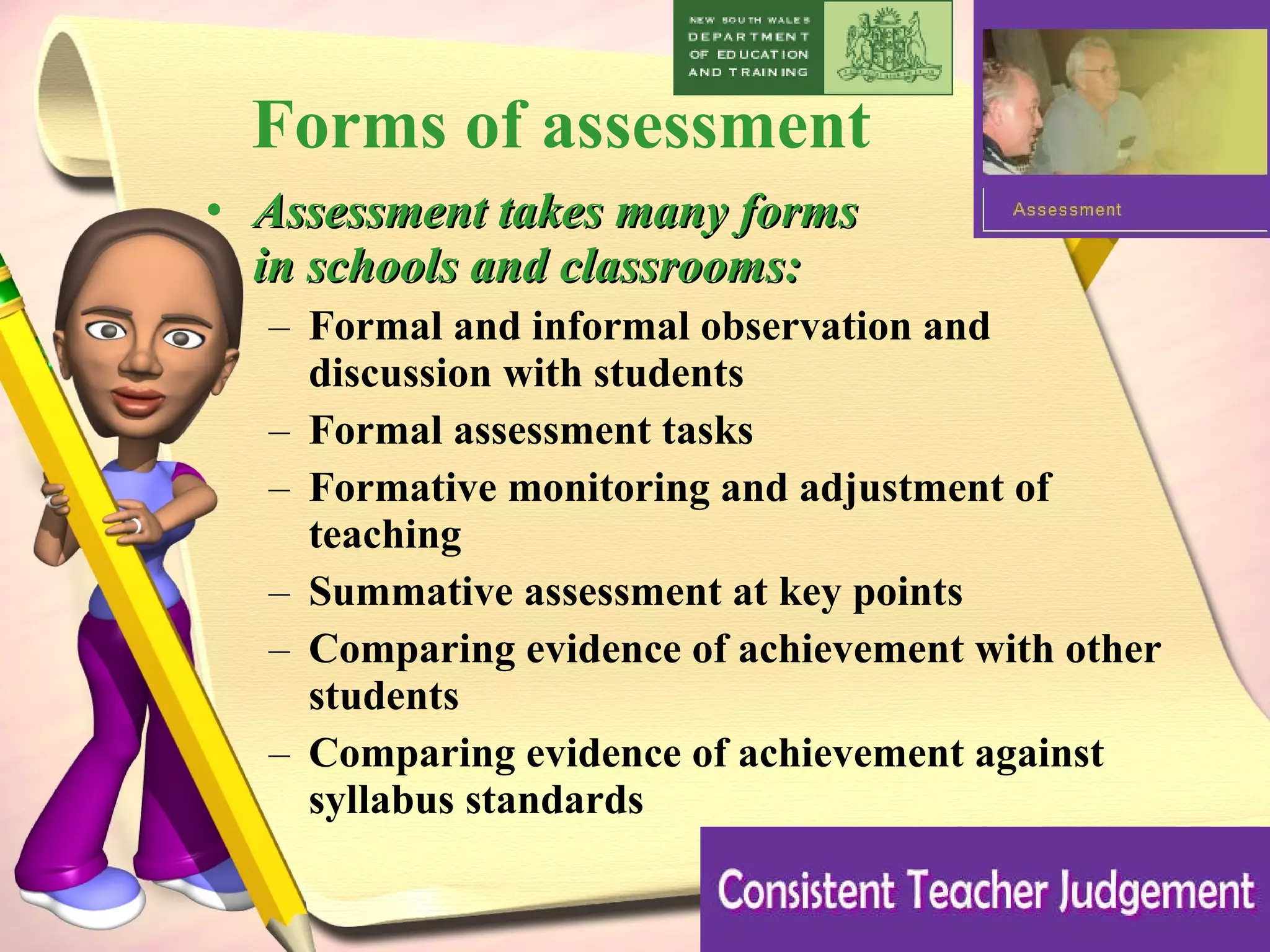
Forms of assessment Assessment takes many forms  in schools and classrooms:  Formal and informal observation and  discussion with students  Formal assessment tasks  Formative monitoring and adjustment of teaching  Summative assessment at key points  Comparing evidence of achievement with other students  Comparing evidence of achievement against syllabus standards
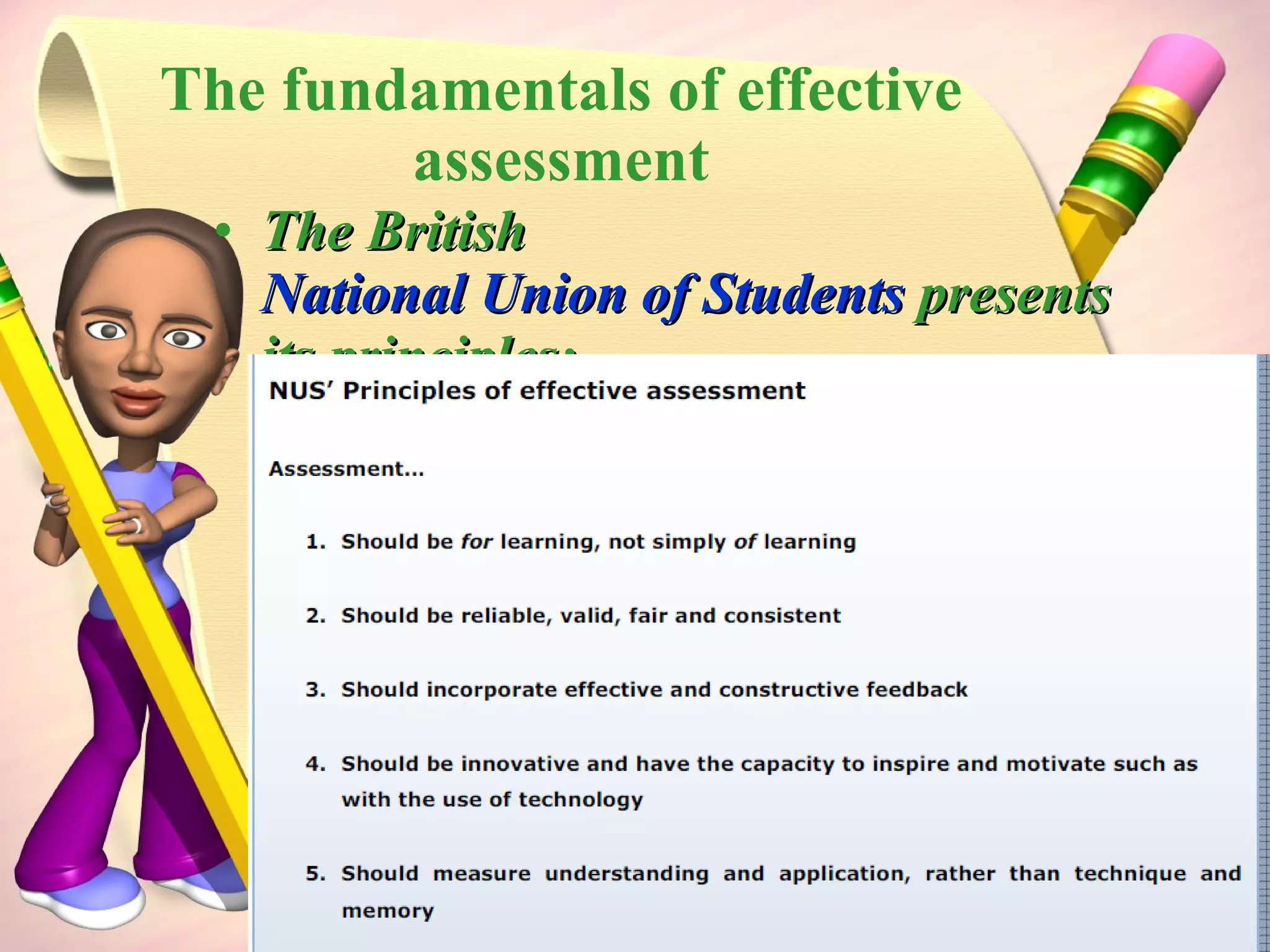
The fundamentals of effective assessment The British  National Union of Students  presents its principles:
More principles of effective assessment
Is Assessment in an LMC effective? Practice does not fit theory: Theoretically, the level of involvement in planning, teaching, and assessment should be no less than a partnership with other educators. However, the current practice of the instructional (including assessment) and curriculum roles in many school library media centers does not reflect the present theoretical and epistemological expectations of assessment in school librarianship articulated in professional literature and national guidelines . . .   Thinking beyond the Disjunctive Opposition of Information Literacy Assessment in Theory and Practice
What’s the problem? Impediments: Lack of time Role perception conflict Lack of teacher interest in cooperation Too many students to serve  Thinking beyond the Disjunctive Opposition of Information Literacy Assessment in Theory and Practice Others?
What is Authentic Assessment?  Definitions A form of assessment in which students are asked to perform real-world tasks that demonstrate meaningful application of essential knowledge and skills -- Jon Mueller “ . . . Engaging and worthy problems or questions of importance, in which students must use knowledge to fashion performances effectively and creatively. The tasks are either replicas of or analogous to the kinds of problems faced by adult citizens and consumers or professionals in the field.” -- Grant Wiggins -- ( Wiggins, 1993, p. 229 ).
What Roles Can Library Media Center Staff Play in Assessment Development? Work with classroom teachers to develop learning goals and standards Develop resources and assessment tasks for classroom teachers Design your own assessments
The Co-Role of the LMS Expanding the assignment and creating a learning environment that allows authentic learning activities to become possible  Facilitat[ing] the activity with the teacher so that many learning environments can be made available to students  Provid[ing] input and evidence in the evaluation of the students[’] ability to process information into meaningful communication   Authentic Assessment  by Daniel Callison
Types of authentic assessment Observations: checklists of desired behaviors, rubrics that identify criteria for successful performance and describe different levels of performance, and rating scales that place levels of performance along a continuum.  From  Working Smarter: Being Strategic About Assessment and Accountability  by Violet H. Harada, based on Ann Davies,  Making Classroom Assessment Work
Products: checklists that list criteria for proficiency, rubrics that describe various levels of proficiency, and graphic organizers that organize and synthesize students’ work.  From  Working Smarter: Being Strategic About Assessment and Accountability  by Violet H. Harada, based on Ann Davies,  Making Classroom Assessment Work Types of authentic assessment
Conversations: formal and informal conferences, logs to record thoughts and feelings about the content and process, and notes and letters to self-assess and seek feedback.  From  Working Smarter: Being Strategic About Assessment and Accountability  by Violet H. Harada, based on Ann Davies,  Making Classroom Assessment Work Types of authentic assessment
Creating rubrics Ultimately, a good rubric is a promise to the learner that the elements outlined in the rubric are the valued, and therefore gradable, elements. When developing a rubric, I encourage my graduate students to think about the areas in which they would like the student to develop proficiencies and then articulate how they will know that the student has developed these proficiencies. Building Rubrics into Powerful Learning Assessment Tools
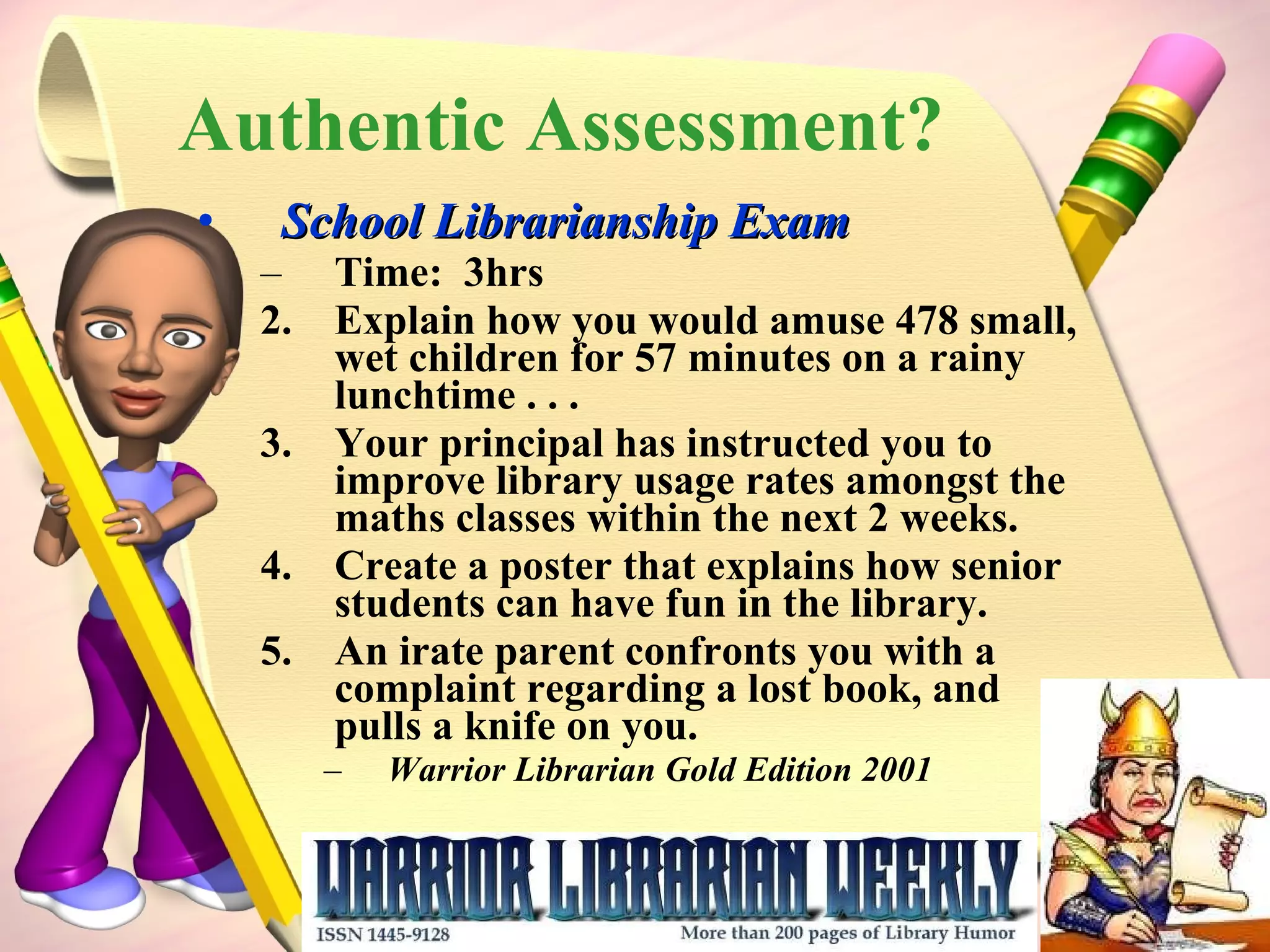
Authentic Assessment? School Librarianship Exam Time:  3hrs Explain how you would amuse 478 small, wet children for 57 minutes on a rainy lunchtime . . .  Your principal has instructed you to improve library usage rates amongst the maths classes within the next 2 weeks. Create a poster that explains how senior students can have fun in the library. An irate parent confronts you with a complaint regarding a lost book, and  pulls a knife on you. Warrior Librarian Gold Edition 2001
How did you do?

Information Literacy Assessment 2003 version

  • 1.
    ASSESSMENT OF INFORMATIONLITERACY LEARNING LIB 601 Libraries and Learning Fall 2009
  • 2.
    What is assessment?Definition Assessment is the process of identifying, gathering and interpreting information about students’ learning. The central purpose of assessment is to provide information on student achievement and progress and set the direction for ongoing teaching and learning. Assessment provides information for those involved in the teaching and learning process to compare what is known and can be demonstrated against standards.
  • 3.
    Assessment OF learningWhat is assessment OF learning? Assessment of learning involves working with the range of available evidence that enables staff and the wider assessment community to check on pupils’ progress and using this information in a number of ways.
  • 4.
    Assessment AS learningWhat is assessment AS learning? Assessment as learning is about reflecting on evidence of learning. This is part of the cycle of assessment where pupils and staff set learning goals, share learning intentions and success criteria, and evaluate their learning through dialogue and self and peer assessment.
  • 5.
    Assessment FOR learningWhat is assessment FOR learning? Assessment for learning focuses on the gap between where learners are in their learning, and where they need to be – the desired goal. This can be achieved through processes such as sharing criteria with learners, effective questioning and feedback.
  • 6.
    Why assess learning?To find out if they get what we’ve tried to teach them To find out if we taught them well enough To find ways of improving our teaching
  • 7.
    Forms of assessmentAssessment takes many forms in schools and classrooms: Formal and informal observation and discussion with students Formal assessment tasks Formative monitoring and adjustment of teaching Summative assessment at key points Comparing evidence of achievement with other students Comparing evidence of achievement against syllabus standards
  • 8.
    The fundamentals ofeffective assessment The British National Union of Students presents its principles:
  • 9.
    More principles ofeffective assessment
  • 10.
    Is Assessment inan LMC effective? Practice does not fit theory: Theoretically, the level of involvement in planning, teaching, and assessment should be no less than a partnership with other educators. However, the current practice of the instructional (including assessment) and curriculum roles in many school library media centers does not reflect the present theoretical and epistemological expectations of assessment in school librarianship articulated in professional literature and national guidelines . . . Thinking beyond the Disjunctive Opposition of Information Literacy Assessment in Theory and Practice
  • 11.
    What’s the problem?Impediments: Lack of time Role perception conflict Lack of teacher interest in cooperation Too many students to serve Thinking beyond the Disjunctive Opposition of Information Literacy Assessment in Theory and Practice Others?
  • 12.
    What is AuthenticAssessment? Definitions A form of assessment in which students are asked to perform real-world tasks that demonstrate meaningful application of essential knowledge and skills -- Jon Mueller “ . . . Engaging and worthy problems or questions of importance, in which students must use knowledge to fashion performances effectively and creatively. The tasks are either replicas of or analogous to the kinds of problems faced by adult citizens and consumers or professionals in the field.” -- Grant Wiggins -- ( Wiggins, 1993, p. 229 ).
  • 13.
    What Roles CanLibrary Media Center Staff Play in Assessment Development? Work with classroom teachers to develop learning goals and standards Develop resources and assessment tasks for classroom teachers Design your own assessments
  • 14.
    The Co-Role ofthe LMS Expanding the assignment and creating a learning environment that allows authentic learning activities to become possible Facilitat[ing] the activity with the teacher so that many learning environments can be made available to students Provid[ing] input and evidence in the evaluation of the students[’] ability to process information into meaningful communication Authentic Assessment by Daniel Callison
  • 15.
    Types of authenticassessment Observations: checklists of desired behaviors, rubrics that identify criteria for successful performance and describe different levels of performance, and rating scales that place levels of performance along a continuum. From Working Smarter: Being Strategic About Assessment and Accountability by Violet H. Harada, based on Ann Davies, Making Classroom Assessment Work
  • 16.
    Products: checklists thatlist criteria for proficiency, rubrics that describe various levels of proficiency, and graphic organizers that organize and synthesize students’ work. From Working Smarter: Being Strategic About Assessment and Accountability by Violet H. Harada, based on Ann Davies, Making Classroom Assessment Work Types of authentic assessment
  • 17.
    Conversations: formal andinformal conferences, logs to record thoughts and feelings about the content and process, and notes and letters to self-assess and seek feedback. From Working Smarter: Being Strategic About Assessment and Accountability by Violet H. Harada, based on Ann Davies, Making Classroom Assessment Work Types of authentic assessment
  • 18.
    Creating rubrics Ultimately,a good rubric is a promise to the learner that the elements outlined in the rubric are the valued, and therefore gradable, elements. When developing a rubric, I encourage my graduate students to think about the areas in which they would like the student to develop proficiencies and then articulate how they will know that the student has developed these proficiencies. Building Rubrics into Powerful Learning Assessment Tools
  • 19.
    Authentic Assessment? SchoolLibrarianship Exam Time: 3hrs Explain how you would amuse 478 small, wet children for 57 minutes on a rainy lunchtime . . . Your principal has instructed you to improve library usage rates amongst the maths classes within the next 2 weeks. Create a poster that explains how senior students can have fun in the library. An irate parent confronts you with a complaint regarding a lost book, and pulls a knife on you. Warrior Librarian Gold Edition 2001
  • 20.