Assessment for Learning
Project
Introduction Webinar
November 12, 2015
Who we are
Initiative Partners:
Center for Innovation in Education
Next Generation Learning Challenges
Design Partner: 2Revolutions
Funding Partners:
William & Flora Hewlett Foundation
Bill & Melinda Gates Foundation
The Need
1) Traditional summative assessments measure
only a small percentage of what matters most
2) Assessment is too often isolated from
instruction and conflated with accountability
3) Educators have not been prepared and
empowered to determine the most appropriate
roles for assessment that support learning
Goal One
Advance our understanding of
assessment’s essential roles in the
learning process, as learning models
become more personalized, less cohort-
restricted, more competency-based and
student-centered.
Goal One Funding Priorities
• The design and implementation of models
of on-going formative assessment and
feedback that improve learning, deepen
student agency, and increase college and
career readiness
• Demonstrations that essential intra- and
interpersonal skills and dispositions can
be taught, learned, and assessed as a
natural and necessary part of a child’s
experience in public education
Goal Two
Help to inform and develop crucial
enablers such as a) models of assessment
and accountability system design, b)
models of educator capacity building,
and/or c) use of technology tools, all to
advance Goal One.
Goal Two Funding Priorities
• The development of models that build educator capacity
to gather, interpret, and apply professional judgment of
student learning based on multiple and varied forms of
evidence across a wide range of student competencies
• The design and exploration of systems of aligned
assessment and accountability policies that embrace and
enable richer/deeper success definitions for students and
multiple, varied forms of measurement of student
progress towards those definitions
• The use of technology tools within systems of assessment
to enable educators using formative assessment and
related data to better inform instruction and a student-
centered learning experience
Why a “Request for Learning?”
• Promote and model a culture of continuous
learning
• A flexible structure that allows a personalized
experience for grantees and latitude over
project length and grant/budget request
• Opportunities for additional investment in
grantees demonstrating learning and
innovation that can inform their own work
and that of others
Design principles
• Grounded in the concepts of personalized
learning and deeper learning, with reference to
building student agency in assessment as
appropriate
• Focused on formative assessment in ways that
build from a foundation of prior learning
• Reflective of a strong vision of instruction with
clarity about how strategies and systems of
assessments support better instructional
practice
Design principles
• User-centric and problem-specific, illustrating
good perspective on the relationship of the
problem to the system within which it operates
• Designed to be transformational versus
incremental with the potential to be scalable
and contribute to the broader learning around
innovative systems of assessment
Is this a fit for you?
• Public school, CMO, LEA, SEA, or non-profit partnering
directly with schools
• Demonstrated commitment to assessment FOR learning
• Readiness to design, test, study, refine innovations in
practice
• Eagerness to learn and grow, not simply scale current
practice
• Keen awareness of systems-level implications for impact
• Passionate to participate in learning community
• A vision with the potential to transform rather than
incrementally improve assessment for learning
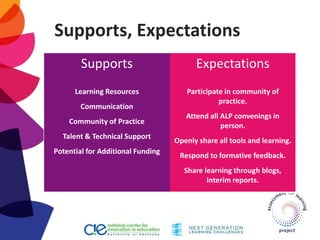
Supports
Learning Resources
Communication
Community of Practice
Talent & Technical Support
Potential for Additional Funding
Expectations
Participate in community of
practice.
Attend all ALP convenings in
person.
Openly share all tools and learning.
Respond to formative feedback.
Share learning through blogs,
interim reports.
Supports, Expectations
Grant specifics
• 12-15 grants, duration of 6-24 months
• Initial awards of $50,000 - $225,000
• Additional technical support from pool
of national TA providers
• Potential for follow-on grants
Criteria for review
Ideas: Innovative idea(s) that address core challenges in
assessment for learning, aligned to our funding priorities
Learning: A clearly defined problem, a testable hypothesis, a
plan for testing the hypothesis and communicating what
you’ve learned
Impact: The potential to further understanding and advance
practice at multiple levels of the system, directly addressing
the funding priorities
Readiness: The right team, with the dispositions of learners
and innovators, that can already demonstrate a level of
knowledge and/or skill, and is well-positioned to propel
learning forward
(Please review pages 10-11 of RFL for detailed criteria)
How to submit
Click on at:
http://nextgenlearning.org/AssessmentForLearningProject
Narrative (5-pages, Word doc)
• Address criteria on pages 10-11 of RFL
• Be explicit about how the project will address the funding priorities
• Remember to state timeframe
An artifact of your choosing
• e.g. slides, short video, illustrative graphic, sample of current work
• Should demonstrate your vision, plan, and/or capacity
• Can draw from existing work or be created for this application
A budget (Spreadsheet in .xlsx or .pdf)
• 6-24 Months, beginning in Jan 2016
• Income by source, expenses by category
• Budget narrative of <1 page, can be attached to full narrative
Before you apply
Visit: http://nextgenlearning.org/AssessmentForLearningProject
Closely review: RFL, Supporting Materials,
Sample Grant Agreement, Conflict of
Interest & IP Policies.
Continually check: FAQs on ALP site.
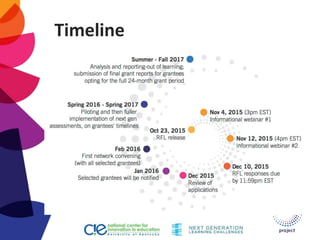
Timeline
Q&A
http://nextgenlearning.org/AssessmentForLearningProject
NGLC Program Officer: tsiddall@educause.edu

Introduction to the Assessment for Learning Project

  • 1.
  • 2.
    Who we are InitiativePartners: Center for Innovation in Education Next Generation Learning Challenges Design Partner: 2Revolutions Funding Partners: William & Flora Hewlett Foundation Bill & Melinda Gates Foundation
  • 3.
    The Need 1) Traditionalsummative assessments measure only a small percentage of what matters most 2) Assessment is too often isolated from instruction and conflated with accountability 3) Educators have not been prepared and empowered to determine the most appropriate roles for assessment that support learning
  • 4.
    Goal One Advance ourunderstanding of assessment’s essential roles in the learning process, as learning models become more personalized, less cohort- restricted, more competency-based and student-centered.
  • 5.
    Goal One FundingPriorities • The design and implementation of models of on-going formative assessment and feedback that improve learning, deepen student agency, and increase college and career readiness • Demonstrations that essential intra- and interpersonal skills and dispositions can be taught, learned, and assessed as a natural and necessary part of a child’s experience in public education
  • 6.
    Goal Two Help toinform and develop crucial enablers such as a) models of assessment and accountability system design, b) models of educator capacity building, and/or c) use of technology tools, all to advance Goal One.
  • 7.
    Goal Two FundingPriorities • The development of models that build educator capacity to gather, interpret, and apply professional judgment of student learning based on multiple and varied forms of evidence across a wide range of student competencies • The design and exploration of systems of aligned assessment and accountability policies that embrace and enable richer/deeper success definitions for students and multiple, varied forms of measurement of student progress towards those definitions • The use of technology tools within systems of assessment to enable educators using formative assessment and related data to better inform instruction and a student- centered learning experience
  • 8.
    Why a “Requestfor Learning?” • Promote and model a culture of continuous learning • A flexible structure that allows a personalized experience for grantees and latitude over project length and grant/budget request • Opportunities for additional investment in grantees demonstrating learning and innovation that can inform their own work and that of others
  • 9.
    Design principles • Groundedin the concepts of personalized learning and deeper learning, with reference to building student agency in assessment as appropriate • Focused on formative assessment in ways that build from a foundation of prior learning • Reflective of a strong vision of instruction with clarity about how strategies and systems of assessments support better instructional practice
  • 10.
    Design principles • User-centricand problem-specific, illustrating good perspective on the relationship of the problem to the system within which it operates • Designed to be transformational versus incremental with the potential to be scalable and contribute to the broader learning around innovative systems of assessment
  • 11.
    Is this afit for you? • Public school, CMO, LEA, SEA, or non-profit partnering directly with schools • Demonstrated commitment to assessment FOR learning • Readiness to design, test, study, refine innovations in practice • Eagerness to learn and grow, not simply scale current practice • Keen awareness of systems-level implications for impact • Passionate to participate in learning community • A vision with the potential to transform rather than incrementally improve assessment for learning
  • 12.
    Supports Learning Resources Communication Community ofPractice Talent & Technical Support Potential for Additional Funding Expectations Participate in community of practice. Attend all ALP convenings in person. Openly share all tools and learning. Respond to formative feedback. Share learning through blogs, interim reports. Supports, Expectations
  • 13.
    Grant specifics • 12-15grants, duration of 6-24 months • Initial awards of $50,000 - $225,000 • Additional technical support from pool of national TA providers • Potential for follow-on grants
  • 14.
    Criteria for review Ideas:Innovative idea(s) that address core challenges in assessment for learning, aligned to our funding priorities Learning: A clearly defined problem, a testable hypothesis, a plan for testing the hypothesis and communicating what you’ve learned Impact: The potential to further understanding and advance practice at multiple levels of the system, directly addressing the funding priorities Readiness: The right team, with the dispositions of learners and innovators, that can already demonstrate a level of knowledge and/or skill, and is well-positioned to propel learning forward (Please review pages 10-11 of RFL for detailed criteria)
  • 15.
    How to submit Clickon at: http://nextgenlearning.org/AssessmentForLearningProject Narrative (5-pages, Word doc) • Address criteria on pages 10-11 of RFL • Be explicit about how the project will address the funding priorities • Remember to state timeframe An artifact of your choosing • e.g. slides, short video, illustrative graphic, sample of current work • Should demonstrate your vision, plan, and/or capacity • Can draw from existing work or be created for this application A budget (Spreadsheet in .xlsx or .pdf) • 6-24 Months, beginning in Jan 2016 • Income by source, expenses by category • Budget narrative of <1 page, can be attached to full narrative
  • 16.
    Before you apply Visit:http://nextgenlearning.org/AssessmentForLearningProject Closely review: RFL, Supporting Materials, Sample Grant Agreement, Conflict of Interest & IP Policies. Continually check: FAQs on ALP site.
  • 17.
  • 18.