Information Literacy
Vandana Govind Kelkar.
Librarian.
Yashwantrao Chavan Mahavidayala, Halkarni.
Tal:-Chandgad. Dist:- Kolhapur.
MAHARASHTRA.
INDIA
sukhhergad68@gmail.com
United Nations
Sustainable Development Goals 2015-2030
Goal 4:
Quality Education
• Ensure Inclusive and equitable education and promote Life long
learning opportunities for all.
• Information literacy promotes life long learning in todays era.
• While buying a house.
• Hiring a car.
• Choosing a school.
• Making an investment.
• Voting for representative.
• While arranging long tour.
We use information literacy term in day to
day life.
. Present age is information age.
.Information is timely required.
.Information literacy is a Participative Technology Term.
.It improves our quality of life.
INFORMATION LITERACY (Definition ):-
.Association of college and research Libraries,2000:-
Information Literacy is set off abilities requiring individuals to
recognize when information is needed and have the ability to, locate,
evaluate and use effectively the needed information.
• Library Association (ALA) :-
Information literacy “ ability to recognize when information is
needed and to locate, evaluate and use.”
.
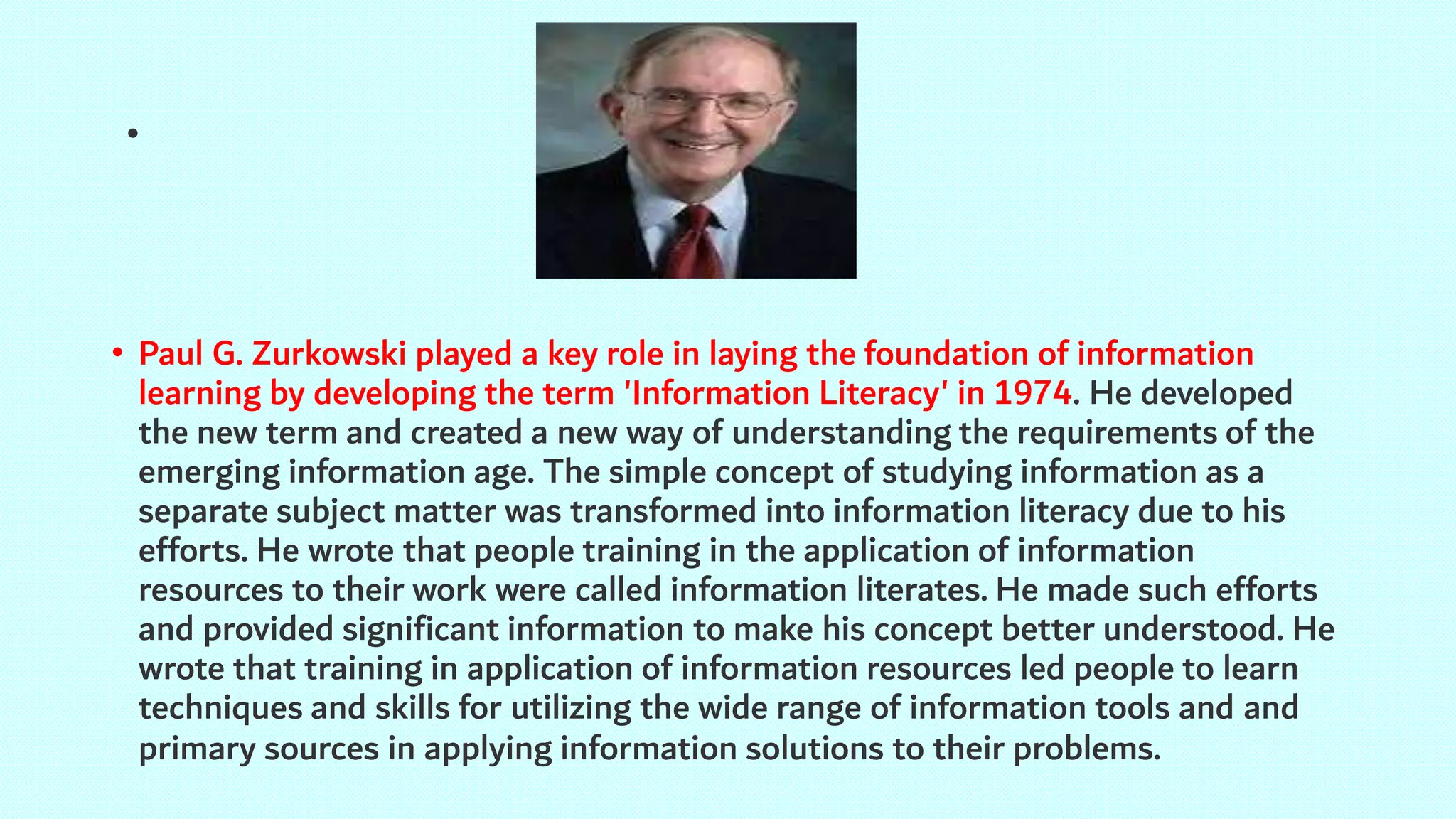
• Paul G. Zurkowski played a key role in laying the foundation of information
learning by developing the term 'Information Literacy' in 1974. He developed
the new term and created a new way of understanding the requirements of the
emerging information age. The simple concept of studying information as a
separate subject matter was transformed into information literacy due to his
efforts. He wrote that people training in the application of information
resources to their work were called information literates. He made such efforts
and provided significant information to make his concept better understood. He
wrote that training in application of information resources led people to learn
techniques and skills for utilizing the wide range of information tools and and
primary sources in applying information solutions to their problems.
Need of Information Literacy.
• To develop information literacy skills in learners.
• Changing Shape of libraries.
• Help to become independent learner.
• To Import skills of Information Technology.
• To support the people who has lack of ability.
• Information literacy is important for effective and civilized society.
Objectives of Information Literacy.
• EDUCATION IN INFORMATION LITERACY.
• Creating a thinking style according to the demands of the information
society.
• Creating, skills and working abilities with information sources .
• Independent solution regarding information accessing, processing,
storing and sending information.
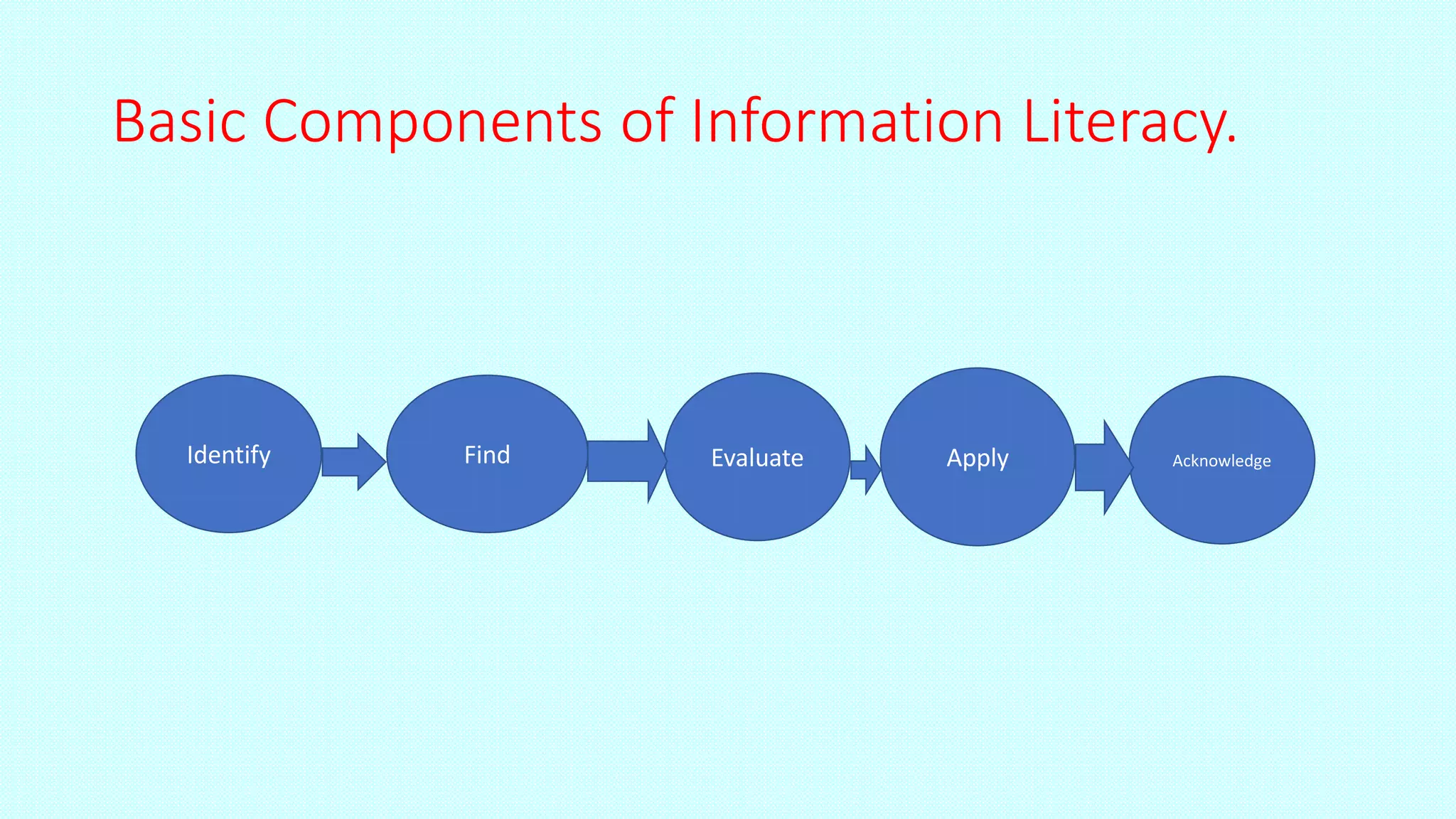
Basic Components of Information Literacy.
Identify Find Evaluate Apply Acknowledge
Dimensions of Information Literacy.
• Media literacy:- is the ability of access, analyze, evaluate and create
media.
• Network Literacy:-deals with the computer and networks kills to a
participate in networked society.
• Digital Literacy:- Deals with knowledge, skills, behavior of users to
handle digital devices such as smart phones, laptops etc.….
• Scientific Literacy:- deals with the knowledge and understanding of
scientific concepts and processes needed for personal decision
making.
• Visual Literacy:- Irt is the ability to understand the information in the
form of images, presentations and interpret the same .
• Traditional Information Literacy:- to locate, select evaluate and use of
information effectively.
LEVELS OF INFORMATION LITERACY
Cognitive
Level
Semiotic Level Physical Level
Critical Thinking
Understanding
Application
Access to information
products and tools ,
such as books ,
computer, internet etc
Reading
Writing
Processing
Concept of Information Literacy (Lau 2014)
• User Training.
• Library Orientation.
• Development of Information Skills.
• Bibliographic Instruction.
• Information Fluency.
• Information Competencies.
• User Education.
Role of librarians:-
• Librarians have to identify and select age specific literature and have to
look online electronic resources.
• They have to re educate themselves to acquire new skills and
competencies of information literacy skills.
• Librarian must strongly committed for the institutional and library
administration.
• Prepare themselves to be come effective teachers of information literacy
programs.
• Have to arrange user orientation programs.
References.
• https://www.researchgate.net/publication/337470963_Basic_Concepts
_in_Information_Literacy
• https://www.researchgate.net/publication/228411535_Information_Lit
eracy_and_Learning
• https://ir.inflibnet.ac.in/bitstream/1944/1207/1/42.pdf
• https://www.researchgate.net/publication/293703989_Foundations_o
f_information_literacy_Learning_from_paul_zurkowski
• These references are taken for educational purpose only. There is not
any commercial purpose for this.
Thank You.

Information litaracy.pdf

  • 1.
    Information Literacy Vandana GovindKelkar. Librarian. Yashwantrao Chavan Mahavidayala, Halkarni. Tal:-Chandgad. Dist:- Kolhapur. MAHARASHTRA. INDIA sukhhergad68@gmail.com
  • 2.
    United Nations Sustainable DevelopmentGoals 2015-2030 Goal 4: Quality Education • Ensure Inclusive and equitable education and promote Life long learning opportunities for all. • Information literacy promotes life long learning in todays era.
  • 3.
    • While buyinga house. • Hiring a car. • Choosing a school. • Making an investment. • Voting for representative. • While arranging long tour. We use information literacy term in day to day life.
  • 4.
    . Present ageis information age. .Information is timely required. .Information literacy is a Participative Technology Term. .It improves our quality of life.
  • 5.
    INFORMATION LITERACY (Definition):- .Association of college and research Libraries,2000:- Information Literacy is set off abilities requiring individuals to recognize when information is needed and have the ability to, locate, evaluate and use effectively the needed information. • Library Association (ALA) :- Information literacy “ ability to recognize when information is needed and to locate, evaluate and use.”
  • 6.
    . • Paul G.Zurkowski played a key role in laying the foundation of information learning by developing the term 'Information Literacy' in 1974. He developed the new term and created a new way of understanding the requirements of the emerging information age. The simple concept of studying information as a separate subject matter was transformed into information literacy due to his efforts. He wrote that people training in the application of information resources to their work were called information literates. He made such efforts and provided significant information to make his concept better understood. He wrote that training in application of information resources led people to learn techniques and skills for utilizing the wide range of information tools and and primary sources in applying information solutions to their problems.
  • 7.
    Need of InformationLiteracy. • To develop information literacy skills in learners. • Changing Shape of libraries. • Help to become independent learner. • To Import skills of Information Technology. • To support the people who has lack of ability. • Information literacy is important for effective and civilized society.
  • 8.
    Objectives of InformationLiteracy. • EDUCATION IN INFORMATION LITERACY. • Creating a thinking style according to the demands of the information society. • Creating, skills and working abilities with information sources . • Independent solution regarding information accessing, processing, storing and sending information.
  • 9.
    Basic Components ofInformation Literacy. Identify Find Evaluate Apply Acknowledge
  • 10.
    Dimensions of InformationLiteracy. • Media literacy:- is the ability of access, analyze, evaluate and create media. • Network Literacy:-deals with the computer and networks kills to a participate in networked society. • Digital Literacy:- Deals with knowledge, skills, behavior of users to handle digital devices such as smart phones, laptops etc.…. • Scientific Literacy:- deals with the knowledge and understanding of scientific concepts and processes needed for personal decision making. • Visual Literacy:- Irt is the ability to understand the information in the form of images, presentations and interpret the same . • Traditional Information Literacy:- to locate, select evaluate and use of information effectively.
  • 11.
    LEVELS OF INFORMATIONLITERACY Cognitive Level Semiotic Level Physical Level Critical Thinking Understanding Application Access to information products and tools , such as books , computer, internet etc Reading Writing Processing
  • 12.
    Concept of InformationLiteracy (Lau 2014) • User Training. • Library Orientation. • Development of Information Skills. • Bibliographic Instruction. • Information Fluency. • Information Competencies. • User Education.
  • 13.
    Role of librarians:- •Librarians have to identify and select age specific literature and have to look online electronic resources. • They have to re educate themselves to acquire new skills and competencies of information literacy skills. • Librarian must strongly committed for the institutional and library administration. • Prepare themselves to be come effective teachers of information literacy programs. • Have to arrange user orientation programs.
  • 14.
    References. • https://www.researchgate.net/publication/337470963_Basic_Concepts _in_Information_Literacy • https://www.researchgate.net/publication/228411535_Information_Lit eracy_and_Learning •https://ir.inflibnet.ac.in/bitstream/1944/1207/1/42.pdf • https://www.researchgate.net/publication/293703989_Foundations_o f_information_literacy_Learning_from_paul_zurkowski • These references are taken for educational purpose only. There is not any commercial purpose for this.
  • 15.