© Copyright 2016 Farsight Security, Inc.
All Right Reserved.
FARSIGHT SECURITY
M e r i k e K a e o , C T O
m e r i k e @ f s i . i o
Information Exchange Collaboration
Across Technical/Operational/Policy
Boundaries
DISCUSSION POINTS
•  Introduction and Background
•  Barriers to Sharing
•  Communities of Trust
•  Global Efforts To Bring About Action
•  Evolving Standards and Frameworks
•  Being Part of the Solution
BACKGROUND – MERIKE KÄO
•  Work History
–  National Institutes of Health (Network Engineer, 1988-1993)
–  Cisco Systems (Network Architect, 1993-2000)
–  Double Shot Security (Founder, 2000-2012)
–  IID (CISO, 2013-2014)
–  Farsight Security (CTO, 2014 – present)
•  Industry Recognition/Participation
–  Authored “Designing Network Security”
–  Active Contributor to IETF Standards
–  SSAC member (ICANN)
–  IP6 Forum fellow since 2007
–  Member of FCC CSRIC III (Botnet remediation)
–  Member of EU NIS WG2
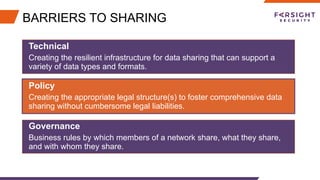
BARRIERS TO SHARING
Technical
Creating the resilient infrastructure for data sharing that can support a
variety of data types and formats.
Policy
Creating the appropriate legal structure(s) to foster comprehensive data
sharing without cumbersome legal liabilities.
Governance
Business rules by which members of a network share, what they share,
and with whom they share.
A PERIOD OF RAPID CHANGE
•  Intelligent, interconnected devices are continuing
to be connected to the global Internet
•  Data is accumulating faster than it can be
organized or effectively protected
•  The complexity of the Internet ecosystem creates
a rich environment exploitable by activists,
criminals, and nation states
•  Data will continue be stolen or modified using
subtle, persistent, directed attacks
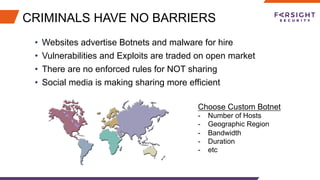
CRIMINALS HAVE NO BARRIERS
•  Websites advertise Botnets and malware for hire
•  Vulnerabilities and Exploits are traded on open market
•  There are no enforced rules for NOT sharing
•  Social media is making sharing more efficient
Choose Custom Botnet
-  Number of Hosts
-  Geographic Region
-  Bandwidth
-  Duration
-  etc
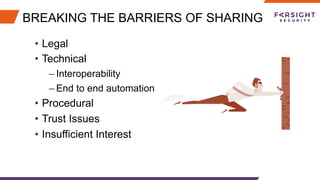
BREAKING THE BARRIERS OF SHARING
•  Legal
•  Technical
– Interoperability
– End to end automation
•  Procedural
•  Trust Issues
•  Insufficient Interest
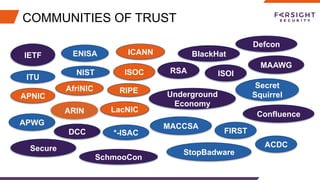
COMMUNITIES OF TRUST
IETF
ISOI
BlackHat
SchmooCon
ENISA
APNIC
RIPEAfriNIC
LacNIC
Underground
Economy
DCC
Defcon
RSA
ICANN
ISOC
Secure
ARIN
NIST
ITU
Secret
Squirrel
APWG
MAAWG
StopBadware
ACDC
MACCSA
*-ISAC FIRST
Confluence
AND THERE’S MORE…
•  Industry Sectors
Aerospace, Automotive, Aviation, Chemical Industry, Construction,
Consumer Products, Education, Energy, Environment, Financial
(Banking, Exchanges, Insurance, Payments), Food, Health,
Heating&Ventilation, Machine Safety, Materials, Nanotechnology,
Oil&Gas, Pharmaceutical, Research Facilities, Services, Smart
Metering, Space,Transport (Road, Rail, Shipping), etc.
•  National Initiatives
UN, NATO, EU, Africa, National CERTs, etc.
GLOBAL EFFORTS FOR ACTION
•  DNS-OARC: DNS System Security
•  FIRST: Vulnerability management
•  ISACs: Specialized Interest Groups
•  M3AAWG / APWG: Anti SPAM, Phishing and
Crime
•  NSP-SEC: Big Backbone Providers and IP
Based Remediation
•  OPSEC-Trust: Situational Awareness
MODELS, METHODS AND MECHANISMS
•  Models of Exchange
–  Voluntary exchange vs Mandatory disclosure
•  Methods of Exchange
–  Trust-based
–  Formalized
–  Security clearance-based
–  Ad-hoc
•  Mechanisms of Exchange
–  Person to person
–  Machine to machine
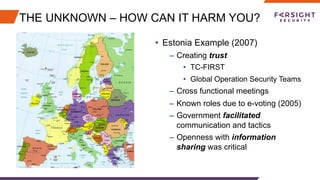
THE UNKNOWN – HOW CAN IT HARM YOU?
•  Estonia Example (2007)
–  Creating trust
•  TC-FIRST
•  Global Operation Security Teams
–  Cross functional meetings
–  Known roles due to e-voting (2005)
–  Government facilitated
communication and tactics
–  Openness with information
sharing was critical
DO YOU HAVE A CIRT?
•  You Should Have a Computer Incident response Team
–  Who is part of this?
–  What are their responsibilities?
•  Important – Define a single individual to be in charge (also have a
backup for that individual)
•  Know who you need to contact
–  Legal / regulatory responsibility
–  Upstream ISPs who may help filter on DDoS attacks
–  Impacted individuals
CONTINUE TO INCREASE SHARING
•  Initial Step – Build Trust Thru Networking
•  Start by sharing for specific use cases that don’t impact privacy
and personally identifiable information (PII)
–  SSH Brute Force Attacks
–  DNS/SMTP/NTP Amplification Attacks
–  Passive DNS Information
•  Investigate how to share data that may impact privacy/PII and
what can be anonymized but still be useful
–  SPAM / Phishing details
THOUGHTS ON PASSIVE DNS
•  DNS is used by ALL electronic communications
•  pDNS still new to many people despite existing since 2004
•  PII issues depend on where you do your observations
•  Valuable data that is shared to get information on malware
campaigns
EVOLVING STANDARDS & FRAMEWORKS
•  FIRST Initiatives
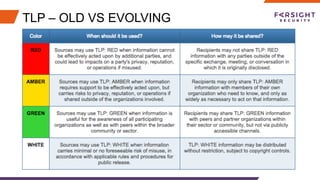
–  Traffic Light Protocol (TLP) SIG
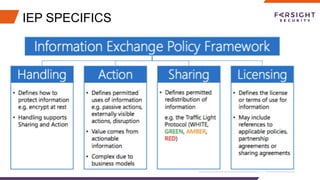
–  Information Exchange Policy (IEP) SIG
–  Information Sharing SIG
•  OASIS
–  Cybox/STIX/TAXII
•  Other Ongoing Work
–  NIST / ENISA
–  IETF
TLP – OLD VS EVOLVING
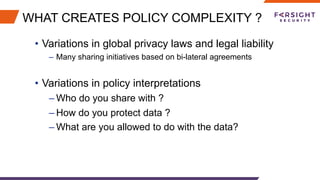
WHAT CREATES POLICY COMPLEXITY ?
•  Variations in global privacy laws and legal liability
–  Many sharing initiatives based on bi-lateral agreements
•  Variations in policy interpretations
– Who do you share with ?
– How do you protect data ?
– What are you allowed to do with the data?
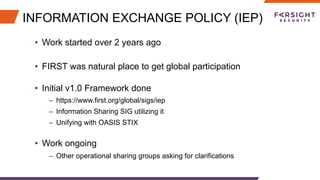
INFORMATION EXCHANGE POLICY (IEP)
•  Work started over 2 years ago
•  FIRST was natural place to get global participation
•  Initial v1.0 Framework done
–  https://www.first.org/global/sigs/iep
–  Information Sharing SIG utilizing it
–  Unifying with OASIS STIX
•  Work ongoing
–  Other operational sharing groups asking for clarifications
IEP SPECIFICS
IEP and STIX
•  IEP Appendix A
–  STIX JSON representation of an IEP implementation
•  Close collaboration with OASIS
–  STIX 2.0 documentation has reference to IEP
–  IEP work ongoing to include IEP within STIX
BEING PART OF THE SOLUTION
•  Participate in policy work
•  Work with national CIRT teams
•  Help formulate privacy laws that
protect citizens personal
privacy but don’t hinder
protecting critical electronic
communications
•  Share what you can and help
cross-functional education
© Copyright 2016 Farsight Security, Inc.
All Right Reserved.
QUESTIONS ?
FARSIGHT SECURITY

Information Exchange Collaboration across Technical/Operational/Policy Boundaries

  • 1.
    © Copyright 2016Farsight Security, Inc. All Right Reserved. FARSIGHT SECURITY M e r i k e K a e o , C T O m e r i k e @ f s i . i o Information Exchange Collaboration Across Technical/Operational/Policy Boundaries
  • 2.
    DISCUSSION POINTS •  Introductionand Background •  Barriers to Sharing •  Communities of Trust •  Global Efforts To Bring About Action •  Evolving Standards and Frameworks •  Being Part of the Solution
  • 3.
    BACKGROUND – MERIKEKÄO •  Work History –  National Institutes of Health (Network Engineer, 1988-1993) –  Cisco Systems (Network Architect, 1993-2000) –  Double Shot Security (Founder, 2000-2012) –  IID (CISO, 2013-2014) –  Farsight Security (CTO, 2014 – present) •  Industry Recognition/Participation –  Authored “Designing Network Security” –  Active Contributor to IETF Standards –  SSAC member (ICANN) –  IP6 Forum fellow since 2007 –  Member of FCC CSRIC III (Botnet remediation) –  Member of EU NIS WG2
  • 4.
    BARRIERS TO SHARING Technical Creatingthe resilient infrastructure for data sharing that can support a variety of data types and formats. Policy Creating the appropriate legal structure(s) to foster comprehensive data sharing without cumbersome legal liabilities. Governance Business rules by which members of a network share, what they share, and with whom they share.
  • 5.
    A PERIOD OFRAPID CHANGE •  Intelligent, interconnected devices are continuing to be connected to the global Internet •  Data is accumulating faster than it can be organized or effectively protected •  The complexity of the Internet ecosystem creates a rich environment exploitable by activists, criminals, and nation states •  Data will continue be stolen or modified using subtle, persistent, directed attacks
  • 6.
    CRIMINALS HAVE NOBARRIERS •  Websites advertise Botnets and malware for hire •  Vulnerabilities and Exploits are traded on open market •  There are no enforced rules for NOT sharing •  Social media is making sharing more efficient Choose Custom Botnet -  Number of Hosts -  Geographic Region -  Bandwidth -  Duration -  etc
  • 7.
    BREAKING THE BARRIERSOF SHARING •  Legal •  Technical – Interoperability – End to end automation •  Procedural •  Trust Issues •  Insufficient Interest
  • 8.
  • 9.
    AND THERE’S MORE… • Industry Sectors Aerospace, Automotive, Aviation, Chemical Industry, Construction, Consumer Products, Education, Energy, Environment, Financial (Banking, Exchanges, Insurance, Payments), Food, Health, Heating&Ventilation, Machine Safety, Materials, Nanotechnology, Oil&Gas, Pharmaceutical, Research Facilities, Services, Smart Metering, Space,Transport (Road, Rail, Shipping), etc. •  National Initiatives UN, NATO, EU, Africa, National CERTs, etc.
  • 10.
    GLOBAL EFFORTS FORACTION •  DNS-OARC: DNS System Security •  FIRST: Vulnerability management •  ISACs: Specialized Interest Groups •  M3AAWG / APWG: Anti SPAM, Phishing and Crime •  NSP-SEC: Big Backbone Providers and IP Based Remediation •  OPSEC-Trust: Situational Awareness
  • 11.
    MODELS, METHODS ANDMECHANISMS •  Models of Exchange –  Voluntary exchange vs Mandatory disclosure •  Methods of Exchange –  Trust-based –  Formalized –  Security clearance-based –  Ad-hoc •  Mechanisms of Exchange –  Person to person –  Machine to machine
  • 12.
    THE UNKNOWN –HOW CAN IT HARM YOU? •  Estonia Example (2007) –  Creating trust •  TC-FIRST •  Global Operation Security Teams –  Cross functional meetings –  Known roles due to e-voting (2005) –  Government facilitated communication and tactics –  Openness with information sharing was critical
  • 13.
    DO YOU HAVEA CIRT? •  You Should Have a Computer Incident response Team –  Who is part of this? –  What are their responsibilities? •  Important – Define a single individual to be in charge (also have a backup for that individual) •  Know who you need to contact –  Legal / regulatory responsibility –  Upstream ISPs who may help filter on DDoS attacks –  Impacted individuals
  • 14.
    CONTINUE TO INCREASESHARING •  Initial Step – Build Trust Thru Networking •  Start by sharing for specific use cases that don’t impact privacy and personally identifiable information (PII) –  SSH Brute Force Attacks –  DNS/SMTP/NTP Amplification Attacks –  Passive DNS Information •  Investigate how to share data that may impact privacy/PII and what can be anonymized but still be useful –  SPAM / Phishing details
  • 15.
    THOUGHTS ON PASSIVEDNS •  DNS is used by ALL electronic communications •  pDNS still new to many people despite existing since 2004 •  PII issues depend on where you do your observations •  Valuable data that is shared to get information on malware campaigns
  • 16.
    EVOLVING STANDARDS &FRAMEWORKS •  FIRST Initiatives –  Traffic Light Protocol (TLP) SIG –  Information Exchange Policy (IEP) SIG –  Information Sharing SIG •  OASIS –  Cybox/STIX/TAXII •  Other Ongoing Work –  NIST / ENISA –  IETF
  • 17.
    TLP – OLDVS EVOLVING
  • 18.
    WHAT CREATES POLICYCOMPLEXITY ? •  Variations in global privacy laws and legal liability –  Many sharing initiatives based on bi-lateral agreements •  Variations in policy interpretations – Who do you share with ? – How do you protect data ? – What are you allowed to do with the data?
  • 19.
    INFORMATION EXCHANGE POLICY(IEP) •  Work started over 2 years ago •  FIRST was natural place to get global participation •  Initial v1.0 Framework done –  https://www.first.org/global/sigs/iep –  Information Sharing SIG utilizing it –  Unifying with OASIS STIX •  Work ongoing –  Other operational sharing groups asking for clarifications
  • 20.
  • 21.
    IEP and STIX • IEP Appendix A –  STIX JSON representation of an IEP implementation •  Close collaboration with OASIS –  STIX 2.0 documentation has reference to IEP –  IEP work ongoing to include IEP within STIX
  • 22.
    BEING PART OFTHE SOLUTION •  Participate in policy work •  Work with national CIRT teams •  Help formulate privacy laws that protect citizens personal privacy but don’t hinder protecting critical electronic communications •  Share what you can and help cross-functional education
  • 23.
    © Copyright 2016Farsight Security, Inc. All Right Reserved. QUESTIONS ? FARSIGHT SECURITY