1
Introduction to APNIC and
Regional Internet Registries
(RIRs)
IGFA 2017
Kabul
28 March 2017
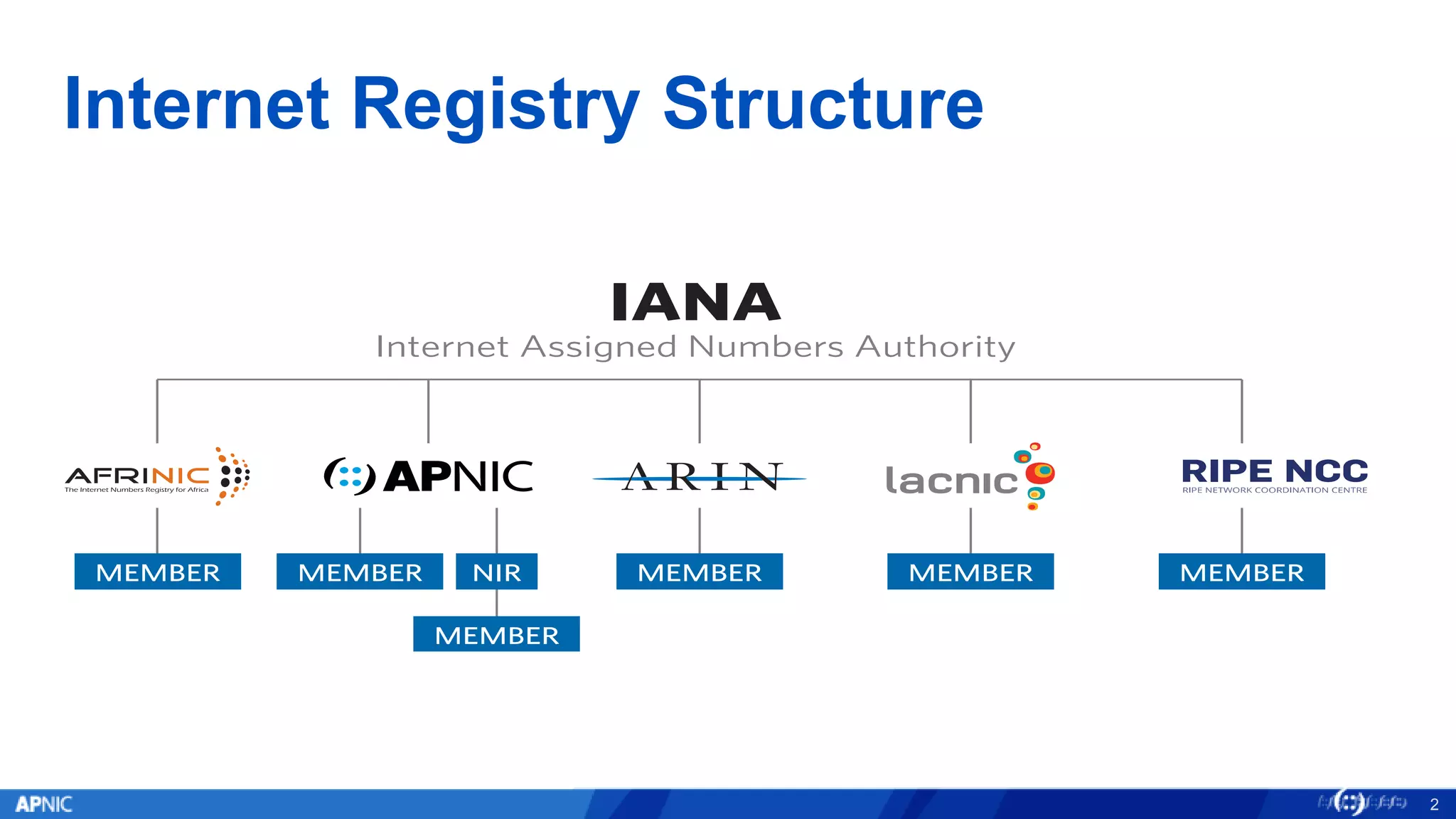
Internet Registry Structure
2
What is APNIC?
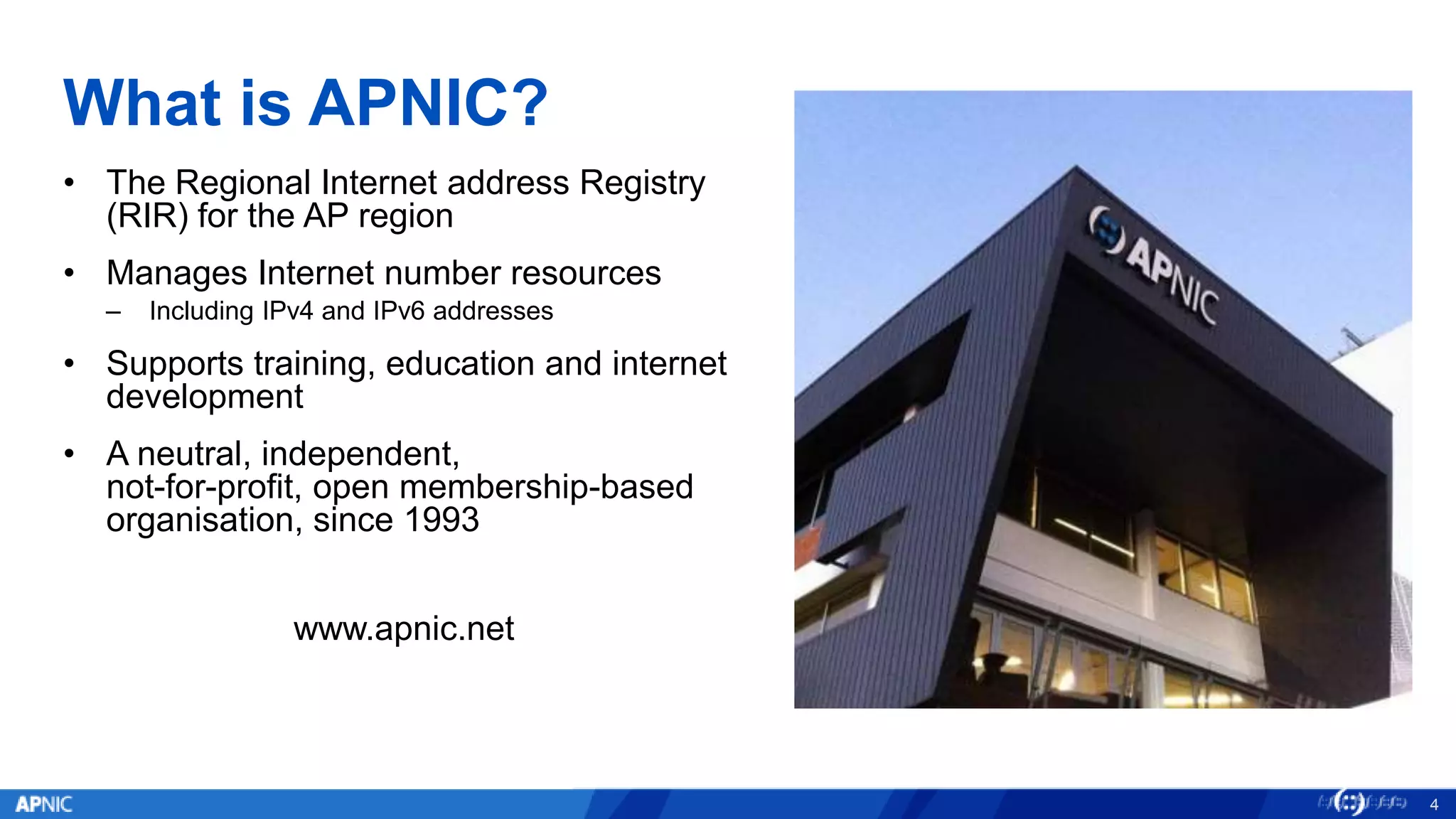
• The Regional Internet address Registry
(RIR) for the AP region
• Manages Internet number resources
– Including IPv4 and IPv6 addresses
• Supports training, education and internet
development
• A neutral, independent,
not-for-profit, open membership-based
organisation, since 1993
www.apnic.net
4
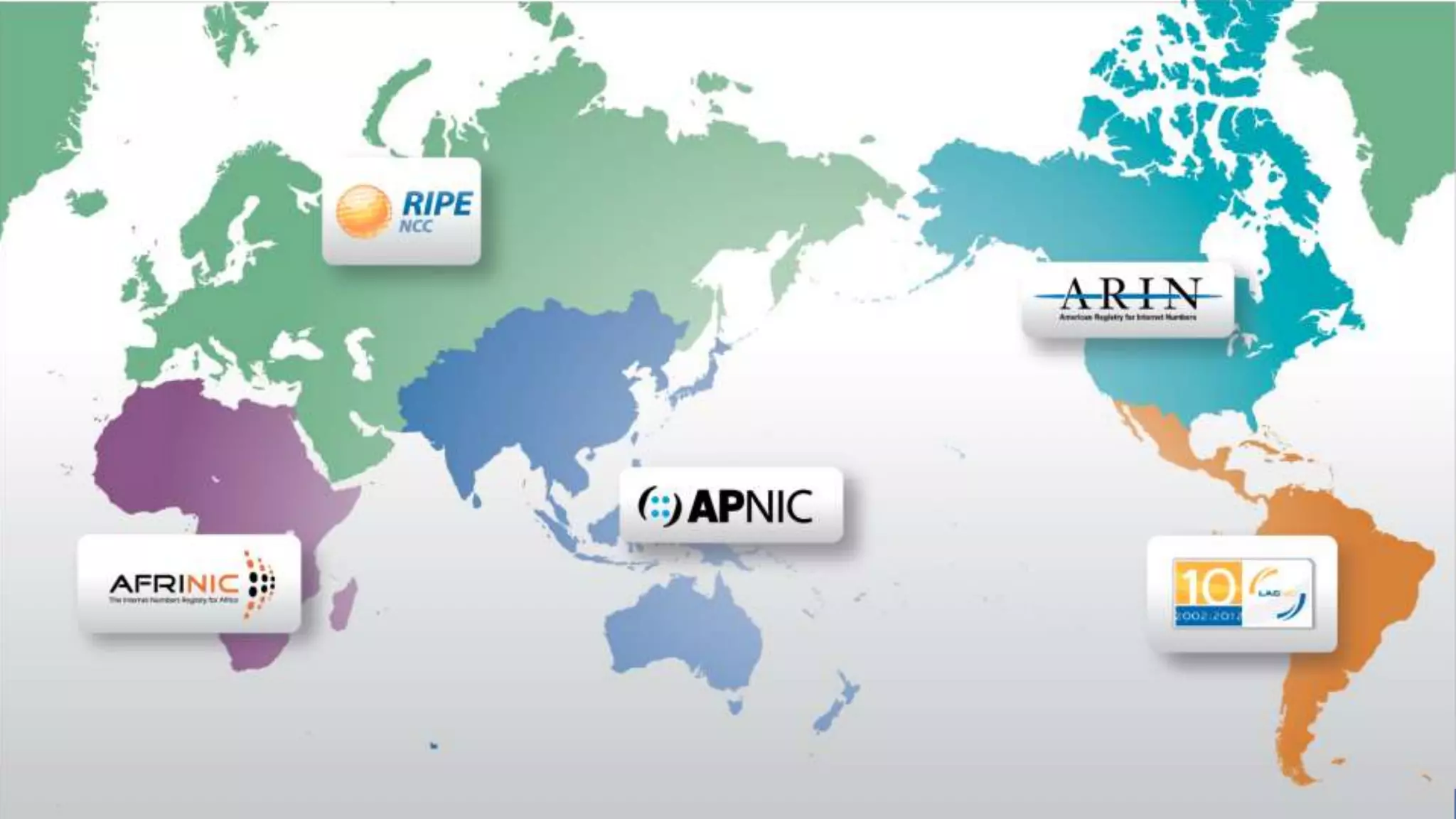
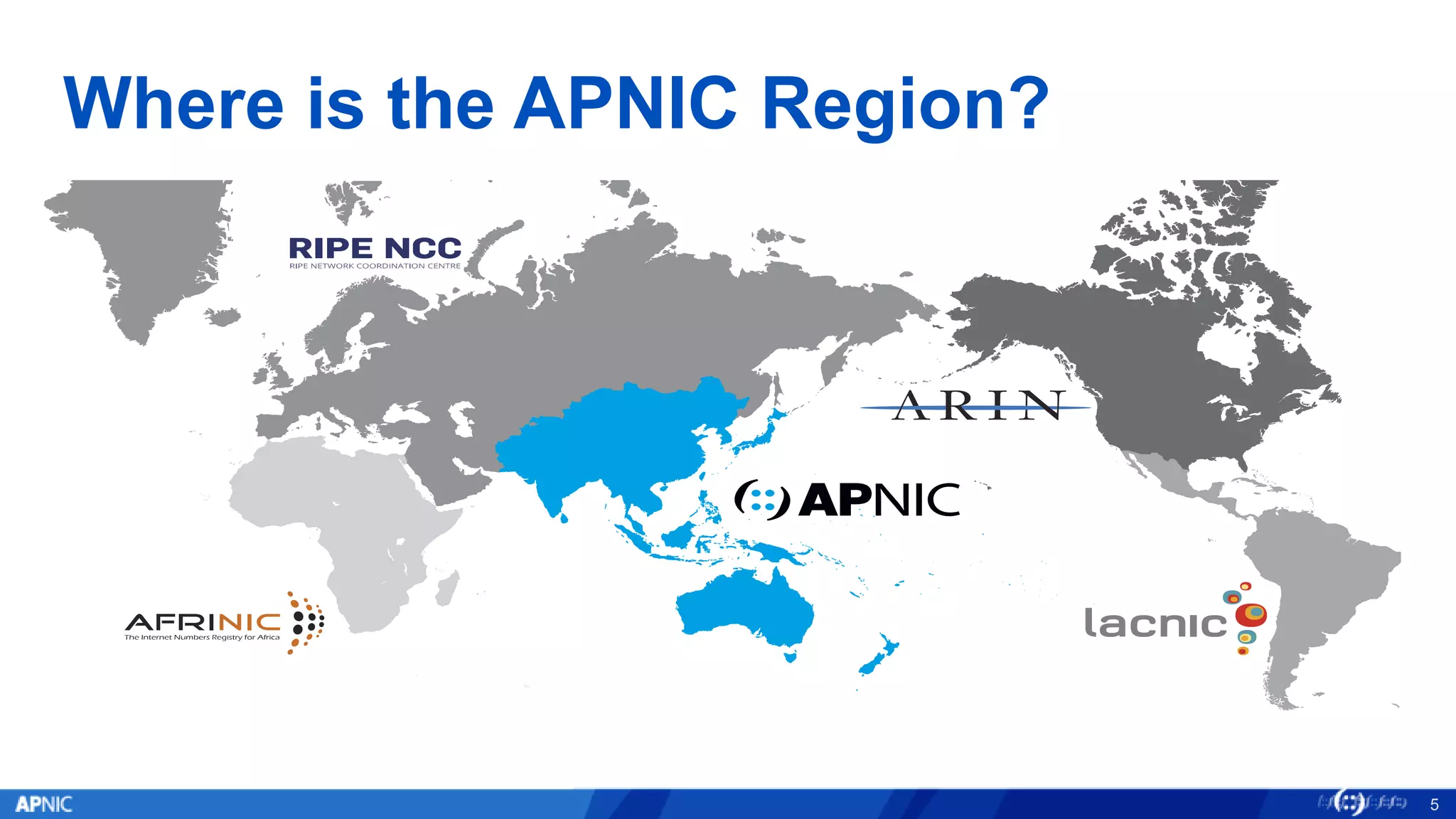
Where is the APNIC Region?
5
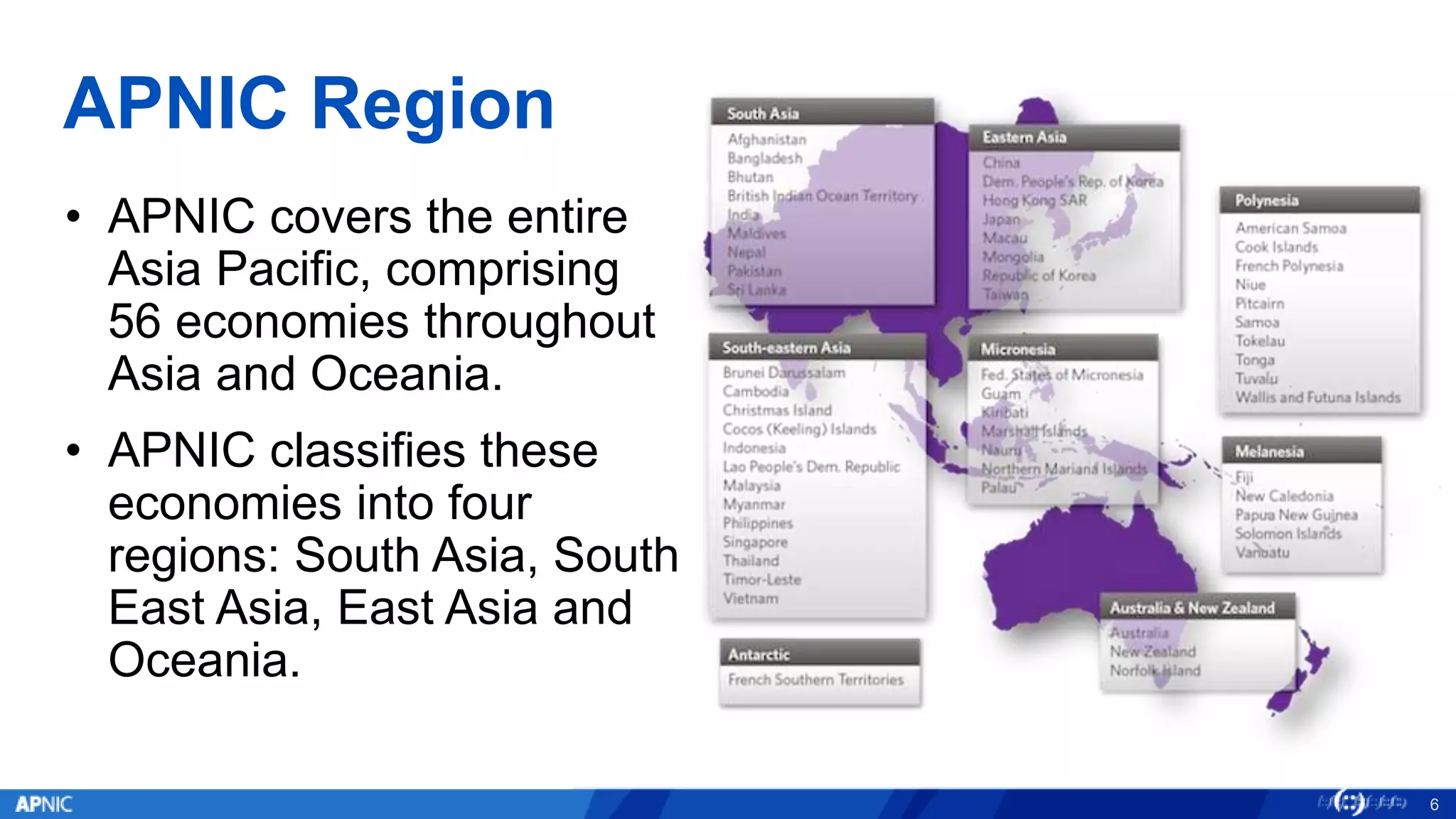
APNIC Region
• APNIC covers the entire
Asia Pacific, comprising
56 economies throughout
Asia and Oceania.
• APNIC classifies these
economies into four
regions: South Asia, South
East Asia, East Asia and
Oceania.
6
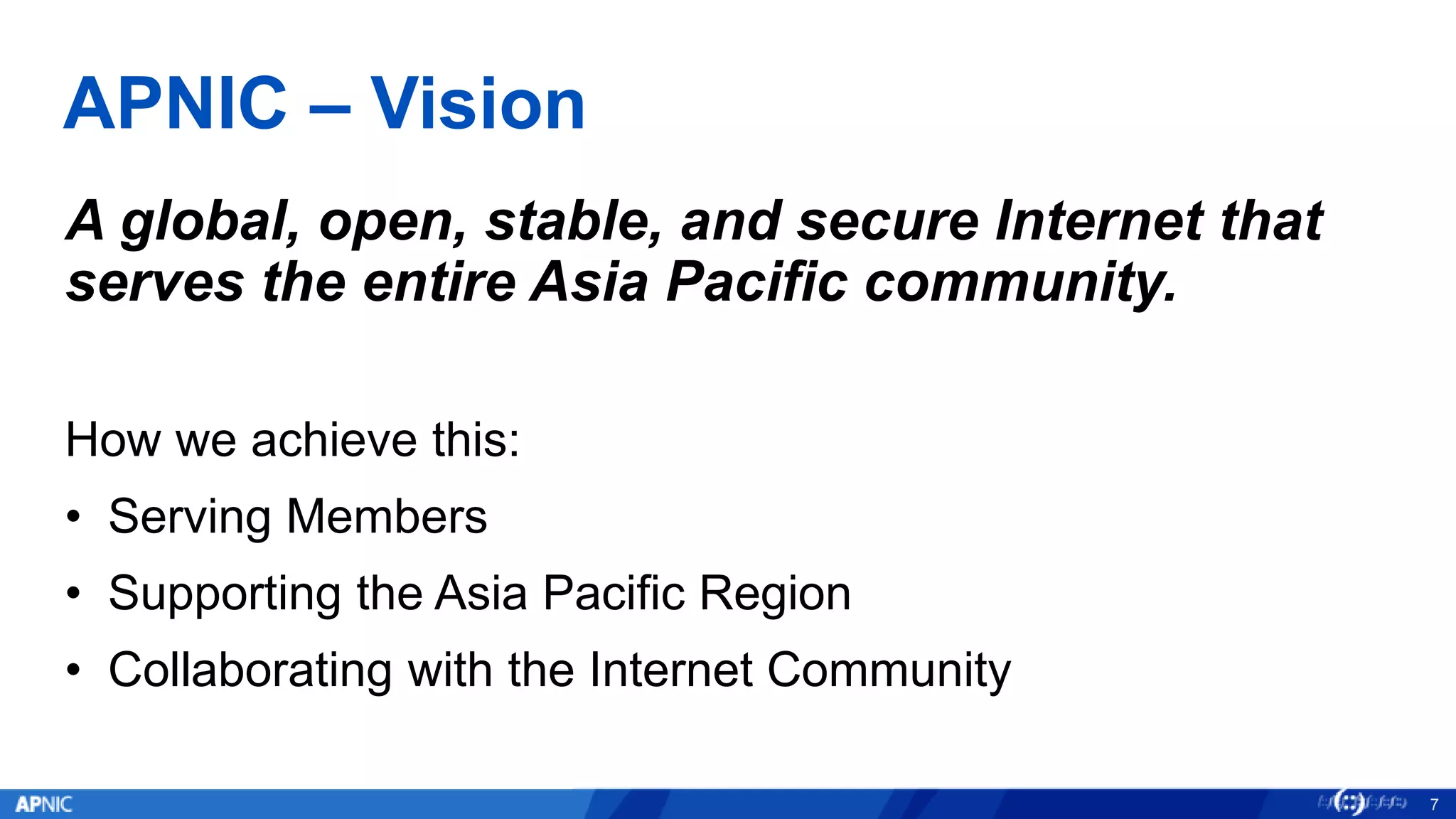
APNIC – Vision
A global, open, stable, and secure Internet that
serves the entire Asia Pacific community.
How we achieve this:
• Serving Members
• Supporting the Asia Pacific Region
• Collaborating with the Internet Community
7
8
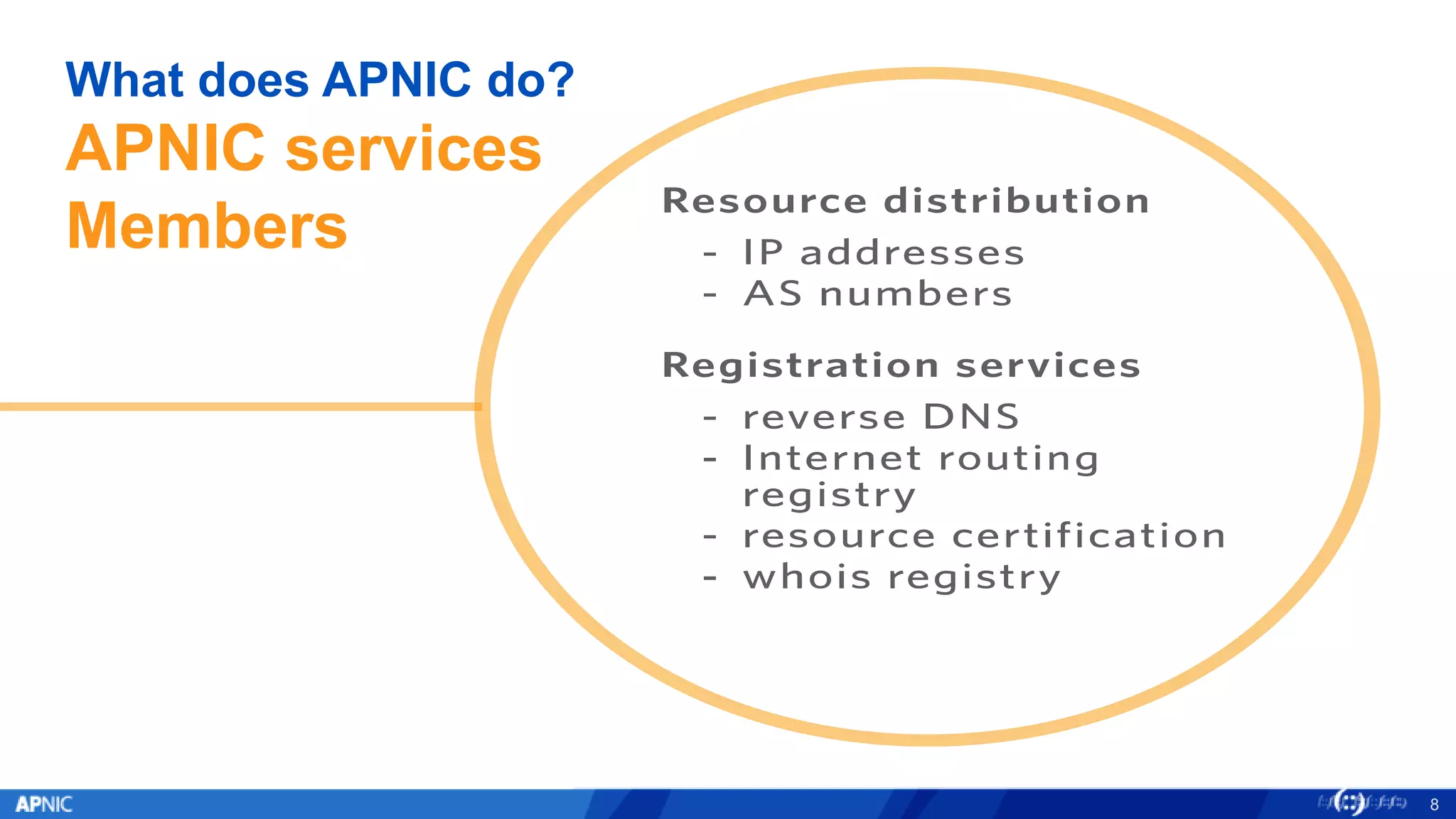
What does APNIC do?
APNIC services
Members
9
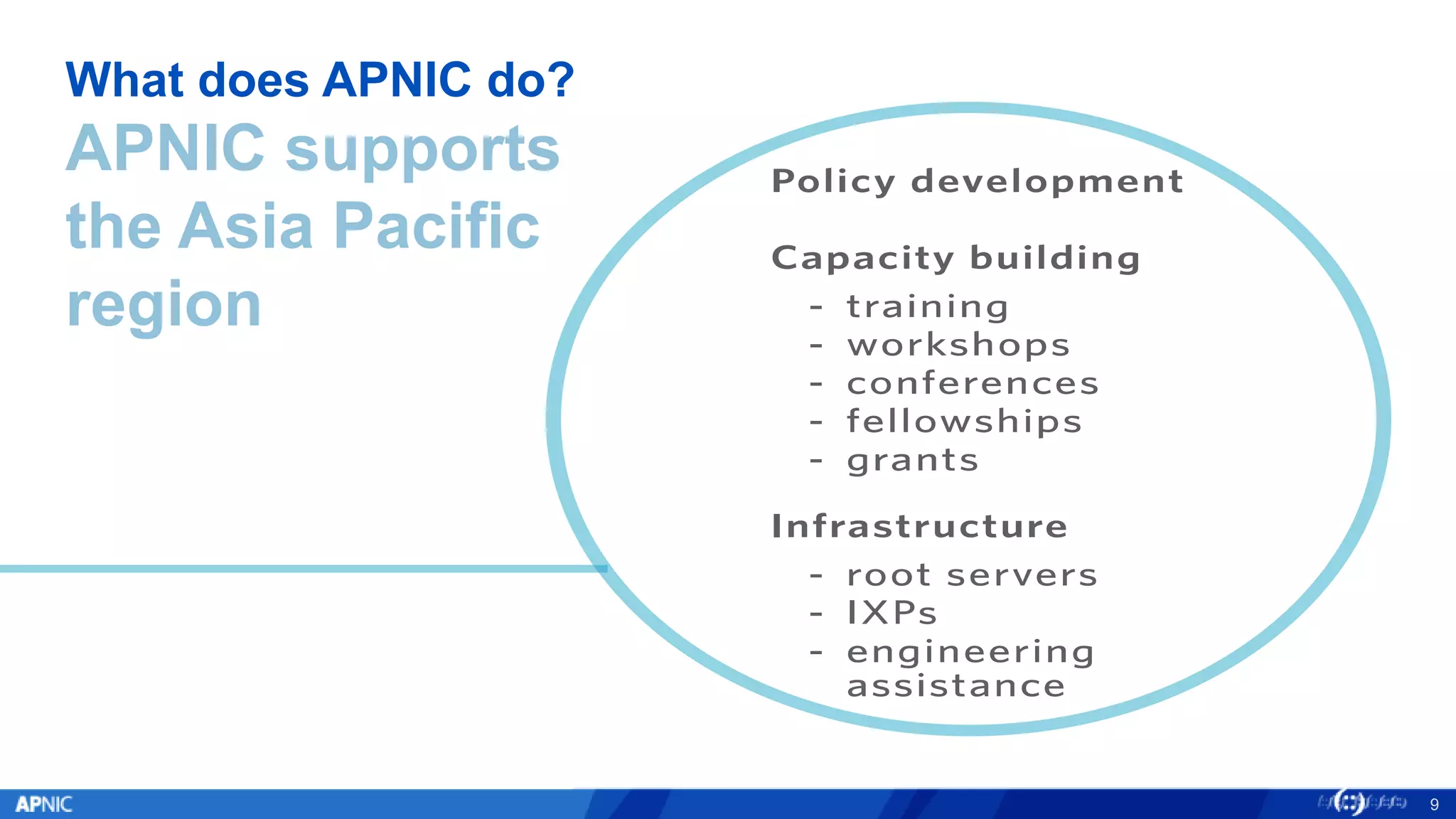
What does APNIC do?
APNIC supports
the Asia Pacific
region
10
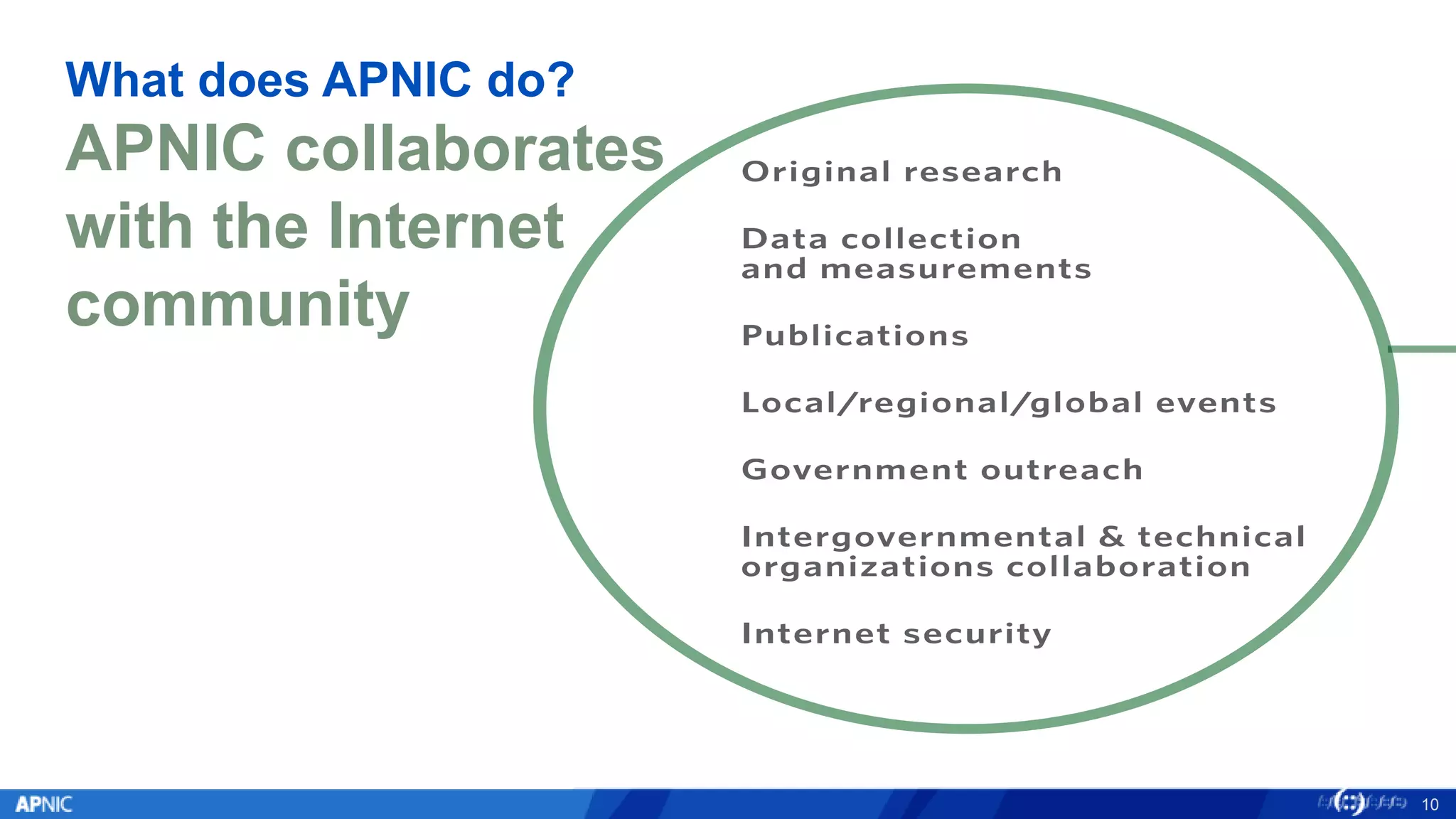
What does APNIC do?
APNIC collaborates
with the Internet
community
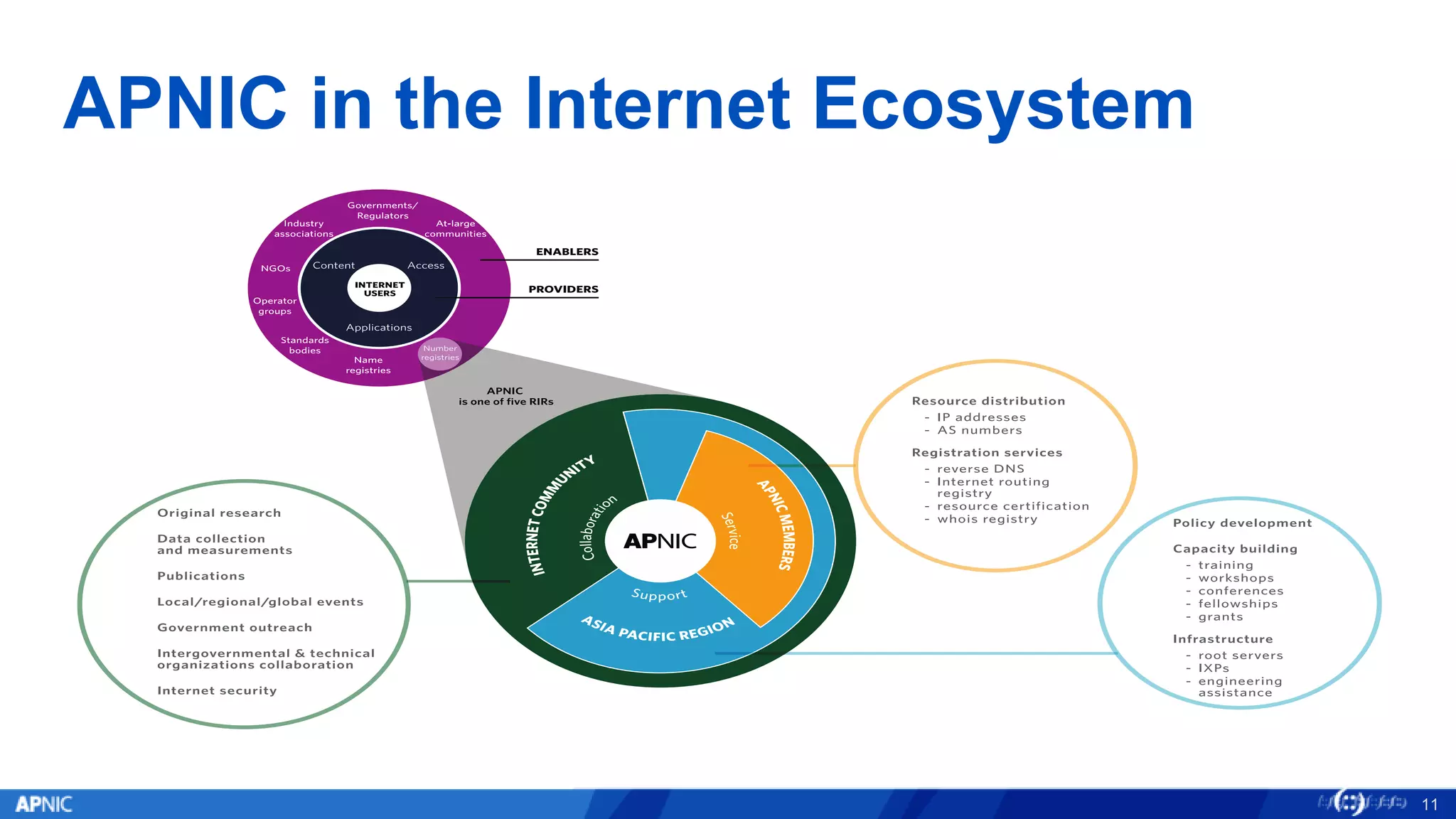
APNIC in the Internet Ecosystem
11
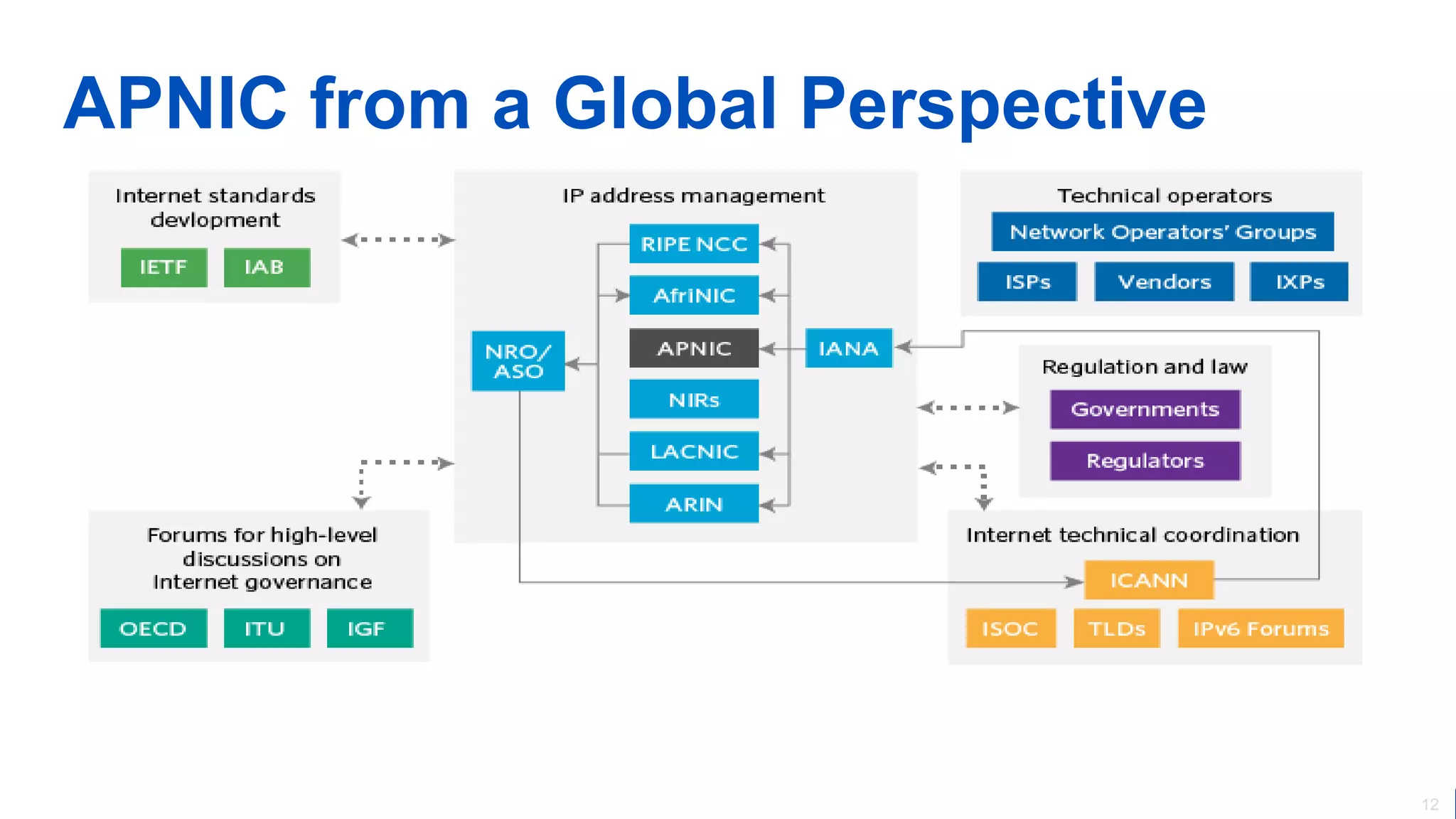
APNIC from a Global Perspective
12
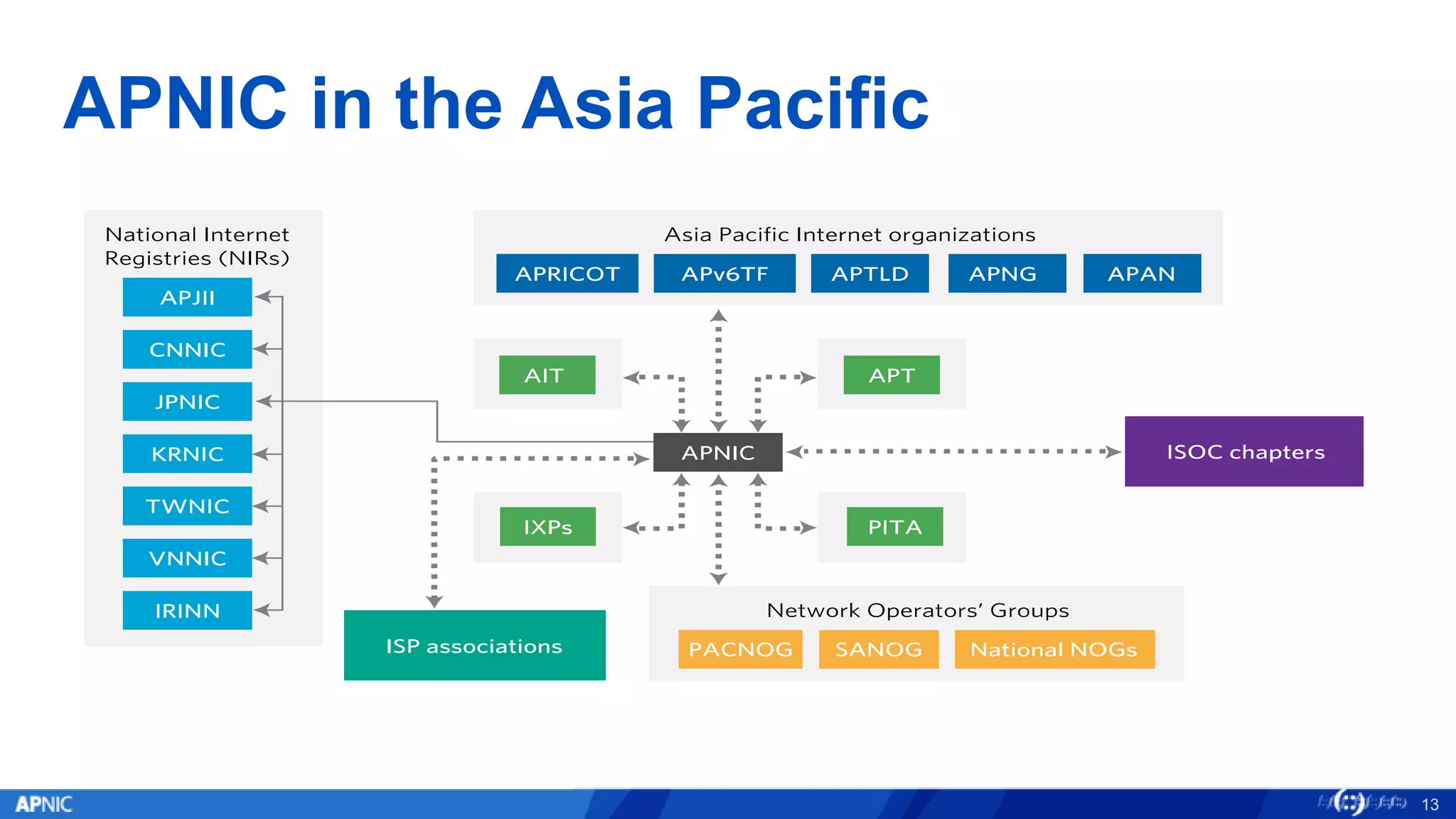
APNIC in the Asia Pacific
13
Policy Development
• Creating a policy environment that supports the region’s
Internet development
• Developed by the membership and broader Internet
community
14
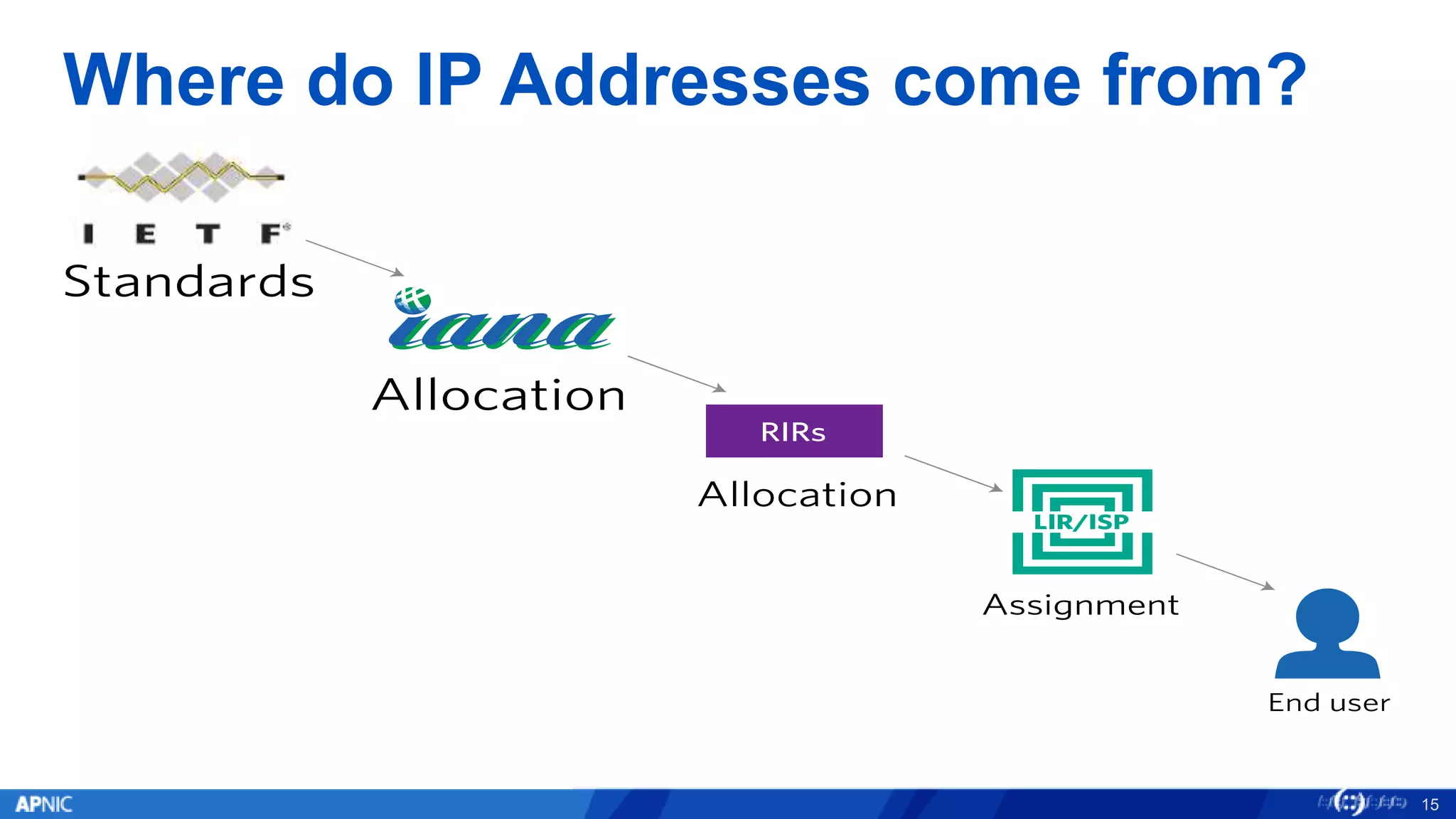
Where do IP Addresses come from?
15
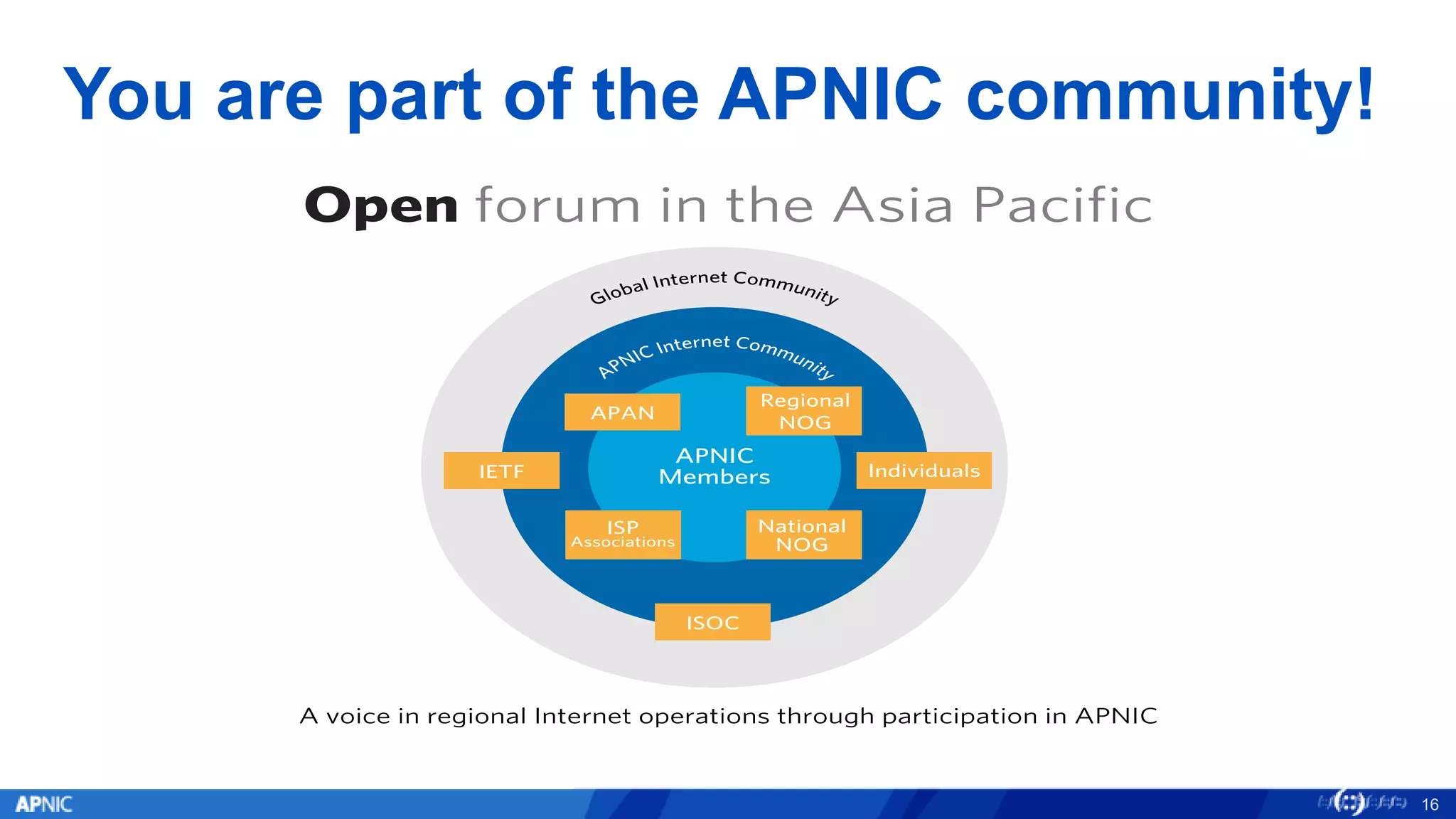
You are part of the APNIC community!
16
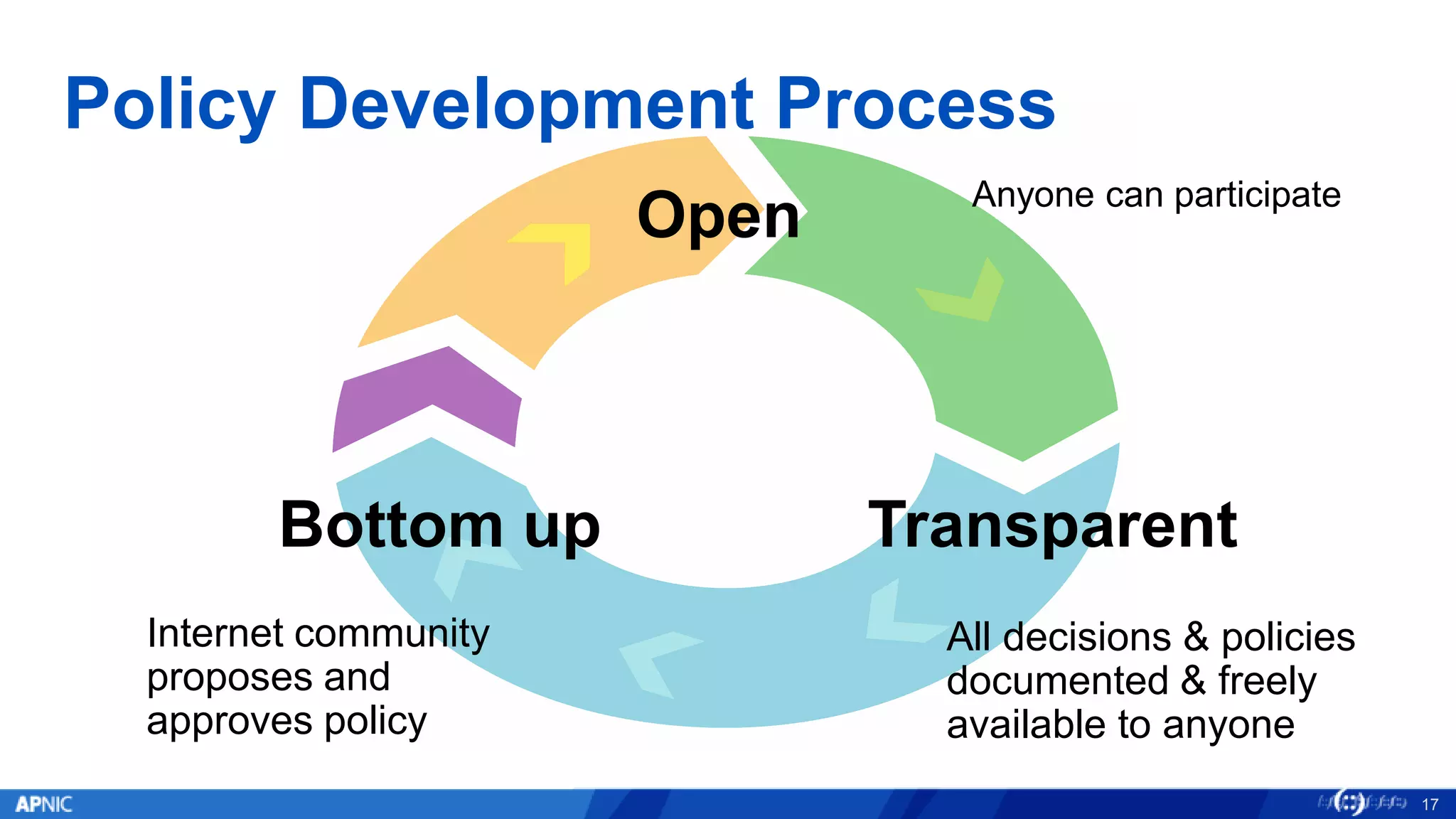
Policy Development Process
17
All decisions & policies
documented & freely
available to anyone
Internet community
proposes and
approves policy
Open
TransparentBottom up
Anyone can participate
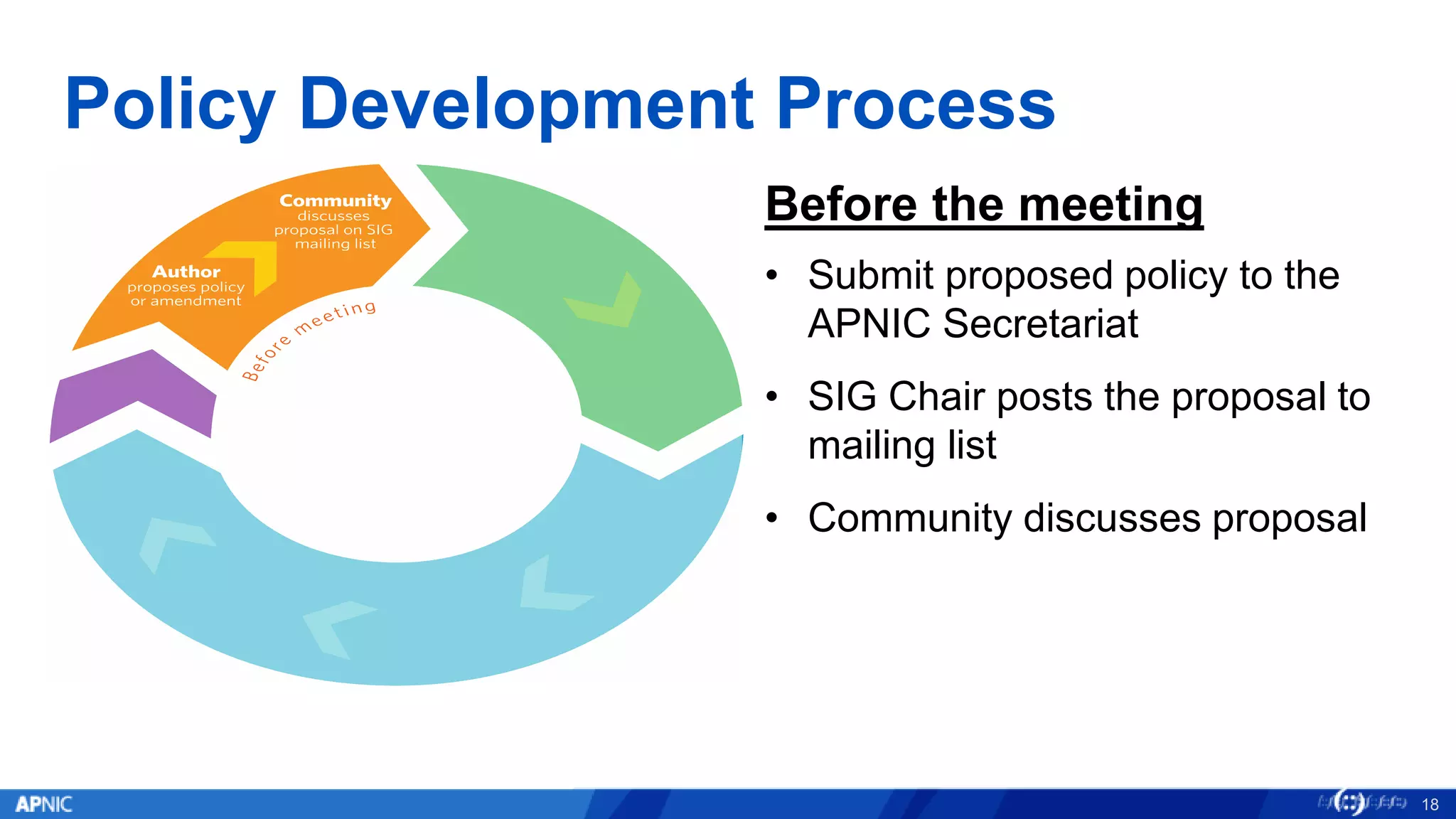
Policy Development Process
Before the meeting
• Submit proposed policy to the
APNIC Secretariat
• SIG Chair posts the proposal to
mailing list
• Community discusses proposal
18
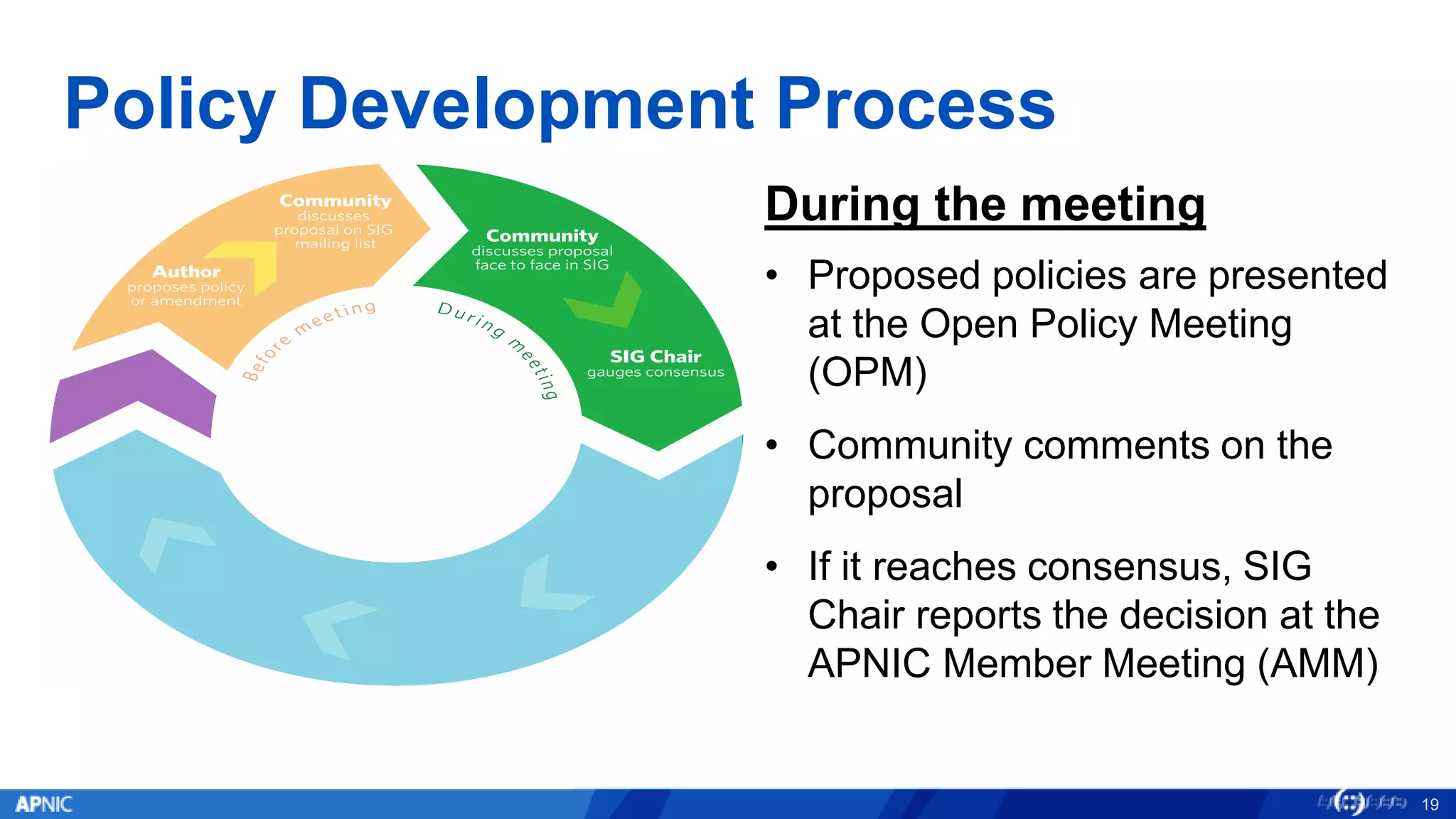
Policy Development Process
During the meeting
• Proposed policies are presented
at the Open Policy Meeting
(OPM)
• Community comments on the
proposal
• If it reaches consensus, SIG
Chair reports the decision at the
APNIC Member Meeting (AMM)
19
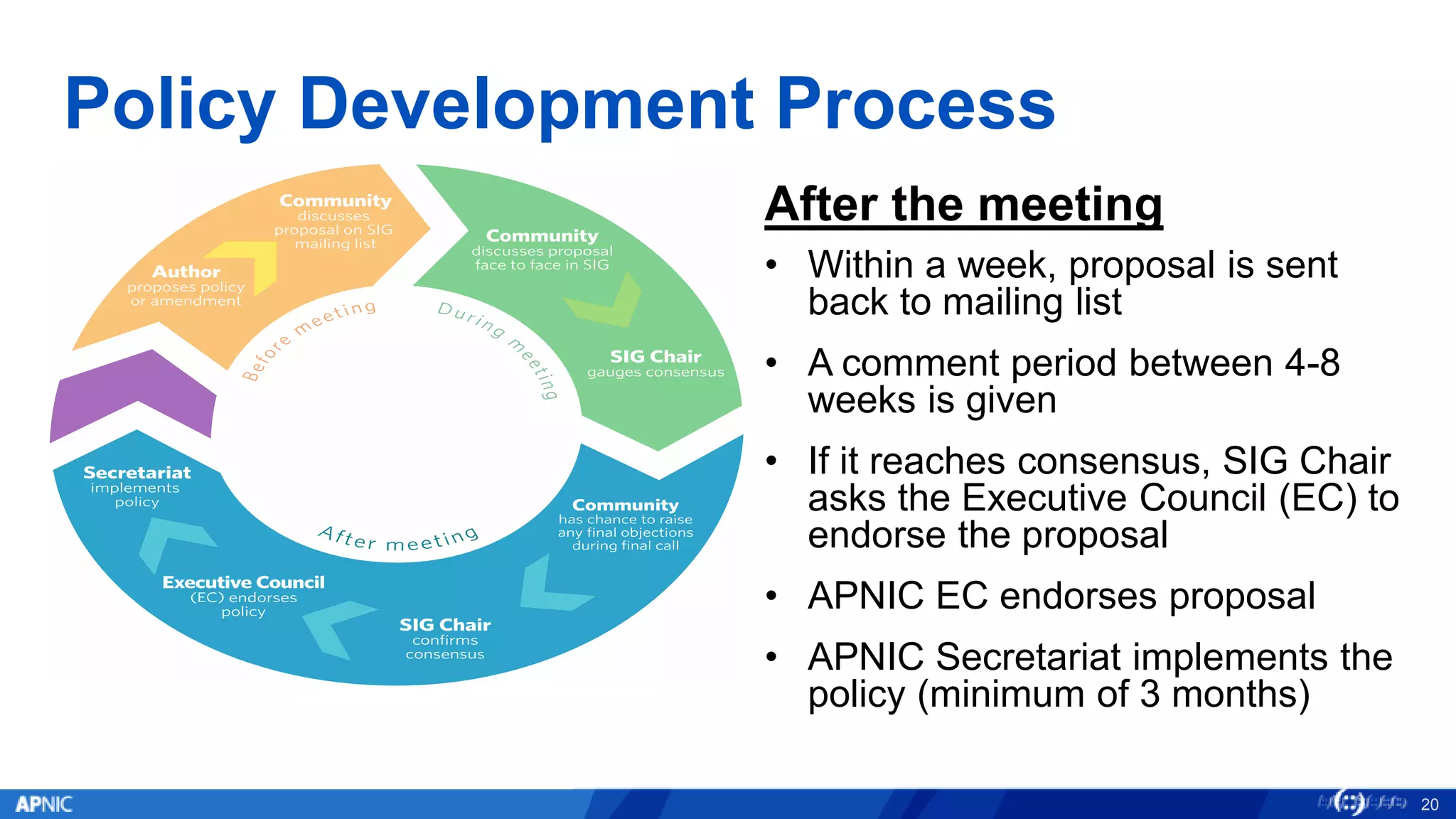
Policy Development Process
After the meeting
• Within a week, proposal is sent
back to mailing list
• A comment period between 4-8
weeks is given
• If it reaches consensus, SIG Chair
asks the Executive Council (EC) to
endorse the proposal
• APNIC EC endorses proposal
• APNIC Secretariat implements the
policy (minimum of 3 months)
20
Policy Discussions
• Comment
– Participants are encouraged to comment on the proposal
• Discuss
– The Chair encourages discussion about the pros and cons of the
proposal
• Show of hands
– to broadly measure opinion – not a vote
• Consensus
– declared if there are no objections
21
How to Participate
• Read the policy proposals currently under discussion
• Check out discussions on the Policy SIG mailing list
• Join the discussion at APNIC conferences
– webcast (live streaming)
– live transcripts
– comment on Jabber chat
• Provide your feedback
– Training or community outreach events
22
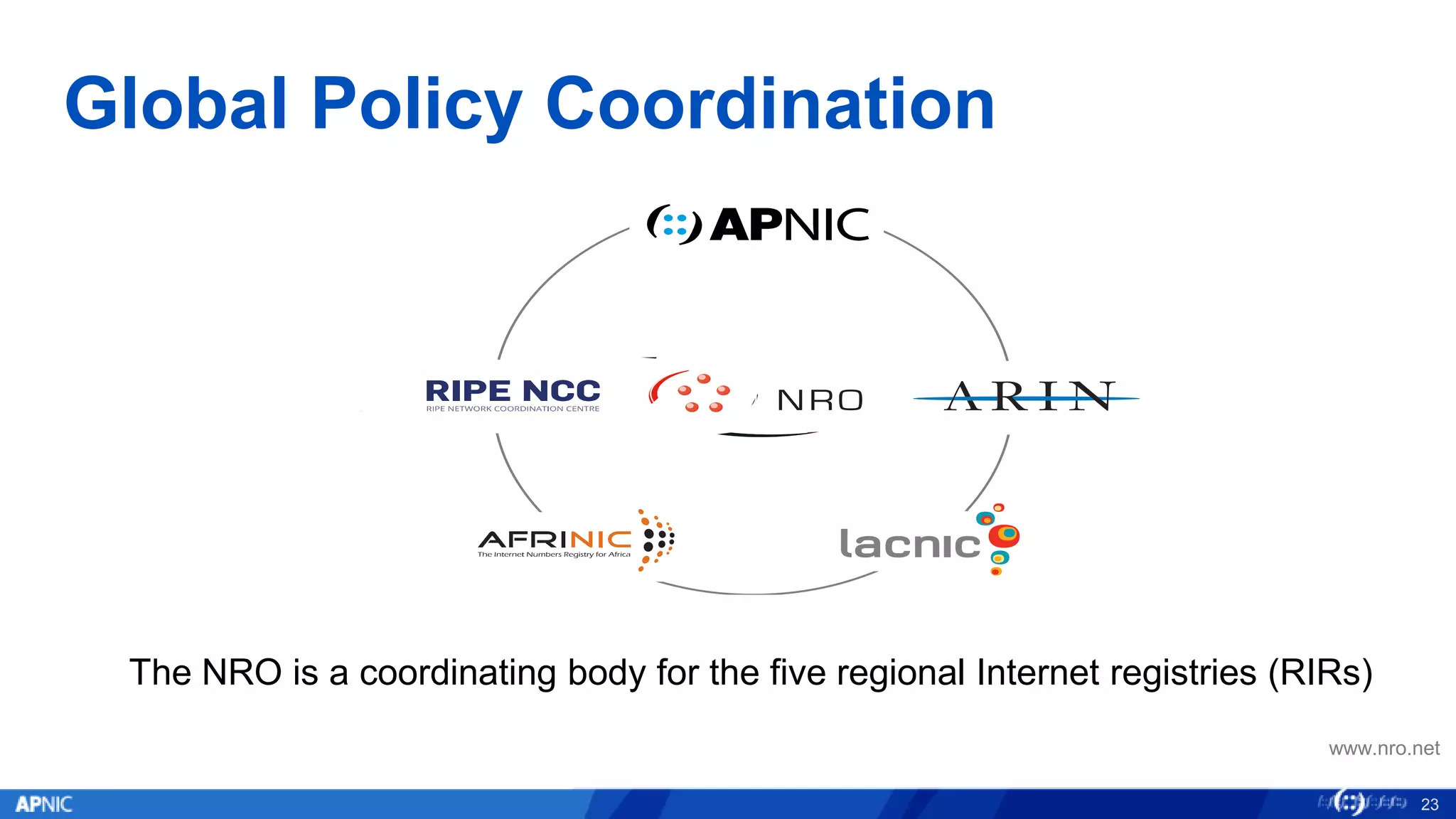
Global Policy Coordination
The NRO is a coordinating body for the five regional Internet registries (RIRs)
www.nro.net
23
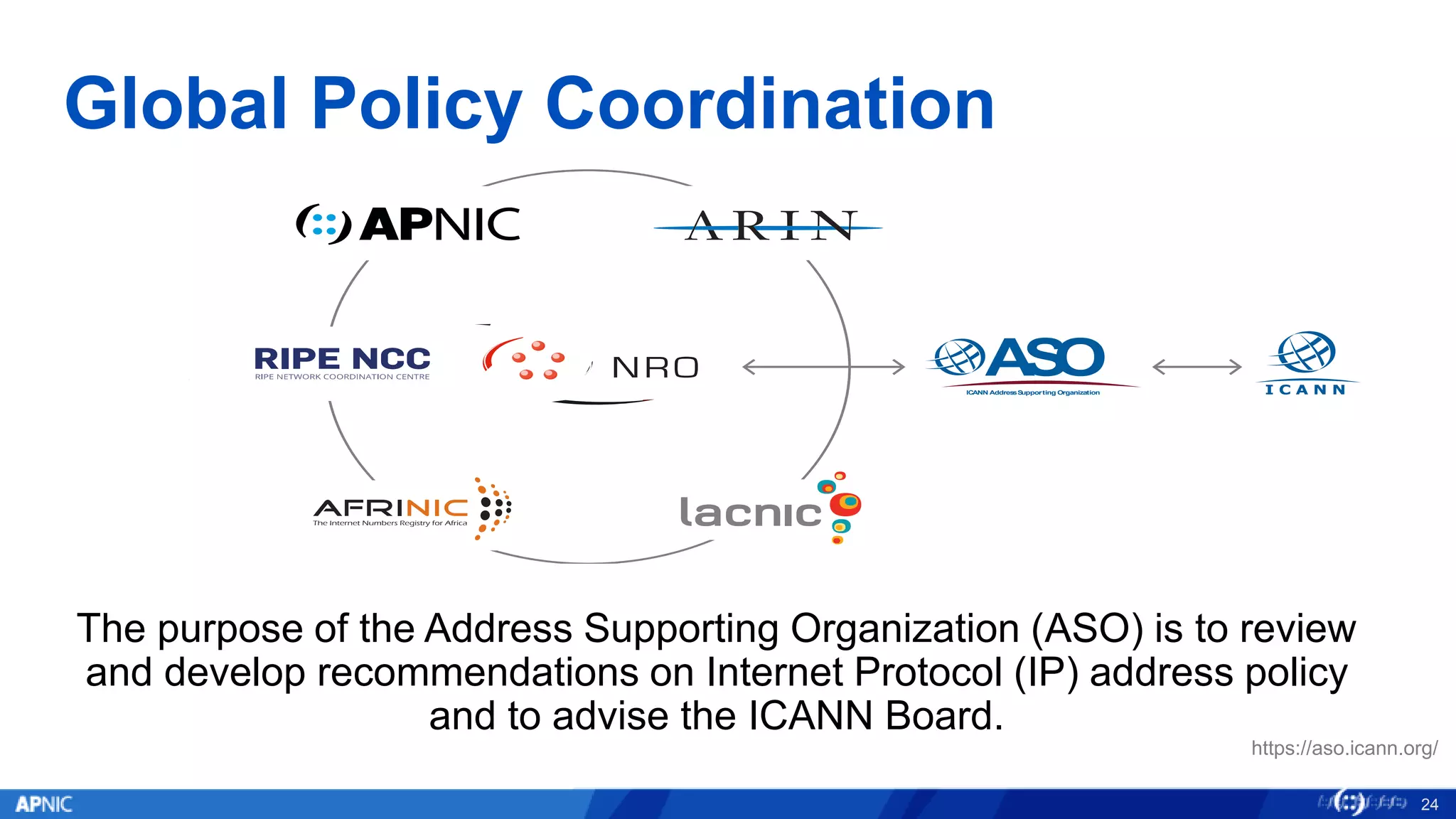
Global Policy Coordination
The purpose of the Address Supporting Organization (ASO) is to review
and develop recommendations on Internet Protocol (IP) address policy
and to advise the ICANN Board.
ASOICANN AddressSupporting Organization
https://aso.icann.org/
24
Training and Technical Assistance
25
TA- Indonesia
Network Security workshop, Hong
Kong
• 62 face-to-face courses in 25 locations
to 1,934 trainees
• Nine community trainers delivered 12
face-to-face courses in six locations
• 883 trainees in 130 eLearning sessions
• Updated IRM, IRR, Network Security,
MPLS, SDN, NFV courses with new
hands-on exercises
• Technical Assistance provided to nine
Members (ID, FJ, NC, BD, TL)
Training, Laos
Community Outreach
26
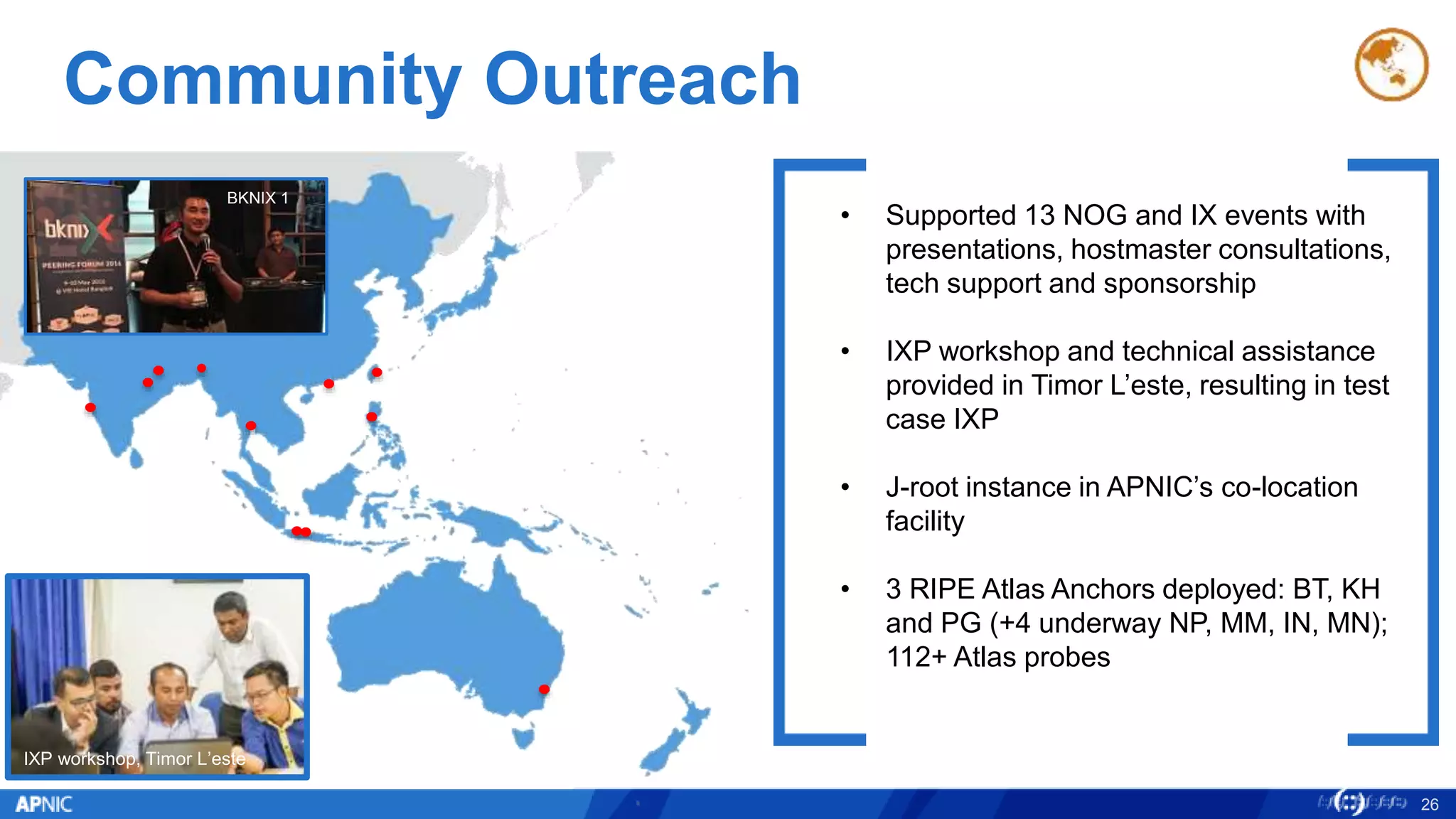
IXP workshop, Timor L’este
• Supported 13 NOG and IX events with
presentations, hostmaster consultations,
tech support and sponsorship
• IXP workshop and technical assistance
provided in Timor L’este, resulting in test
case IXP
• J-root instance in APNIC’s co-location
facility
• 3 RIPE Atlas Anchors deployed: BT, KH
and PG (+4 underway NP, MM, IN, MN);
112+ Atlas probes
BKNIX 1
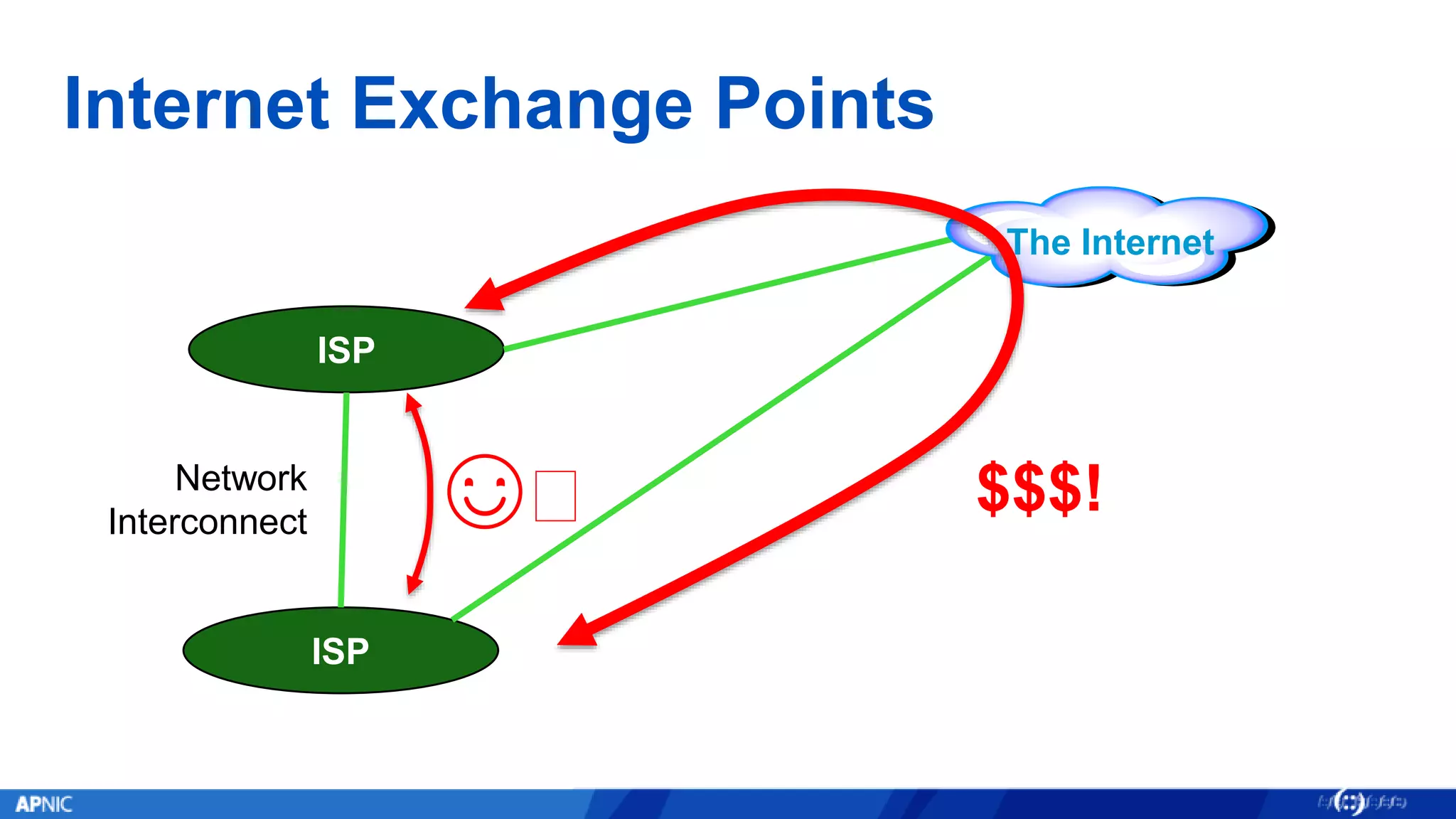
Internet Exchange Points
ISP
ISP
$$$!
The Internet
☺︎Network
Interconnect
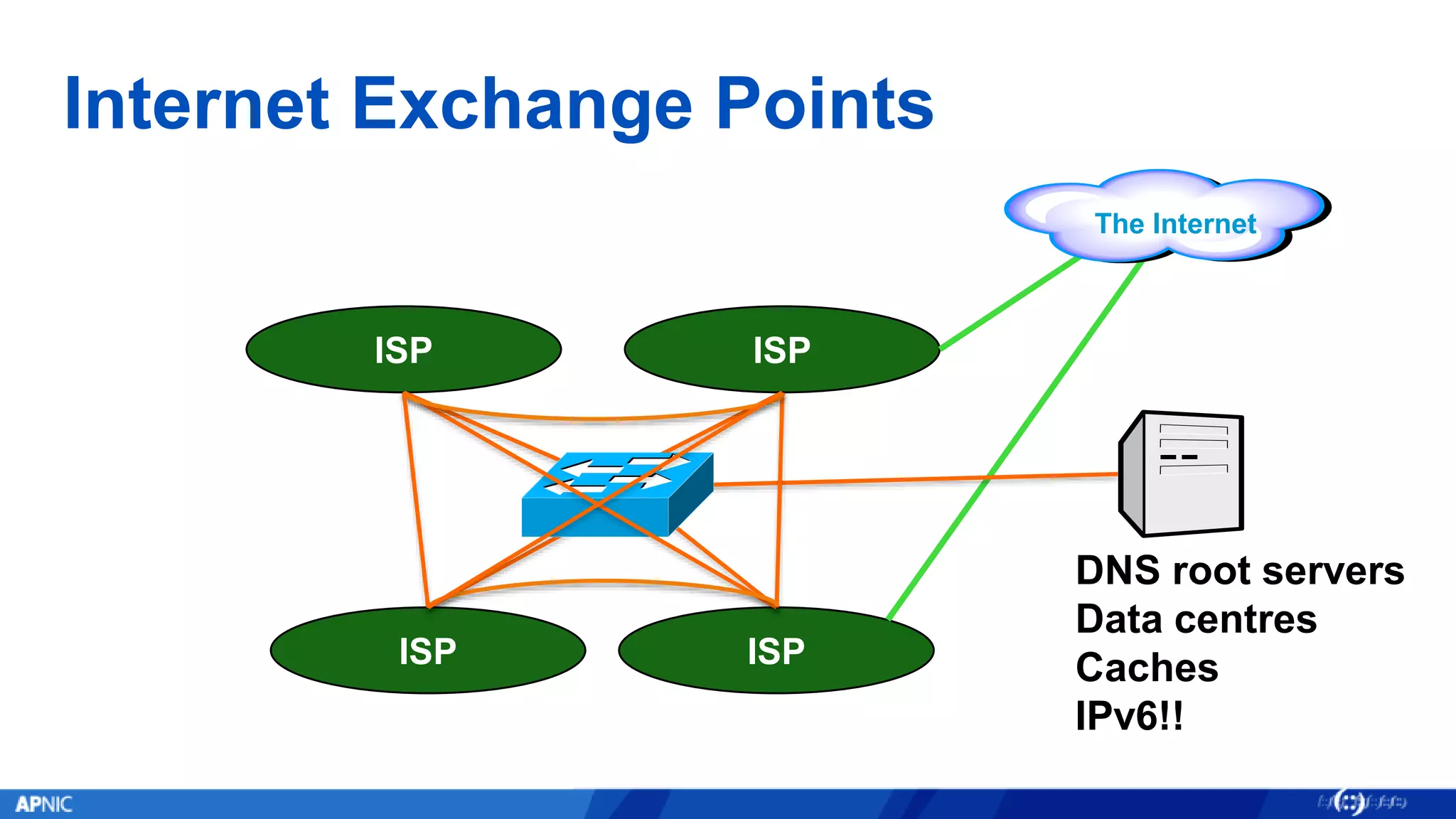
Internet Exchange Points
ISP
ISP
The Internet
ISP
DNS root servers
Data centres
Caches
IPv6!!
ISP
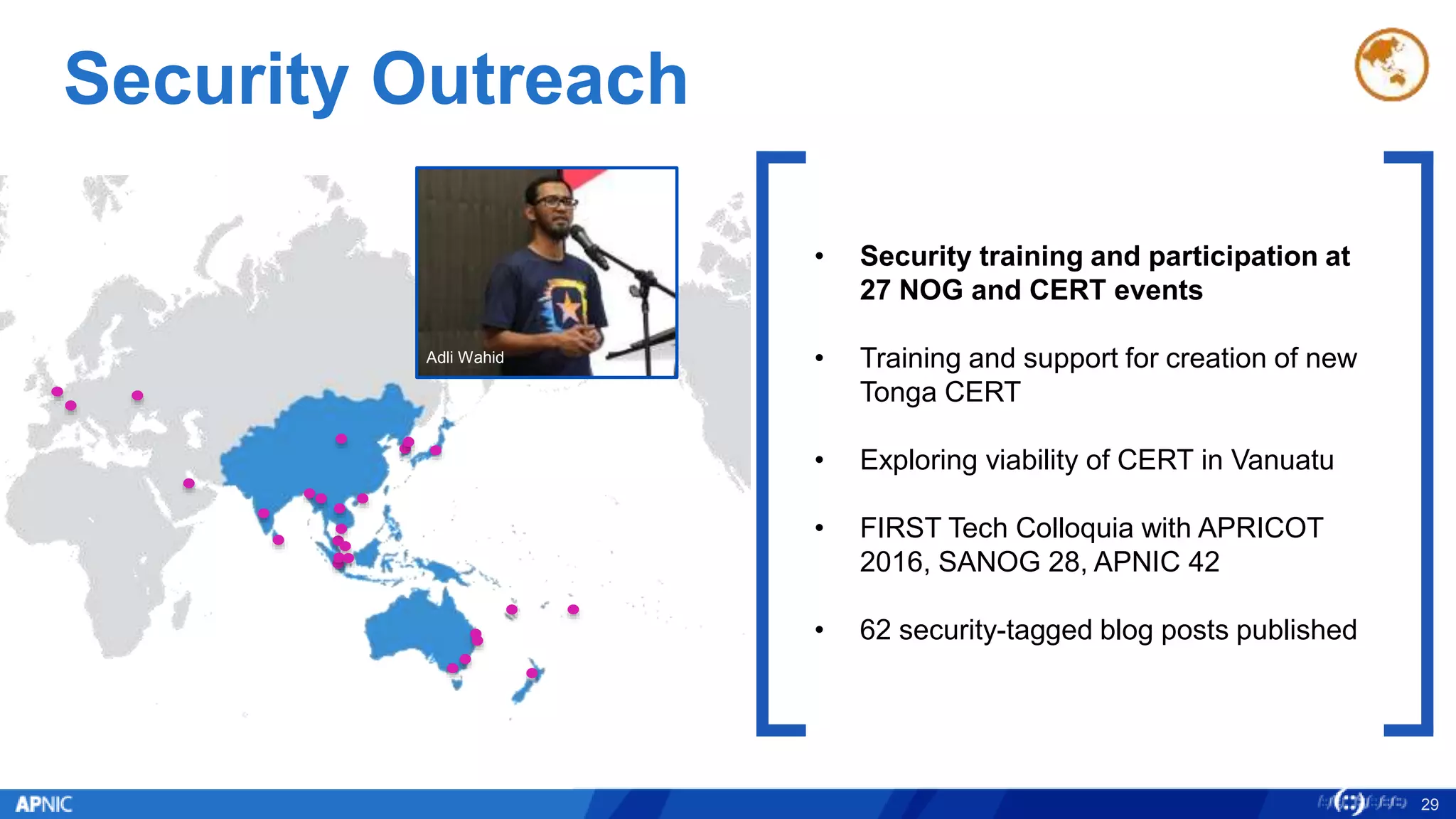
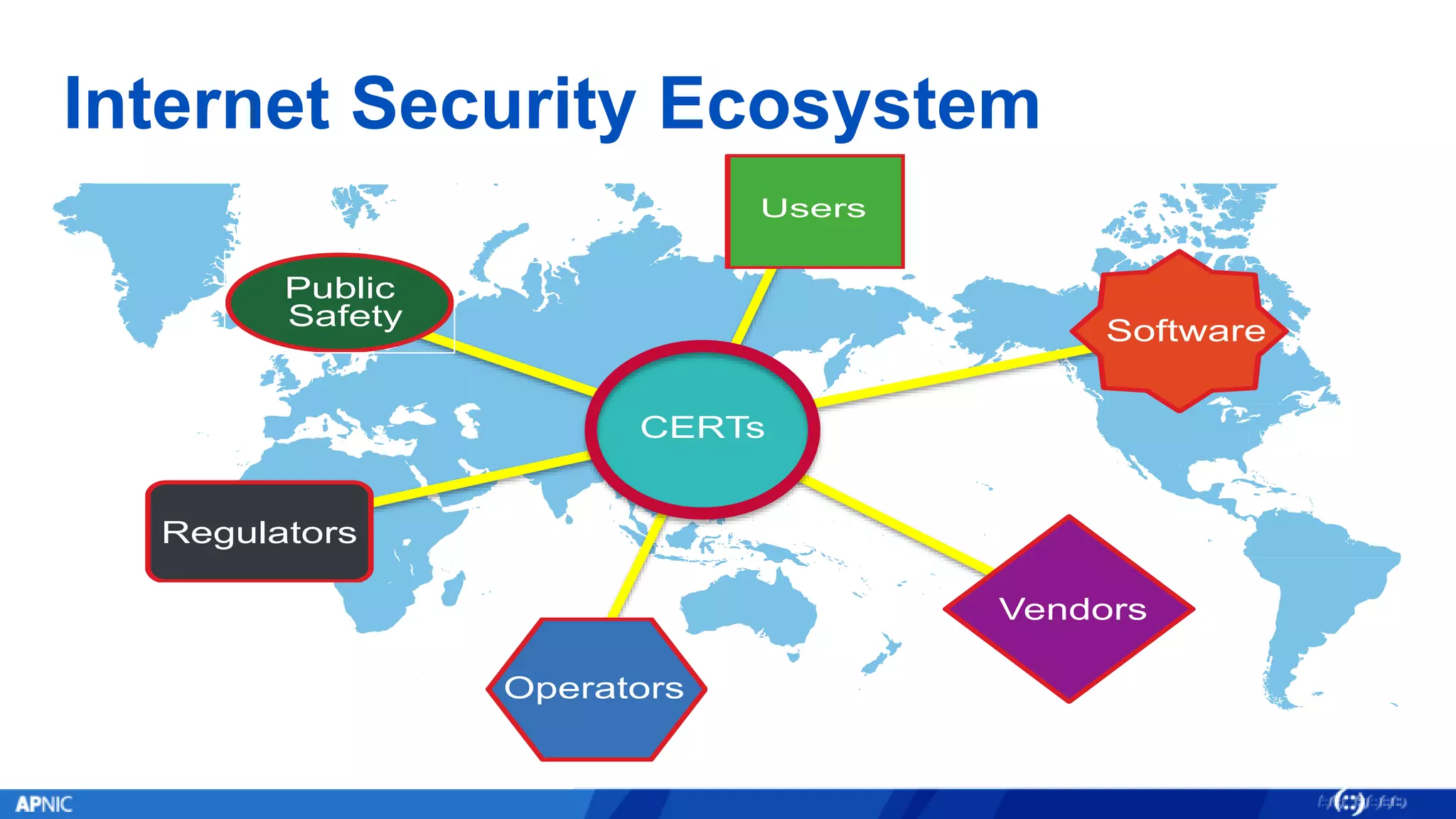
Security Outreach
29
• Security training and participation at
27 NOG and CERT events
• Training and support for creation of new
Tonga CERT
• Exploring viability of CERT in Vanuatu
• FIRST Tech Colloquia with APRICOT
2016, SANOG 28, APNIC 42
• 62 security-tagged blog posts published
Adli Wahid
Users
Public
Safety
Regulators
Operators
Vendors
Software
Internet Security Ecosystem
CERTs
Asia-Pacific
CERTs
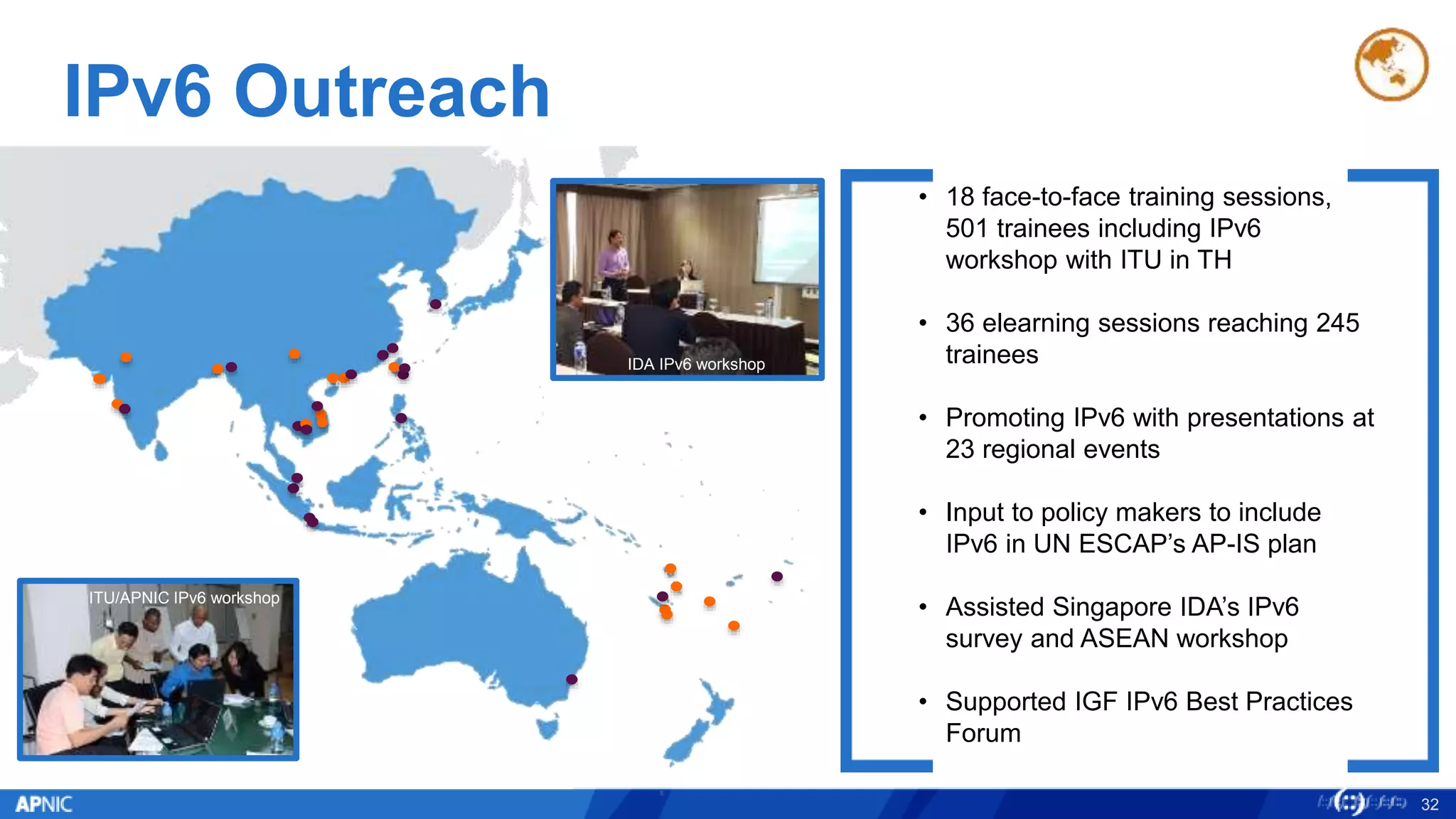
IPv6 Outreach
APNIC/ITU IPv6
Workshop, Bangkok
32
• 18 face-to-face training sessions,
501 trainees including IPv6
workshop with ITU in TH
• 36 elearning sessions reaching 245
trainees
• Promoting IPv6 with presentations at
23 regional events
• Input to policy makers to include
IPv6 in UN ESCAP’s AP-IS plan
• Assisted Singapore IDA’s IPv6
survey and ASEAN workshop
• Supported IGF IPv6 Best Practices
Forum
ITU/APNIC IPv6 workshop
IDA IPv6 workshop
APNIC Conferences
33
APRICOT
2016
APNIC 42
APRICOT 2016
APRICOT
2016
APNIC 42
Delegates 531 332
Economies represented 53 39
APNIC Members
represented
125 133
AGM delegates 237 287
Remote sessions
viewed
1,238 1,545
Fellows
Women
Youth
22
6
52
20
14
APNIC 42
blog.apnic.net
34
• Inclusive source of APNIC
community news and views –
352 posts including 80 guest
posts in 2016
• Strong readership growth
continues – monthly average
unique views 16,560 in 2016
(9,741 in 2015)
• Community submissions
welcome!
70% 86%
2016
2015
Views Guest Posts
198,715
116,892
80
43
APNIC Foundation
35
• Officially incorporated in Hong Kong in
September 2016
• First year of operation to begin in 2017
Partner & Project Amount
IDRC for Seed Alliance 500,000 CAD
JICA for APNIC Academy 20,000 USD
ITU for IPv6 Training 9,500 USD
ITU for IXP Training 4,300 USD
https://apnic.foundation
Next APNIC Conference
36
Registration and
fellowships available soon
https://conference.apnic.net/44
Coming later…
37
APRICOT 2018, Kathmandu, Nepal
19 February to 1 March 2018
Fellowships will be available!
Stay in Touch!
38
blog.apnic.net
apnic.net/social
39
THANK YOU
Sunny Chendi
Senior Advisor Community Development
sunny@apnic.net

IGFA 2017: Introduction to APNIC and Regional Internet Registries

  • 1.
    1 Introduction to APNICand Regional Internet Registries (RIRs) IGFA 2017 Kabul 28 March 2017
  • 2.
  • 4.
    What is APNIC? •The Regional Internet address Registry (RIR) for the AP region • Manages Internet number resources – Including IPv4 and IPv6 addresses • Supports training, education and internet development • A neutral, independent, not-for-profit, open membership-based organisation, since 1993 www.apnic.net 4
  • 5.
    Where is theAPNIC Region? 5
  • 6.
    APNIC Region • APNICcovers the entire Asia Pacific, comprising 56 economies throughout Asia and Oceania. • APNIC classifies these economies into four regions: South Asia, South East Asia, East Asia and Oceania. 6
  • 7.
    APNIC – Vision Aglobal, open, stable, and secure Internet that serves the entire Asia Pacific community. How we achieve this: • Serving Members • Supporting the Asia Pacific Region • Collaborating with the Internet Community 7
  • 8.
    8 What does APNICdo? APNIC services Members
  • 9.
    9 What does APNICdo? APNIC supports the Asia Pacific region
  • 10.
    10 What does APNICdo? APNIC collaborates with the Internet community
  • 11.
    APNIC in theInternet Ecosystem 11
  • 12.
    APNIC from aGlobal Perspective 12
  • 13.
    APNIC in theAsia Pacific 13
  • 14.
    Policy Development • Creatinga policy environment that supports the region’s Internet development • Developed by the membership and broader Internet community 14
  • 15.
    Where do IPAddresses come from? 15
  • 16.
    You are partof the APNIC community! 16
  • 17.
    Policy Development Process 17 Alldecisions & policies documented & freely available to anyone Internet community proposes and approves policy Open TransparentBottom up Anyone can participate
  • 18.
    Policy Development Process Beforethe meeting • Submit proposed policy to the APNIC Secretariat • SIG Chair posts the proposal to mailing list • Community discusses proposal 18
  • 19.
    Policy Development Process Duringthe meeting • Proposed policies are presented at the Open Policy Meeting (OPM) • Community comments on the proposal • If it reaches consensus, SIG Chair reports the decision at the APNIC Member Meeting (AMM) 19
  • 20.
    Policy Development Process Afterthe meeting • Within a week, proposal is sent back to mailing list • A comment period between 4-8 weeks is given • If it reaches consensus, SIG Chair asks the Executive Council (EC) to endorse the proposal • APNIC EC endorses proposal • APNIC Secretariat implements the policy (minimum of 3 months) 20
  • 21.
    Policy Discussions • Comment –Participants are encouraged to comment on the proposal • Discuss – The Chair encourages discussion about the pros and cons of the proposal • Show of hands – to broadly measure opinion – not a vote • Consensus – declared if there are no objections 21
  • 22.
    How to Participate •Read the policy proposals currently under discussion • Check out discussions on the Policy SIG mailing list • Join the discussion at APNIC conferences – webcast (live streaming) – live transcripts – comment on Jabber chat • Provide your feedback – Training or community outreach events 22
  • 23.
    Global Policy Coordination TheNRO is a coordinating body for the five regional Internet registries (RIRs) www.nro.net 23
  • 24.
    Global Policy Coordination Thepurpose of the Address Supporting Organization (ASO) is to review and develop recommendations on Internet Protocol (IP) address policy and to advise the ICANN Board. ASOICANN AddressSupporting Organization https://aso.icann.org/ 24
  • 25.
    Training and TechnicalAssistance 25 TA- Indonesia Network Security workshop, Hong Kong • 62 face-to-face courses in 25 locations to 1,934 trainees • Nine community trainers delivered 12 face-to-face courses in six locations • 883 trainees in 130 eLearning sessions • Updated IRM, IRR, Network Security, MPLS, SDN, NFV courses with new hands-on exercises • Technical Assistance provided to nine Members (ID, FJ, NC, BD, TL) Training, Laos
  • 26.
    Community Outreach 26 IXP workshop,Timor L’este • Supported 13 NOG and IX events with presentations, hostmaster consultations, tech support and sponsorship • IXP workshop and technical assistance provided in Timor L’este, resulting in test case IXP • J-root instance in APNIC’s co-location facility • 3 RIPE Atlas Anchors deployed: BT, KH and PG (+4 underway NP, MM, IN, MN); 112+ Atlas probes BKNIX 1
  • 27.
    Internet Exchange Points ISP ISP $$$! TheInternet ☺︎Network Interconnect
  • 28.
    Internet Exchange Points ISP ISP TheInternet ISP DNS root servers Data centres Caches IPv6!! ISP
  • 29.
    Security Outreach 29 • Securitytraining and participation at 27 NOG and CERT events • Training and support for creation of new Tonga CERT • Exploring viability of CERT in Vanuatu • FIRST Tech Colloquia with APRICOT 2016, SANOG 28, APNIC 42 • 62 security-tagged blog posts published Adli Wahid
  • 30.
  • 31.
  • 32.
    IPv6 Outreach APNIC/ITU IPv6 Workshop,Bangkok 32 • 18 face-to-face training sessions, 501 trainees including IPv6 workshop with ITU in TH • 36 elearning sessions reaching 245 trainees • Promoting IPv6 with presentations at 23 regional events • Input to policy makers to include IPv6 in UN ESCAP’s AP-IS plan • Assisted Singapore IDA’s IPv6 survey and ASEAN workshop • Supported IGF IPv6 Best Practices Forum ITU/APNIC IPv6 workshop IDA IPv6 workshop
  • 33.
    APNIC Conferences 33 APRICOT 2016 APNIC 42 APRICOT2016 APRICOT 2016 APNIC 42 Delegates 531 332 Economies represented 53 39 APNIC Members represented 125 133 AGM delegates 237 287 Remote sessions viewed 1,238 1,545 Fellows Women Youth 22 6 52 20 14 APNIC 42
  • 34.
    blog.apnic.net 34 • Inclusive sourceof APNIC community news and views – 352 posts including 80 guest posts in 2016 • Strong readership growth continues – monthly average unique views 16,560 in 2016 (9,741 in 2015) • Community submissions welcome! 70% 86% 2016 2015 Views Guest Posts 198,715 116,892 80 43
  • 35.
    APNIC Foundation 35 • Officiallyincorporated in Hong Kong in September 2016 • First year of operation to begin in 2017 Partner & Project Amount IDRC for Seed Alliance 500,000 CAD JICA for APNIC Academy 20,000 USD ITU for IPv6 Training 9,500 USD ITU for IXP Training 4,300 USD https://apnic.foundation
  • 36.
    Next APNIC Conference 36 Registrationand fellowships available soon https://conference.apnic.net/44
  • 37.
    Coming later… 37 APRICOT 2018,Kathmandu, Nepal 19 February to 1 March 2018 Fellowships will be available!
  • 38.
  • 39.
    39 THANK YOU Sunny Chendi SeniorAdvisor Community Development sunny@apnic.net