Issue Date:
Revision:
Enhancing Security
Incident Response
Capabilities in the Asia
Pacific Region
6th APT Cybersecurity Forum
Adli Wahid
Security Specialist, APNIC
Agenda
1. About APNIC
2. Enhancing Incident Response
Capabilities
3. Recent and future activities
2
About APNIC
3
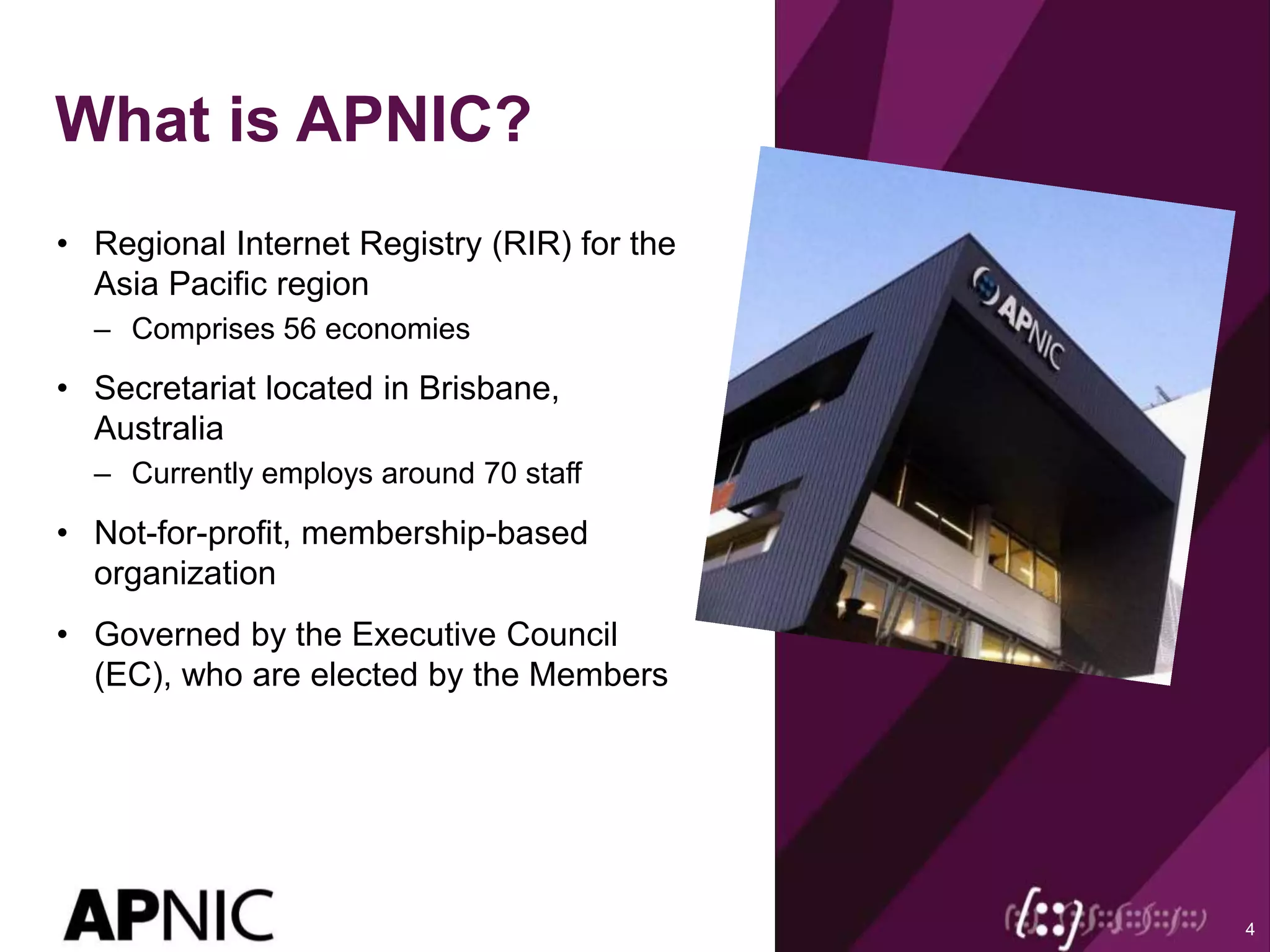
What is APNIC?
• Regional Internet Registry (RIR) for the
Asia Pacific region
– Comprises 56 economies
• Secretariat located in Brisbane,
Australia
– Currently employs around 70 staff
• Not-for-profit, membership-based
organization
• Governed by the Executive Council
(EC), who are elected by the Members
4
APNIC’s Vision:
A global, open, stable, and secure Internet that
serves the entire Asia Pacific community.
How we achieve this:
• Serving Members
• Supporting the Asia Pacific Region
• Collaborating with the Internet Community
5
Enhancing Incident
Response Capabilities in the
AP Region
6
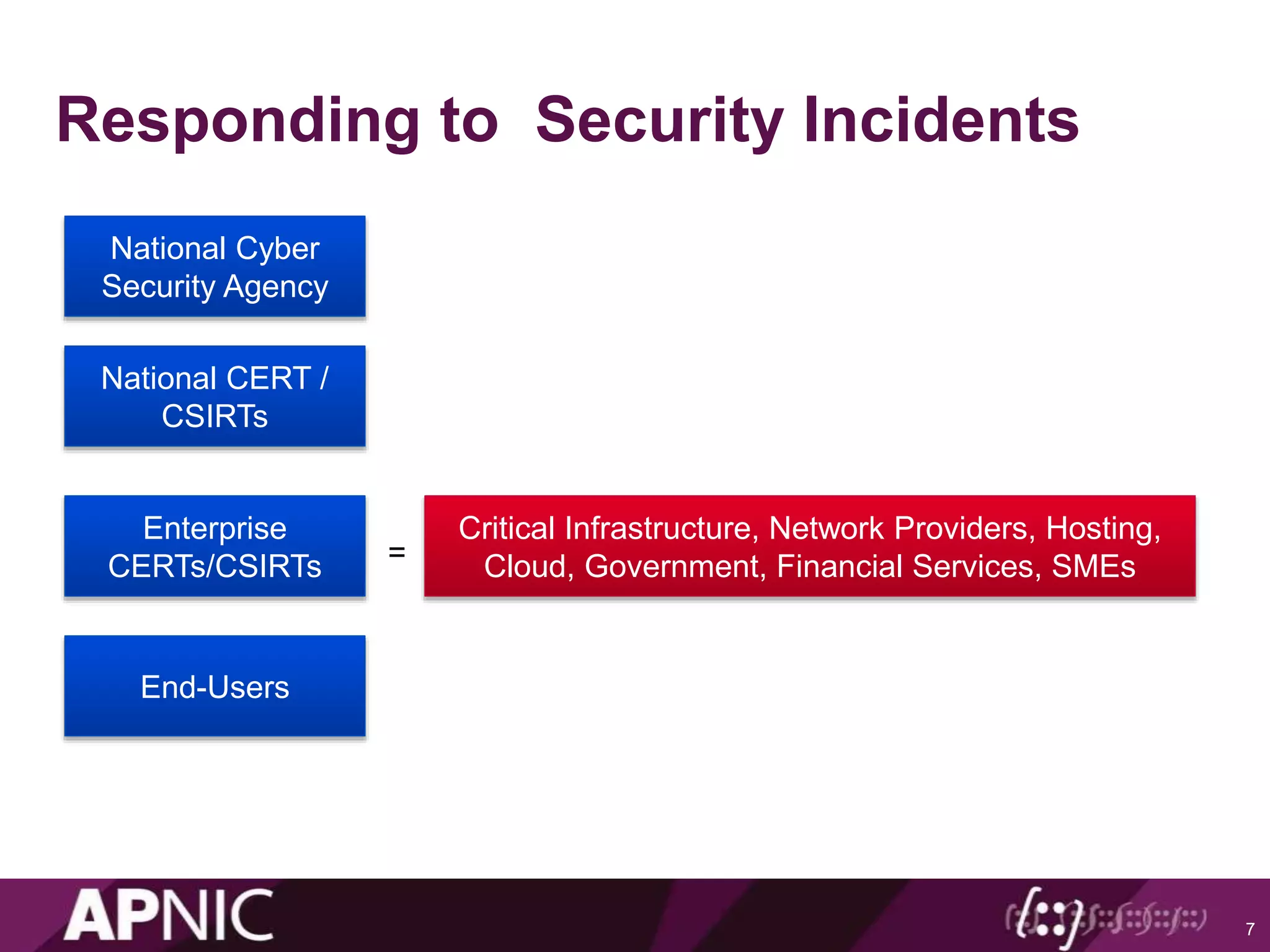
Responding to Security Incidents
7
National Cyber
Security Agency
National CERT /
CSIRTs
Enterprise
CERTs/CSIRTs
End-Users
Critical Infrastructure, Network Providers, Hosting,
Cloud, Government, Financial Services, SMEs=
Network Operators / Service
Providers
• A key player in the Incident Response process
• Availability is important
– Critical Infrastructure (Internet Exchange)
– Increasing becoming a target
• Need to be aware of the (changing) threat landscape
– Help increase resilience the infrastructure by applying best practices
– Provide timely assistance & mitigation
– Emerging Trends - IOTs
– CERT/CSIRT of the last resort
• Network Operators Groups (NOGs)
– Local & Regional NOGs
– APRICOT & APNIC Conference
8
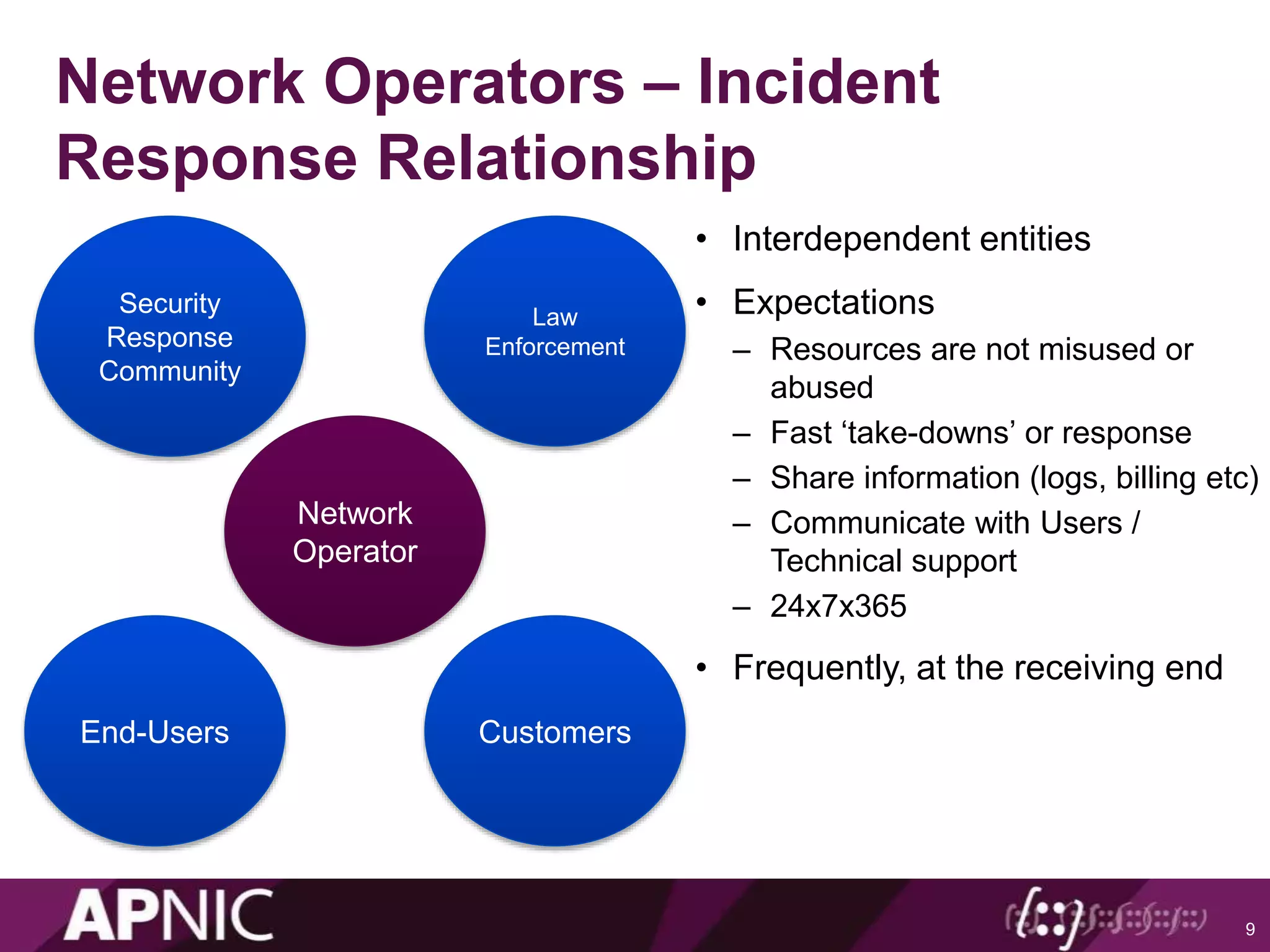
Network Operators – Incident
Response Relationship
• Interdependent entities
• Expectations
– Resources are not misused or
abused
– Fast ‘take-downs’ or response
– Share information (logs, billing etc)
– Communicate with Users /
Technical support
– 24x7x365
• Frequently, at the receiving end
9
Network
Operator
End-Users Customers
Security
Response
Community
Law
Enforcement
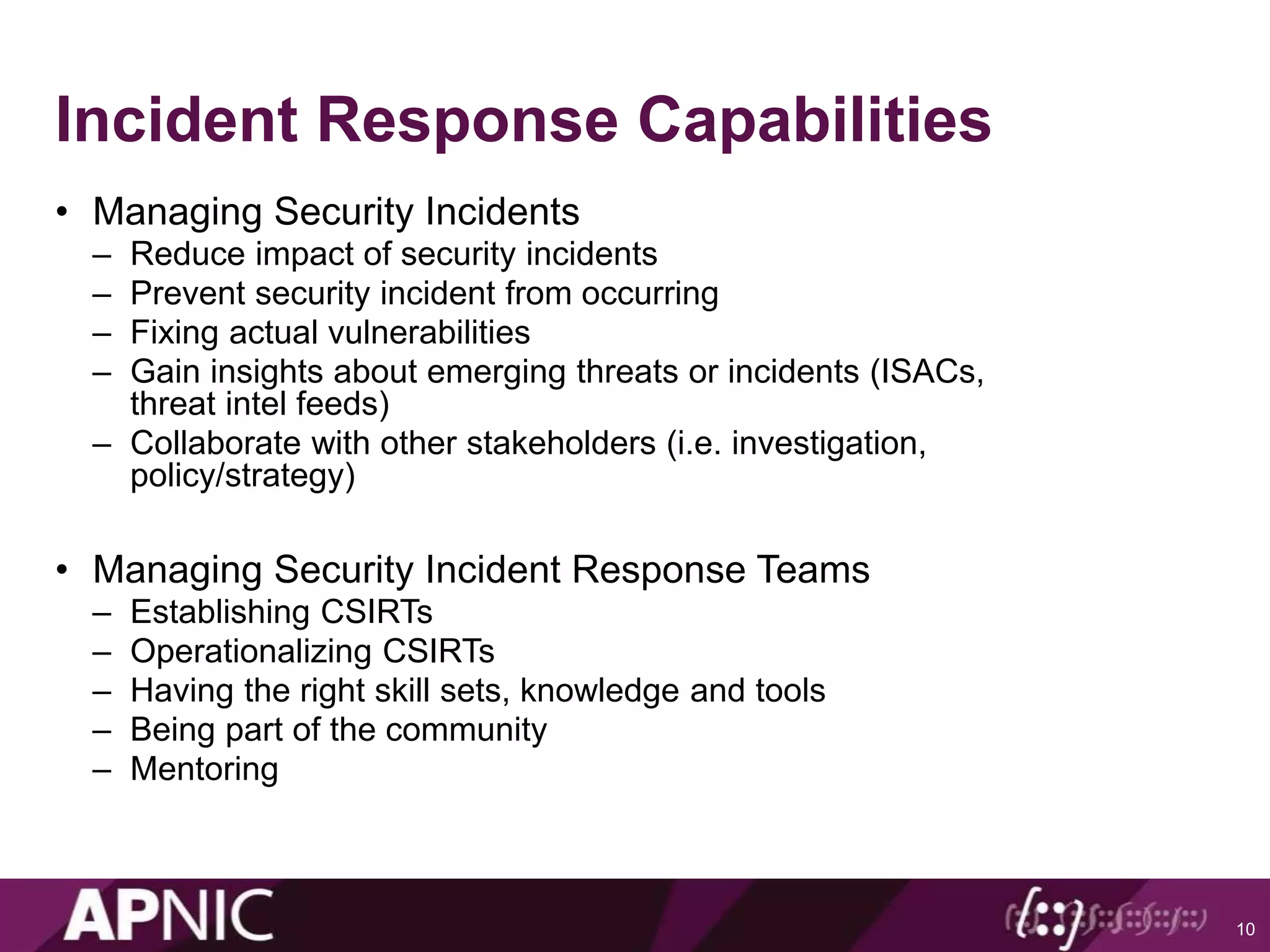
Incident Response Capabilities
• Managing Security Incidents
– Reduce impact of security incidents
– Prevent security incident from occurring
– Fixing actual vulnerabilities
– Gain insights about emerging threats or incidents (ISACs,
threat intel feeds)
– Collaborate with other stakeholders (i.e. investigation,
policy/strategy)
• Managing Security Incident Response Teams
– Establishing CSIRTs
– Operationalizing CSIRTs
– Having the right skill sets, knowledge and tools
– Being part of the community
– Mentoring
10
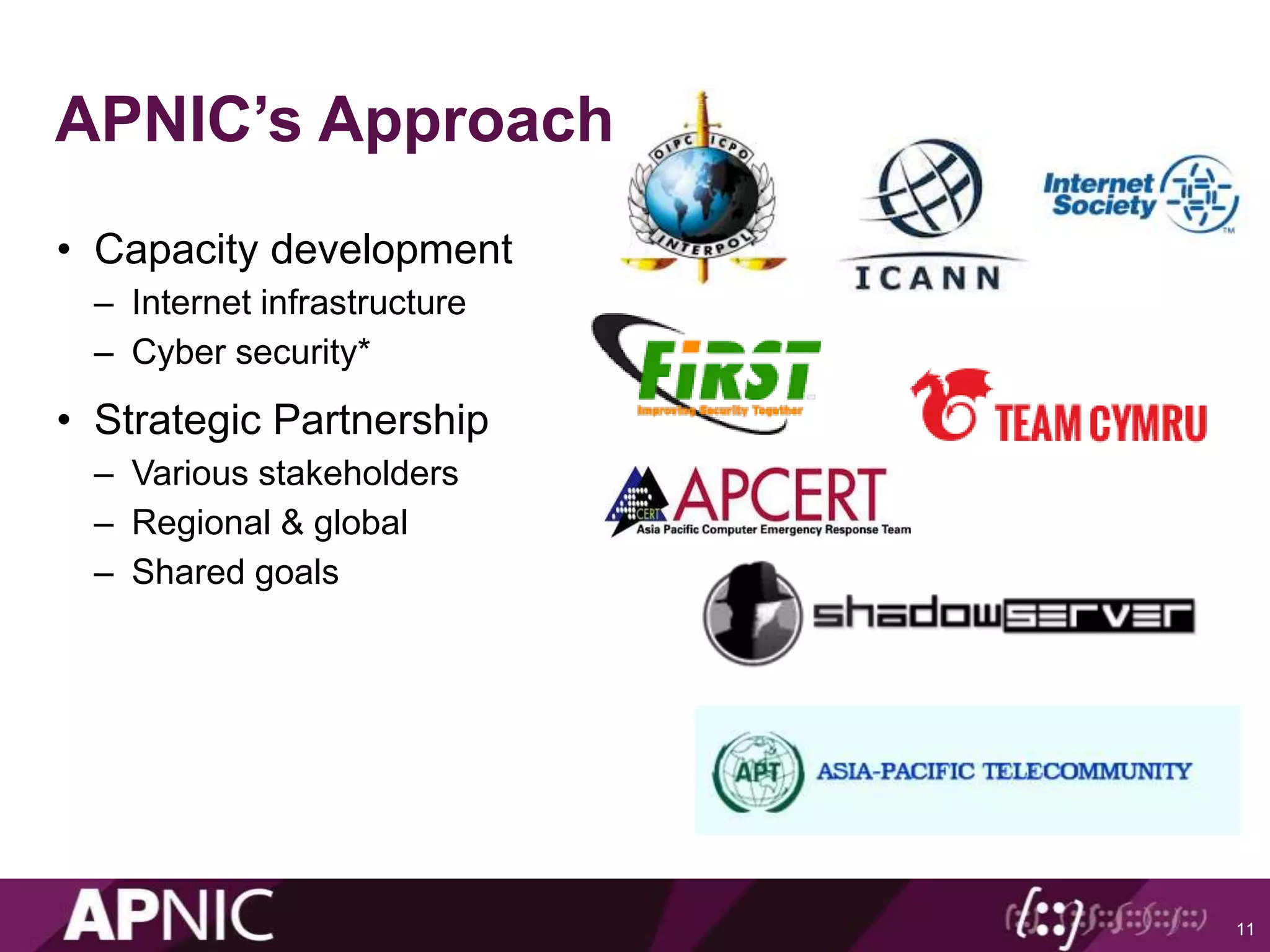
APNIC’s Approach
• Capacity development
– Internet infrastructure
– Cyber security*
• Strategic Partnership
– Various stakeholders
– Regional & global
– Shared goals
11
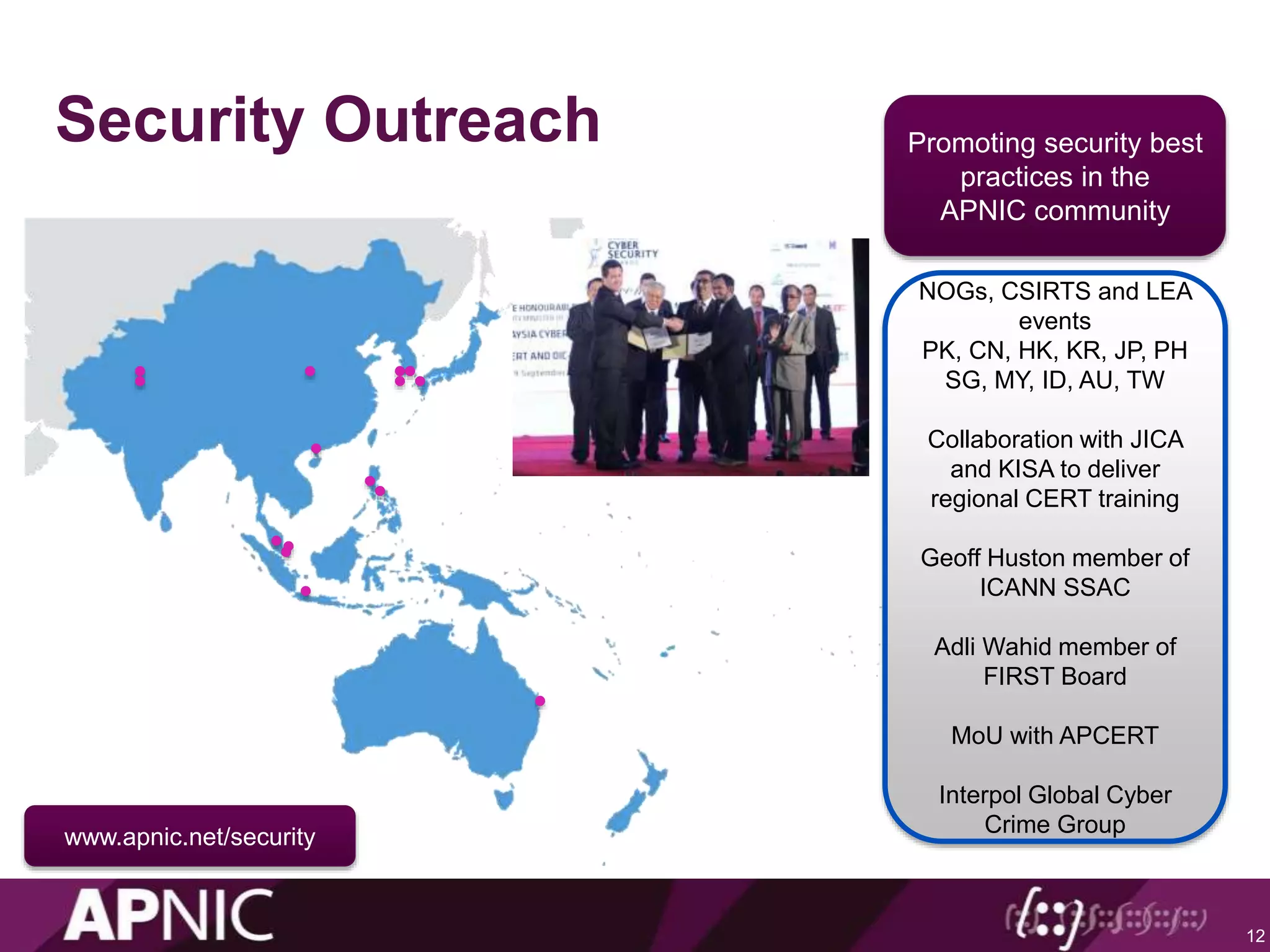
Security Outreach
12
Craig Ng
Promoting security best
practices in the
APNIC community
NOGs, CSIRTS and LEA
events
PK, CN, HK, KR, JP, PH
SG, MY, ID, AU, TW
Collaboration with JICA
and KISA to deliver
regional CERT training
Geoff Huston member of
ICANN SSAC
Adli Wahid member of
FIRST Board
MoU with APCERT
Interpol Global Cyber
Crime Group
Adli Wahid
www.apnic.net/security
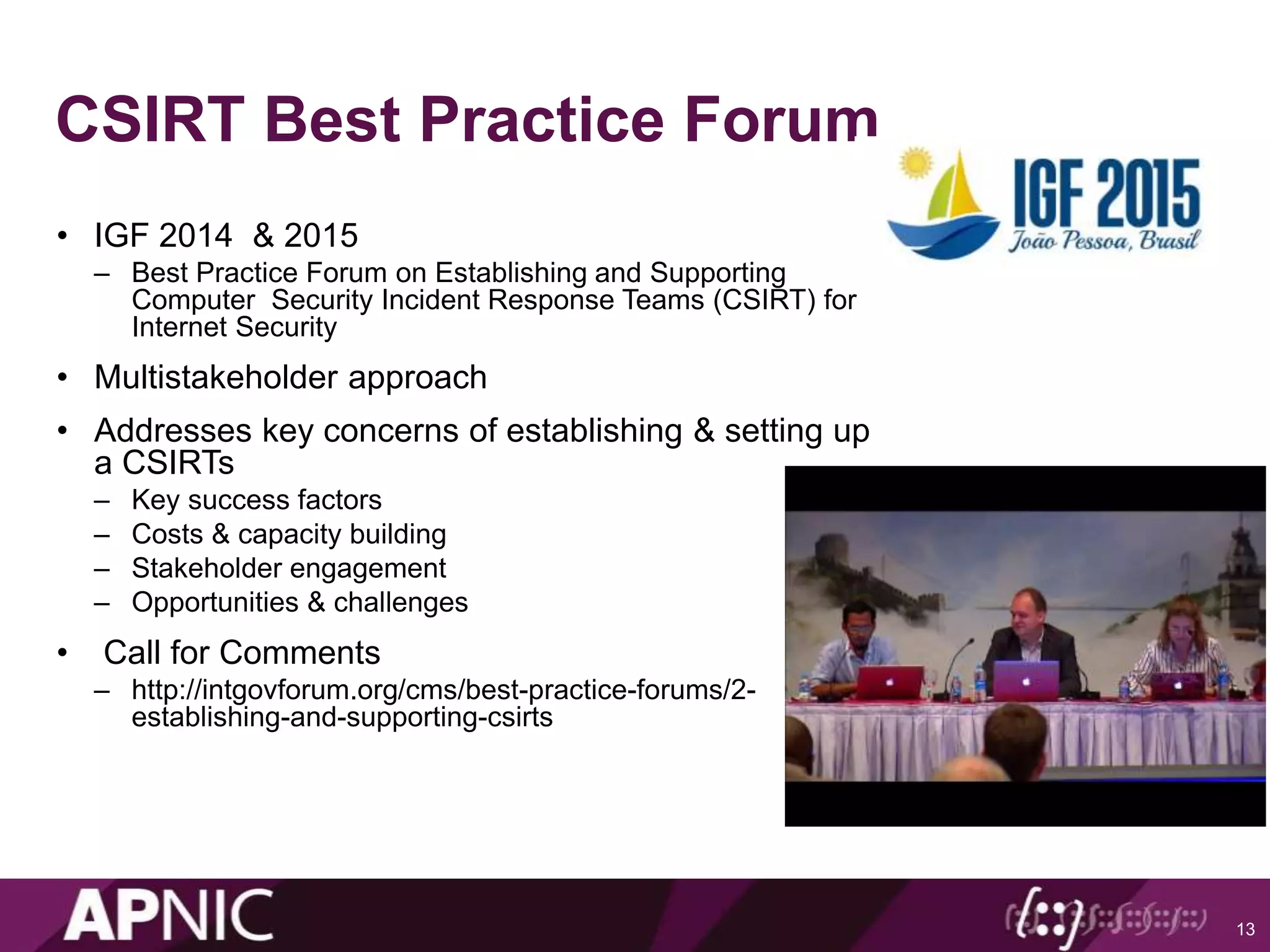
CSIRT Best Practice Forum
• IGF 2014 & 2015
– Best Practice Forum on Establishing and Supporting
Computer Security Incident Response Teams (CSIRT) for
Internet Security
• Multistakeholder approach
• Addresses key concerns of establishing & setting up
a CSIRTs
– Key success factors
– Costs & capacity building
– Stakeholder engagement
– Opportunities & challenges
• Call for Comments
– http://intgovforum.org/cms/best-practice-forums/2-
establishing-and-supporting-csirts
13
Upcoming Activities
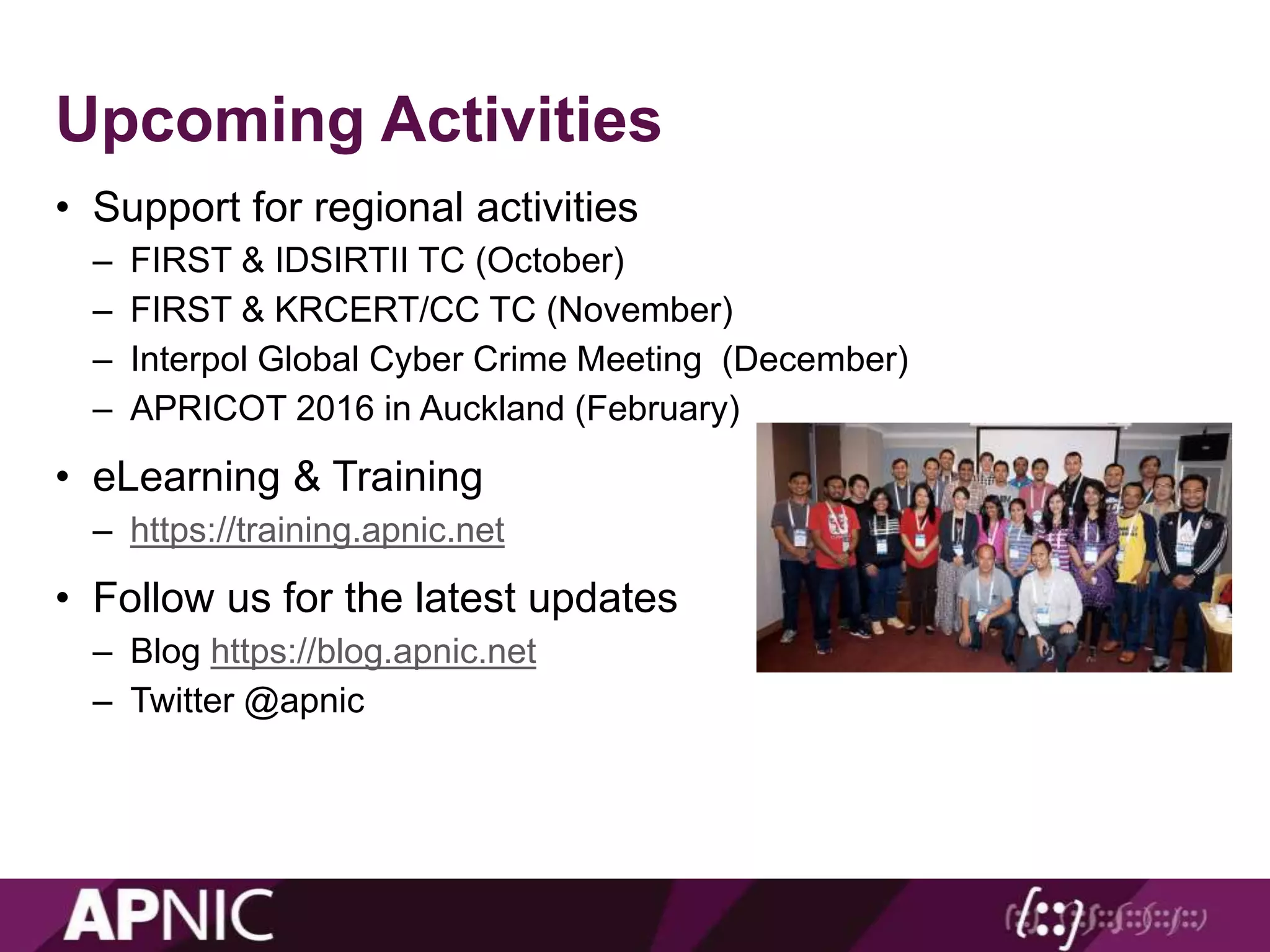
• Support for regional activities
– FIRST & IDSIRTII TC (October)
– FIRST & KRCERT/CC TC (November)
– Interpol Global Cyber Crime Meeting (December)
– APRICOT 2016 in Auckland (February)
• eLearning & Training
– https://training.apnic.net
• Follow us for the latest updates
– Blog https://blog.apnic.net
– Twitter @apnic
Resource Public Key Infrastructure (RPKI)
15
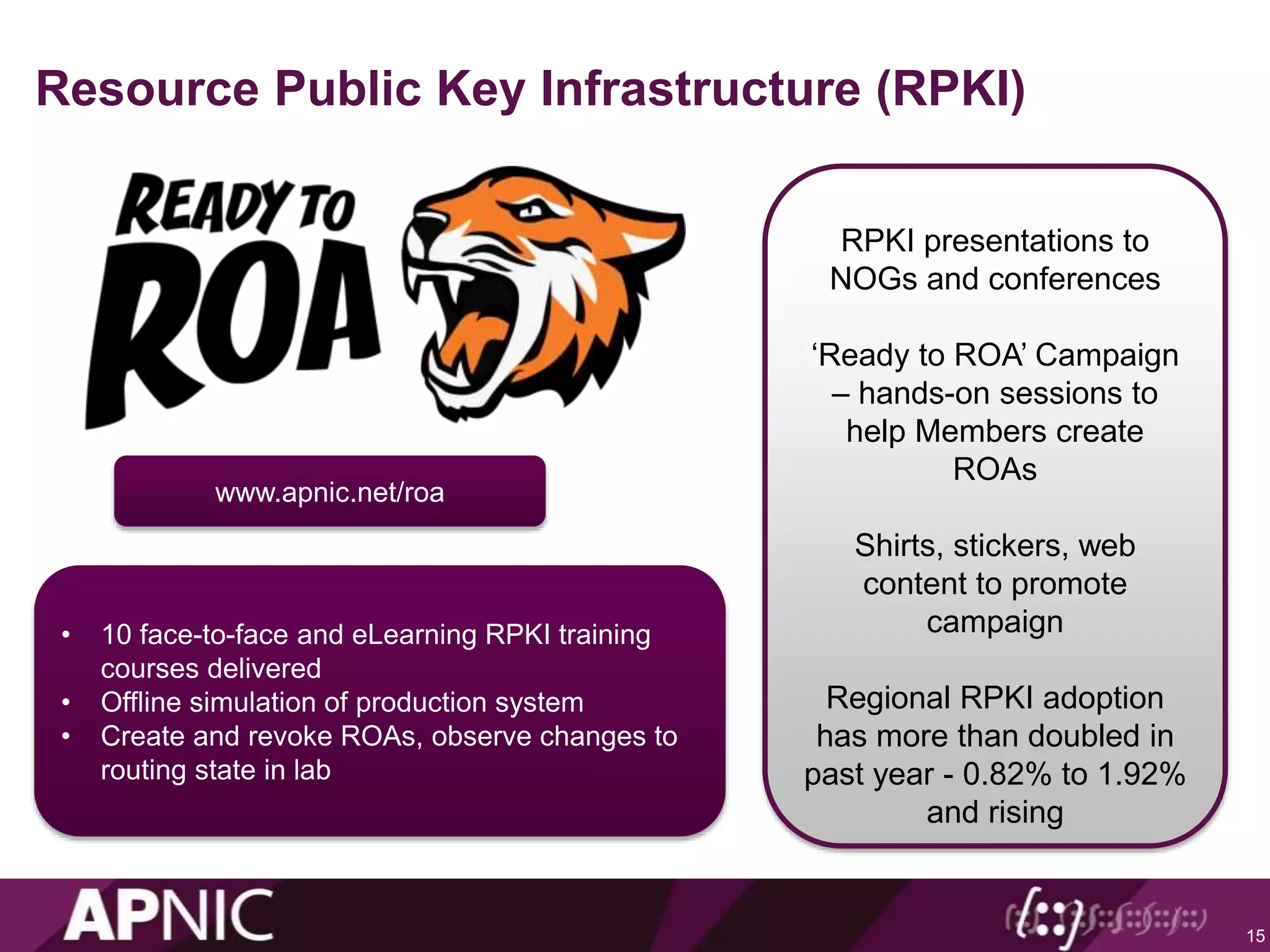
RPKI presentations to
NOGs and conferences
‘Ready to ROA’ Campaign
– hands-on sessions to
help Members create
ROAs
Shirts, stickers, web
content to promote
campaign
Regional RPKI adoption
has more than doubled in
past year - 0.82% to 1.92%
and rising
www.apnic.net/roa
• 10 face-to-face and eLearning RPKI training
courses delivered
• Offline simulation of production system
• Create and revoke ROAs, observe changes to
routing state in lab
Internet Operational Research Grants
16
New fund supporting the Internet research
community in the Asia Pacific
Research aiming to improve availability,
reliability, and security of the Internet in the
Asia Pacific
Network
measurement
and analysis
IPv6 deployment BGP Routing
Network
Security
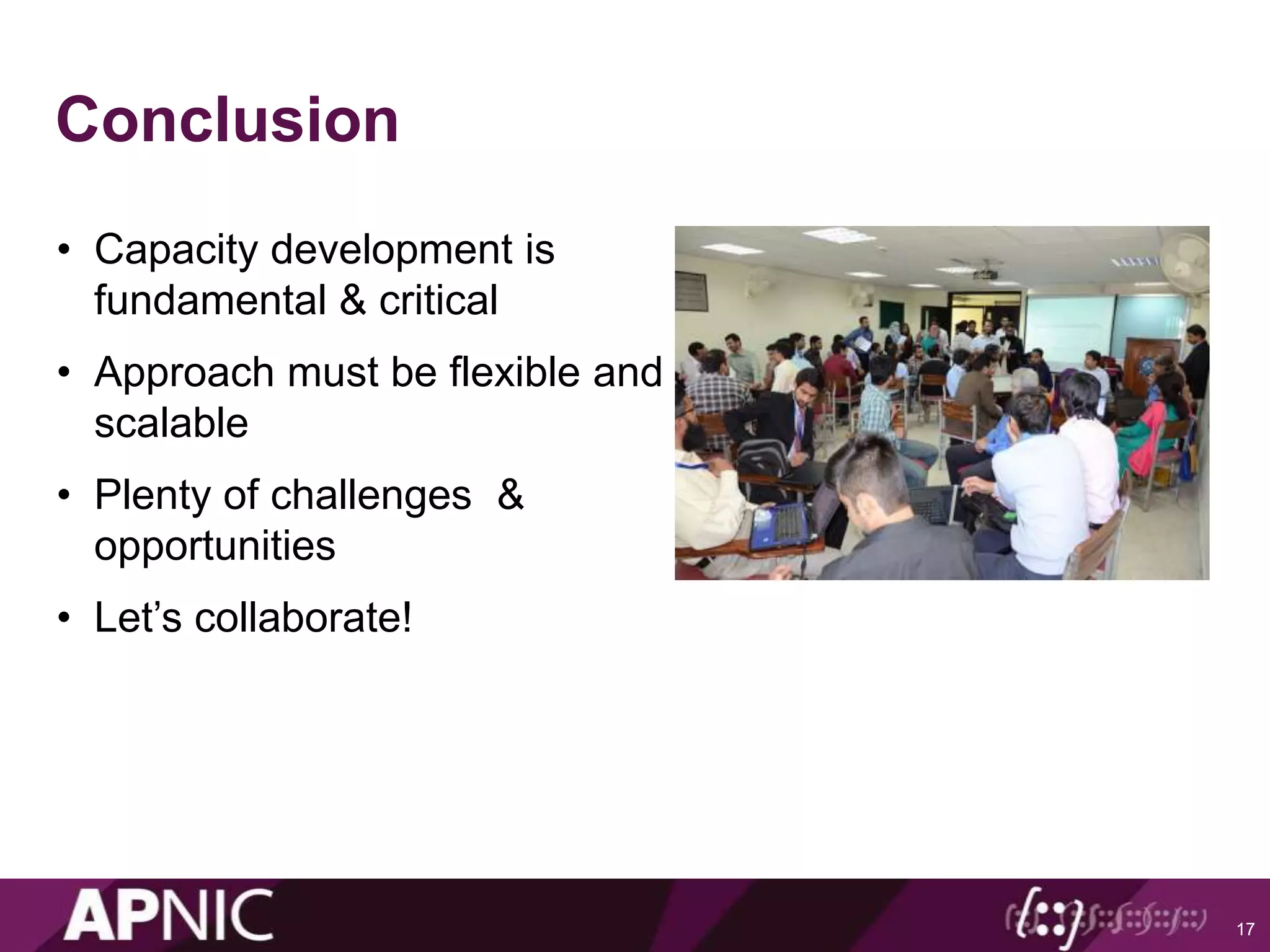
Conclusion
• Capacity development is
fundamental & critical
• Approach must be flexible and
scalable
• Plenty of challenges &
opportunities
• Let’s collaborate!
17
Thank You
Adli Wahid
www.apnic.net
adli@apnic.net
18

Enhancing security incident response capabilities in the AP

  • 1.
    Issue Date: Revision: Enhancing Security IncidentResponse Capabilities in the Asia Pacific Region 6th APT Cybersecurity Forum Adli Wahid Security Specialist, APNIC
  • 2.
    Agenda 1. About APNIC 2.Enhancing Incident Response Capabilities 3. Recent and future activities 2
  • 3.
  • 4.
    What is APNIC? •Regional Internet Registry (RIR) for the Asia Pacific region – Comprises 56 economies • Secretariat located in Brisbane, Australia – Currently employs around 70 staff • Not-for-profit, membership-based organization • Governed by the Executive Council (EC), who are elected by the Members 4
  • 5.
    APNIC’s Vision: A global,open, stable, and secure Internet that serves the entire Asia Pacific community. How we achieve this: • Serving Members • Supporting the Asia Pacific Region • Collaborating with the Internet Community 5
  • 6.
  • 7.
    Responding to SecurityIncidents 7 National Cyber Security Agency National CERT / CSIRTs Enterprise CERTs/CSIRTs End-Users Critical Infrastructure, Network Providers, Hosting, Cloud, Government, Financial Services, SMEs=
  • 8.
    Network Operators /Service Providers • A key player in the Incident Response process • Availability is important – Critical Infrastructure (Internet Exchange) – Increasing becoming a target • Need to be aware of the (changing) threat landscape – Help increase resilience the infrastructure by applying best practices – Provide timely assistance & mitigation – Emerging Trends - IOTs – CERT/CSIRT of the last resort • Network Operators Groups (NOGs) – Local & Regional NOGs – APRICOT & APNIC Conference 8
  • 9.
    Network Operators –Incident Response Relationship • Interdependent entities • Expectations – Resources are not misused or abused – Fast ‘take-downs’ or response – Share information (logs, billing etc) – Communicate with Users / Technical support – 24x7x365 • Frequently, at the receiving end 9 Network Operator End-Users Customers Security Response Community Law Enforcement
  • 10.
    Incident Response Capabilities •Managing Security Incidents – Reduce impact of security incidents – Prevent security incident from occurring – Fixing actual vulnerabilities – Gain insights about emerging threats or incidents (ISACs, threat intel feeds) – Collaborate with other stakeholders (i.e. investigation, policy/strategy) • Managing Security Incident Response Teams – Establishing CSIRTs – Operationalizing CSIRTs – Having the right skill sets, knowledge and tools – Being part of the community – Mentoring 10
  • 11.
    APNIC’s Approach • Capacitydevelopment – Internet infrastructure – Cyber security* • Strategic Partnership – Various stakeholders – Regional & global – Shared goals 11
  • 12.
    Security Outreach 12 Craig Ng Promotingsecurity best practices in the APNIC community NOGs, CSIRTS and LEA events PK, CN, HK, KR, JP, PH SG, MY, ID, AU, TW Collaboration with JICA and KISA to deliver regional CERT training Geoff Huston member of ICANN SSAC Adli Wahid member of FIRST Board MoU with APCERT Interpol Global Cyber Crime Group Adli Wahid www.apnic.net/security
  • 13.
    CSIRT Best PracticeForum • IGF 2014 & 2015 – Best Practice Forum on Establishing and Supporting Computer Security Incident Response Teams (CSIRT) for Internet Security • Multistakeholder approach • Addresses key concerns of establishing & setting up a CSIRTs – Key success factors – Costs & capacity building – Stakeholder engagement – Opportunities & challenges • Call for Comments – http://intgovforum.org/cms/best-practice-forums/2- establishing-and-supporting-csirts 13
  • 14.
    Upcoming Activities • Supportfor regional activities – FIRST & IDSIRTII TC (October) – FIRST & KRCERT/CC TC (November) – Interpol Global Cyber Crime Meeting (December) – APRICOT 2016 in Auckland (February) • eLearning & Training – https://training.apnic.net • Follow us for the latest updates – Blog https://blog.apnic.net – Twitter @apnic
  • 15.
    Resource Public KeyInfrastructure (RPKI) 15 RPKI presentations to NOGs and conferences ‘Ready to ROA’ Campaign – hands-on sessions to help Members create ROAs Shirts, stickers, web content to promote campaign Regional RPKI adoption has more than doubled in past year - 0.82% to 1.92% and rising www.apnic.net/roa • 10 face-to-face and eLearning RPKI training courses delivered • Offline simulation of production system • Create and revoke ROAs, observe changes to routing state in lab
  • 16.
    Internet Operational ResearchGrants 16 New fund supporting the Internet research community in the Asia Pacific Research aiming to improve availability, reliability, and security of the Internet in the Asia Pacific Network measurement and analysis IPv6 deployment BGP Routing Network Security
  • 17.
    Conclusion • Capacity developmentis fundamental & critical • Approach must be flexible and scalable • Plenty of challenges & opportunities • Let’s collaborate! 17
  • 18.

Editor's Notes

  • #8 We have to realize that different economies have different Cyber Security Environment. Some have frameworks, policies and institutions in place. But others don’t. Even if you have everything in place – there is a lot of dependencies. You need to look at the bigger picture (NEC Talk yesterday)
  • #9 Keeping information up to date
  • #10 Host Critical Infrastructure Case Studies – Take downs Environment
  • #11 Understanding about security incidents
  • #12 Win-win approach & through various means
  • #13 Security specialist Adli Wahid, is working with different teams within APNIC as well as building relationship with potential and new partners that APNIC can leverage. Adli was recently elected as a board member of the Forum of Incident and Security Response Teams Build capability through training, providing content on security at APNIC and LEA training Participation in NOGs, inter-governmental forums, CERTS etc. We take that knowledge and share it with Members to raise awareness Highlighting relevant initiatives to Members to improve security such as IRT objects in whois, RPKI, and SAVE (BCP 38) We also supported security community events such as the PHCERT & APCERT Conference this year MOU with APCERT in the area of promoting security awareness, improving incident response and supporting capacity development activities
  • #14 Where do we capture this CSIRT Knowledge
  • #15 We would like to encourage members to participate in our event. Let us know for opportunities
  • #16 In the last meeting I highlighted our ROA. Ready to ROA our initiative to promote security routing The main aim is to get Network Operators to create Route Object Authorisations – which will enable others to validate the origin of routing announcement. * 1.92 uptake as of September 2015 (https:// This is also part of our effort to promote Routing Security among network operators and cyber security agencies There has been some progress since we actively promote it at various events. It must be stressed however that his is only the first step
  • #17 APNIC is the secretariat of ISIF (Internet Society Innovation Fund) Help spread the word about ISIF grant – covers IPv6 and Operational Network Security. Up to 60k AUD grant
  • #18 How to make it scale? How do we cover areas that do not have enough resources?