INFORMATION
EDUCATION AND
COMMUNICATION
INTRODUCTION
02
➤ The importance of health education has been increasingly realised during the
last three decades so much that health education has emerged as a speciality
in itself.
➤ The aim of health education is to bring about a change in health behaviour of
the people in such a manner that the harmful health practices given up while
good ones are reinforced.
DEFINITION OF IEC
03
➤ Information Education and Communication is an approach which
attempts to change or reinforce a set of behaviour in a target audience
regarding a specific problem in a predefined period of time.
DEFINITION OF IEC
04
➤ It combines strategies, approaches and method that enable individuals,
families, groups, organisations, and communities to play active role in
achieving, protecting and sustaining their own health. embodied in IEC is
the process of learning that empowers people to make decisions, modify
behaviours and change social conditions.
OBJECTIVES OF IEC
05
➤ Increase reach of services
➤ Improve the quality of services.
➤ Make supervision more oriented towards problem solving.
➤ Link supervision with training at various level.
OBJECTIVES OF IEC
06
➤ Concentrate on local field problems both for development of training
material and their users.
➤ Combine interpersonal communication strategy with mass media appraoch.
➤ Improve performance level through continuous with village community
volunteers.
IMPORTANCE OF IEC
07
1. It create awareness, increase knowledge and change attitudes
2. It is not expensive.
3. It ensures feedback mechanism.
MAJOR COMPONENT OF
IEC
08
1. Visit schedule
2. Training
3. Supervision
4. Monitoring and evaluation
PLANNING AN IEC
STRATEGY
09
➤ IEC success when it is planned with a comprehensive strategy.
➤ Gain knowledge and incorporate community tradition.
➤ There must be true dialogue.
➤Everything cannot be changed at once and focus on relevancy.
PLANNING AN IEC STRATEGY
10
➤ It should be cost effective.
➤Campaign for preventive behaviour.
➤Fear arousal needs to be used with caution.
➤ The timing should be appropriate.
➤ Information overload is to be avoided.
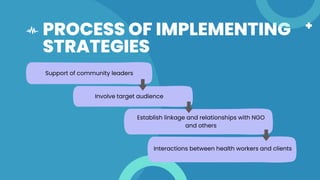
PROCESS OF IMPLEMENTING
STRATEGIES
Establish linkage and relationships with NGO
and others
02
Interactions between health workers and clients
Support of community leaders
Involve target audience
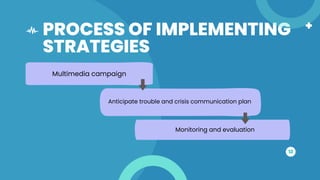
PROCESS OF IMPLEMENTING
STRATEGIES
Monitoring and evaluation
12
Multimedia campaign
Anticipate trouble and crisis communication plan
RESOURCES FOR IEC
13
➤Print media
RESOURCES FOR IEC
14
➤Mass media
➤Television
RESOURCES FOR IEC
15
➤Radio ➤Internet
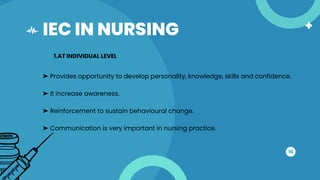
IEC IN NURSING
16
1.AT INDIVIDUAL LEVEL
➤ Provides opportunity to develop personality, knowledge, skills and confidence.
➤ It increase awareness.
➤ Reinforcement to sustain behavioural change.
➤ Communication is very important in nursing practice.
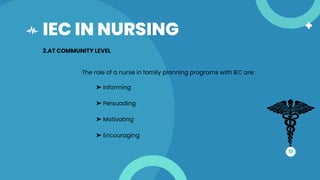
IEC IN NURSING
17
2.AT COMMUNITY LEVEL
The role of a nurse in family planning programs with IEC are:
➤ Informing
➤ Persuading
➤ Motivating
➤ Encouraging
YOU
THANK

INFORMATION EDUCATION AND COMMUNICATION.pdf

  • 1.
  • 2.
    INTRODUCTION 02 ➤ The importanceof health education has been increasingly realised during the last three decades so much that health education has emerged as a speciality in itself. ➤ The aim of health education is to bring about a change in health behaviour of the people in such a manner that the harmful health practices given up while good ones are reinforced.
  • 3.
    DEFINITION OF IEC 03 ➤Information Education and Communication is an approach which attempts to change or reinforce a set of behaviour in a target audience regarding a specific problem in a predefined period of time.
  • 4.
    DEFINITION OF IEC 04 ➤It combines strategies, approaches and method that enable individuals, families, groups, organisations, and communities to play active role in achieving, protecting and sustaining their own health. embodied in IEC is the process of learning that empowers people to make decisions, modify behaviours and change social conditions.
  • 5.
    OBJECTIVES OF IEC 05 ➤Increase reach of services ➤ Improve the quality of services. ➤ Make supervision more oriented towards problem solving. ➤ Link supervision with training at various level.
  • 6.
    OBJECTIVES OF IEC 06 ➤Concentrate on local field problems both for development of training material and their users. ➤ Combine interpersonal communication strategy with mass media appraoch. ➤ Improve performance level through continuous with village community volunteers.
  • 7.
    IMPORTANCE OF IEC 07 1.It create awareness, increase knowledge and change attitudes 2. It is not expensive. 3. It ensures feedback mechanism.
  • 8.
    MAJOR COMPONENT OF IEC 08 1.Visit schedule 2. Training 3. Supervision 4. Monitoring and evaluation
  • 9.
    PLANNING AN IEC STRATEGY 09 ➤IEC success when it is planned with a comprehensive strategy. ➤ Gain knowledge and incorporate community tradition. ➤ There must be true dialogue. ➤Everything cannot be changed at once and focus on relevancy.
  • 10.
    PLANNING AN IECSTRATEGY 10 ➤ It should be cost effective. ➤Campaign for preventive behaviour. ➤Fear arousal needs to be used with caution. ➤ The timing should be appropriate. ➤ Information overload is to be avoided.
  • 11.
    PROCESS OF IMPLEMENTING STRATEGIES Establishlinkage and relationships with NGO and others 02 Interactions between health workers and clients Support of community leaders Involve target audience
  • 12.
    PROCESS OF IMPLEMENTING STRATEGIES Monitoringand evaluation 12 Multimedia campaign Anticipate trouble and crisis communication plan
  • 13.
  • 14.
    RESOURCES FOR IEC 14 ➤Massmedia ➤Television
  • 15.
  • 16.
    IEC IN NURSING 16 1.ATINDIVIDUAL LEVEL ➤ Provides opportunity to develop personality, knowledge, skills and confidence. ➤ It increase awareness. ➤ Reinforcement to sustain behavioural change. ➤ Communication is very important in nursing practice.
  • 17.
    IEC IN NURSING 17 2.ATCOMMUNITY LEVEL The role of a nurse in family planning programs with IEC are: ➤ Informing ➤ Persuading ➤ Motivating ➤ Encouraging
  • 18.