Information Visualization for
    Social Network Analysis

          Ben Shneiderman       ben@cs.umd.edu
                  Twitter: @benbendc

Founding Director (1983-2000), Human-Computer Interaction Lab
         Professor, Department of Computer Science
       Member, Institute for Advanced Computer Studies
Interdisciplinary research community
  - Computer Science & Info Studies
    - Psych, Socio, Poli Sci & MITH
         (www.cs.umd.edu/hcil)
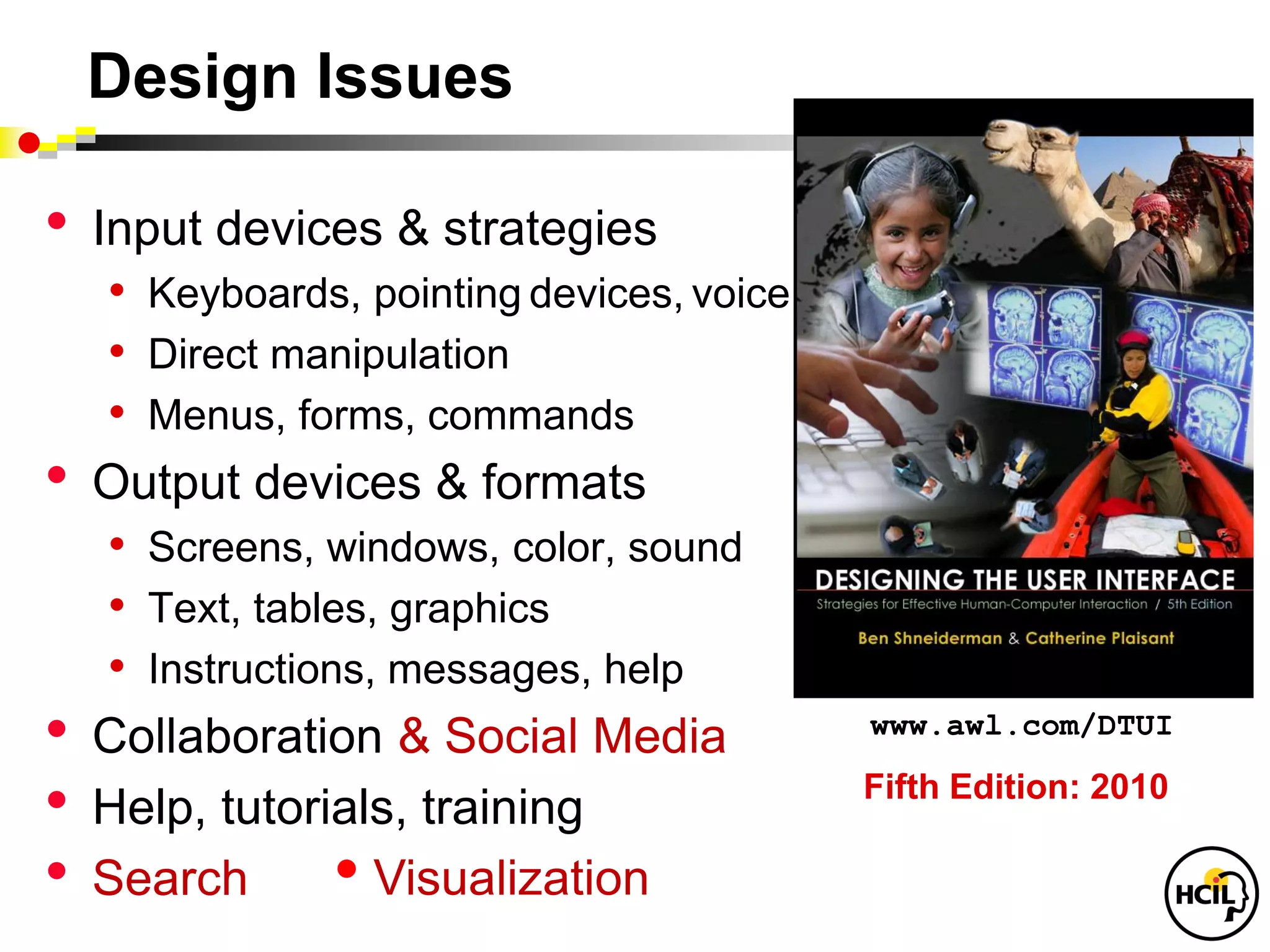
Design Issues

•   Input devices & strategies
     • Keyboards, pointing devices, voice
     • Direct manipulation
     • Menus, forms, commands
•   Output devices & formats
     • Screens, windows, color, sound
     • Text, tables, graphics
     • Instructions, messages, help
•   Collaboration & Social Media            www.awl.com/DTUI

•   Help, tutorials, training
                                            Fifth Edition: 2010

•   Search        • Visualization
HCI Pride: Serving 5B Users

Mobile, desktop, web, cloud
 Diverse users: novice/expert, young/old, literate/illiterate,
   abled/disabled, cultural, ethnic & linguistic diversity, gender,
   personality, skills, motivation, ...

 Diverse applications: E-commerce, law, health/wellness,
   education, creative arts, community relationships, politics,
   IT4ID, policy negotiation, mediation, peace studies, ...

 Diverse interfaces: Ubiquitous, pervasive, embedded, tangible,
   invisible, multimodal, immersive/augmented/virtual, ambient,
   social, affective, empathic, persuasive, ...
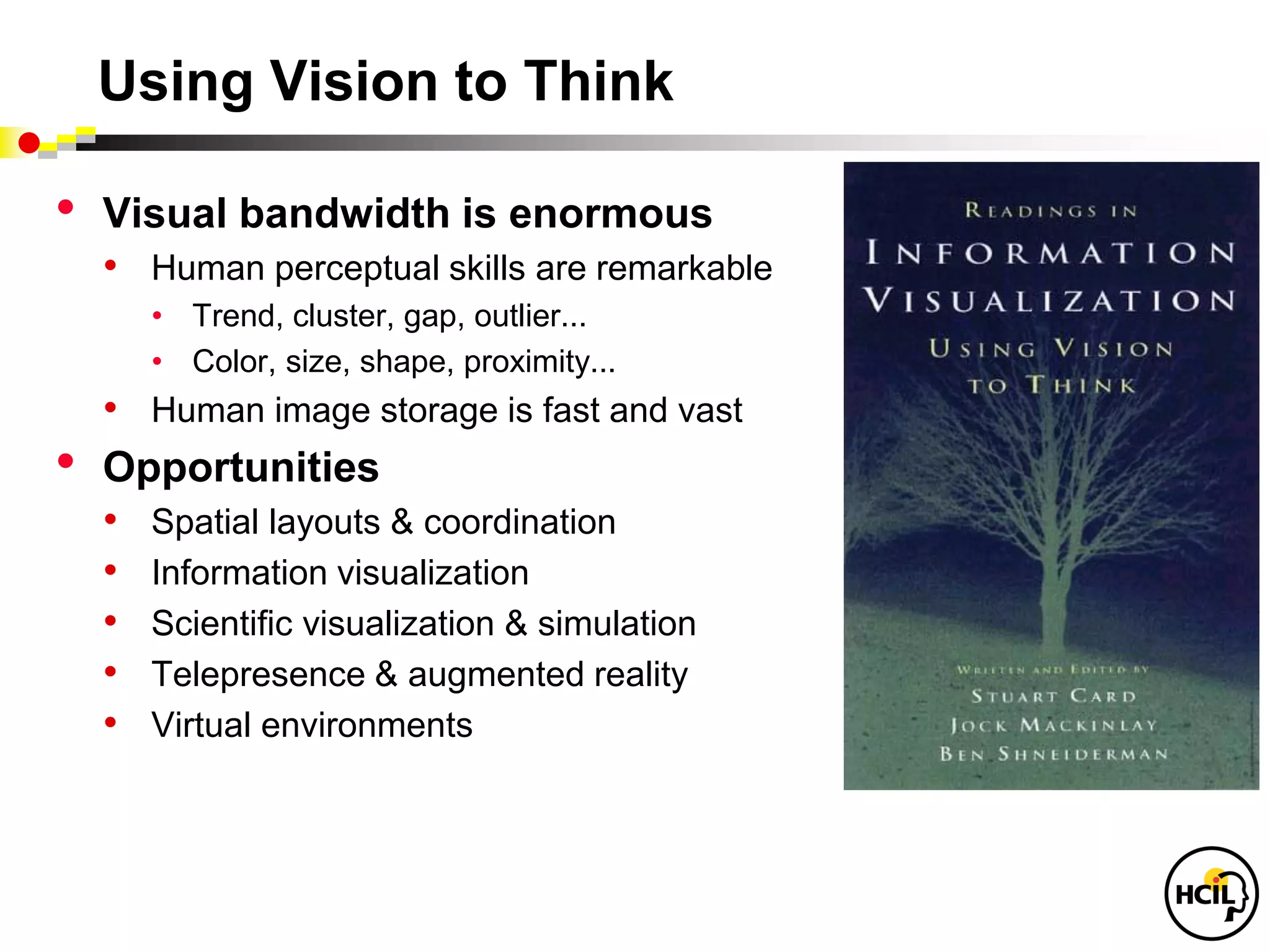
Using Vision to Think

•   Visual bandwidth is enormous
    • Human perceptual skills are remarkable
      • Trend, cluster, gap, outlier...
      • Color, size, shape, proximity...
    • Human image storage is fast and vast
•   Opportunities
    • Spatial layouts & coordination
    • Information visualization
    • Scientific visualization & simulation
    • Telepresence & augmented reality
    • Virtual environments
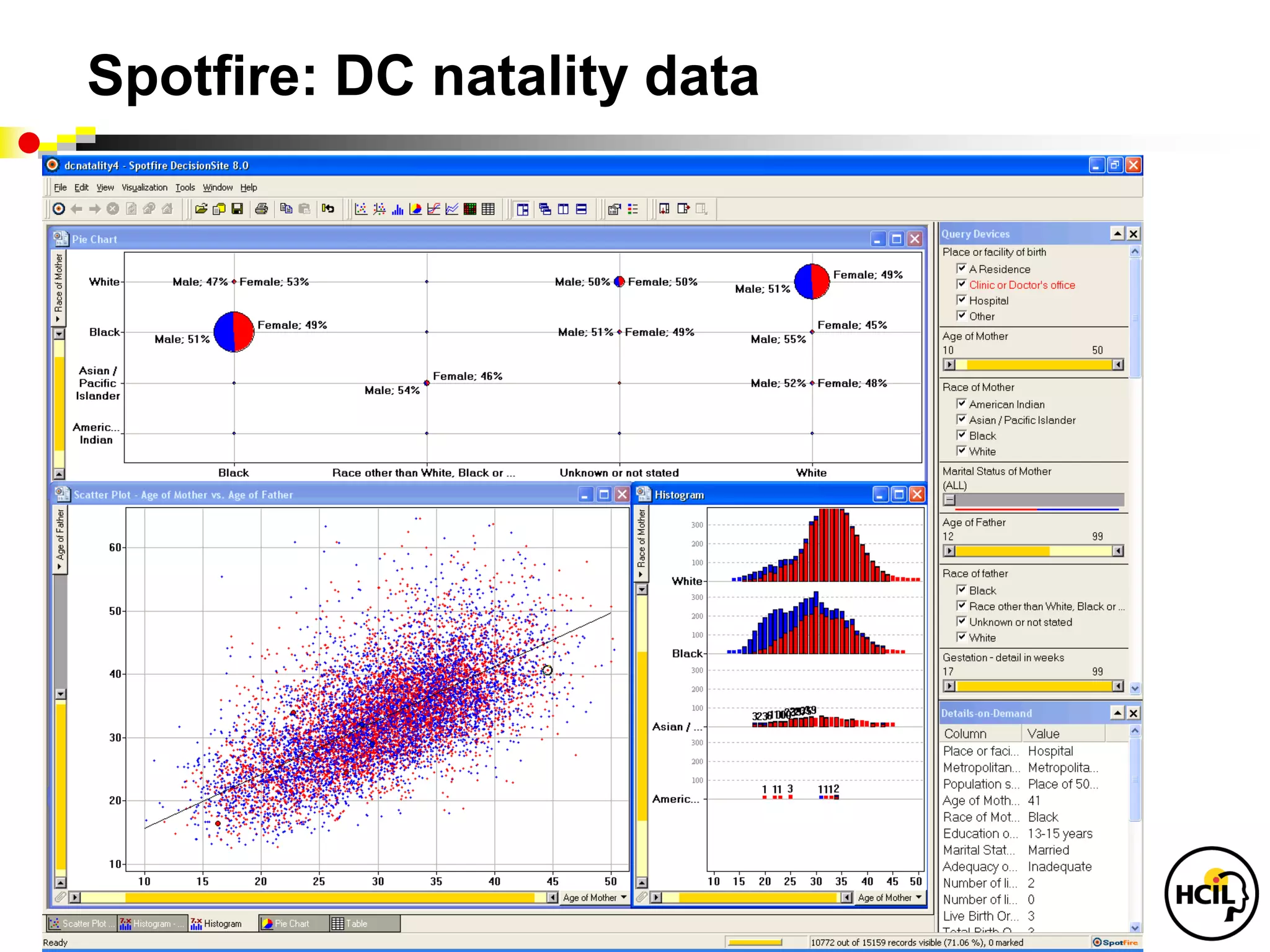
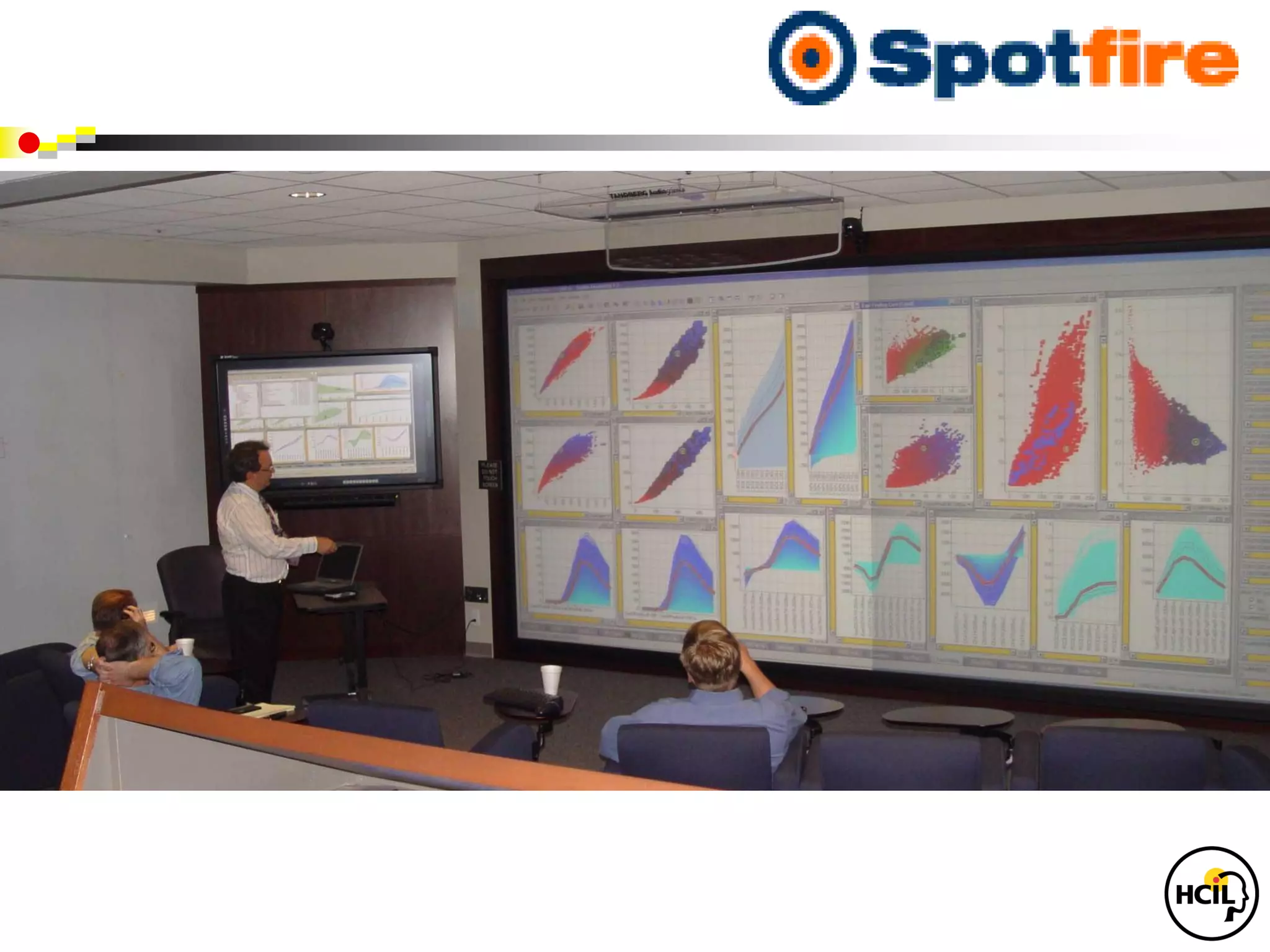
Spotfire: DC natality data
Information Visualization: Mantra

•   Overview, zoom & filter, details-on-demand
Information Visualization: Data Types

           •
SciViz .


               1-D Linear   Document Lens, SeeSoft, Info Mural
           •   2-D Map      GIS, ArcView, PageMaker, Medical imagery
           •   3-D World    CAD, Medical, Molecules, Architecture


           •   Multi-Var    Spotfire, Tableau, GGobi, TableLens, ParCoords,
           •
InfoViz


               Temporal     LifeLines, TimeSearcher, Palantir, DataMontage
           •   Tree         Cone/Cam/Hyperbolic, SpaceTree, Treemap
           •   Network      Pajek, JUNG, UCINet, SocialAction, NodeXL
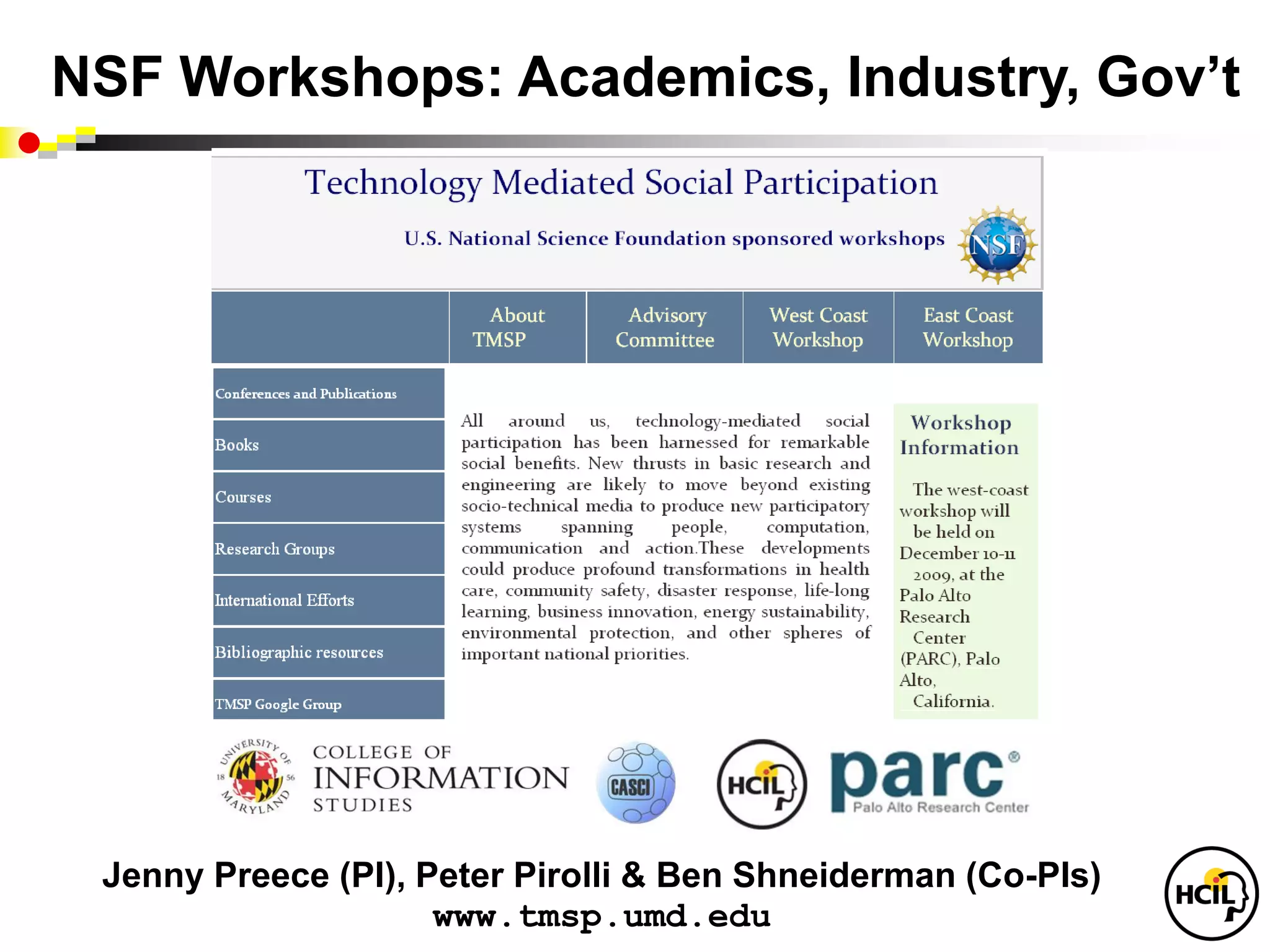
NSF Workshops: Academics, Industry, Gov’t


 Jenny Preece (PI), Peter Pirolli & Ben Shneiderman (Co-PIs)
                     www.tmsp.umd.edu
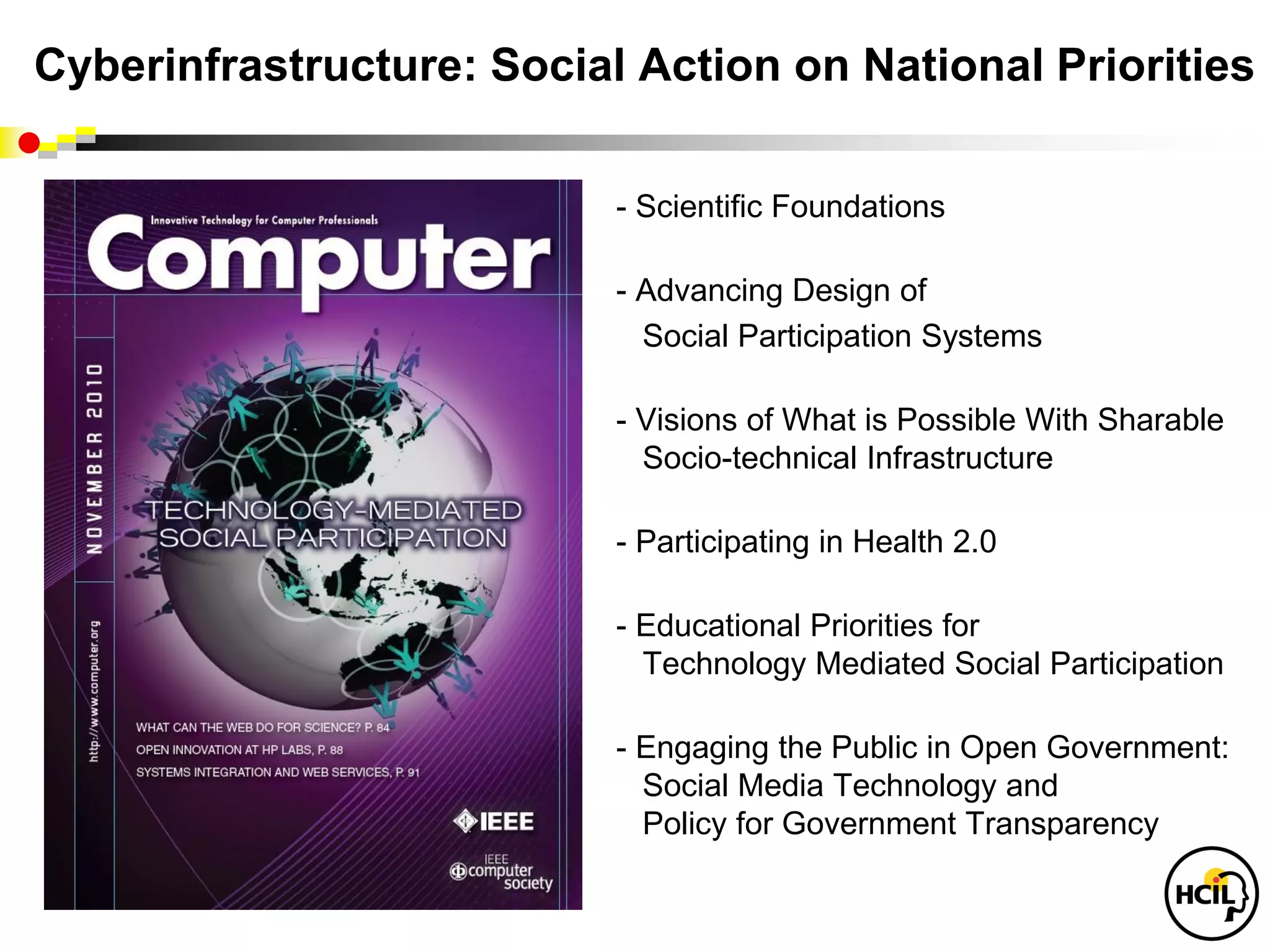
Cyberinfrastructure: Social Action on National Priorities

                           - Scientific Foundations

                           - Advancing Design of
                             Social Participation Systems

                           - Visions of What is Possible With Sharable
                             Socio-technical Infrastructure

                           - Participating in Health 2.0

                           - Educational Priorities for
                             Technology Mediated Social Participation

                           - Engaging the Public in Open Government:
                             Social Media Technology and
                             Policy for Government Transparency
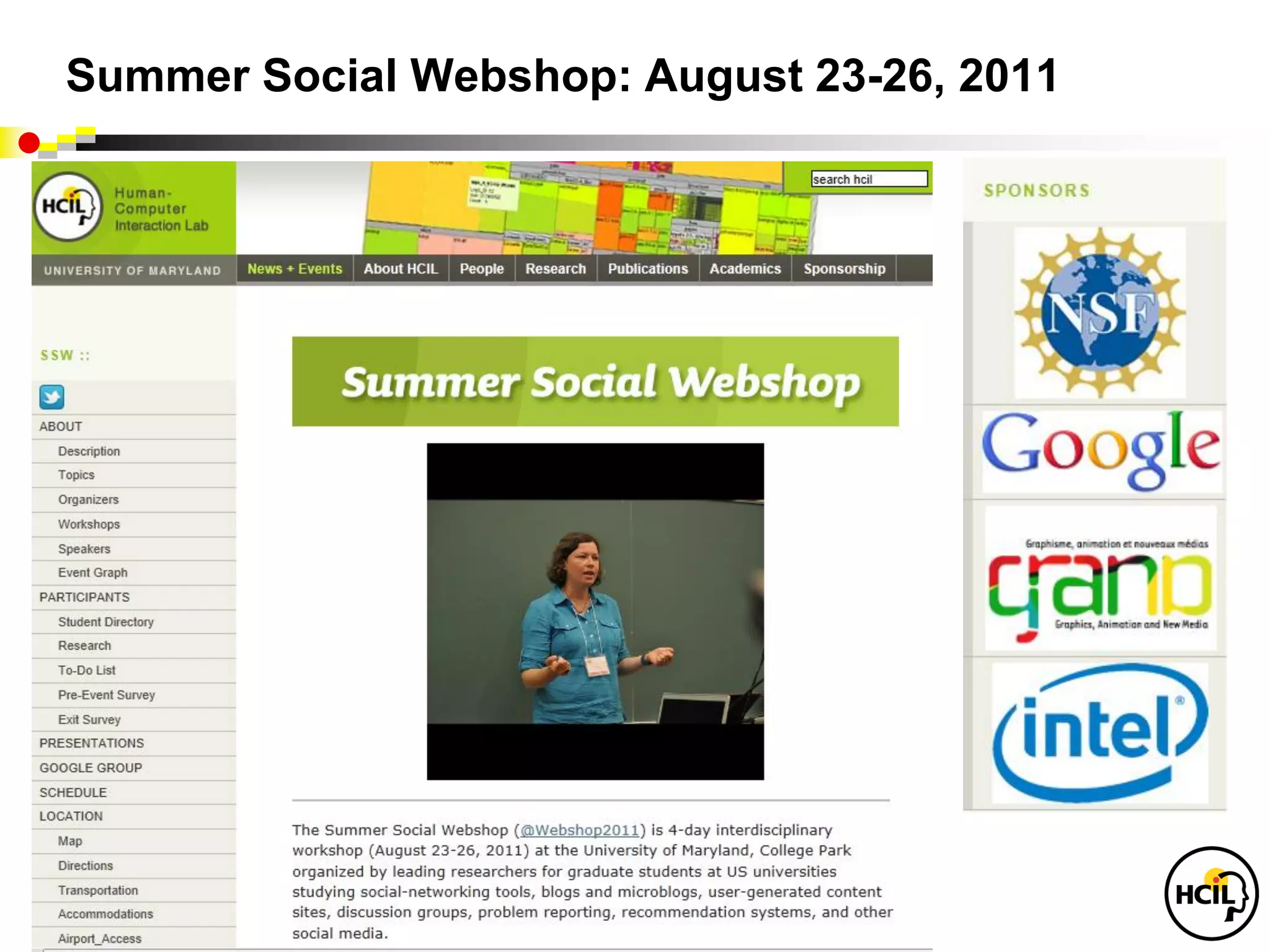
Summer Social Webshop: August 23-26, 2011
UN Millennium Development Goals

To be achieved by 2015 and hunger
• Eradicate extreme poverty
 • Achieve universal primary education
 • Promote gender equality and empower women
 • Reduce child mortality
 • Improve maternal health
 • Combat HIV/AIDS, malaria and other diseases
 • Ensure environmental sustainability
 • Develop a global partnership for development
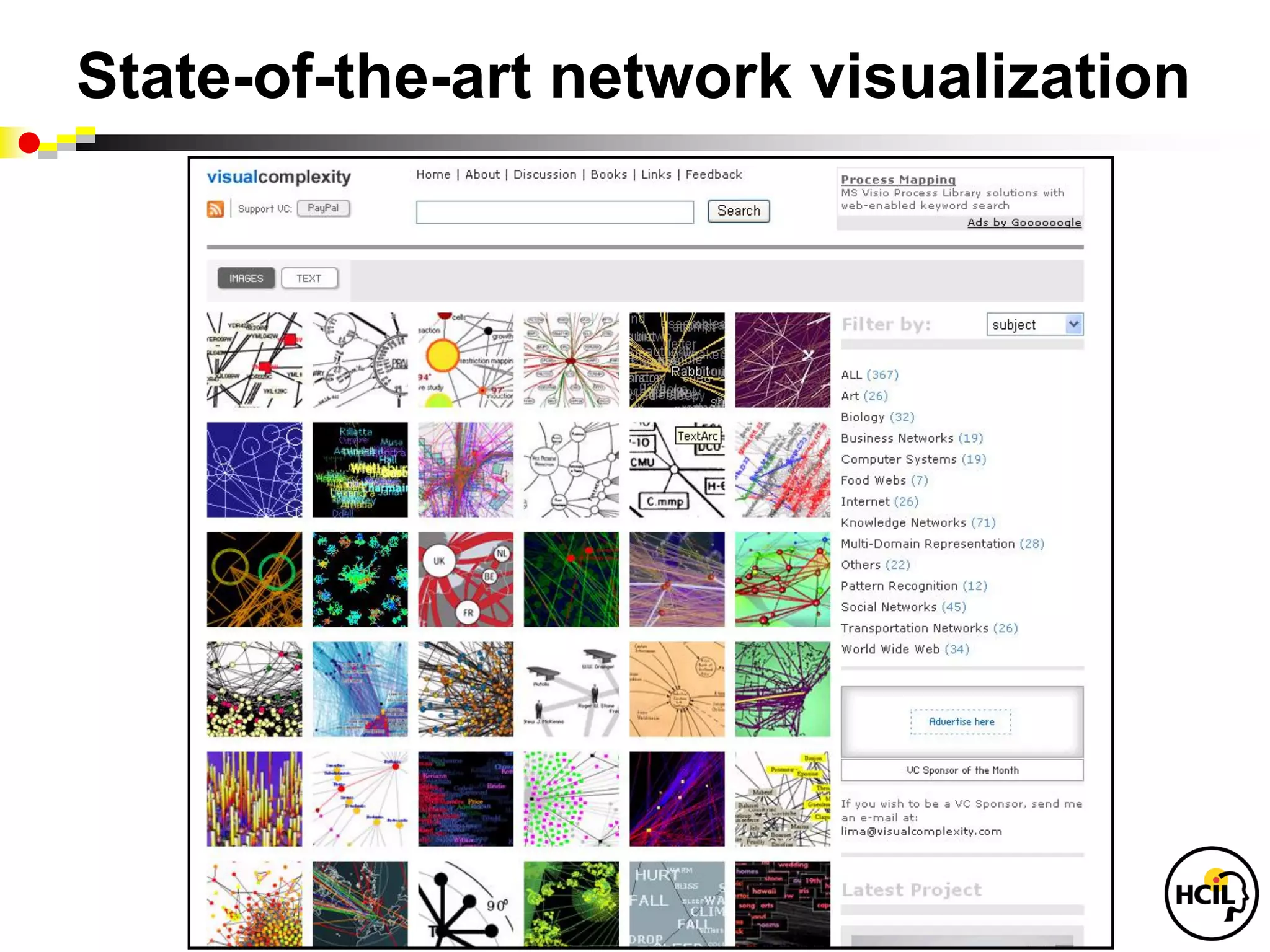
State-of-the-art network visualization
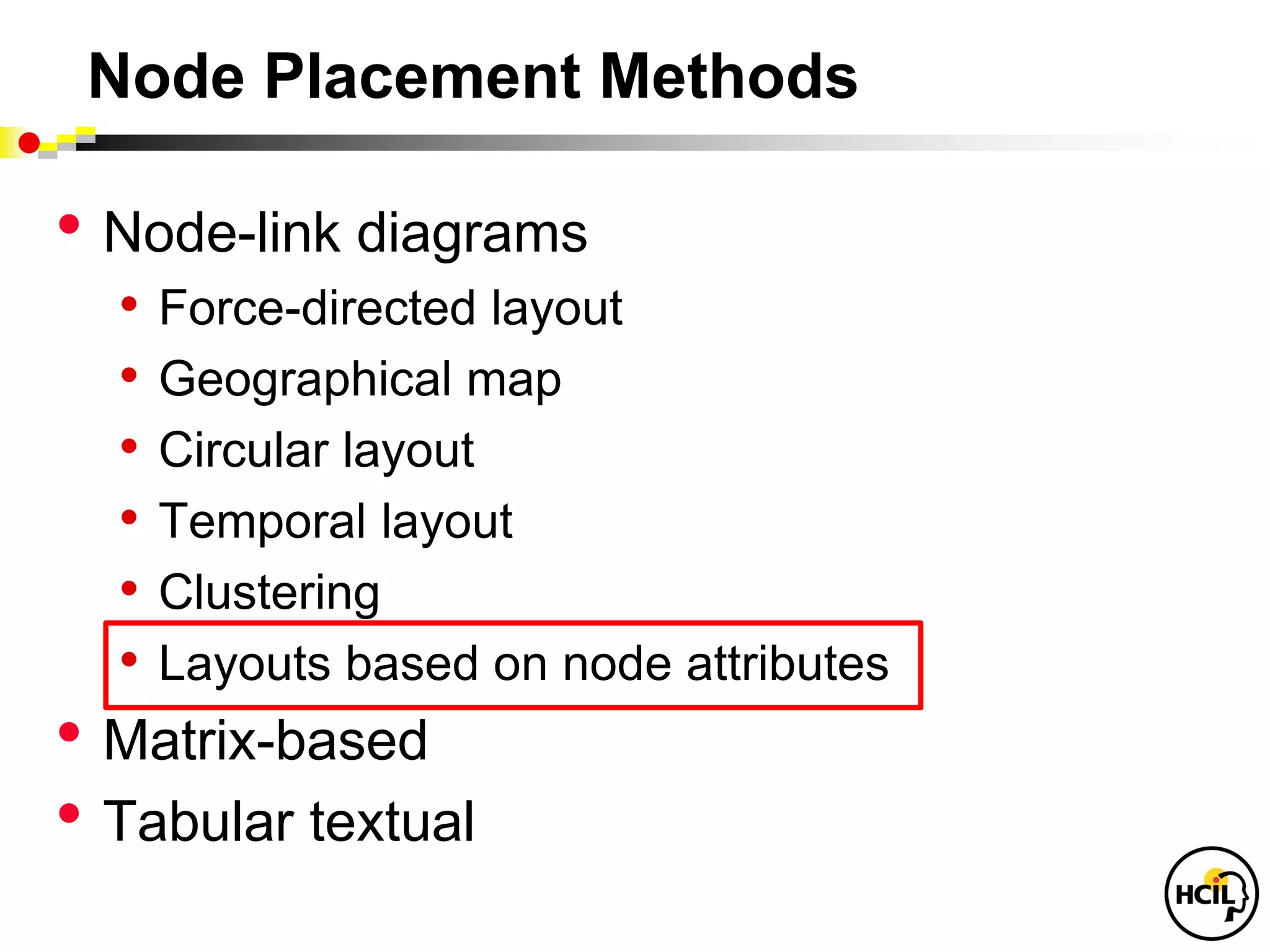
Node Placement Methods

• Node-link diagrams
    • Force-directed layout
    • Geographical map
    • Circular layout
    • Temporal layout
    • Clustering
    • Layouts based on node attributes
•   Matrix-based
•   Tabular textual
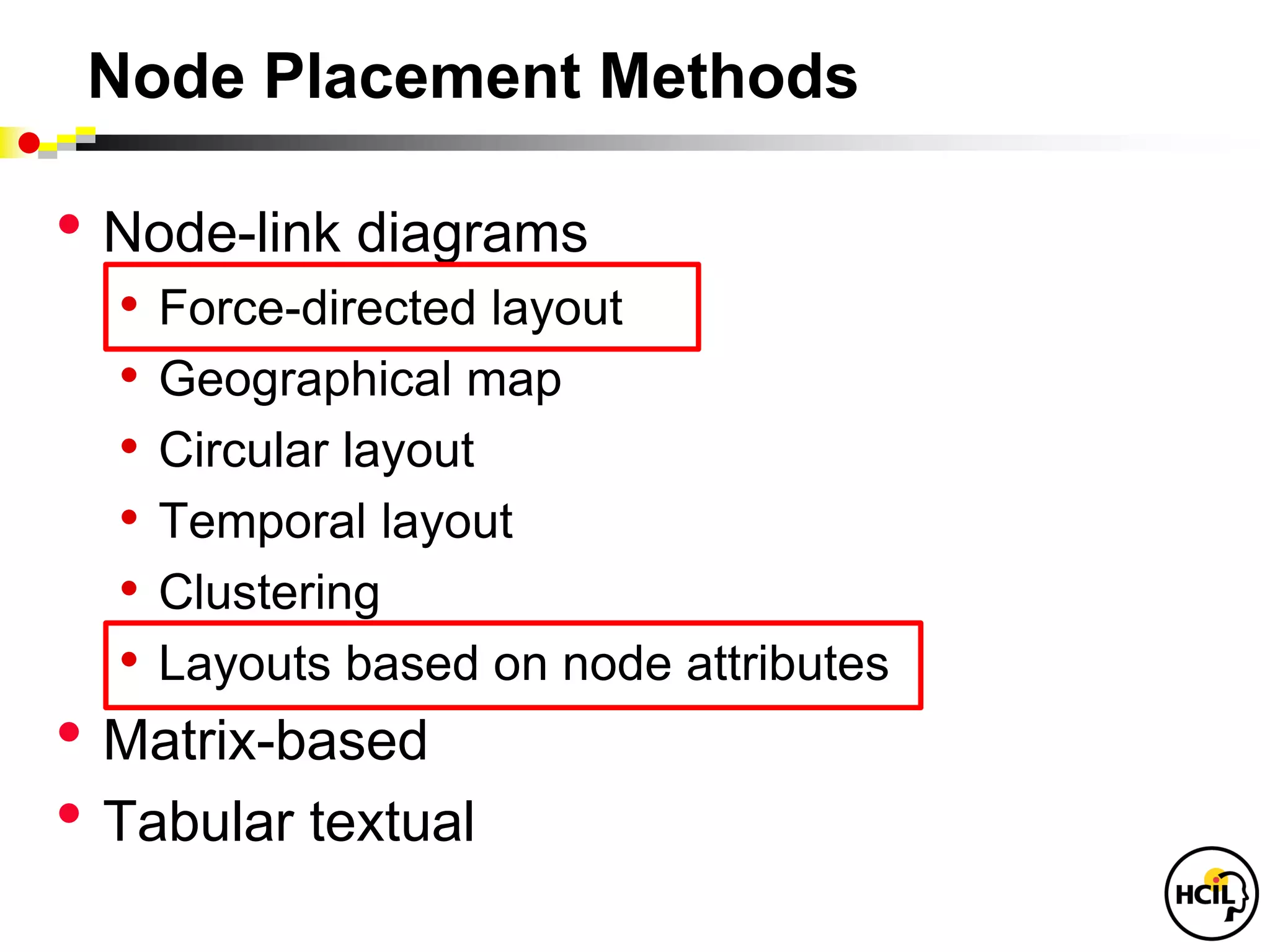
Node Placement Methods

• Node-link diagrams
    • Force-directed layout
    • Geographical map
    • Circular layout
    • Temporal layout
    • Clustering
    • Layouts based on node attributes
•   Matrix-based
•   Tabular textual
Node Placement Methods

• Node-link diagrams
    • Force-directed layout
    • Geographical map
    • Circular layout
    • Temporal layout
    • Clustering
    • Layouts based on node attributes
•   Matrix-based
•   Tabular textual
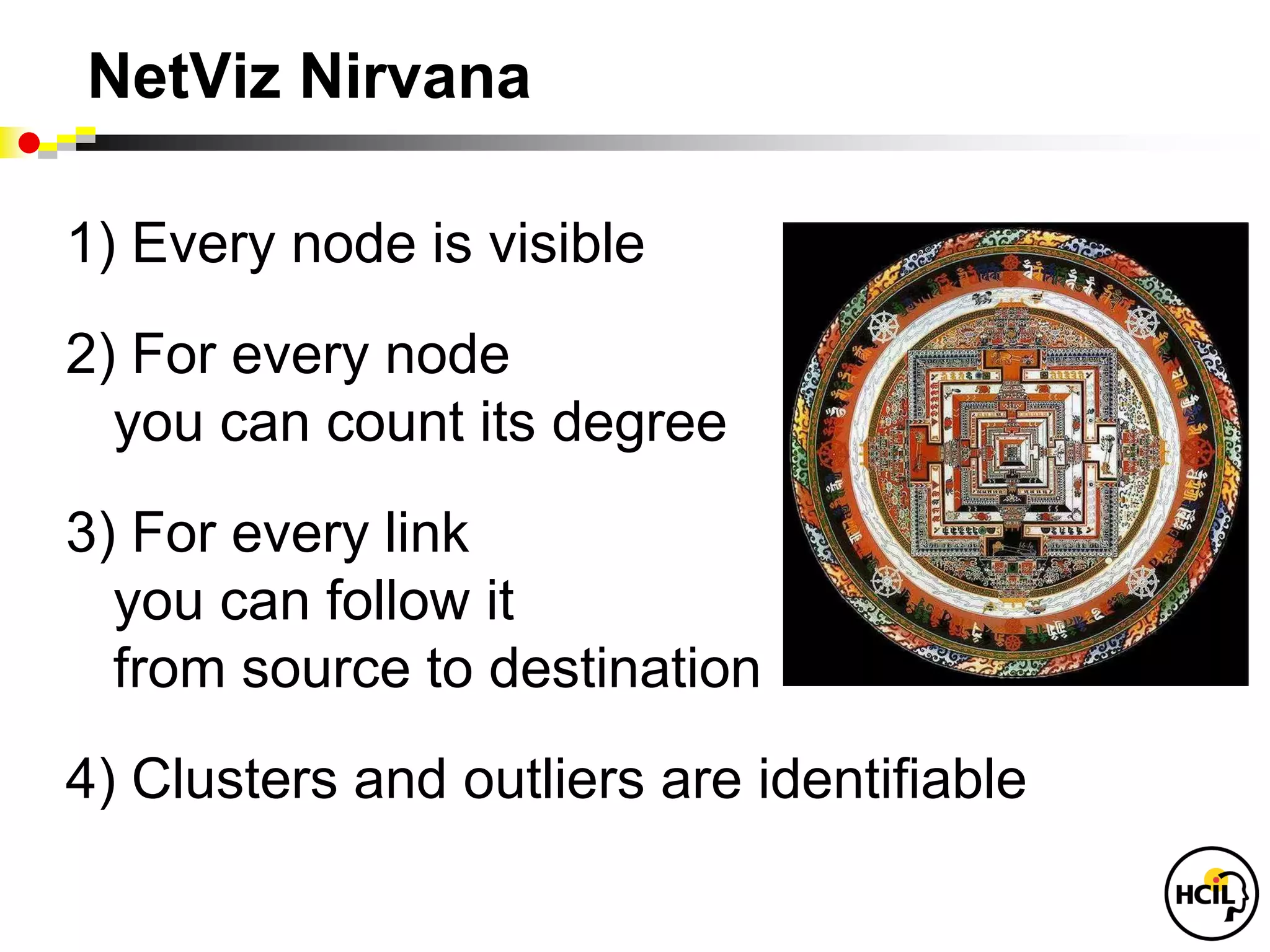
NetViz Nirvana

1) Every node is visible
2) For every node
  you can count its degree
3) For every link
  you can follow it
  from source to destination
4) Clusters and outliers are identifiable
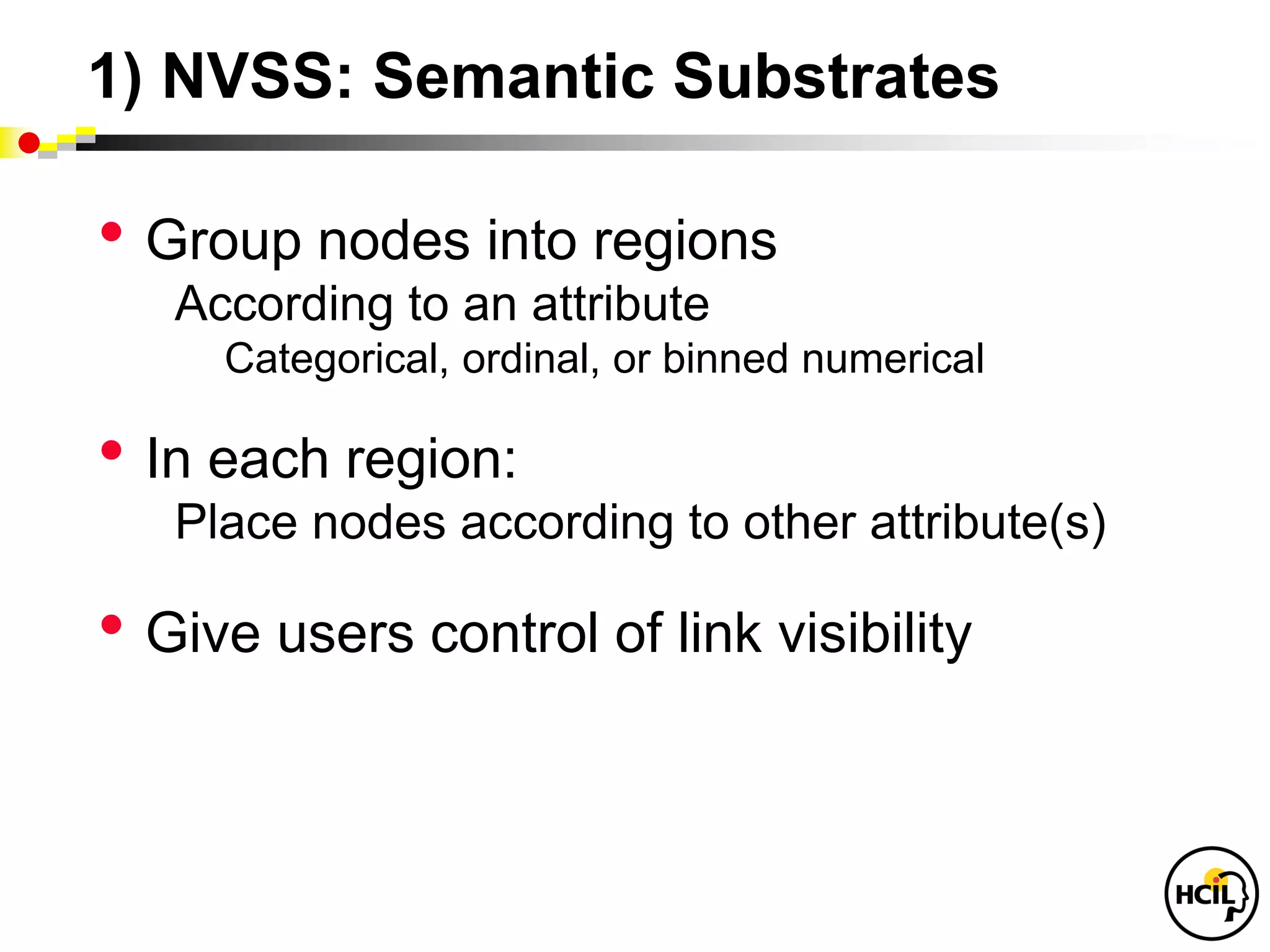
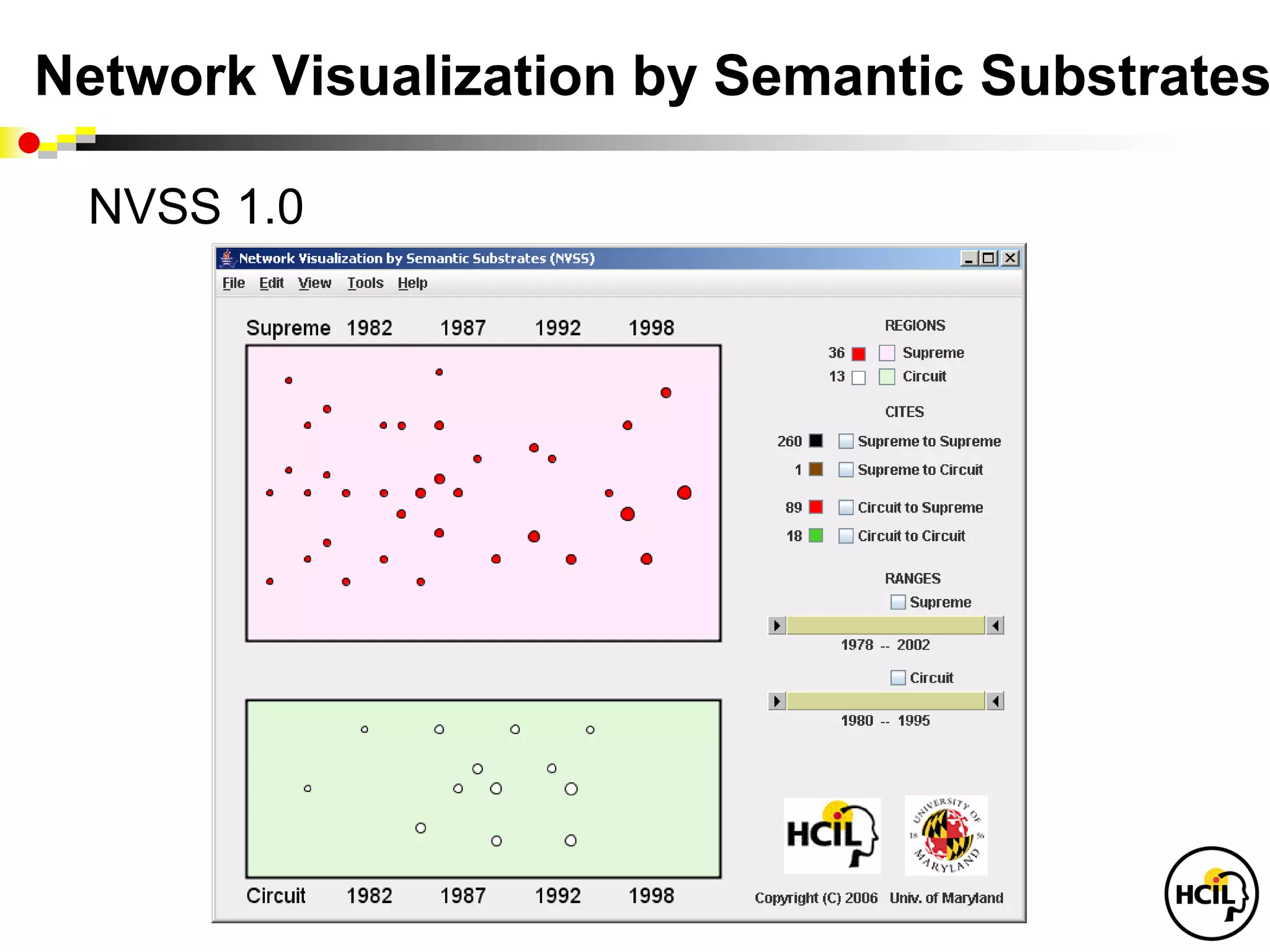
1) NVSS: Semantic Substrates

• Group nodes into regions
   According to an attribute
     Categorical, ordinal, or binned numerical

• In each region:
   Place nodes according to other attribute(s)

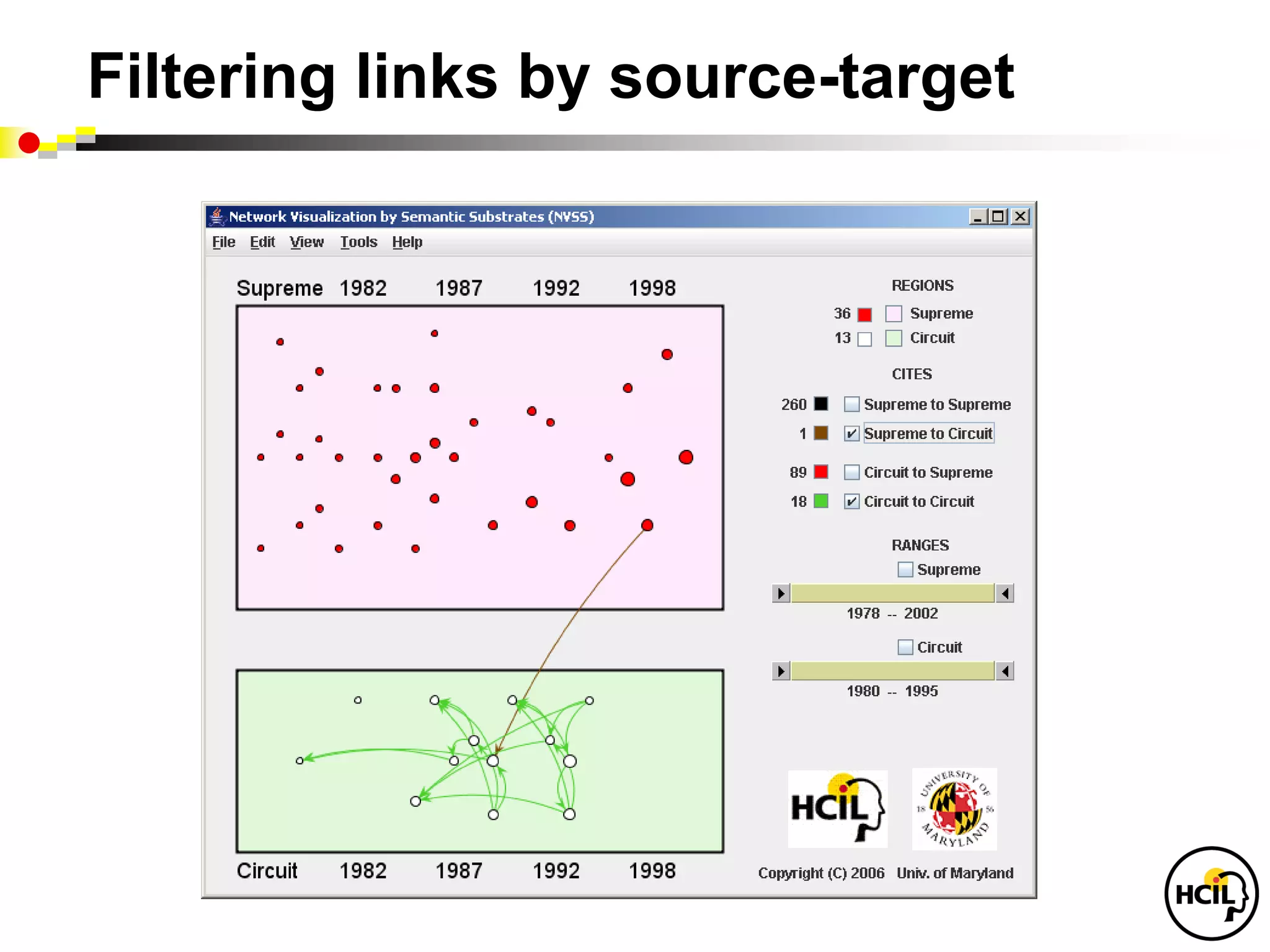
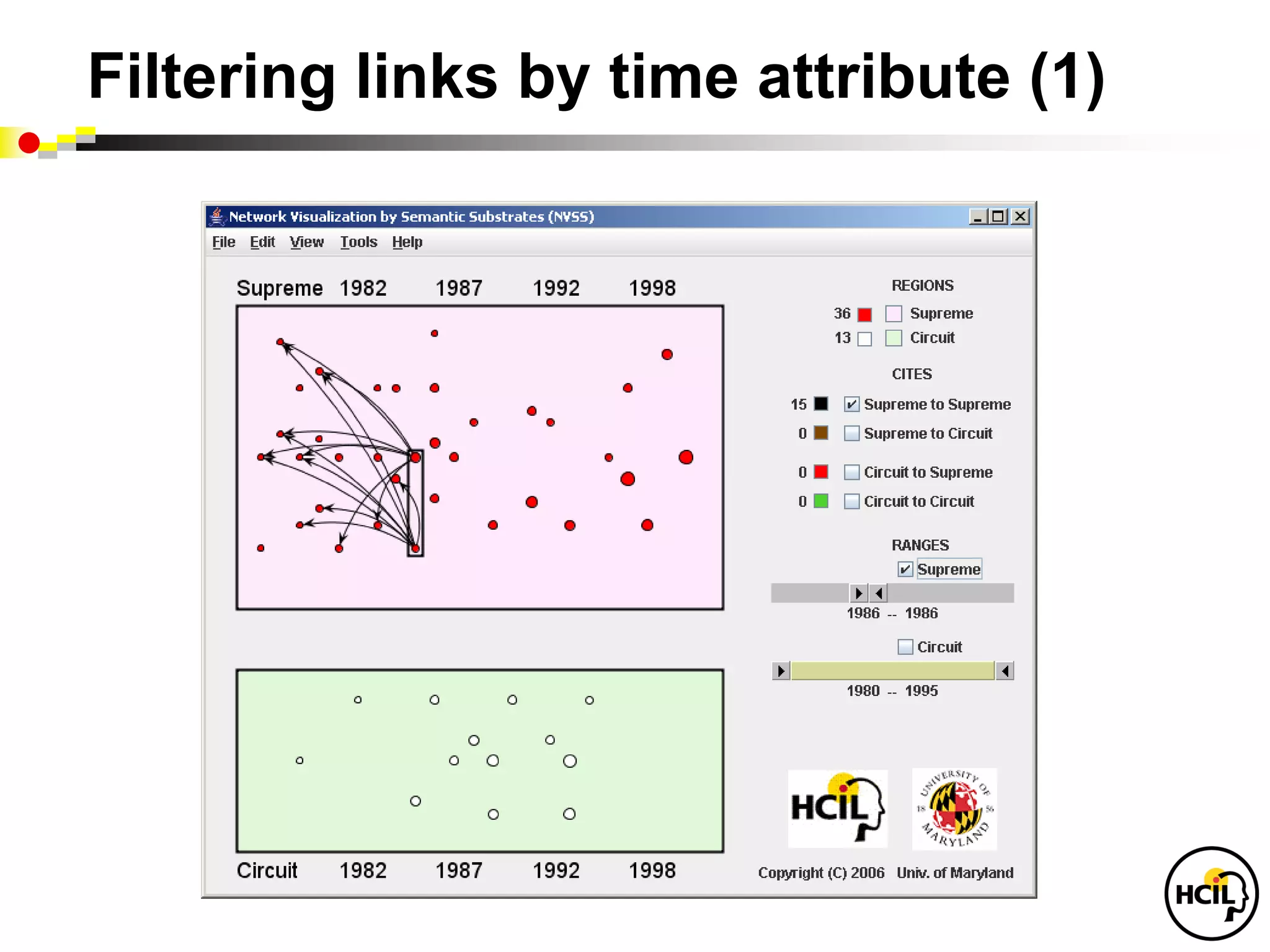
• Give users control of link visibility
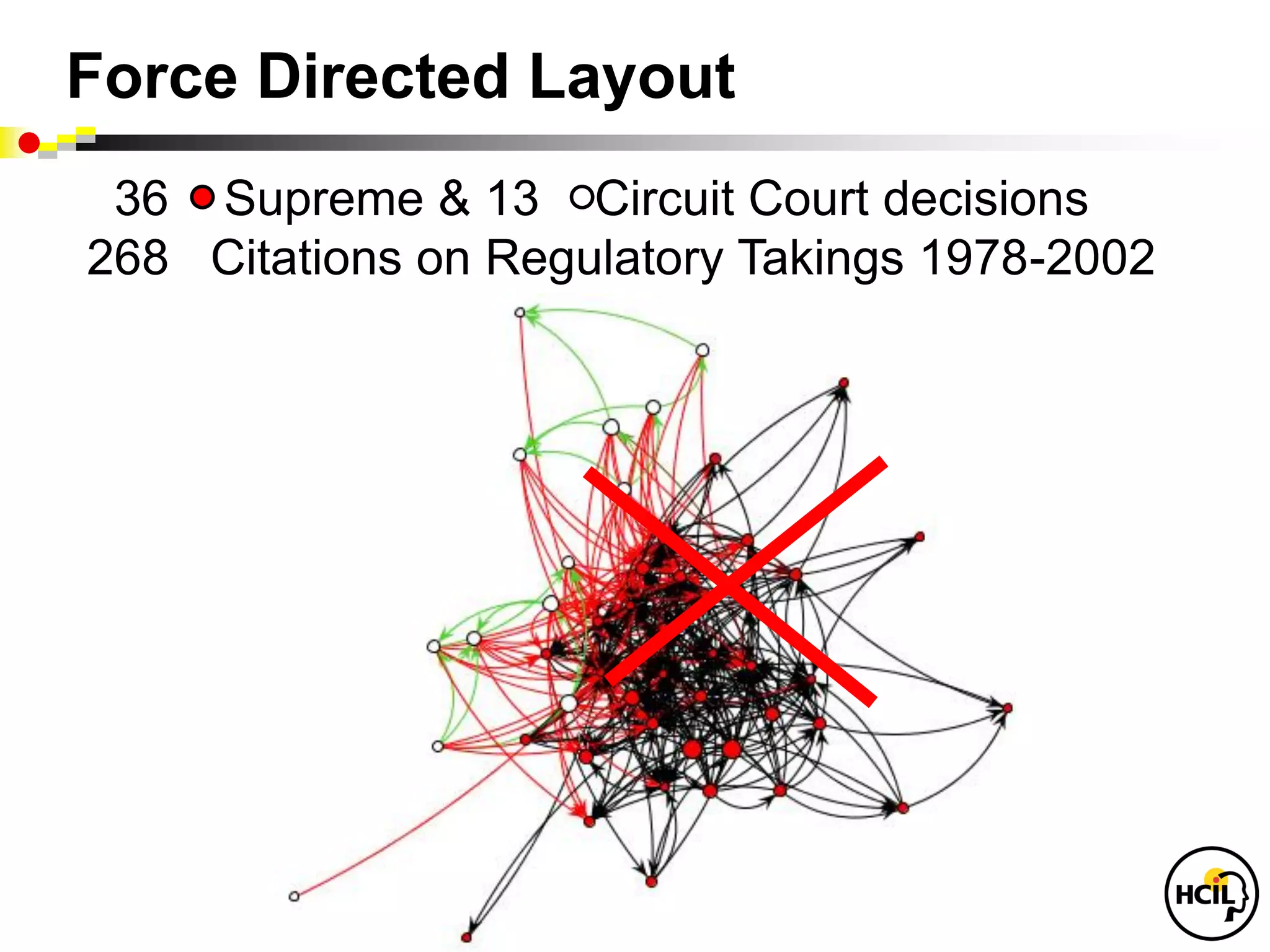
Force Directed Layout
 36 Supreme & 13 Circuit Court decisions
268 Citations on Regulatory Takings 1978-2002
Network Visualization by Semantic Substrates

 NVSS 1.0
Filtering links by source-target
Filtering links by time attribute (1)
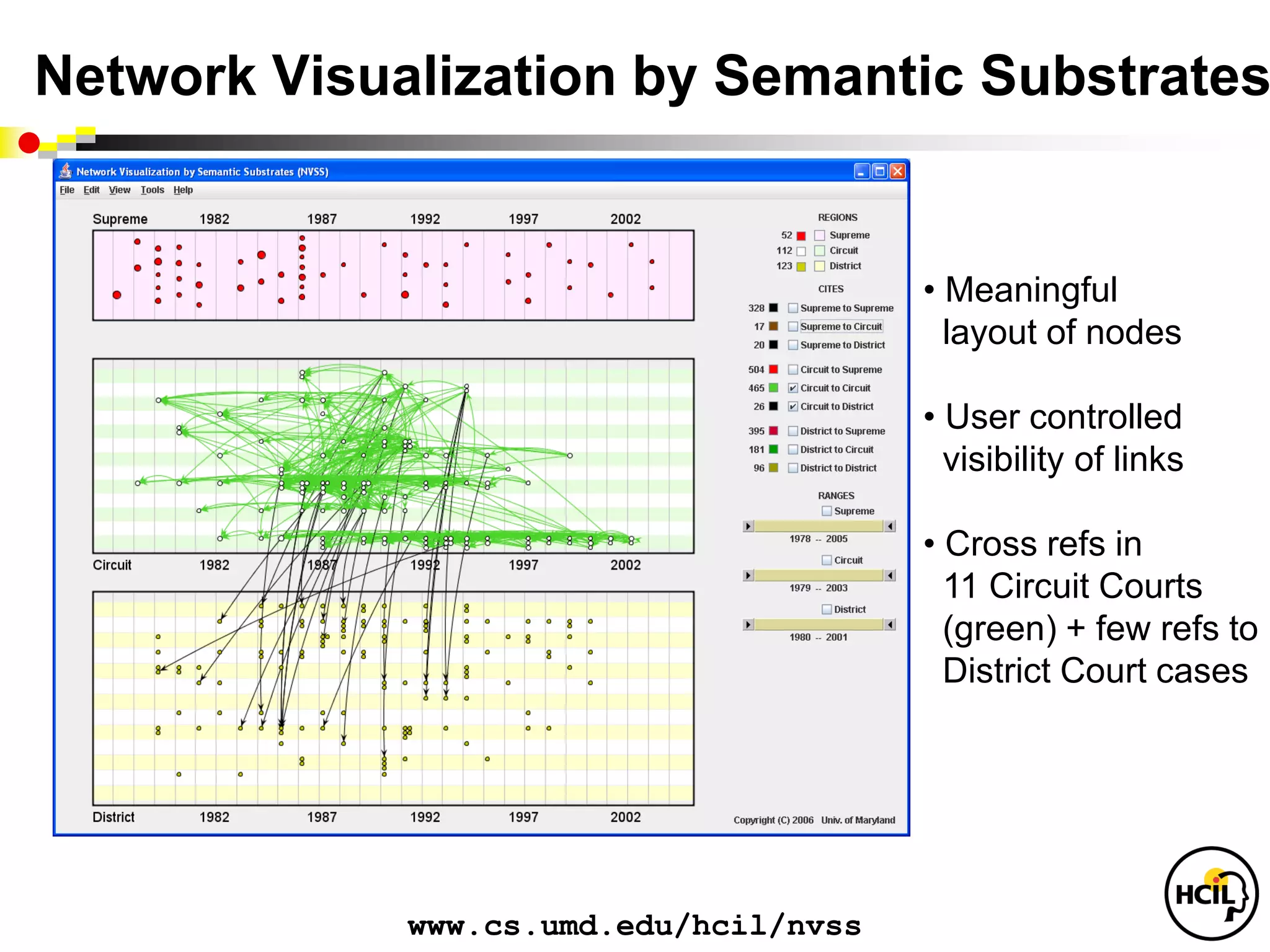
Network Visualization by Semantic Substrates


                                        • Meaningful
                                          layout of nodes

                                        • User controlled
                                          visibility of links

                                        • Cross refs in
                                          11 Circuit Courts
                                          (green) + few refs to
                                          District Court cases


             www.cs.umd.edu/hcil/nvss
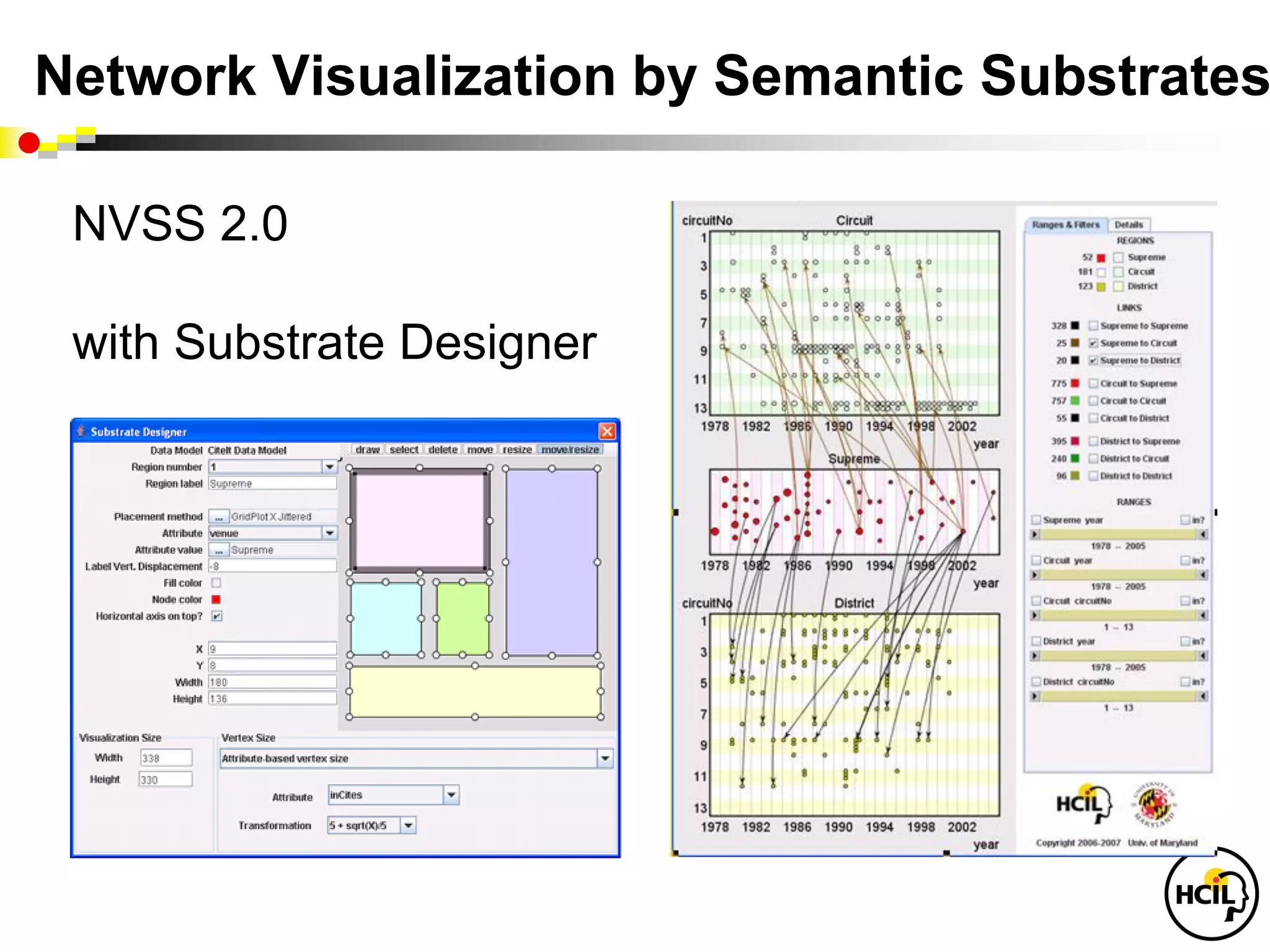
Network Visualization by Semantic Substrates

 NVSS 2.0

 with Substrate Designer
2) SocialAction:
Integrating Statistics & Visualization

Senate 2007: 180 out of 310 Votes in Common
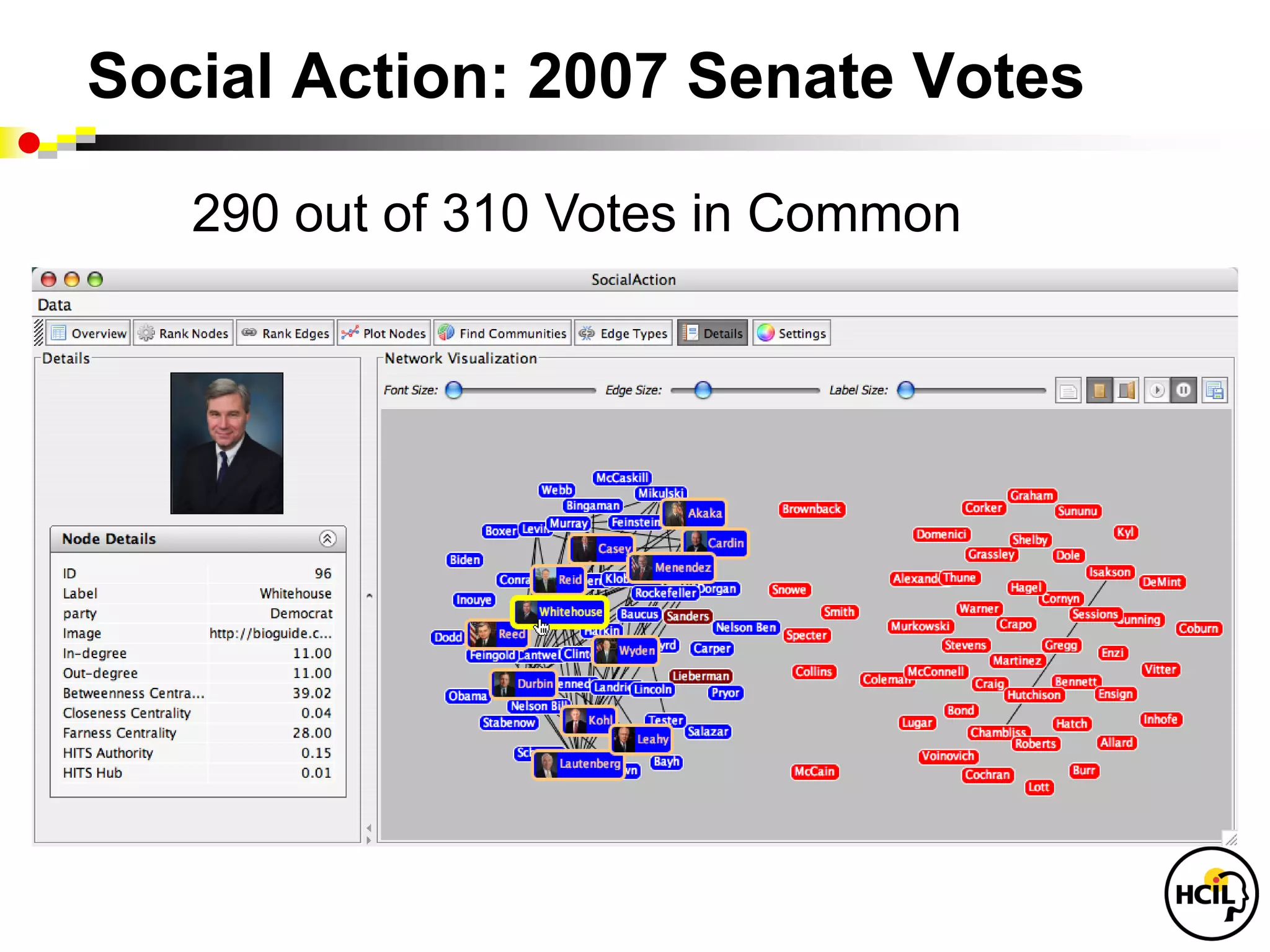
Social Action: 2007 Senate Votes

   290 out of 310 Votes in Common
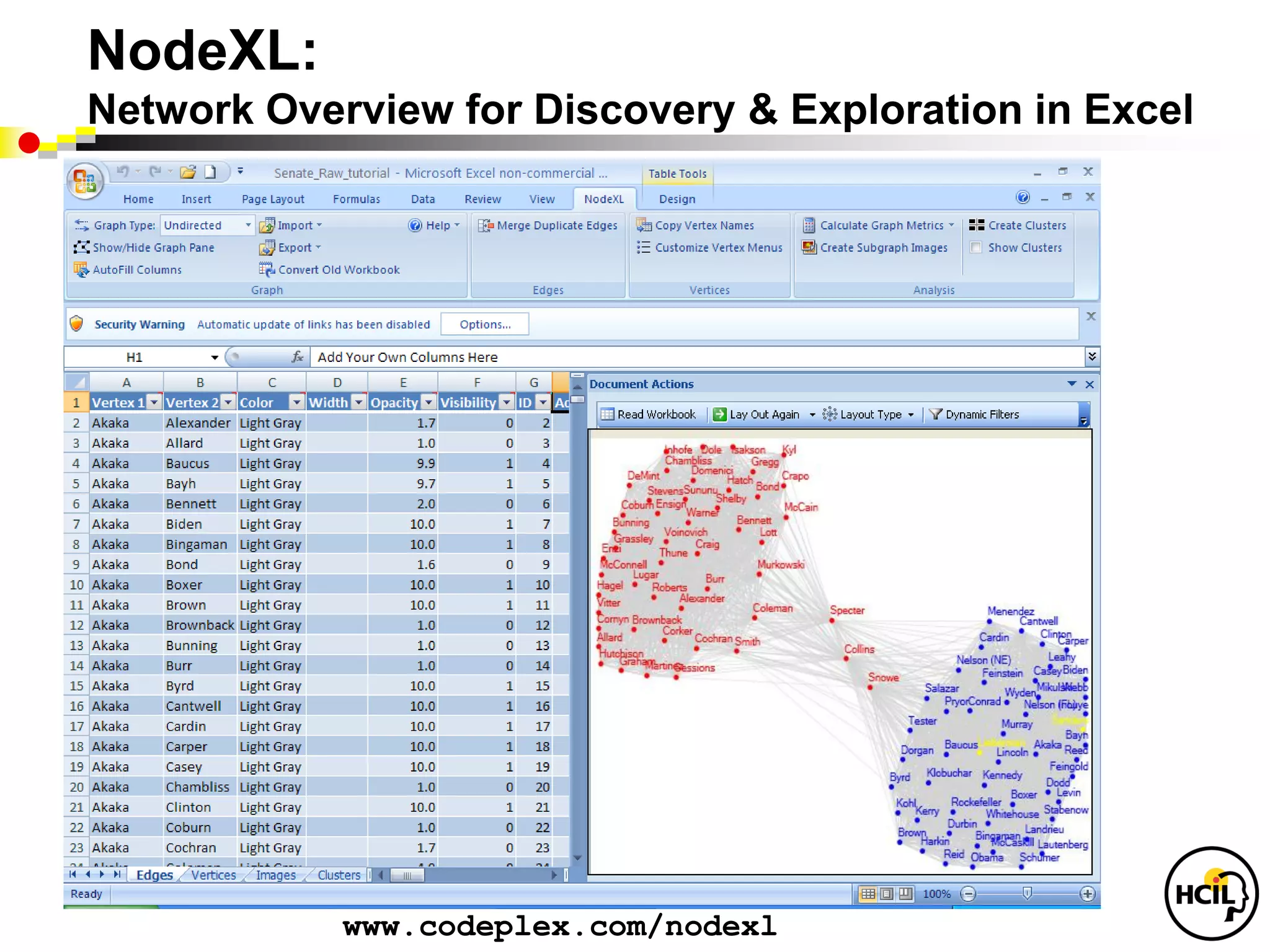
NodeXL:
Network Overview for Discovery & Exploration in Excel


            www.codeplex.com/nodexl
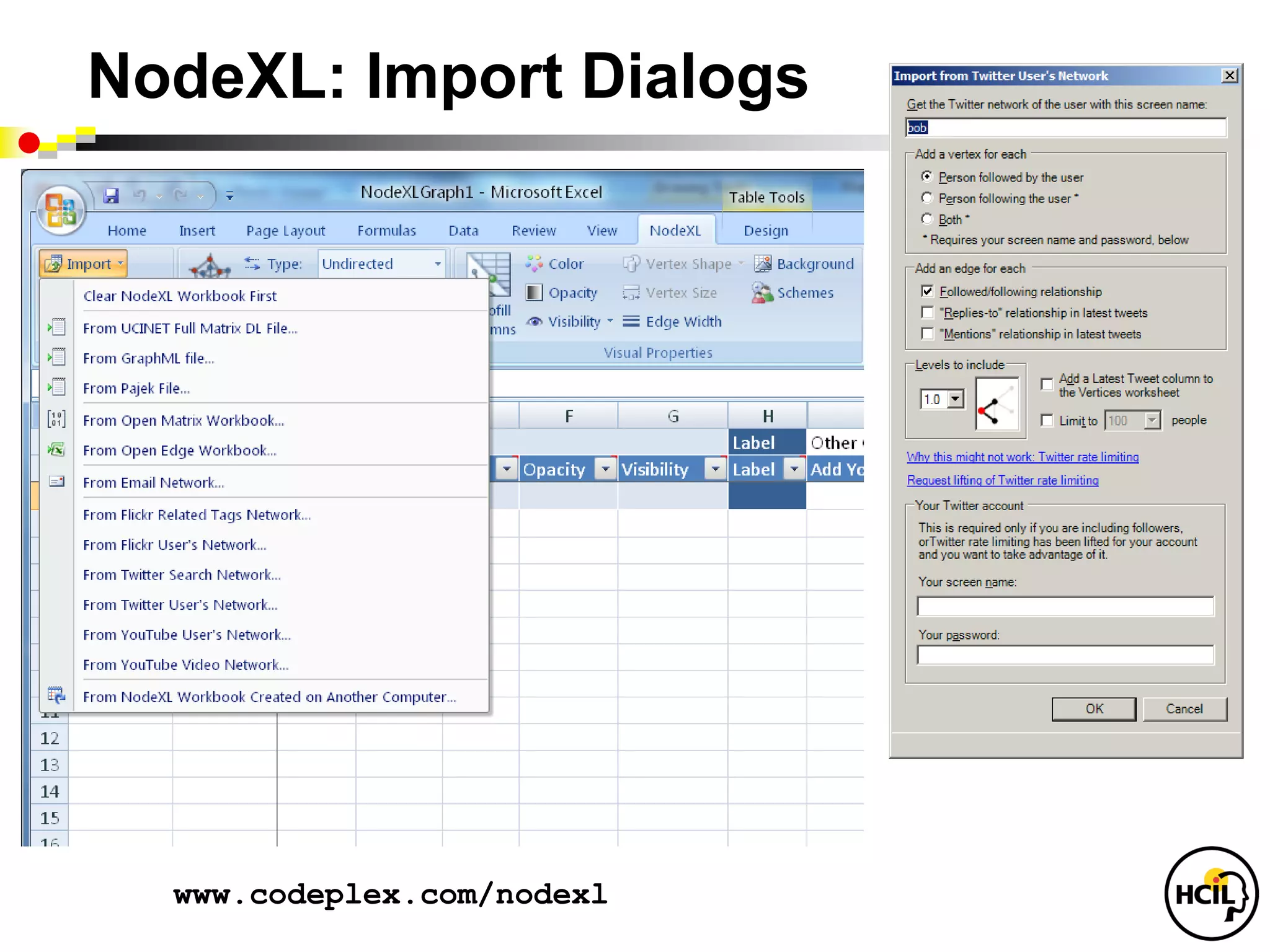
NodeXL: Import Dialogs


  www.codeplex.com/nodexl
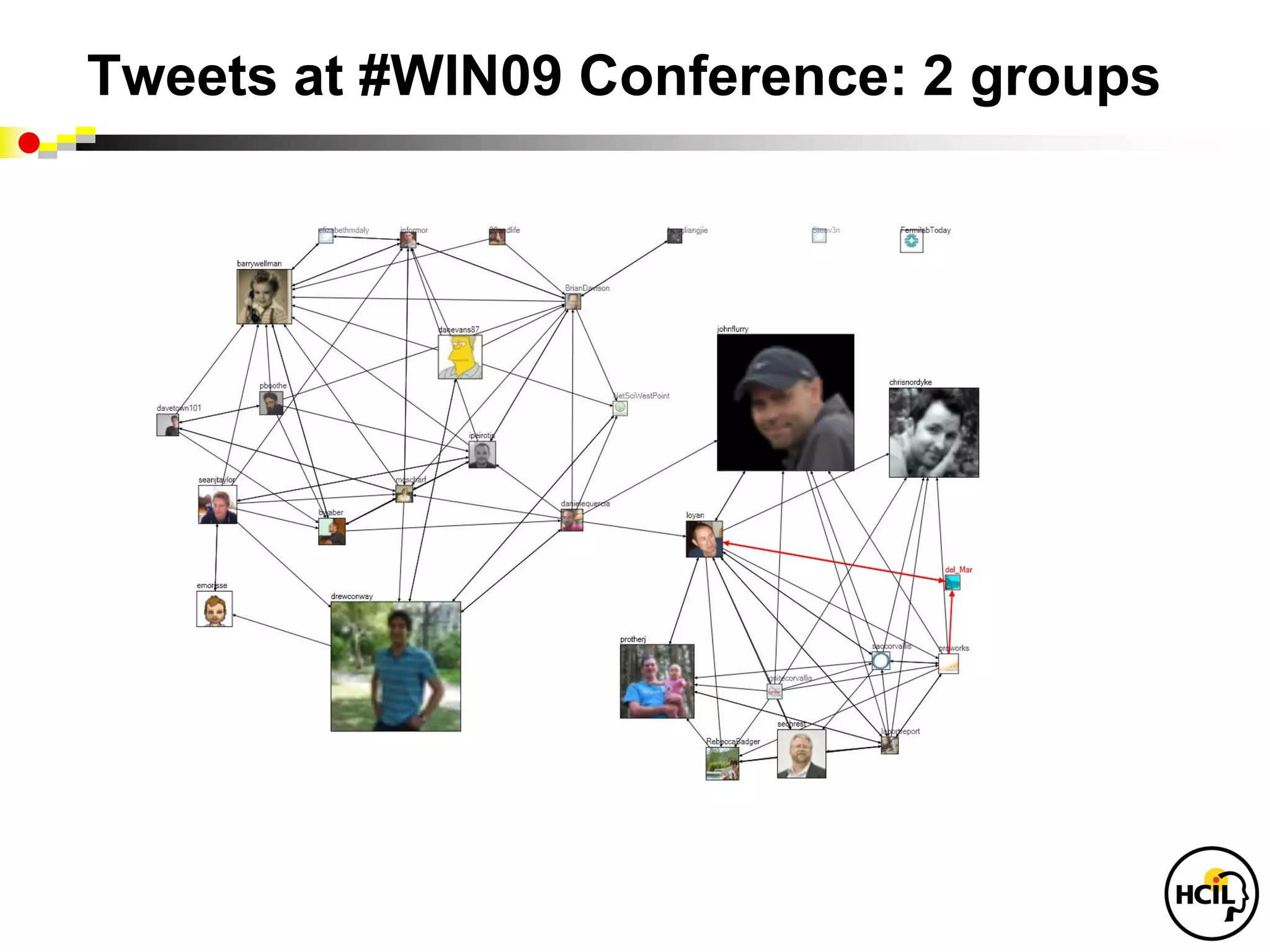
Tweets at #WIN09 Conference: 2 groups
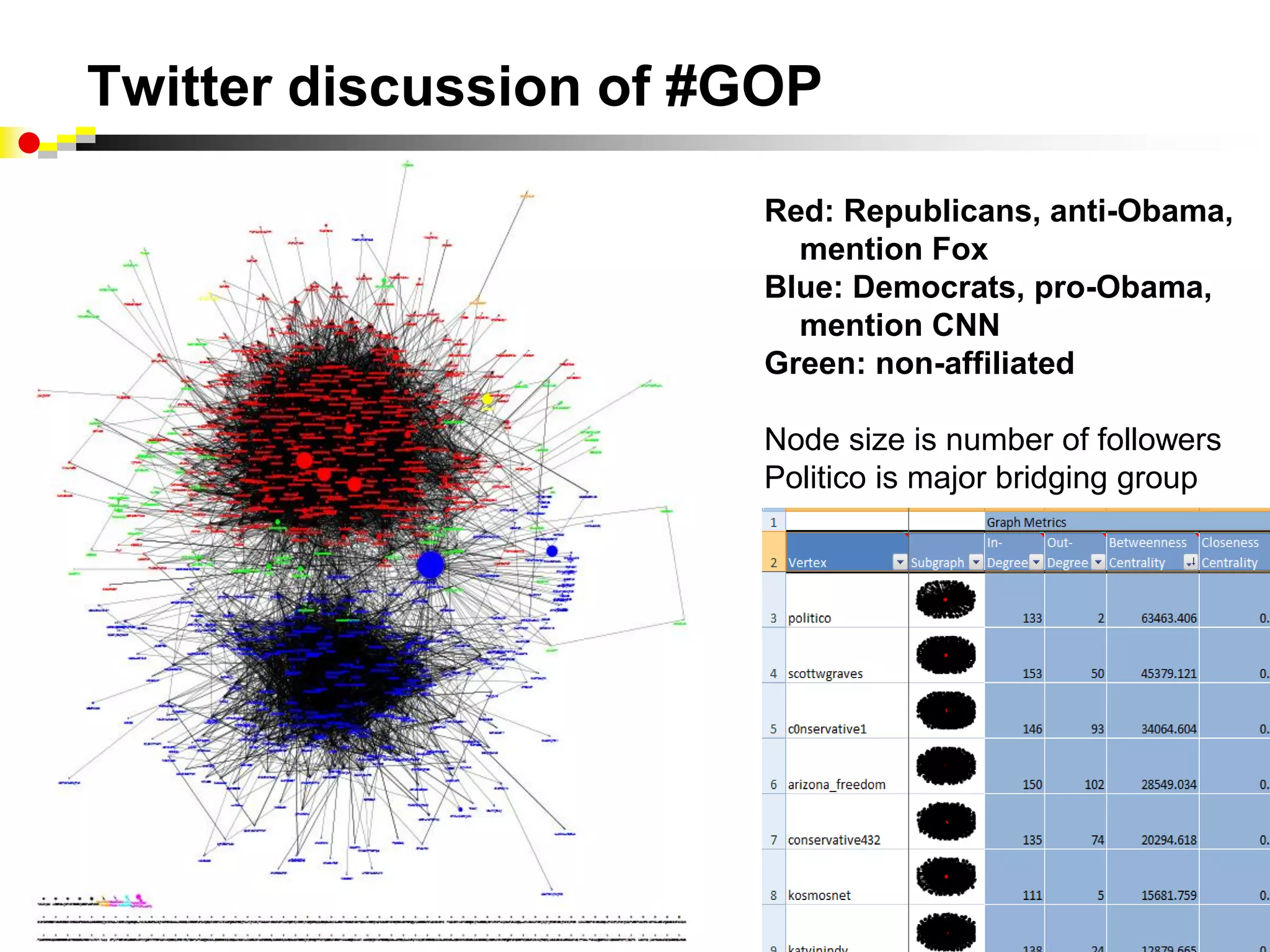
Twitter discussion of #GOP

                       Red: Republicans, anti-Obama,
                         mention Fox
                       Blue: Democrats, pro-Obama,
                         mention CNN
                       Green: non-affiliated

                       Node size is number of followers
                       Politico is major bridging group
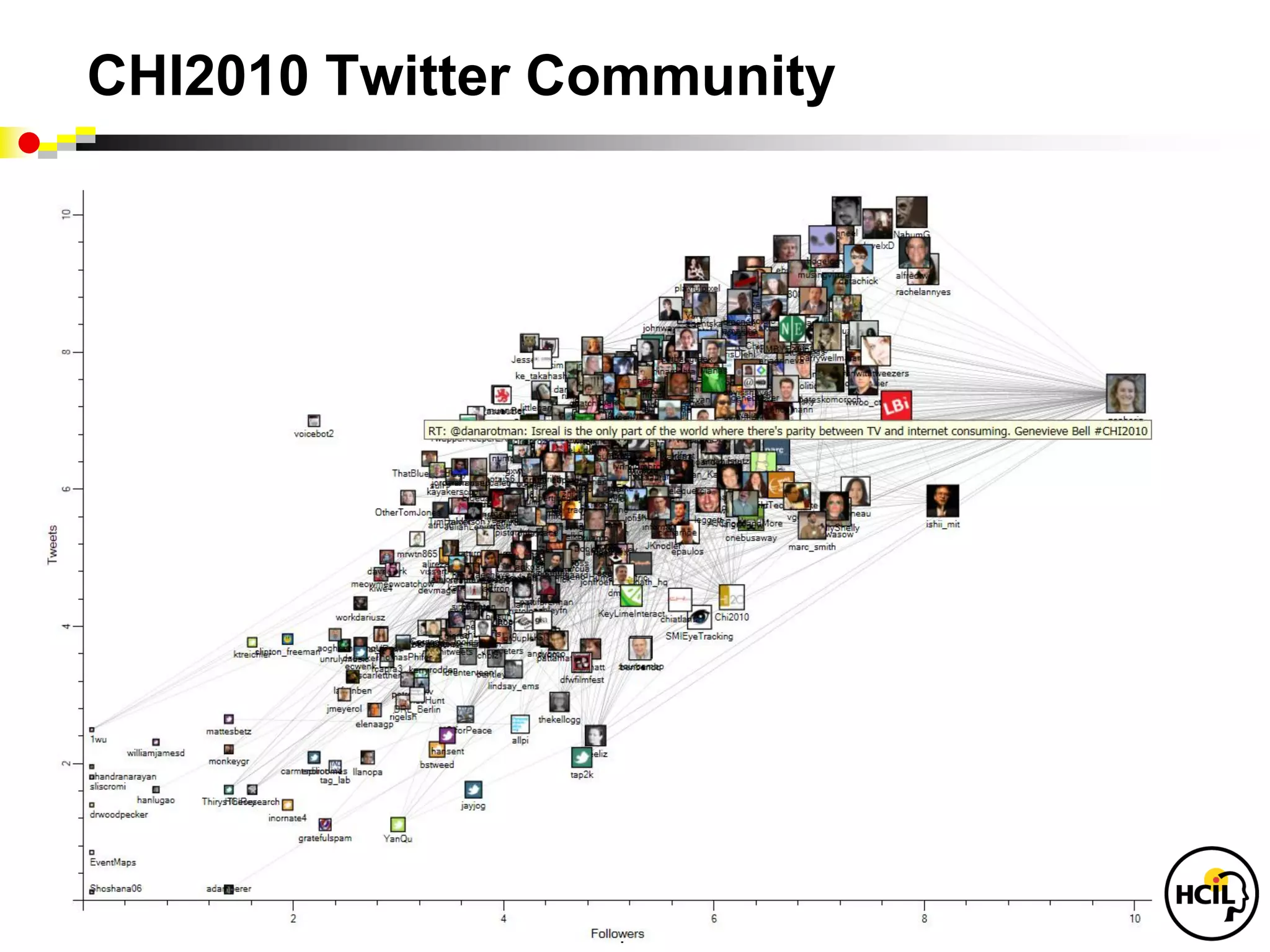
CHI2010 Twitter Community


              www.codeplex.com/nodexl/
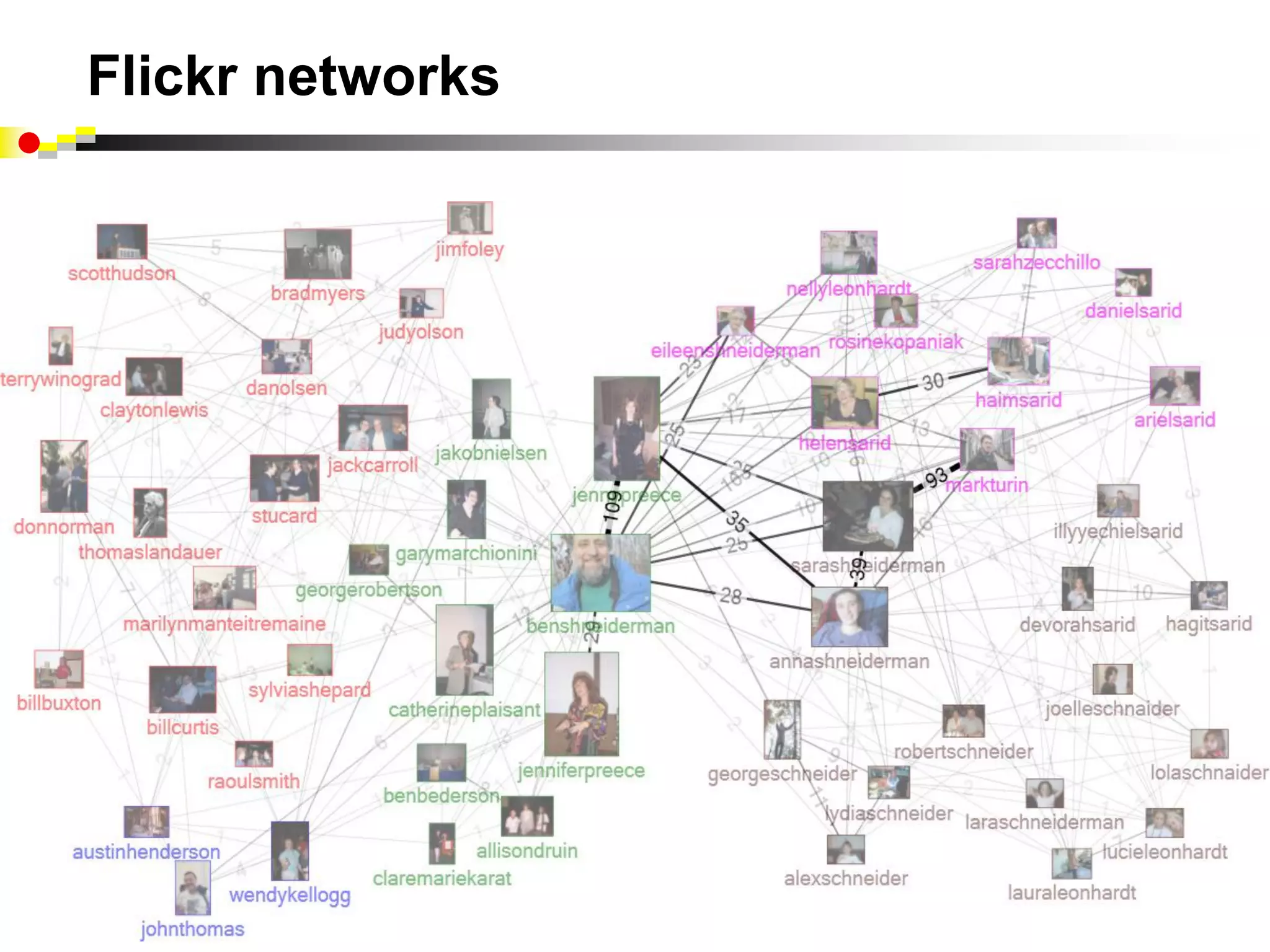
Flickr networks
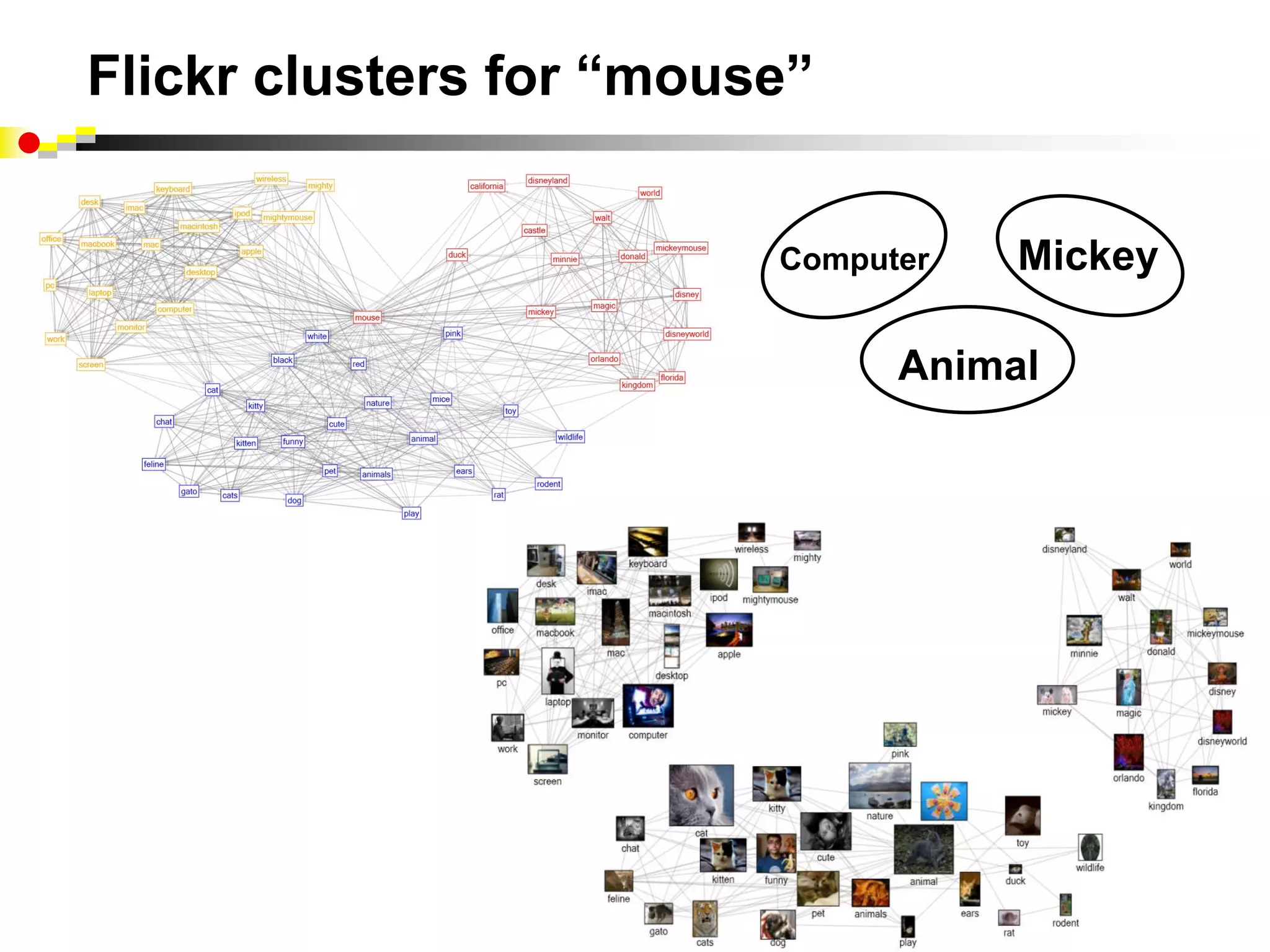
Flickr clusters for “mouse”


                         Computer   Mickey

                               Animal
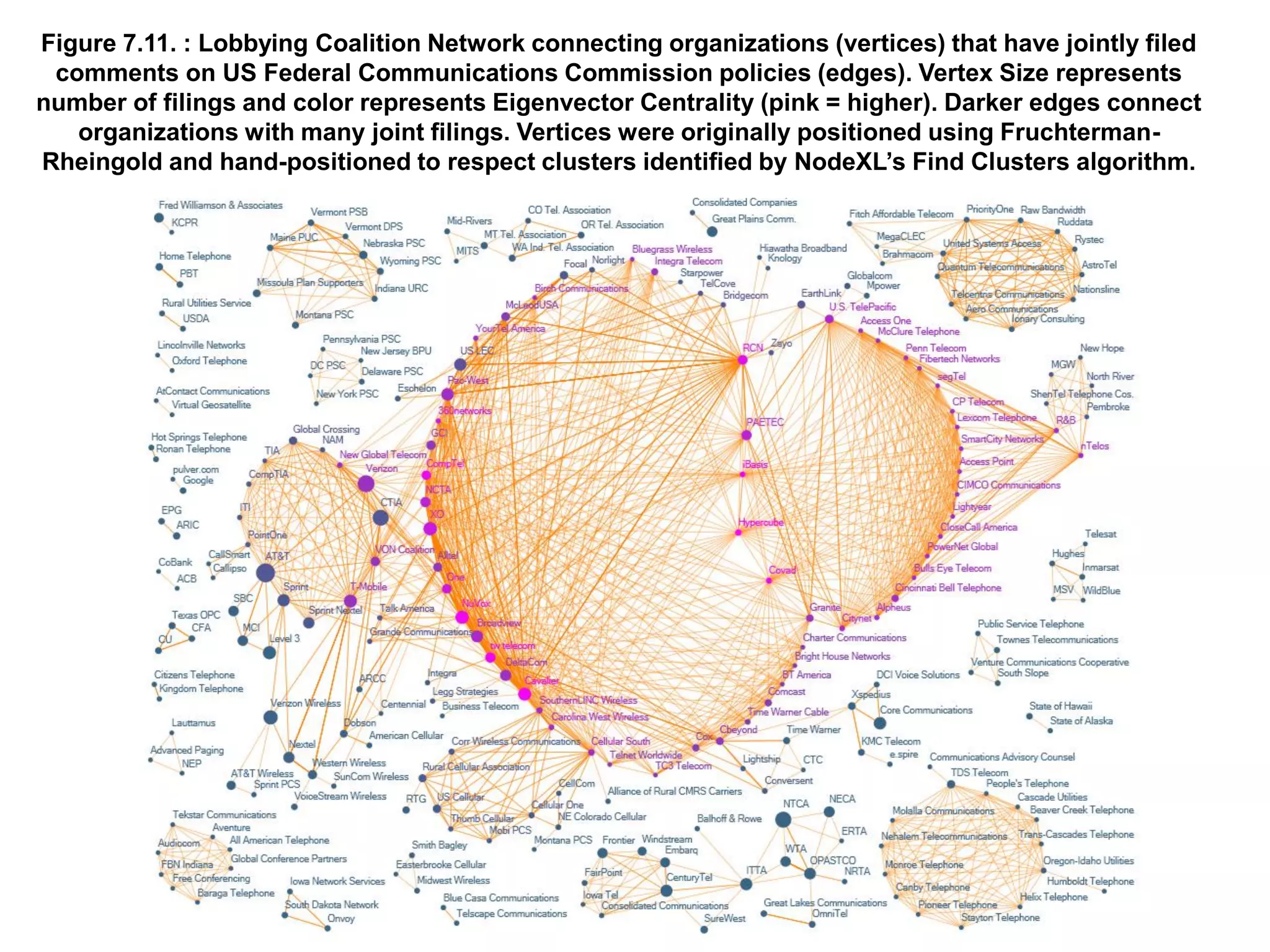
Figure 7.11. : Lobbying Coalition Network connecting organizations (vertices) that have jointly filed
 comments on US Federal Communications Commission policies (edges). Vertex Size represents
number of filings and color represents Eigenvector Centrality (pink = higher). Darker edges connect
   organizations with many joint filings. Vertices were originally positioned using Fruchterman-
Rheingold and hand-positioned to respect clusters identified by NodeXL’s Find Clusters algorithm.
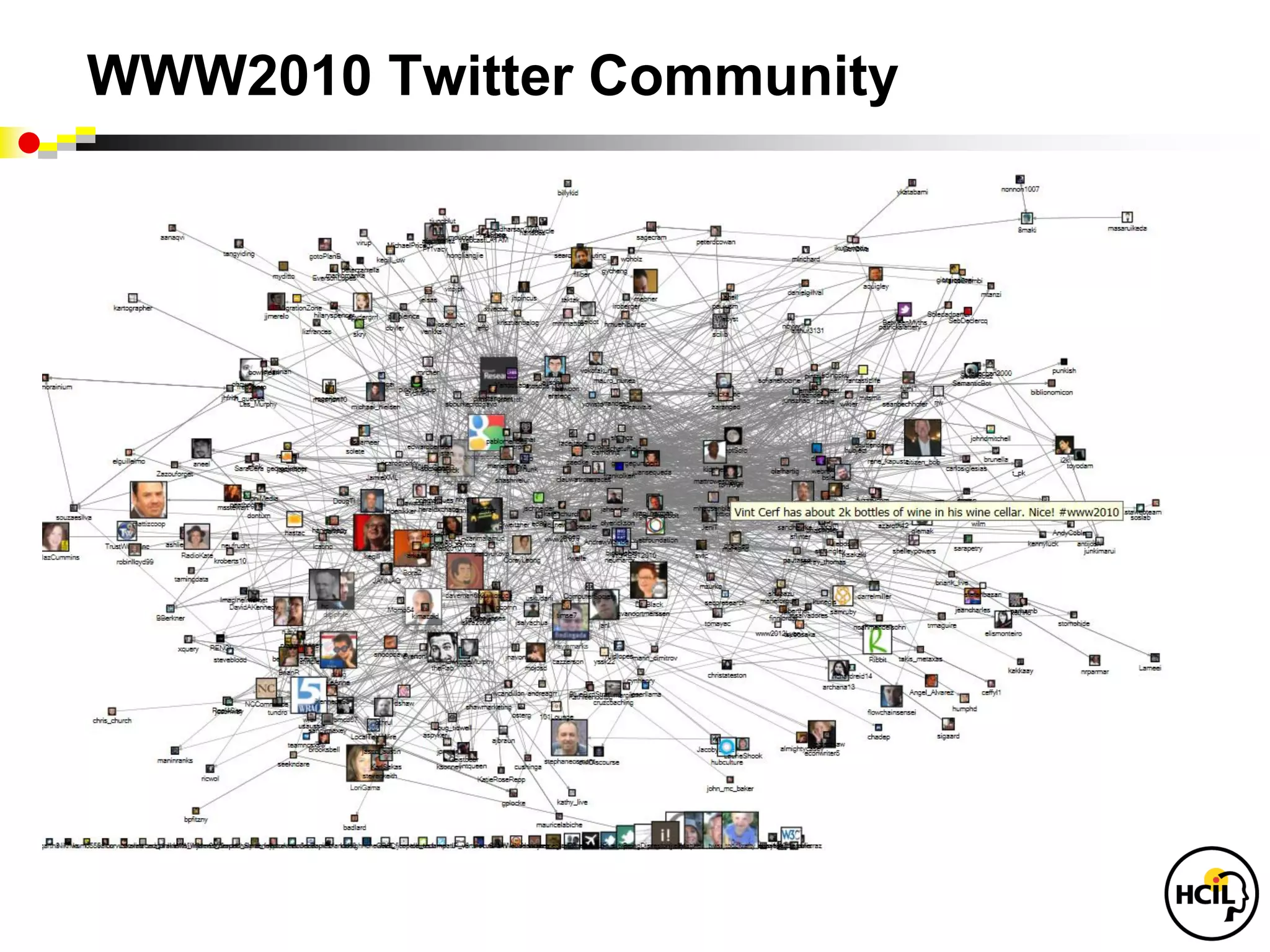
WWW2010 Twitter Community
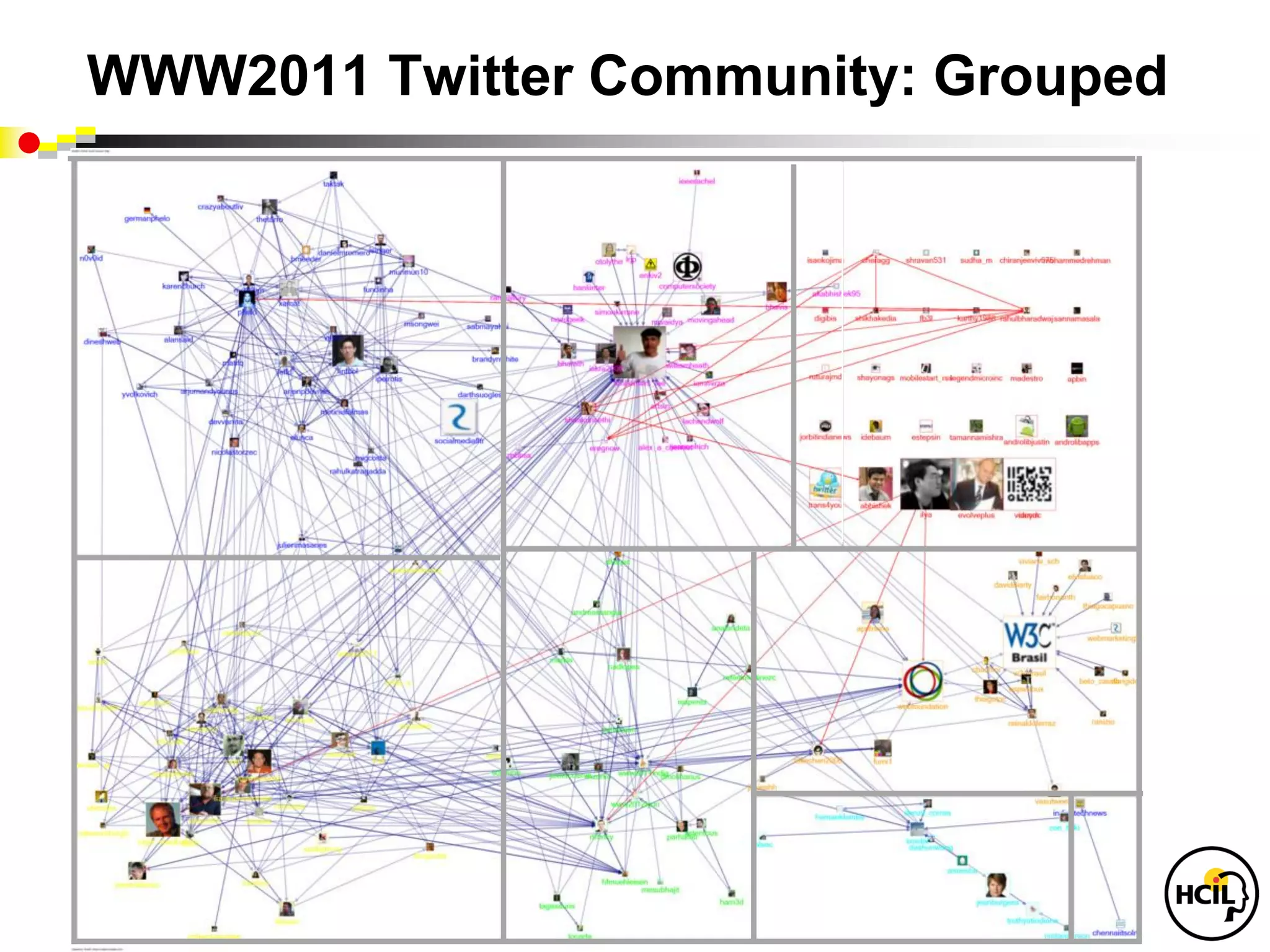
WWW2011 Twitter Community: Grouped
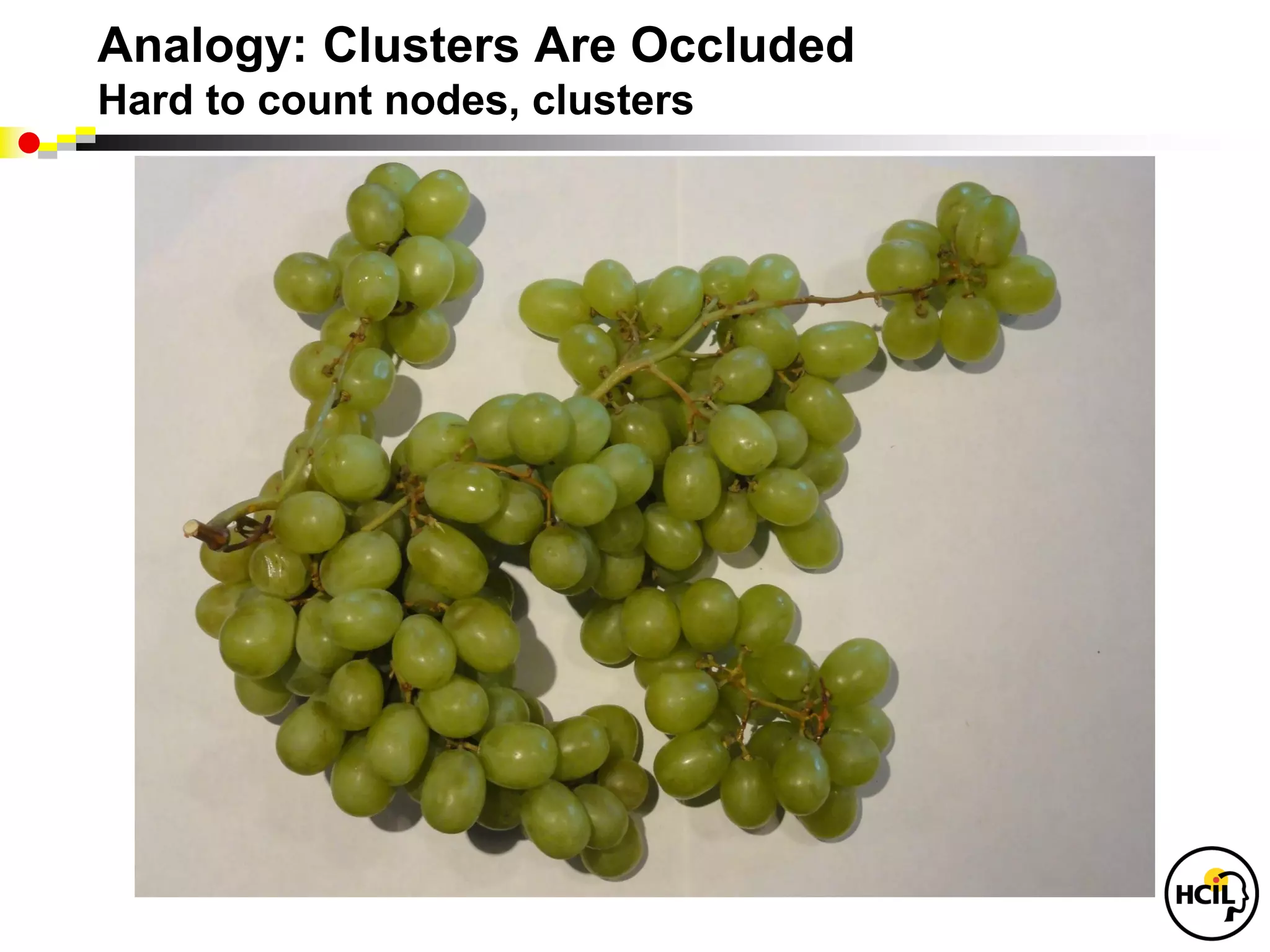
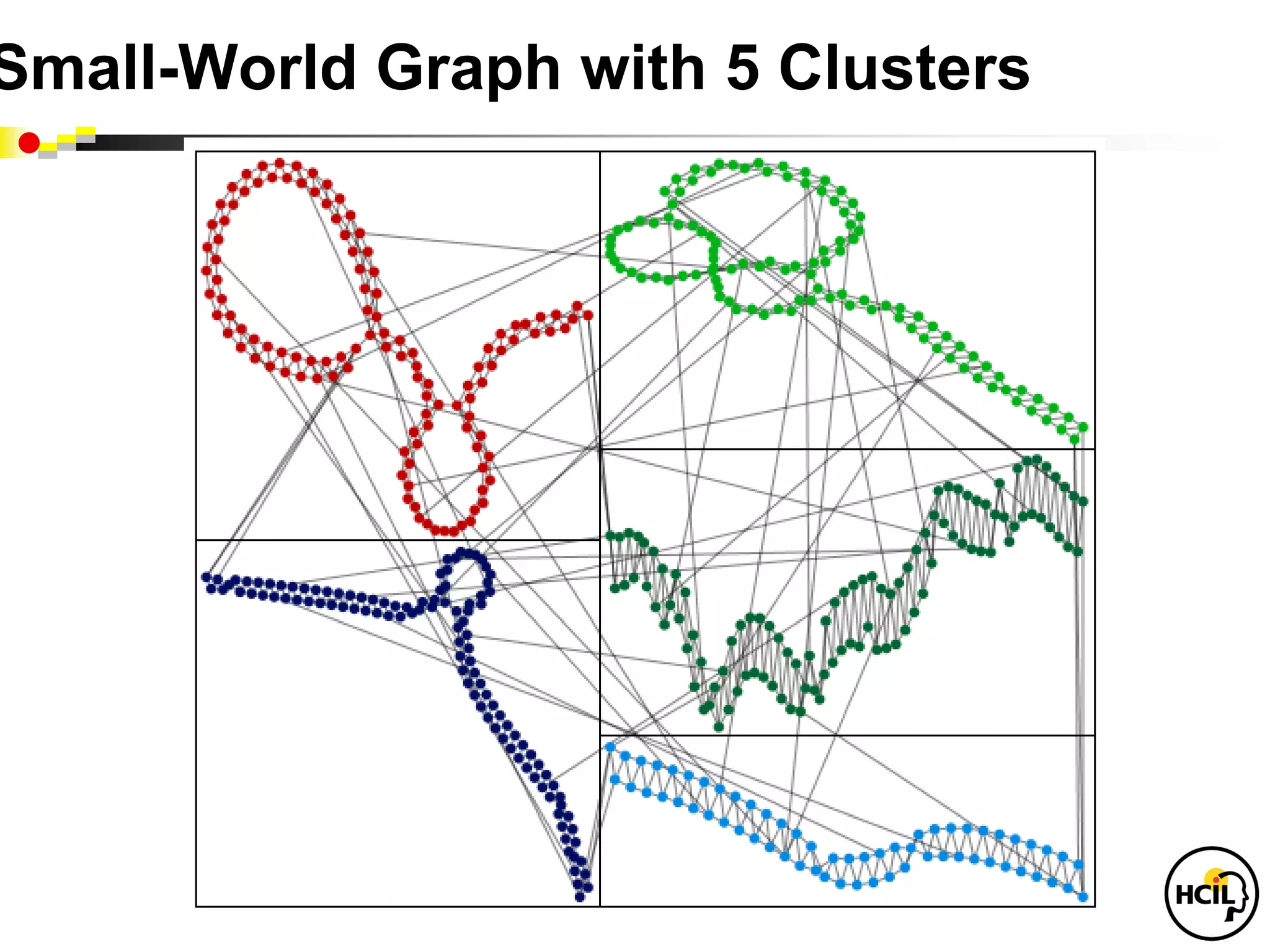
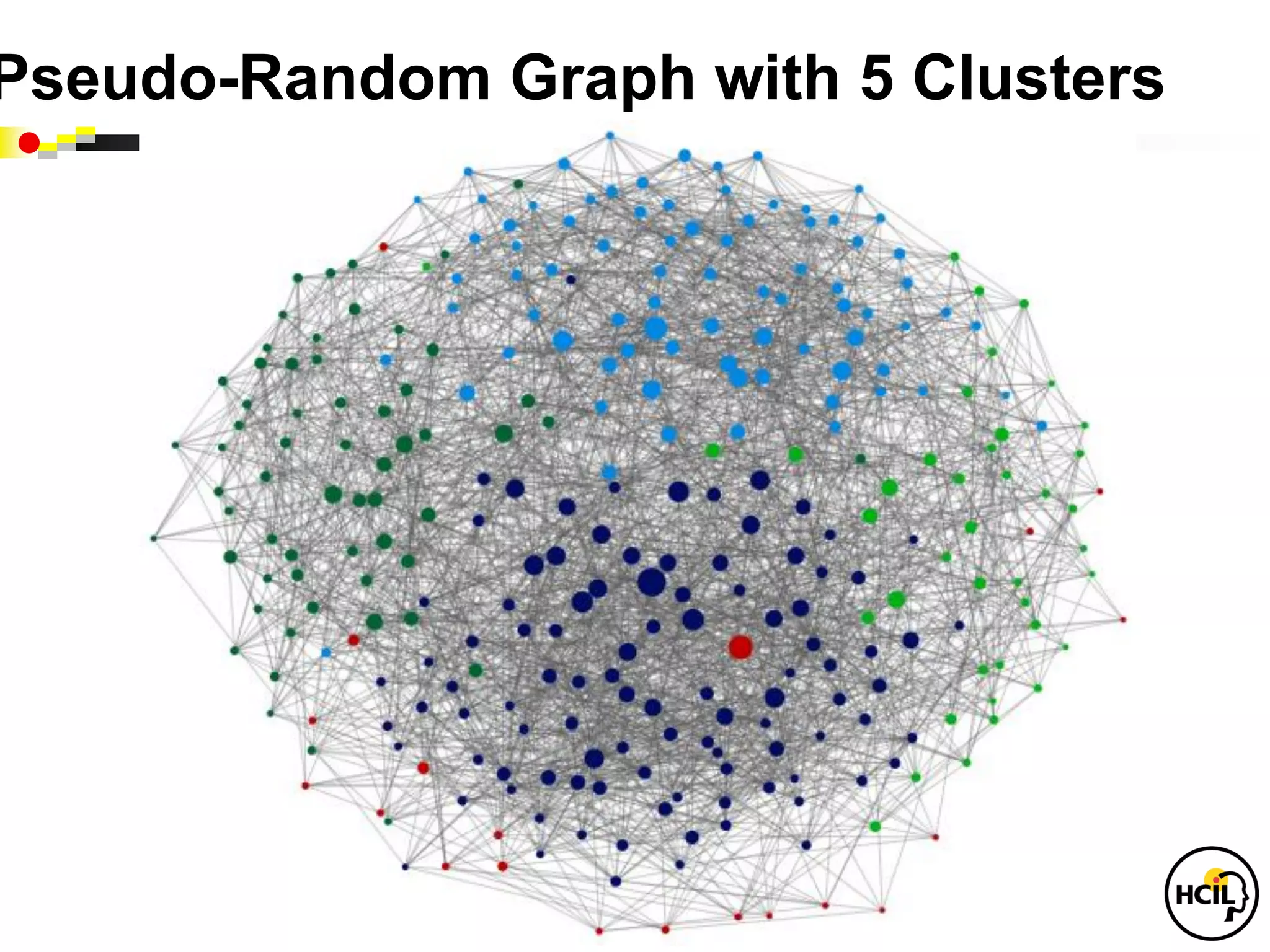
Analogy: Clusters Are Occluded
Hard to count nodes, clusters
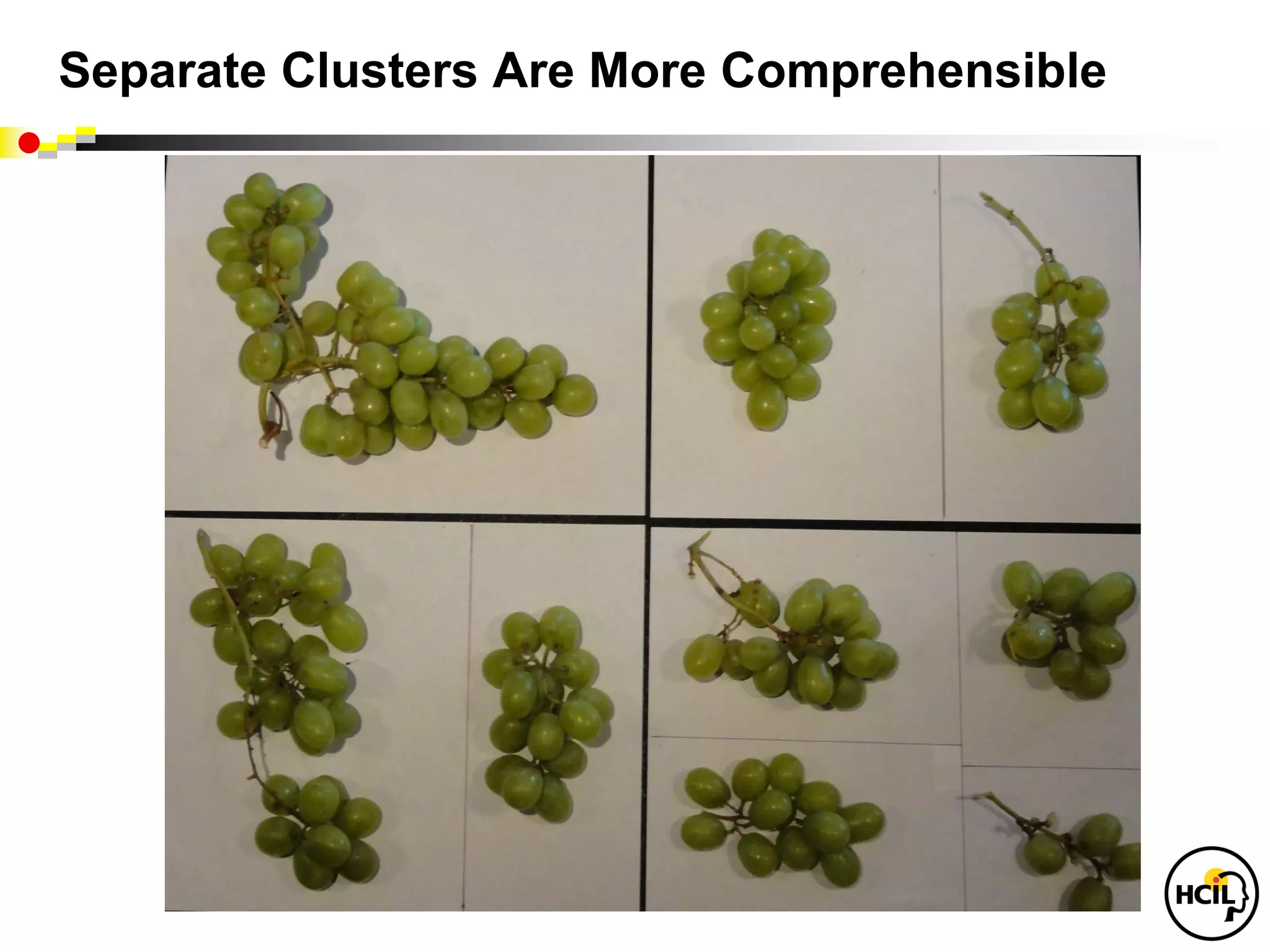
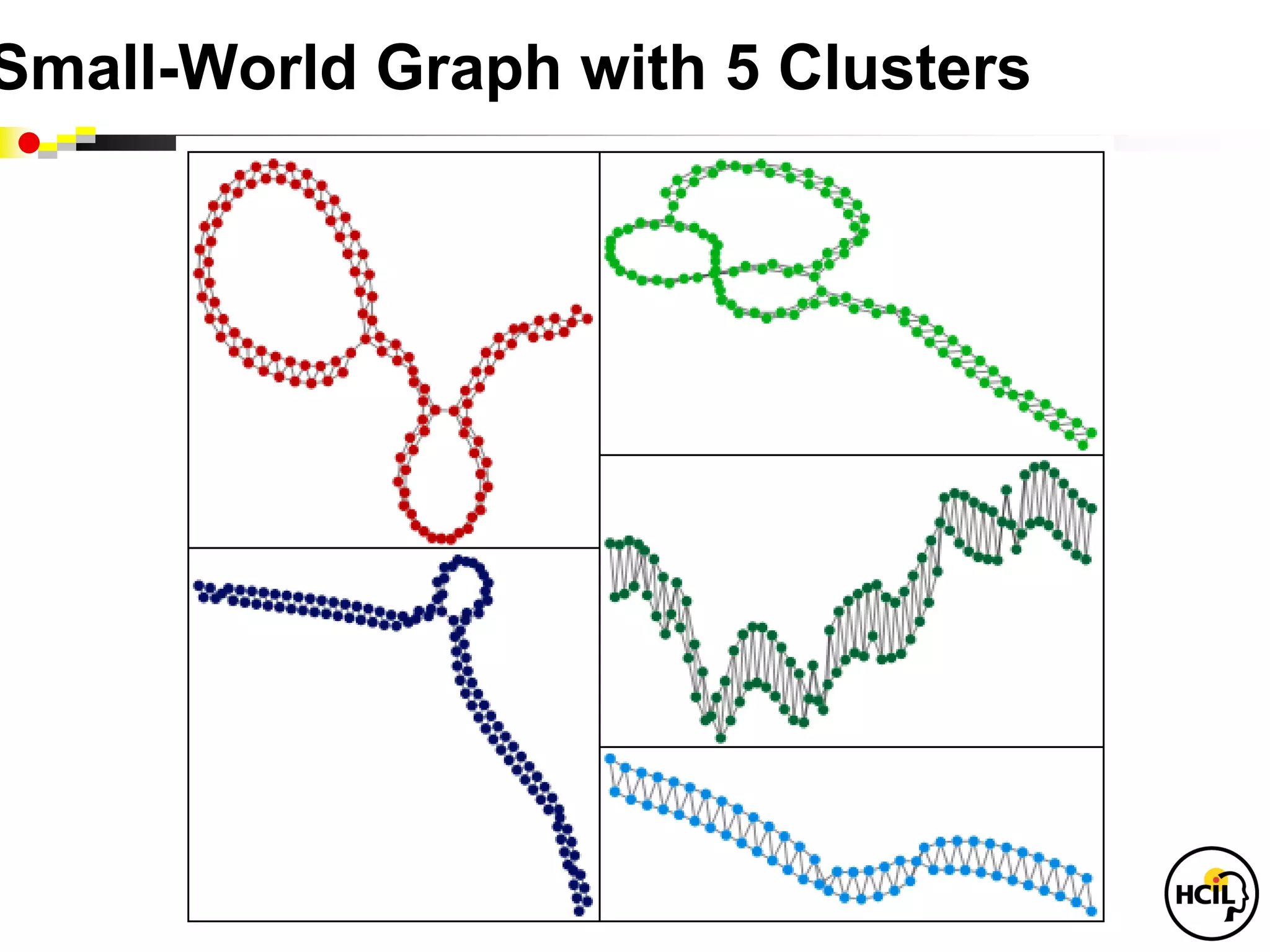
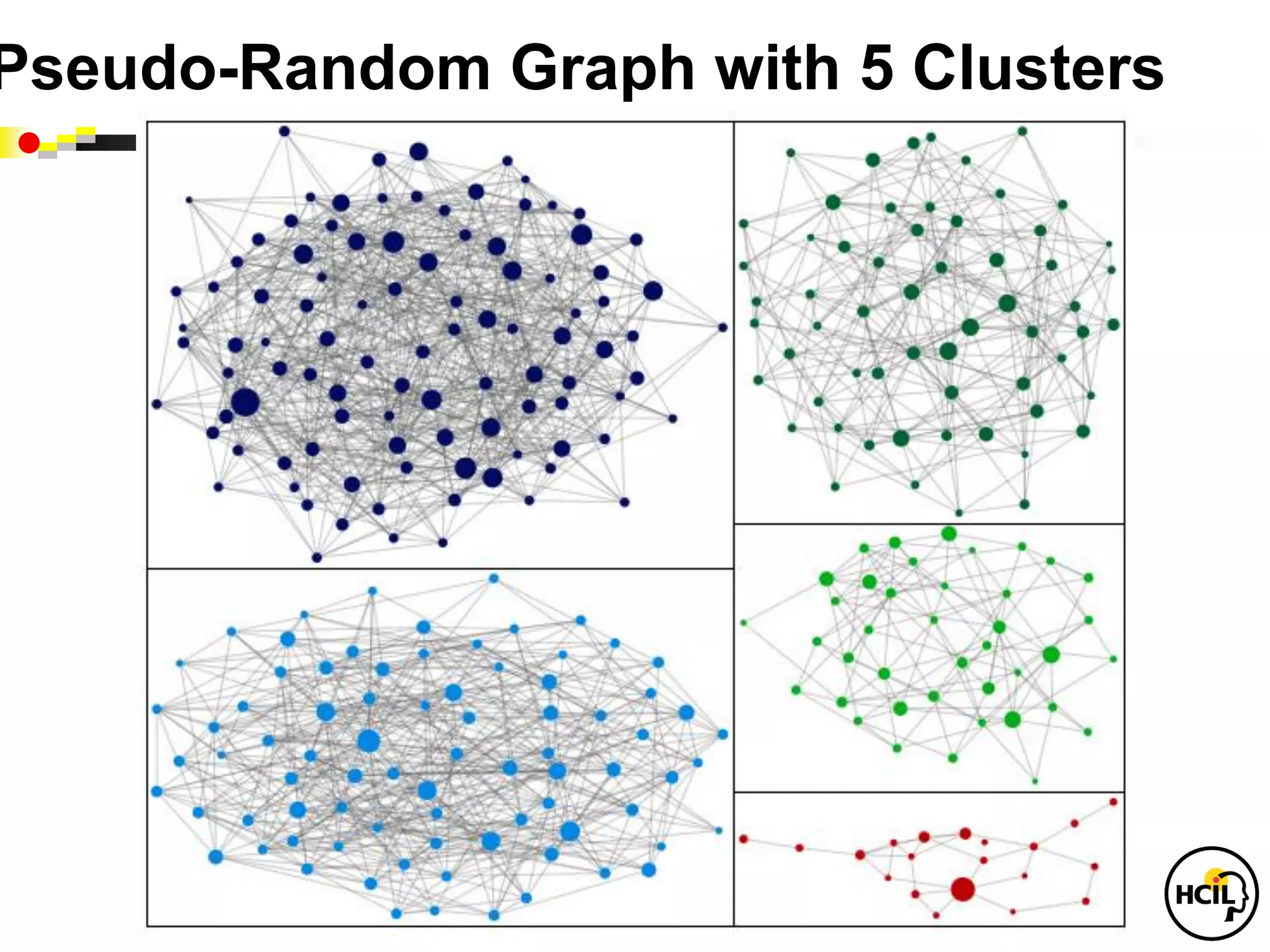
Separate Clusters Are More Comprehensible
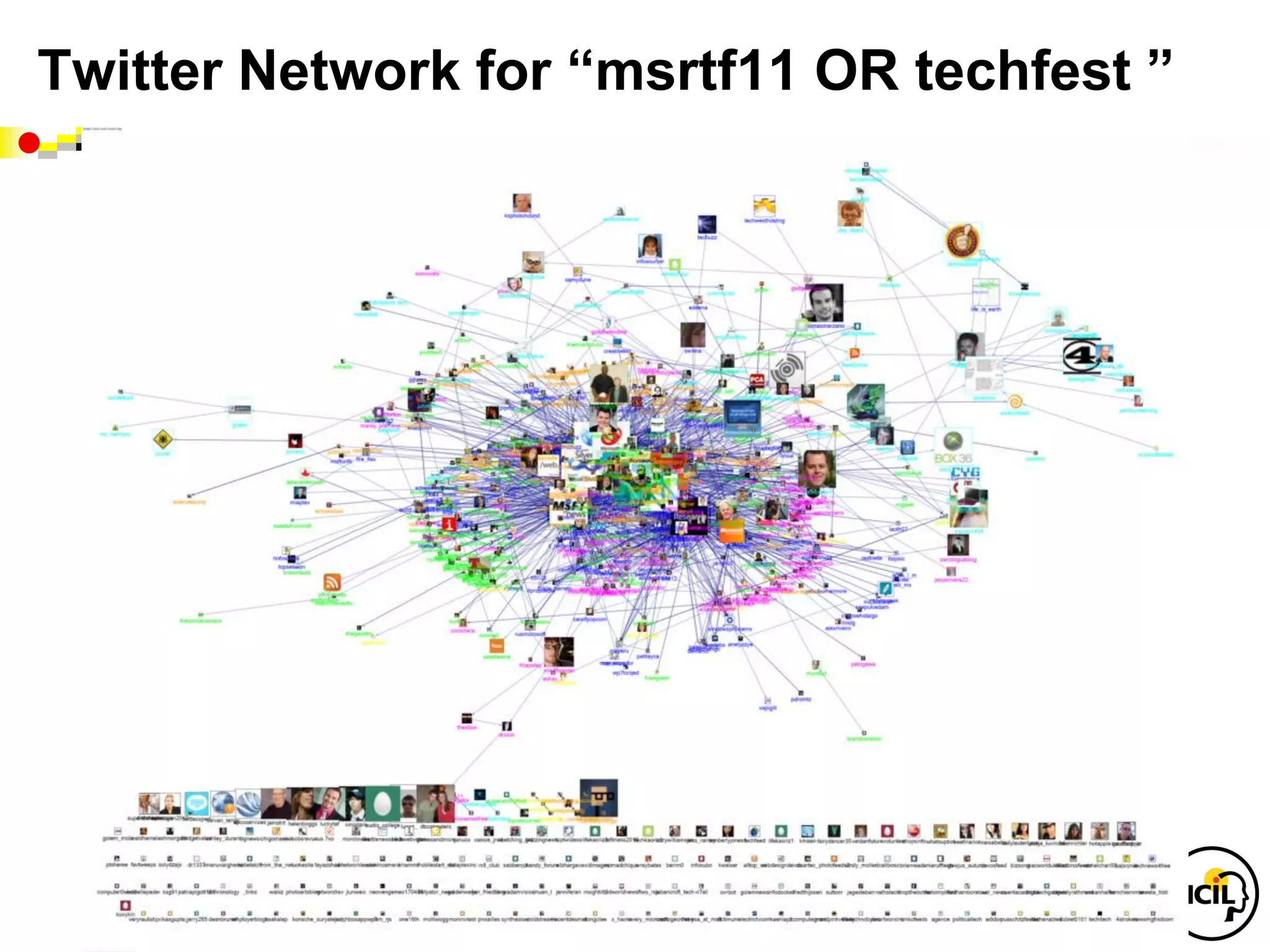
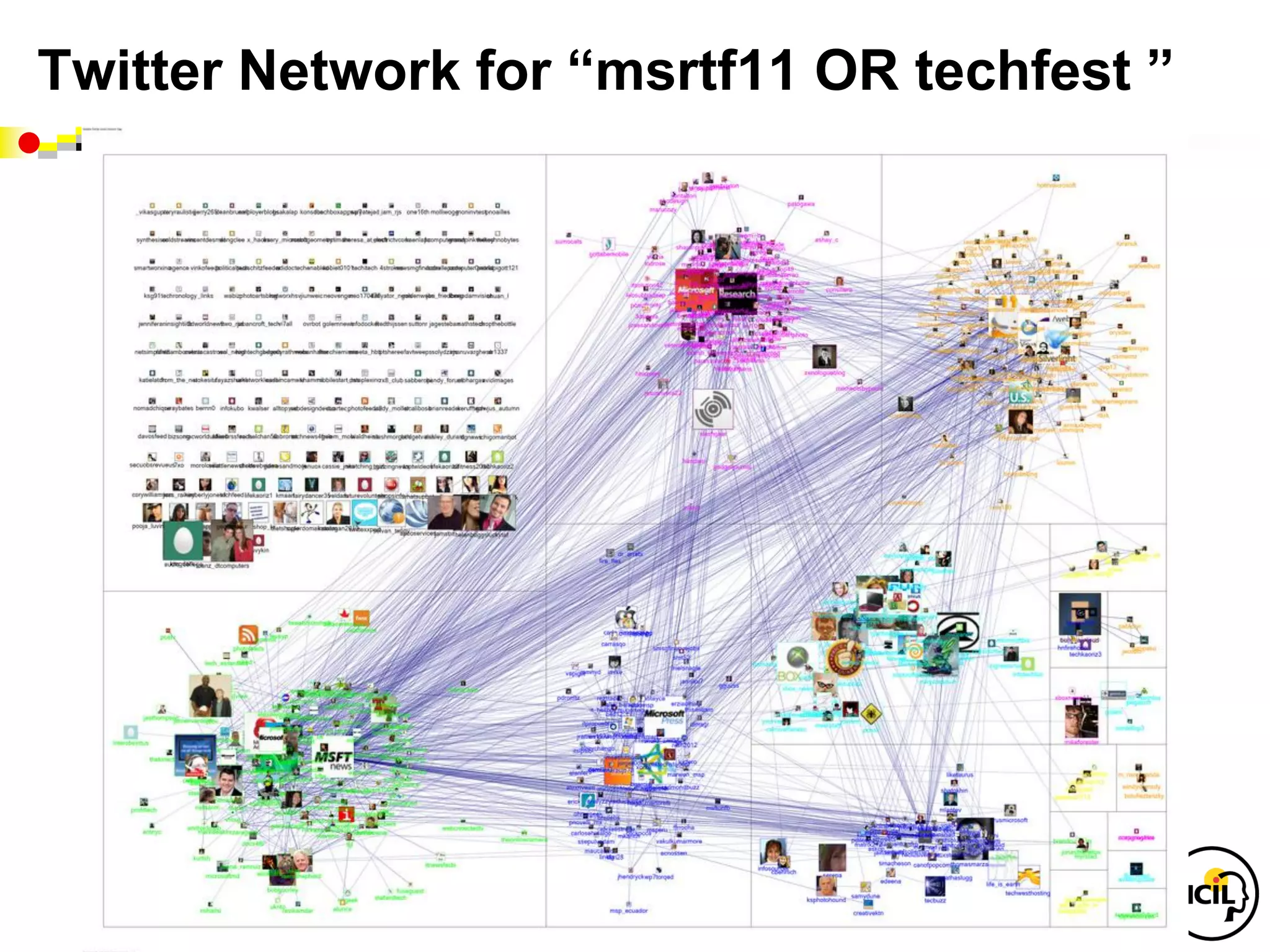
Twitter Network for “msrtf11 OR techfest ”
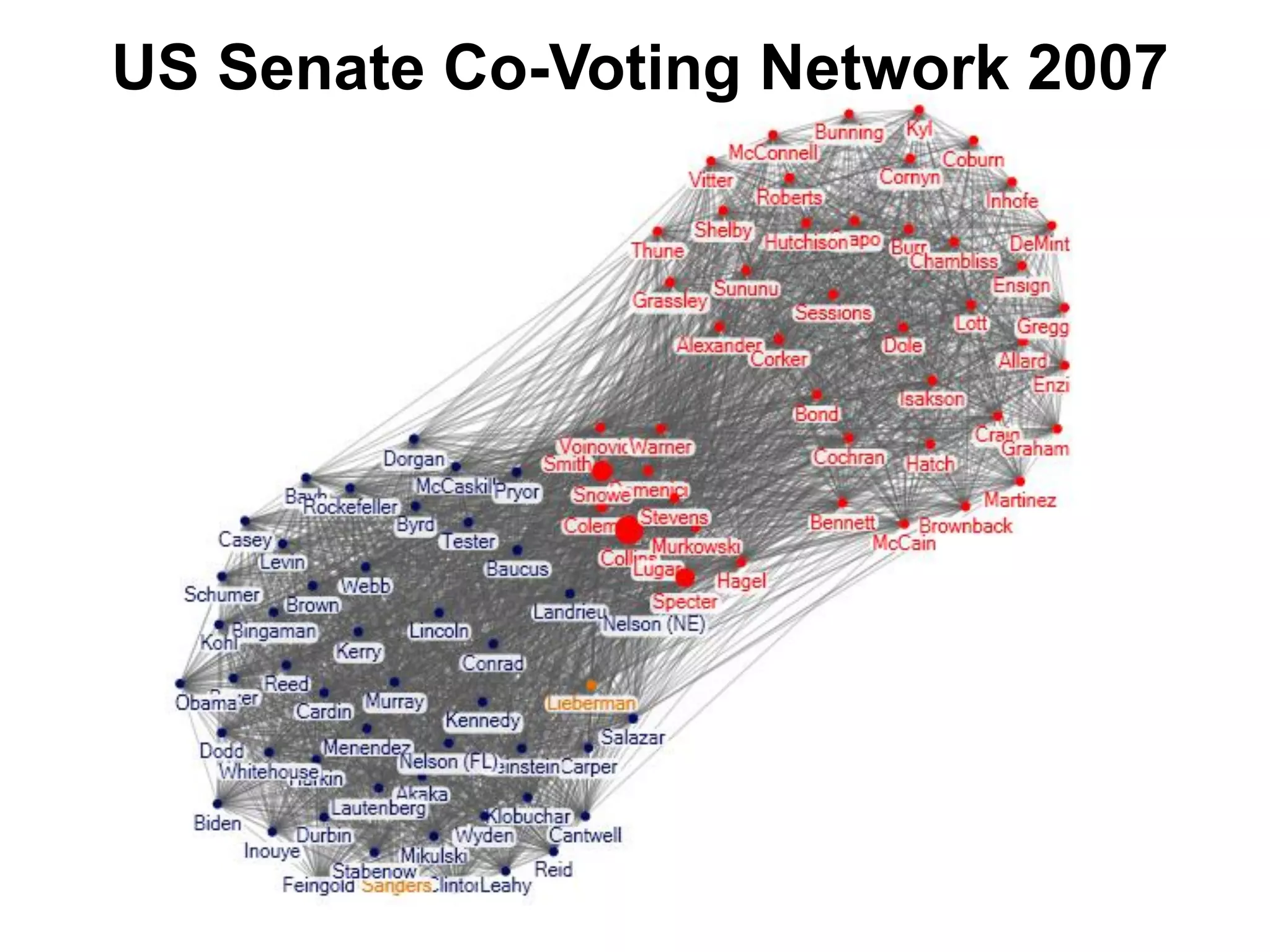
US Senate Co-Voting Network 2007
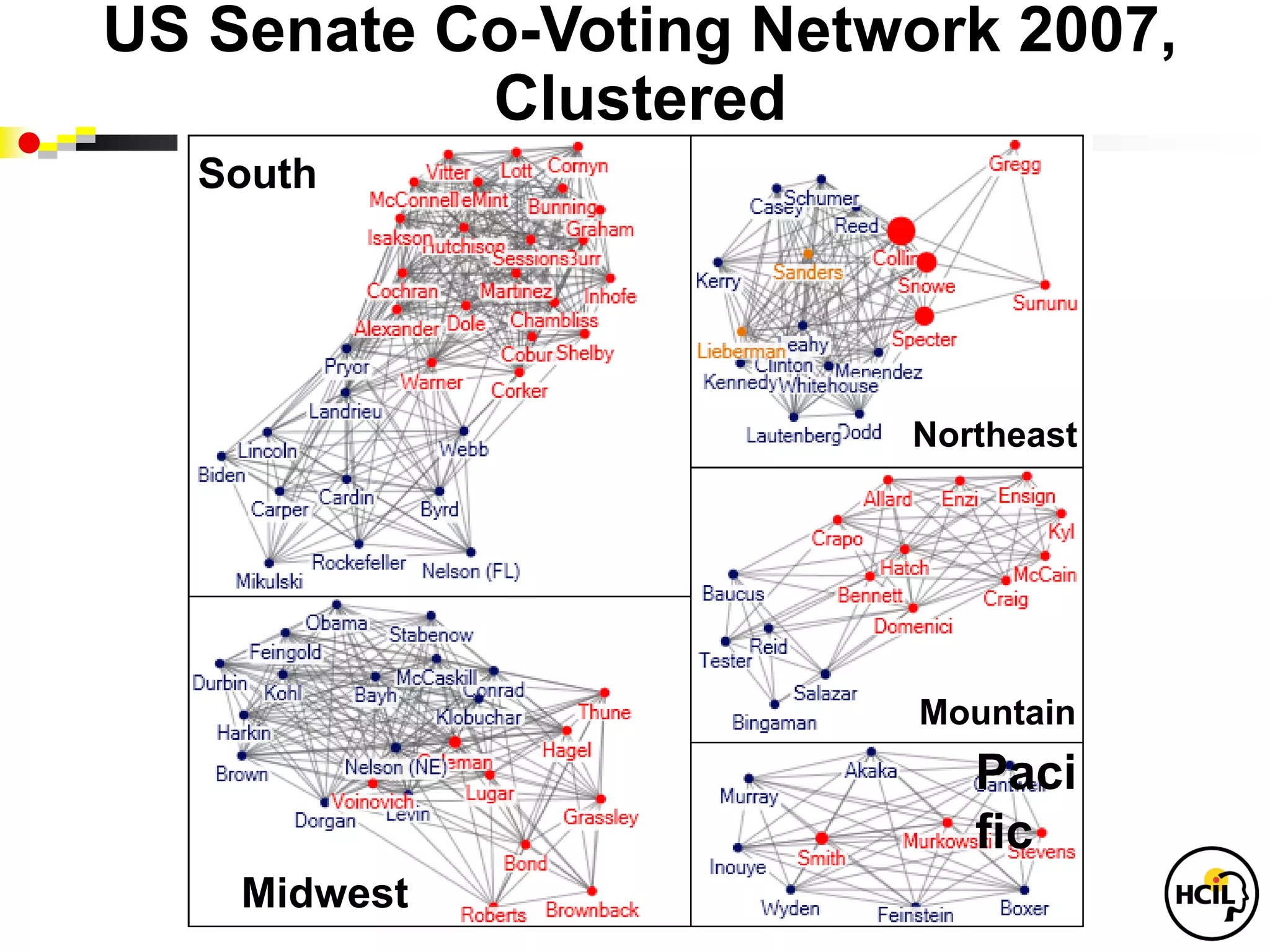
US Senate Co-Voting Network 2007,
           Clustered
  South


                        Northeast


                         Mountain
                           Paci
                           fic
    Midwest
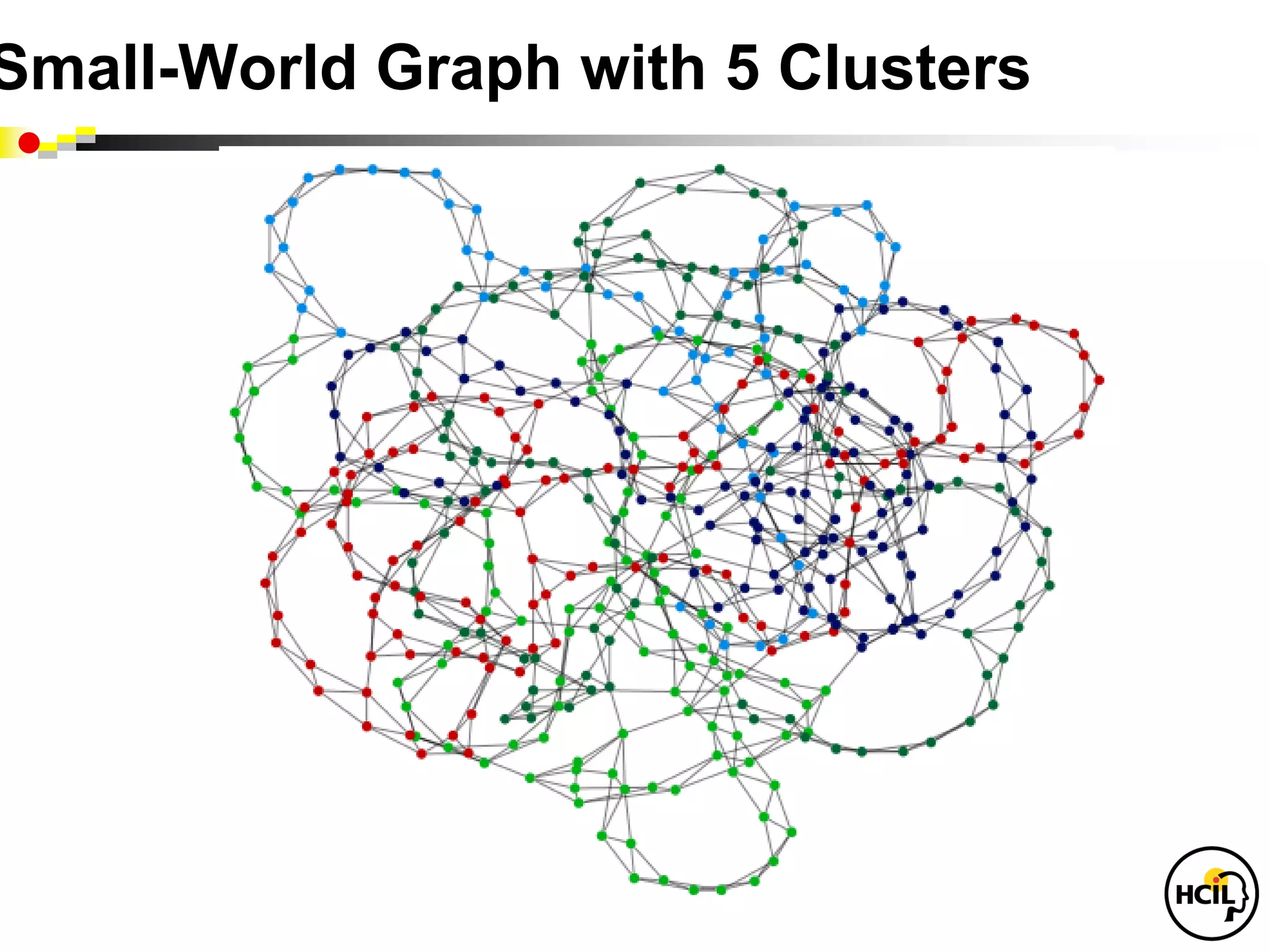
Small-World Graph with 5 Clusters
Pseudo-Random Graph with 5 Clusters
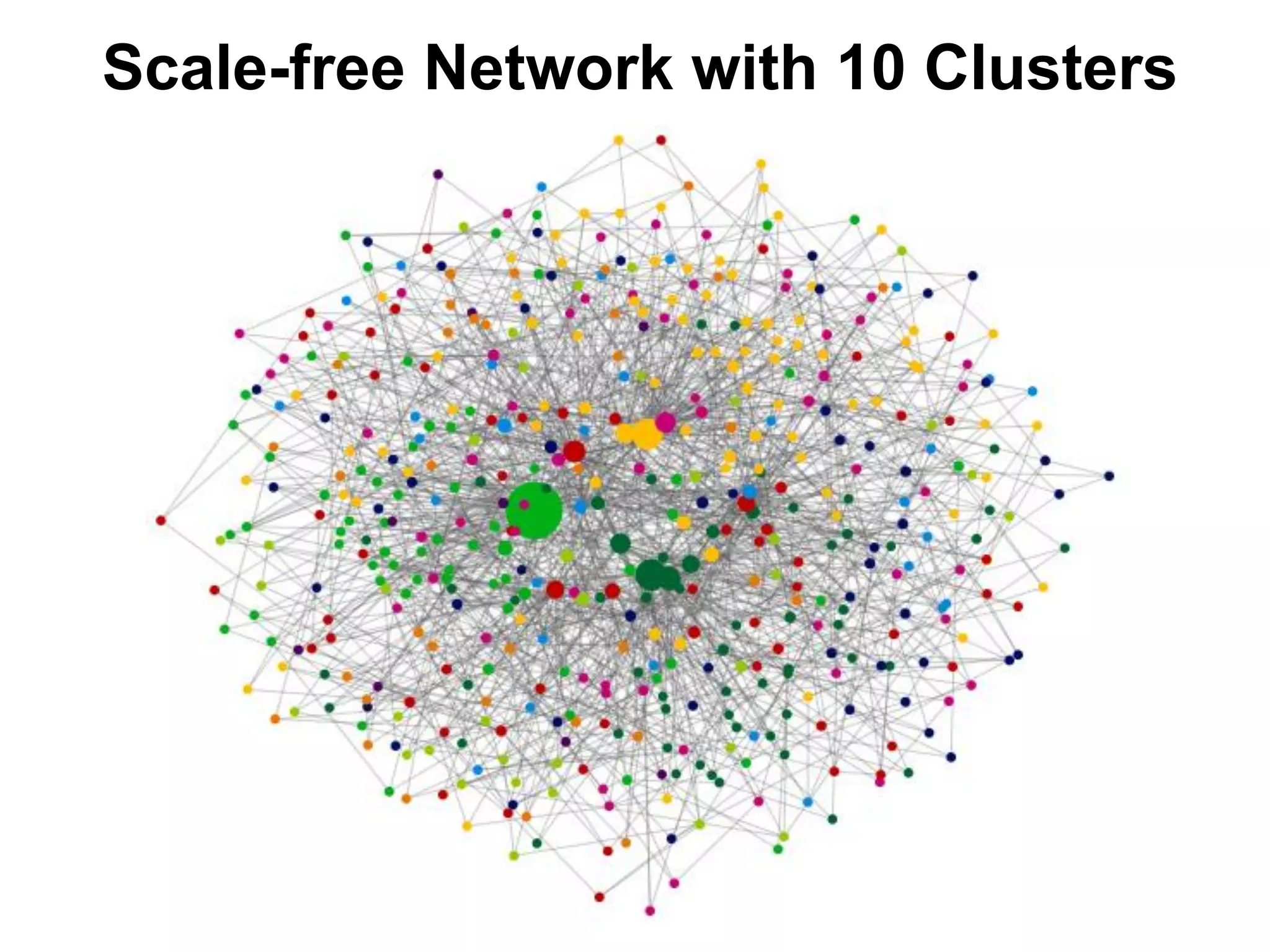
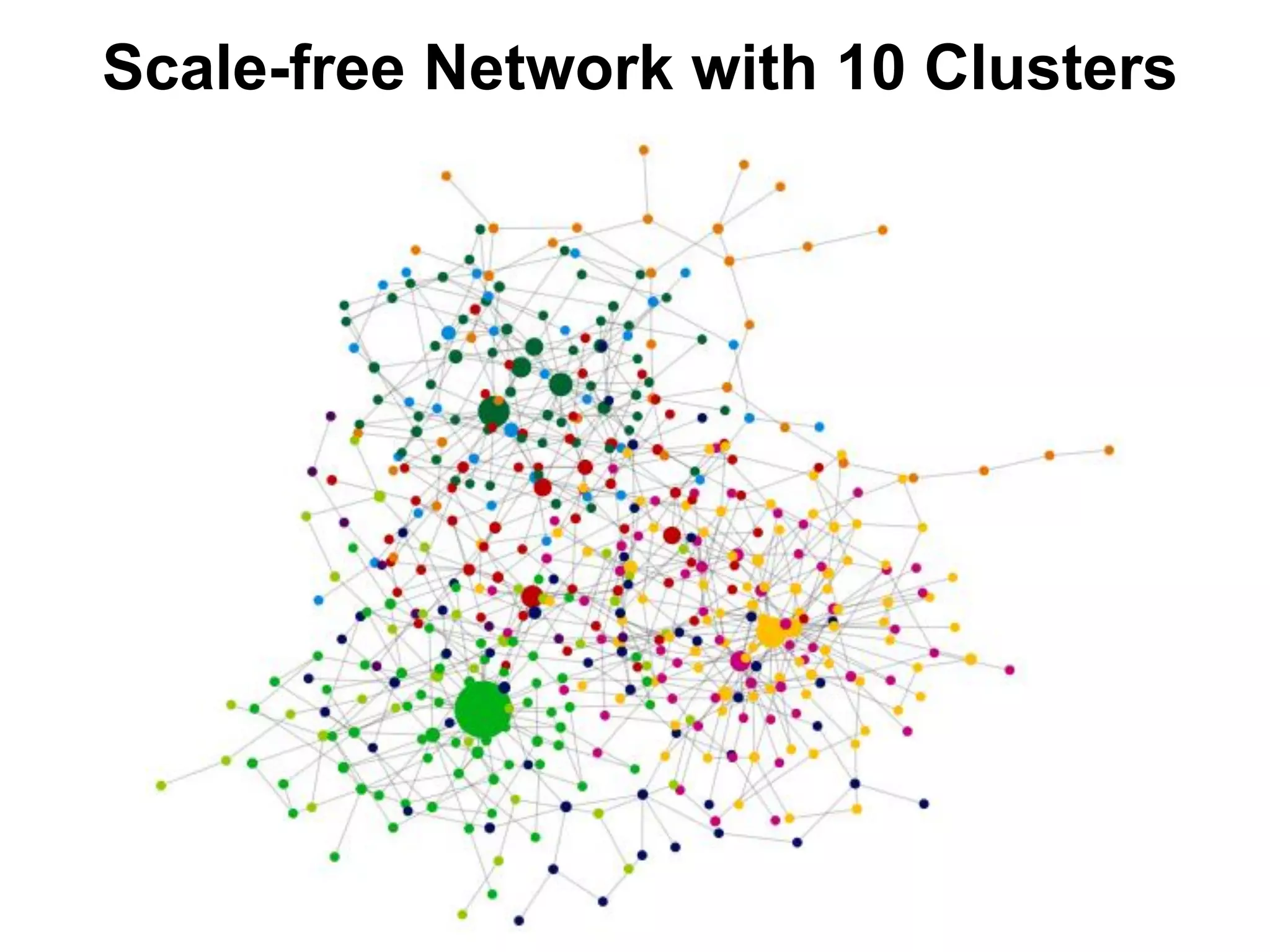
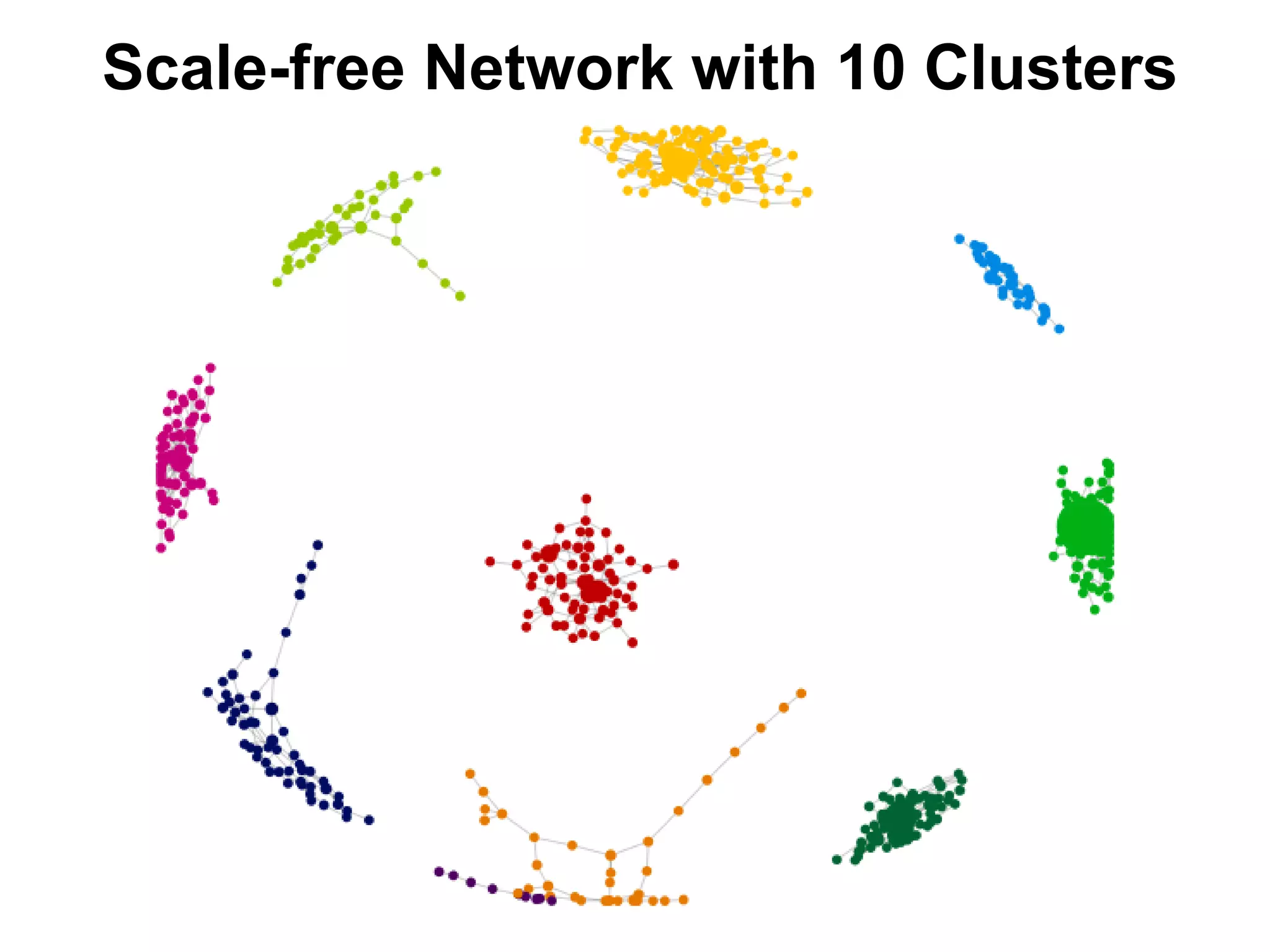
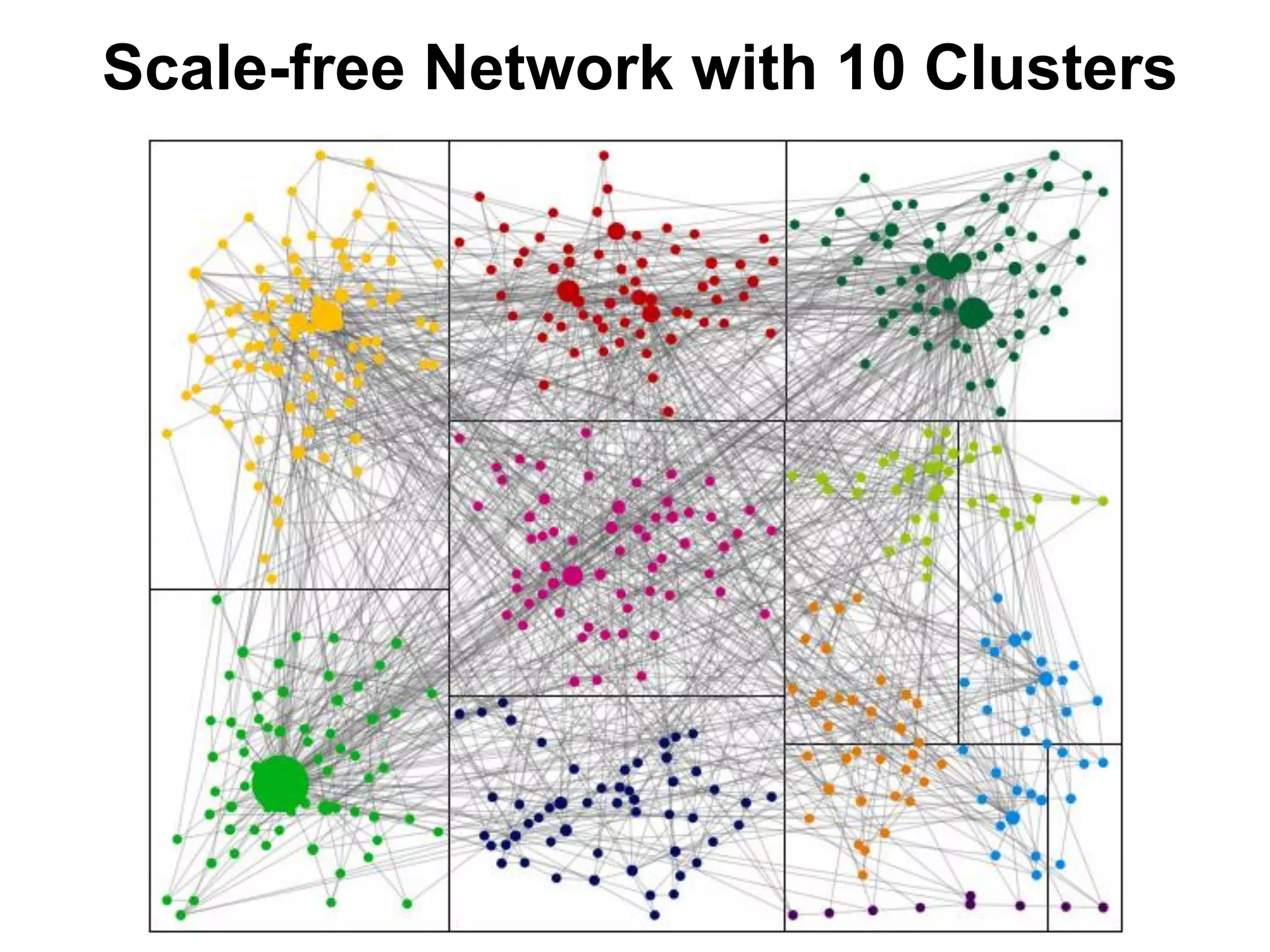
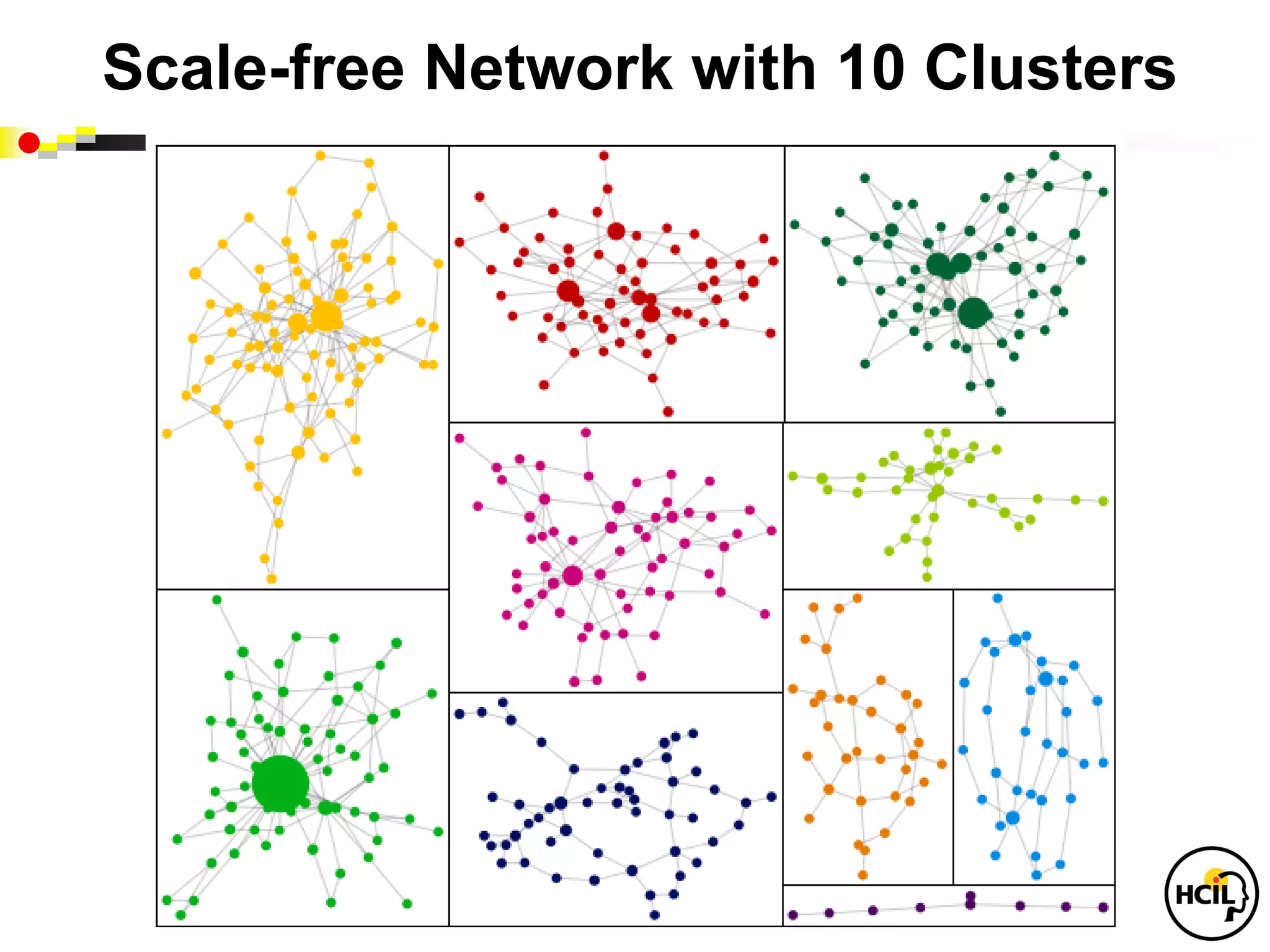
Scale-free Network with 10 Clusters
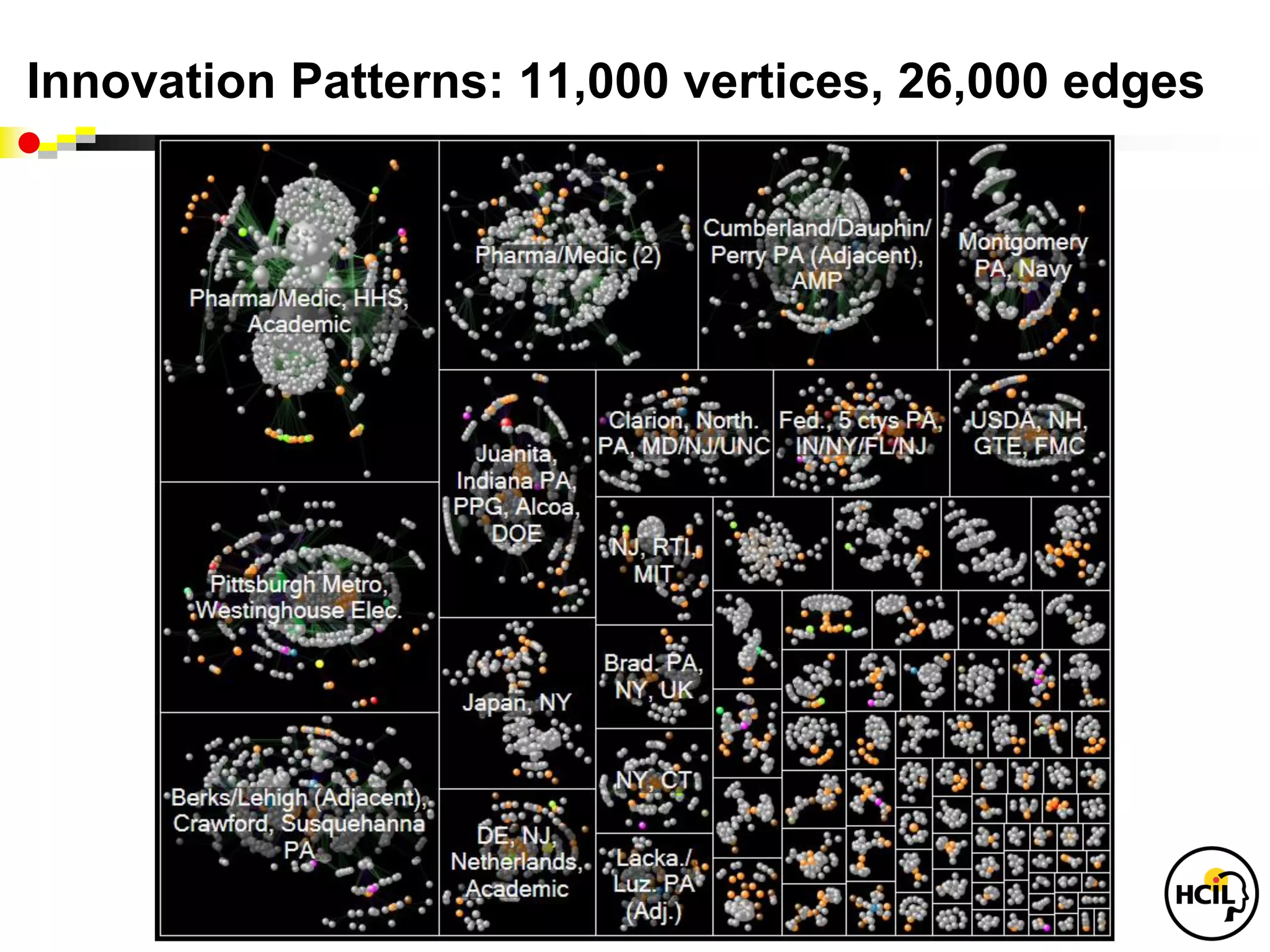
Innovation Patterns: 11,000 vertices, 26,000 edges
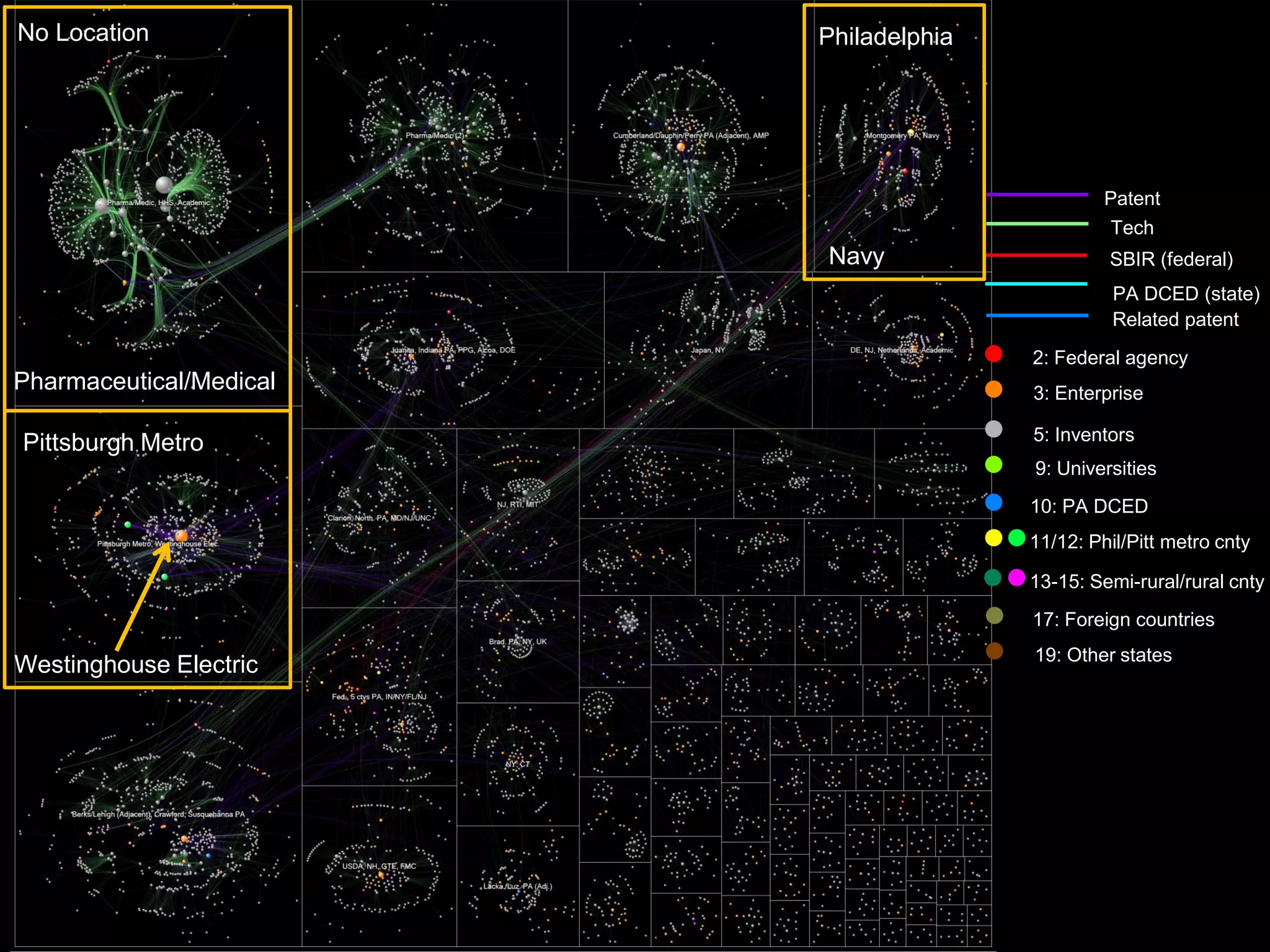
No Location              Philadelphia


                                                 Patent
                                                  Tech
                         Navy                    SBIR (federal)
                                                  PA DCED (state)
                                                  Related patent
                                        2: Federal agency
Pharmaceutical/Medical                  3: Enterprise

Pittsburgh Metro                        5: Inventors
                                        9: Universities
                                        10: PA DCED
                                        11/12: Phil/Pitt metro cnty

                                        13-15: Semi-rural/rural cnty
                                        17: Foreign countries
                                        19: Other states
Westinghouse Electric
No Location                     Philadelphia
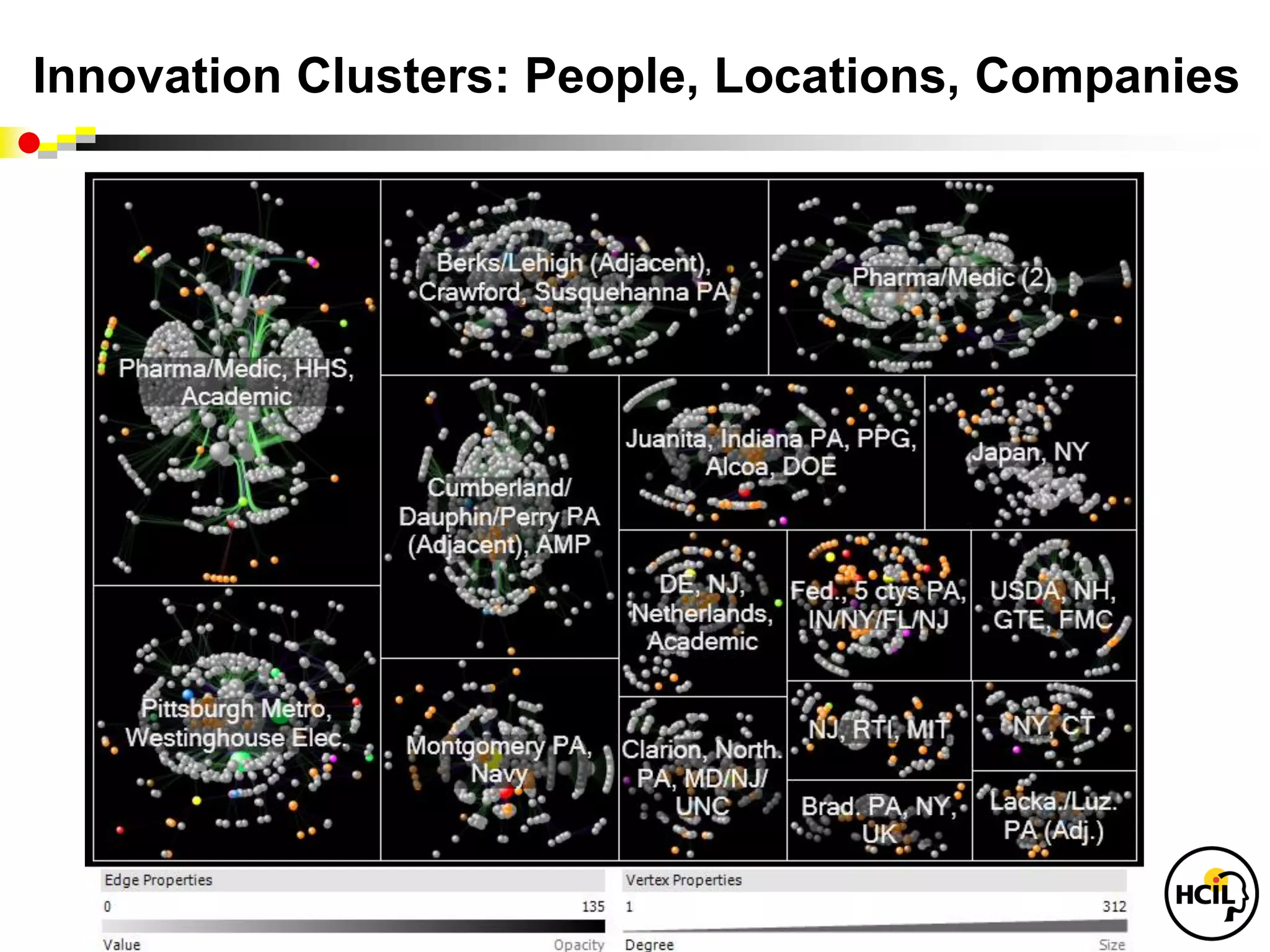
 Innovation Clusters: People, Locations, Companies

                                                        Patent
                                                         Tech
                                 Navy                   SBIR (federal)
                                                         PA DCED (state)
                                                         Related patent
                                               2: Federal agency
Pharmaceutical/Medical                         3: Enterprise

Pittsburgh Metro                               5: Inventors
                                               9: Universities
                                               10: PA DCED
                                               11/12: Phil/Pitt metro cnty

                                               13-15: Semi-rural/rural cnty
                                               17: Foreign countries
                                               19: Other states
Westinghouse Electric
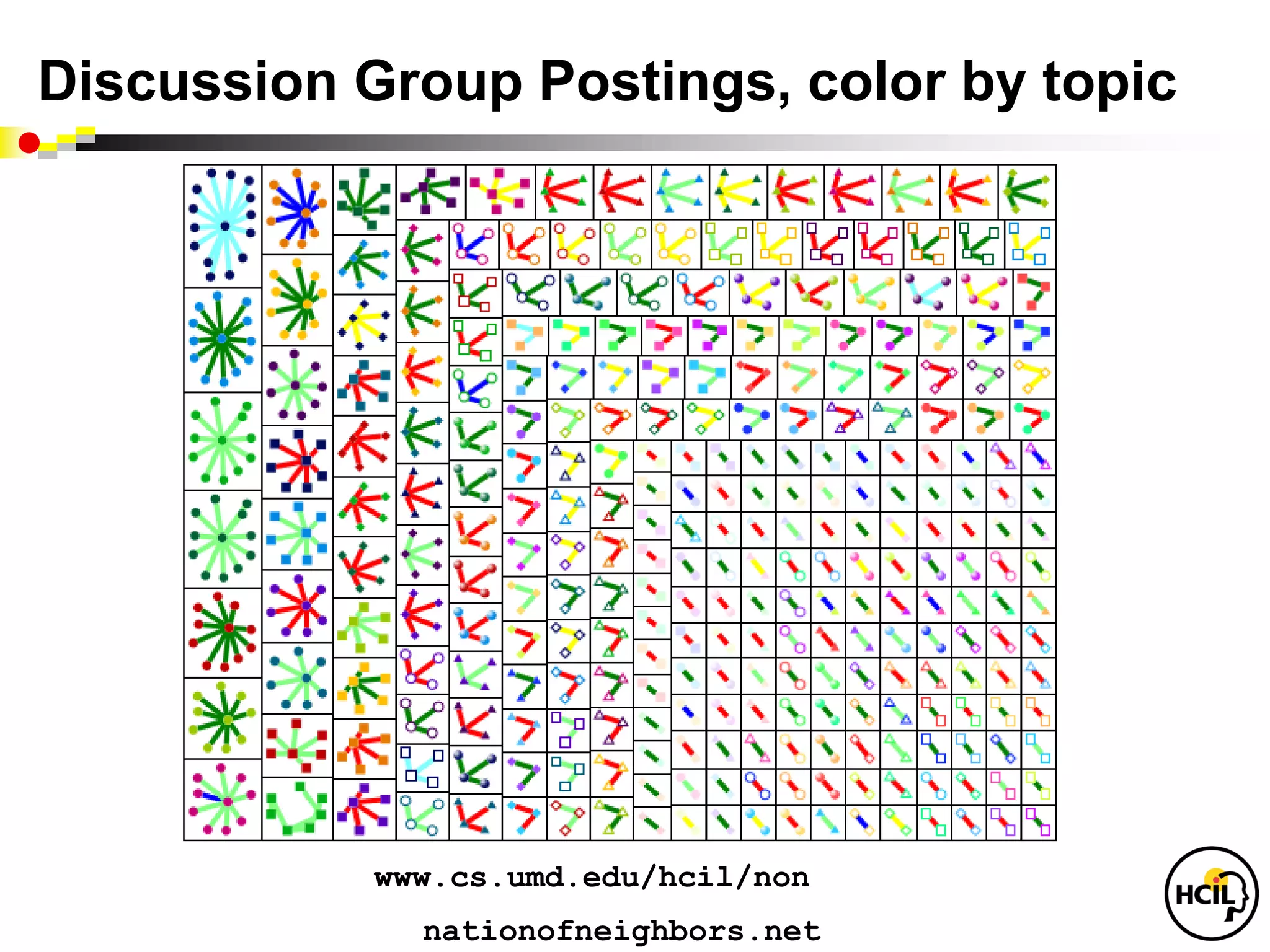
Discussion Group Postings, color by topic


            www.cs.umd.edu/hcil/non
              nationofneighbors.net
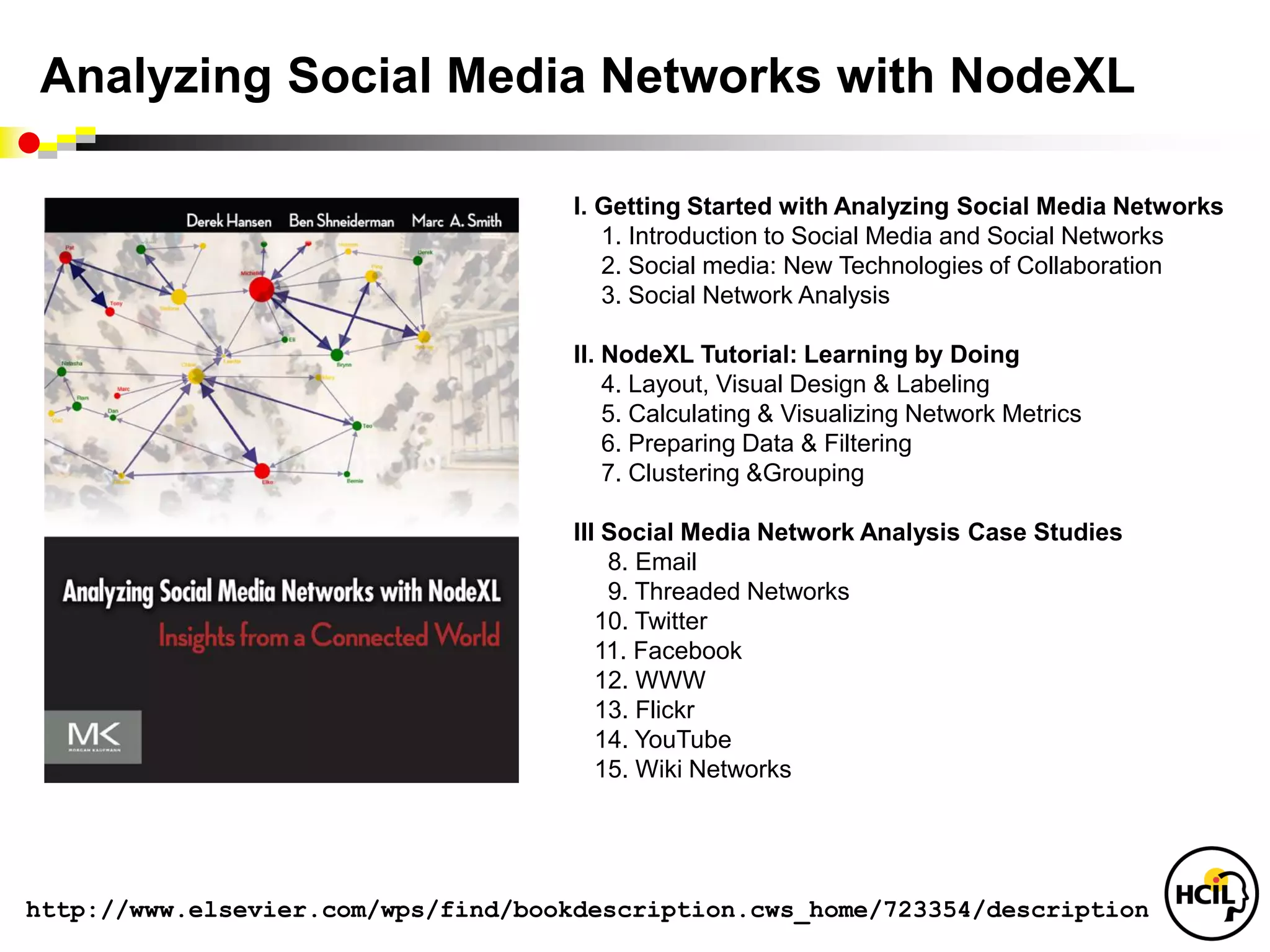
Analyzing Social Media Networks with NodeXL

                                     I. Getting Started with Analyzing Social Media Networks
                                        1. Introduction to Social Media and Social Networks
                                        2. Social media: New Technologies of Collaboration
                                        3. Social Network Analysis

                                     II. NodeXL Tutorial: Learning by Doing
                                         4. Layout, Visual Design & Labeling
                                         5. Calculating & Visualizing Network Metrics
                                         6. Preparing Data & Filtering
                                         7. Clustering &Grouping

                                     III Social Media Network Analysis Case Studies
                                         8. Email
                                         9. Threaded Networks
                                        10. Twitter
                                        11. Facebook
                                        12. WWW
                                        13. Flickr
                                        14. YouTube
                                        15. Wiki Networks


http://www.elsevier.com/wps/find/bookdescription.cws_home/723354/description
Social Media Research Foundation


               Social Media Research Foundation
                       smrfoundation.org


     We are a group of researchers who want to create
     open tools, generate and host open data, and
     support open scholarship related to social media.


                    smrfoundation.org
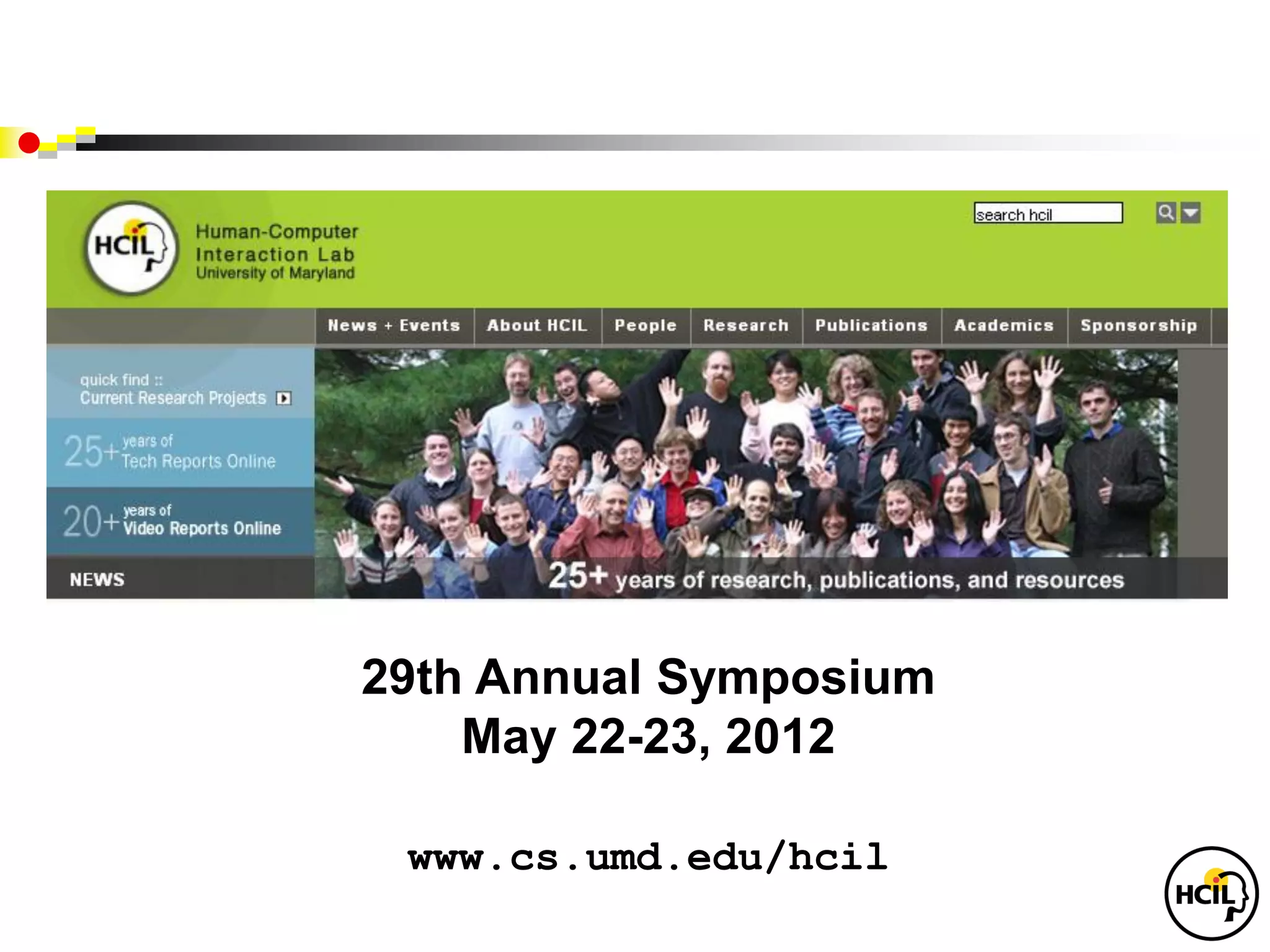
29th Annual Symposium
    May 22-23, 2012

 www.cs.umd.edu/hcil

Information Visualization for Social Network Analysis,

  • 1.
    Information Visualization for Social Network Analysis Ben Shneiderman ben@cs.umd.edu Twitter: @benbendc Founding Director (1983-2000), Human-Computer Interaction Lab Professor, Department of Computer Science Member, Institute for Advanced Computer Studies
  • 2.
    Interdisciplinary research community - Computer Science & Info Studies - Psych, Socio, Poli Sci & MITH (www.cs.umd.edu/hcil)
  • 3.
    Design Issues • Input devices & strategies • Keyboards, pointing devices, voice • Direct manipulation • Menus, forms, commands • Output devices & formats • Screens, windows, color, sound • Text, tables, graphics • Instructions, messages, help • Collaboration & Social Media www.awl.com/DTUI • Help, tutorials, training Fifth Edition: 2010 • Search • Visualization
  • 4.
    HCI Pride: Serving5B Users Mobile, desktop, web, cloud  Diverse users: novice/expert, young/old, literate/illiterate, abled/disabled, cultural, ethnic & linguistic diversity, gender, personality, skills, motivation, ...  Diverse applications: E-commerce, law, health/wellness, education, creative arts, community relationships, politics, IT4ID, policy negotiation, mediation, peace studies, ...  Diverse interfaces: Ubiquitous, pervasive, embedded, tangible, invisible, multimodal, immersive/augmented/virtual, ambient, social, affective, empathic, persuasive, ...
  • 5.
    Using Vision toThink • Visual bandwidth is enormous • Human perceptual skills are remarkable • Trend, cluster, gap, outlier... • Color, size, shape, proximity... • Human image storage is fast and vast • Opportunities • Spatial layouts & coordination • Information visualization • Scientific visualization & simulation • Telepresence & augmented reality • Virtual environments
  • 6.
  • 8.
    Information Visualization: Mantra • Overview, zoom & filter, details-on-demand • Overview, zoom & filter, details-on-demand • Overview, zoom & filter, details-on-demand • Overview, zoom & filter, details-on-demand • Overview, zoom & filter, details-on-demand • Overview, zoom & filter, details-on-demand • Overview, zoom & filter, details-on-demand • Overview, zoom & filter, details-on-demand • Overview, zoom & filter, details-on-demand • Overview, zoom & filter, details-on-demand
  • 9.
    Information Visualization: DataTypes • SciViz . 1-D Linear Document Lens, SeeSoft, Info Mural • 2-D Map GIS, ArcView, PageMaker, Medical imagery • 3-D World CAD, Medical, Molecules, Architecture • Multi-Var Spotfire, Tableau, GGobi, TableLens, ParCoords, • InfoViz Temporal LifeLines, TimeSearcher, Palantir, DataMontage • Tree Cone/Cam/Hyperbolic, SpaceTree, Treemap • Network Pajek, JUNG, UCINet, SocialAction, NodeXL
  • 10.
    NSF Workshops: Academics,Industry, Gov’t Jenny Preece (PI), Peter Pirolli & Ben Shneiderman (Co-PIs) www.tmsp.umd.edu
  • 11.
    Cyberinfrastructure: Social Actionon National Priorities - Scientific Foundations - Advancing Design of Social Participation Systems - Visions of What is Possible With Sharable Socio-technical Infrastructure - Participating in Health 2.0 - Educational Priorities for Technology Mediated Social Participation - Engaging the Public in Open Government: Social Media Technology and Policy for Government Transparency
  • 12.
    Summer Social Webshop:August 23-26, 2011
  • 13.
    UN Millennium DevelopmentGoals To be achieved by 2015 and hunger • Eradicate extreme poverty • Achieve universal primary education • Promote gender equality and empower women • Reduce child mortality • Improve maternal health • Combat HIV/AIDS, malaria and other diseases • Ensure environmental sustainability • Develop a global partnership for development
  • 14.
  • 15.
    Node Placement Methods •Node-link diagrams • Force-directed layout • Geographical map • Circular layout • Temporal layout • Clustering • Layouts based on node attributes • Matrix-based • Tabular textual
  • 16.
    Node Placement Methods •Node-link diagrams • Force-directed layout • Geographical map • Circular layout • Temporal layout • Clustering • Layouts based on node attributes • Matrix-based • Tabular textual
  • 17.
    Node Placement Methods •Node-link diagrams • Force-directed layout • Geographical map • Circular layout • Temporal layout • Clustering • Layouts based on node attributes • Matrix-based • Tabular textual
  • 18.
    NetViz Nirvana 1) Everynode is visible 2) For every node you can count its degree 3) For every link you can follow it from source to destination 4) Clusters and outliers are identifiable
  • 19.
    1) NVSS: SemanticSubstrates • Group nodes into regions According to an attribute Categorical, ordinal, or binned numerical • In each region: Place nodes according to other attribute(s) • Give users control of link visibility
  • 20.
    Force Directed Layout 36 Supreme & 13 Circuit Court decisions 268 Citations on Regulatory Takings 1978-2002
  • 21.
    Network Visualization bySemantic Substrates NVSS 1.0
  • 22.
    Filtering links bysource-target
  • 23.
    Filtering links bytime attribute (1)
  • 24.
    Network Visualization bySemantic Substrates • Meaningful layout of nodes • User controlled visibility of links • Cross refs in 11 Circuit Courts (green) + few refs to District Court cases www.cs.umd.edu/hcil/nvss
  • 25.
    Network Visualization bySemantic Substrates NVSS 2.0 with Substrate Designer
  • 26.
    2) SocialAction: Integrating Statistics& Visualization Senate 2007: 180 out of 310 Votes in Common
  • 27.
    Social Action: 2007Senate Votes 290 out of 310 Votes in Common
  • 28.
    NodeXL: Network Overview forDiscovery & Exploration in Excel www.codeplex.com/nodexl
  • 29.
    NodeXL: Import Dialogs www.codeplex.com/nodexl
  • 30.
    Tweets at #WIN09Conference: 2 groups
  • 31.
    Twitter discussion of#GOP Red: Republicans, anti-Obama, mention Fox Blue: Democrats, pro-Obama, mention CNN Green: non-affiliated Node size is number of followers Politico is major bridging group
  • 32.
    CHI2010 Twitter Community www.codeplex.com/nodexl/
  • 33.
  • 34.
    Flickr clusters for“mouse” Computer Mickey Animal
  • 35.
    Figure 7.11. :Lobbying Coalition Network connecting organizations (vertices) that have jointly filed comments on US Federal Communications Commission policies (edges). Vertex Size represents number of filings and color represents Eigenvector Centrality (pink = higher). Darker edges connect organizations with many joint filings. Vertices were originally positioned using Fruchterman- Rheingold and hand-positioned to respect clusters identified by NodeXL’s Find Clusters algorithm.
  • 36.
  • 37.
  • 38.
    Analogy: Clusters AreOccluded Hard to count nodes, clusters
  • 39.
    Separate Clusters AreMore Comprehensible
  • 40.
    Twitter Network for“msrtf11 OR techfest ”
  • 41.
    Twitter Network for“msrtf11 OR techfest ”
  • 42.
    US Senate Co-VotingNetwork 2007
  • 43.
    US Senate Co-VotingNetwork 2007, Clustered South Northeast Mountain Paci fic Midwest
  • 44.
  • 45.
  • 46.
  • 47.
  • 48.
  • 49.
  • 50.
  • 51.
  • 52.
  • 53.
  • 54.
    Innovation Patterns: 11,000vertices, 26,000 edges
  • 55.
    No Location Philadelphia Patent Tech Navy SBIR (federal) PA DCED (state) Related patent 2: Federal agency Pharmaceutical/Medical 3: Enterprise Pittsburgh Metro 5: Inventors 9: Universities 10: PA DCED 11/12: Phil/Pitt metro cnty 13-15: Semi-rural/rural cnty 17: Foreign countries 19: Other states Westinghouse Electric
  • 56.
    No Location Philadelphia Innovation Clusters: People, Locations, Companies Patent Tech Navy SBIR (federal) PA DCED (state) Related patent 2: Federal agency Pharmaceutical/Medical 3: Enterprise Pittsburgh Metro 5: Inventors 9: Universities 10: PA DCED 11/12: Phil/Pitt metro cnty 13-15: Semi-rural/rural cnty 17: Foreign countries 19: Other states Westinghouse Electric
  • 57.
    Discussion Group Postings,color by topic www.cs.umd.edu/hcil/non nationofneighbors.net
  • 58.
    Analyzing Social MediaNetworks with NodeXL I. Getting Started with Analyzing Social Media Networks 1. Introduction to Social Media and Social Networks 2. Social media: New Technologies of Collaboration 3. Social Network Analysis II. NodeXL Tutorial: Learning by Doing 4. Layout, Visual Design & Labeling 5. Calculating & Visualizing Network Metrics 6. Preparing Data & Filtering 7. Clustering &Grouping III Social Media Network Analysis Case Studies 8. Email 9. Threaded Networks 10. Twitter 11. Facebook 12. WWW 13. Flickr 14. YouTube 15. Wiki Networks http://www.elsevier.com/wps/find/bookdescription.cws_home/723354/description
  • 59.
    Social Media ResearchFoundation Social Media Research Foundation smrfoundation.org We are a group of researchers who want to create open tools, generate and host open data, and support open scholarship related to social media. smrfoundation.org
  • 60.
    29th Annual Symposium May 22-23, 2012 www.cs.umd.edu/hcil