
Information Visualization for
           Knowledge Discovery
                   Ben Shneiderman
                 ben@cs.umd.edu   @benbendc

Founding Director (1983-2000), Human-Computer Interaction Lab
         Professor, Department of Computer Science
       Member, Institute for Advanced Computer Studies


                 University of Maryland
                College Park, MD 20742
Interdisciplinary research community
 - Computer Science & Info Studies
 - Psych, Socio, Poli Sci & MITH
      (www.cs.umd.edu/hcil)
Design Issues

•   Input devices & strategies
     • Keyboards, pointing devices, voice
     • Direct manipulation
     • Menus, forms, commands
•   Output devices & formats
     • Screens, windows, color, sound
     • Text, tables, graphics
     • Instructions, messages, help
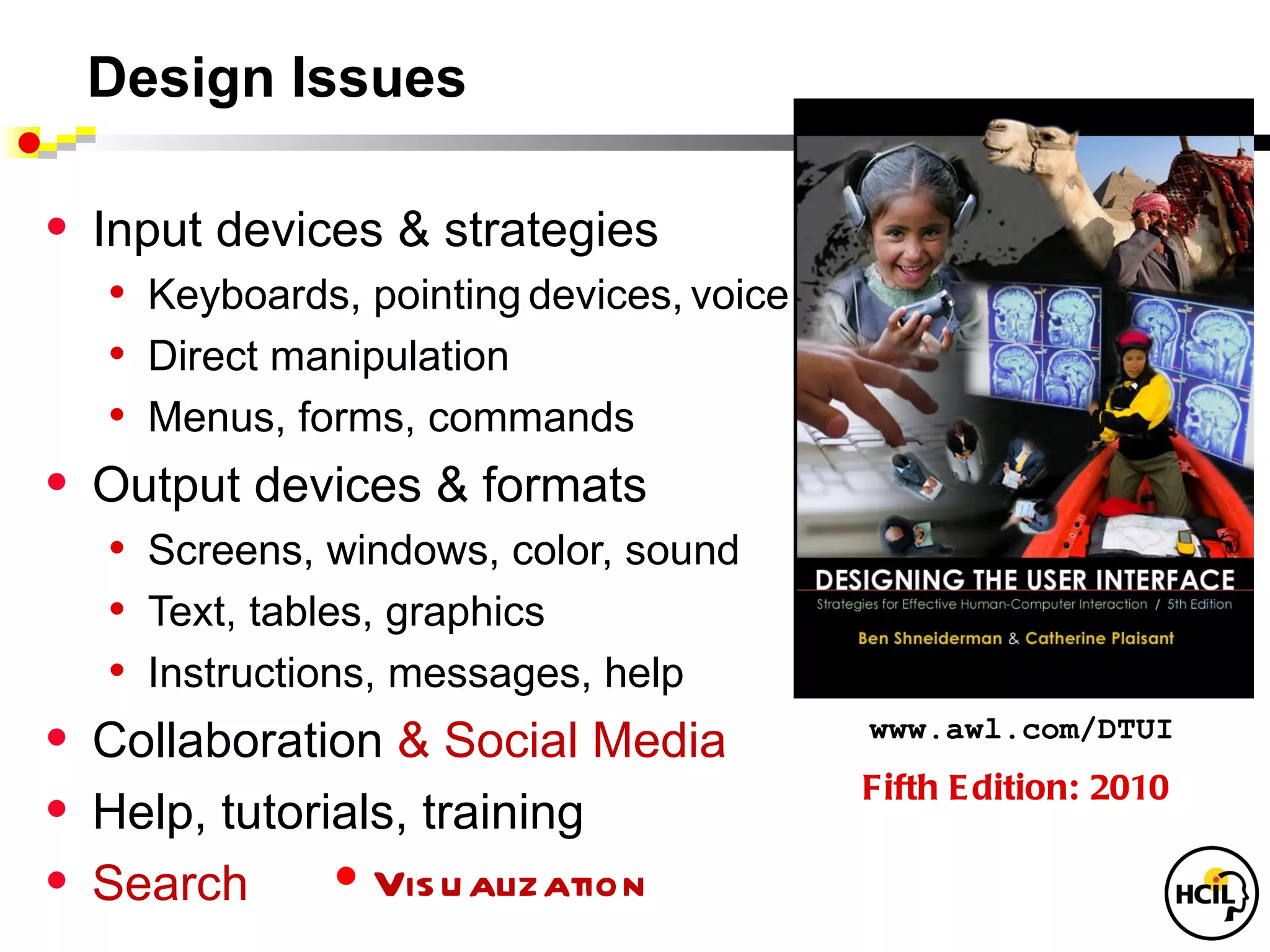
•   Collaboration & Social Media            www.awl.com/DTUI
                                            Fifth E dition: 2010
•   Help, tutorials, training
•   Search        • Vis u alization
Information Visualization

•   Visual bandwidth is enormous
    • Human perceptual skills are remarkable
      • Trend, cluster, gap, outlier...
      • Color, size, shape, proximity...


•   Three challenges
    • Meaningful visual displays of massive data
    • Interaction: widgets & window coordination
    • Process models for discovery
Business takes action

•   General Dynamics buys MayaViz
•   Agilent buys GeneSpring
•   Google buys Gapminder
•   Oracle buys Hyperion
•   Microsoft buys Proclarity
•   InfoBuilders buys Advizor Solutions
•   SAP buys (Business Objects buys
           Xcelsius & Inxight & Crystal Reports )
•   IBM buys (Cognos buys Celequest) & ILOG
•   TIBCO buys Spotfire
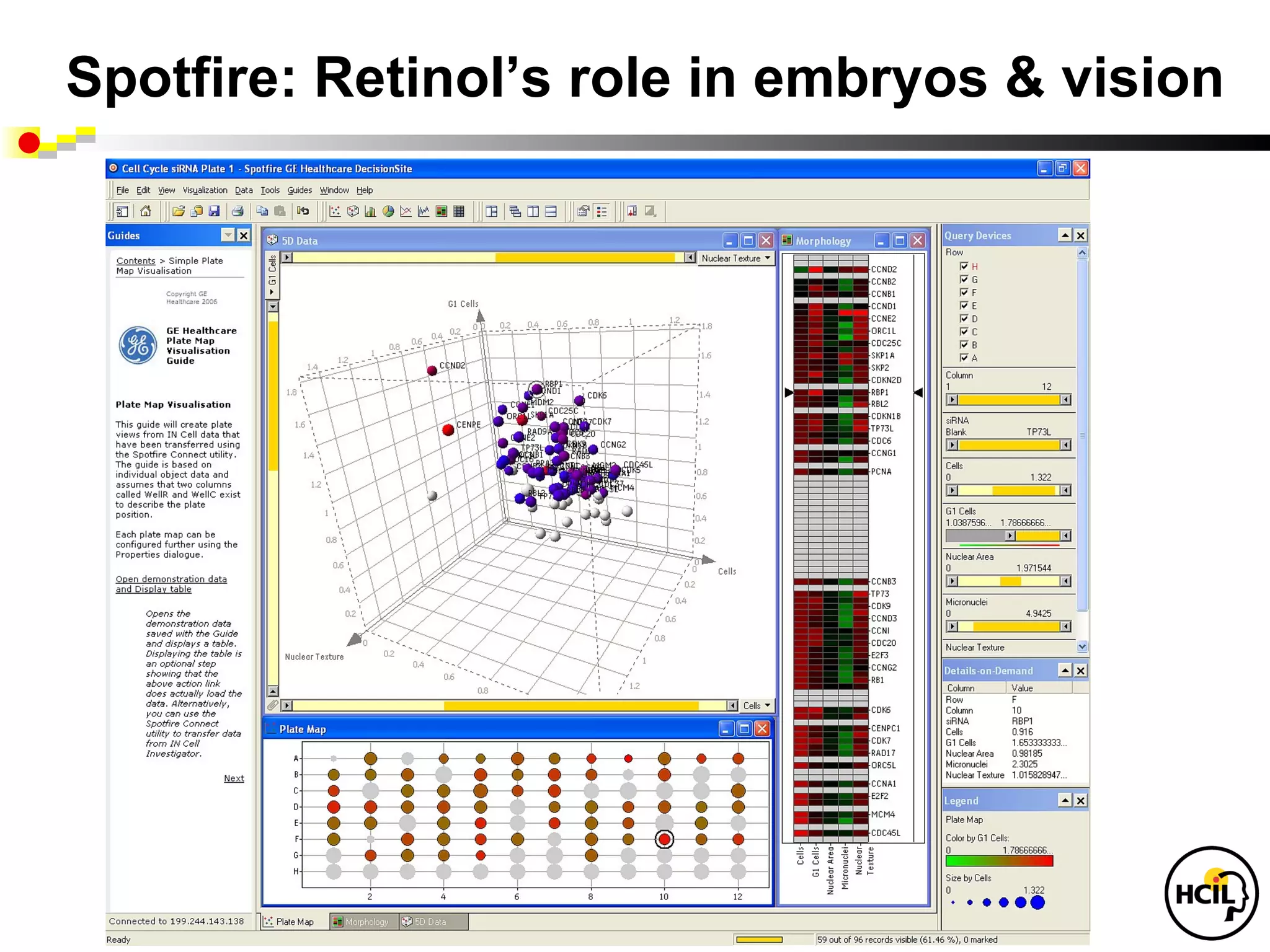
Spotfire: Retinol’s role in embryos & vision
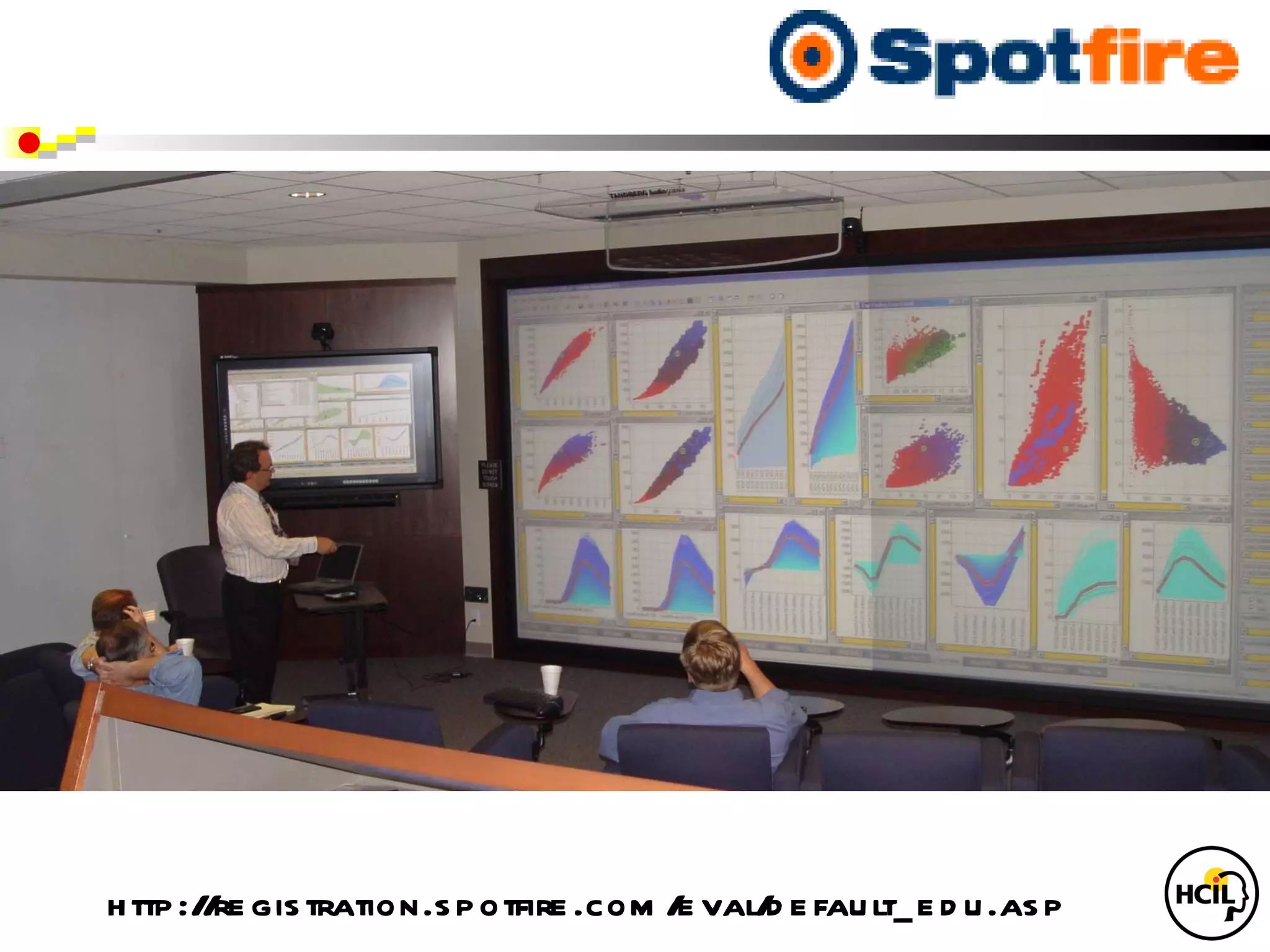
h ttp :/ re gis tration.s p otfire .com / val/ e fau lt_ e d u .as p
        /                                e    d
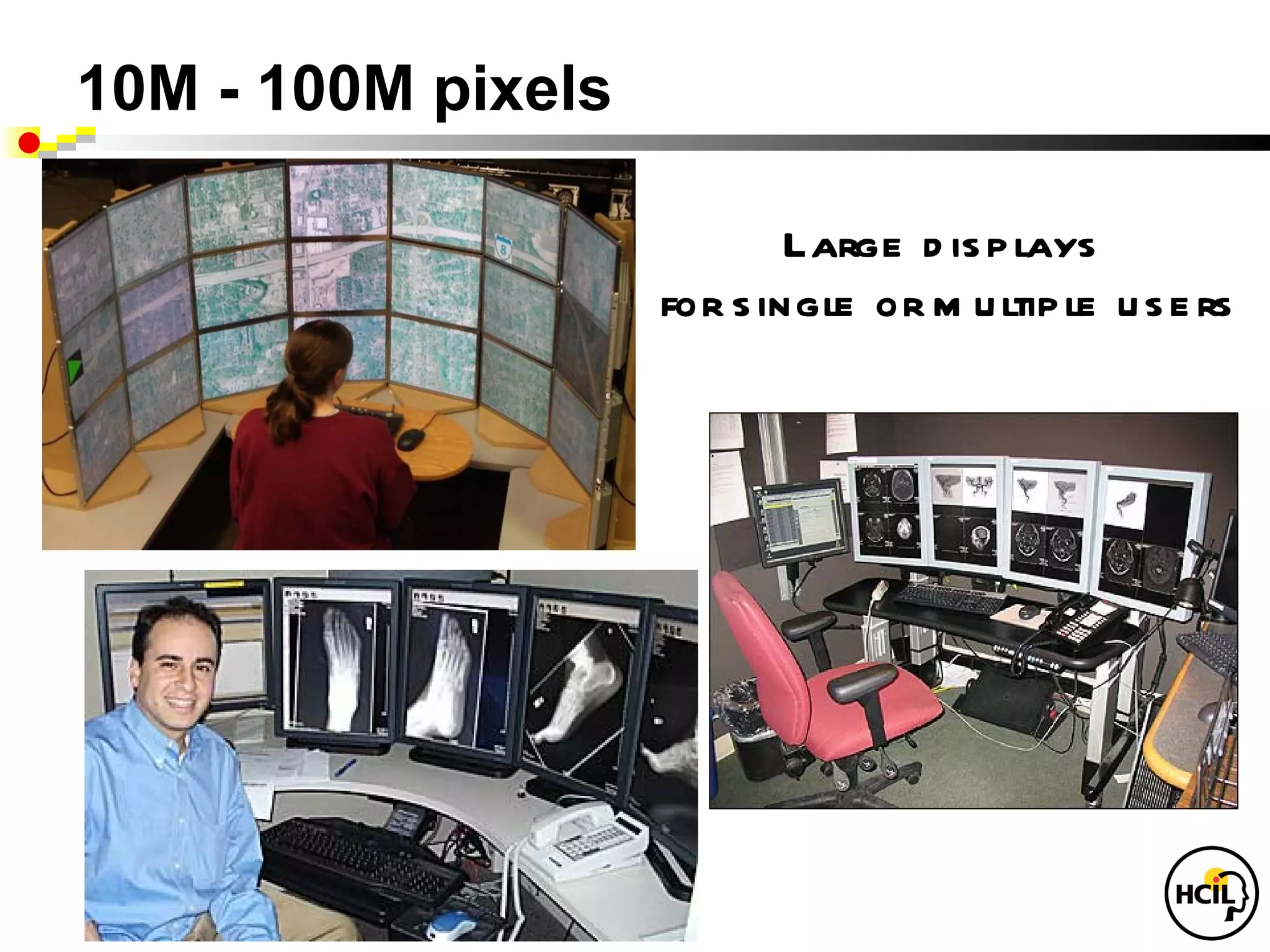
10M - 100M pixels

                            Large d is p lays
                    for s ingle or m u ltip le u s e rs
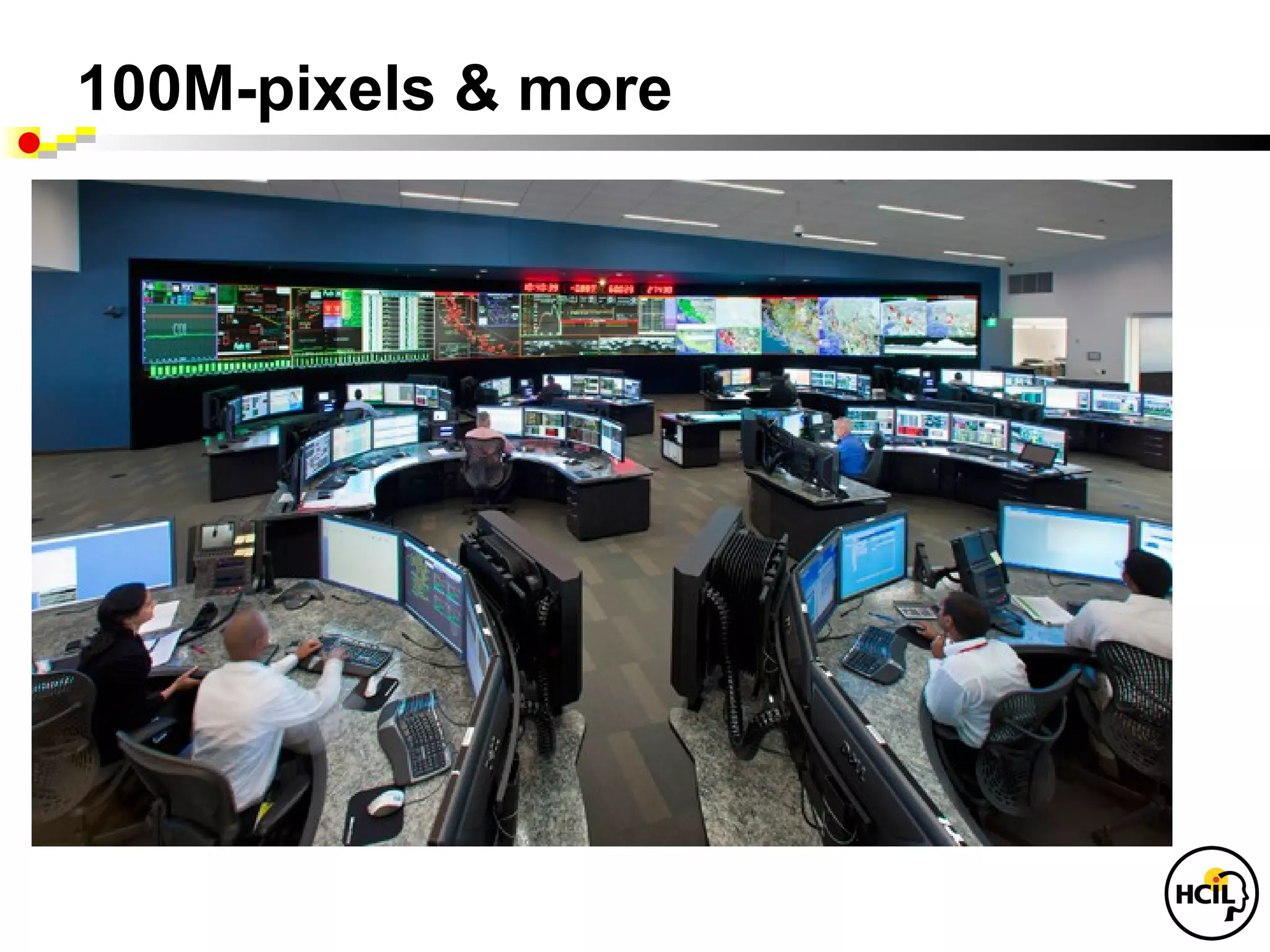
100M-pixels & more
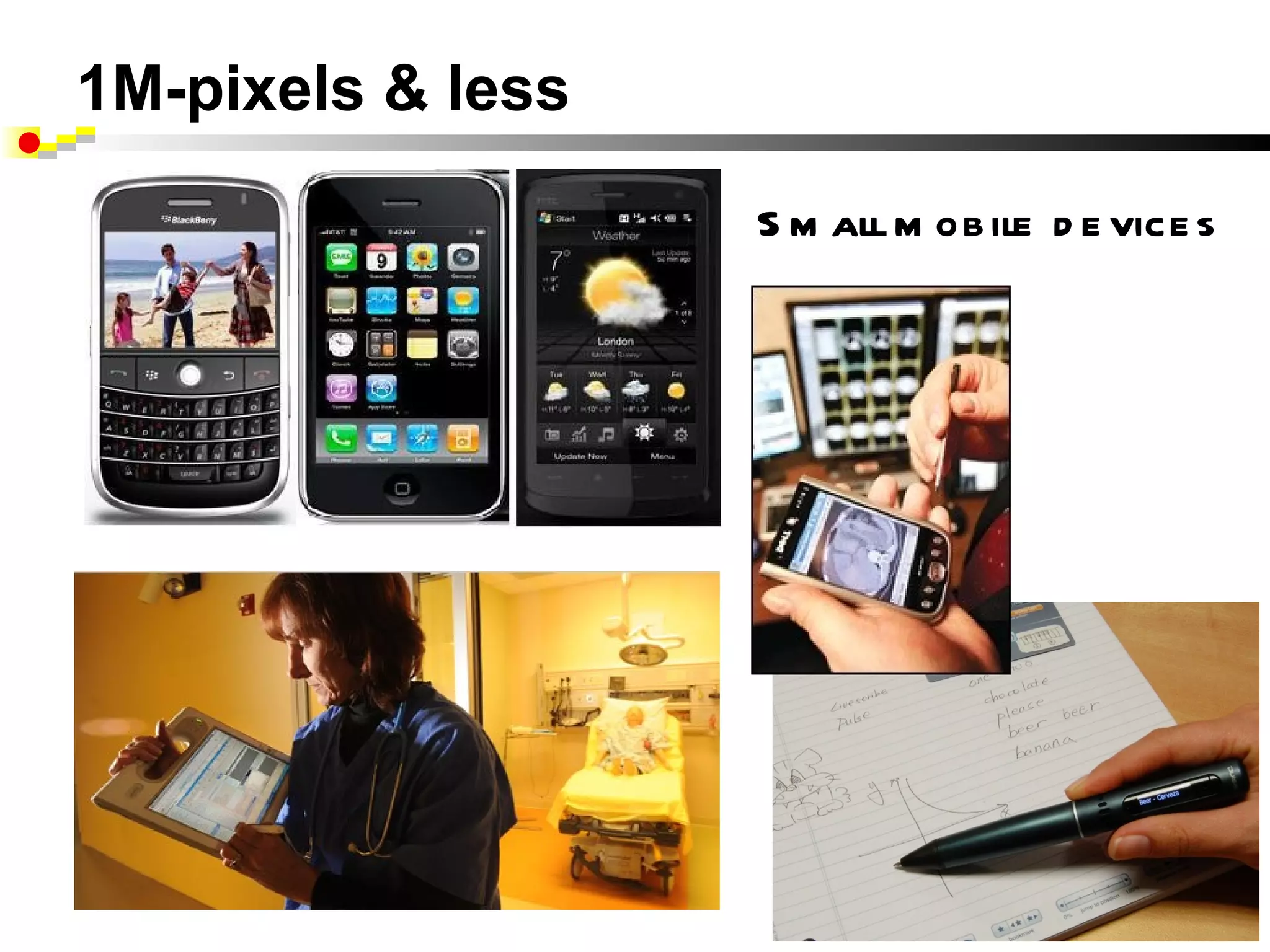
1M-pixels & less
                   S m all m ob ile d e vice s
Information Visualization: Mantra

•   Overview, zoom & filter, details-on-demand
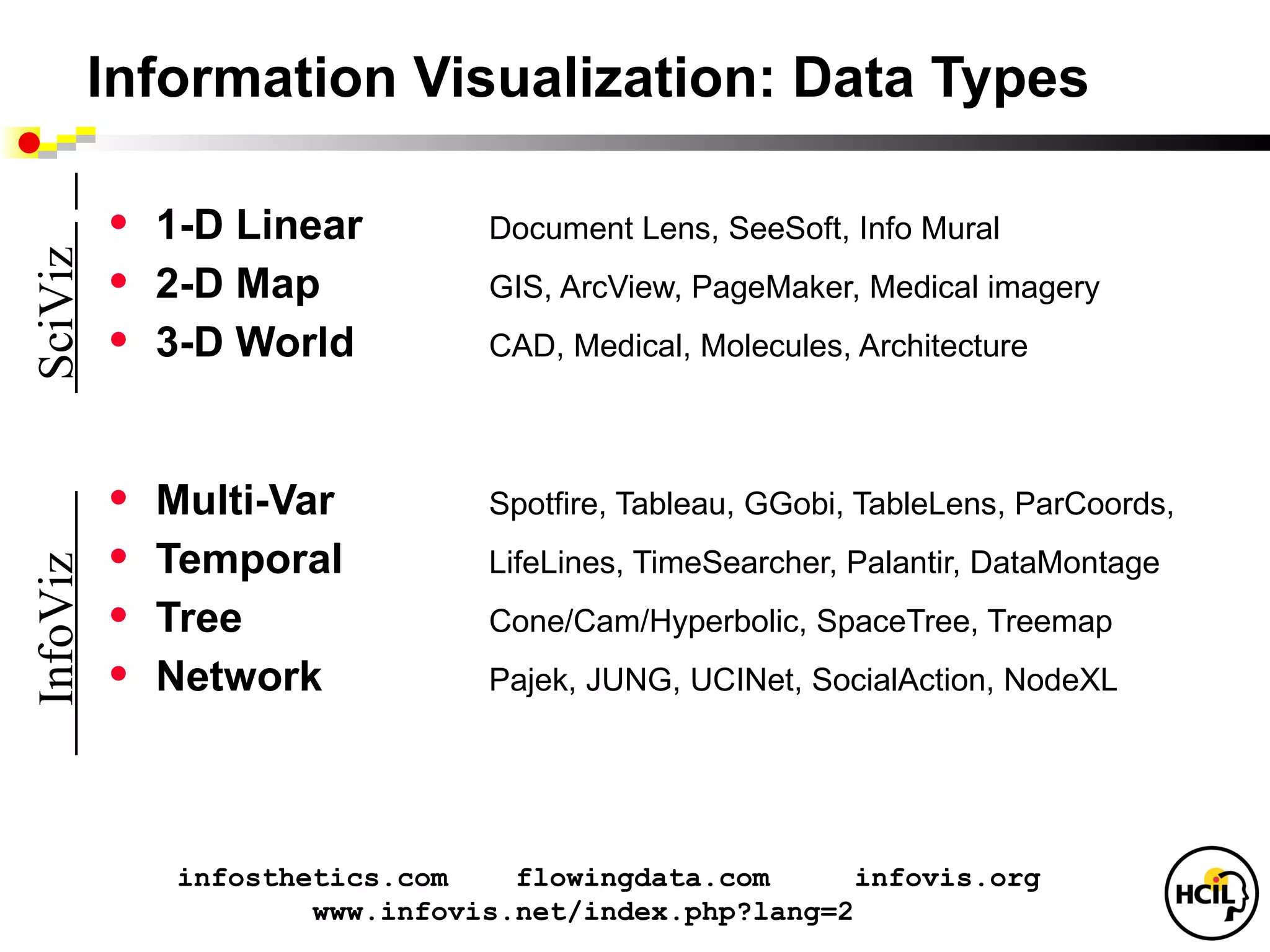
Information Visualization: Data Types

           •   1-D Linear
SciViz .


                                  Document Lens, SeeSoft, Info Mural
           •   2-D Map            GIS, ArcView, PageMaker, Medical imagery
           •   3-D World          CAD, Medical, Molecules, Architecture


           •   Multi-Var          Spotfire, Tableau, GGobi, TableLens, ParCoords,
           •   Temporal           LifeLines, TimeSearcher, Palantir, DataMontage
InfoViz


           •   Tree               Cone/Cam/Hyperbolic, SpaceTree, Treemap
           •   Network            Pajek, JUNG, UCINet, SocialAction, NodeXL


                infosthetics.com    flowingdata.com      infovis.org
                        www.infovis.net/index.php?lang=2
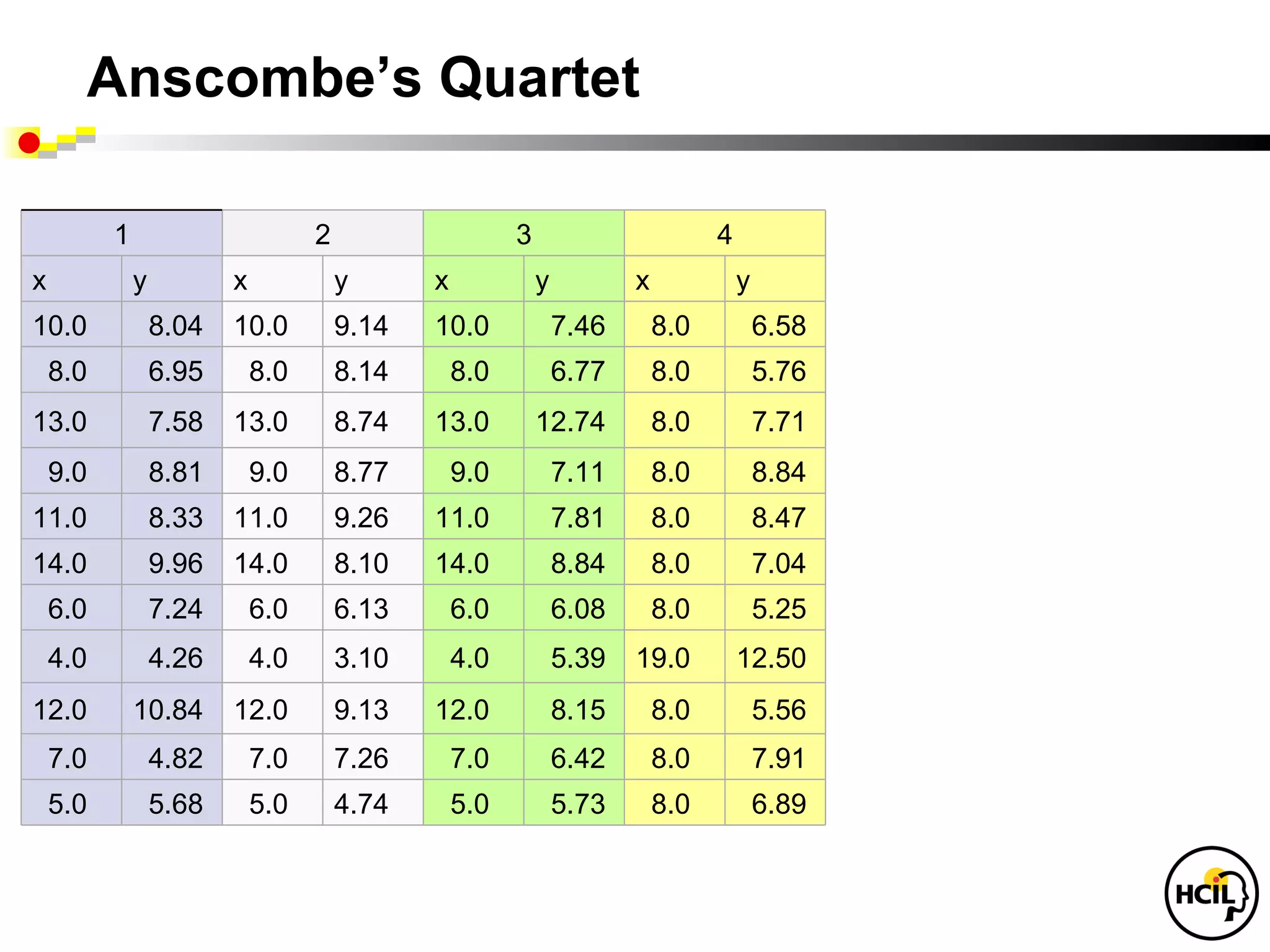
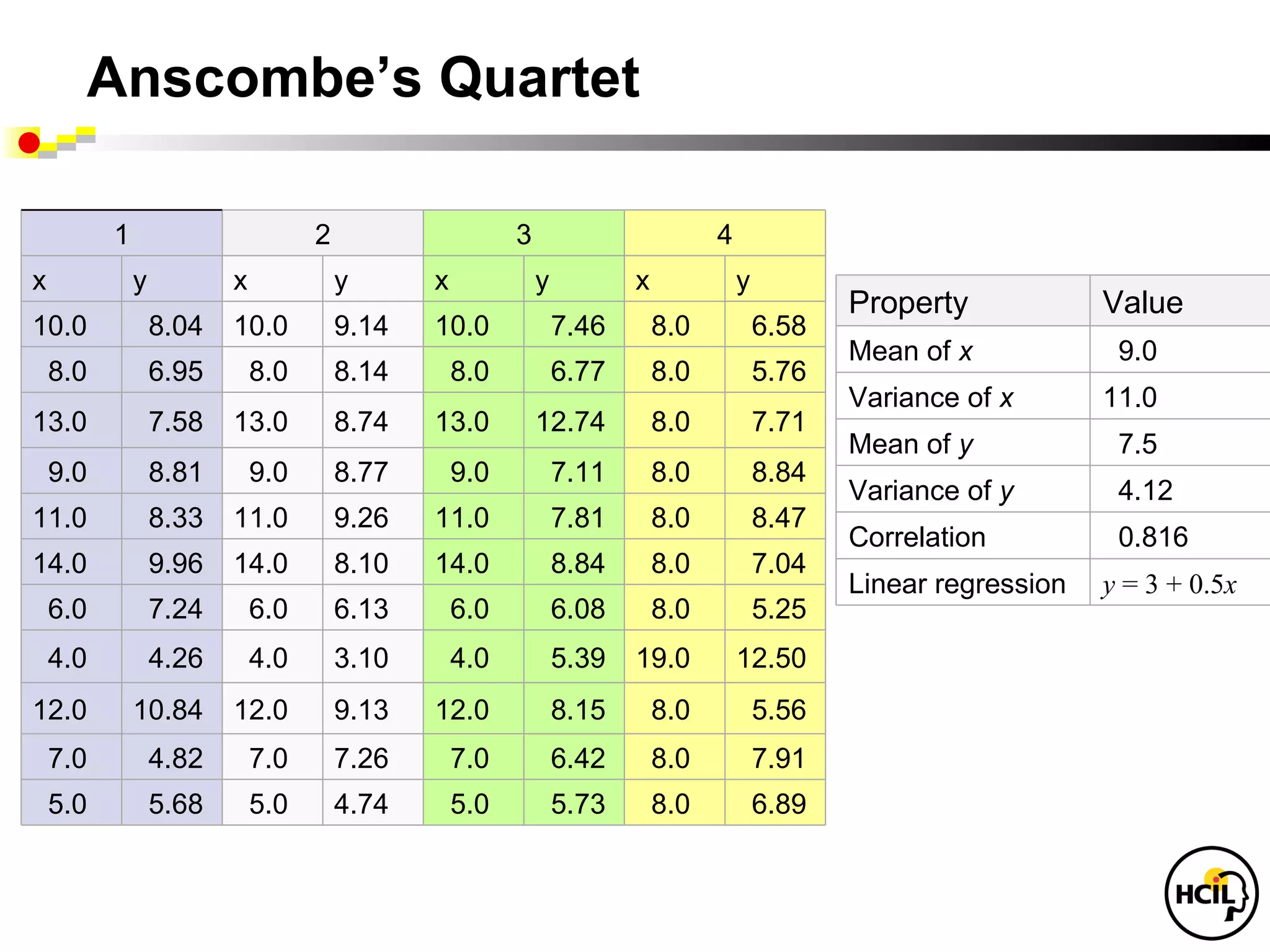
Anscombe’s Quartet

          1                        2                    3                        4
x             y          x             y      x             y          x             y
10.0              8.04   10.0          9.14   10.0              7.46       8.0           6.58
    8.0           6.95       8.0       8.14       8.0           6.77       8.0           5.76
13.0              7.58   13.0          8.74   13.0          12.74          8.0           7.71
    9.0           8.81       9.0       8.77       9.0           7.11       8.0           8.84
11.0              8.33   11.0          9.26   11.0              7.81       8.0           8.47
14.0              9.96   14.0          8.10   14.0              8.84       8.0           7.04
    6.0           7.24       6.0       6.13       6.0           6.08       8.0           5.25
    4.0           4.26       4.0       3.10       4.0           5.39   19.0          12.50
12.0          10.84      12.0          9.13   12.0              8.15       8.0           5.56
    7.0           4.82       7.0       7.26       7.0           6.42       8.0           7.91
    5.0           5.68       5.0       4.74       5.0           5.73       8.0           6.89
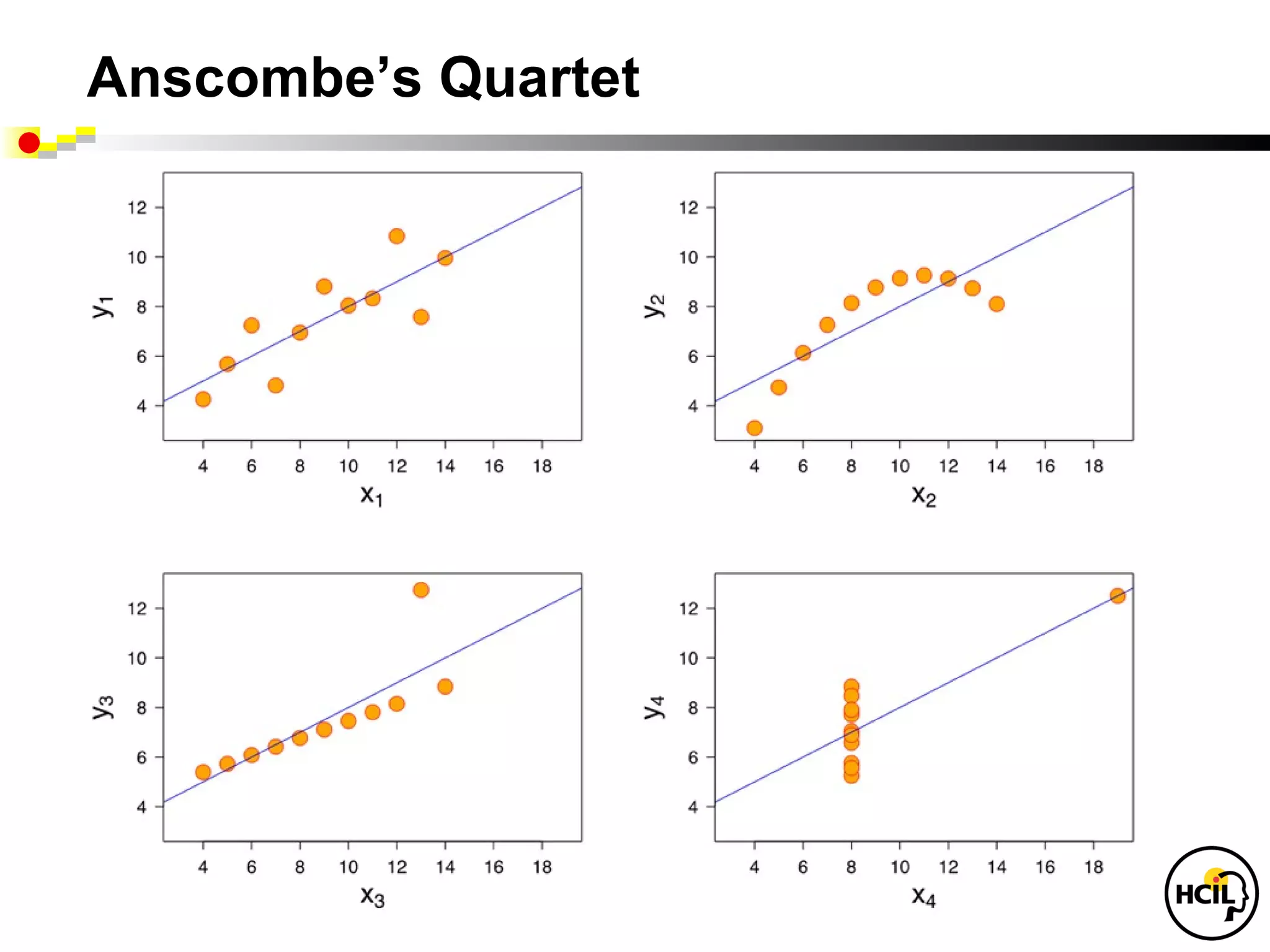
Anscombe’s Quartet

          1                        2                    3                        4
x             y          x             y      x             y          x             y
                                                                                                Property            Value
10.0              8.04   10.0          9.14   10.0              7.46       8.0           6.58
                                                                                                Mean of x            9.0
    8.0           6.95       8.0       8.14       8.0           6.77       8.0           5.76
                                                                                                Variance of x       11.0
13.0              7.58   13.0          8.74   13.0          12.74          8.0           7.71
                                                                                                Mean of y            7.5
    9.0           8.81       9.0       8.77       9.0           7.11       8.0           8.84
                                                                                                Variance of y        4.12
11.0              8.33   11.0          9.26   11.0              7.81       8.0           8.47
                                                                                                Correlation          0.816
14.0              9.96   14.0          8.10   14.0              8.84       8.0           7.04
                                                                                                Linear regression   y = 3 + 0.5x
    6.0           7.24       6.0       6.13       6.0           6.08       8.0           5.25
    4.0           4.26       4.0       3.10       4.0           5.39   19.0          12.50
12.0          10.84      12.0          9.13   12.0              8.15       8.0           5.56
    7.0           4.82       7.0       7.26       7.0           6.42       8.0           7.91
    5.0           5.68       5.0       4.74       5.0           5.73       8.0           6.89
Anscombe’s Quartet
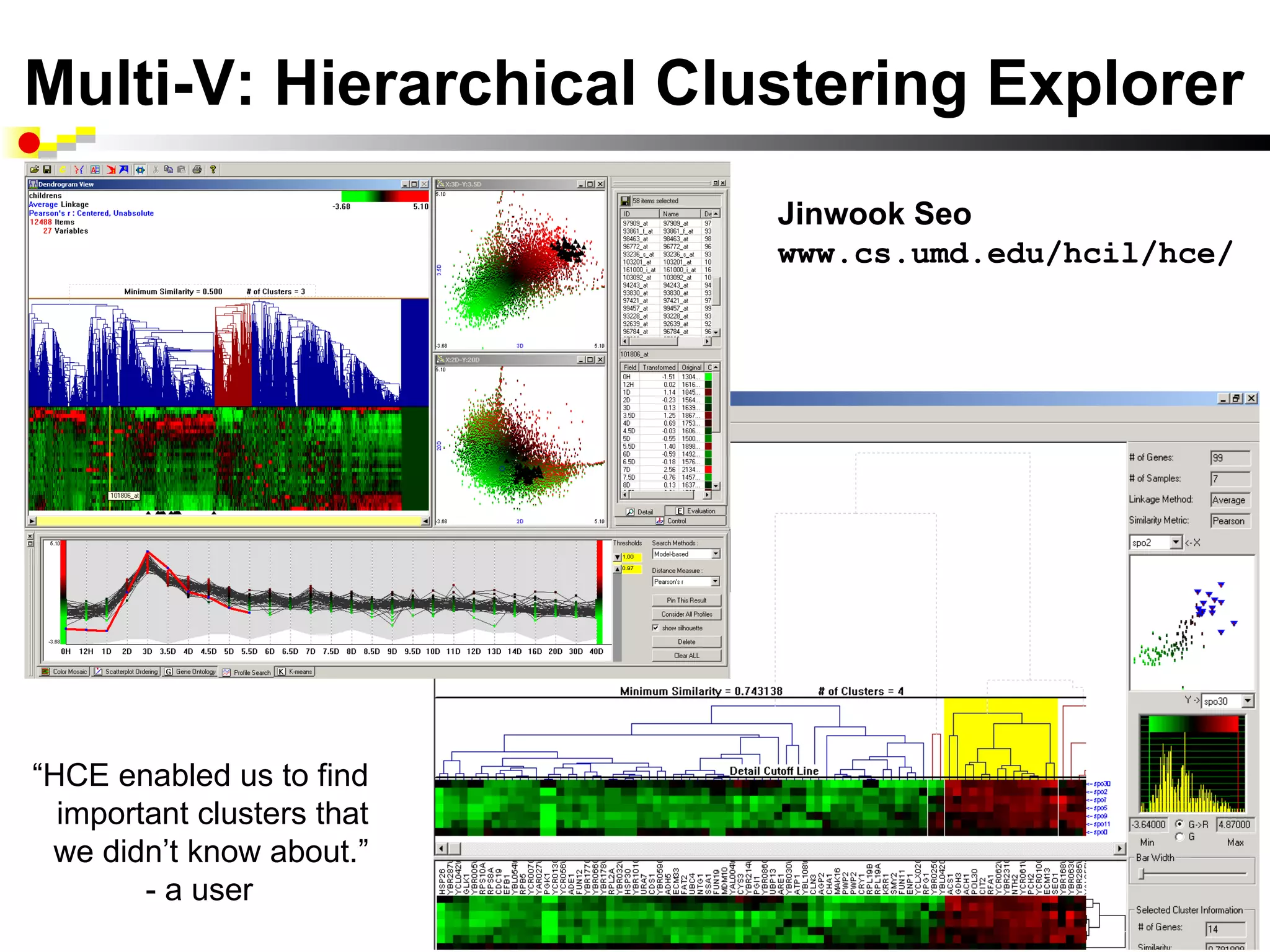
Multi-V: Hierarchical Clustering Explorer
                            Jinwook Seo
                            www.cs.umd.edu/hcil/hce/


“HCE enabled us to find
  important clusters that
 we didn’t know about.”
        - a user
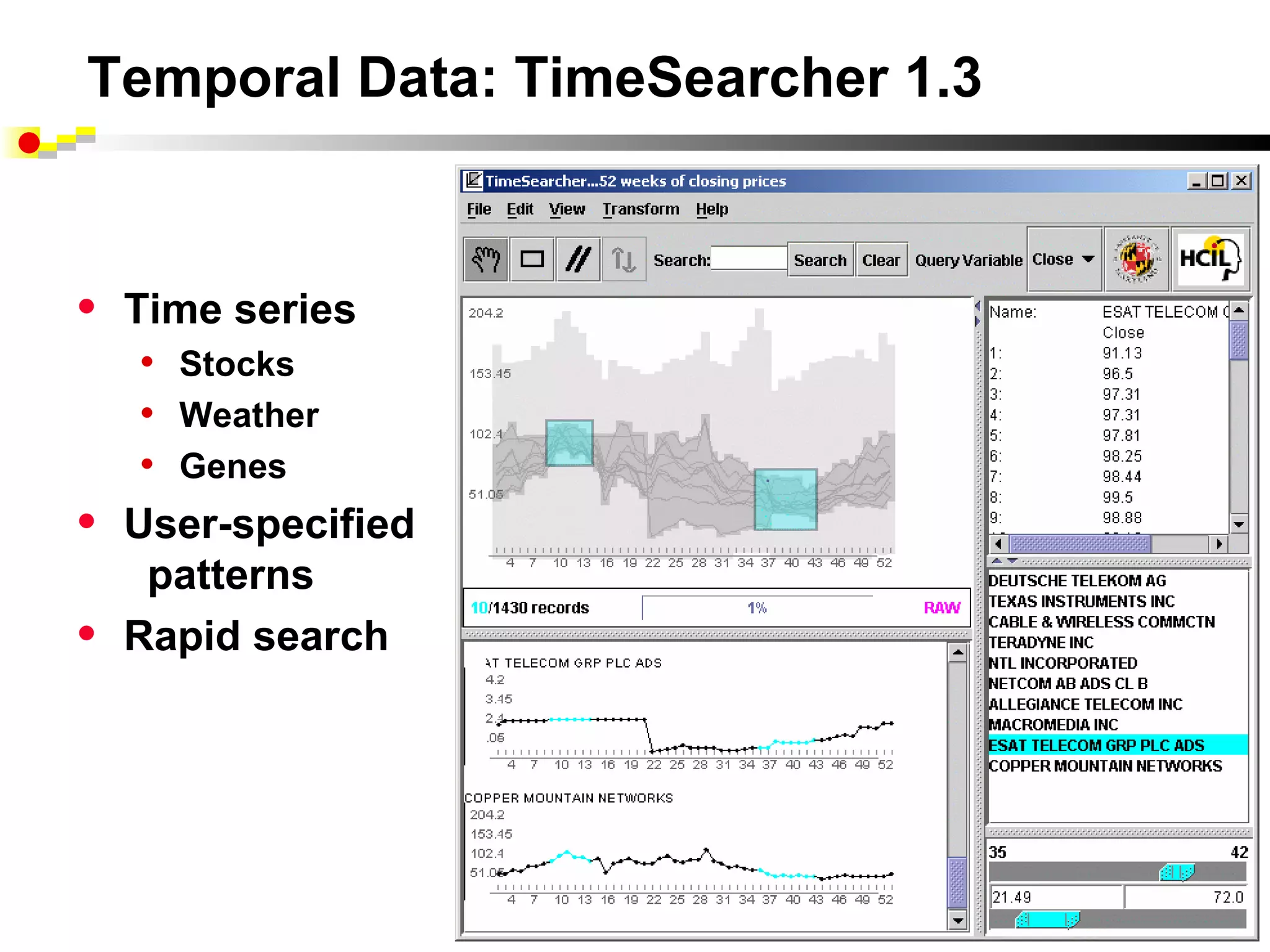
Temporal Data: TimeSearcher 1.3


•   Time series
     • Stocks
     • Weather
     • Genes
•   User-specified
      patterns
•   Rapid search
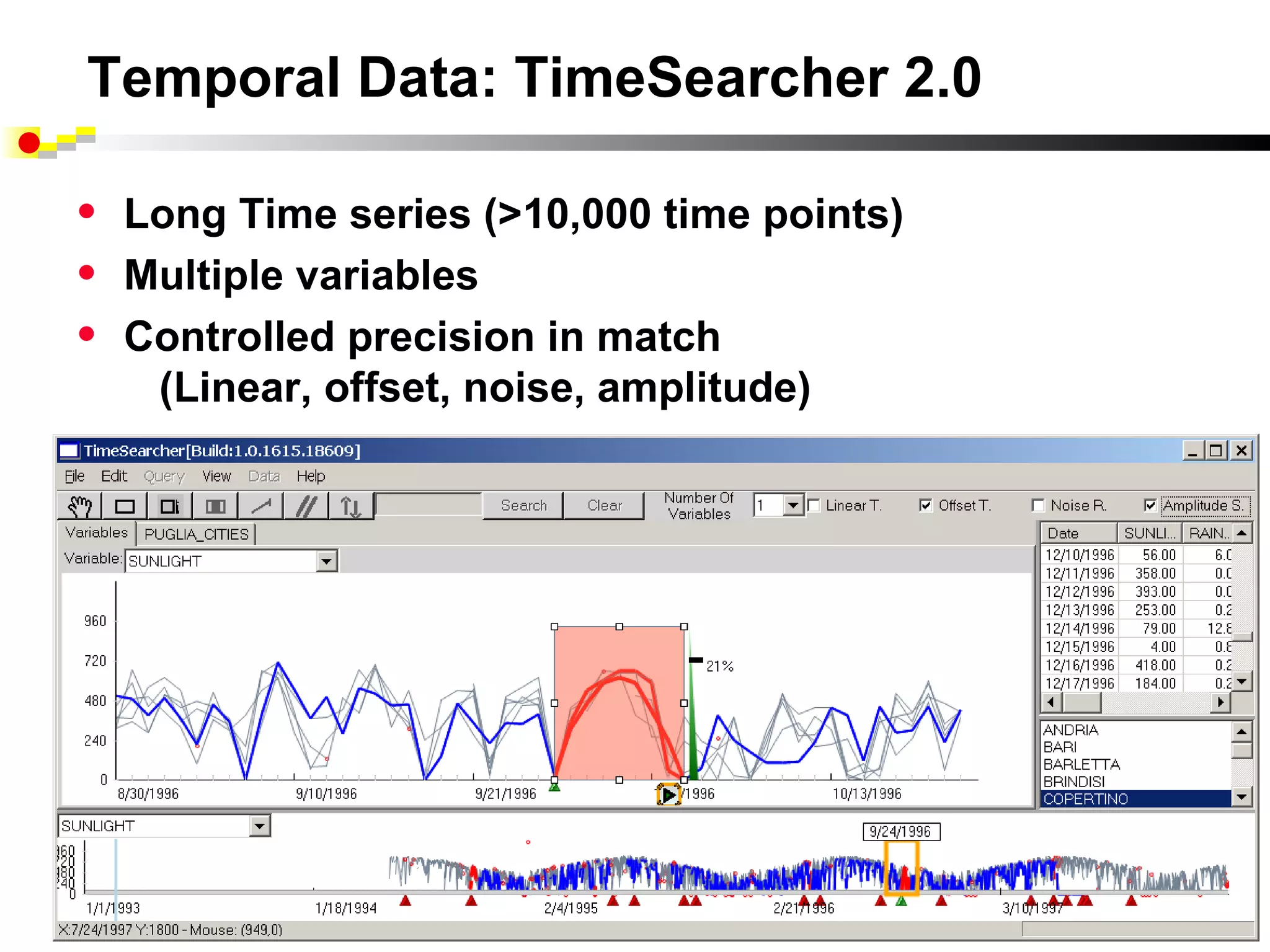
Temporal Data: TimeSearcher 2.0

•   Long Time series (>10,000 time points)
•   Multiple variables
•   Controlled precision in match
     (Linear, offset, noise, amplitude)
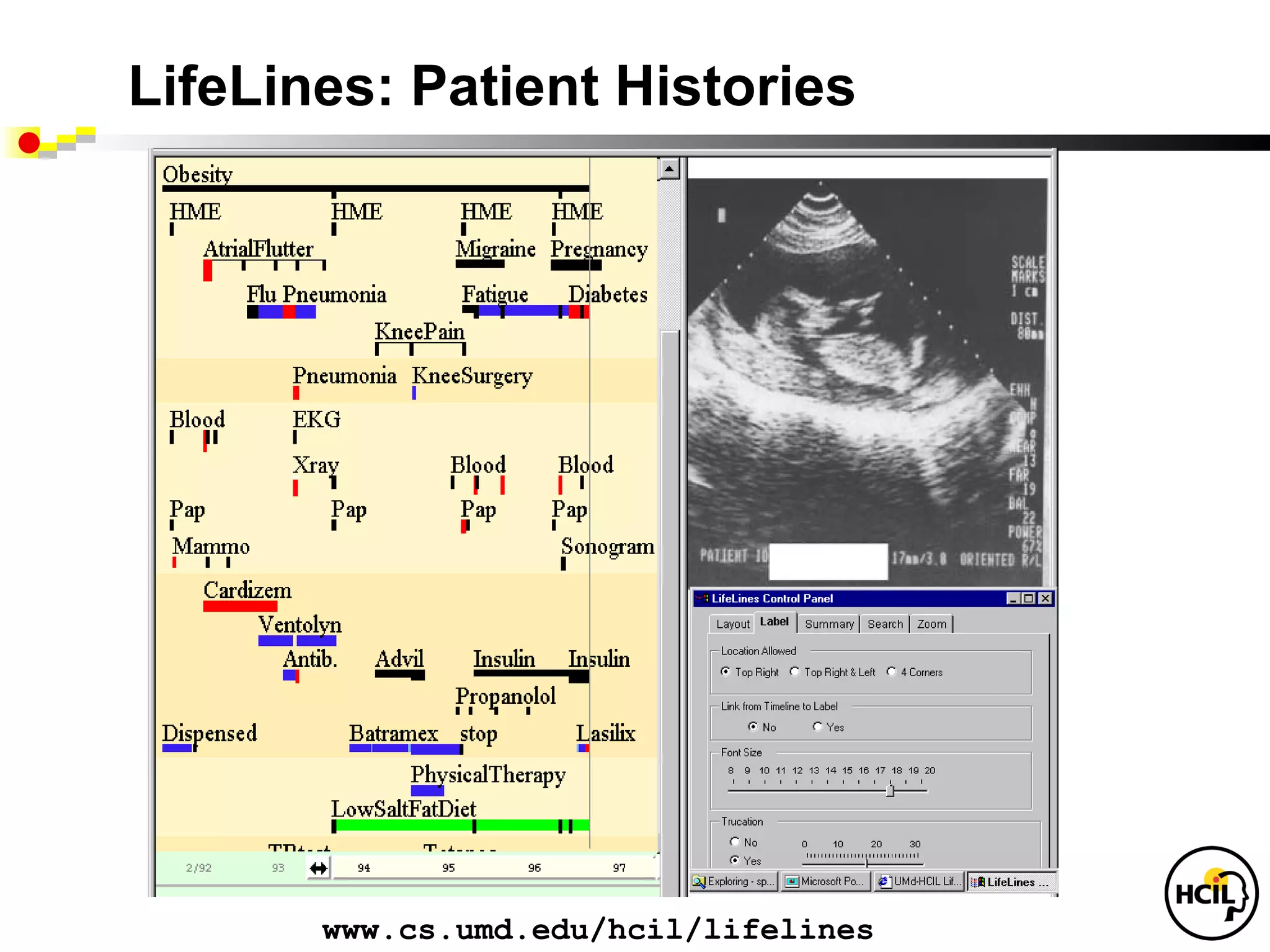
LifeLines: Patient Histories


       www.cs.umd.edu/hcil/lifelines
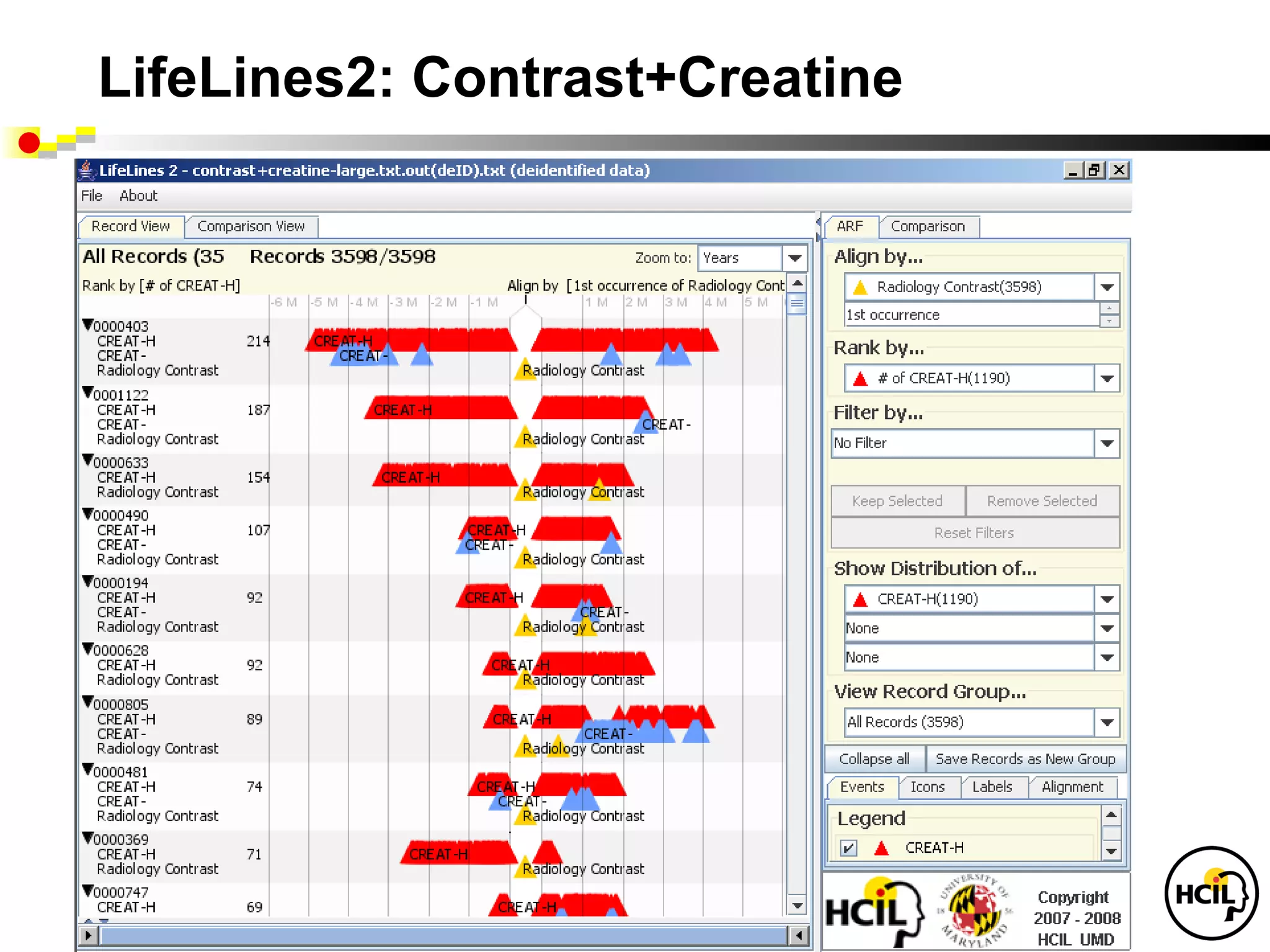
LifeLines2: Contrast+Creatine
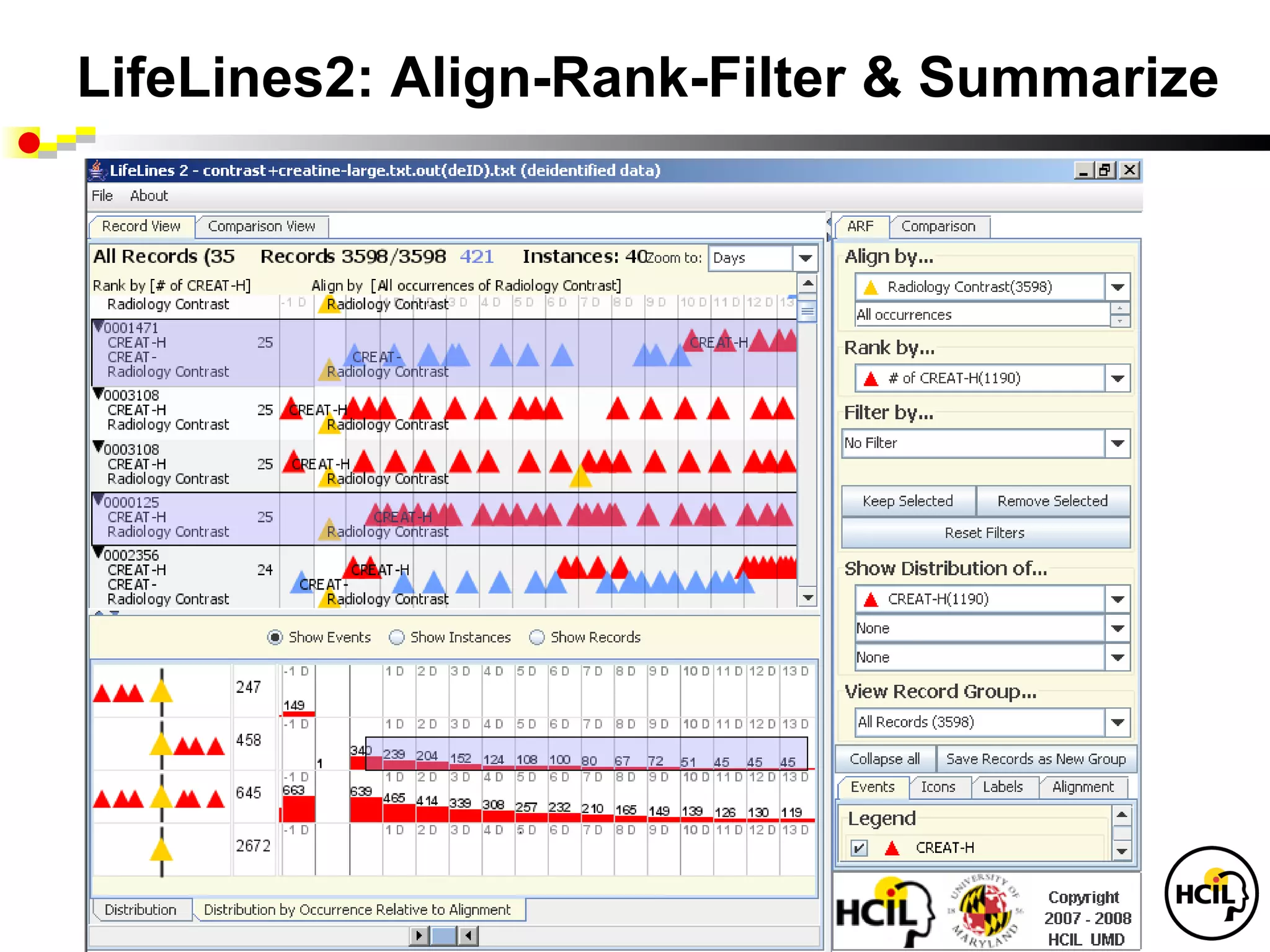
LifeLines2: Align-Rank-Filter & Summarize
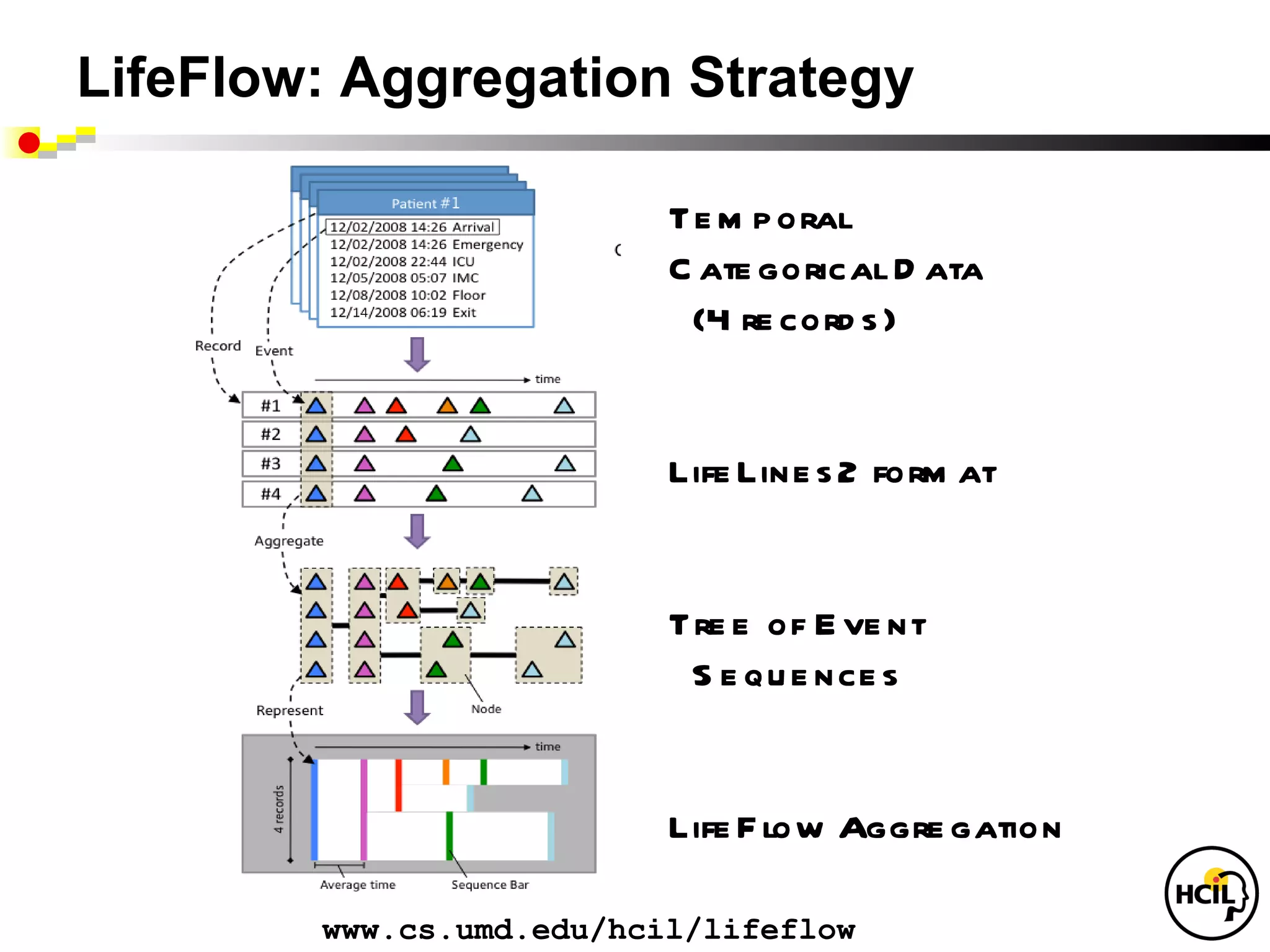
LifeFlow: Aggregation Strategy

                          Te m p oral
                          C ate gorical D ata
                           (4 re cord s )


                          Life Line s 2 form at


                          Tre e of E ve nt
                           S e qu e nce s


                          Life F low Aggre gation

        www.cs.umd.edu/hcil/lifeflow
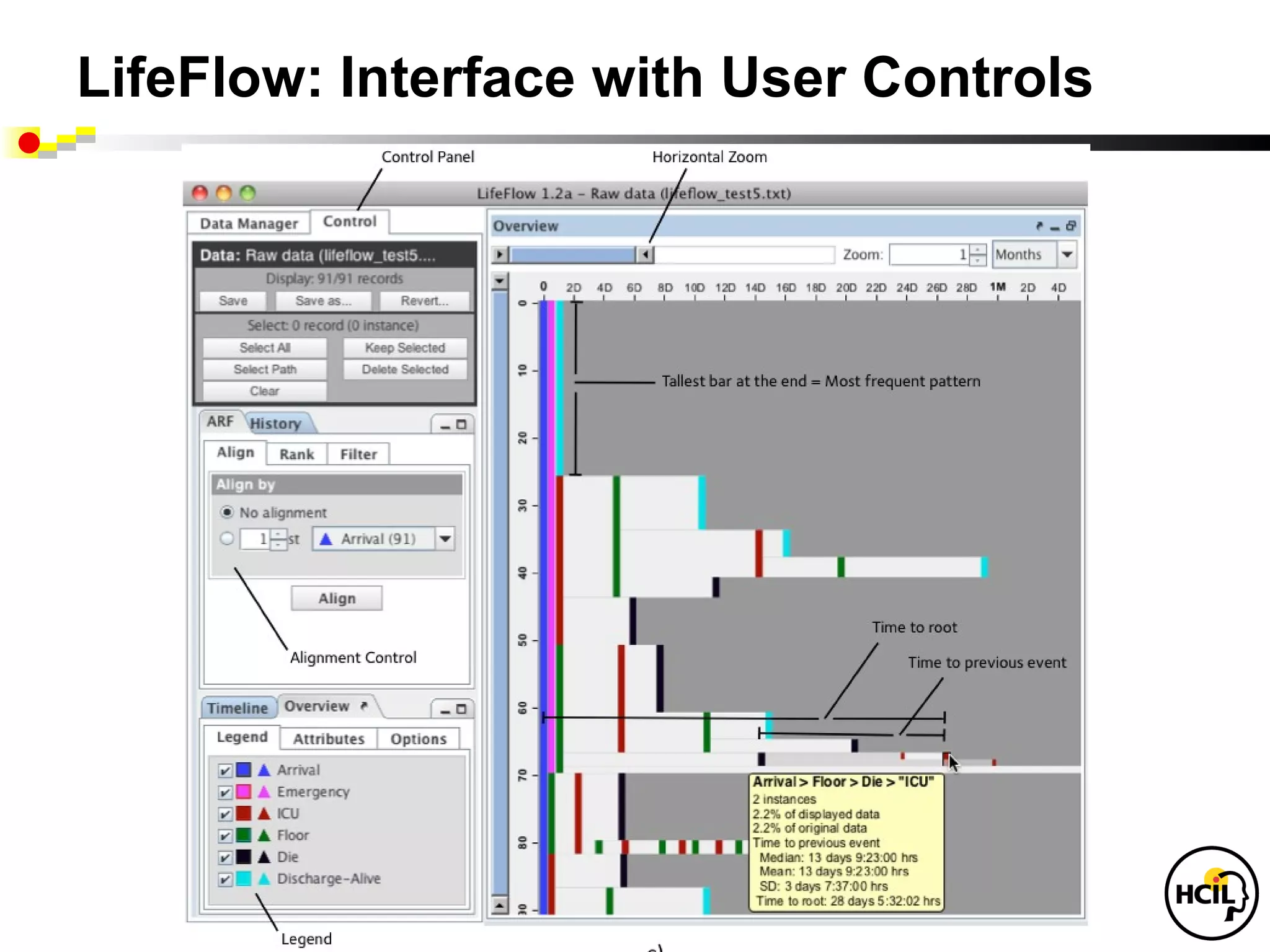
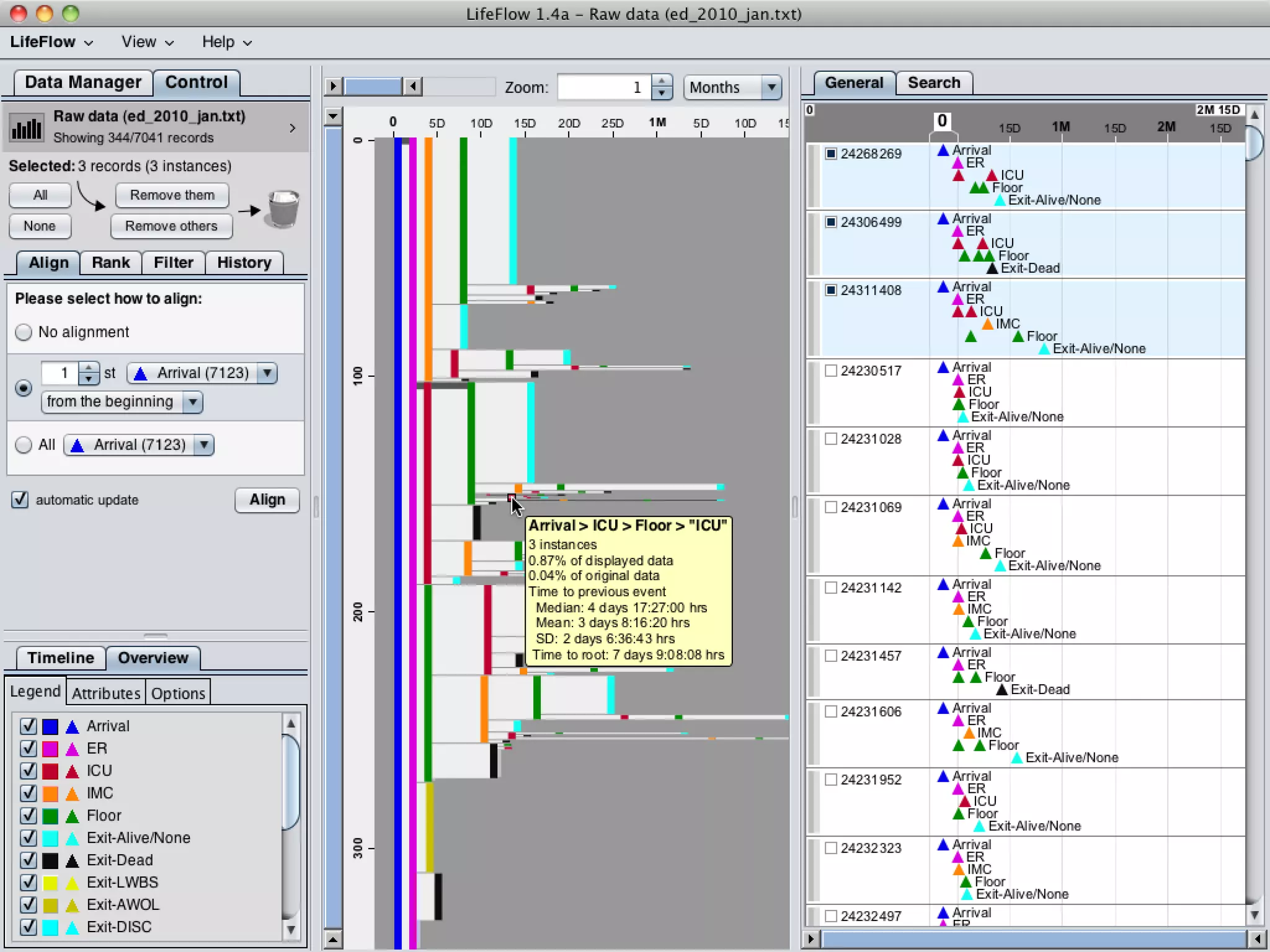
LifeFlow: Interface with User Controls
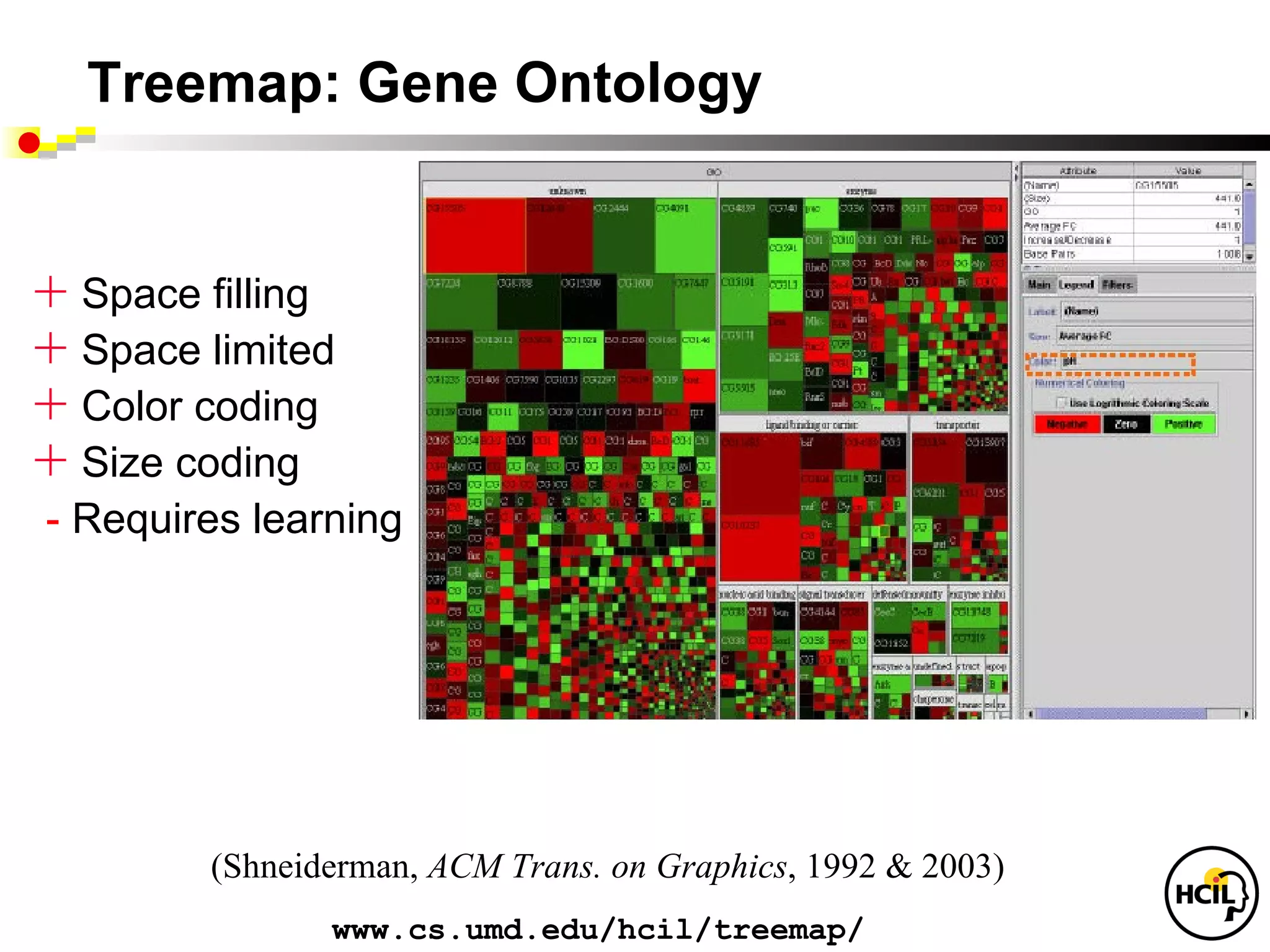
Treemap: Gene Ontology


+ Space filling
+ Space limited
+ Color coding
+ Size coding
- Requires learning


        (Shneiderman, ACM Trans. on Graphics, 1992 & 2003)
               www.cs.umd.edu/hcil/treemap/
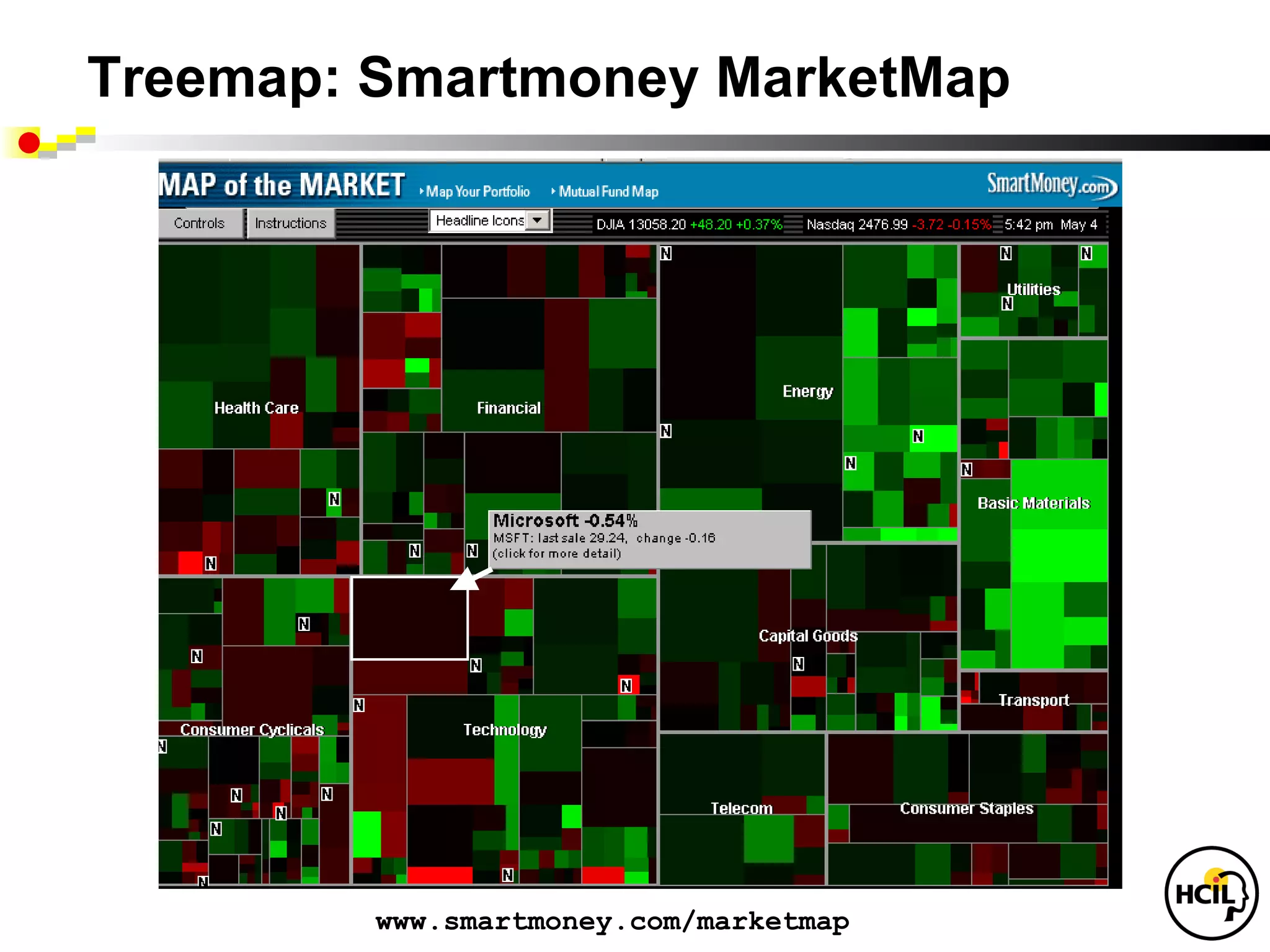
Treemap: Smartmoney MarketMap


         www.smartmoney.com/marketmap
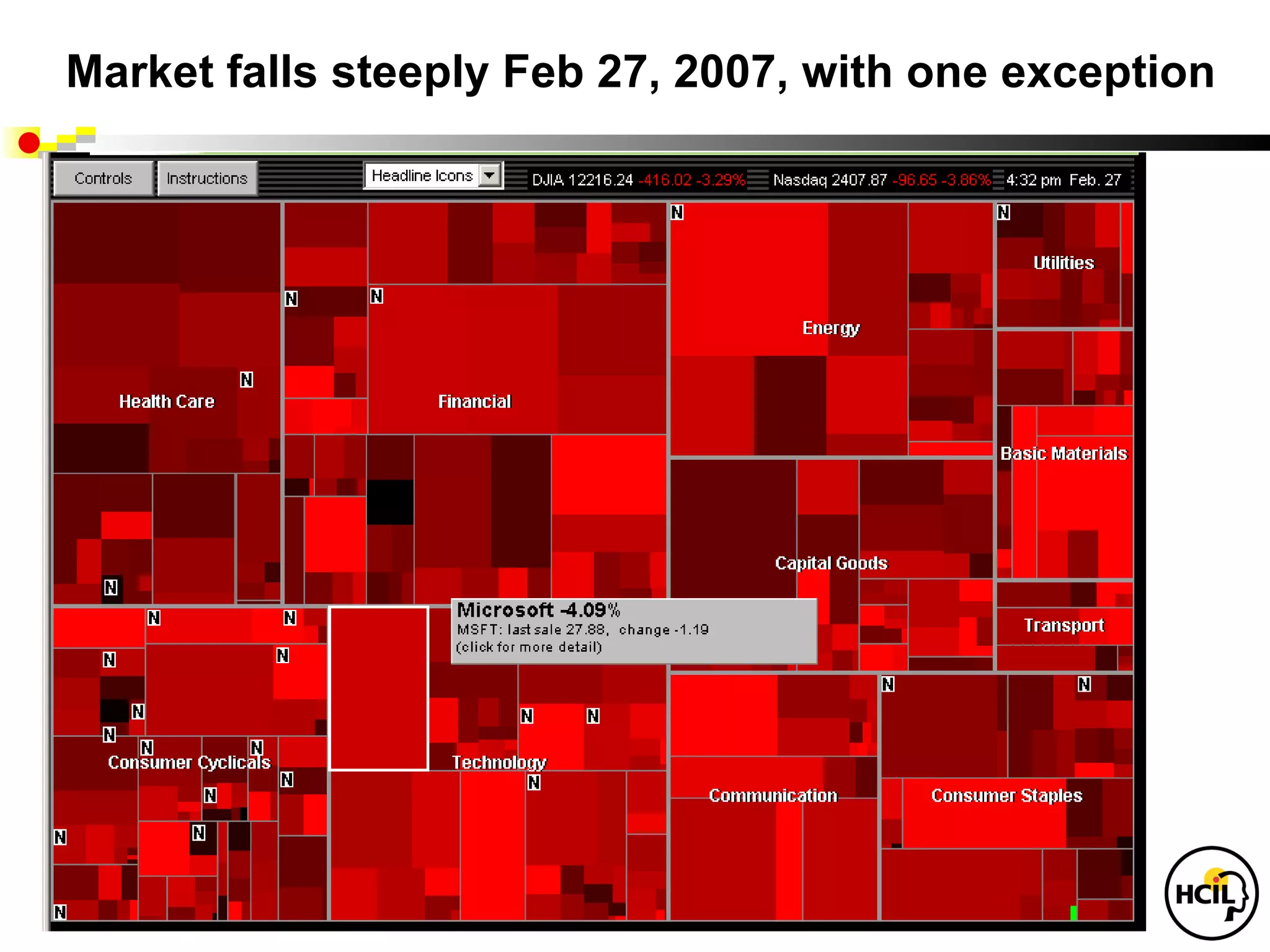
Market falls steeply Feb 27, 2007, with one exception
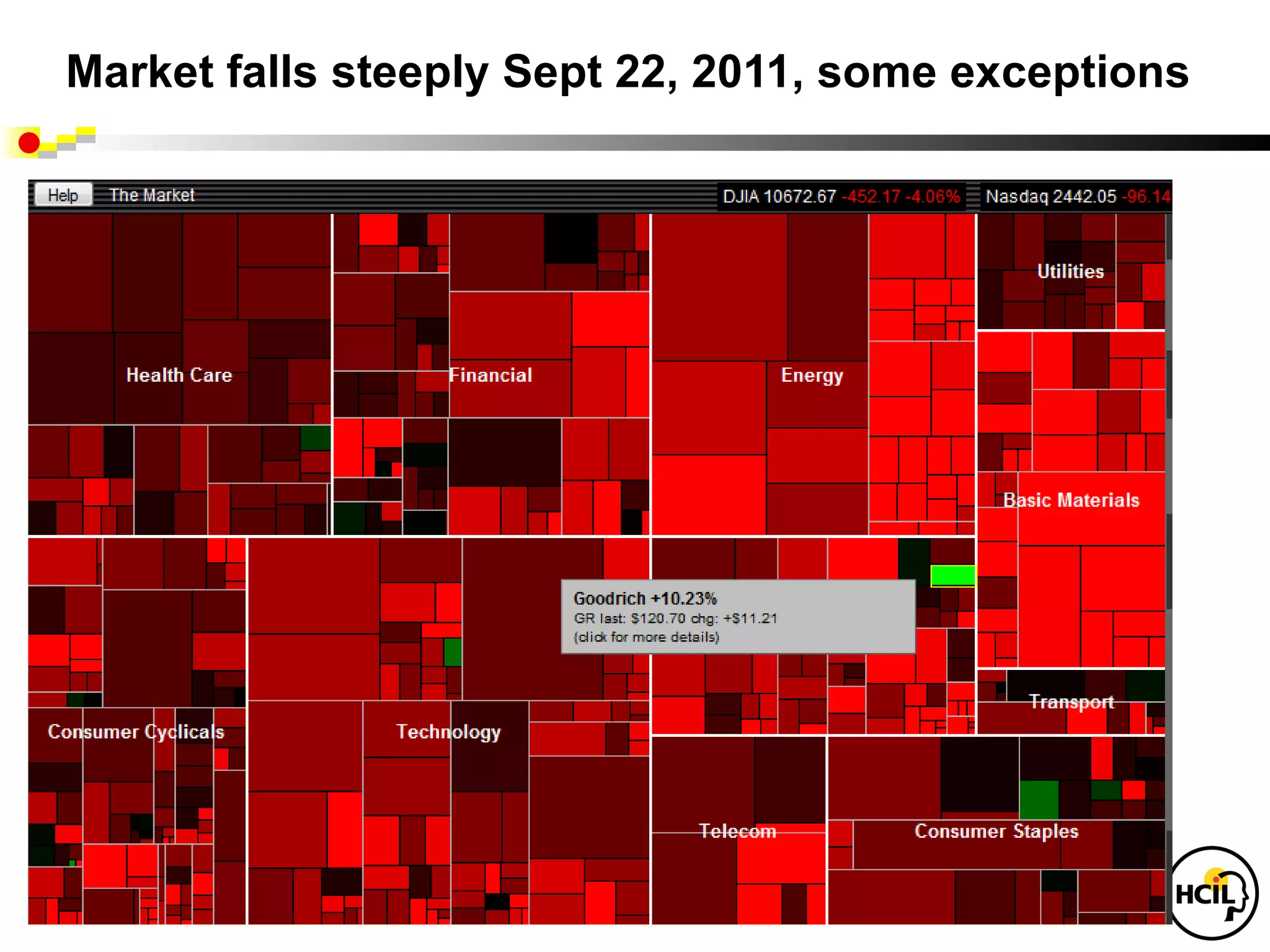
Market falls steeply Sept 22, 2011, some exceptions
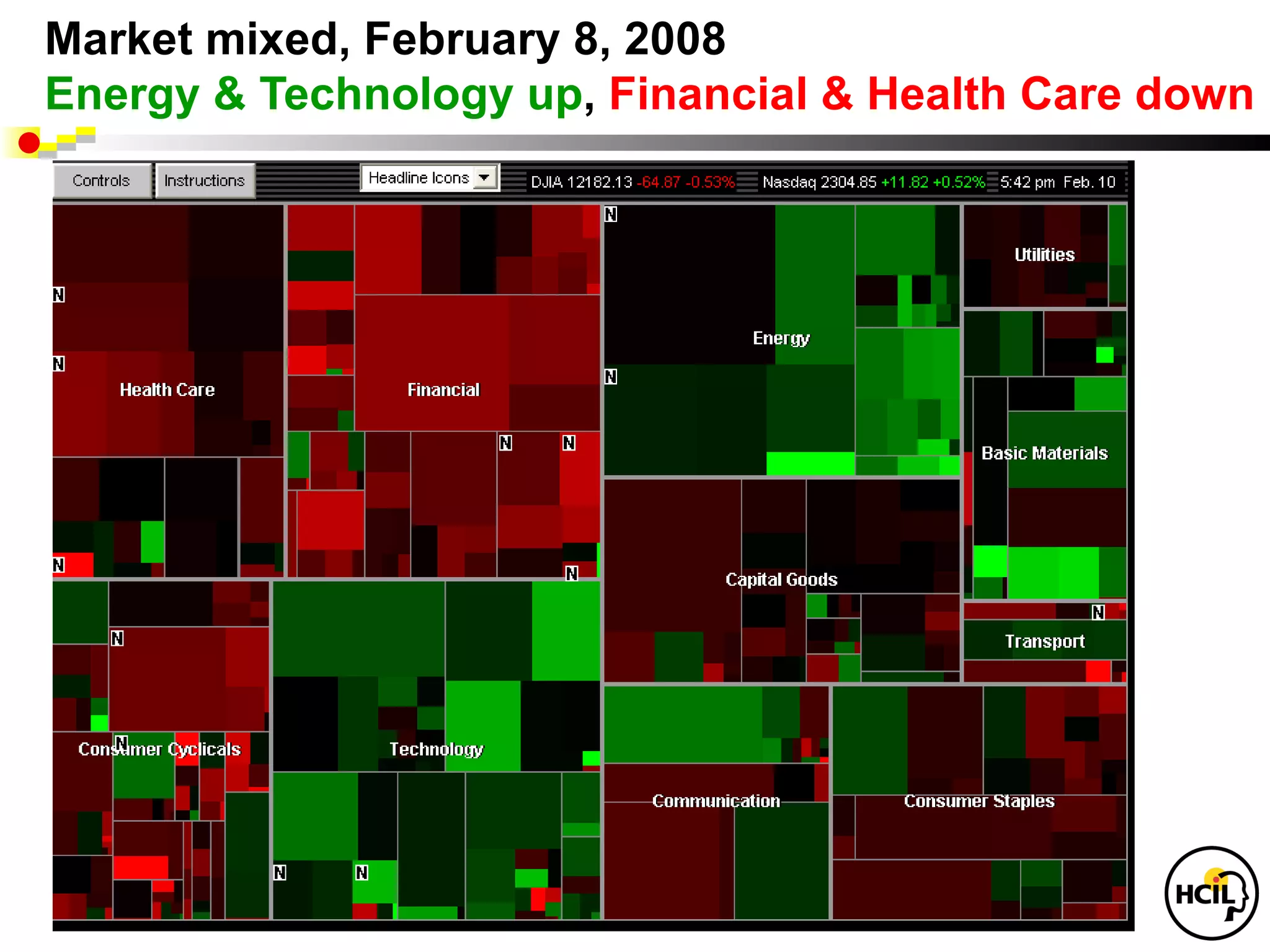
Market mixed, February 8, 2008
Energy & Technology up, Financial & Health Care down
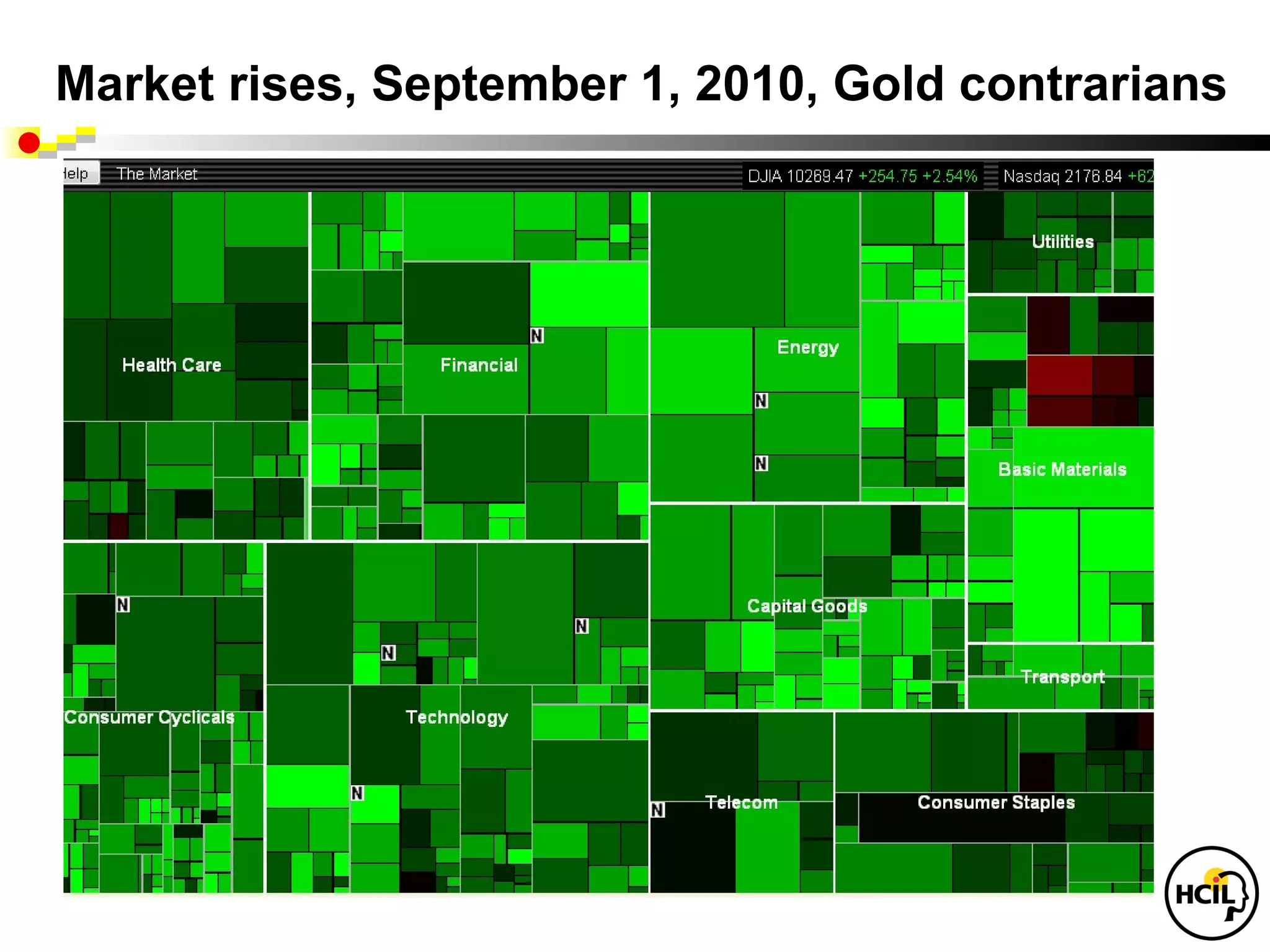
Market rises, September 1, 2010, Gold contrarians
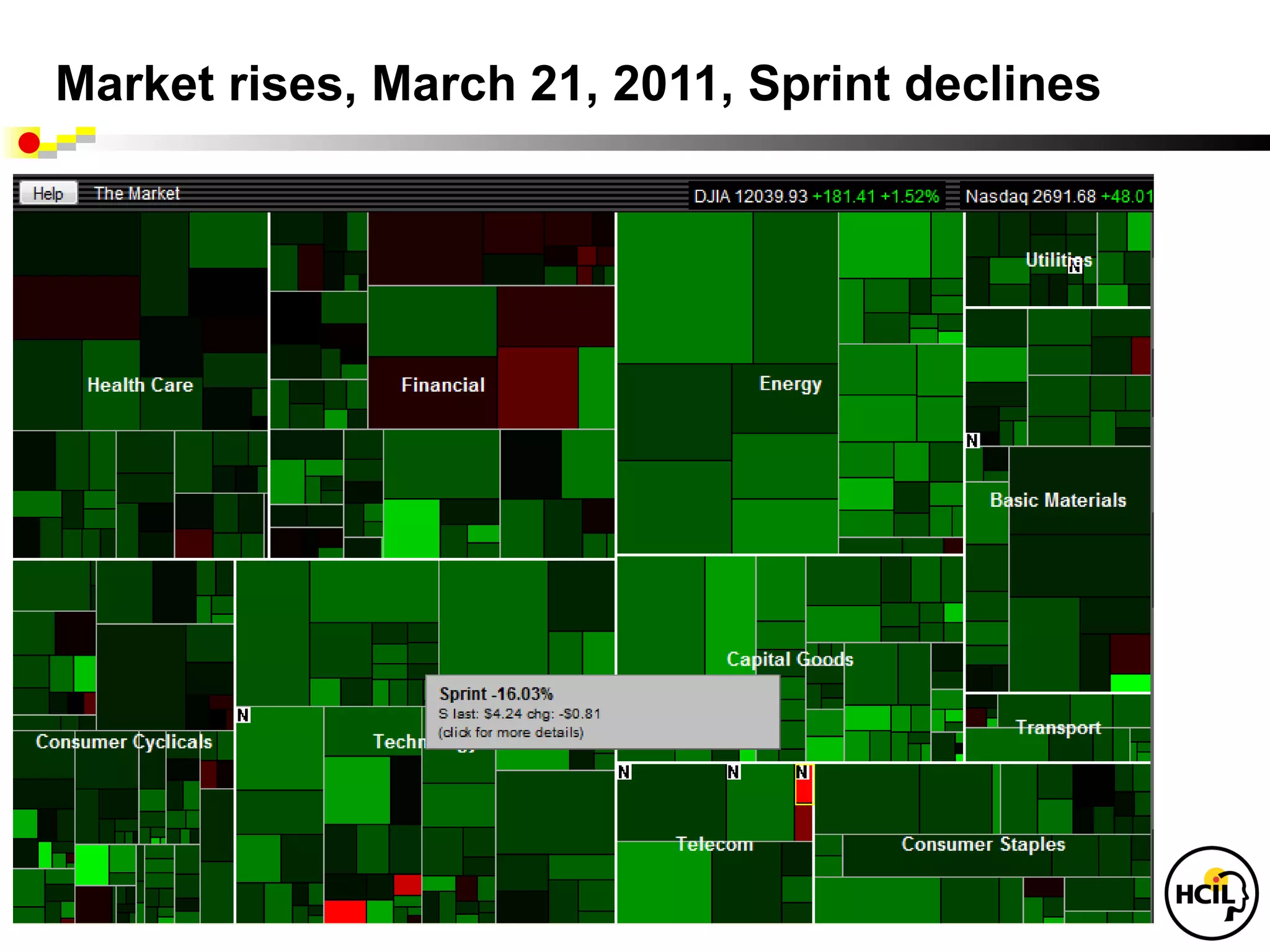
Market rises, March 21, 2011, Sprint declines
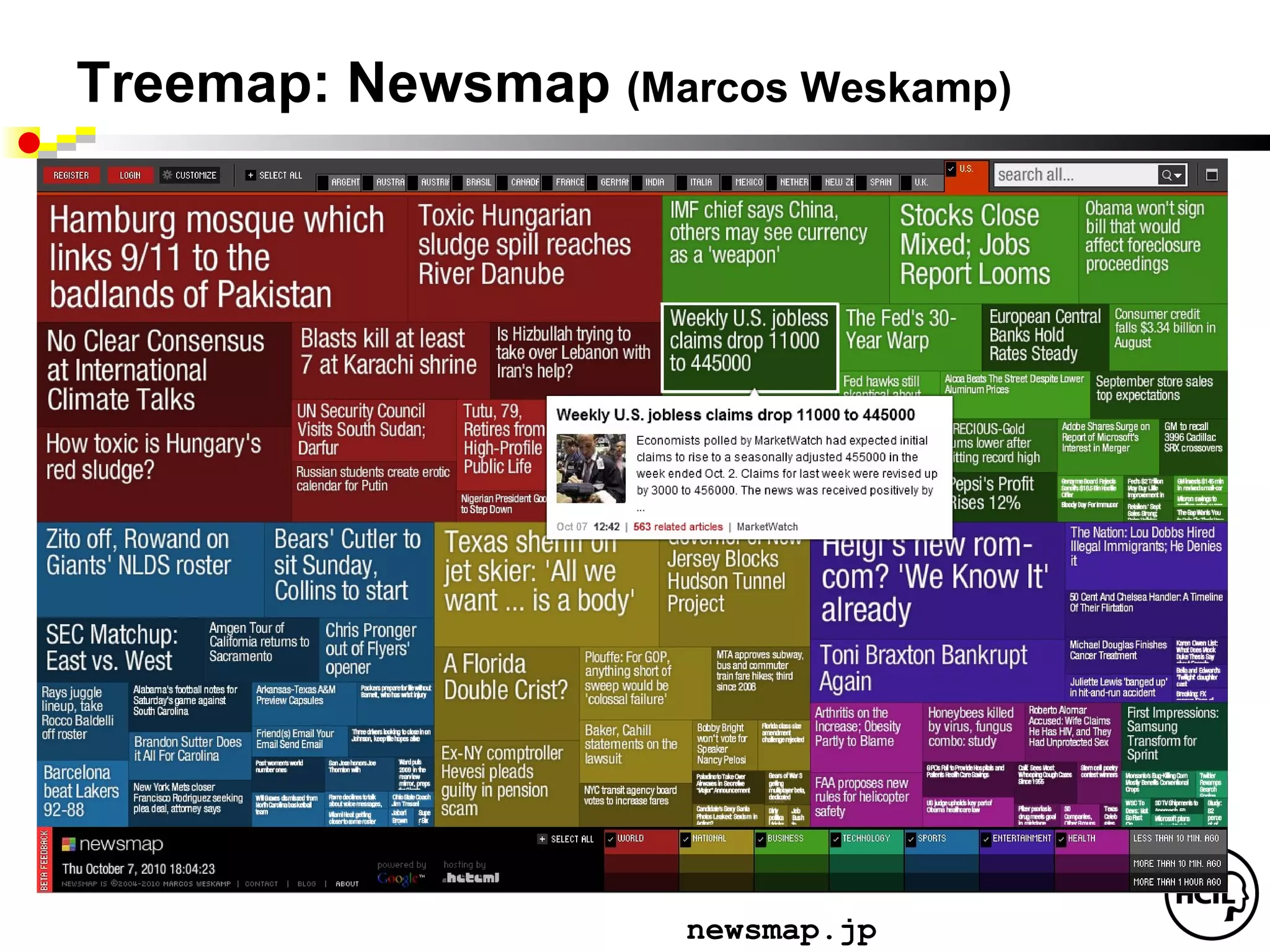
Treemap: Newsmap (Marcos Weskamp)


                     newsmap.jp
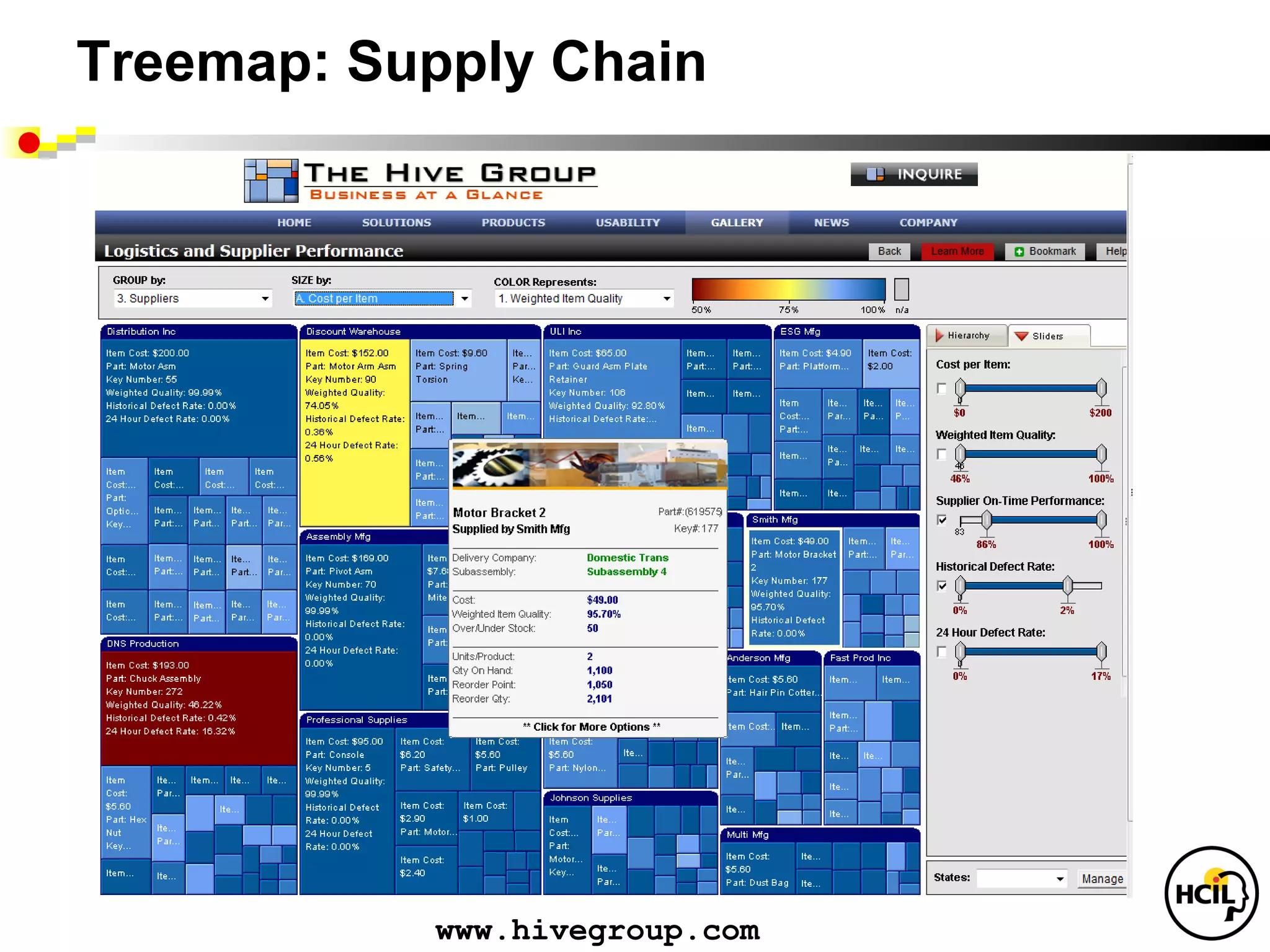
Treemap: Supply Chain


           www.hivegroup.com
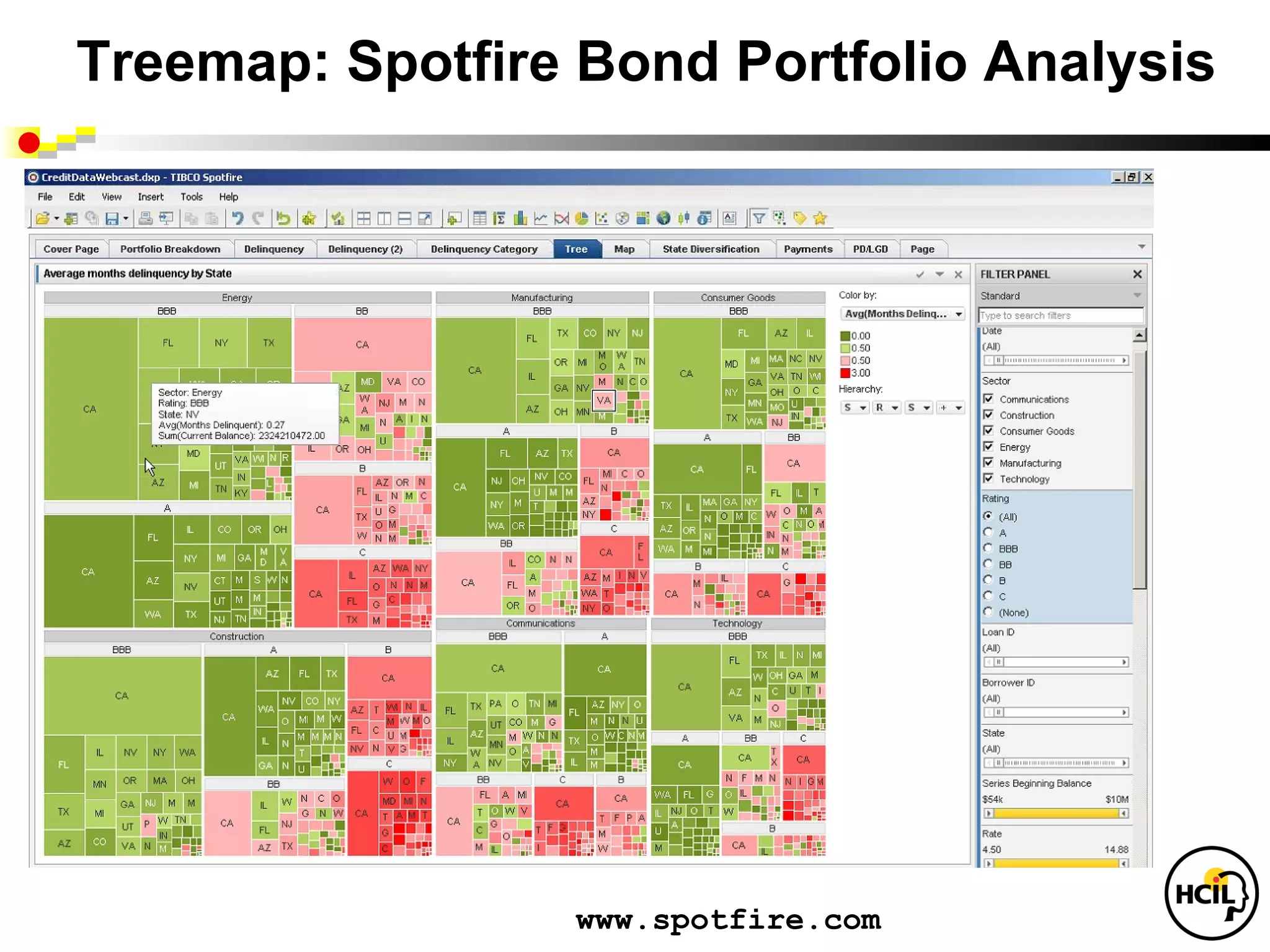
Treemap: Spotfire Bond Portfolio Analysis


                 www.spotfire.com
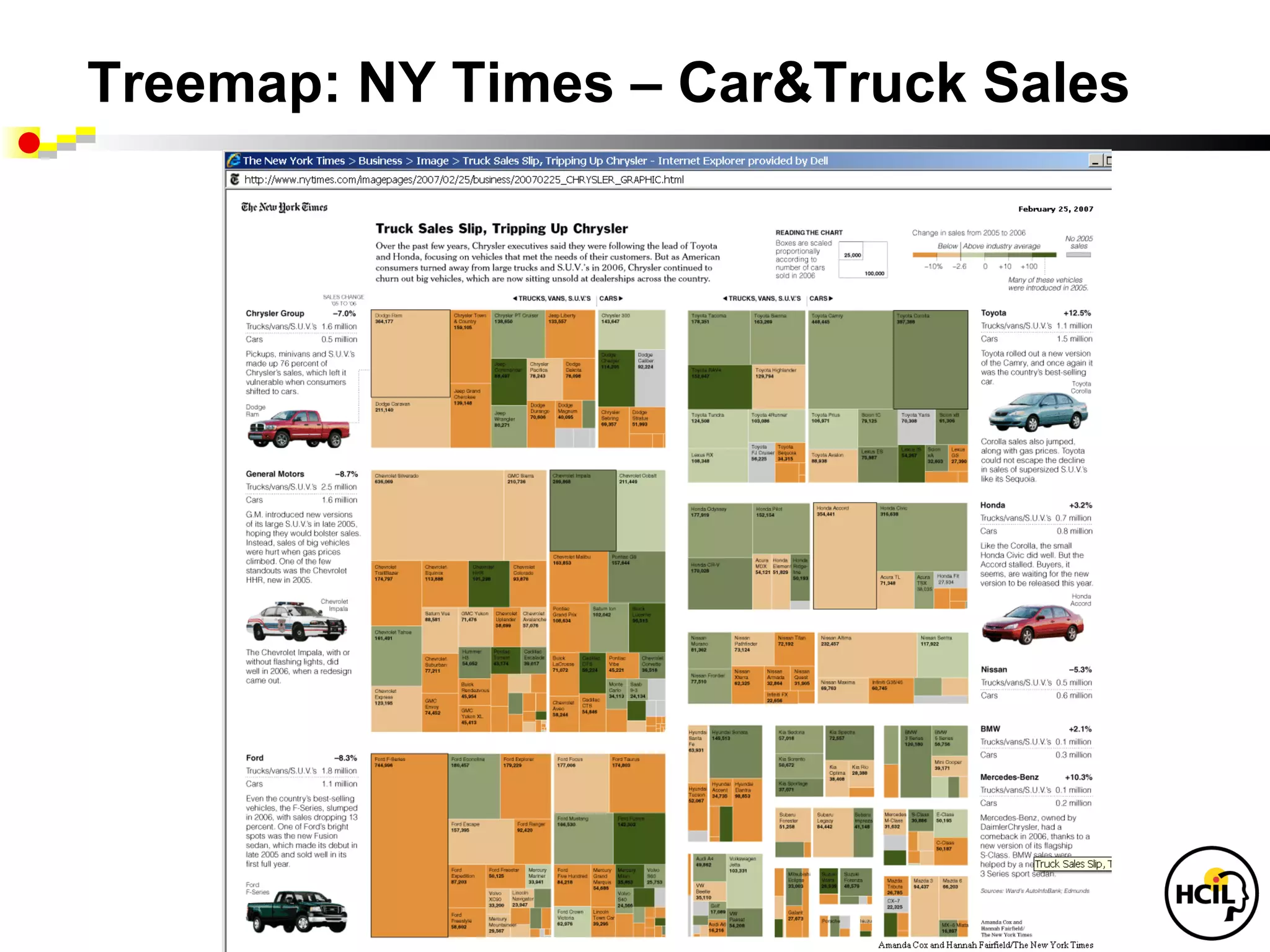
Treemap: NY Times – Car&Truck Sales


        www.cs.umd.edu/hcil/treemap/
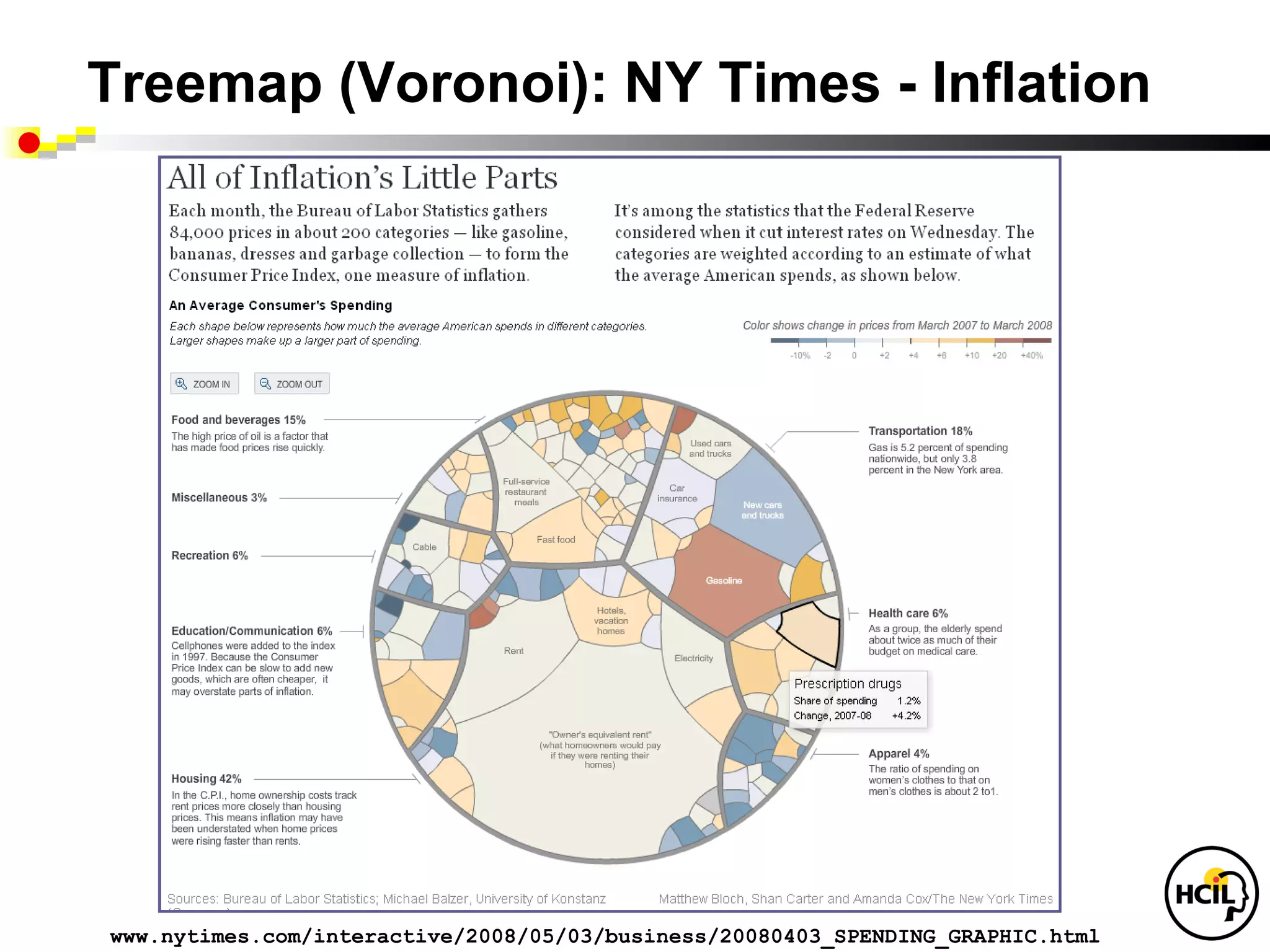
Treemap (Voronoi): NY Times - Inflation


www.nytimes.com/interactive/2008/05/03/business/20080403_SPENDING_GRAPHIC.html
Info vis 4-2012-part1

Info vis 4-2012-part1

  • 1.
    Information Visualization for Knowledge Discovery Ben Shneiderman ben@cs.umd.edu @benbendc Founding Director (1983-2000), Human-Computer Interaction Lab Professor, Department of Computer Science Member, Institute for Advanced Computer Studies University of Maryland College Park, MD 20742
  • 2.
    Interdisciplinary research community - Computer Science & Info Studies - Psych, Socio, Poli Sci & MITH (www.cs.umd.edu/hcil)
  • 3.
    Design Issues • Input devices & strategies • Keyboards, pointing devices, voice • Direct manipulation • Menus, forms, commands • Output devices & formats • Screens, windows, color, sound • Text, tables, graphics • Instructions, messages, help • Collaboration & Social Media www.awl.com/DTUI Fifth E dition: 2010 • Help, tutorials, training • Search • Vis u alization
  • 4.
    Information Visualization • Visual bandwidth is enormous • Human perceptual skills are remarkable • Trend, cluster, gap, outlier... • Color, size, shape, proximity... • Three challenges • Meaningful visual displays of massive data • Interaction: widgets & window coordination • Process models for discovery
  • 5.
    Business takes action • General Dynamics buys MayaViz • Agilent buys GeneSpring • Google buys Gapminder • Oracle buys Hyperion • Microsoft buys Proclarity • InfoBuilders buys Advizor Solutions • SAP buys (Business Objects buys Xcelsius & Inxight & Crystal Reports ) • IBM buys (Cognos buys Celequest) & ILOG • TIBCO buys Spotfire
  • 6.
    Spotfire: Retinol’s rolein embryos & vision
  • 7.
    h ttp :/re gis tration.s p otfire .com / val/ e fau lt_ e d u .as p / e d
  • 8.
    10M - 100Mpixels Large d is p lays for s ingle or m u ltip le u s e rs
  • 9.
  • 10.
    1M-pixels & less S m all m ob ile d e vice s
  • 11.
    Information Visualization: Mantra • Overview, zoom & filter, details-on-demand • Overview, zoom & filter, details-on-demand • Overview, zoom & filter, details-on-demand • Overview, zoom & filter, details-on-demand • Overview, zoom & filter, details-on-demand • Overview, zoom & filter, details-on-demand • Overview, zoom & filter, details-on-demand • Overview, zoom & filter, details-on-demand • Overview, zoom & filter, details-on-demand • Overview, zoom & filter, details-on-demand
  • 12.
    Information Visualization: DataTypes • 1-D Linear SciViz . Document Lens, SeeSoft, Info Mural • 2-D Map GIS, ArcView, PageMaker, Medical imagery • 3-D World CAD, Medical, Molecules, Architecture • Multi-Var Spotfire, Tableau, GGobi, TableLens, ParCoords, • Temporal LifeLines, TimeSearcher, Palantir, DataMontage InfoViz • Tree Cone/Cam/Hyperbolic, SpaceTree, Treemap • Network Pajek, JUNG, UCINet, SocialAction, NodeXL infosthetics.com flowingdata.com infovis.org www.infovis.net/index.php?lang=2
  • 13.
    Anscombe’s Quartet 1 2 3 4 x y x y x y x y 10.0 8.04 10.0 9.14 10.0 7.46 8.0 6.58 8.0 6.95 8.0 8.14 8.0 6.77 8.0 5.76 13.0 7.58 13.0 8.74 13.0 12.74 8.0 7.71 9.0 8.81 9.0 8.77 9.0 7.11 8.0 8.84 11.0 8.33 11.0 9.26 11.0 7.81 8.0 8.47 14.0 9.96 14.0 8.10 14.0 8.84 8.0 7.04 6.0 7.24 6.0 6.13 6.0 6.08 8.0 5.25 4.0 4.26 4.0 3.10 4.0 5.39 19.0 12.50 12.0 10.84 12.0 9.13 12.0 8.15 8.0 5.56 7.0 4.82 7.0 7.26 7.0 6.42 8.0 7.91 5.0 5.68 5.0 4.74 5.0 5.73 8.0 6.89
  • 14.
    Anscombe’s Quartet 1 2 3 4 x y x y x y x y Property Value 10.0 8.04 10.0 9.14 10.0 7.46 8.0 6.58 Mean of x 9.0 8.0 6.95 8.0 8.14 8.0 6.77 8.0 5.76 Variance of x 11.0 13.0 7.58 13.0 8.74 13.0 12.74 8.0 7.71 Mean of y 7.5 9.0 8.81 9.0 8.77 9.0 7.11 8.0 8.84 Variance of y 4.12 11.0 8.33 11.0 9.26 11.0 7.81 8.0 8.47 Correlation 0.816 14.0 9.96 14.0 8.10 14.0 8.84 8.0 7.04 Linear regression y = 3 + 0.5x 6.0 7.24 6.0 6.13 6.0 6.08 8.0 5.25 4.0 4.26 4.0 3.10 4.0 5.39 19.0 12.50 12.0 10.84 12.0 9.13 12.0 8.15 8.0 5.56 7.0 4.82 7.0 7.26 7.0 6.42 8.0 7.91 5.0 5.68 5.0 4.74 5.0 5.73 8.0 6.89
  • 15.
  • 16.
    Multi-V: Hierarchical ClusteringExplorer Jinwook Seo www.cs.umd.edu/hcil/hce/ “HCE enabled us to find important clusters that we didn’t know about.” - a user
  • 17.
    Temporal Data: TimeSearcher1.3 • Time series • Stocks • Weather • Genes • User-specified patterns • Rapid search
  • 18.
    Temporal Data: TimeSearcher2.0 • Long Time series (>10,000 time points) • Multiple variables • Controlled precision in match (Linear, offset, noise, amplitude)
  • 19.
    LifeLines: Patient Histories www.cs.umd.edu/hcil/lifelines
  • 20.
  • 21.
  • 22.
    LifeFlow: Aggregation Strategy Te m p oral C ate gorical D ata (4 re cord s ) Life Line s 2 form at Tre e of E ve nt S e qu e nce s Life F low Aggre gation www.cs.umd.edu/hcil/lifeflow
  • 23.
  • 29.
    Treemap: Gene Ontology +Space filling + Space limited + Color coding + Size coding - Requires learning (Shneiderman, ACM Trans. on Graphics, 1992 & 2003) www.cs.umd.edu/hcil/treemap/
  • 30.
    Treemap: Smartmoney MarketMap www.smartmoney.com/marketmap
  • 31.
    Market falls steeplyFeb 27, 2007, with one exception
  • 32.
    Market falls steeplySept 22, 2011, some exceptions
  • 33.
    Market mixed, February8, 2008 Energy & Technology up, Financial & Health Care down
  • 34.
    Market rises, September1, 2010, Gold contrarians
  • 35.
    Market rises, March21, 2011, Sprint declines
  • 36.
    Treemap: Newsmap (MarcosWeskamp) newsmap.jp
  • 37.
    Treemap: Supply Chain www.hivegroup.com
  • 38.
    Treemap: Spotfire BondPortfolio Analysis www.spotfire.com
  • 39.
    Treemap: NY Times– Car&Truck Sales www.cs.umd.edu/hcil/treemap/
  • 40.
    Treemap (Voronoi): NYTimes - Inflation www.nytimes.com/interactive/2008/05/03/business/20080403_SPENDING_GRAPHIC.html

Editor's Notes

  • #7 "The IN Cell Analyzer automated microscope was used to identify proteins influencing the division of human cells. After the images were analyzed, quantitative results were transferred to Spotfire DecisionSite. This screen revealed the previously unknown involvement of the retinol binding protein RBP1 in cell cycle control.(Stubbs S, & Thomas N. 2006 Methods in Enzymology; 414:1-21.) Retinol a form of Vitamin A plays a crucial role in vision and during embryonic development"  
  • #21 Contrast and Creatinine dataset In some diagnostic radiology procedures, patients are injected contrast material. However, some patients develop adverse side effects to the contrast material. One serious side effect is renal failure, which is detected by high creatinine levels in a patient's blood. This adverse effect usually occur within two weeks after the radiology contrast. WHC is interested in finding the proportion of patients who exhibit this condition in historical records. Screenshots 1-aligned-ranked.png: We align by the 1st occurrence of radiology contrast and rank by the number of creatinine high (CREAT-H) events to bring the most severe patients to the top. We realize two things: (1) some patients have more than 1 "Radiology Contrast" events, and (2), some patients have consistently high creatinine readings (chronic kidney failure). 2-aligned(all)-distribution-selected.png We align by all occurrences of raiology contrast, and then show the temporal summary of CREAT-H events. The patients are presented in 4 exclusive sets in the summary: those who have CREAT-H only before alignment, only after alignment, both before and after, and neither. We then select from the "only after" summary the patients who have at least one CREAT-H event within 2 weeks of any "Radiology Contrast" event. There are 421 patients.
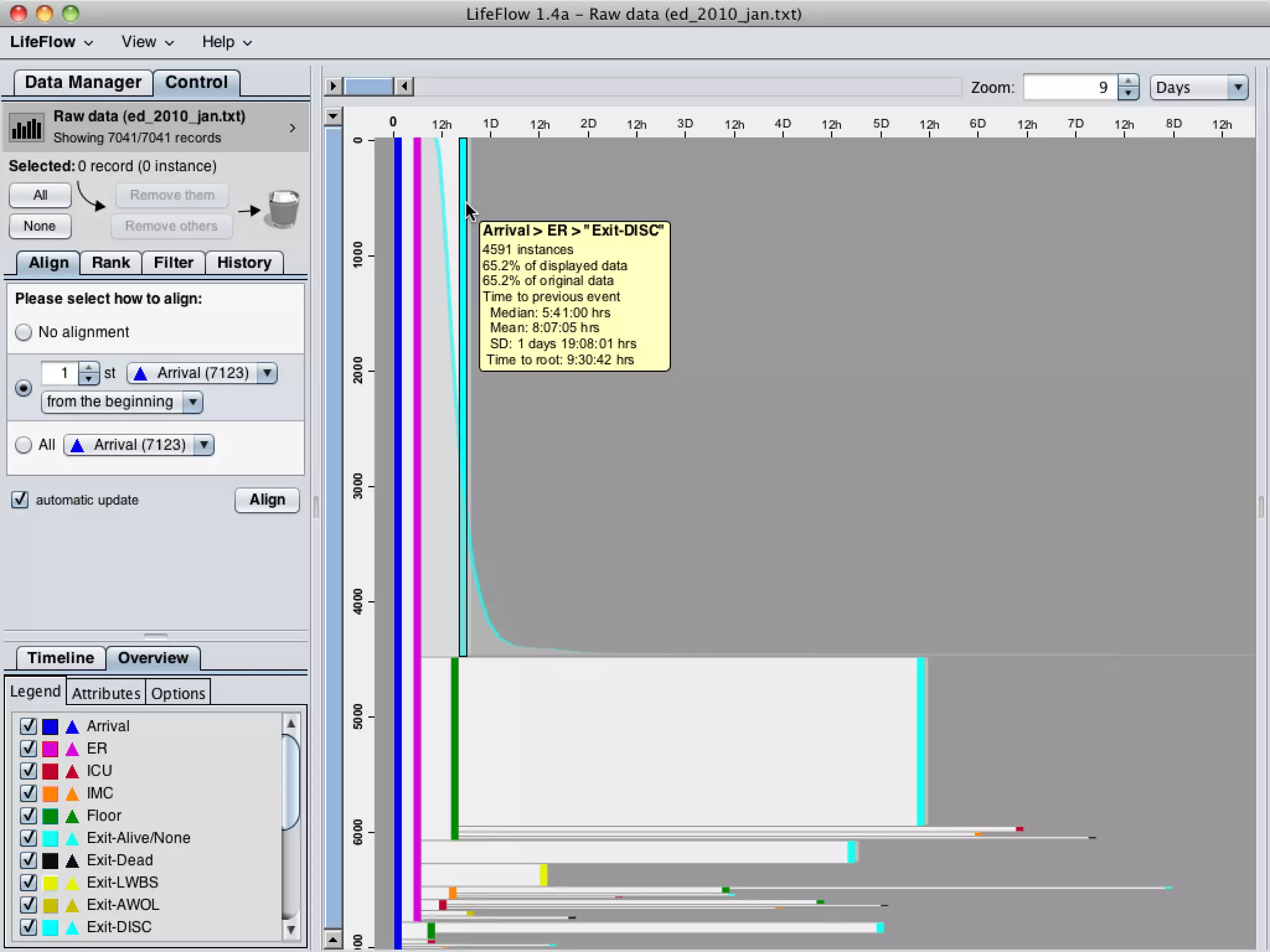
  • #25 Using LifeFlow, 7,041 patients are aggregated into this visualization and LifeFlow immediately reveal the most common pattern, which you could not do easily in SQL. You could easily notice this huge pattern “Arrival -> ER -> Exit”, meaning patients who visited with minor injuries or simple conditions and left the hospital immediately after receiving their treatment. When hovering the mouse over, LifeFlow displays a tooltip that gives more information, such as number of patients and other statistics, and also shows the distribution of the patients. As the horizontal gap represents time, you can see from the distribution that some patients left the hospital very quickly after visiting the emergency room while some of them stayed longer. *optional The second most common pattern is “Arrival (Blue) -> ER (Pink) -> Floor (Green) -> Exit (Cyan)”, meaning patients who were admitted to observe the conditions and then everything went well so they left the hospital. You can also use the horizontal gap to compare these patients with the patients who exit from the emergency room. Comparing the gap from pink to cyan and pink to green, you can see that the gap from pink to green is smaller than pink to cyan, so the patients were transferred to Floor faster than exit the hospital in average. You have seen the two most common cases, now I will remove the common patterns so we can analyze the less frequent patterns.
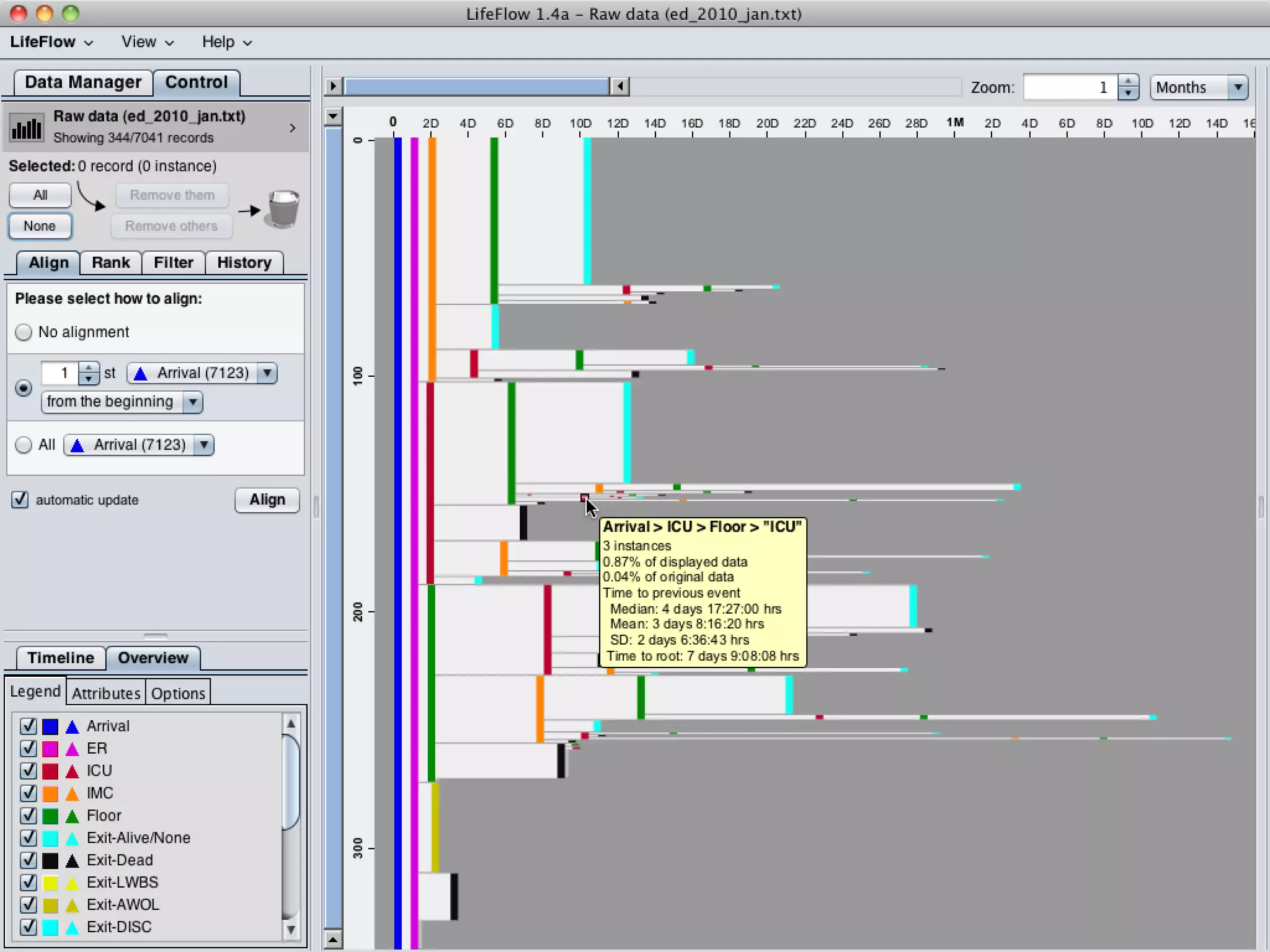
  • #26 After removing all the common cases, we have 344 patients left. These are mostly the patients who were admitted. There are many information that I can explain from this visualization here, but I will go straight into the case that our physician partners are mostly interested in. The mouse is pointing at this sequence, which represents the “bounce backs” patients, meaning patients who were transferred from ICU to Floor because they seemed to get better, however, they were transferred back to the ICU. So the physician are interested in finding these patients to analyze what made them made the wrong decisions. *optional Another case is the step ups, which means the patients whose level of care were escalated to higher level, you can see from the visualization that there were patients who were transferred from ER to Floor (green) to ICU (red) and IMC (orange). The number of these patients and the average transferred time could be compare to the hospital standards to measure the quality of care.
  • #27 Ben: This slide is optional. You can use it to show that when you click on the bounce backs patients, you can get the details of each patient in LifeLines2 view.
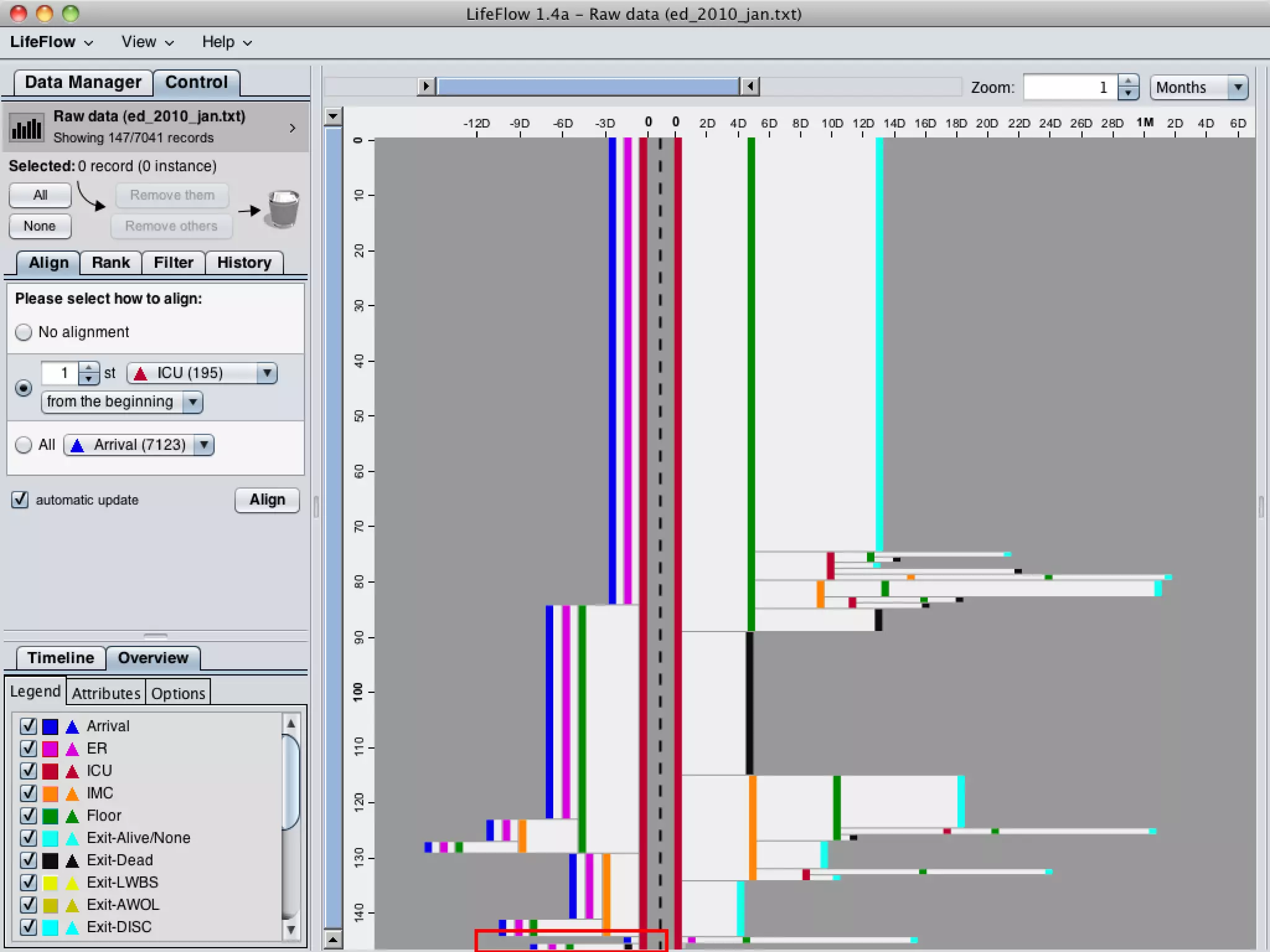
  • #28 Another interesting feature is you can align by a particular event. For example, if you want to know what happened before and after the patients went to the ICU, you can align by ICU. The dash line separate between what happened before and what happened after. You can see that the ICU patients mostly came from the ER (pink), and most of them were transferred to Floor (green) after that. Unfortunately, some of them died after they were transferred to the ICU (black). From this visualization, you may notice a small pattern in the bottom. Let me zoom in.
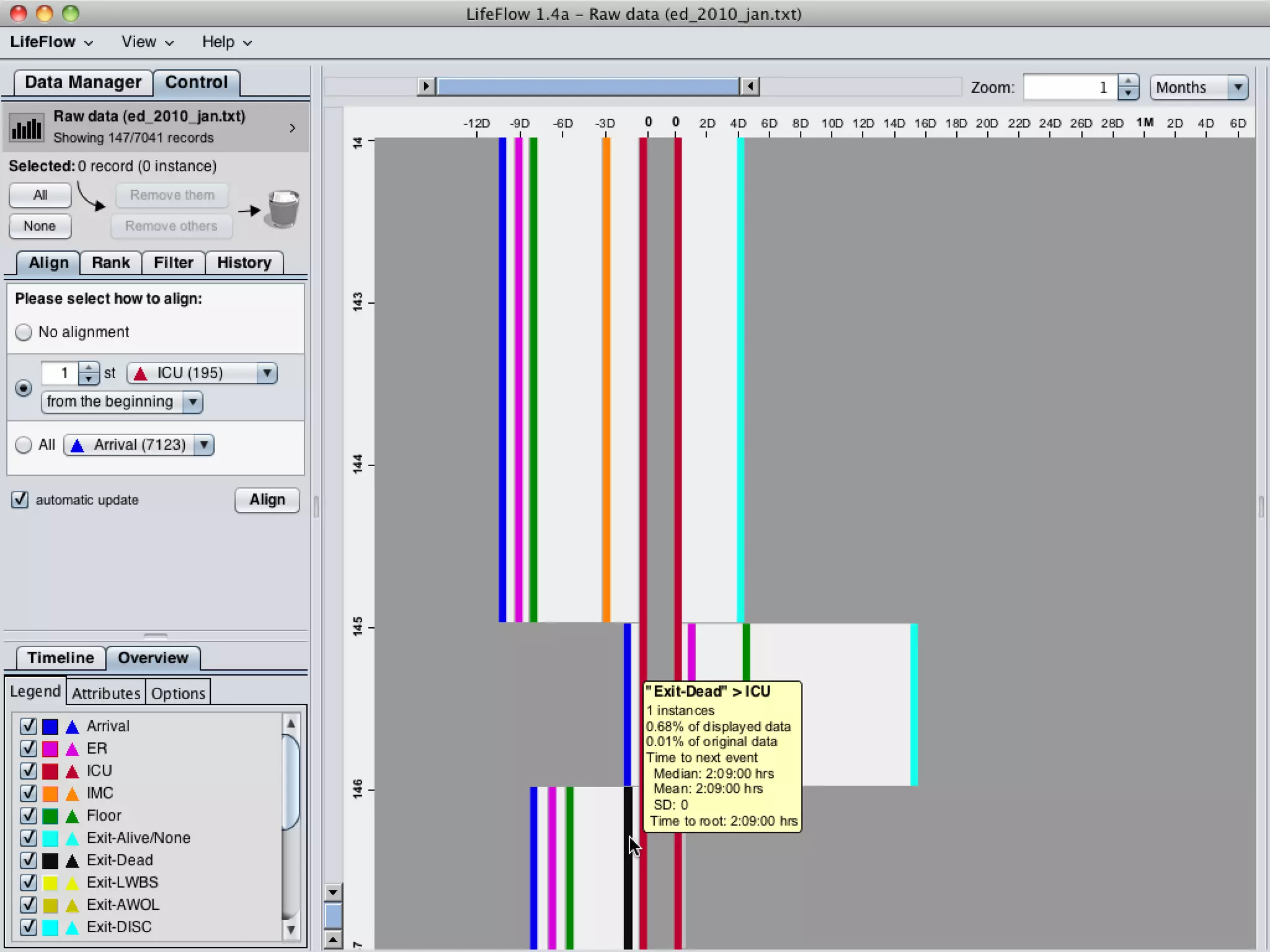
  • #29 So this patient was dead before transferred to the ICU, which is impossible. Of course, this must be problem with data entry. But we may never notice it if the data are hidden in the database. Therefore, you can see that LifeFlow support this kind of analysis by giving overview, showing common trends, providing summary of every sequences, you can do SQL and calculate average for every transfer if you like, but in LifeFlow, it is right there, you just need to move your mouse over. showing every possible transfer pattern and may led you to a discovery of surprising pattern.
  • #42 Live Demonstration