
Influenza Drama 
Premier john 
Secrets Behind Him 
 Let us Start Enjoy 
1
The premier john of the 
drama 
 Pandemics 
 Spanish flue A (H1N1) 1918 
 Asian flue A (H2N2) 1957 
 Hong Kong flue A (H3N3) 1968 
 Russian flue A (H1N1) 1977 
2
What we will speak about 
 Introduction 
 Family orthomyxoviridae 
 Influenza virus 
 Anatomy 
 Naming 
 Zoonosis 
 Transmission to human How? 
3
Influenza Pathogenethis 4 
7 DAYS POST-INFECTION
Influenza life cycle 
Steps 
5
Diagnosis 
 The act of 
professional 
6
Classification 
 Influenza is one of orthomyxoviridae 
 ss(-) RNA virus 
 minus sense single strand RNA virus 
7
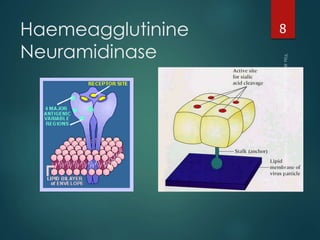
Haemeagglutinine 
Neuramidinase 
8
HA protein - attachment, 
fusion 
 HA 
9 
S S 
S S 
S S 
cell enzymes 
acid pH
anatomy 
 orthomyxoviridae 10 
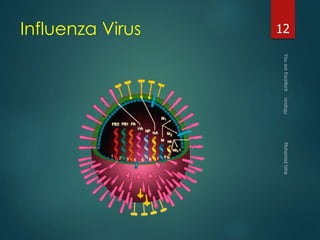
HA - hemagglutinin 
NA - neuraminidase 
helical nucleocapsid (RNA plus 
NP protein) 
lipid bilayer membrane 
polymerase complex 
M1 protein 
type A, B, C : NP, M1 protein 
sub-types: HA or NA protein
ORTHOMYXOVIRUSES 11 
HA - hemagglutinin 
NA - neuraminidase 
helical nucleocapsid (RNA plus 
NP protein) 
lipid bilayer membrane 
polymerase complex 
M1 protein
Influenza Virus 12
pictures 
13
From inside himself 
 infuenza 
14
Human influenza 
15
ORTHOMYXOVIRUSES 16 
 pleomorphic 
 influenza types A,B,C 
 febrile, respiratory 
illness with systemic 
symptoms
Family 
orthomyxoviridae 
 Influenza A B and C 
 Only A and B can cause Human disease 
 Influenza A 
 infect awide variety of mammals 
 And tends undergo antigenic changes 
17
Virus character 
 Enveloped (80-120 nM ) 
 Segmented negative stranded RNA 
 8 segment A and B 
 7 segments c 
 Total genome size average 13.6 
 Average 0.89 – 2.34 kb each segment 
18
type A, B, C : NP, M1 
protein 
sub-types: HA or NA protein 
19 
HA - hemagglutinin 
NA - neuraminidase 
helical nucleocapsid (RNA plus 
NP protein) 
lipid bilayer membrane 
polymerase complex 
M1 protein
Influenza Asubtypes 
 15 hemagglutinine 
 9 Neuraminidase subtypes 
 Subtypes of type A 
 Important for human 
 H1N1 
 H2N2 
20
Antigentic shift drift 
 Antigenic shift 
 Completely new HA subtype 
 Only with influenza A 
 Assocaited with pandemics 
 Antigenic drift 
 Relatively minor subtype changes 
 Influenza A and B 
 EPIDEMIC and regional out break 
21
Influenza virus 
3types 
 Type A 
Associated with widespread epidemic 
Pandemic 
TYPE B infrequently associated with 
regional wide spread epidemic 
Type C 
associated with sporadic cases 
minor localized disease 
22
How to name influenza 
virus 
 Type ABC citystrain#year 
isolatedglycoprotein 
 HA (1-15) 
 NA ( 1-9) 
 eg. AHONG KONG031968H3N3 
 World wide pandemics= pandemic 
 1918-1919 influenza pandemic caused 
 2o million deathes 
 1947 asian influenza 
23
Influenza changes rapidely 
 Antigenic drift 
 substitution in HA and NA 
 This can increase the escape from the 
immune system 
 Antigenic shift assortment of gene 
segment in cells 
 Infected by different strain avian gene 
substituted with human strain gene 
 Swine can replicate both strain 
 This can open up for infection of new host 
 Both make it difficult to obtain good 
vaccine 
24
25 
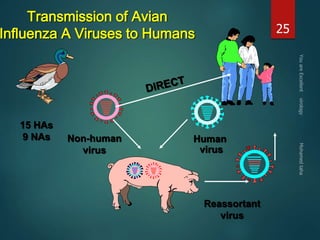
Influenza A Viruses to Humans 
Human 
virus 
Reassortant 
virus 
Transmission of Avian 
Non-human 
virus 
15 HAs 
9 NAs
 where 
26 
where do “new” HA
Timeline of Emergence of 
Influenza Viruses in Humans 
27 
H9 
1998/9 
1918 1957 1968 1977 1997 
2003 
H1 
H1 
B 
H2 
H7 
H5 H5 
Spanish 
Influenza 
Asian 
Influenza 
Russian 
Influenza 
Avian 
Influenza 
Hong Kong 
Influenza 
H3 
Pandemic 
vaccines 
Regular vaccines 
1918
Influenza Virus Types & 
Subtypes in Humans 
(Trivalent Vaccine) 
 Type A 
 Seasonal epidemics caused by H3N2, H1N1, and 
H1N2 subtypes 
 Pandemics (caused by new subtypes) 
 Type B 
 No subtypes 
 Seasonal epidemics only 
28
Timeline of Emergence of 
Influenza Viruses in Humans 
29 
H9 
1998/9 
1918 1957 1968 1977 1997 
2003 
H1 
H1 
B 
H2 
H7 
H5 H5 
Spanish 
Influenza 
Asian 
Influenza 
Russian 
Influenza 
Avian 
Influenza 
Hong Kong 
Influenza 
H3 
Pandemic 
vaccines 
Regular vaccines
Variation 30
cycle 31
History of antigenic shift 32
Shift 33
Antigenc shift = 
34
Reasortment 
35
variation 36
Transmission 37
Influenza pandemics 
 Antigenic shift has occurred at least 3 
times in the past, each time resulting in 
highly lethal pandemics. 
 All three pandemics in the 20th century 
spread world wide within 1 year of 
detection 
 1918 Spanish flu (H1N1) which caused 
the death of 20-40 million people 
 1957 Asian flu (H2N2) 
 1968 Hong Kong flu (H3N2). This 
subtype still circulates today. 
38
Lessons from the past 
 Hospital in 
pandemic 
Photo of the caution taken by officials during 
the influenza epidemic of 1918 
39 
.
isolation 40
41 
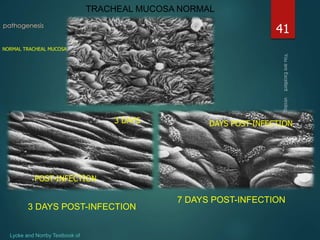
TRACHEAL MUCOSA NORMAL 
7 DAYS POST-INFECTION 
pathogenesis 
NORMAL TRACHEAL MUCOSA 
3 DAYS POST-INFECTION 
Lycke and Norrby Textbook of 
3 DAYS DAYS POST-INFECTION 
POST-INFECTION
changes 
 DECREASED CLEARANCE 
 RISK BACTERIAL INFECTION 
 VIREMIA RARE 
42
43
Diagnosis 
 Avian influenza 
44
Avian influenza 
The highly pathogenic 
form of avian 
influenza A was first 
recognized in Italy in 
1878 
45
Highly pathogenic 
This strain 
46 
It is extremely 
contagious and 
rapidly fatal in 
birds with a mortality 
approaching 100%.
 All outbreaks of the highly pathogenic form of avian 
influenza have been caused by subtypes H5 and H7. 
47
 The virus multiplies in the intestines of these birds and is 
shed in saliva, nasal secretions and feces. 
48
 A single gram of contaminated feces 
contains enough virus to infect 1 
million birds 
 The virus can survive in 
contaminated manure for up to 3 
months and in contaminated water up 
to 30 days. 
 Birds that survive infection excrete 
virus for at least 10 days, orally and 
in feces, thus facilitating further 
spread. 
49
 H5N1 has jumped the species barrier on 2 
separate occasions in the recent past causing 
severe disease in humans. 
 The first documented human infection by H5N1 
occurred in Hong Kong, China in 1997. 
 18 people were hospitalized, 6 died. 
 The entire domestic bird population of Hong 
Kong, 1.5 million birds, was culled in 3 days. 
 Human infection stopped after all chickens were 
culled. 
 Limited human-to-human transmission of H5N1 
was documented. 
50
How do people die? 
 Unlike influenza viruses we are 
more familiar with in which 
respiratory symptoms dominate, 
H5N1 replicates in a wide range 
of cell types 
 This results in severe 
disseminated disease affecting 
multiple organs and causing 
high mortality. 
51
Presentation 
 Patients with documented H5N1 typically present to 
the hospital 2-6 days after the onset of fever and 
cough. 
 Other early symptoms include sore throat, runny 
nose and myalgia's. SOB develops in 1 to 5 days. 
 At admission all patients have clinically apparent 
pneumonia with either patchy or interstitial 
infiltrates. 
 Leukocyte count is normal or decreased, and 
transaminases may be mildly to moderately 
elevated. 
 Patients go on to develop disseminated disease 
affecting multiple organs 
 Secondary bacterial infection has not been a factor 
52
53
There are 2 classes of drugs available that are 
effective against the influenza virus: 
 The M2 inhibitors: amantidine and ramantidine 
 The neuraminidase inhibitors: oseltamivir and 
zaminivir 
In preliminary studies H1M5 has been shown to be 
resistant to the M2 inhibitors 
54
Another interesting bit of information 
 H5N1 infection has been confirmed in a 
single household of domestic cats in 
Thailand. 14 of 15 cats in the household 
died. 
 One dead cat was known to have 
contact with a dead chicken. 
 Up to now, domestic cats were not been 
considered susceptible to infection with 
influenza viruses although some older 
studies from the 1970s reported 
experimental infection of domestic cats 
under laboratory conditions. 
55
Diagnosis 
 The role of profetional 
 How it is down 
 At what level 
56
avian 
 History of high 
mortality 
 Clinical signs 
 nervous signs 
 Diarhae 
 Sudden death 
57
diagnosis 
 PM 
 The respiratory 
digestive system 
 Multiorgans 
affected 
58
Laboratory diagnosis 
 Sample 
 Live bird 
 Tracheal swap 
 Cloacal swap 
 Faeces 
 Dead bird 
 Organs 
 faeces 
59
identification 
 Procedures 
 Inoculation of 9-11day old emryonated 
chicken eggs followed by 
 Haemagglutination immunodiffusion test 
 Confirm presence of influenza virus 
 Subtype determination with nonspecific 
antisera 
 Strain virulence evaluation of 
intravinouspathogencity index (IVPI) in 4-8 
week old chicken 
60
Serology 
 Tests available 
 ELISA Detect antibodies to AI virus 
 Doesn’t distinguish subtypes 
 AGID 
 Agar gel diffusion 
 Both within 1 week of infection 
 HI haemagglutination I inhibition test 
 Serotype specific test 
 Available for each H subtype 
 HI titers are positive a few days later than 
ELISA 
61
Enzyme linked 
immunabsorbant assay (ELISA) 
62 
Sample to be tested 
virus 
capturing antibody 
Enzyme -> colour 
Detecting antibody
Haemagglutination (HA) 63 
virus 
No virus
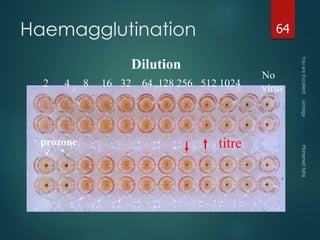
Haemagglutination 64 
Dilution 
2 4 8 16 32 64 128 256 512 
1024 
prozone titre 
No 
virus
immunoflourscent 
 Able to detect 
antibodies to 
 specific 
neuraminidase 
subtype 
65
RT -PCR 
 Reverse transcriptase polymerase chain reaction 
 Able to detect virus at very low level 
 The presence of subtype H5or H& can be 
confirmed BY using H5 or H7 specific primer 
66
Human 
 FEVER 
 HEADACHE 
 MYALGIA 
 COUGH 
 RHINITIS 
 OCULAR SYMPTOMS 
67
Clinical finding 
 SEVERITY 
 VERY YOUNG 
 ELDERLY 
 IMMUNO-COMPROMISED 
 HEART OR LUNG DISEASE 
68
PULMONARY 
COMPLICATIONS 
 CROUP (YOUNG CHILDREN) 
 PRIMARY INFLUENZA VIRUS PNEUMONIA 
 SECONDARY BACTERIAL INFECTION 
 Streptococcus pneumonia 
 Staphylococcus aurous 
 Hemophilius influenzae 
69
MORTALITY 
 MAJOR CAUSES OF INFLUENZA VIRUS- ASSOCIATED 
DEATH 
 BACTERIAL PNEUMONIA 
 CARDIAC FAILURE 
 90% OF DEATHS IN THOSE OVER 65 YEARS OF AGE 
70
DIAGNOSIS 
 ISOLATION 
 NOSE, THROAT SWAB 
 TISSUE CULTURE OR EGGS 
 SEROLOGY 
 RAPID TESTS 
 provisional - clinical picture + outbreak 
71
hours of incubtion 48 
IPA on MDCK cells infected by A/H1N1 
72
Prevention by vaccine 
 inactivated 
 egg grown 
 sub-unit vaccine for children 
 reassortant live vaccine approved 2003 
 for healthy persons (those not at risk for complications from 
influenza infection) ages 5-49 years 
73
Prevention of Influenza 
 Avoid close contact 
with people who 
are sick 
 Stay home when 
you are sick 
 Cover Your Cough 
 Frequent hand 
washing 
 Avoid touching 
eyes, nose or mouth 
 Antiviral drugs 
74
surveillance 75
Drugs preventive 
 RIMANTADINE (M2) 
 type A only 
 AMANTADINE (M2) 
 type A only 
 ZANAMIVIR (NA) 
 types A and B, not yet approved for prevention 
 OSELTAMIVIR (NA) 
 types A and B 
76
Treatment drug 
 RIMANTADINE (M2) 
 type A only, needs to be given early 
 AMANTADINE (M2) 
 type A only, needs to be given early 
 ZANAMIVIR (NA) 
 types A and B, needs to be given early 
 OSELTAMIVIR (NA) 
 types A and B, needs to be given early 
77
Avian influenza vaccine 
 Convential vaccine 
 Inactivated oil emulsion vaccine used 
world wide 
 Recominant vaccine 
 Vector I LT vaccine or pox 
 Heteroglogous vaccine 
 In avian influenza contain the same 
agglutinine 
 Adifferent Neuramindase 
78

Influenza secrets do you know

  • 1.
    Influenza Drama Premierjohn Secrets Behind Him  Let us Start Enjoy 1
  • 2.
    The premier johnof the drama  Pandemics  Spanish flue A (H1N1) 1918  Asian flue A (H2N2) 1957  Hong Kong flue A (H3N3) 1968  Russian flue A (H1N1) 1977 2
  • 3.
    What we willspeak about  Introduction  Family orthomyxoviridae  Influenza virus  Anatomy  Naming  Zoonosis  Transmission to human How? 3
  • 4.
    Influenza Pathogenethis 4 7 DAYS POST-INFECTION
  • 5.
  • 6.
    Diagnosis  Theact of professional 6
  • 7.
    Classification  Influenzais one of orthomyxoviridae  ss(-) RNA virus  minus sense single strand RNA virus 7
  • 8.
  • 9.
    HA protein -attachment, fusion  HA 9 S S S S S S cell enzymes acid pH
  • 10.
    anatomy  orthomyxoviridae10 HA - hemagglutinin NA - neuraminidase helical nucleocapsid (RNA plus NP protein) lipid bilayer membrane polymerase complex M1 protein type A, B, C : NP, M1 protein sub-types: HA or NA protein
  • 11.
    ORTHOMYXOVIRUSES 11 HA- hemagglutinin NA - neuraminidase helical nucleocapsid (RNA plus NP protein) lipid bilayer membrane polymerase complex M1 protein
  • 12.
  • 13.
  • 14.
    From inside himself  infuenza 14
  • 15.
  • 16.
    ORTHOMYXOVIRUSES 16 pleomorphic  influenza types A,B,C  febrile, respiratory illness with systemic symptoms
  • 17.
    Family orthomyxoviridae Influenza A B and C  Only A and B can cause Human disease  Influenza A  infect awide variety of mammals  And tends undergo antigenic changes 17
  • 18.
    Virus character Enveloped (80-120 nM )  Segmented negative stranded RNA  8 segment A and B  7 segments c  Total genome size average 13.6  Average 0.89 – 2.34 kb each segment 18
  • 19.
    type A, B,C : NP, M1 protein sub-types: HA or NA protein 19 HA - hemagglutinin NA - neuraminidase helical nucleocapsid (RNA plus NP protein) lipid bilayer membrane polymerase complex M1 protein
  • 20.
    Influenza Asubtypes 15 hemagglutinine  9 Neuraminidase subtypes  Subtypes of type A  Important for human  H1N1  H2N2 20
  • 21.
    Antigentic shift drift  Antigenic shift  Completely new HA subtype  Only with influenza A  Assocaited with pandemics  Antigenic drift  Relatively minor subtype changes  Influenza A and B  EPIDEMIC and regional out break 21
  • 22.
    Influenza virus 3types  Type A Associated with widespread epidemic Pandemic TYPE B infrequently associated with regional wide spread epidemic Type C associated with sporadic cases minor localized disease 22
  • 23.
    How to nameinfluenza virus  Type ABC citystrain#year isolatedglycoprotein  HA (1-15)  NA ( 1-9)  eg. AHONG KONG031968H3N3  World wide pandemics= pandemic  1918-1919 influenza pandemic caused  2o million deathes  1947 asian influenza 23
  • 24.
    Influenza changes rapidely  Antigenic drift  substitution in HA and NA  This can increase the escape from the immune system  Antigenic shift assortment of gene segment in cells  Infected by different strain avian gene substituted with human strain gene  Swine can replicate both strain  This can open up for infection of new host  Both make it difficult to obtain good vaccine 24
  • 25.
    25 Influenza AViruses to Humans Human virus Reassortant virus Transmission of Avian Non-human virus 15 HAs 9 NAs
  • 26.
     where 26 where do “new” HA
  • 27.
    Timeline of Emergenceof Influenza Viruses in Humans 27 H9 1998/9 1918 1957 1968 1977 1997 2003 H1 H1 B H2 H7 H5 H5 Spanish Influenza Asian Influenza Russian Influenza Avian Influenza Hong Kong Influenza H3 Pandemic vaccines Regular vaccines 1918
  • 28.
    Influenza Virus Types& Subtypes in Humans (Trivalent Vaccine)  Type A  Seasonal epidemics caused by H3N2, H1N1, and H1N2 subtypes  Pandemics (caused by new subtypes)  Type B  No subtypes  Seasonal epidemics only 28
  • 29.
    Timeline of Emergenceof Influenza Viruses in Humans 29 H9 1998/9 1918 1957 1968 1977 1997 2003 H1 H1 B H2 H7 H5 H5 Spanish Influenza Asian Influenza Russian Influenza Avian Influenza Hong Kong Influenza H3 Pandemic vaccines Regular vaccines
  • 30.
  • 31.
  • 32.
  • 33.
  • 34.
  • 35.
  • 36.
  • 37.
  • 38.
    Influenza pandemics Antigenic shift has occurred at least 3 times in the past, each time resulting in highly lethal pandemics.  All three pandemics in the 20th century spread world wide within 1 year of detection  1918 Spanish flu (H1N1) which caused the death of 20-40 million people  1957 Asian flu (H2N2)  1968 Hong Kong flu (H3N2). This subtype still circulates today. 38
  • 39.
    Lessons from thepast  Hospital in pandemic Photo of the caution taken by officials during the influenza epidemic of 1918 39 .
  • 40.
  • 41.
    41 TRACHEAL MUCOSANORMAL 7 DAYS POST-INFECTION pathogenesis NORMAL TRACHEAL MUCOSA 3 DAYS POST-INFECTION Lycke and Norrby Textbook of 3 DAYS DAYS POST-INFECTION POST-INFECTION
  • 42.
    changes  DECREASEDCLEARANCE  RISK BACTERIAL INFECTION  VIREMIA RARE 42
  • 43.
  • 44.
    Diagnosis  Avianinfluenza 44
  • 45.
    Avian influenza Thehighly pathogenic form of avian influenza A was first recognized in Italy in 1878 45
  • 46.
    Highly pathogenic Thisstrain 46 It is extremely contagious and rapidly fatal in birds with a mortality approaching 100%.
  • 47.
     All outbreaksof the highly pathogenic form of avian influenza have been caused by subtypes H5 and H7. 47
  • 48.
     The virusmultiplies in the intestines of these birds and is shed in saliva, nasal secretions and feces. 48
  • 49.
     A singlegram of contaminated feces contains enough virus to infect 1 million birds  The virus can survive in contaminated manure for up to 3 months and in contaminated water up to 30 days.  Birds that survive infection excrete virus for at least 10 days, orally and in feces, thus facilitating further spread. 49
  • 50.
     H5N1 hasjumped the species barrier on 2 separate occasions in the recent past causing severe disease in humans.  The first documented human infection by H5N1 occurred in Hong Kong, China in 1997.  18 people were hospitalized, 6 died.  The entire domestic bird population of Hong Kong, 1.5 million birds, was culled in 3 days.  Human infection stopped after all chickens were culled.  Limited human-to-human transmission of H5N1 was documented. 50
  • 51.
    How do peopledie?  Unlike influenza viruses we are more familiar with in which respiratory symptoms dominate, H5N1 replicates in a wide range of cell types  This results in severe disseminated disease affecting multiple organs and causing high mortality. 51
  • 52.
    Presentation  Patientswith documented H5N1 typically present to the hospital 2-6 days after the onset of fever and cough.  Other early symptoms include sore throat, runny nose and myalgia's. SOB develops in 1 to 5 days.  At admission all patients have clinically apparent pneumonia with either patchy or interstitial infiltrates.  Leukocyte count is normal or decreased, and transaminases may be mildly to moderately elevated.  Patients go on to develop disseminated disease affecting multiple organs  Secondary bacterial infection has not been a factor 52
  • 53.
  • 54.
    There are 2classes of drugs available that are effective against the influenza virus:  The M2 inhibitors: amantidine and ramantidine  The neuraminidase inhibitors: oseltamivir and zaminivir In preliminary studies H1M5 has been shown to be resistant to the M2 inhibitors 54
  • 55.
    Another interesting bitof information  H5N1 infection has been confirmed in a single household of domestic cats in Thailand. 14 of 15 cats in the household died.  One dead cat was known to have contact with a dead chicken.  Up to now, domestic cats were not been considered susceptible to infection with influenza viruses although some older studies from the 1970s reported experimental infection of domestic cats under laboratory conditions. 55
  • 56.
    Diagnosis  Therole of profetional  How it is down  At what level 56
  • 57.
    avian  Historyof high mortality  Clinical signs  nervous signs  Diarhae  Sudden death 57
  • 58.
    diagnosis  PM  The respiratory digestive system  Multiorgans affected 58
  • 59.
    Laboratory diagnosis Sample  Live bird  Tracheal swap  Cloacal swap  Faeces  Dead bird  Organs  faeces 59
  • 60.
    identification  Procedures  Inoculation of 9-11day old emryonated chicken eggs followed by  Haemagglutination immunodiffusion test  Confirm presence of influenza virus  Subtype determination with nonspecific antisera  Strain virulence evaluation of intravinouspathogencity index (IVPI) in 4-8 week old chicken 60
  • 61.
    Serology  Testsavailable  ELISA Detect antibodies to AI virus  Doesn’t distinguish subtypes  AGID  Agar gel diffusion  Both within 1 week of infection  HI haemagglutination I inhibition test  Serotype specific test  Available for each H subtype  HI titers are positive a few days later than ELISA 61
  • 62.
    Enzyme linked immunabsorbantassay (ELISA) 62 Sample to be tested virus capturing antibody Enzyme -> colour Detecting antibody
  • 63.
  • 64.
    Haemagglutination 64 Dilution 2 4 8 16 32 64 128 256 512 1024 prozone titre No virus
  • 65.
    immunoflourscent  Ableto detect antibodies to  specific neuraminidase subtype 65
  • 66.
    RT -PCR Reverse transcriptase polymerase chain reaction  Able to detect virus at very low level  The presence of subtype H5or H& can be confirmed BY using H5 or H7 specific primer 66
  • 67.
    Human  FEVER  HEADACHE  MYALGIA  COUGH  RHINITIS  OCULAR SYMPTOMS 67
  • 68.
    Clinical finding SEVERITY  VERY YOUNG  ELDERLY  IMMUNO-COMPROMISED  HEART OR LUNG DISEASE 68
  • 69.
    PULMONARY COMPLICATIONS CROUP (YOUNG CHILDREN)  PRIMARY INFLUENZA VIRUS PNEUMONIA  SECONDARY BACTERIAL INFECTION  Streptococcus pneumonia  Staphylococcus aurous  Hemophilius influenzae 69
  • 70.
    MORTALITY  MAJORCAUSES OF INFLUENZA VIRUS- ASSOCIATED DEATH  BACTERIAL PNEUMONIA  CARDIAC FAILURE  90% OF DEATHS IN THOSE OVER 65 YEARS OF AGE 70
  • 71.
    DIAGNOSIS  ISOLATION  NOSE, THROAT SWAB  TISSUE CULTURE OR EGGS  SEROLOGY  RAPID TESTS  provisional - clinical picture + outbreak 71
  • 72.
    hours of incubtion48 IPA on MDCK cells infected by A/H1N1 72
  • 73.
    Prevention by vaccine  inactivated  egg grown  sub-unit vaccine for children  reassortant live vaccine approved 2003  for healthy persons (those not at risk for complications from influenza infection) ages 5-49 years 73
  • 74.
    Prevention of Influenza  Avoid close contact with people who are sick  Stay home when you are sick  Cover Your Cough  Frequent hand washing  Avoid touching eyes, nose or mouth  Antiviral drugs 74
  • 75.
  • 76.
    Drugs preventive RIMANTADINE (M2)  type A only  AMANTADINE (M2)  type A only  ZANAMIVIR (NA)  types A and B, not yet approved for prevention  OSELTAMIVIR (NA)  types A and B 76
  • 77.
    Treatment drug RIMANTADINE (M2)  type A only, needs to be given early  AMANTADINE (M2)  type A only, needs to be given early  ZANAMIVIR (NA)  types A and B, needs to be given early  OSELTAMIVIR (NA)  types A and B, needs to be given early 77
  • 78.
    Avian influenza vaccine  Convential vaccine  Inactivated oil emulsion vaccine used world wide  Recominant vaccine  Vector I LT vaccine or pox  Heteroglogous vaccine  In avian influenza contain the same agglutinine  Adifferent Neuramindase 78