E419 – Macro Economics – II
Unit - II: Inflation and Deflation
Types and Causes – Methods of measuring Inflation – Economic Effects of Inflation -
Measures to control Inflation - Anti-inflation Policy – Deflation and its Effects – The
difference between inflationary and deflationary gap - Phillip’s Curve – Rational Expectation
Hypothesis
INFLATION
MEANING OF INFLATION:
In economics, inflation (or price inflation) is a general rise in the price level of an economy
over a period of time. When the general price level rises, each unit of currency buys fewer
goods and services; consequently, inflation reflects a reduction in the purchasing power per
unit of money – a loss of real value in the medium of exchange and unit of account within the
economy.
TYPES OF INFLATION:
There are different types of inflation to get an analysis of distributional and other effects of
inflation. There are mainly four types of inflation. Experts say that demand-pull and cost-
push are more two types of inflation not yet categorized. There are various other types of
inflation like asset inflation and wage inflation.
THE MAIN TYPES OF INFLATION ARE LISTED BELOW BY THEIR SPEED
LEVELS NAMELY:
I. On The Basis of Speed and Intensity
1. Creeping:
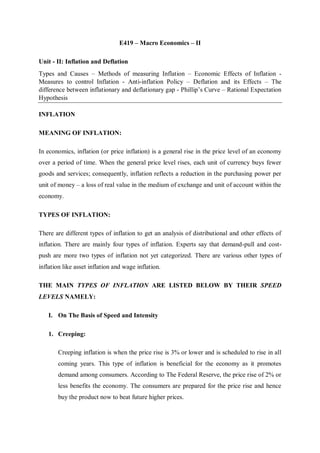
Creeping inflation is when the price rise is 3% or lower and is scheduled to rise in all
coming years. This type of inflation is beneficial for the economy as it promotes
demand among consumers. According to The Federal Reserve, the price rise of 2% or
less benefits the economy. The consumers are prepared for the price rise and hence
buy the product now to beat future higher prices.
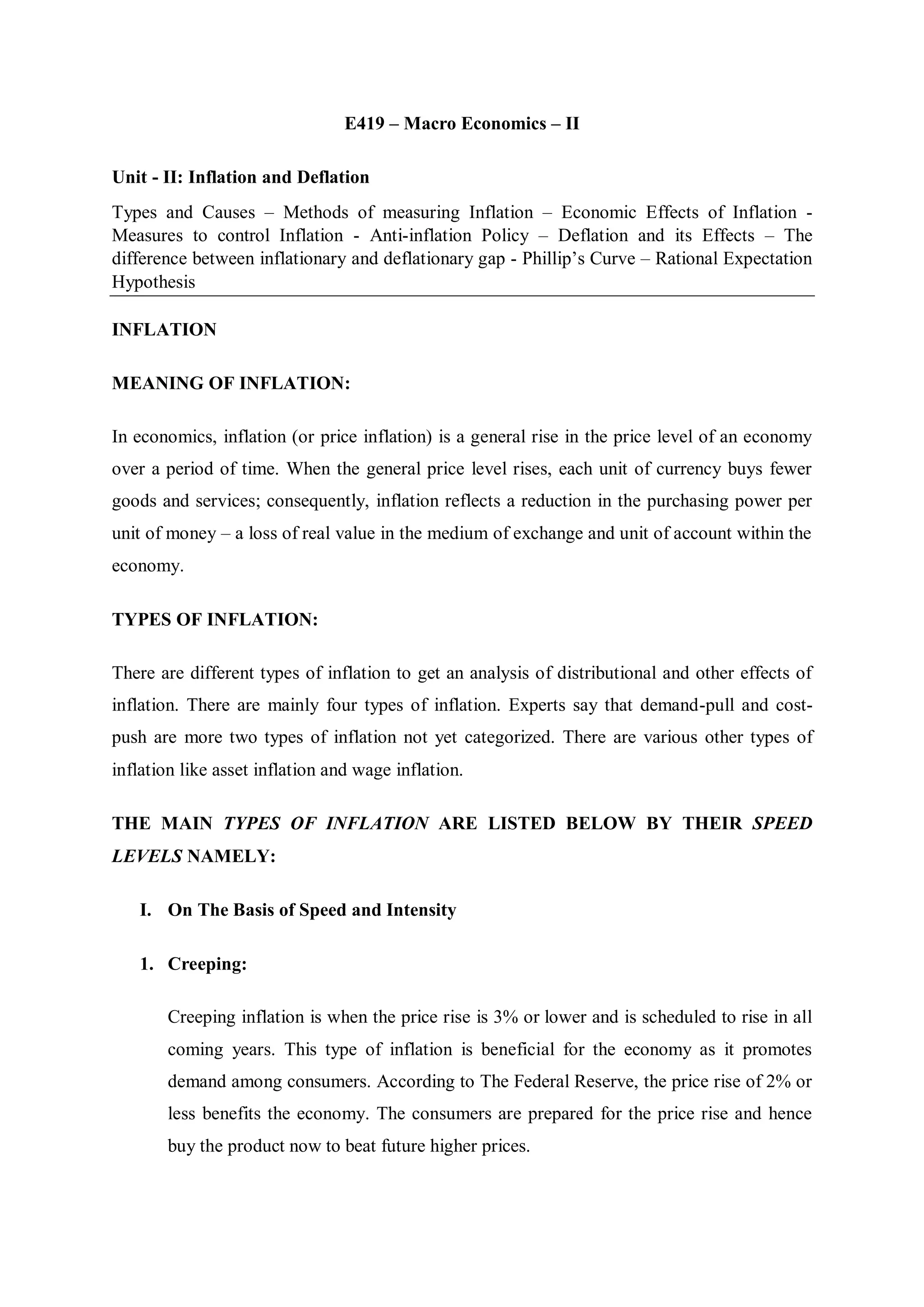
2. Walking:
This inflation is between 3 to 10% a year. This is harmful to the economy as it heats
up the cycle. People are willing to buy more and more to beat future high prices
which affect supply as well. Suppliers can’t keep up the supply drive among people.
3. Galloping:
This inflation rises to 10% or more and is absolute havoc to the economy. Money
loses its value very fast and businesses can’t keep up with cost and prices. Investors
avoid the country, the government loses its credibility, and the economy becomes
unstable. This inflation at any cost should be avoided at any cost.
4. Hyperinflation:
It is when prices skyrocket more than 50% a month and this situation is infrequent.
This usually happens when the government prints money to pay for wars.
II. On The Basis of Causes:
1. Currency Inflation
It is caused by the printing of currency notes.
2. Credit Inflation
Commercial banks sanction loans and advances to people in large numbers when the
economy needs. This situation leads to rising in the price level.
3. Deficit-induced Inflation
When expenditure exceeds revenue, the budget of the government reflects a deficit.
To meet the gap, the government may ask the central bank to print additional money.
Any price rise during this period is called deficit-induced inflation.
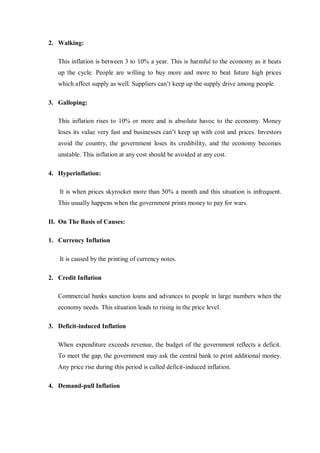
4. Demand-pull Inflation
An increase in demand over available output leads to this type of inflation and leads
to a rise in price. This type of inflation is caused due to an increase in aggregate
demand in the economy.
Causes of Demand-Pull Inflation:
 A growing economy or increase in the supply of money – When consumers
feel confident, they spend more and take on more debt. This leads to a steady
increase in demand, which means higher prices.
 Asset inflation or Increase in Forex reserves– A sudden rise in exports forces a
depreciation of the currencies involved.
 Government spending or Deficit financing by the government – When the
government spends more freely, prices go up.
 Due to fiscal stimulus.
 Increased borrowing.
 Depreciation of rupee.
 Low unemployment rate.
Effects of Demand-Pull Inflation:
 Shortage in supply
 Increase in the prices of the goods (inflation).
 The overall increase in the cost of living.
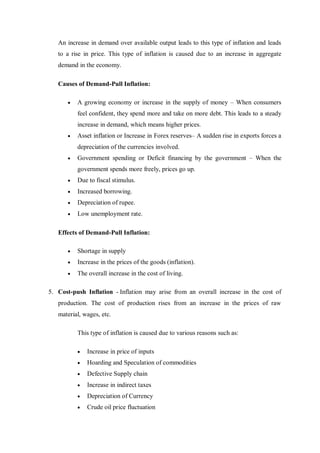
5. Cost-push Inflation - Inflation may arise from an overall increase in the cost of
production. The cost of production rises from an increase in the prices of raw
material, wages, etc.
This type of inflation is caused due to various reasons such as:
 Increase in price of inputs
 Hoarding and Speculation of commodities
 Defective Supply chain
 Increase in indirect taxes
 Depreciation of Currency
 Crude oil price fluctuation
 Defective food supply chain
 Low growth of Agricultural sector
 Food Inflation
 Interest rates increased by RBI
Cost pull inflation is considered bad among the two types of inflation. Because the
National Income is reduced along with the reduction in supply in the Cost-push type
of inflation.
PROS AND CONS OF INFLATION:
Inflation is taken as both positive as well as negative depending upon which side one
takes and how constructively the situation gets managed.
For example, People owning tangible assets would want to sell their assets as they
will get a higher price for the same. This will not go accordingly with the buyer as
they would not want to buy the assets at a higher price.
Pros:
 It enables growth
 Allows adjustment of wages
 It allows adjustment of prices
Cons:
 It creates uncertainty and lowers investment.
 Leads to lower growth and instability
 Reduces international competitiveness
 Leads to recession
 Fall in value of savings.
REMEDIES TO CONTROL INFLATION:
The different remedies to solve issues related to inflation can be stated as:
 Monetary Policy (Contractionary policy)
The monetary policy of the Reserve Bank of India is aimed at managing the quantity of
money in order to meet the requirements of different sectors of the economy and to boost
economic growth.
This contractionary policy is manifested by decreasing bond prices and increasing interest
rates. This helps in reducing expenses during inflation which ultimately helps halt economic
growth and, in turn, the rate of inflation.
 Fiscal Policy
o Monetary policy is often seen separate from fiscal policy which deals with
taxation, spending by government and borrowing. Monetary policy is either
contractionary or expansionary.
o When the total money supply is increased rapidly than normal, it is called an
expansionary policy while a slower increase or even a decrease of the same
refers to a contractionary policy.
o It deals with the Revenue and Expenditure policy of the government.
Tools of fiscal policy
1. Direct Taxes and Indirect taxes – Direct taxes should be increased and indirect taxes
should be reduced.
2. Public Expenditure should be decreased (should borrow less from RBI and more from
other financial institutions)
 Supply Management measures
o Import commodities that are in short supply
o Decrease exports
o Govt may put a check on hoarding and speculation
o Distribution through Public Distribution System (PDS).
METHODS OF MEASURING INFLATION:
1. Wholesale Price Index (WPI) – It is estimated by the Ministry of Commerce &
Industry and measured on a monthly basis.
2. Consumer Price Index (CPI) – It is calculated by taking price changes for each item
in the predetermined lot of goods and averaging them.
3. Producer Price Index – It is a measure of the average change in the selling
prices over time received by domestic producers for their output.
4. Commodity Price Indices – It is a fixed-weight index or (weighted) average of
selected commodity prices, which may be based on spot or futures price
5. Core Price Index – It measures the prices paid by consumers for goods and services
without the volatility caused by movements in food and energy prices. It is a way to
measure the underlying inflation trends.
6. GDP deflator – It is a measure of general price inflation.
EFFECT OF INFLATION ON THE ECONOMY:
The effect of inflation on the economy can be stated as:
 The effect of inflation is not distributed evenly in the economy. There are chances of
hidden costs for different goods and services in the economy.
 Sudden or unpredictable inflation rates are harmful to an overall economy. They lead
to market instability and thereby make it difficult for companies to plan a budget for
the long-term.
 Inflation can act as a drag on productivity as companies are forced to mobilize
resources away from products and services to handle the situations of profit and losses
from inflation.
 Moderate inflation enables labour markets to reach equilibrium at a faster pace.
Anti-inflationary policy to reduce inflation
Anti-inflation policy refers to measures which can counteract inflation.
The need for counteracting inflation arises because its effects exercise great
detrimental influences on the economy of a country.
 Monetary policy – Higher interest rates. This increases the cost of borrowing and
discourages spending. This leads to lower economic growth and lower inflation.
 Tight fiscal policy – Higher income tax and/or lower government spending, will
reduce aggregate demand, leading to lower growth and less demand-pull inflation
 Supply-side policies – These aim to increase long-term competitiveness, e.g.
privatisation and deregulation may help reduce costs of business, leading to lower
inflation.
DEFLATION
MEANING OF DEFLATION:
Inflation is contrasted by deflation, where the purchasing power of money is increased and
prices of commodity decrease.
Deflation is a decrease in the general price level of goods and services in a country. It is the
opposite of inflation, which is when general price levels in a country are rising. In the short-
term, deflation impacts consumers positively because it increases their purchasing power,
allowing them to save more money as their income increases relative to their expenses.
EFFECTS OF DEFLATION:
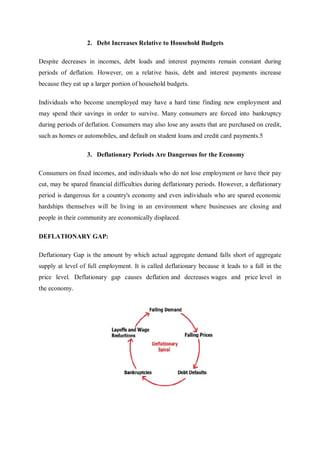
Deflation reduces production of goods and services due to reduction in demand for goods and
services from the consumers. Reduction in production of goods and services leads to reduced
investments, reduction in the salaries of employees, and also increase unemployment. All
these leads to massive reduction in the economic growth of the nation.
1. Deflation Creates Higher Rates of Unemployment
At the beginning of a deflationary period, there is a temporary lull when consumers' income
remains steady while prices decline. Eventually, these falling prices begin to have an impact
on the health of companies. In response to falling revenue, companies are forced to cut pay
and layoff workers. This results in increased unemployment, incomes declining and
consumer confidence decreasing.
When incomes decline and confidence is lowered, consumers decrease their spending. This
creates another situation where companies are pushed to cut their prices in order to sell their
products.
2. Debt Increases Relative to Household Budgets
Despite decreases in incomes, debt loads and interest payments remain constant during
periods of deflation. However, on a relative basis, debt and interest payments increase
because they eat up a larger portion of household budgets.
Individuals who become unemployed may have a hard time finding new employment and
may spend their savings in order to survive. Many consumers are forced into bankruptcy
during periods of deflation. Consumers may also lose any assets that are purchased on credit,
such as homes or automobiles, and default on student loans and credit card payments.5
3. Deflationary Periods Are Dangerous for the Economy
Consumers on fixed incomes, and individuals who do not lose employment or have their pay
cut, may be spared financial difficulties during deflationary periods. However, a deflationary
period is dangerous for a country's economy and even individuals who are spared economic
hardships themselves will be living in an environment where businesses are closing and
people in their community are economically displaced.
DEFLATIONARY GAP:
Deflationary Gap is the amount by which actual aggregate demand falls short of aggregate
supply at level of full employment. It is called deflationary because it leads to a fall in the
price level. Deflationary gap causes deflation and decreases wages and price level in
the economy.
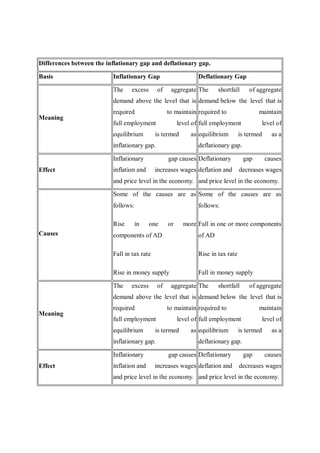
Differences between the inflationary gap and deflationary gap.
Basis Inflationary Gap Deflationary Gap
Meaning
The excess of aggregate
demand above the level that is
required to maintain
full employment level of
equilibrium is termed as
inflationary gap.
The shortfall of aggregate
demand below the level that is
required to maintain
full employment level of
equilibrium is termed as a
deflationary gap.
Effect
Inflationary gap causes
inflation and increases wages
and price level in the economy.
Deflationary gap causes
deflation and decreases wages
and price level in the economy.
Causes
Some of the causes are as
follows:
Rise in one or more
components of AD
Fall in tax rate
Rise in money supply
Some of the causes are as
follows:
Fall in one or more components
of AD
Rise in tax rate
Fall in money supply
Meaning
The excess of aggregate
demand above the level that is
required to maintain
full employment level of
equilibrium is termed as
inflationary gap.
The shortfall of aggregate
demand below the level that is
required to maintain
full employment level of
equilibrium is termed as a
deflationary gap.
Effect
Inflationary gap causes
inflation and increases wages
and price level in the economy.
Deflationary gap causes
deflation and decreases wages
and price level in the economy.
WHAT IS THE PHILLIPS CURVE?
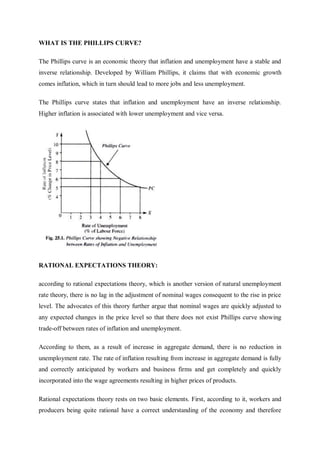
The Phillips curve is an economic theory that inflation and unemployment have a stable and
inverse relationship. Developed by William Phillips, it claims that with economic growth
comes inflation, which in turn should lead to more jobs and less unemployment.
The Phillips curve states that inflation and unemployment have an inverse relationship.
Higher inflation is associated with lower unemployment and vice versa.
RATIONAL EXPECTATIONS THEORY:
according to rational expectations theory, which is another version of natural unemployment
rate theory, there is no lag in the adjustment of nominal wages consequent to the rise in price
level. The advocates of this theory further argue that nominal wages are quickly adjusted to
any expected changes in the price level so that there does not exist Phillips curve showing
trade-off between rates of inflation and unemployment.
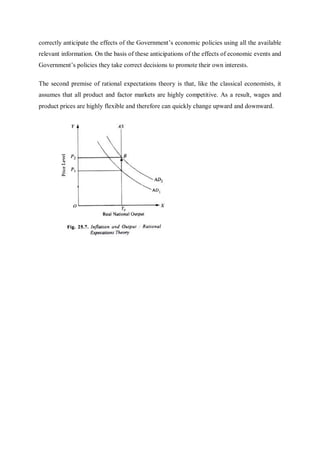
According to them, as a result of increase in aggregate demand, there is no reduction in
unemployment rate. The rate of inflation resulting from increase in aggregate demand is fully
and correctly anticipated by workers and business firms and get completely and quickly
incorporated into the wage agreements resulting in higher prices of products.
Rational expectations theory rests on two basic elements. First, according to it, workers and
producers being quite rational have a correct understanding of the economy and therefore
correctly anticipate the effects of the Government’s economic policies using all the available
relevant information. On the basis of these anticipations of the effects of economic events and
Government’s policies they take correct decisions to promote their own interests.
The second premise of rational expectations theory is that, like the classical economists, it
assumes that all product and factor markets are highly competitive. As a result, wages and
product prices are highly flexible and therefore can quickly change upward and downward.

Unit -2 Inflation and Deflation.pdf Dr.U.Ramesh

  • 1.
    E419 – MacroEconomics – II Unit - II: Inflation and Deflation Types and Causes – Methods of measuring Inflation – Economic Effects of Inflation - Measures to control Inflation - Anti-inflation Policy – Deflation and its Effects – The difference between inflationary and deflationary gap - Phillip’s Curve – Rational Expectation Hypothesis INFLATION MEANING OF INFLATION: In economics, inflation (or price inflation) is a general rise in the price level of an economy over a period of time. When the general price level rises, each unit of currency buys fewer goods and services; consequently, inflation reflects a reduction in the purchasing power per unit of money – a loss of real value in the medium of exchange and unit of account within the economy. TYPES OF INFLATION: There are different types of inflation to get an analysis of distributional and other effects of inflation. There are mainly four types of inflation. Experts say that demand-pull and cost- push are more two types of inflation not yet categorized. There are various other types of inflation like asset inflation and wage inflation. THE MAIN TYPES OF INFLATION ARE LISTED BELOW BY THEIR SPEED LEVELS NAMELY: I. On The Basis of Speed and Intensity 1. Creeping: Creeping inflation is when the price rise is 3% or lower and is scheduled to rise in all coming years. This type of inflation is beneficial for the economy as it promotes demand among consumers. According to The Federal Reserve, the price rise of 2% or less benefits the economy. The consumers are prepared for the price rise and hence buy the product now to beat future higher prices.
  • 2.
    2. Walking: This inflationis between 3 to 10% a year. This is harmful to the economy as it heats up the cycle. People are willing to buy more and more to beat future high prices which affect supply as well. Suppliers can’t keep up the supply drive among people. 3. Galloping: This inflation rises to 10% or more and is absolute havoc to the economy. Money loses its value very fast and businesses can’t keep up with cost and prices. Investors avoid the country, the government loses its credibility, and the economy becomes unstable. This inflation at any cost should be avoided at any cost. 4. Hyperinflation: It is when prices skyrocket more than 50% a month and this situation is infrequent. This usually happens when the government prints money to pay for wars. II. On The Basis of Causes: 1. Currency Inflation It is caused by the printing of currency notes. 2. Credit Inflation Commercial banks sanction loans and advances to people in large numbers when the economy needs. This situation leads to rising in the price level. 3. Deficit-induced Inflation When expenditure exceeds revenue, the budget of the government reflects a deficit. To meet the gap, the government may ask the central bank to print additional money. Any price rise during this period is called deficit-induced inflation. 4. Demand-pull Inflation
  • 3.
    An increase indemand over available output leads to this type of inflation and leads to a rise in price. This type of inflation is caused due to an increase in aggregate demand in the economy. Causes of Demand-Pull Inflation:  A growing economy or increase in the supply of money – When consumers feel confident, they spend more and take on more debt. This leads to a steady increase in demand, which means higher prices.  Asset inflation or Increase in Forex reserves– A sudden rise in exports forces a depreciation of the currencies involved.  Government spending or Deficit financing by the government – When the government spends more freely, prices go up.  Due to fiscal stimulus.  Increased borrowing.  Depreciation of rupee.  Low unemployment rate. Effects of Demand-Pull Inflation:  Shortage in supply  Increase in the prices of the goods (inflation).  The overall increase in the cost of living. 5. Cost-push Inflation - Inflation may arise from an overall increase in the cost of production. The cost of production rises from an increase in the prices of raw material, wages, etc. This type of inflation is caused due to various reasons such as:  Increase in price of inputs  Hoarding and Speculation of commodities  Defective Supply chain  Increase in indirect taxes  Depreciation of Currency  Crude oil price fluctuation
  • 4.
     Defective foodsupply chain  Low growth of Agricultural sector  Food Inflation  Interest rates increased by RBI Cost pull inflation is considered bad among the two types of inflation. Because the National Income is reduced along with the reduction in supply in the Cost-push type of inflation. PROS AND CONS OF INFLATION: Inflation is taken as both positive as well as negative depending upon which side one takes and how constructively the situation gets managed. For example, People owning tangible assets would want to sell their assets as they will get a higher price for the same. This will not go accordingly with the buyer as they would not want to buy the assets at a higher price. Pros:  It enables growth  Allows adjustment of wages  It allows adjustment of prices Cons:  It creates uncertainty and lowers investment.  Leads to lower growth and instability  Reduces international competitiveness  Leads to recession  Fall in value of savings. REMEDIES TO CONTROL INFLATION: The different remedies to solve issues related to inflation can be stated as:  Monetary Policy (Contractionary policy)
  • 5.
    The monetary policyof the Reserve Bank of India is aimed at managing the quantity of money in order to meet the requirements of different sectors of the economy and to boost economic growth. This contractionary policy is manifested by decreasing bond prices and increasing interest rates. This helps in reducing expenses during inflation which ultimately helps halt economic growth and, in turn, the rate of inflation.  Fiscal Policy o Monetary policy is often seen separate from fiscal policy which deals with taxation, spending by government and borrowing. Monetary policy is either contractionary or expansionary. o When the total money supply is increased rapidly than normal, it is called an expansionary policy while a slower increase or even a decrease of the same refers to a contractionary policy. o It deals with the Revenue and Expenditure policy of the government. Tools of fiscal policy 1. Direct Taxes and Indirect taxes – Direct taxes should be increased and indirect taxes should be reduced. 2. Public Expenditure should be decreased (should borrow less from RBI and more from other financial institutions)  Supply Management measures o Import commodities that are in short supply o Decrease exports o Govt may put a check on hoarding and speculation o Distribution through Public Distribution System (PDS). METHODS OF MEASURING INFLATION: 1. Wholesale Price Index (WPI) – It is estimated by the Ministry of Commerce & Industry and measured on a monthly basis. 2. Consumer Price Index (CPI) – It is calculated by taking price changes for each item in the predetermined lot of goods and averaging them.
  • 6.
    3. Producer PriceIndex – It is a measure of the average change in the selling prices over time received by domestic producers for their output. 4. Commodity Price Indices – It is a fixed-weight index or (weighted) average of selected commodity prices, which may be based on spot or futures price 5. Core Price Index – It measures the prices paid by consumers for goods and services without the volatility caused by movements in food and energy prices. It is a way to measure the underlying inflation trends. 6. GDP deflator – It is a measure of general price inflation. EFFECT OF INFLATION ON THE ECONOMY: The effect of inflation on the economy can be stated as:  The effect of inflation is not distributed evenly in the economy. There are chances of hidden costs for different goods and services in the economy.  Sudden or unpredictable inflation rates are harmful to an overall economy. They lead to market instability and thereby make it difficult for companies to plan a budget for the long-term.  Inflation can act as a drag on productivity as companies are forced to mobilize resources away from products and services to handle the situations of profit and losses from inflation.  Moderate inflation enables labour markets to reach equilibrium at a faster pace. Anti-inflationary policy to reduce inflation Anti-inflation policy refers to measures which can counteract inflation. The need for counteracting inflation arises because its effects exercise great detrimental influences on the economy of a country.  Monetary policy – Higher interest rates. This increases the cost of borrowing and discourages spending. This leads to lower economic growth and lower inflation.  Tight fiscal policy – Higher income tax and/or lower government spending, will reduce aggregate demand, leading to lower growth and less demand-pull inflation
  • 7.
     Supply-side policies– These aim to increase long-term competitiveness, e.g. privatisation and deregulation may help reduce costs of business, leading to lower inflation. DEFLATION MEANING OF DEFLATION: Inflation is contrasted by deflation, where the purchasing power of money is increased and prices of commodity decrease. Deflation is a decrease in the general price level of goods and services in a country. It is the opposite of inflation, which is when general price levels in a country are rising. In the short- term, deflation impacts consumers positively because it increases their purchasing power, allowing them to save more money as their income increases relative to their expenses. EFFECTS OF DEFLATION: Deflation reduces production of goods and services due to reduction in demand for goods and services from the consumers. Reduction in production of goods and services leads to reduced investments, reduction in the salaries of employees, and also increase unemployment. All these leads to massive reduction in the economic growth of the nation. 1. Deflation Creates Higher Rates of Unemployment At the beginning of a deflationary period, there is a temporary lull when consumers' income remains steady while prices decline. Eventually, these falling prices begin to have an impact on the health of companies. In response to falling revenue, companies are forced to cut pay and layoff workers. This results in increased unemployment, incomes declining and consumer confidence decreasing. When incomes decline and confidence is lowered, consumers decrease their spending. This creates another situation where companies are pushed to cut their prices in order to sell their products.
  • 8.
    2. Debt IncreasesRelative to Household Budgets Despite decreases in incomes, debt loads and interest payments remain constant during periods of deflation. However, on a relative basis, debt and interest payments increase because they eat up a larger portion of household budgets. Individuals who become unemployed may have a hard time finding new employment and may spend their savings in order to survive. Many consumers are forced into bankruptcy during periods of deflation. Consumers may also lose any assets that are purchased on credit, such as homes or automobiles, and default on student loans and credit card payments.5 3. Deflationary Periods Are Dangerous for the Economy Consumers on fixed incomes, and individuals who do not lose employment or have their pay cut, may be spared financial difficulties during deflationary periods. However, a deflationary period is dangerous for a country's economy and even individuals who are spared economic hardships themselves will be living in an environment where businesses are closing and people in their community are economically displaced. DEFLATIONARY GAP: Deflationary Gap is the amount by which actual aggregate demand falls short of aggregate supply at level of full employment. It is called deflationary because it leads to a fall in the price level. Deflationary gap causes deflation and decreases wages and price level in the economy.
  • 9.
    Differences between theinflationary gap and deflationary gap. Basis Inflationary Gap Deflationary Gap Meaning The excess of aggregate demand above the level that is required to maintain full employment level of equilibrium is termed as inflationary gap. The shortfall of aggregate demand below the level that is required to maintain full employment level of equilibrium is termed as a deflationary gap. Effect Inflationary gap causes inflation and increases wages and price level in the economy. Deflationary gap causes deflation and decreases wages and price level in the economy. Causes Some of the causes are as follows: Rise in one or more components of AD Fall in tax rate Rise in money supply Some of the causes are as follows: Fall in one or more components of AD Rise in tax rate Fall in money supply Meaning The excess of aggregate demand above the level that is required to maintain full employment level of equilibrium is termed as inflationary gap. The shortfall of aggregate demand below the level that is required to maintain full employment level of equilibrium is termed as a deflationary gap. Effect Inflationary gap causes inflation and increases wages and price level in the economy. Deflationary gap causes deflation and decreases wages and price level in the economy.
  • 10.
    WHAT IS THEPHILLIPS CURVE? The Phillips curve is an economic theory that inflation and unemployment have a stable and inverse relationship. Developed by William Phillips, it claims that with economic growth comes inflation, which in turn should lead to more jobs and less unemployment. The Phillips curve states that inflation and unemployment have an inverse relationship. Higher inflation is associated with lower unemployment and vice versa. RATIONAL EXPECTATIONS THEORY: according to rational expectations theory, which is another version of natural unemployment rate theory, there is no lag in the adjustment of nominal wages consequent to the rise in price level. The advocates of this theory further argue that nominal wages are quickly adjusted to any expected changes in the price level so that there does not exist Phillips curve showing trade-off between rates of inflation and unemployment. According to them, as a result of increase in aggregate demand, there is no reduction in unemployment rate. The rate of inflation resulting from increase in aggregate demand is fully and correctly anticipated by workers and business firms and get completely and quickly incorporated into the wage agreements resulting in higher prices of products. Rational expectations theory rests on two basic elements. First, according to it, workers and producers being quite rational have a correct understanding of the economy and therefore
  • 11.
    correctly anticipate theeffects of the Government’s economic policies using all the available relevant information. On the basis of these anticipations of the effects of economic events and Government’s policies they take correct decisions to promote their own interests. The second premise of rational expectations theory is that, like the classical economists, it assumes that all product and factor markets are highly competitive. As a result, wages and product prices are highly flexible and therefore can quickly change upward and downward.