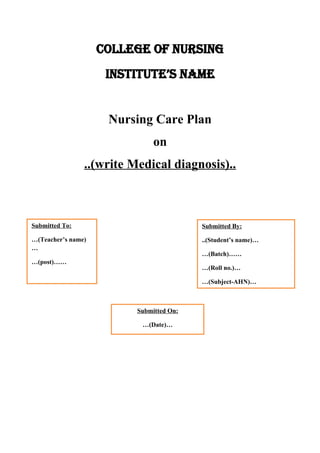
COLLEGE OF NURSING
Institute’s name
Nursing Care Plan
on
..(write Medical diagnosis)..
Submitted To:
…(Teacher’s name)
…
…(post)……
Submitted By:
..(Student’s name)…
…(Batch)……
…(Roll no.)…
…(Subject-AHN)…
Submitted On:
…(Date)…
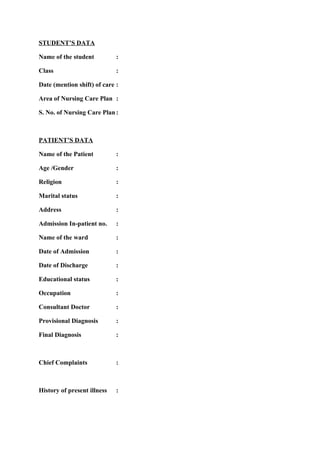
STUDENT’S DATA
Name of the student :
Class :
Date (mention shift) of care :
Area of Nursing Care Plan :
S. No. of Nursing Care Plan:
PATIENT’S DATA
Name of the Patient :
Age /Gender :
Religion :
Marital status :
Address :
Admission In-patient no. :
Name of the ward :
Date of Admission :
Date of Discharge :
Educational status :
Occupation :
Consultant Doctor :
Provisional Diagnosis :
Final Diagnosis :
Chief Complaints :
History of present illness :
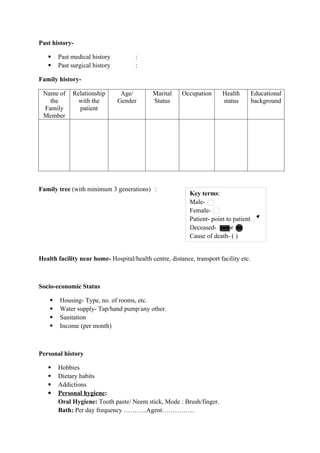
Past history-
 Past medical history :
 Past surgical history :
Family history-
Name of
the
Family
Member
Relationship
with the
patient
Age/
Gender
Marital
Status
Occupation Health
status
Educational
background
Family tree (with minimum 3 generations) :
Health facility near home- Hospital/health centre, distance, transport facility etc.
Socio-economic Status
 Housing- Type, no. of rooms, etc.
 Water supply- Tap/hand pump/any other.
 Sanitation
 Income (per month)
Personal history
 Hobbies
 Dietary habits
 Addictions
 Personal hygiene:
Oral Hygiene: Tooth paste/ Neem stick, Mode : Brush/finger.
Bath: Per day frequency ………..Agent……………
Key terms:
Male-
Female-
Patient- point to patient
Deceased- or
Cause of death- ( )
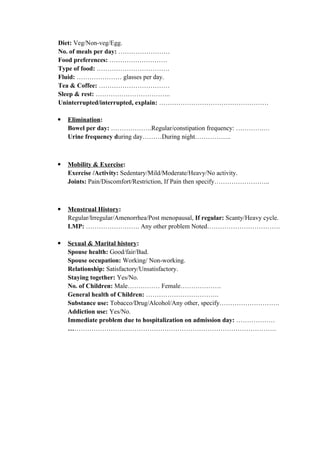
Diet: Veg/Non-veg/Egg.
No. of meals per day: ……………………
Food preferences: ………………………
Type of food: …………………………….
Fluid: ………………… glasses per day.
Tea & Coffee: ……………………………
Sleep & rest: ……………………………..
Uninterrupted/interrupted, explain: ……………………………………………
 Elimination:
Bowel per day: ……………….Regular/constipation frequency: ………….…
Urine frequency during day………During night……………..
 Mobility & Exercise:
Exercise /Activity: Sedentary/Mild/Moderate/Heavy/No activity.
Joints: Pain/Discomfort/Restriction, If Pain then specify……………………..
 Menstrual History:
Regular/Irregular/Amenorrhea/Post menopausal, If regular: Scanty/Heavy cycle.
LMP: ……………………. Any other problem Noted…………………………….
 Sexual & Marital history:
Spouse health: Good/fair/Bad.
Spouse occupation: Working/ Non-working.
Relationship: Satisfactory/Unsatisfactory.
Staying together: Yes/No.
No. of Children: Male…………… Female……………….
General health of Children: …………………………….
Substance use: Tobacco/Drug/Alcohol/Any other, specify……………………….
Addiction use: Yes/No.
Immediate problem due to hospitalization on admission day: ………………
…………………………………………………………………………………….
PHYSICAL ASSESSMENT
General appearance & behavior:
 Gender-
 Body built-
 Posture-
 Gait-
 Hygiene-
 Grooming-
 Nutritional status-
 Level of consciousness-
 Speech & Orientation-
 Weight-
 Height (in c.m.)-
Head to foot examination:
 Head
Scalp:
Hair distribution & characteristics:
Any other abnormality:
 Eye
Eyebrows:
Eyelids:
Eyelashes:
Sclera:
Conjunctiva:
Pupil:
Vision:
Any other abnormality:
 Ears
Hearing:
Discharges:
Pain:
Cerumen:
Any other abnormality:
 Mouth
Lips:
Teeth:
Gums:
Tongue:
Any other abnormality:
 Throat
Inflammation:
Any other abnormality:
 Neck
Inspection:
Palpation:
 Chest
Inspection:
Shape……………… Symmetry……………….
Skin color………………..Nipple……………….
Palpation:
Mass palpated…………… Axillary lymph nodes…………………
Discharge from nipple……………………
 Abdomen
Color:
Skin texture:
Distention:
Tenderness:
Visible movement:
Any other abnormality:
 Back
Color:
Lesion:
Shape of vertebral column:
Any other abnormality:
 Extremities
Symmetry:
Color:
Muscle strength & tone:
Any other abnormality:
Systemic Examination:
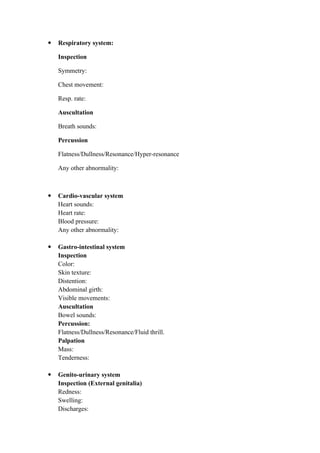
 Respiratory system:
Inspection
Symmetry:
Chest movement:
Resp. rate:
Auscultation
Breath sounds:
Percussion
Flatness/Dullness/Resonance/Hyper-resonance
Any other abnormality:
 Cardio-vascular system
Heart sounds:
Heart rate:
Blood pressure:
Any other abnormality:
 Gastro-intestinal system
Inspection
Color:
Skin texture:
Distention:
Abdominal girth:
Visible movements:
Auscultation
Bowel sounds:
Percussion:
Flatness/Dullness/Resonance/Fluid thrill.
Palpation
Mass:
Tenderness:
 Genito-urinary system
Inspection (External genitalia)
Redness:
Swelling:
Discharges:
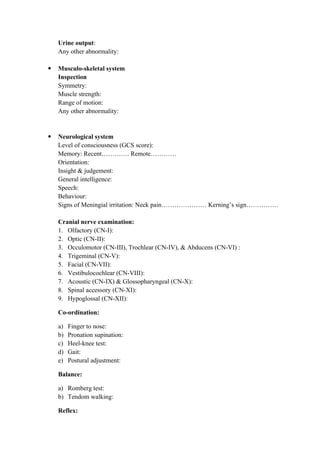
Urine output:
Any other abnormality:
 Musculo-skeletal system
Inspection
Symmetry:
Muscle strength:
Range of motion:
Any other abnormality:
 Neurological system
Level of consciousness (GCS score):
Memory: Recent…………. Remote…………
Orientation:
Insight & judgement:
General intelligence:
Speech:
Behaviour:
Signs of Meningial irritation: Neck pain………………… Kerning’s sign……………
Cranial nerve examination:
1. Olfactory (CN-I):
2. Optic (CN-II):
3. Occulomotor (CN-III), Trochlear (CN-IV), & Abducens (CN-VI) :
4. Trigeminal (CN-V):
5. Facial (CN-VII):
6. Vestibulocochlear (CN-VIII):
7. Acoustic (CN-IX) & Glossopharyngeal (CN-X):
8. Spinal accessory (CN-XI):
9. Hypoglossal (CN-XII):
Co-ordination:
a) Finger to nose:
b) Pronation supination:
c) Heel-knee test:
d) Gait:
e) Postural adjustment:
Balance:
a) Romberg test:
b) Tendom walking:
Reflex:
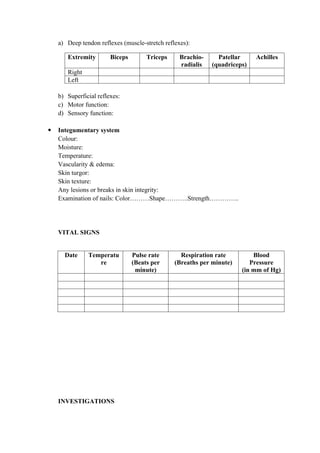
a) Deep tendon reflexes (muscle-stretch reflexes):
Extremity Biceps Triceps Brachio-
radialis
Patellar
(quadriceps)
Achilles
Right
Left
b) Superficial reflexes:
c) Motor function:
d) Sensory function:
 Integumentary system
Colour:
Moisture:
Temperature:
Vascularity & edema:
Skin turgor:
Skin texture:
Any lesions or breaks in skin integrity:
Examination of nails: Color………Shape………..Strength…………..
VITAL SIGNS
Date Temperatu
re
Pulse rate
(Beats per
minute)
Respiration rate
(Breaths per minute)
Blood
Pressure
(in mm of Hg)
INVESTIGATIONS
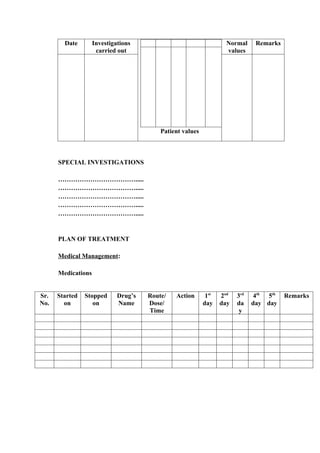
Date Investigations
carried out
Patient values
Normal
values
Remarks
SPECIAL INVESTIGATIONS
……………………………….....
……………………………….....
……………………………….....
……………………………….....
……………………………….....
PLAN OF TREATMENT
Medical Management:
Medications
Sr.
No.
Started
on
Stopped
on
Drug’s
Name
Route/
Dose/
Time
Action 1st
day
2nd
day
3rd
da
y
4th
day
5th
day
Remarks
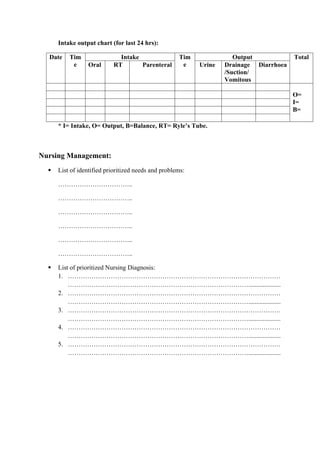
Intake output chart (for last 24 hrs):
Date Tim
e
Intake Tim
e
Output Total
Oral RT Parenteral Urine Drainage
/Suction/
Vomitous
Diarrhoea
O=
I=
B=
* I= Intake, O= Output, B=Balance, RT= Ryle’s Tube.
Nursing Management:
 List of identified prioritized needs and problems:
……………………………..
……………………………..
……………………………..
……………………………..
……………………………..
……………………………..
 List of prioritized Nursing Diagnosis:
1. ………………………………………………………………………………………
…………………………………………………………………………....................
2. ………………………………………………………………………………………
…………………………………………………………………………....................
3. ………………………………………………………………………………………
…………………………………………………………………………....................
4. ………………………………………………………………………………………
…………………………………………………………………………....................
5. ………………………………………………………………………………………
…………………………………………………………………………....................
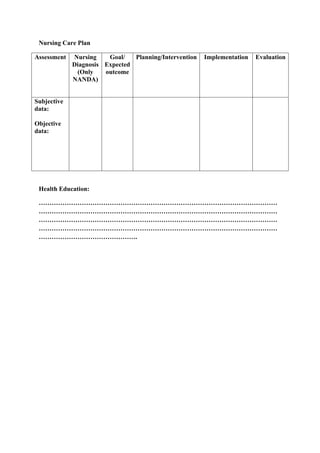
Nursing Care Plan
Assessment Nursing
Diagnosis
(Only
NANDA)
Goal/
Expected
outcome
Planning/Intervention Implementation Evaluation
Subjective
data:
Objective
data:
Health Education:
…………………………………………………………………………………………………
…………………………………………………………………………………………………
…………………………………………………………………………………………………
…………………………………………………………………………………………………
……………………………………….
Format for Nursing Care Plan for Nursing Students.docx

  • 1.
    COLLEGE OF NURSING Institute’sname Nursing Care Plan on ..(write Medical diagnosis).. Submitted To: …(Teacher’s name) … …(post)…… Submitted By: ..(Student’s name)… …(Batch)…… …(Roll no.)… …(Subject-AHN)… Submitted On: …(Date)…
  • 2.
    STUDENT’S DATA Name ofthe student : Class : Date (mention shift) of care : Area of Nursing Care Plan : S. No. of Nursing Care Plan: PATIENT’S DATA Name of the Patient : Age /Gender : Religion : Marital status : Address : Admission In-patient no. : Name of the ward : Date of Admission : Date of Discharge : Educational status : Occupation : Consultant Doctor : Provisional Diagnosis : Final Diagnosis : Chief Complaints : History of present illness :
  • 3.
    Past history-  Pastmedical history :  Past surgical history : Family history- Name of the Family Member Relationship with the patient Age/ Gender Marital Status Occupation Health status Educational background Family tree (with minimum 3 generations) : Health facility near home- Hospital/health centre, distance, transport facility etc. Socio-economic Status  Housing- Type, no. of rooms, etc.  Water supply- Tap/hand pump/any other.  Sanitation  Income (per month) Personal history  Hobbies  Dietary habits  Addictions  Personal hygiene: Oral Hygiene: Tooth paste/ Neem stick, Mode : Brush/finger. Bath: Per day frequency ………..Agent…………… Key terms: Male- Female- Patient- point to patient Deceased- or Cause of death- ( )
  • 4.
    Diet: Veg/Non-veg/Egg. No. ofmeals per day: …………………… Food preferences: ……………………… Type of food: ……………………………. Fluid: ………………… glasses per day. Tea & Coffee: …………………………… Sleep & rest: …………………………….. Uninterrupted/interrupted, explain: ……………………………………………  Elimination: Bowel per day: ……………….Regular/constipation frequency: ………….… Urine frequency during day………During night……………..  Mobility & Exercise: Exercise /Activity: Sedentary/Mild/Moderate/Heavy/No activity. Joints: Pain/Discomfort/Restriction, If Pain then specify……………………..  Menstrual History: Regular/Irregular/Amenorrhea/Post menopausal, If regular: Scanty/Heavy cycle. LMP: ……………………. Any other problem Noted…………………………….  Sexual & Marital history: Spouse health: Good/fair/Bad. Spouse occupation: Working/ Non-working. Relationship: Satisfactory/Unsatisfactory. Staying together: Yes/No. No. of Children: Male…………… Female………………. General health of Children: ……………………………. Substance use: Tobacco/Drug/Alcohol/Any other, specify………………………. Addiction use: Yes/No. Immediate problem due to hospitalization on admission day: ……………… …………………………………………………………………………………….
  • 5.
    PHYSICAL ASSESSMENT General appearance& behavior:  Gender-  Body built-  Posture-  Gait-  Hygiene-  Grooming-  Nutritional status-  Level of consciousness-  Speech & Orientation-  Weight-  Height (in c.m.)- Head to foot examination:  Head Scalp: Hair distribution & characteristics: Any other abnormality:  Eye Eyebrows: Eyelids: Eyelashes: Sclera: Conjunctiva: Pupil: Vision: Any other abnormality:  Ears Hearing: Discharges: Pain: Cerumen: Any other abnormality:  Mouth Lips: Teeth: Gums: Tongue:
  • 6.
    Any other abnormality: Throat Inflammation: Any other abnormality:  Neck Inspection: Palpation:  Chest Inspection: Shape……………… Symmetry………………. Skin color………………..Nipple………………. Palpation: Mass palpated…………… Axillary lymph nodes………………… Discharge from nipple……………………  Abdomen Color: Skin texture: Distention: Tenderness: Visible movement: Any other abnormality:  Back Color: Lesion: Shape of vertebral column: Any other abnormality:  Extremities Symmetry: Color: Muscle strength & tone: Any other abnormality: Systemic Examination:
  • 7.
     Respiratory system: Inspection Symmetry: Chestmovement: Resp. rate: Auscultation Breath sounds: Percussion Flatness/Dullness/Resonance/Hyper-resonance Any other abnormality:  Cardio-vascular system Heart sounds: Heart rate: Blood pressure: Any other abnormality:  Gastro-intestinal system Inspection Color: Skin texture: Distention: Abdominal girth: Visible movements: Auscultation Bowel sounds: Percussion: Flatness/Dullness/Resonance/Fluid thrill. Palpation Mass: Tenderness:  Genito-urinary system Inspection (External genitalia) Redness: Swelling: Discharges:
  • 8.
    Urine output: Any otherabnormality:  Musculo-skeletal system Inspection Symmetry: Muscle strength: Range of motion: Any other abnormality:  Neurological system Level of consciousness (GCS score): Memory: Recent…………. Remote………… Orientation: Insight & judgement: General intelligence: Speech: Behaviour: Signs of Meningial irritation: Neck pain………………… Kerning’s sign…………… Cranial nerve examination: 1. Olfactory (CN-I): 2. Optic (CN-II): 3. Occulomotor (CN-III), Trochlear (CN-IV), & Abducens (CN-VI) : 4. Trigeminal (CN-V): 5. Facial (CN-VII): 6. Vestibulocochlear (CN-VIII): 7. Acoustic (CN-IX) & Glossopharyngeal (CN-X): 8. Spinal accessory (CN-XI): 9. Hypoglossal (CN-XII): Co-ordination: a) Finger to nose: b) Pronation supination: c) Heel-knee test: d) Gait: e) Postural adjustment: Balance: a) Romberg test: b) Tendom walking: Reflex:
  • 9.
    a) Deep tendonreflexes (muscle-stretch reflexes): Extremity Biceps Triceps Brachio- radialis Patellar (quadriceps) Achilles Right Left b) Superficial reflexes: c) Motor function: d) Sensory function:  Integumentary system Colour: Moisture: Temperature: Vascularity & edema: Skin turgor: Skin texture: Any lesions or breaks in skin integrity: Examination of nails: Color………Shape………..Strength………….. VITAL SIGNS Date Temperatu re Pulse rate (Beats per minute) Respiration rate (Breaths per minute) Blood Pressure (in mm of Hg) INVESTIGATIONS
  • 10.
    Date Investigations carried out Patientvalues Normal values Remarks SPECIAL INVESTIGATIONS ………………………………..... ………………………………..... ………………………………..... ………………………………..... ………………………………..... PLAN OF TREATMENT Medical Management: Medications Sr. No. Started on Stopped on Drug’s Name Route/ Dose/ Time Action 1st day 2nd day 3rd da y 4th day 5th day Remarks
  • 11.
    Intake output chart(for last 24 hrs): Date Tim e Intake Tim e Output Total Oral RT Parenteral Urine Drainage /Suction/ Vomitous Diarrhoea O= I= B= * I= Intake, O= Output, B=Balance, RT= Ryle’s Tube. Nursing Management:  List of identified prioritized needs and problems: …………………………….. …………………………….. …………………………….. …………………………….. …………………………….. ……………………………..  List of prioritized Nursing Diagnosis: 1. ……………………………………………………………………………………… ………………………………………………………………………….................... 2. ……………………………………………………………………………………… ………………………………………………………………………….................... 3. ……………………………………………………………………………………… ………………………………………………………………………….................... 4. ……………………………………………………………………………………… ………………………………………………………………………….................... 5. ……………………………………………………………………………………… …………………………………………………………………………....................
  • 12.
    Nursing Care Plan AssessmentNursing Diagnosis (Only NANDA) Goal/ Expected outcome Planning/Intervention Implementation Evaluation Subjective data: Objective data: Health Education: ………………………………………………………………………………………………… ………………………………………………………………………………………………… ………………………………………………………………………………………………… ………………………………………………………………………………………………… ……………………………………….