TYPES OF INFERTILITY
Thereare two types of infertility.
Primary infertility: Primary infertility denotes couples who
have never been able to conceive.
Secondary infertility: Secondary infertility individual and
couple has conceived in the past but is now unable to
conceived again
4.
CAUSES IN MEN
•Low sperm count
• Low sperm mobility
• Abnormal sperm
• Genetic factors
• Hypospadias
• Radiation therapy
• Ejaculatory problem
5.
Cause in female
•Advance age
• Smoking
• Alcohal
• Obses or overweight
• Eating disorder
• Diet
• Sexually transmitted
infection
Exposure to some chemical
Mental stress
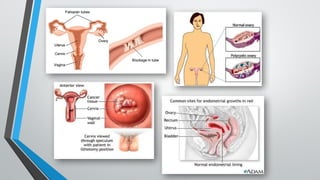
Pcos polycystic ovarian
syndrome
Poor egg quality
Problem in cervix
Tube block
7.
RISK FACTORS
Male
- Drugs
-Tobacco
-Healthproblems
-Radiation/Chemotherapy
-Age
-Enviromental factors
Female
• Age
• Stress
• Poor diet
• Over/underweight
• Tobacco
• STD’s
• Health problems
8.
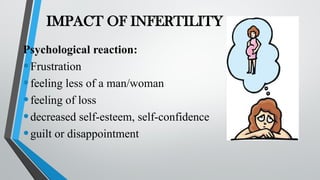
IMPACT OF INFERTILITY
Psychologicalreaction:
•Frustration
•feeling less of a man/woman
•feeling of loss
•decreased self-esteem, self-confidence
•guilt or disappointment
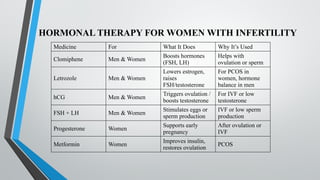
Medicine For WhatIt Does Why It’s Used
Clomiphene Men & Women
Boosts hormones
(FSH, LH)
Helps with
ovulation or sperm
Letrozole Men & Women
Lowers estrogen,
raises
FSH/testosterone
For PCOS in
women, hormone
balance in men
hCG Men & Women
Triggers ovulation /
boosts testosterone
For IVF or low
testosterone
FSH + LH Men & Women
Stimulates eggs or
sperm production
IVF or low sperm
production
Progesterone Women
Supports early
pregnancy
After ovulation or
IVF
Metformin Women
Improves insulin,
restores ovulation
PCOS
HORMONAL THERAPY FOR WOMEN WITH INFERTILITY
14.
ASSISTED REPRODUCTIVE TECHNIQUES
ART(Assisted reproductive technology) procedures
involves surgically removing eggs from woman ovaries,
combining them with sperm in the laboratory and
returning them to the woman's body.
15.
Indication of ART
1.Abnormal fallopian tubes : blocked tube or absent
tube.
2. unexplained infertility
3. Male sub fertility (sperm count less)
4. Immunologic infertility
5. Severe Oligospermia. (low sperm count in semen.)
6. Azoospermia. (absence of sperm)
16.
TYPES OFART PROCEDURE
1. Fertility Medication
2. In vitro fertilization and embryo transfer
3. Zygote intrafallopian transfer
4. Gamete intrafallopian transfer
5. Intracytoplasmic sperm injection
IN VITRO FERTILIZATION(IVF)
• IVF is one of the most well-known and commonly used
ART methods.
• It involves the removing of eggs from a woman's
ovaries and fertilizing them with sperm outside the body
in a laboratory.
•The fertilized eggs (embryos) are then transferred back
into the woman’s uterus for implantation.
19.
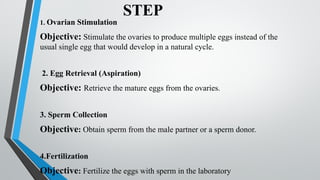
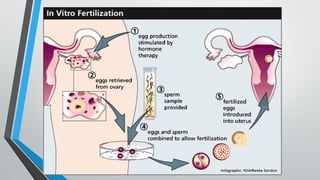
STEP
1. Ovarian Stimulation
Objective:Stimulate the ovaries to produce multiple eggs instead of the
usual single egg that would develop in a natural cycle.
2. Egg Retrieval (Aspiration)
Objective: Retrieve the mature eggs from the ovaries.
3. Sperm Collection
Objective: Obtain sperm from the male partner or a sperm donor.
4.Fertilization
Objective: Fertilize the eggs with sperm in the laboratory
20.
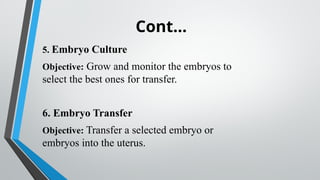
Cont…
5. Embryo Culture
Objective:Grow and monitor the embryos to
select the best ones for transfer.
6. Embryo Transfer
Objective: Transfer a selected embryo or
embryos into the uterus.
22.
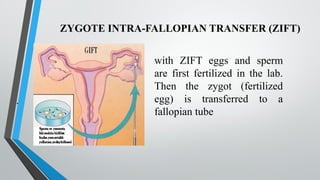
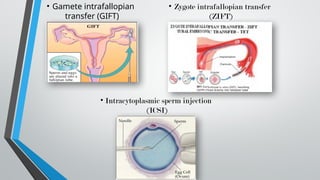
ZYGOTE INTRA-FALLOPIAN TRANSFER(ZIFT)
.
with ZIFT eggs and sperm
are first fertilized in the lab.
Then the zygot (fertilized
egg) is transferred to a
fallopian tube
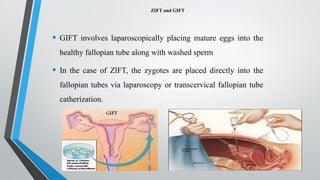
ZIFT and GIFT
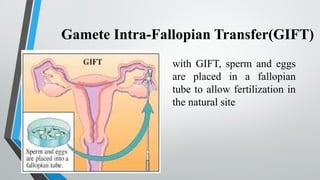
•GIFT involves laparoscopically placing mature eggs into the
healthy fallopian tube along with washed sperm
• In the case of ZlFT, the zygotes are placed directly into the
fallopian tubes via laparoscopy or transcervical fallopian tube
catherization.
25.
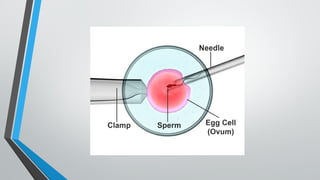
Intracytoplasmic Sperm Injection( ICSI )
ICSI is typically used in cases of male infertility, where sperm quality or quantity is
low, or when previous IVF attempts have failed due to fertilization issues.
Steps involved in ICSI:
-Ovarian Stimulation
-Egg Retrieval
-Sperm Collection
-Sperm Selection
-Fertilization
-Embryo Transfer
27.
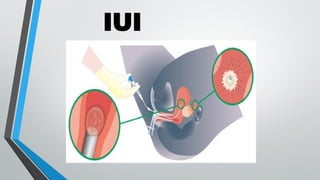
INTRA UTERINE INSEMINATION
(IUI)
Inthis procedure, sperm is collected and then directly
inserted into the uterus around the time of ovulation to
increase the chances of sperm reaching and fertilizing an egg.
STEP
Ovulation cycle monitoring
Sperm collection
Insemination: The prepared sperm is inserted into the
uterus through a thin catheter
SURROGACY
Where a womenagree to becomes pregnant
and deliver a child for a contracted party. It
may be her own genetic child conceived
through in-vitro fertilization or embryo
transfer using another woman’s ova.
31.
FREEZING
1. Embryo freezing:
-When there are excess embryos they are frozen to be
used for future embryo transfer.
-The success of this procedure depends on the quality of
the Embryos .
2. Oocyte Freezing :
-This is less successful at the present time and still in
research (the eggs gets destroyed in the freezing
procedure).
NURSES ROLE OFART
• Give psychological and emotional support about
social stigma.
• Assisting in reducing stress and tension
• Reassurance the patient and couple.
• Give proper advice for ethical issues.
• Give proper information about procedure of ART.
• Give cognitive behavioral therapy in that yoga,
exercise, information on nutrition.
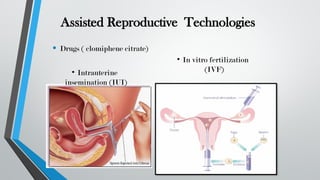
#37 Drugs to stimulate ovulation
Intrauterine insemination (IUI) where prepared sperm placed inside uterus
In vitro fertilization (IVF) where eggs are extracted, fertilized in a laboratory and the embryo transferred to the uterus
Gamete intrafallopian transfer (GIFT) where unfertilized eggs and sperm are placed in the fallopian tubes
Zygote intrafallopian transfer (ZIFT) where eggs are fertilized in the laboratory and the fertilized eggs (zygote) placed in the fallopian tubes
Intracytoplasmic sperm injection (ICSI) used for male infertility where a sperm is injected directly into an egg and then the embryo is transferred to the uterus
#39 Sorting sperm to select only those that will produce girls and do not carry x-linked chromosomal diseases
Pre-implantation diagnosis allows DNA testing of embryonic cells to confirm that only healthy embryos are transferred to avoid genetic diseases