
INFECTION CONTROL@
OUR HOSPITALS
PLAN FOR ACTION
Dr.T.V.Rao MD
Dr.T.V.Rao MD1
The Purpose of the
Programme
 The purpose of this
program is to maintain a
healthy and safe Hospital
by the prevention and
control of health care
related infections /
diseases. This is achieved
by surveillance and
investigation of infectious
diseases and public
education.
Dr.T.V.Rao MD2
Beginning of infection
control Programmes
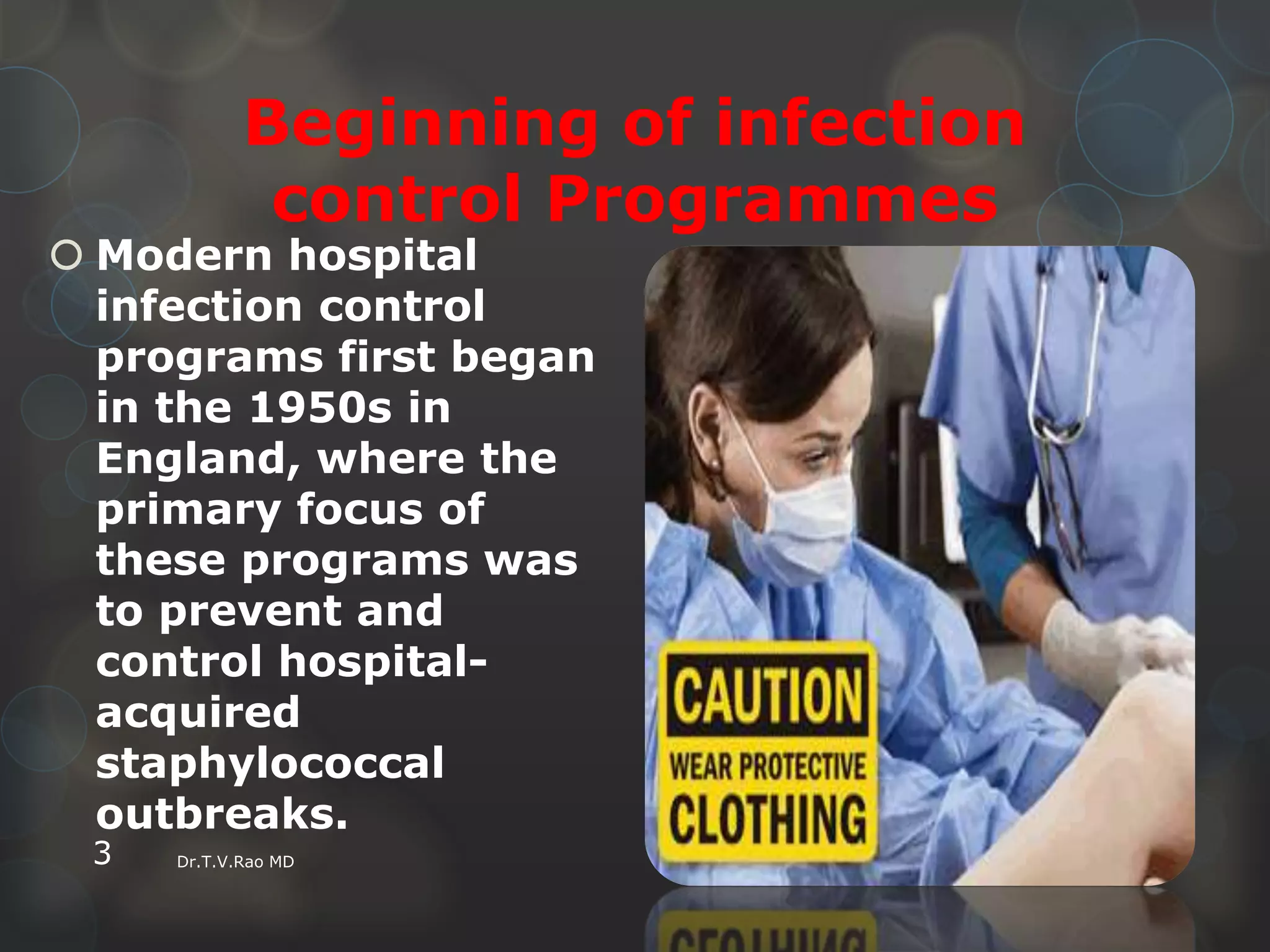
 Modern hospital
infection control
programs first began
in the 1950s in
England, where the
primary focus of
these programs was
to prevent and
control hospital-
acquired
staphylococcal
outbreaks.
Dr.T.V.Rao MD3
CDC starts the Training in
Hospital Infection control
 The Communicable Disease Center, later
to be renamed the Centers for Disease
Control and Prevention (CDC), began the
first training courses specifically about
infection control and surveillance. In
1969, the Joint Commission for
Accreditation of Hospitals--later to become
the Joint Commission on Accreditation of
Healthcare Organizations (JCAHO)--first
required hospitals to have organized
infection control committees and isolation
facilities.
Dr.T.V.Rao MD4
AIDS influences for better
understanding of Infection Control
 The second and certainly most
significant factor influencing
infection control at the time
was the advent of acquired
immunodeficiency syndrome
(AIDS). The human
immunodeficiency virus (HIV)
has taken an enormous toll in
terms of loss of life and
productivity. For infection
control professionals (ICPs),
HIV has been a challenge for
education, risk reduction and
resource utilization.
Dr.T.V.Rao MD5
Educating our Health
Care Workers
 Education programs for employees and volunteers
are one method to ensure competent infection
control practices. It is a unique challenge since
employees represent a wide range of expertise and
educational background. The ICP must become
knowledgeable in adult education principles and
use educational tools and techniques that will
motivate and sustain behavioral change. Much has
been written about the education of healthcare
workers (HCWs). Some of the tools used to
educate HCWs successfully include newsletter,
posters and videos
Dr.T.V.Rao MD6
The Scientific study ( SENIC )
gives guidelines
 Study of the Efficacy of Nosocomial Infection
Control (SENIC) project was published, validating
the cost-benefit of infection control programs. Data
collected in 1970 and 1976-1977 suggested that
one-third of all nosocomial infections could be
prevented if all the following were present:
 One infection control professional (ICP) for every
250 beds.
 An effective infection control physician.
 A program reporting infection rates back to the
surgeon and those clinically involved with the
infection.
 An organized hospital-wide surveillance system.
Dr.T.V.Rao MD7
Why we should control the
Infections in our Hospitals
 Increasing emerging infections
 Increasing resistant organisms
 Increasing drug costs
 Institute of Medicine Report--healthcare-associated
infections
 Nursing shortage
 OSHA safety legislation
 Multiple benchmark systems
 FDA legislation on reuse of single-use devices
Dr.T.V.Rao MD8
Assessing Infection Control
Programs
 The first step should be to make an
assessment of the current infection control
program. This review will have to include any
new customers to service resulting from any
mergers and acquisition (e.g., home health,
starting of multi specialties, ambulatory care
surgical centers) involving the healthcare
organizations. ICPs should assess the infection
control program for compliance with written
standards and guidelines, areas that need
improvement and available resources. ICPs
can begin by systematically reviewing the
most current regulatory standards and
guidelines.
Dr.T.V.Rao MD9
Formulating an Infection
Control Plan
 Every infection control program should develop a well-
defined written plan outlining the organizational
philosophy regarding infection prevention and control.
The plan should take into account the goals, mission
statement, and an assessment of the infection control
program. It should include a statement of authority, and
should review patient demographics including
geographic locations of patients served by the
healthcare system. The scope of responsibilities for
actions to be taken to accomplish the goals should be
included in this plan. Data, if available, should always
drive the plan. This plan is often referred to as the
quality improvement (QI) infection control (IC) plan and
should be reviewed and revised annually. Each revision
should include defining the objectives of the goals, with
due dates and responsible parties
Dr.T.V.Rao MD10
Infection Control should
Evaluate
 ICPs should evaluate their institutional
needs and develop a surveillance plan to
present to the infection control committee
on a yearly basis. Choosing one or two
specific surveillance problems and setting
a goal for reduction will focus the efforts
of the ICP. requires documenting the
rationale for selecting a specific
surveillance approach, the time needed to
implement the plan, and the benchmark
selected for comparison
Dr.T.V.Rao MD11
Our plan for future should
include
 Unlike scheduled activities, occasional
clusters of patients who are colonized or
infected will trigger further investigation
including a case-control study. New
laboratory methods developed and refined
within the last decade can now determine
how related the strain is at the molecular
level. The QI/IC plan should include
special problem-focused studies that
describe personnel or environmental
sampling, including what circumstances
and who has the authority to order
Dr.T.V.Rao MD12
Antibiotic Utilization
Isolation of Patients
 Information obtained from surveillance,
laboratory cultures, or screening for
epidemiologically-important pathogens
must be used to ensure that appropriate
isolation is instituted. The ICP should be
identified as the expert consultant on
control and prevention of communicable
diseases and then should have the
administrative power to isolate patients
Dr.T.V.Rao MD13
A Dedicated Hand Washing can Reduce
the Major Spread of Infections
Dr.T.V.Rao MD14
WHONET - Documentation
 Establishing
WHONET
Documentation
makes the
Antibiograms
assessments easy by
Microbiologists and
Consultants at any
Hospital.
 We are fully
functional to the
advantages of the
WHONET
documentation,
Dr.T.V.Rao MD15
Our Vision to Future
 Infection control
programs must
maintain training
records of employees.
The minimum training
required is annual
OSHA blood borne
pathogen, tuberculosis
prevention and control
and new employee
orientation.
Dr.T.V.Rao MD16
 The Programme Created by
Dr.T.V.Rao MD for Benefit of Health
Care Workers for Basic vision in
Developing better Health Care
 Dr.T.V.Rao MD
 Email
 doctortvrao@gmail.com
Dr.T.V.Rao MD17

INFECTION CONTROL@ OUR HOSPITALS PLAN FOR ACTION

  • 1.
    INFECTION CONTROL@ OUR HOSPITALS PLANFOR ACTION Dr.T.V.Rao MD Dr.T.V.Rao MD1
  • 2.
    The Purpose ofthe Programme  The purpose of this program is to maintain a healthy and safe Hospital by the prevention and control of health care related infections / diseases. This is achieved by surveillance and investigation of infectious diseases and public education. Dr.T.V.Rao MD2
  • 3.
    Beginning of infection controlProgrammes  Modern hospital infection control programs first began in the 1950s in England, where the primary focus of these programs was to prevent and control hospital- acquired staphylococcal outbreaks. Dr.T.V.Rao MD3
  • 4.
    CDC starts theTraining in Hospital Infection control  The Communicable Disease Center, later to be renamed the Centers for Disease Control and Prevention (CDC), began the first training courses specifically about infection control and surveillance. In 1969, the Joint Commission for Accreditation of Hospitals--later to become the Joint Commission on Accreditation of Healthcare Organizations (JCAHO)--first required hospitals to have organized infection control committees and isolation facilities. Dr.T.V.Rao MD4
  • 5.
    AIDS influences forbetter understanding of Infection Control  The second and certainly most significant factor influencing infection control at the time was the advent of acquired immunodeficiency syndrome (AIDS). The human immunodeficiency virus (HIV) has taken an enormous toll in terms of loss of life and productivity. For infection control professionals (ICPs), HIV has been a challenge for education, risk reduction and resource utilization. Dr.T.V.Rao MD5
  • 6.
    Educating our Health CareWorkers  Education programs for employees and volunteers are one method to ensure competent infection control practices. It is a unique challenge since employees represent a wide range of expertise and educational background. The ICP must become knowledgeable in adult education principles and use educational tools and techniques that will motivate and sustain behavioral change. Much has been written about the education of healthcare workers (HCWs). Some of the tools used to educate HCWs successfully include newsletter, posters and videos Dr.T.V.Rao MD6
  • 7.
    The Scientific study( SENIC ) gives guidelines  Study of the Efficacy of Nosocomial Infection Control (SENIC) project was published, validating the cost-benefit of infection control programs. Data collected in 1970 and 1976-1977 suggested that one-third of all nosocomial infections could be prevented if all the following were present:  One infection control professional (ICP) for every 250 beds.  An effective infection control physician.  A program reporting infection rates back to the surgeon and those clinically involved with the infection.  An organized hospital-wide surveillance system. Dr.T.V.Rao MD7
  • 8.
    Why we shouldcontrol the Infections in our Hospitals  Increasing emerging infections  Increasing resistant organisms  Increasing drug costs  Institute of Medicine Report--healthcare-associated infections  Nursing shortage  OSHA safety legislation  Multiple benchmark systems  FDA legislation on reuse of single-use devices Dr.T.V.Rao MD8
  • 9.
    Assessing Infection Control Programs The first step should be to make an assessment of the current infection control program. This review will have to include any new customers to service resulting from any mergers and acquisition (e.g., home health, starting of multi specialties, ambulatory care surgical centers) involving the healthcare organizations. ICPs should assess the infection control program for compliance with written standards and guidelines, areas that need improvement and available resources. ICPs can begin by systematically reviewing the most current regulatory standards and guidelines. Dr.T.V.Rao MD9
  • 10.
    Formulating an Infection ControlPlan  Every infection control program should develop a well- defined written plan outlining the organizational philosophy regarding infection prevention and control. The plan should take into account the goals, mission statement, and an assessment of the infection control program. It should include a statement of authority, and should review patient demographics including geographic locations of patients served by the healthcare system. The scope of responsibilities for actions to be taken to accomplish the goals should be included in this plan. Data, if available, should always drive the plan. This plan is often referred to as the quality improvement (QI) infection control (IC) plan and should be reviewed and revised annually. Each revision should include defining the objectives of the goals, with due dates and responsible parties Dr.T.V.Rao MD10
  • 11.
    Infection Control should Evaluate ICPs should evaluate their institutional needs and develop a surveillance plan to present to the infection control committee on a yearly basis. Choosing one or two specific surveillance problems and setting a goal for reduction will focus the efforts of the ICP. requires documenting the rationale for selecting a specific surveillance approach, the time needed to implement the plan, and the benchmark selected for comparison Dr.T.V.Rao MD11
  • 12.
    Our plan forfuture should include  Unlike scheduled activities, occasional clusters of patients who are colonized or infected will trigger further investigation including a case-control study. New laboratory methods developed and refined within the last decade can now determine how related the strain is at the molecular level. The QI/IC plan should include special problem-focused studies that describe personnel or environmental sampling, including what circumstances and who has the authority to order Dr.T.V.Rao MD12
  • 13.
    Antibiotic Utilization Isolation ofPatients  Information obtained from surveillance, laboratory cultures, or screening for epidemiologically-important pathogens must be used to ensure that appropriate isolation is instituted. The ICP should be identified as the expert consultant on control and prevention of communicable diseases and then should have the administrative power to isolate patients Dr.T.V.Rao MD13
  • 14.
    A Dedicated HandWashing can Reduce the Major Spread of Infections Dr.T.V.Rao MD14
  • 15.
    WHONET - Documentation Establishing WHONET Documentation makes the Antibiograms assessments easy by Microbiologists and Consultants at any Hospital.  We are fully functional to the advantages of the WHONET documentation, Dr.T.V.Rao MD15
  • 16.
    Our Vision toFuture  Infection control programs must maintain training records of employees. The minimum training required is annual OSHA blood borne pathogen, tuberculosis prevention and control and new employee orientation. Dr.T.V.Rao MD16
  • 17.
     The ProgrammeCreated by Dr.T.V.Rao MD for Benefit of Health Care Workers for Basic vision in Developing better Health Care  Dr.T.V.Rao MD  Email  doctortvrao@gmail.com Dr.T.V.Rao MD17