
Prepare Children for Change Care for Children
Change agents as common causes of childhood distress Divorce Moving house Changing schools Illness hospitalisation
Common causes in child care settings Changes to routines Changes of staff Change of room Departure of special peer friend
Informing children of change Children may  become distressed and angry when not informed or prepared for change Children need time to adjust to change Children need time to process the information – how it will effect them, how they will feel about the change and what part they will play in it
When change is external to the centre It is not the caregiver’s role to inform the child about impending external change Care-givers can talk to parents about giving children time to prepare for change- even if they are not sure the change will actually take place
Giving children notice of change within the service Ensure that children are given notice of any staff changes so that they can be prepared for it. Even relief staff can be prepared for by informing the children from time to time that when staff are ill, a new person takes their place
Prepare children for permanent staff changes Staff changes constitute one of the most upsetting and stressful events that effect children in child care Staff changes need to be prepared for as thoroughly as any other part of the program
Strategies for preparing children for change Explain honestly to children what is to happen (ie that you have been successful in applying for another position) Give children time to prepare for change Use symbols and rituals to make connections between the past and the present Build children’s confidence in the person who will replace you
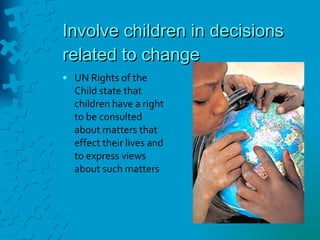
Involve children in decisions related to change UN Rights of the Child state that children have a right to be consulted about matters that effect their lives and to express views about such matters
Toddlers and Pre-schoolers can be involved in decisions about small changes that may effect their lives  School age children can increasingly become involved in in large scale change eg. The courts now respect the rights of children over 12 years to choose which parent they prefer to live with In School age services it is important to involve school age children in decisions that directly affect their lives. Therefore it is good to involve these children when choosing replacement staff
Introduce unfamiliar people Sometimes we can forget that children can feel unsettled when they don’t know who everyone is – what role different people have in their lives. It is hard for children to know if they can trust the newcomer if they are not introduced Make sure you introduce yourself to children who are unfamiliar to you and that you introduce all visitors, relief staff and guests to children as soon as they arrive.
Introductions are good manners
Prepare children for change in the setting Changing rooms or caregivers can be distressing Try to keep children with the same caregiver as long as possible When changes have to be made, it is important that children do not feel abandoned by caregivers with whom they have developed relationships
Robert is old enough to move from the toddler room to the kinder room. However, when taken there by his mother  he becomes very distressed. He reverts to wetting even though he has been toilet trained for 8 months. Write down how you would have prevented the stress caused to Robert and his mother if you were the caregiver concerned
Talk to his mother about the possibility of his going to the kindy room several weeks before it happened Talk to Robert & explain that he might like to go to the kindy room in a few weeks Encourage the caregivers in the kindy room to visit Robert in his room to establish a relationship with him Arrange for one of the children in the kindy room to take responsibility for showing Robert around & helping him learn the kindy routines
Encourage Robert’s Mum to visit the kindy room with him Linking – gradually extend the amount of time Robert spends in the kindy room Allow Robert to make the final decision about when he felt comfortable enough to stay in the kindy room permanently
Prepare children for school The transition from child care to school can be traumatic for children if it is not planned carefully. Children have to adjust to new routines and rules as well as make new relationships with staff and other children They may experience a deep sense of loss at leaving the centre
Activity  4.16 Make list of strategies you would use to help children prepare for beginning school My Mummy saying goodbye to me
Prepare children for unforseen change Sometimes events that impact on children’s lives are often difficult for caregivers to foresee. Eg Separation, divorce, hospitalisation, moving house What we do know is that all these events are more likely to cause stress to children with little previous experience, knowledge and understanding about these events than for children who have some idea about what might happen to them in such circumstances
These play experiences also enable children whose siblings may be in hospital to talk and work out their own feelings. These children commonly experience guilt, jealousy, rejection, isolation and fear which sometimes leads to behaviour problems. It is not unusual for children with a sibling in hospital to harbour hostile thoughts about the sibling and this may make them feel guilty. They may even believe they are the cause of their sibling’s illness. Others feel guilty because they wish their sibling dead, or because they are not able to make their sibling better, or because they themselves are healthy. Activity 4.17
Did you include… Reading stories about children in similar circumstances Setting up the dramatic play area with props associated with events (hospital, wedding etc) Inviting children to talk about their family Encouraging children to draw. paint about their family and family circumstances Inviting a mother with a new baby to the centre Involving children in the care of the babies
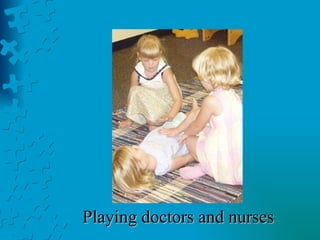
Playing doctors and nurses
Settle new arrivals The way in which children separate from parents provides useful information about how children are feeling & coping with group care. Caregivers need to take careful note of the way children separate from parents/family members Children who separate well, look pleased to see their caregivers, join other children in play easily, are showing signs of familiarity and trust Likewise at the end of the day, children who look pleased to see their parents & leave the caregiver easily at the end of the day are also showing signs of feeling secure & confident.
Children who find separations difficult may be feeling anxious, fearful or angry Some experience all three emotions at the same time Children will need support & help to cope with their feelings as well as time to develop more secure relationships with caregivers Individual children will react differently to separation from their parents and family members
 
What would you want your child’s caregiver to do if you were leaving your child in care for the first time?
Did you have any of these? Encourage you to spend time with your child in the care setting Introduce you to the person who was going to take special responsibility for your child Show you that he/she understood your child’s likes/dislikes Show you that he/she would give your child lots of support and attention Show you that he/she would recognise when your child was hungry, tired or uncomfortable Encourage you to contact the service by phone throughout the day if necessary
Importance of social referencing Social referencing is the mechanism through which infants learn how to respond to new or novel experiences When faced with new people or situations, infants look to familiar adults for cues about how they should behave If the familiar adult accepts the new situation or person, the child is also likely to accept it and feel relaxed.
 
Parents will be more relaxed if they can observe you caring for and developing a relationship with their child. You would not be unusual if you felt uncomfortable interacting with the child in front of the parents for the first time This is quite natural, however, as well as providing reassurance to the child’s parents/family, establishing a relationship with the child while the parents are still present is important for the child’s sense of well-being. Handout P 210
Responding to the distress of parents & children Parents who use child care are often struggling with conflicting feelings about wanting to care for their children & needing to return to work Often parents feel relief that someone will help them care for their child as well as anxiety about not wanting to lose control & handing over trust to a stranger Many parents feel worried that the caregiver will replace them in their child’s affections
It is very important to recognise signs of parental distress & act to reassure & minimise this distress as quickly as possible Signs of parental distress may include not wanting to stay with the child or not wanting to leave at all. Anxious parents may also become extremely distressed if their child’s personal belongings are not cared for, misplaced or used by another child
How would you reassure a parent who was showing distress at leaving his/her child in your care?
Did we include these?... Explain that the role of the caregiver is to develop secondary attachments with children that support rather than weaken the child’s primary caregiver Being considerate & ensuring that the child’s personal belongings are cared for appropriately Talking to parents& asking their advice about how to establish feeding, sleeping & toileting routines with their child Discussing the child’s day with parents so they feel informed about what the child had been doing while they have been away. This also reassures them that you have given their child attention & noticed them during the day.
Showing parents that you understand the conflicts that they are experiencing Inviting parents to spend as much time as they want with their child in the program
On Placement While you are on placement, or in your workplace, observe caregivers settling children who are experiencing stress at separation from attachment figures. Look at how the caregiver provides physical comfort while actively involving the child in an activity that captures the child’s interest and provides him/her with some control over the situation
Routines & rituals In addition to comforting & distracting the child, caregivers can also minimise children’s distress by establishing specific routines & rituals These can be used both at the beginning and at the end of the day It is not unusual for children to be equally distressed at both ends of the day.
Routines A routine is usually associated with the time that an event is to be carried out eg arrival at 7.30 and pick up at 4.00pm. Routines include eating, sleeping, toileting etc Routines provide predictability for all concerned
Rituals Rituals refer to the way routines are carried out Rituals provide young children (and some adults) with a sense of order and control.
Providing security for children Develop your relationship with the child early. To help do that try the following strategies Provide home/service links Parents spend time at centre Send photo home Display family photos at centre Piece of Mum or dad’s clothing Cuddly toy or blanket Holding & physical contact  The more we do it the safer the child will feel & the more their confidence will grow Do not deny comfort to the child by ignoring their distress
Ways to provide physical comfort Sitting on the floor with children close to you Using a sling to carry young infants Stroking and patting infants when they are falling asleep Taking time for an extra cuddle and hug at nappy change time Sitting next to children at their level during meals or group times Crouching down next to a child when speaking to them
Caregiver vulnerability Unfortunately caregivers are vulnerable to charges of inappropriate handling of children in their care. For this reason & to protect the your interests & the interests of children in your care, make sure you are not left on your own with children. If you are stroking or massaging an infant or toddler, make sure you are doing it in sight of other caregivers and that you have checked with the qualified staff that the child’s parents are happy for their child to be handled this way.
Providing handles for secondary attachments As well as physical contact & reassurance it is important to involve a child in a shared activity Handles for secondary attachments are experiences, materials or toys that attract a child’s attention & enable both child & caregiver to engage in shared activity. Toys which have proved effective are those which provide an element of surprise eg pop up toys, activity boards that make different sounds & Jack-in-the-box.
Separation with older children Older children can also find separation from family members stressful Even children who are well-established at the centre still require gentle support & understanding when their parents leave. For older children, you may choose an experience you know they will enjoy. Ask the child (& parents) what sorts of things they like to do. Plan to include these in the environment on the days you know they will be attending Make sure that you are free to help the child join in with the experience when they arrive.
Responding to anger on arrival Anger at arrival time is often triggered by feelings of powerlessness& lack of control over what is happening to them Children may be brought to the centre when they would rather be doing other things It is the responsibility of the caregiver to help children who are feeling like this to regain poer & control over their lives within the child care setting. Handout p222
The End

Prepare children-for-change

  • 1.
    Prepare Children forChange Care for Children
  • 2.
    Change agents ascommon causes of childhood distress Divorce Moving house Changing schools Illness hospitalisation
  • 3.
    Common causes inchild care settings Changes to routines Changes of staff Change of room Departure of special peer friend
  • 4.
    Informing children ofchange Children may become distressed and angry when not informed or prepared for change Children need time to adjust to change Children need time to process the information – how it will effect them, how they will feel about the change and what part they will play in it
  • 5.
    When change isexternal to the centre It is not the caregiver’s role to inform the child about impending external change Care-givers can talk to parents about giving children time to prepare for change- even if they are not sure the change will actually take place
  • 6.
    Giving children noticeof change within the service Ensure that children are given notice of any staff changes so that they can be prepared for it. Even relief staff can be prepared for by informing the children from time to time that when staff are ill, a new person takes their place
  • 7.
    Prepare children forpermanent staff changes Staff changes constitute one of the most upsetting and stressful events that effect children in child care Staff changes need to be prepared for as thoroughly as any other part of the program
  • 8.
    Strategies for preparingchildren for change Explain honestly to children what is to happen (ie that you have been successful in applying for another position) Give children time to prepare for change Use symbols and rituals to make connections between the past and the present Build children’s confidence in the person who will replace you
  • 9.
    Involve children indecisions related to change UN Rights of the Child state that children have a right to be consulted about matters that effect their lives and to express views about such matters
  • 10.
    Toddlers and Pre-schoolerscan be involved in decisions about small changes that may effect their lives School age children can increasingly become involved in in large scale change eg. The courts now respect the rights of children over 12 years to choose which parent they prefer to live with In School age services it is important to involve school age children in decisions that directly affect their lives. Therefore it is good to involve these children when choosing replacement staff
  • 11.
    Introduce unfamiliar peopleSometimes we can forget that children can feel unsettled when they don’t know who everyone is – what role different people have in their lives. It is hard for children to know if they can trust the newcomer if they are not introduced Make sure you introduce yourself to children who are unfamiliar to you and that you introduce all visitors, relief staff and guests to children as soon as they arrive.
  • 12.
  • 13.
    Prepare children forchange in the setting Changing rooms or caregivers can be distressing Try to keep children with the same caregiver as long as possible When changes have to be made, it is important that children do not feel abandoned by caregivers with whom they have developed relationships
  • 14.
    Robert is oldenough to move from the toddler room to the kinder room. However, when taken there by his mother he becomes very distressed. He reverts to wetting even though he has been toilet trained for 8 months. Write down how you would have prevented the stress caused to Robert and his mother if you were the caregiver concerned
  • 15.
    Talk to hismother about the possibility of his going to the kindy room several weeks before it happened Talk to Robert & explain that he might like to go to the kindy room in a few weeks Encourage the caregivers in the kindy room to visit Robert in his room to establish a relationship with him Arrange for one of the children in the kindy room to take responsibility for showing Robert around & helping him learn the kindy routines
  • 16.
    Encourage Robert’s Mumto visit the kindy room with him Linking – gradually extend the amount of time Robert spends in the kindy room Allow Robert to make the final decision about when he felt comfortable enough to stay in the kindy room permanently
  • 17.
    Prepare children forschool The transition from child care to school can be traumatic for children if it is not planned carefully. Children have to adjust to new routines and rules as well as make new relationships with staff and other children They may experience a deep sense of loss at leaving the centre
  • 18.
    Activity 4.16Make list of strategies you would use to help children prepare for beginning school My Mummy saying goodbye to me
  • 19.
    Prepare children forunforseen change Sometimes events that impact on children’s lives are often difficult for caregivers to foresee. Eg Separation, divorce, hospitalisation, moving house What we do know is that all these events are more likely to cause stress to children with little previous experience, knowledge and understanding about these events than for children who have some idea about what might happen to them in such circumstances
  • 20.
    These play experiencesalso enable children whose siblings may be in hospital to talk and work out their own feelings. These children commonly experience guilt, jealousy, rejection, isolation and fear which sometimes leads to behaviour problems. It is not unusual for children with a sibling in hospital to harbour hostile thoughts about the sibling and this may make them feel guilty. They may even believe they are the cause of their sibling’s illness. Others feel guilty because they wish their sibling dead, or because they are not able to make their sibling better, or because they themselves are healthy. Activity 4.17
  • 21.
    Did you include…Reading stories about children in similar circumstances Setting up the dramatic play area with props associated with events (hospital, wedding etc) Inviting children to talk about their family Encouraging children to draw. paint about their family and family circumstances Inviting a mother with a new baby to the centre Involving children in the care of the babies
  • 22.
  • 23.
    Settle new arrivalsThe way in which children separate from parents provides useful information about how children are feeling & coping with group care. Caregivers need to take careful note of the way children separate from parents/family members Children who separate well, look pleased to see their caregivers, join other children in play easily, are showing signs of familiarity and trust Likewise at the end of the day, children who look pleased to see their parents & leave the caregiver easily at the end of the day are also showing signs of feeling secure & confident.
  • 24.
    Children who findseparations difficult may be feeling anxious, fearful or angry Some experience all three emotions at the same time Children will need support & help to cope with their feelings as well as time to develop more secure relationships with caregivers Individual children will react differently to separation from their parents and family members
  • 25.
  • 26.
    What would youwant your child’s caregiver to do if you were leaving your child in care for the first time?
  • 27.
    Did you haveany of these? Encourage you to spend time with your child in the care setting Introduce you to the person who was going to take special responsibility for your child Show you that he/she understood your child’s likes/dislikes Show you that he/she would give your child lots of support and attention Show you that he/she would recognise when your child was hungry, tired or uncomfortable Encourage you to contact the service by phone throughout the day if necessary
  • 28.
    Importance of socialreferencing Social referencing is the mechanism through which infants learn how to respond to new or novel experiences When faced with new people or situations, infants look to familiar adults for cues about how they should behave If the familiar adult accepts the new situation or person, the child is also likely to accept it and feel relaxed.
  • 29.
  • 30.
    Parents will bemore relaxed if they can observe you caring for and developing a relationship with their child. You would not be unusual if you felt uncomfortable interacting with the child in front of the parents for the first time This is quite natural, however, as well as providing reassurance to the child’s parents/family, establishing a relationship with the child while the parents are still present is important for the child’s sense of well-being. Handout P 210
  • 31.
    Responding to thedistress of parents & children Parents who use child care are often struggling with conflicting feelings about wanting to care for their children & needing to return to work Often parents feel relief that someone will help them care for their child as well as anxiety about not wanting to lose control & handing over trust to a stranger Many parents feel worried that the caregiver will replace them in their child’s affections
  • 32.
    It is veryimportant to recognise signs of parental distress & act to reassure & minimise this distress as quickly as possible Signs of parental distress may include not wanting to stay with the child or not wanting to leave at all. Anxious parents may also become extremely distressed if their child’s personal belongings are not cared for, misplaced or used by another child
  • 33.
    How would youreassure a parent who was showing distress at leaving his/her child in your care?
  • 34.
    Did we includethese?... Explain that the role of the caregiver is to develop secondary attachments with children that support rather than weaken the child’s primary caregiver Being considerate & ensuring that the child’s personal belongings are cared for appropriately Talking to parents& asking their advice about how to establish feeding, sleeping & toileting routines with their child Discussing the child’s day with parents so they feel informed about what the child had been doing while they have been away. This also reassures them that you have given their child attention & noticed them during the day.
  • 35.
    Showing parents thatyou understand the conflicts that they are experiencing Inviting parents to spend as much time as they want with their child in the program
  • 36.
    On Placement Whileyou are on placement, or in your workplace, observe caregivers settling children who are experiencing stress at separation from attachment figures. Look at how the caregiver provides physical comfort while actively involving the child in an activity that captures the child’s interest and provides him/her with some control over the situation
  • 37.
    Routines & ritualsIn addition to comforting & distracting the child, caregivers can also minimise children’s distress by establishing specific routines & rituals These can be used both at the beginning and at the end of the day It is not unusual for children to be equally distressed at both ends of the day.
  • 38.
    Routines A routineis usually associated with the time that an event is to be carried out eg arrival at 7.30 and pick up at 4.00pm. Routines include eating, sleeping, toileting etc Routines provide predictability for all concerned
  • 39.
    Rituals Rituals referto the way routines are carried out Rituals provide young children (and some adults) with a sense of order and control.
  • 40.
    Providing security forchildren Develop your relationship with the child early. To help do that try the following strategies Provide home/service links Parents spend time at centre Send photo home Display family photos at centre Piece of Mum or dad’s clothing Cuddly toy or blanket Holding & physical contact The more we do it the safer the child will feel & the more their confidence will grow Do not deny comfort to the child by ignoring their distress
  • 41.
    Ways to providephysical comfort Sitting on the floor with children close to you Using a sling to carry young infants Stroking and patting infants when they are falling asleep Taking time for an extra cuddle and hug at nappy change time Sitting next to children at their level during meals or group times Crouching down next to a child when speaking to them
  • 42.
    Caregiver vulnerability Unfortunatelycaregivers are vulnerable to charges of inappropriate handling of children in their care. For this reason & to protect the your interests & the interests of children in your care, make sure you are not left on your own with children. If you are stroking or massaging an infant or toddler, make sure you are doing it in sight of other caregivers and that you have checked with the qualified staff that the child’s parents are happy for their child to be handled this way.
  • 43.
    Providing handles forsecondary attachments As well as physical contact & reassurance it is important to involve a child in a shared activity Handles for secondary attachments are experiences, materials or toys that attract a child’s attention & enable both child & caregiver to engage in shared activity. Toys which have proved effective are those which provide an element of surprise eg pop up toys, activity boards that make different sounds & Jack-in-the-box.
  • 44.
    Separation with olderchildren Older children can also find separation from family members stressful Even children who are well-established at the centre still require gentle support & understanding when their parents leave. For older children, you may choose an experience you know they will enjoy. Ask the child (& parents) what sorts of things they like to do. Plan to include these in the environment on the days you know they will be attending Make sure that you are free to help the child join in with the experience when they arrive.
  • 45.
    Responding to angeron arrival Anger at arrival time is often triggered by feelings of powerlessness& lack of control over what is happening to them Children may be brought to the centre when they would rather be doing other things It is the responsibility of the caregiver to help children who are feeling like this to regain poer & control over their lives within the child care setting. Handout p222
  • 46.

Editor's Notes

  • #3 Divorce Moving house Changing schools Illness hospitalisation
  • #4 Changes to routines Changes of staff Change of room Departure of special peer friend
  • #5 Children may become distressed and angry when not informed or prepared for change Children need time to adjust to change Children need time to process the information – how it will effect them, how they will feel about the change and what part they will play in it
  • #6 It is not the caregiver’s role to inform the child about impending external change Care-givers can talk to parents about giving children time to prepare for change- even if they are not sure the change will actually take place. Children as young as two years are very perceptive and will often become unsettled if they feel that adults around them are planning something they are not party to. For example, children who are involved in preparing for the birth of a new baby are likely to be more accepting & less distressed at the arrival if than children for whom it was kept secret. Handout 1
  • #7 Ensure that children are given notice of any staff changes so that they can be prepared for it. Even relief staff can be prepared for by informing the children from time to time that when staff are ill, a new person takes their place but the other staff member will be back as soon as she is better. Activity 4.10
  • #8 Staff changes constitute one of the most upsetting and stressful events that effect children in child care Staff changes need to be prepared for as thoroughly as any other part of the program Handout 2
  • #9 Explain honestly to children what is to happen (ie that you have been successful in applying for another position) Give children time to prepare for change Use symbols and rituals to make connections between the past and the present Build children’s confidence in the person who will replace you
  • #10 UN Rights of the Child state that children have a right to be consulted about matters that effect their lives and to express views about such matters The extent to which children can express their views and be conssulted about change will depend on their developmental ability to understand, analyse and make decisions about situations
  • #11 Toddlers and Pre-schoolers can be involved in decisions about small changes that may effect their lives their lives School age children can increasingly become involved in in large scale change eg. The courts now respect the rights of children over 12 years to choose which parent they prefer to live with. In School age services it is important to involve school age children in decisions that directly affect their lives. Therefore it is good to involve these children when choosing replacement staff – READ SCENARIO P195 ACTIVITY 4.14
  • #12 Sometimes we can forget that children can feel unsettled when they don’t know who everyone is – what role different people have in their lives. It is hard for children to know if they can trust the newcomer if they are not introduced Make sure you introduce yourself to children who are unfamiliar to you and that you introduce all visitors, relief staff and guests to children as soon as they arrive.
  • #14 Changing rooms or caregivers can be distressing Try to keep children with the same caregiver as long as possible When changes have to be made, it is important that children do not feel abandoned by caregivers with whom they have developed relationships
  • #15 Re-look at activity 4.10. Write down how you would have prevented the stress caused to Robert and his mother if you were the caregiver concerned
  • #16 Talk to his mother about the possibility of his going to the kindy room several weeks before it happened Talk to Robert & explain that he might like to go to the kindy room in a few weeks Encourage the caregivers in the kindy room to visit Robert in his room to establish a relationship with him Arrange for one of the children in the kindy room to take responsibility for showing Robert around & helping him learn the kindy routines
  • #17 Encourage Robert’s Mum to visit the kindy room with him Linking – gradually extend the amount of time Robert spends in the kindy room Allow Robert to make the final decision about when he felt comfortable enough to stay in the kindy room permanently
  • #18 The transition from child care to school can be traumatic for children if it is not planned carefully. Children have to adjust to new routines and rules as well as make new relationships with staff and other children They may experience a deep sense of loss at leaving the centre
  • #20 Sometimes events that impact on children’s lives are often difficult for caregivers to foresee. Eg Separation, divorce, hospitalisation, moving house What we do know is that all these events are more likely to cause stress to children with little previous experience, knowledge and understanding about these events than for children who have some idea about what might happen to them in such circumstances The caregiver in the following case study understands that building in activities and experiences that teach children about the hospital experience can make a big difference to a child’s ability to cope with stressful situations READ CASE STUDY P201
  • #21 These play experiences also enable children whose siblings may be in hospital to talk and work out their own feelings. These children commonly experience guilt, jealousy, rejection, isolation and fear which sometimes leads to behaviour problems. It is not unusual for children with a sibling in hospital to harbour hostile thoughts about the sibling and this may make them feel guilty. They may even believe they are the cause of their sibling’s illness. Others feel guilty because they wish their sibling dead, or because they are not able to make their sibling better, or because they themselves are healthy. Activity 4.17
  • #22 Reading stories about children in similar circumstances Setting up the dramatic play area with props associated with events (hospital, wedding etc) Inviting children to talk about their family Encouraging children to draw. paint about their family and family circumstances Inviting a mother with a new baby to the centre Involving children in the care of the babies
  • #24 The way in which children separate from parents provides useful information about how children are feeling & coping with group care. Caregivers need to take careful note of the way children separate from parents/family members Children who separate well, look pleased to see their caregivers, join other children in play easily, are showing signs of familiarity and trust Likewise at the end of the day, children who look pleased to see their parents & leave the caregiver easily at the end of the day are also showing signs of feeling secure & confident.
  • #25 Children who find separations difficult may be feeling anxious, fearful or angry Some experience all three emotions at the same time Children will need support & help to cope with their feelings as well as time to develop more secure relationships with caregivers Individual children will react differently to separation from their parents and family members
  • #27 What would you want your child’s caregiver to do if you were leaving your child in care for the first time?
  • #28 Encourage you to spend time with your child in the care setting Introduce you to the person who was going to take special responsibility for your child Show you that he/she understood your child’s likes/dislikes Show you that he/she would give your child lots of support and attention Show you that he/she would recognise when your child was hungry, tired or uncomfortable Encourage you to contact the service by phone throughout the day if necessary
  • #29 Social referencing is the mechanism through which infants learn how to respond to new or novel experiences When faced with new people or situations, infants look to familiar adults for cues about how they should behave If the familiar adult accepts the new situation or person, the child is also likely to accept it and feel relaxed. If, on the other hand the familiar adult appears etnse or distressed about the new situation,the child is likely to feel the same way
  • #31 Parents will be more relaxed if they can observe you caring for and developing a relationship with their child. You would not be unusual if you felt uncomfortable interacting with the child in front of the parents for the first time This is quite natural, however, as well as providing reassurance to the child’s parents/family, establishing a relationship with the child while the parents are still present is important for the child’s sense of well-being. Handout P 210
  • #32 Parents who use child care are often struggling with conflicting feelings about wanting to care for their children & needing to return to work Often parents feel relief that someone will help them care for their child as well as anxiety about not wanting to lose control & handing over trust to a stranger Many parents feel worried that the caregiver will replace them in their child’s affections
  • #33 It is very important to recognise signs of parental distress & act to reassure & minimise this distress as quickly as possible Signs of parental distress may include not wanting to stay with the chid or not wanting to leave at all. Anxious parents may also become extremely distressed if their child’s personal belongings are not cared for, misplaced or used by another child
  • #34 How would you reassure a parent who was showing distress at leaving her child in your care?
  • #35 Explain that the role of the caregiver is to develop secondary attachments with children that support rather than weaken the child’s primary caregiver Being considerate & ensuring that the child’s personal belongings are care for appropriately Talking to parents& asking their advice about how to establish feeding, sleeping & toileting routines with their child Discussing the child’s day with parents so they feel informed about what the child had been doing while they have been away. This also reassures them that you have given their child attention & noticed them during the day.
  • #36 Showing parents that you understand the conflicts that they are experiencing Inviting parents to spend as much time as they want with their child in the program
  • #37 While you are on placement, or in your workplace, observe caregivers settling children who are experiencing stress at separation from attachment figures. Look at how the caregiver pronides physical comfort while actively involving the child in an activity that captures the child’s interest and provides him/her with some control over the situation
  • #38 In addition to comforting & distracting the child, caregivers can also minimise children’s distress by establishing specific routines & rituals These routines & rituals are used during the transition from home to child care and again later in the day during the transition from child care to the home It is not unusual for children to be equally distressed at both ends of the day.
  • #39 A routine is usually associated with the time that an event is to be carried out eg a child may arrive at 7.30 in the morning nd be picked up at 4 om each afternoon. This is the child’s routine. Routines include eating, sleeping, toileting etc
  • #40 Rituals refer to the way routines are carried out Rituals provide young children (and some adults) with a sense of order and control. Example p217 Handout
  • #41 Develop your relationship with the child early. To help do that try the following strategies Provide home/service links. Children feel safer and more secure if they feel there is a connection between the service & their home. The most obvious way is to encourage family members to spend time at the service. This enables parents & staff to get to know one another & feel more relaxed. Sending home a photo of the caregiver & displaying home photos in the centre are good ways to help transition. Sometimes a piece of Mum or Dad’s clothing left at the service can provide the link between home and the service and serve as a souce of comfort to the child as does a cuddly toy or blanket. Holding & physical contact. READ P217
  • #42 Sitting on the floor with children close to you Using a sling to carry young infants Stroking and patting infants when they are falling asleep Taking time for an extra cuddle and hug at nappy change time Sitting next to children at their level during meals or group times Crouching down next to a child when speaking to them
  • #43 Unfortunately caregivers are vulnerable to charges of inappropriate handling of children in their care. For this reason & to protect your interests & the interests of children in your care, make sure you are not left on your own with children. If you are stroking ir massaging an infant or toddler, make sure you are doing it in sight of other caregivers and that you have checked with the qualified staff tat the child’s parents are happy for their child to be handled this way.
  • #44 As well as physical contact & reassurance it is important to involve a child in a shared activity Handles for secondary attachments are experiences, materials or toys that attract a child’s attention & enable both child & caregiver to engage in shared activity. Through the process of sharing the activity the child begins to develop trust in the caregiver & relx in their company. When the same exoerience is used repeatedly to enable the same caregiver & child to share the activity it becomes a “Handle” for the formation of the attachment between them. Toys which have proved effective are those which provide an element of surprise eg pop up toys, activity boards that make different sounds & Jack-in-the-box. The fact that the toy often needs an adult to help operate it provides the opportunity for shared activity and the repetitive nature of the actions taken by the adult and toy itself provides a predictability & sense of control that soothes the child.
  • #45 Older children can also find separation from family members stressful Even children who are well-established at the centre still require gentle support & understanding when their parents leave. For older children, you may choose and experience you know they will enjoy. Ask the child (& parents) what sorts of things they like to do. Plan to include these in the environment on the days you know they will be attending Make sure that you are free to help the child join in with the experience when they arrive.
  • #46 Anger at arrival time is often triggered by feelings of powerlessness& lack of control over what is happening to them Imagine if you were feeling extremely tired and you were suddenly dragged from your bed by someone who wanted you to go out shopping with them. Or, imagine you were watching your favourite TV show and someone came in and turned off the TV. In either case you would feel angry, especially if you could not change the situation. Unfortunately, children may be brought to the centre when they would rather be doing other things. Their inability to do anything about it leads them to feel powerless and out of control