GROWTH AND
DEVELOPMENT OF INFANT
Presented by :
Miss .Shrutika . S .Navilyale
MSc Nursing 1st year
Child Health Nursing
KAHER INS Belagavi
INTRODUCTION
The pediatric age group ranges form 0-18 yrs i.e. from the day of
conception to the 18 yrs of age .
They are :
 Prenatal period :From conception to birth
 Neonatal period :Birth to four weeks
 Infancy period :Four weeks to 1 year
 Toddler period :From 1-3 years
 Preschool period :3-6 years (early childhood )
 School period :6-12 years( late childhood )
 Adolescence :From puberty to beginning of adulthood (13-18 years)
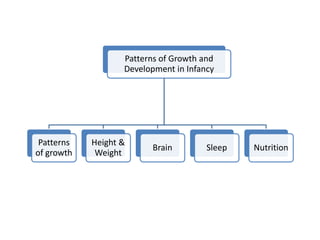
Patterns of Growth and
Development in Infancy
Patterns
of growth
Height &
Weight
Brain Sleep Nutrition
Development follows an orderly, step-by-
step sequence in three different patterns:
Cephalo-caudal development is a “head-
to-foot” pattern. Prenatally and at birth
the newborn’s head is proportionately
larger; development continues
downward(for e.g. shoulders, middle trunk
and so on)
Head area : top parts of head eyes and
brain grow faster than the lower jaw
Motor development also follows Cephalo-
caudal development principle
• see objects before they can control
their torso
• Use hands long before they crawl and
walk
Proximal-distal (proximodistal) development
is an “inward-to-outward” pattern.
Development starts at the trunk of the body
and moves further outward.
Simple-to-complex development is a pattern
relating to the difficulty of tasks. Babies start
with simply eating and sleeping and progress
from there. Tasks involving a combination of
motions is more complex.
GROWTH AND DEVELOPMENT OF INFANT (0-1 YEAR)
PHYSICAL GROWTH:
• Weight :
Average weight of newborn is 2.5kgs which decreases by 10% in first 10
days of life and then increases at the rate of 500 to 600 gms per
month for first 6 months .
• Length :
At birth the length of newborn is 45-50 cm . It increases approximately
2-2.5 cm per month during first 6 months .
• Head circumference:
At birth it is approximately 33-35cm and increases at the rate of 1.5 cm
per month during the first 6 months .
• Chest circumference :
About 31-33 cm .
•Pulse rate :
130 ± 20 / min
• Respiration rate:
35 ± 10 /minute
• Blood pressure:
80/50 ± 20/10 mm Hg
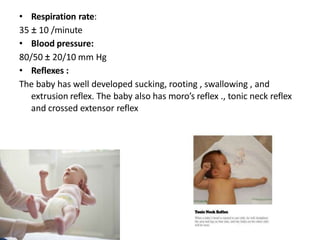
• Reflexes :
The baby has well developed sucking, rooting , swallowing , and
extrusion reflex. The baby also has moro’s reflex ., tonic neck reflex
and crossed extensor reflex
Conti…
MOTOR DEVELOPMENT:
a)Gross motor development :
• Lies in flexed position with hands clenched .
• Turns head when in prone position.
• Head lags behind when baby is pulled up from
supine to sitting position.
b)Fine motor development:
• Grasp reflex is strong .
• Baby can grasp an object placed in hand but
drops it immediately.
SENSORY DEVELOPMENT :
• Protective blinking reflex is present.
• Indefinite stare at surrounding .
• Notice faces and bright objects but if only if
they are in line vision.
Conti..
LANGUAGE DEVELOPMENT :
• Startles to loud noise .
• Responds to human voice.
• Makes comfort sounds during feeding .
• Begins to coo.
NEWBORN SENSES:
Touch:
• It is most highly developed senses.
• It is mostly at lips , tongue, ears, and forehead.
• Newborn is usually comfortable with touch.
Vision :
• pupils react to light.
• Follow objects in line of vision .
• Bright lights is unpleasant to newborns.
Conti….
 Hearing:
 The newborn infant usually makes some response to sound from
birth.
 The newborn infant responds to sounds with cry or eye movements ,
cessation of activity and /or startle activity.
 Taste:
 Well developed as bitter and sour fluids are resisted while sweet
fluids are accepted.
 Smell :
 Only evidence in newborn infants search for nipple .
2 months
 Physical development:
 Posterior fontanel closes at 3-6 weeks age.
 Tears starts appearing .
 Drooling begins.
 Motor development:
 Gross motor:
 Less fixed prone position – arms flexed , hip flat and legs extended.
 Lifts head almost to 45 degree flat surface when lying prone.
 Fine motor:
 Hands may be open.
 Holds rattle when placed in hand.
Conti...
 Sensory development:
 Turns head to side when sound occurs at ear level.
 Eyes follow moving objects and persons nearby.
 Visual acuity is hyper active.
 Language :
 Laughs and squeals .
 Crying becomes differentiated.
 Utters single vowel sounds.
 Social development:
 Smiles to mother/ caregivers.
 Knows that cry will bring attention.
3 months
 Physical development:
 Flexion posture is reduced .
 Grasping , crossed extensor and moro’s reflex disappears.
 Landavu reflex appears.
 Motor development:
 Gross motor:
 Able to lift head to 90 degree when in prone position.
 Able to hold head erect but head still bobs forward.
 Rolls over back to front.
 Fine motor:
 Can grasp toy but lacks firm hold.
 Carries objects and hands to mouth at will.
Conti...
 Sensory development:
 Turns head and looks at same direction to locate sound.
 Blinks at objects that threaten the eyes.
 Language development:
 Cries less.
 Shows pleasure in making sounds.
 Chuckles and coos.
 Social development:
 May lough loud.
 Looks in direction of speaker.
4 months
 Physical development:
 Drooling indicates appearance of saliva.
 Tonic neck reflex and rooting reflex disappears.
 Motor development:
 Gross development:
 Holds head erect and steady when placed sitting
position.
 Sits for short time with support.
 Head lag disappears when pulled to sit.
 Fine motor:
 Brings hands together in midline and plays with fingers.
 Reaches for objects.
Conti...
 Sensory development:
 Follows objects to 180 degrees.
 Fairly good binocular vision .
 Beginning of hand – eye coordination.
 Language development:
 Utters two syllable vowels sounds.
 Can vocalize consonants like ‘m, b, g’.
 Responds differently to pleasant and angry voice.
 Social development:
 Initial social play by smiling.
5 months
 Physical development:
 Weight is almost double of birth weight.
 Motor development:
 Gross motor :
 Sits with alight support.
 Pulls feet up to mouth when in supine .
 Rolls from back to abdomen.
 Fine motor:
 Attempts to catch dangling objects with 2 hands.
 Brings use of forefinger and thumb in pincer grasp.
 Tries to obtain objects beyond reach.
 Can hold 1 object while looking at another.
Conti...
 Sensory development:
 Looks in direction of sound made below ear.
 Stops crying in response to music.
 Visual acuity is 20/20.
 language development:
 Responds to his or her name.
 Vocalize disappears when desired object is taken away.
 Begins to mimic sound.
 Cries on seeing strangers.
 Social development:
 Smiles to self in mirror.
 Differentiates strangers from family members.
6 months
 Physical development:
 Weight gain 300- 400 gms / month during next 6 months .
 Length increases at the rate of 1.25 cm/month.
 Head circumference increases at the rate of 0.5- 1 cm/ month.
 Pulse rate is 120±20/min.
 Respiration is 31 ± 9 / min.
 Blood pressure is 90/60 ± 28/10 mmHg .
 Teeth eruption starts with lower two central incisors.
 Motor development:
 Gross motor development:
 Sits leaning forward on both the hands .
 Moves from place to place by rolling .

Conti...
 Fine motor :
 Can grasp at will.
 Drops one object when offered other .
 Begins to transfer objects from one hand to another.
 Bangs objects that held.
 Language development:
 Babbling .
 Vocalizes monosyllables.
 Recognizes familiar words
 Talks to own image in mirror.
 Social development:
 Recognizes parents .
 Extends arms to picked.
7 months
 Physical development:
 Parachute reflex appears.
 Mashes food with jaws.
 Motor development:
 Gross motor :
 Lifts head as if trying to sit up when in supine position.
 Sustains all weight on feet when held in standing position .
 Early stepping movements.
 Fine motor :
 Holds 2 toys together.
 Transfer toys from 1 hand to another.
Conti...
 Sensory development:
 Has preference in taste for food.
 Depth perception is beginning to develop.
 Language development:
 Recognize own name .
 Responds to gestures.
 V
ocalizes ‘baba ’‘dada’.
 Social development:
 Shows fears for strangers .
 Closes lips tightly when disliked food is offered.
8 months
 Physical development:
 Begins to show patterns in bladder and bowl elimination .
 Eruption of upper central incisors.
 Motor development.
 Gross motor:
 Pulls to standing position with help.
 Raises self to sitting position.
 Palmar grasp disappears.
 Fine motor :
 Holds 2 objects while looking at third.
 Uses index finger and thumb like pincer
 Feeds self with fingers food .
 Drinks from cup with assistance .
Conti...
 Sensory development :
 Recognizes familiar words and sounds.
 Language :
 Begins to understand meaning of “No” .
 Continues syllable ‘dada’, ‘mama’with specific meaning .
 Vocalizes to toys.
 Social development:
 Fear for strangers .
 Dislike dressing and diaper changing .
 Separation anxiety develops.
9 months
 Physical development:
 Eruption of upper lateral incisors.
 Motor development:
 Gross motor :
 Sits down.
 Crawls and creeps .
 Holds own bottle .
 Fine motor:
 Rings bell.
 Holds bottle and places nipple in mouth if wants .
Conti..
 Sensory development:
 Head turns directly to the source of noise .
 Recognizes by looking or moving towards familiar objects when
named .
 Language development:
 Stops activity in response to “ no” .
 Social development:
 Dislike face wash.
 Cries when scolded.
 Wants to please the caregiver .
10 months
 Physical development:
 Drooling stops .
 Macula is well developed and fine visual discrimination can be made .
 Motor development :
 Gross motor :
 Walking skill development continues .
 Creeps and cruises well.
 Does not want lie down unless sleepy.
 Making stepping movements forward when 2 hands are held .
 Fine motor :
 Fine grasp of tiny objects.
 Brings hand together and plays .
Conti...
 Sensory development :
 Tilts head backwards to see up.
 Localizes sound from above or below .
 Searches for lost toys.
 Language development:
 Says dada , mama with meaning .
 Comprehends “bye – bye” .
 Imitates sound of animals .
 Social development:
 Plays social games with adults .
11 months
 Physical development:
 Sleeps 14-16 hrs / day and still naps.
 Motor development:
 Gross motor:
 Stands erect with minimum support.
 Walks holding furniture .
 Pushes toys .
 Fine motor :
 Explore objects carefully.
 Removes covers from boxes and toys out of boxes.
 Beginning to hold pen and marks on paper.
Conti….
 Sensory development:
 Can follow rapidly moving objects.
 Language development:
 Responds to simple questions .
 Understands simple directions .
 Imitates specific sounds of other.
 Social development:
 Reacts to restriction with frustration.
Enjoys playing with empty dish and spoon after
meals .
12 months
 Physical development:
 Weight becomes tripe of birth weight .
 Height is increased about 50% of birth.
 Head circumferences is about 46 cm , increased by 1/3 since birth.
 Chest circumference becomes equal to head circumferences .
 Pulse rate is 115 ± 20 per minute .
 Respiration is 30 ± 10 per minute .
 Blood pressure is 96/66 ± 30 / 24 mm Hg .
 Babinski reflex disappears.
 Landau reflex also disappears .
 Has 6-8 deciduous teeth.
Conti….
 Motor development :
 Gross motor :
 Stands alone for variable length of time .
 Walks few steps with help or alone .
 Can sit down from standing position with help.
 Improved competence in motor skills through practice .
 Fine motor :
 Good pincer grasp.
 Picks up small bits of food and transfer to mouth .
 Enjoy eating with fingers.
 Can drink himself with cup.
 Tries to feed himself / herself with spoon but spills
content.
 Releases one or more objects inside another object or
container.
Conti...
 Sensory Development:
 Full binocular vision well- established .
 Follows fast moving objects with eyes .
 Language development:
 Has one words or a few in vocabulary.
 Comprehends ‘give’and stops when told ‘no’.
 Has receptive vocabulary of several words .
 Says 3-5 words besides dada , mama.
 Social development:
 Responds to request for affection such as kissing .
 Attachment developed to primary caregiver.
 Cooperates in dressing .
Psychosocial development ( 0-1 yr )
Trust v/s mistrust
Psychosexual development (0-1yr )
Oral stage
Intellectual development ( 0-1 yr )
Sensory motor development
Moral development (0-2 yr )
Preconventional morality
Play materials :
• 4 weeks to 4months : bright and moving objects, hanging cradle toys,
musical toys , balloons , rattles etc.
• 4- 6 months : soft squeeze toys, rattles , toy animals , balloons etc.
• 7- 9 months : squeeze and sounds toys , blocks, cubes , plastic ring
and rattles .
• 10 – 12 months : motion toys , water play, blocks , dolls, ball, musical
toys ,rocking horse wakers , pull and push objects.
INFANCY.pptx
INFANCY.pptx
INFANCY.pptx
INFANCY.pptx

INFANCY.pptx

  • 1.
    GROWTH AND DEVELOPMENT OFINFANT Presented by : Miss .Shrutika . S .Navilyale MSc Nursing 1st year Child Health Nursing KAHER INS Belagavi
  • 2.
    INTRODUCTION The pediatric agegroup ranges form 0-18 yrs i.e. from the day of conception to the 18 yrs of age . They are :  Prenatal period :From conception to birth  Neonatal period :Birth to four weeks  Infancy period :Four weeks to 1 year  Toddler period :From 1-3 years  Preschool period :3-6 years (early childhood )  School period :6-12 years( late childhood )  Adolescence :From puberty to beginning of adulthood (13-18 years)
  • 3.
    Patterns of Growthand Development in Infancy Patterns of growth Height & Weight Brain Sleep Nutrition
  • 4.
    Development follows anorderly, step-by- step sequence in three different patterns: Cephalo-caudal development is a “head- to-foot” pattern. Prenatally and at birth the newborn’s head is proportionately larger; development continues downward(for e.g. shoulders, middle trunk and so on) Head area : top parts of head eyes and brain grow faster than the lower jaw Motor development also follows Cephalo- caudal development principle • see objects before they can control their torso • Use hands long before they crawl and walk
  • 5.
    Proximal-distal (proximodistal) development isan “inward-to-outward” pattern. Development starts at the trunk of the body and moves further outward. Simple-to-complex development is a pattern relating to the difficulty of tasks. Babies start with simply eating and sleeping and progress from there. Tasks involving a combination of motions is more complex.
  • 6.
    GROWTH AND DEVELOPMENTOF INFANT (0-1 YEAR) PHYSICAL GROWTH: • Weight : Average weight of newborn is 2.5kgs which decreases by 10% in first 10 days of life and then increases at the rate of 500 to 600 gms per month for first 6 months . • Length : At birth the length of newborn is 45-50 cm . It increases approximately 2-2.5 cm per month during first 6 months . • Head circumference: At birth it is approximately 33-35cm and increases at the rate of 1.5 cm per month during the first 6 months . • Chest circumference : About 31-33 cm . •Pulse rate : 130 ± 20 / min
  • 7.
    • Respiration rate: 35± 10 /minute • Blood pressure: 80/50 ± 20/10 mm Hg • Reflexes : The baby has well developed sucking, rooting , swallowing , and extrusion reflex. The baby also has moro’s reflex ., tonic neck reflex and crossed extensor reflex
  • 8.
    Conti… MOTOR DEVELOPMENT: a)Gross motordevelopment : • Lies in flexed position with hands clenched . • Turns head when in prone position. • Head lags behind when baby is pulled up from supine to sitting position. b)Fine motor development: • Grasp reflex is strong . • Baby can grasp an object placed in hand but drops it immediately. SENSORY DEVELOPMENT : • Protective blinking reflex is present. • Indefinite stare at surrounding . • Notice faces and bright objects but if only if they are in line vision.
  • 9.
    Conti.. LANGUAGE DEVELOPMENT : •Startles to loud noise . • Responds to human voice. • Makes comfort sounds during feeding . • Begins to coo. NEWBORN SENSES: Touch: • It is most highly developed senses. • It is mostly at lips , tongue, ears, and forehead. • Newborn is usually comfortable with touch. Vision : • pupils react to light. • Follow objects in line of vision . • Bright lights is unpleasant to newborns.
  • 10.
    Conti….  Hearing:  Thenewborn infant usually makes some response to sound from birth.  The newborn infant responds to sounds with cry or eye movements , cessation of activity and /or startle activity.  Taste:  Well developed as bitter and sour fluids are resisted while sweet fluids are accepted.  Smell :  Only evidence in newborn infants search for nipple .
  • 11.
    2 months  Physicaldevelopment:  Posterior fontanel closes at 3-6 weeks age.  Tears starts appearing .  Drooling begins.  Motor development:  Gross motor:  Less fixed prone position – arms flexed , hip flat and legs extended.  Lifts head almost to 45 degree flat surface when lying prone.  Fine motor:  Hands may be open.  Holds rattle when placed in hand.
  • 12.
    Conti...  Sensory development: Turns head to side when sound occurs at ear level.  Eyes follow moving objects and persons nearby.  Visual acuity is hyper active.  Language :  Laughs and squeals .  Crying becomes differentiated.  Utters single vowel sounds.  Social development:  Smiles to mother/ caregivers.  Knows that cry will bring attention.
  • 13.
    3 months  Physicaldevelopment:  Flexion posture is reduced .  Grasping , crossed extensor and moro’s reflex disappears.  Landavu reflex appears.  Motor development:  Gross motor:  Able to lift head to 90 degree when in prone position.  Able to hold head erect but head still bobs forward.  Rolls over back to front.  Fine motor:  Can grasp toy but lacks firm hold.  Carries objects and hands to mouth at will.
  • 15.
    Conti...  Sensory development: Turns head and looks at same direction to locate sound.  Blinks at objects that threaten the eyes.  Language development:  Cries less.  Shows pleasure in making sounds.  Chuckles and coos.  Social development:  May lough loud.  Looks in direction of speaker.
  • 16.
    4 months  Physicaldevelopment:  Drooling indicates appearance of saliva.  Tonic neck reflex and rooting reflex disappears.  Motor development:  Gross development:  Holds head erect and steady when placed sitting position.  Sits for short time with support.  Head lag disappears when pulled to sit.  Fine motor:  Brings hands together in midline and plays with fingers.  Reaches for objects.
  • 17.
    Conti...  Sensory development: Follows objects to 180 degrees.  Fairly good binocular vision .  Beginning of hand – eye coordination.  Language development:  Utters two syllable vowels sounds.  Can vocalize consonants like ‘m, b, g’.  Responds differently to pleasant and angry voice.  Social development:  Initial social play by smiling.
  • 18.
    5 months  Physicaldevelopment:  Weight is almost double of birth weight.  Motor development:  Gross motor :  Sits with alight support.  Pulls feet up to mouth when in supine .  Rolls from back to abdomen.  Fine motor:  Attempts to catch dangling objects with 2 hands.  Brings use of forefinger and thumb in pincer grasp.  Tries to obtain objects beyond reach.  Can hold 1 object while looking at another.
  • 19.
    Conti...  Sensory development: Looks in direction of sound made below ear.  Stops crying in response to music.  Visual acuity is 20/20.  language development:  Responds to his or her name.  Vocalize disappears when desired object is taken away.  Begins to mimic sound.  Cries on seeing strangers.  Social development:  Smiles to self in mirror.  Differentiates strangers from family members.
  • 20.
    6 months  Physicaldevelopment:  Weight gain 300- 400 gms / month during next 6 months .  Length increases at the rate of 1.25 cm/month.  Head circumference increases at the rate of 0.5- 1 cm/ month.  Pulse rate is 120±20/min.  Respiration is 31 ± 9 / min.  Blood pressure is 90/60 ± 28/10 mmHg .  Teeth eruption starts with lower two central incisors.  Motor development:  Gross motor development:  Sits leaning forward on both the hands .  Moves from place to place by rolling . 
  • 21.
    Conti...  Fine motor:  Can grasp at will.  Drops one object when offered other .  Begins to transfer objects from one hand to another.  Bangs objects that held.  Language development:  Babbling .  Vocalizes monosyllables.  Recognizes familiar words  Talks to own image in mirror.  Social development:  Recognizes parents .  Extends arms to picked.
  • 22.
    7 months  Physicaldevelopment:  Parachute reflex appears.  Mashes food with jaws.  Motor development:  Gross motor :  Lifts head as if trying to sit up when in supine position.  Sustains all weight on feet when held in standing position .  Early stepping movements.  Fine motor :  Holds 2 toys together.  Transfer toys from 1 hand to another.
  • 23.
    Conti...  Sensory development: Has preference in taste for food.  Depth perception is beginning to develop.  Language development:  Recognize own name .  Responds to gestures.  V ocalizes ‘baba ’‘dada’.  Social development:  Shows fears for strangers .  Closes lips tightly when disliked food is offered.
  • 24.
    8 months  Physicaldevelopment:  Begins to show patterns in bladder and bowl elimination .  Eruption of upper central incisors.  Motor development.  Gross motor:  Pulls to standing position with help.  Raises self to sitting position.  Palmar grasp disappears.  Fine motor :  Holds 2 objects while looking at third.  Uses index finger and thumb like pincer  Feeds self with fingers food .  Drinks from cup with assistance .
  • 25.
    Conti...  Sensory development:  Recognizes familiar words and sounds.  Language :  Begins to understand meaning of “No” .  Continues syllable ‘dada’, ‘mama’with specific meaning .  Vocalizes to toys.  Social development:  Fear for strangers .  Dislike dressing and diaper changing .  Separation anxiety develops.
  • 26.
    9 months  Physicaldevelopment:  Eruption of upper lateral incisors.  Motor development:  Gross motor :  Sits down.  Crawls and creeps .  Holds own bottle .  Fine motor:  Rings bell.  Holds bottle and places nipple in mouth if wants .
  • 27.
    Conti..  Sensory development: Head turns directly to the source of noise .  Recognizes by looking or moving towards familiar objects when named .  Language development:  Stops activity in response to “ no” .  Social development:  Dislike face wash.  Cries when scolded.  Wants to please the caregiver .
  • 28.
    10 months  Physicaldevelopment:  Drooling stops .  Macula is well developed and fine visual discrimination can be made .  Motor development :  Gross motor :  Walking skill development continues .  Creeps and cruises well.  Does not want lie down unless sleepy.  Making stepping movements forward when 2 hands are held .  Fine motor :  Fine grasp of tiny objects.  Brings hand together and plays .
  • 29.
    Conti...  Sensory development:  Tilts head backwards to see up.  Localizes sound from above or below .  Searches for lost toys.  Language development:  Says dada , mama with meaning .  Comprehends “bye – bye” .  Imitates sound of animals .  Social development:  Plays social games with adults .
  • 30.
    11 months  Physicaldevelopment:  Sleeps 14-16 hrs / day and still naps.  Motor development:  Gross motor:  Stands erect with minimum support.  Walks holding furniture .  Pushes toys .  Fine motor :  Explore objects carefully.  Removes covers from boxes and toys out of boxes.  Beginning to hold pen and marks on paper.
  • 31.
    Conti….  Sensory development: Can follow rapidly moving objects.  Language development:  Responds to simple questions .  Understands simple directions .  Imitates specific sounds of other.  Social development:  Reacts to restriction with frustration. Enjoys playing with empty dish and spoon after meals .
  • 32.
    12 months  Physicaldevelopment:  Weight becomes tripe of birth weight .  Height is increased about 50% of birth.  Head circumferences is about 46 cm , increased by 1/3 since birth.  Chest circumference becomes equal to head circumferences .  Pulse rate is 115 ± 20 per minute .  Respiration is 30 ± 10 per minute .  Blood pressure is 96/66 ± 30 / 24 mm Hg .  Babinski reflex disappears.  Landau reflex also disappears .  Has 6-8 deciduous teeth.
  • 33.
    Conti….  Motor development:  Gross motor :  Stands alone for variable length of time .  Walks few steps with help or alone .  Can sit down from standing position with help.  Improved competence in motor skills through practice .  Fine motor :  Good pincer grasp.  Picks up small bits of food and transfer to mouth .  Enjoy eating with fingers.  Can drink himself with cup.  Tries to feed himself / herself with spoon but spills content.  Releases one or more objects inside another object or container.
  • 34.
    Conti...  Sensory Development: Full binocular vision well- established .  Follows fast moving objects with eyes .  Language development:  Has one words or a few in vocabulary.  Comprehends ‘give’and stops when told ‘no’.  Has receptive vocabulary of several words .  Says 3-5 words besides dada , mama.  Social development:  Responds to request for affection such as kissing .  Attachment developed to primary caregiver.  Cooperates in dressing .
  • 35.
    Psychosocial development (0-1 yr ) Trust v/s mistrust Psychosexual development (0-1yr ) Oral stage Intellectual development ( 0-1 yr ) Sensory motor development Moral development (0-2 yr ) Preconventional morality
  • 36.
    Play materials : •4 weeks to 4months : bright and moving objects, hanging cradle toys, musical toys , balloons , rattles etc. • 4- 6 months : soft squeeze toys, rattles , toy animals , balloons etc. • 7- 9 months : squeeze and sounds toys , blocks, cubes , plastic ring and rattles . • 10 – 12 months : motion toys , water play, blocks , dolls, ball, musical toys ,rocking horse wakers , pull and push objects.