Israel R. Asinas
May 10, 2016
Presented by: Israel R. Asinas
Development During
Infancy and
Toddlerhood
Israel R. Asinas
Discussant
Israel R. Asinas
May 10, 2016
Presented by: Israel R. Asinas
Coverage:
• Characteristics of Infancy
and Toddlerhood
• Emotional Behavior in
Infancy and Toddlerhood
• Development and
Socialization
Infancy is the
beginning or early
period of existence as
an individual.
“Toddler” is the
term applied to one
and two year old
children.
Characteristics of
Infancy and
Toddlerhood
1. It is the true
foundation of age.
2. It is an age of
rapid growth and
development.
3. It is an age of
decreasing
dependency.
4. It is beginning of
creativity, sex role
typing and
socialization.
5. It is a hazardous
period.
Physical
Development of
Infants and
Toddlers
Physical Proportions and
Brain Development
• The head grows the fastest and matures
the earliest, followed by the rest of the
body downward.
• Parts that are closest to the center of the
infant's body (e.g., the trunk) grow faster
and mature earlier than do parts that are
farther from the center (e.g., the hands).
• The physical structure of the brain
develops rapidly as well. .
Motor Development (Reflexes)
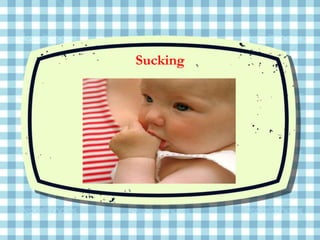
• Sucking Reflex
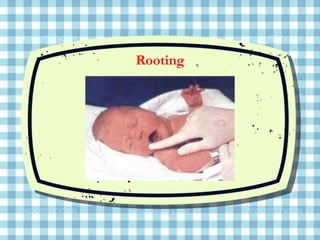
• Rooting Reflex
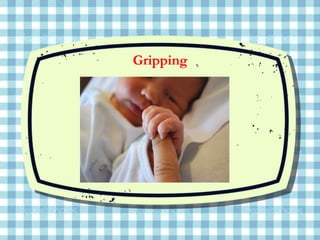
• Gripping Reflex
• Curling Reflex
• Startle/Moro Reflex
• Galant Reflex
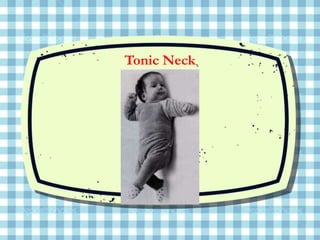
• Tonic Neck Reflex
Sucking
Sucking
Sucking
Rooting
Sucking
Gripping
Sucking
Curling
Sucking
Startle/Moro
Sucking
Tonic Neck
Emotional
Behavior of
Infants and
Toddlers
Emotional Behavior of Infants and
Toddlers
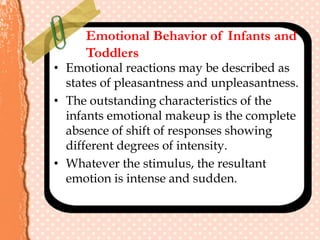
• Emotional reactions may be described as
states of pleasantness and unpleasantness.
• The outstanding characteristics of the
infants emotional makeup is the complete
absence of shift of responses showing
different degrees of intensity.
• Whatever the stimulus, the resultant
emotion is intense and sudden.
Social
Development of
Infants and
Toddlers
Social Development of Infants and
Toddlers
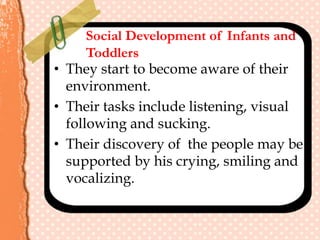
• They start to become aware of their
environment.
• Their tasks include listening, visual
following and sucking.
• Their discovery of the people may be
supported by his crying, smiling and
vocalizing.
Developmental
Milestones for
Children from Ages
4 Months to 2 Years
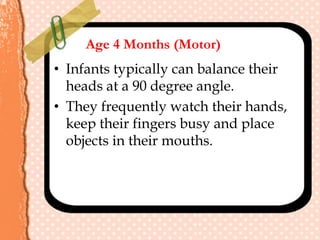
Age 4 Months (Motor)
• Infants typically can balance their
heads at a 90 degree angle.
• They frequently watch their hands,
keep their fingers busy and place
objects in their mouths.
Age 4 Months (Adaptive)
• Infants are able to recognize their
bottles.
• The sight of a bottle often stimulates
bodily activity.
Age 4 Months (Social)
• Infants are able to recognize their
mothers and other familiar faces.
• They imitate smiles and often
respond to familiar people by
reaching, smiling or laughing.
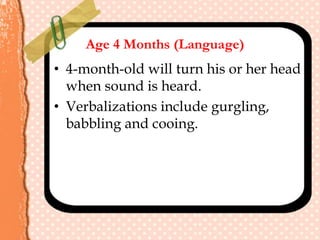
Age 4 Months (Language)
• 4-month-old will turn his or her head
when sound is heard.
• Verbalizations include gurgling,
babbling and cooing.
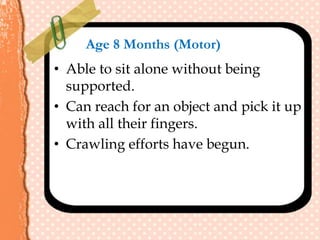
Age 8 Months (Motor)
• Able to sit alone without being
supported.
• Can reach for an object and pick it up
with all their fingers.
• Crawling efforts have begun.
Age 8 Months (Adaptive)
• They can feed themselves pieces of
toast or crackers.
• They will be able to munch instead of
being limited to sucking.
Age 8 Months (Social)
• They begin imitating facial
expressions and gestures.
• They can play peeka-boo and wave
bye-bye.
Age 8 Months (Language)
• Babbling becomes frequent and
complex.
• They attempt copying the verbal
sounds they hear.
• Can say a few words or sounds such
as mama or dada.
Age 1 Year (Motor)
• Most babies can crawl well.
• Usually require support to walk.
• They can open drawers and pull
electrical cords.
Age 1 Year (Adaptive)
• Babies are able to drink from a cup.
• They can feed themselves with their
fingers.
Age 1 Year (Social)
• They tend to repeat behaviors that
are laughed at.
• They also seek attention by squealing
or making noises.
Age 1 Year (Language)
• Babies begin to pay attention to the
sounds they hear.
• They can understand simple
commands.
Age 18 Months (Motor)
• Baby can walk.
• Walking up stairs can be
accomplished by a caregiver holding
the baby’s hands.
• Able to push large objects and pull
toys.
Age 18 Months (Adaptive)
• Ability to feed themselves is much
improved.
• Can hold their own glasses.
• Can cooperate in dressing.
Age 18 Months (Social)
• It is normal for them to be aware of
other children and even enjoy having
them around; however, they don’t
play with others.
Age 18 Months (Language)
• Vocabularies consist of more than
three but less than fifty words.
• They can understand language to
some extent.
Age 2 Years (Motor)
• Can walk and run quite well.
• Throwing a ball in an overhead
manner.
• They are also capable of turning
pages of a book.
Age 2 Years (Adaptive)
• Capable of listening to and following
directions.
• They attempt washing their hands.
Age 2 Years (Social)
• They are becoming more and more
aware of feelings and reactions of
adults.
• They begin to seek adult approval for
correct behavior.
• They also begin to show their
emotions in the forms of affection,
guilt or pity.
Age 2 Years (Language)
• Can usually put two or three words
together to express an idea.
• Simple directions and requests are
usually understood.
Israel R. Asinas
May 10, 2016
Presented by: Israel R. Asinas
-END-

359724731-Development-during-Infancy-and-Toddlerhood-ppt.ppt

  • 1.
    Israel R. Asinas May10, 2016 Presented by: Israel R. Asinas Development During Infancy and Toddlerhood Israel R. Asinas Discussant
  • 2.
    Israel R. Asinas May10, 2016 Presented by: Israel R. Asinas Coverage: • Characteristics of Infancy and Toddlerhood • Emotional Behavior in Infancy and Toddlerhood • Development and Socialization
  • 3.
    Infancy is the beginningor early period of existence as an individual.
  • 4.
    “Toddler” is the termapplied to one and two year old children.
  • 5.
  • 6.
    1. It isthe true foundation of age.
  • 7.
    2. It isan age of rapid growth and development.
  • 8.
    3. It isan age of decreasing dependency.
  • 9.
    4. It isbeginning of creativity, sex role typing and socialization.
  • 10.
    5. It isa hazardous period.
  • 11.
  • 12.
    Physical Proportions and BrainDevelopment • The head grows the fastest and matures the earliest, followed by the rest of the body downward. • Parts that are closest to the center of the infant's body (e.g., the trunk) grow faster and mature earlier than do parts that are farther from the center (e.g., the hands). • The physical structure of the brain develops rapidly as well. .
  • 13.
    Motor Development (Reflexes) •Sucking Reflex • Rooting Reflex • Gripping Reflex • Curling Reflex • Startle/Moro Reflex • Galant Reflex • Tonic Neck Reflex
  • 14.
  • 15.
  • 16.
  • 17.
  • 18.
  • 19.
  • 20.
  • 21.
    Emotional Behavior ofInfants and Toddlers • Emotional reactions may be described as states of pleasantness and unpleasantness. • The outstanding characteristics of the infants emotional makeup is the complete absence of shift of responses showing different degrees of intensity. • Whatever the stimulus, the resultant emotion is intense and sudden.
  • 22.
  • 23.
    Social Development ofInfants and Toddlers • They start to become aware of their environment. • Their tasks include listening, visual following and sucking. • Their discovery of the people may be supported by his crying, smiling and vocalizing.
  • 24.
  • 25.
    Age 4 Months(Motor) • Infants typically can balance their heads at a 90 degree angle. • They frequently watch their hands, keep their fingers busy and place objects in their mouths.
  • 26.
    Age 4 Months(Adaptive) • Infants are able to recognize their bottles. • The sight of a bottle often stimulates bodily activity.
  • 27.
    Age 4 Months(Social) • Infants are able to recognize their mothers and other familiar faces. • They imitate smiles and often respond to familiar people by reaching, smiling or laughing.
  • 28.
    Age 4 Months(Language) • 4-month-old will turn his or her head when sound is heard. • Verbalizations include gurgling, babbling and cooing.
  • 29.
    Age 8 Months(Motor) • Able to sit alone without being supported. • Can reach for an object and pick it up with all their fingers. • Crawling efforts have begun.
  • 30.
    Age 8 Months(Adaptive) • They can feed themselves pieces of toast or crackers. • They will be able to munch instead of being limited to sucking.
  • 31.
    Age 8 Months(Social) • They begin imitating facial expressions and gestures. • They can play peeka-boo and wave bye-bye.
  • 32.
    Age 8 Months(Language) • Babbling becomes frequent and complex. • They attempt copying the verbal sounds they hear. • Can say a few words or sounds such as mama or dada.
  • 33.
    Age 1 Year(Motor) • Most babies can crawl well. • Usually require support to walk. • They can open drawers and pull electrical cords.
  • 34.
    Age 1 Year(Adaptive) • Babies are able to drink from a cup. • They can feed themselves with their fingers.
  • 35.
    Age 1 Year(Social) • They tend to repeat behaviors that are laughed at. • They also seek attention by squealing or making noises.
  • 36.
    Age 1 Year(Language) • Babies begin to pay attention to the sounds they hear. • They can understand simple commands.
  • 37.
    Age 18 Months(Motor) • Baby can walk. • Walking up stairs can be accomplished by a caregiver holding the baby’s hands. • Able to push large objects and pull toys.
  • 38.
    Age 18 Months(Adaptive) • Ability to feed themselves is much improved. • Can hold their own glasses. • Can cooperate in dressing.
  • 39.
    Age 18 Months(Social) • It is normal for them to be aware of other children and even enjoy having them around; however, they don’t play with others.
  • 40.
    Age 18 Months(Language) • Vocabularies consist of more than three but less than fifty words. • They can understand language to some extent.
  • 41.
    Age 2 Years(Motor) • Can walk and run quite well. • Throwing a ball in an overhead manner. • They are also capable of turning pages of a book.
  • 42.
    Age 2 Years(Adaptive) • Capable of listening to and following directions. • They attempt washing their hands.
  • 43.
    Age 2 Years(Social) • They are becoming more and more aware of feelings and reactions of adults. • They begin to seek adult approval for correct behavior. • They also begin to show their emotions in the forms of affection, guilt or pity.
  • 44.
    Age 2 Years(Language) • Can usually put two or three words together to express an idea. • Simple directions and requests are usually understood.
  • 45.
    Israel R. Asinas May10, 2016 Presented by: Israel R. Asinas -END-