The first yearafter birth is called infancy.
Infancy is a period when the baby grows very fast.
The baby doubles in length and triples in weight.
INfancy ages: from birth to 1
For the first month after birth, an infant is called a newborn.
Newborns need about 18 hours of sleep each day. They need long naps
throughout the day.
Erik Erikson's theory of psychosocial development-Infants learn to trust
that their caregivers will meet their basic needs. If these needs are not
consistently met, mistrust, suspicion, and anxiety may develop.
According to Piaget, at the start of the sensorimotor stage (0-2 years old),
infants are only aware of what is right in front of them. They learn with
their senses and motor skills, focusing on what they see and do (visual
and physical interactions) within their immediate environment
According to Freud (stage 1 (0-1) Infant babies' oral desire, often from
their mother, is crucial for their happiness, but lack of stimulation can lead
to hidden aggressive or passive habits.
Montessori theory suggests that a child's journey towards independence
begins from birth and continues as they develop into fully functioning,
empowered individuals.
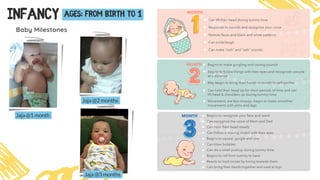
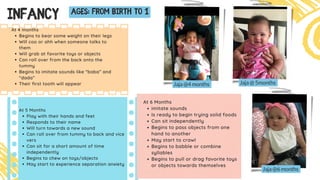
Jaja @1 month
BabyMilestones
INfancy ages: from birth to 1
Jaja @2 months
Jaja @3 months
5.
At 4 months
Beginsto bear some weight on their legs
Will coo or ahh when someone talks to
them
Will grab at favorite toys or objects
Can roll over from the back onto the
tummy
Begins to imitate sounds like “baba” and
“dada”
Their first tooth will appear
INfancy ages: from birth to 1
Jaja @4 months Jaja @ 5months
Jaja @6 months
At 6 Months
imitate sounds
Is ready to begin trying solid foods
Can sit independently
Begins to pass objects from one
hand to another
May start to crawl
Begins to babble or combine
syllables
Begins to pull or drag favorite toys
or objects towards themselves
At 5 Months
Play with their hands and feet
Responds to their name
Will turn towards a new sound
Can roll over from tummy to back and vice
vers
Can sit for a short amount of time
independently
Begins to chew on toys/objects
May start to experience separation anxiety
6.
INfancy ages: frombirth to 1
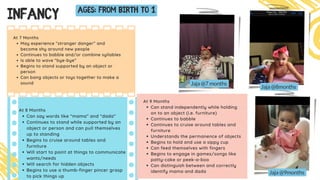
Jaja @7 months
Jaja @8months
Jaja @9months
At 7 Months
May experience “stranger danger” and
become shy around new people
Continues to babble and/or combine syllables
Is able to wave “bye-bye”
Begins to stand supported by an object or
person
Can bang objects or toys together to make a
sound
At 8 Months
Can say words like “mama” and “dada”
Continues to stand while supported by an
object or person and can pull themselves
up to standing
Begins to cruise around tables and
furniture
Will start to point at things to communicate
wants/needs
Will search for hidden objects
Begins to use a thumb-finger pincer grasp
to pick things up
At 9 Months
Can stand independently while holding
on to an object (i.e. furniture)
Continues to babble
Continues to cruise around tables and
furniture
Understands the permanence of objects
Begins to hold and use a sippy cup
Can feed themselves with fingers
Begins to engage in games/songs like
patty-cake or peek-a-boo
Can distinguish between and correctly
identify mama and dada
7.
INfancy
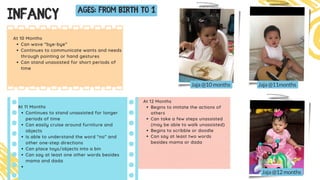
Jaja @10 monthsJaja @11months
Jaja @12 months
At 10 Months
Can wave “bye-bye”
Continues to communicate wants and needs
through pointing or hand gestures
Can stand unassisted for short periods of
time
ages: from birth to 1
At 11 Months
Continues to stand unassisted for longer
periods of time
Can easily cruise around furniture and
objects
Is able to understand the word “no” and
other one-step directions
Can place toys/objects into a bin
Can say at least one other words besides
mama and dada
At 12 Months
Begins to imitate the actions of
others
Can take a few steps unassisted
(may be able to walk unassisted)
Begins to scribble or doodle
Can say at least two words
besides mama or dada
8.
01
02
03
Infant’ Needs
04
06
07
08
09
10
Love, attention,and Security
Long sleep
Basic needs: milk,
nappies,clothes, healthy
food
Daily routines: bathing, reading
Things to look at and some toys
Immunization
Sunlight
Talk ,sing and read with
them
Safety
9.
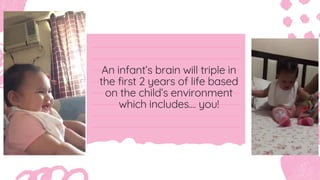
An infant’s brainwill triple in
the first 2 years of life based
on the child’s environment
which includes.... you!
10.
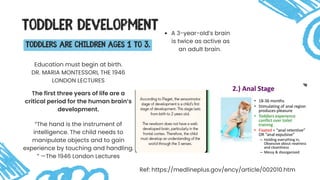
TODDLER DEVELOPMENT
Toddlers arechildren ages 1 to 3.
Education must begin at birth.
DR. MARIA MONTESSORI, THE 1946
LONDON LECTURES
The first three years of life are a
critical period for the human brain’s
development.
“The hand is the instrument of
intelligence. The child needs to
manipulate objects and to gain
experience by touching and handling.
” —The 1946 London Lectures
Ref: https://medlineplus.gov/ency/article/002010.htm
A 3-year-old’s brain
is twice as active as
an adult brain.
11.
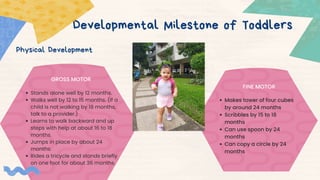
Developmental Milestone ofToddlers
Physical Development
GROSS MOTOR
Makes tower of four cubes
by around 24 months
Scribbles by 15 to 18
months
Can use spoon by 24
months
Can copy a circle by 24
months
Stands alone well by 12 months.
Walks well by 12 to 15 months. (If a
child is not walking by 18 months,
talk to a provider.)
Learns to walk backward and up
steps with help at about 16 to 18
months.
Jumps in place by about 24
months.
Rides a tricycle and stands briefly
on one foot for about 36 months.
FINE MOTOR
12.
Learning of SkillsCannot Occur Until the Child Is Maturationally
Ready.
Individual Differences Affect the Rate of Motor Development.
Skills will not develop through maturation alone. They must be
learned.
Importance of timing (effectiveness) (Connolly et al.)
WHAT’S THE IDEAL AGE FOR LEARNING MOTOR SKILLS? When a
person is maturationally ready, skills can be learned at any age.
even in old age.
Opportunity to Learn, Deprivation, Perfection (influenced by the
environment)
Motor Skills
13.
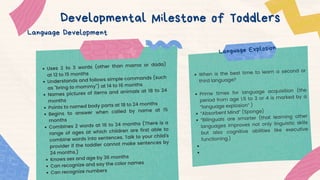
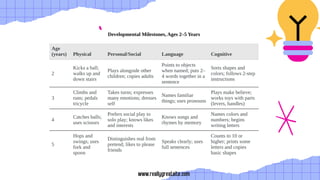
Uses 2 to3 words (other than mama or dada)
at 12 to 15 months
Understands and follows simple commands (such
as "bring to mommy") at 14 to 16 months
Names pictures of items and animals at 18 to 24
months
Points to named body parts at 18 to 24 months
Begins to answer when called by name at 15
months
Combines 2 words at 16 to 24 months (There is a
range of ages at which children are first able to
combine words into sentences. Talk to your child's
provider if the toddler cannot make sentences by
24 months.)
Knows sex and age by 36 months
Can recognize and say the color names
Can recognize numbers
Language Explosion
Language Development
Developmental Milestone of Toddlers
When is the best time to learn a second or
third language?
Prime times for language acquisition (the
period from age 1.5 to 3 or 4 is marked by a
“language explosion” )
“Absorbent Mind” (Sponge)
“Bilinguals are smarter (that learning other
languages improves not only linguistic skills
but also cognitive abilities like executive
functioning.)
14.
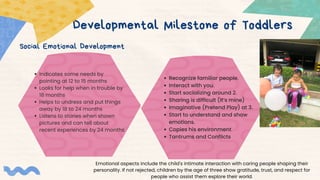
Developmental Milestone ofToddlers
Social Emotional Development
Recognize familiar people.
Interact with you.
Start socializing around 2.
Sharing is difficult (It’s mine)
Imaginative (Pretend Play) at 3.
Start to understand and show
emotions.
Copies his environment
Tantrums and Conflicts
Indicates some needs by
pointing at 12 to 15 months
Looks for help when in trouble by
18 months
Helps to undress and put things
away by 18 to 24 months
Listens to stories when shown
pictures and can tell about
recent experiences by 24 months
Emotional aspects include the child's intimate interaction with caring people shaping their
personality. If not rejected, children by the age of three show gratitude, trust, and respect for
people who assist them explore their world.
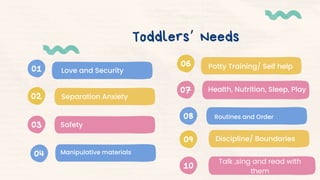
01
02
03
Toddlers’ Needs
Love andSecurity
Separation Anxiety
Safety
04
06
07
Manipulative materials
Potty Training/ Self help
Health, Nutrition, Sleep, Play
Routines and Order
08
Discipline/ Boundaries
09
Talk ,sing and read with
them
10
17.
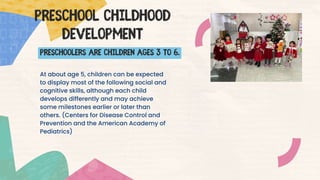
At about age5, children can be expected
to display most of the following social and
cognitive skills, although each child
develops differently and may achieve
some milestones earlier or later than
others. (Centers for Disease Control and
Prevention and the American Academy of
Pediatrics)
Preschool childhood
DEVELOPMENT
PRESCHOOLERS are children ages 3 to 6.
18.
Developmental Milestone ofPreschoolers
Social Emotional Development
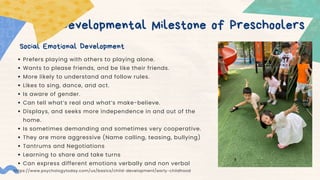
Prefers playing with others to playing alone.
Wants to please friends, and be like their friends.
More likely to understand and follow rules.
Likes to sing, dance, and act.
Is aware of gender.
Can tell what’s real and what’s make-believe.
Displays, and seeks more independence in and out of the
home.
Is sometimes demanding and sometimes very cooperative.
They are more aggressive (Name calling, teasing, bullying)
Tantrums and Negotiations
Learning to share and take turns
Can express different emotions verbally and non verbal
https://www.psychologytoday.com/us/basics/child-development/early-childhood
19.
Cognitive Development andCommunication Skills
Developmental Milestone of Preschoolers
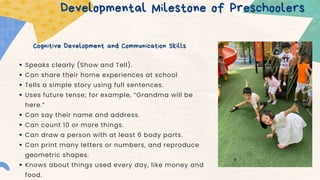
Speaks clearly (Show and Tell).
Can share their home experiences at school
Tells a simple story using full sentences.
Uses future tense; for example, “Grandma will be
here.”
Can say their name and address.
Can count 10 or more things.
Can draw a person with at least 6 body parts.
Can print many letters or numbers, and reproduce
geometric shapes.
Knows about things used every day, like money and
food.
01
02
03
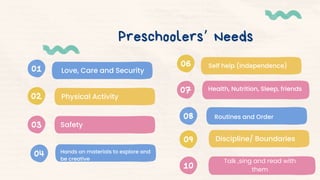
Preschoolers’ Needs
Love, Careand Security
Physical Activity
Safety
04
06
07
Hands on materials to explore and
be creative
Self help (Independence)
Health, Nutrition, Sleep, friends
Routines and Order
08
Discipline/ Boundaries
09
Talk ,sing and read with
them
10
23.
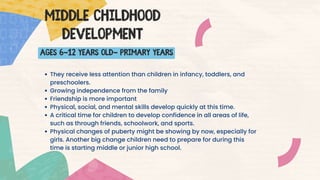
They receive lessattention than children in infancy, toddlers, and
preschoolers.
Growing independence from the family
Friendship is more important
Physical, social, and mental skills develop quickly at this time.
A critical time for children to develop confidence in all areas of life,
such as through friends, schoolwork, and sports.
Physical changes of puberty might be showing by now, especially for
girls. Another big change children need to prepare for during this
time is starting middle or junior high school.
MIDDLE childhood
DEVELOPMENT
Ages 6-12 years old- primary Years
25.
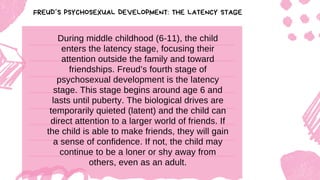
During middle childhood(6-11), the child
enters the latency stage, focusing their
attention outside the family and toward
friendships. Freud’s fourth stage of
psychosexual development is the latency
stage. This stage begins around age 6 and
lasts until puberty. The biological drives are
temporarily quieted (latent) and the child can
direct attention to a larger world of friends. If
the child is able to make friends, they will gain
a sense of confidence. If not, the child may
continue to be a loner or shy away from
others, even as an adult.
FREUD’S PSYCHOSEXUAL DEVELOPMENT: THE LATENCY STAGE
26.
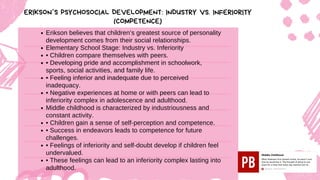
Erikson believes thatchildren’s greatest source of personality
development comes from their social relationships.
Elementary School Stage: Industry vs. Inferiority
• Children compare themselves with peers.
• Developing pride and accomplishment in schoolwork,
sports, social activities, and family life.
• Feeling inferior and inadequate due to perceived
inadequacy.
• Negative experiences at home or with peers can lead to
inferiority complex in adolescence and adulthood.
Middle childhood is characterized by industriousness and
constant activity.
• Children gain a sense of self-perception and competence.
• Success in endeavors leads to competence for future
challenges.
• Feelings of inferiority and self-doubt develop if children feel
undervalued.
• These feelings can lead to an inferiority complex lasting into
adulthood.
ERIKSON’S PSYCHOSOCIAL DEVELOPMENT: INDUSTRY VS. INFERIORITY
(COMPETENCE)
27.
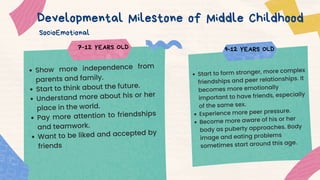
Show more independencefrom
parents and family.
Start to think about the future.
Understand more about his or her
place in the world.
Pay more attention to friendships
and teamwork.
Want to be liked and accepted by
friends
SocioEmotional
Developmental Milestone of Middle Childhood
Start to form stronger, more complex
friendships and peer relationships. It
becomes more emotionally
important to have friends, especially
of the same sex.
Experience more peer pressure.
Become more aware of his or her
body as puberty approaches. Body
image and eating problems
sometimes start around this age.
7-12 YEARS OLD 9-12 YEARS OLD
28.
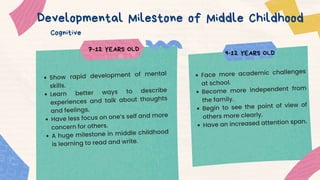
Show rapid developmentof mental
skills.
Learn better ways to describe
experiences and talk about thoughts
and feelings.
Have less focus on one’s self and more
concern for others.
A huge milestone in middle childhood
is learning to read and write.
Cognitive
Developmental Milestone of Middle Childhood
Face more academic challenges
at school.
Become more independent from
the family.
Begin to see the point of view of
others more clearly.
Have an increased attention span.
7-12 YEARS OLD
9-12 YEARS OLD
29.
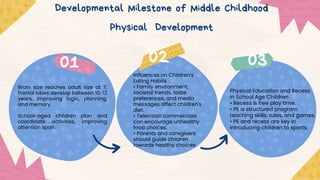
01 03
Physical Development
02
Brainsize reaches adult size at 7,
frontal lobes develop between 10-12
years, improving logic, planning,
and memory.
School-aged children plan and
coordinate activities, improving
attention span.
Influences on Children's
Eating Habits
• Family environment,
societal trends, taste
preferences, and media
messages affect children's
diet.
• Television commercials
can encourage unhealthy
food choices.
• Parents and caregivers
should guide children
towards healthy choices.
Physical Education and Recess
in School Age Children
• Recess is free play time.
• PE is structured program
teaching skills, rules, and games.
• PE and recess are key in
introducing children to sports.
Developmental Milestone of Middle Childhood
30.
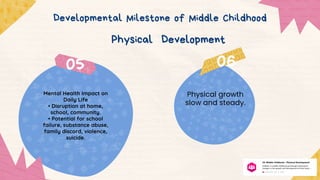
05
Physical Development
06
Physical growth
slowand steady.
Mental Health Impact on
Daily Life
• Disruption at home,
school, community.
• Potential for school
failure, substance abuse,
family discord, violence,
suicide.
Developmental Milestone of Middle Childhood
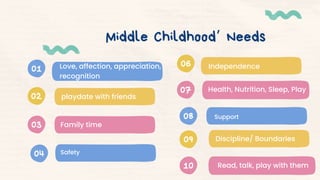
31.
01
02
03
Middle Childhood’ Needs
Love,affection, appreciation,
recognition
playdate with friends
Family time
04
06
07
Safety
Independence
Health, Nutrition, Sleep, Play
Support
08
Discipline/ Boundaries
09
10 Read, talk, play with them
32.
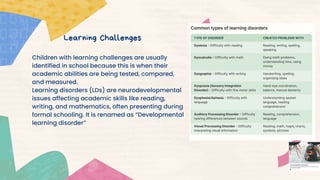
Children with learningchallenges are usually
identified in school because this is when their
academic abilities are being tested, compared,
and measured.
Learning disorders (LDs) are neurodevelopmental
issues affecting academic skills like reading,
writing, and mathematics, often presenting during
formal schooling. It is renamed as “Developmental
learning disorder”
Learning Challenges
33.
Learning Difficulties andDisability Definitions
• Learning difficulty is a mild form of difficulty, evident on
standardized tests.
• Learning disability is severe difficulty evident on
standardized tests, with no significant improvement despite
therapeutic efforts.
• The concept of learning disability is a spectrum of severity
from learning difficulty to disability.ic
• Some authors use the term "learning disability" to refer to
intellectual developmental disability, also known as mental
retardation in ICD-10(International Classification of Diseases)
and intellectual developmental disorder in DSM-5.
• Intellectual delay causes poor scholastic performance and is
characterized by global developmental delay. Subcategories
in ICD-10 are mild, moderate, severe, and profound.
Learning Challenges
34.
Learning Disabilities andBrain Processing
• Learning disabilities are caused by differences in brain function
and information processing.
• Children with learning disabilities typically have average or
above-average intelligence.
• These differences affect how average to above-average
intelligence receives, processes, or expresses information.
• Despite compensating or overcoming the disorder, these
differences in brain processing persist throughout life.
Learning Challenges