
WHAT IS
MOC studied by NIDA BUSINESS SCHOOL (FLEX’27)
MOC 2nd CHAPTER
STRATEGY
?
CHAPTER2
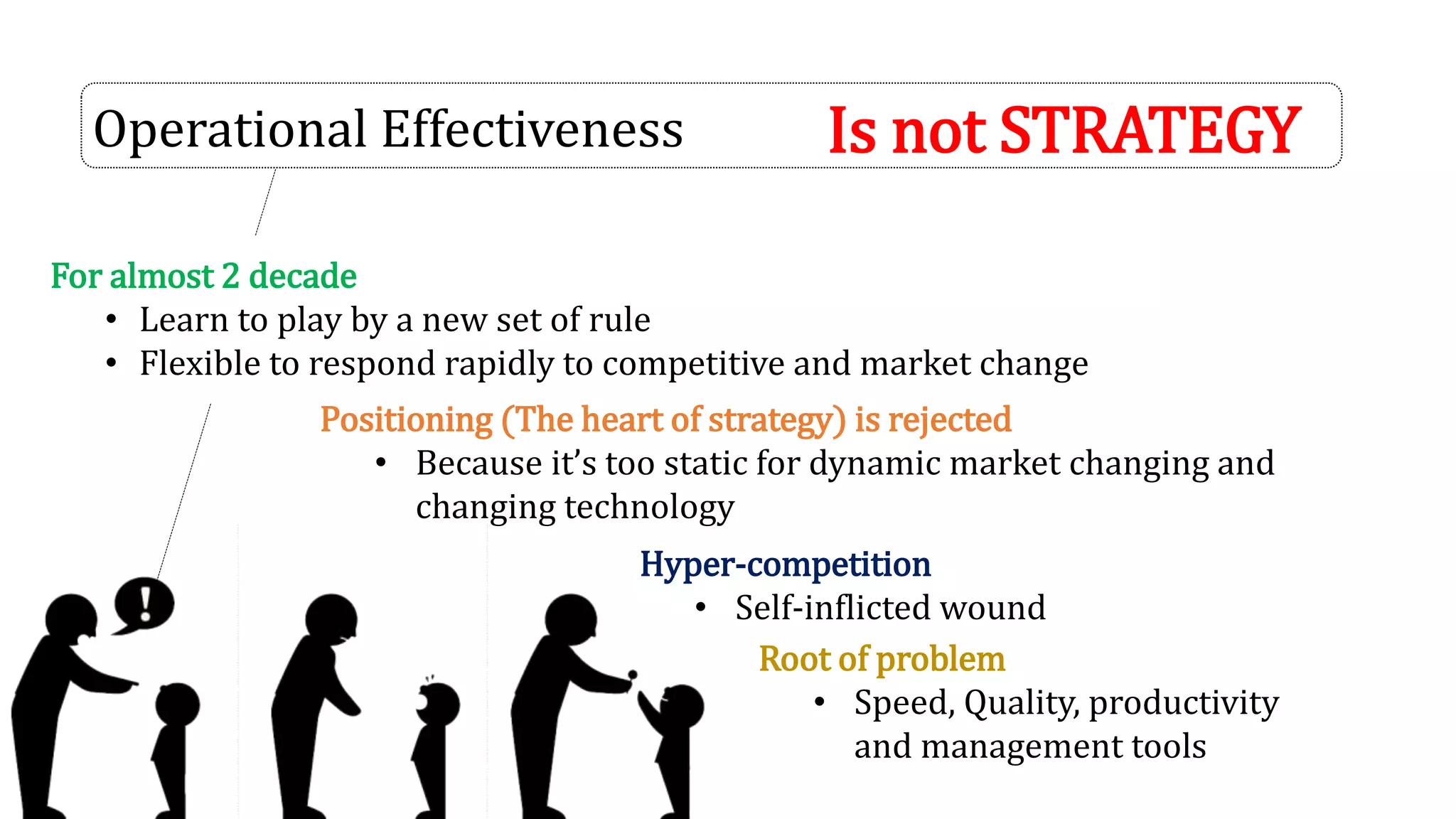
Operational Effectiveness Is not STRATEGY
For almost 2 decade
• Learn to play by a new set of rule
• Flexible to respond rapidly to competitive and market change
Hyper-competition
• Self-inflicted wound
Root of problem
• Speed, Quality, productivity
and management tools
Positioning (The heart of strategy) is rejected
• Because it’s too static for dynamic market changing and
changing technology
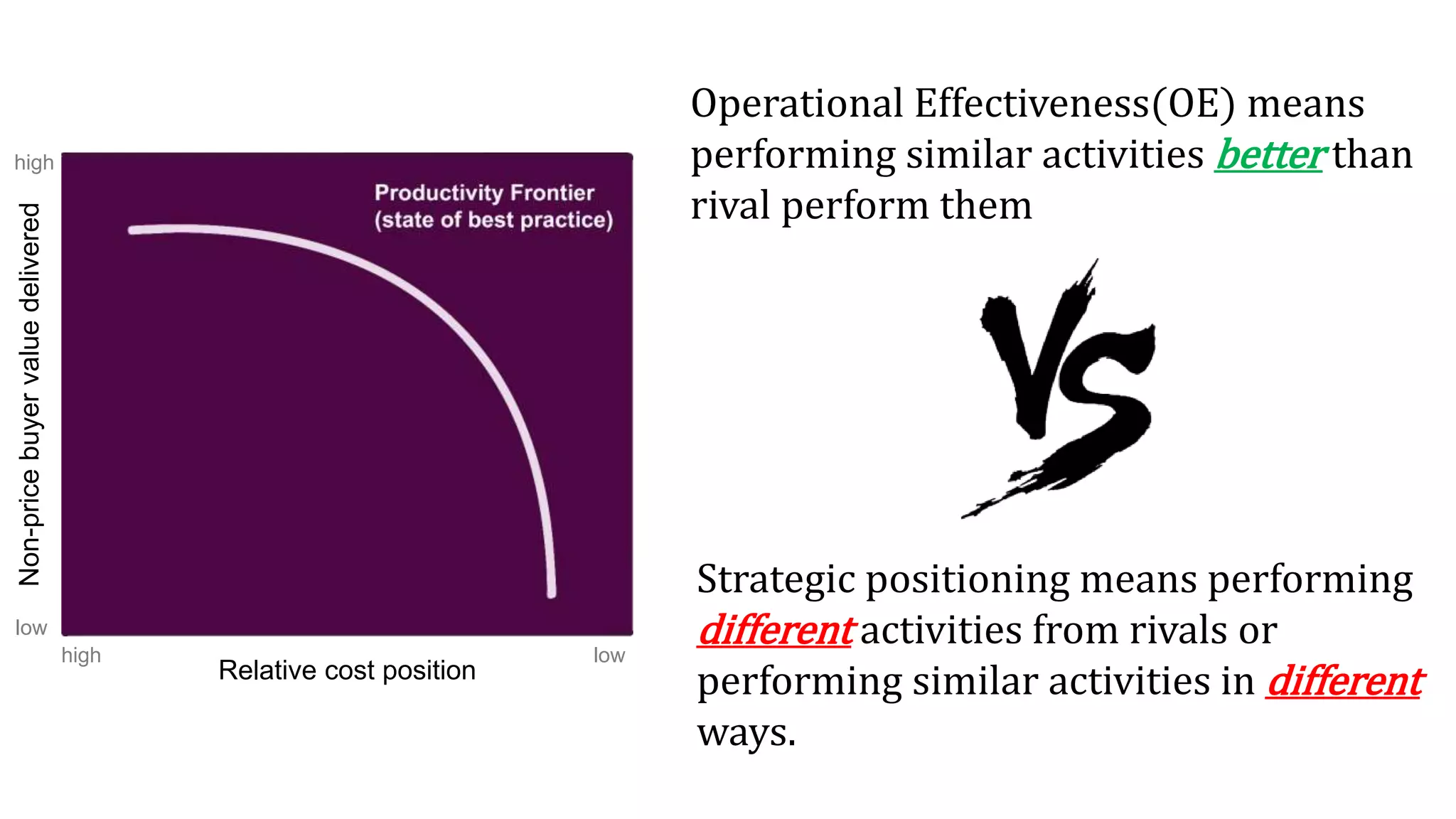
Operational Effectiveness(OE) means
performing similar activities better than
rival perform them
Strategic positioning means performing
different activities from rivals or
performing similar activities in different
ways.
Non-pricebuyervaluedelivered
Relative cost position
high
high
low
low
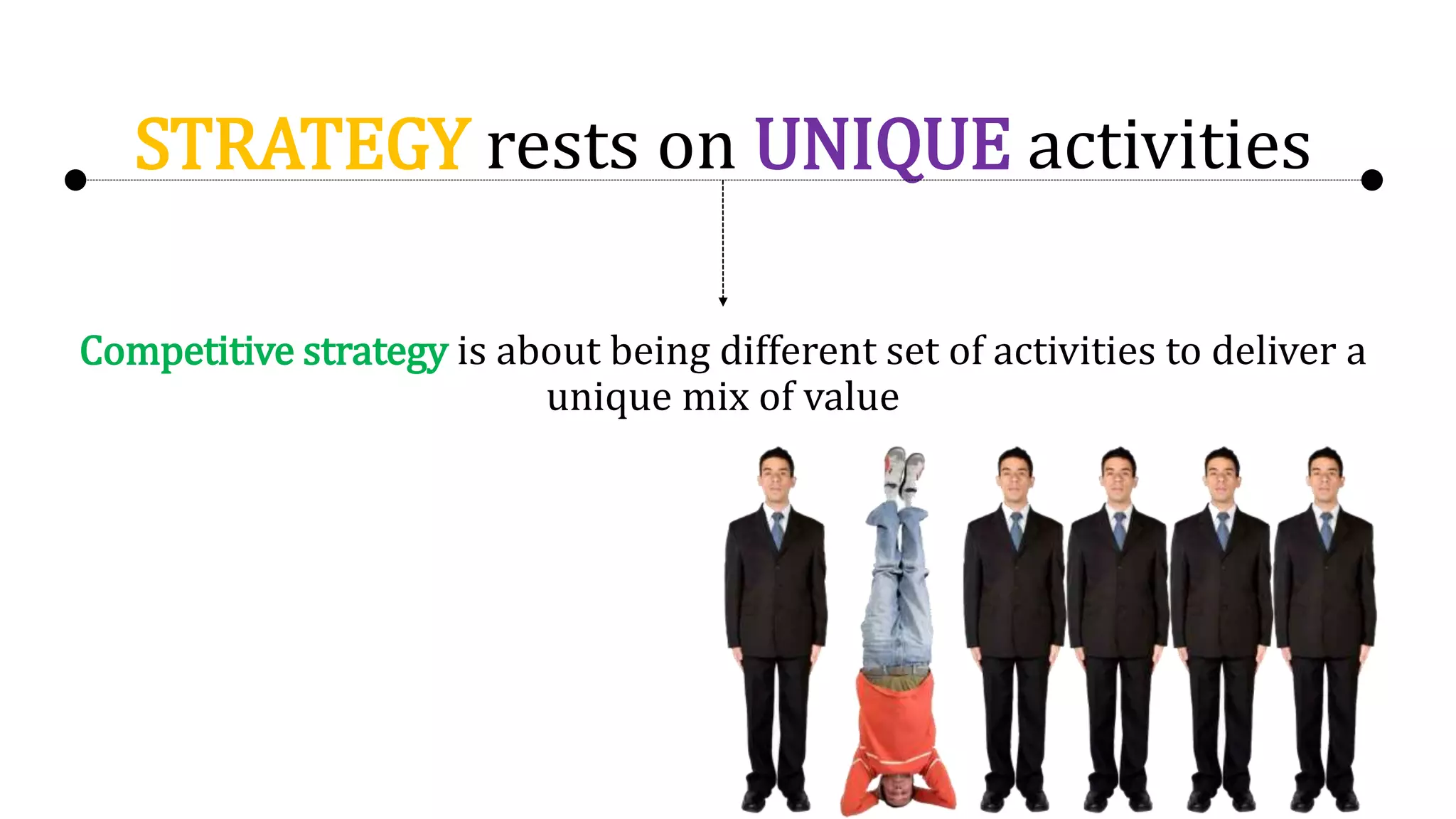
STRATEGY rests on UNIQUE activities
Competitive strategy is about being different set of activities to deliver a
unique mix of value
The origin of strategic position
Variety-based positioning
• Choice of product or service varieties
Needs-based positioning
• Serving most or all the needs of a particular group of customers
Access-based positioning
• Segmenting customers who are accessible in different way.
However, positioning is not always a function of differences on the
demand or customer side. Variety and access positioning in particular, do not
rely on any customer difference
Strategy is the creation of a unique and valuable
position, involving a different set of activities.
A Sustainable Strategic Position Requires Trade-offs
Why do Trade-offs arise?
• Inconsistencies in image or reputation
• Trade offs within activities themselves
• Product features may be incompatible
“You cannot be everything for everyone by
having strategy, it means you have made a
decision to trade off one thing with another”
Michael E. Porter
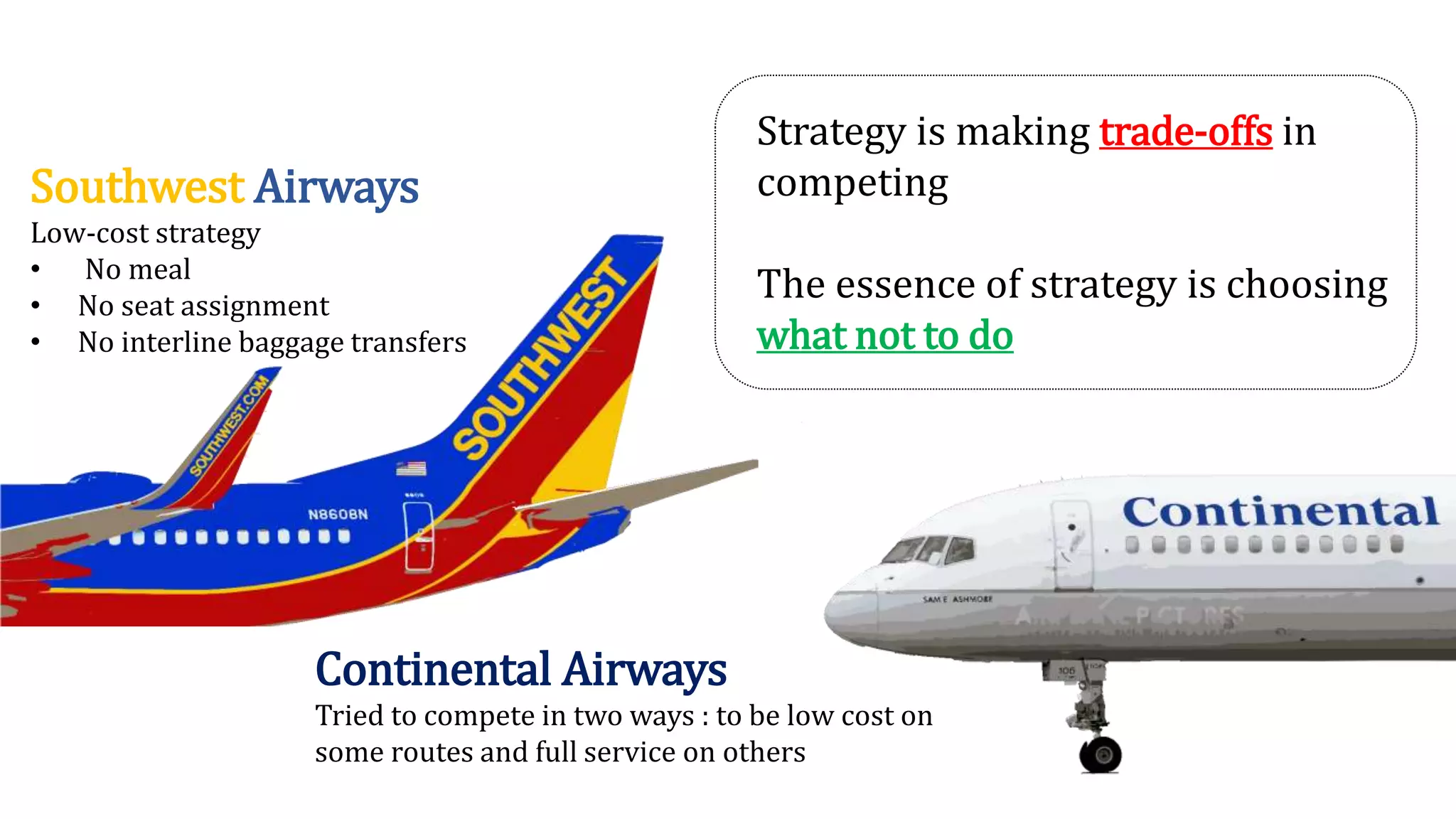
Continental Airways
Tried to compete in two ways : to be low cost on
some routes and full service on others
Southwest Airways
Low-cost strategy
• No meal
• No seat assignment
• No interline baggage transfers
Strategy is making trade-offs in
competing
The essence of strategy is choosing
what not to do
Fit drives both Competitive Advantage and Sustainability
1. Simple Consistency
First-order fit is Simple consistency between each activity (function) and the overall strategy
Ex. Vanguard
2. Activities are reinforcing
Second-order fit occurs when activities are reinforcing
Ex. Neutrogena
3. Optimization of effort
Third-order fit goes beyond activity reinforcement
Ex. The Gap
Types of fit… How Fit work
“ ”
“ ”
FIT and SUSTAINABILITY
Strategyis creating fit among a company’s activities.
The success of a strategy depends on doing many things and integrating
among them. If there is no fit among activities, there is no distinctive
strategy and little sustainability.
Strategicfitamong many activities is fundamental not only
to competitive advantage but also to the sustainability of that
advantage
FAILURE TO CHOOSE
• Many companies and managers do not
understand need of strategy
• Imitating their competitor by flooded
business information
• Operating far from productivity frontier
• Pressured to deliver tangible and measurable
performance
• Pursuit of operational effectiveness
GROWTH TRAP
• Many managers tempted to incremental
growth but blur strategy
• Compromise in pursuit of growth is erode
competitive advantage
• Answer seen as revenue growth, but profit
decline
PROFITABLE GROWTH
• Concentrate in deepening a strategic position
- Deepening make distinctiveness,
strengthen fit and good communicate to
valued customer
- Extension the existing activity system,
that are feasible and rivals would find
impossible to match
ROLE OF LEADERSHIP
• Cleared strategy depend on strong leadership
- Leadership…
Making choice/ trade-off/ defining
and communicating company’s unique
position/ provide the discipline/ teach
lower level manager
• Manager must clearly distinguish
operational effectiveness from strategy
• Strategy renders choices about
- What not to do
- What to do
• However, a company’s choice of a new
position must be driven by the ability
into a sustainable advantage
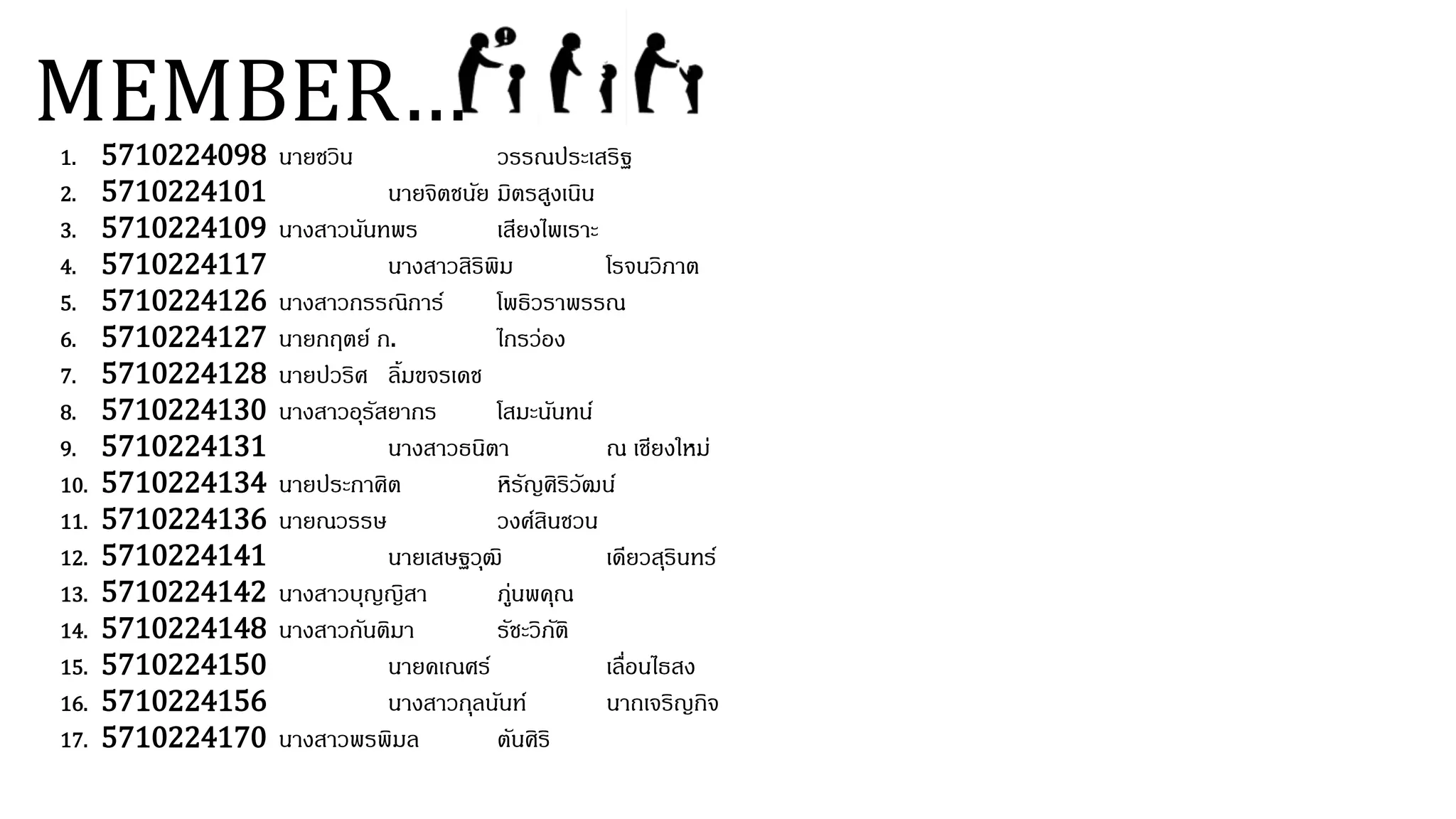
MEMBER…1. 5710224098 นายชวิน วรรณประเสริฐ
2. 5710224101 นายจิตชนัย มิตรสูงเนิน
3. 5710224109 นางสาวนันทพร เสียงไพเราะ
4. 5710224117 นางสาวสิริพิม โรจนวิภาต
5. 5710224126 นางสาวกรรณิการ์ โพธิวราพรรณ
6. 5710224127 นายกฤตย์ ก. ไกรว่อง
7. 5710224128 นายปวริศ ลิ้มขจรเดช
8. 5710224130 นางสาวอุรัสยากร โสมะนันทน์
9. 5710224131 นางสาวธนิตา ณ เชียงใหม่
10. 5710224134 นายประกาศิต หิรัญศิริวัฒน์
11. 5710224136 นายณวรรษ วงศ์สินชวน
12. 5710224141 นายเสษฐวุฒิ เดียวสุรินทร์
13. 5710224142 นางสาวบุญญิสา ภู่นพคุณ
14. 5710224148 นางสาวกันติมา รัชะวิภัติ
15. 5710224150 นายคเณศร์ เลื่อนไธสง
16. 5710224156 นางสาวกุลนันท์ นาถเจริญกิจ
17. 5710224170 นางสาวพรพิมล ตันศิริ

On competition chapter 2 what is strategy

  • 1.
    WHAT IS MOC studiedby NIDA BUSINESS SCHOOL (FLEX’27) MOC 2nd CHAPTER STRATEGY ? CHAPTER2
  • 2.
    Operational Effectiveness Isnot STRATEGY For almost 2 decade • Learn to play by a new set of rule • Flexible to respond rapidly to competitive and market change Hyper-competition • Self-inflicted wound Root of problem • Speed, Quality, productivity and management tools Positioning (The heart of strategy) is rejected • Because it’s too static for dynamic market changing and changing technology
  • 3.
    Operational Effectiveness(OE) means performingsimilar activities better than rival perform them Strategic positioning means performing different activities from rivals or performing similar activities in different ways. Non-pricebuyervaluedelivered Relative cost position high high low low
  • 4.
    STRATEGY rests onUNIQUE activities Competitive strategy is about being different set of activities to deliver a unique mix of value
  • 5.
    The origin ofstrategic position Variety-based positioning • Choice of product or service varieties Needs-based positioning • Serving most or all the needs of a particular group of customers Access-based positioning • Segmenting customers who are accessible in different way. However, positioning is not always a function of differences on the demand or customer side. Variety and access positioning in particular, do not rely on any customer difference Strategy is the creation of a unique and valuable position, involving a different set of activities.
  • 6.
    A Sustainable StrategicPosition Requires Trade-offs Why do Trade-offs arise? • Inconsistencies in image or reputation • Trade offs within activities themselves • Product features may be incompatible “You cannot be everything for everyone by having strategy, it means you have made a decision to trade off one thing with another” Michael E. Porter
  • 7.
    Continental Airways Tried tocompete in two ways : to be low cost on some routes and full service on others Southwest Airways Low-cost strategy • No meal • No seat assignment • No interline baggage transfers Strategy is making trade-offs in competing The essence of strategy is choosing what not to do
  • 8.
    Fit drives bothCompetitive Advantage and Sustainability 1. Simple Consistency First-order fit is Simple consistency between each activity (function) and the overall strategy Ex. Vanguard 2. Activities are reinforcing Second-order fit occurs when activities are reinforcing Ex. Neutrogena 3. Optimization of effort Third-order fit goes beyond activity reinforcement Ex. The Gap Types of fit… How Fit work
  • 9.
    “ ” “ ” FITand SUSTAINABILITY Strategyis creating fit among a company’s activities. The success of a strategy depends on doing many things and integrating among them. If there is no fit among activities, there is no distinctive strategy and little sustainability. Strategicfitamong many activities is fundamental not only to competitive advantage but also to the sustainability of that advantage
  • 10.
    FAILURE TO CHOOSE •Many companies and managers do not understand need of strategy • Imitating their competitor by flooded business information • Operating far from productivity frontier • Pressured to deliver tangible and measurable performance • Pursuit of operational effectiveness
  • 11.
    GROWTH TRAP • Manymanagers tempted to incremental growth but blur strategy • Compromise in pursuit of growth is erode competitive advantage • Answer seen as revenue growth, but profit decline
  • 12.
    PROFITABLE GROWTH • Concentratein deepening a strategic position - Deepening make distinctiveness, strengthen fit and good communicate to valued customer - Extension the existing activity system, that are feasible and rivals would find impossible to match
  • 13.
    ROLE OF LEADERSHIP •Cleared strategy depend on strong leadership - Leadership… Making choice/ trade-off/ defining and communicating company’s unique position/ provide the discipline/ teach lower level manager • Manager must clearly distinguish operational effectiveness from strategy
  • 14.
    • Strategy renderschoices about - What not to do - What to do • However, a company’s choice of a new position must be driven by the ability into a sustainable advantage
  • 16.
    MEMBER…1. 5710224098 นายชวินวรรณประเสริฐ 2. 5710224101 นายจิตชนัย มิตรสูงเนิน 3. 5710224109 นางสาวนันทพร เสียงไพเราะ 4. 5710224117 นางสาวสิริพิม โรจนวิภาต 5. 5710224126 นางสาวกรรณิการ์ โพธิวราพรรณ 6. 5710224127 นายกฤตย์ ก. ไกรว่อง 7. 5710224128 นายปวริศ ลิ้มขจรเดช 8. 5710224130 นางสาวอุรัสยากร โสมะนันทน์ 9. 5710224131 นางสาวธนิตา ณ เชียงใหม่ 10. 5710224134 นายประกาศิต หิรัญศิริวัฒน์ 11. 5710224136 นายณวรรษ วงศ์สินชวน 12. 5710224141 นายเสษฐวุฒิ เดียวสุรินทร์ 13. 5710224142 นางสาวบุญญิสา ภู่นพคุณ 14. 5710224148 นางสาวกันติมา รัชะวิภัติ 15. 5710224150 นายคเณศร์ เลื่อนไธสง 16. 5710224156 นางสาวกุลนันท์ นาถเจริญกิจ 17. 5710224170 นางสาวพรพิมล ตันศิริ