


Competitive Environments
Fahim akhtar
Perfect Competition Model
• Workers are free from intervention such as formal
regulation and moral persuasions
• There are no barriers to entry into or exit out of the
market.
• Firms produce homogeneous, identical, units of output that
are not branded.
• Each unit of input, such as units of labour, are also
homogeneous.
Applying this model one can conclude
• Is that targeted market attractive?
• What is the best way to compete in industry for the
higher profit ship?
• What resources are needed for competitive strategy?
Is that targeted market attractive?
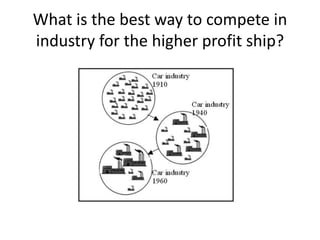
What is the best way to compete in
industry for the higher profit ship?
What resources are needed for
competitive strategy
Barriers to entry
• Structural barriers to entry
• Retaliatory barriers to entry
Structural barriers to entry
• Economies of scale
• Excess capacity
• Product differentiation
• Capital requirement
• Switching cost
• Distribution channel
Economies of scale
Excess capacity
• Excess capacity – market demand
• Excess capacity of production create unfavorable
environment for new ventures
Product differentiation
Capital requirement
Switching cost
• Switching costs are the negative costs that a consumer incurs
as a result of changing suppliers, brands or products. Although
most prevalent switching costs are monetary in nature, there
are also psychological, effort- and time-based switching costs.
•
Distribution channel
Retaliatory barriers to entry
• The size of competitors and their ability to attack.
• The extent and duration of the retaliation.
• The number of competitors who retaliate.
• The ability of competitors to control access to
resources, key suppliers and market channels.
Retaliatory barriers to entry
• Price cutting
• Legal challenges to new ventures
Rivalry between firms
• Numerous and balanced competitors
• Slow industry growth
• High fixed cost
Competitors analysis
• Identifying competitors
• Ranking competitors
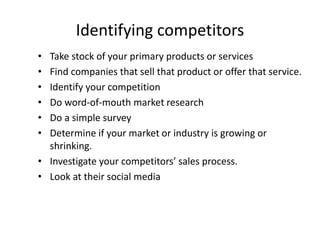
Identifying competitors
• Take stock of your primary products or services
• Find companies that sell that product or offer that service.
• Identify your competition
• Do word-of-mouth market research
• Do a simple survey
• Determine if your market or industry is growing or
shrinking.
• Investigate your competitors’ sales process.
• Look at their social media
Ranking competitors

Copetetive Environment

  • 1.
  • 2.
  • 3.
    Perfect Competition Model •Workers are free from intervention such as formal regulation and moral persuasions • There are no barriers to entry into or exit out of the market. • Firms produce homogeneous, identical, units of output that are not branded. • Each unit of input, such as units of labour, are also homogeneous.
  • 4.
    Applying this modelone can conclude • Is that targeted market attractive? • What is the best way to compete in industry for the higher profit ship? • What resources are needed for competitive strategy?
  • 5.
    Is that targetedmarket attractive?
  • 6.
    What is thebest way to compete in industry for the higher profit ship?
  • 7.
    What resources areneeded for competitive strategy
  • 8.
    Barriers to entry •Structural barriers to entry • Retaliatory barriers to entry
  • 9.
    Structural barriers toentry • Economies of scale • Excess capacity • Product differentiation • Capital requirement • Switching cost • Distribution channel
  • 10.
  • 11.
    Excess capacity • Excesscapacity – market demand • Excess capacity of production create unfavorable environment for new ventures
  • 12.
  • 13.
  • 14.
    Switching cost • Switchingcosts are the negative costs that a consumer incurs as a result of changing suppliers, brands or products. Although most prevalent switching costs are monetary in nature, there are also psychological, effort- and time-based switching costs. •
  • 15.
  • 16.
    Retaliatory barriers toentry • The size of competitors and their ability to attack. • The extent and duration of the retaliation. • The number of competitors who retaliate. • The ability of competitors to control access to resources, key suppliers and market channels.
  • 17.
    Retaliatory barriers toentry • Price cutting • Legal challenges to new ventures
  • 18.
    Rivalry between firms •Numerous and balanced competitors • Slow industry growth • High fixed cost
  • 19.
    Competitors analysis • Identifyingcompetitors • Ranking competitors
  • 20.
    Identifying competitors • Takestock of your primary products or services • Find companies that sell that product or offer that service. • Identify your competition • Do word-of-mouth market research • Do a simple survey • Determine if your market or industry is growing or shrinking. • Investigate your competitors’ sales process. • Look at their social media
  • 21.