Published by www.iiuc28a9.com
 8

                            Tailoring Strategy
                               Chapter Title
                             to Fit Specific
                              Industry and
                           Company Situations

                                     Md. Tarikul Islam
                                  Lecturer in Marketing
16/e PPT                                 IIUC, DC
                                   Cell: 01716 388990
                              E-mail: russelmkg@yahoo.com
                                           .                .
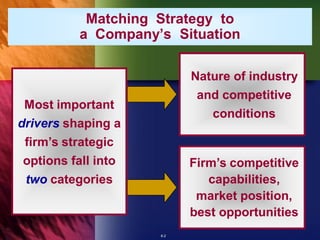
Matching Strategy to
          a Company’s Situation

                           Nature of industry
                            and competitive
 Most important
                              conditions
drivers shaping a
 firm’s strategic
 options fall into         Firm’s competitive
 two categories               capabilities,
                            market position,
                           best opportunities
                     8-2
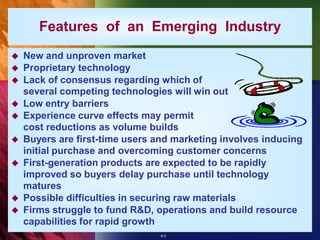
Features of an Emerging Industry
   New and unproven market
   Proprietary technology
   Lack of consensus regarding which of
    several competing technologies will win out
   Low entry barriers
   Experience curve effects may permit
    cost reductions as volume builds
   Buyers are first-time users and marketing involves inducing
    initial purchase and overcoming customer concerns
   First-generation products are expected to be rapidly
    improved so buyers delay purchase until technology
    matures
   Possible difficulties in securing raw materials
   Firms struggle to fund R&D, operations and build resource
    capabilities for rapid growth
                                 8-3
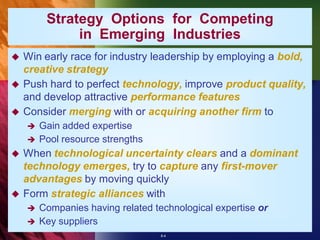
Strategy Options for Competing
              in Emerging Industries
 Win early race for industry leadership by employing a bold,
  creative strategy
 Push hard to perfect technology, improve product quality,
  and develop attractive performance features
 Consider merging with or acquiring another firm to
       Gain added expertise
       Pool resource strengths
   When technological uncertainty clears and a dominant
    technology emerges, try to capture any first-mover
    advantages by moving quickly
   Form strategic alliances with
       Companies having related technological expertise or
       Key suppliers
                                   8-4
Strategy Options for Competing
        in Emerging Industries (continued)
 Pursue    new customers and user applications
 Enter   new geographical areas
 Makeit easy and cheap for first-time buyers to try
 product
 Focus   advertising emphasis on
     Increasing frequency of use
     Creating brand loyalty

 Use   price cuts to attract price-sensitive buyers

                               8-5
Strategic Hurdles for Companies
              in Emerging Industries
   Raising capital to finance initial operations until
       Sales and revenues take off
       Profits appear
       Cash flows turn positive
   Developing a strategy to ride the wave of industry
    growth
       What market segments to pursue
       What competitive advantages to go after
   Managing the rapid expansion of facilities and sales to
    position a company to contend for industry leadership
   Defending against competitors trying to horn in on the
    company’s success
                                      8-6
What Is the Key to Success for
Competing in Rapidly Growing Markets?


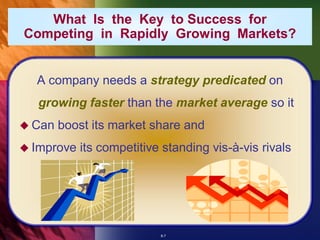
  A company needs a strategy predicated on
  growing faster than the market average so it
 Can   boost its market share and
 Improve   its competitive standing vis-à-vis rivals


                           8-7
Strategy Options for Competing
        in Rapidly Growing Markets
 Drivedown costs per unit to enable price
  reductions that attract droves of new customers
 Pursue rapid product innovation to
   Set a company’s product offering apart from rivals
   Incorporate attributes to appeal to growing numbers of
    customers
 Gain  access to additional distribution
  channels and sales outlets
 Expand a company’s geographic coverage
 Expand product line to add models/styles to appeal
  to a wider range of buyers
                             8-8
Industry Maturity: The Standout Features

 Slowing  demand breeds stiffer competition
 More sophisticated buyers demand bargains
 Greater emphasis on cost and service
 “Topping out” problem in adding
  production capacity
 Product innovation and new
  end uses harder to come by
 International competition increases
 Industry profitability falls
 Mergers and acquisitions reduce number of rivals
                          8-9
Strategy Options for Competing
              in a Mature Industry
 cut   back marginal products and models

 Emphasize    innovation in the value chain

 Strong   focus on cost reduction

 Increase   sales to present customers

 Purchase    rivals at bargain prices

 Expand    internationally

 Build   new, more flexible competitive capabilities
                              8-10
Strategic Pitfalls in a Maturing Industry

 Employing  a ho-hum strategy with no distinctive
  features thus leaving firm “stuck in the middle”
 Being
      slow to mount a defense against stiffening
  competitive pressures
 Concentrating   on short-term profits rather than
  strengthening long-term competitiveness
 Being   slow to respond to price-cutting
 Having    too much excess capacity
 Overspending     on marketing
 Failing   to aggressively pursue cost reductions
                           8-11
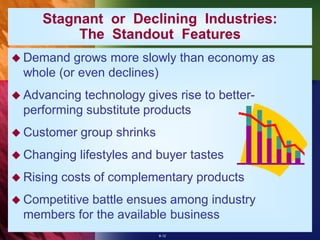
Stagnant or Declining Industries:
          The Standout Features
 Demand   grows more slowly than economy as
  whole (or even declines)
 Advancing  technology gives rise to better-
  performing substitute products
 Customer    group shrinks
 Changing    lifestyles and buyer tastes
 Rising   costs of complementary products
 Competitivebattle ensues among industry
  members for the available business
                              8-12
Strategy Options for Competing
   in a Stagnant or Declining Industry
 Pursue  focus strategy aimed at
  fastest growing market segments
 Stress differentiation based on quality
  improvement or product innovation
 Work diligently to drive costs down
   Cut marginal activities from value chain
   Use outsourcing
   Redesign internal processes to exploit e-commerce
   Consolidate under-utilized production facilities
   Add more distribution channels
   Close low-volume, high-cost distribution outlets
   Prune marginal products
                            8-13
End-Game Strategies
                 for Declining Industries
   An end-game strategy can take either of two paths

       Slow-exit strategy involving

           Gradual phasing down of operations

           Getting the most cash flow from the business

       Fast-exit strategy involving

           Disengaging from an industry during early stages of
            decline

           Quick recovery of as much of a company’s investment as
            possible
                                       8-14
Features of High-Velocity Markets

 Rapid-fire   technological change

 Short   product life-cycles

 Entry   of important new rivals

 Frequentlaunches of
  new competitive moves

 Rapidlyevolving
  customer expectations
                                8-15
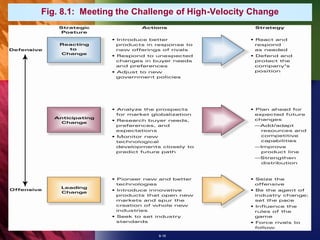
Fig. 8.1: Meeting the Challenge of High-Velocity Change


                           8-16
Strategy Options for Competing
            in High-Velocity Markets
 Invest     aggressively in R&D
 Initiate   fresh actions every few months
 Develop     quick response capabilities
      Shift resources
      Adapt competencies
      Create new competitive capabilities
      Speed new products to market
 Use strategic partnerships to develop
  specialized expertise and capabilities
 Keep    products/services fresh and exciting
                                8-17
Keys to Success in Competing
          in High Velocity Markets
 Cutting-edge    expertise
 Speed     in responding to new developments
 Collaboration   with others
 Agility

 Innovativeness

 Opportunism

 Resource    flexibility
 First-to-market   capabilities
                              8-18
Competitive Features
               of a Fragmented Industry
   Absence of market leaders with large market shares or widespread
    buyer recognition
   Product/service is delivered to neighborhood
    locations to be convenient to local residents
   Buyer demand is so diverse that many firms
    are required to satisfy buyer needs
   Low entry barriers
   Absence of scale economies
   Market for industry’s product/service may be globalizing, thus
    putting many companies across the world in same market arena
   Exploding technologies force firms to specialize just to keep up in
    their area of expertise
   Industry is young and crowded with aspiring contenders, with no
    firm having yet developed recognition to command a large market
    share
                                    8-19
Examples of Fragmented Industries

           Book publishing
    Landscaping and plant nurseries
             Auto repair
         Restaurant industry
          Public accounting
          Women’s dresses
            Meat packing
          Paperboard boxes
          Hotels and motels
              Furniture
                   8-20
Competing in a Fragmented Industry:
         The Strategy Options

 Construct   and operate “formula” facilities

 Become   a low-cost operator

 Specialize   by product type

 Specialize   by customer type

 Focus   on limited geographic area
                           8-21
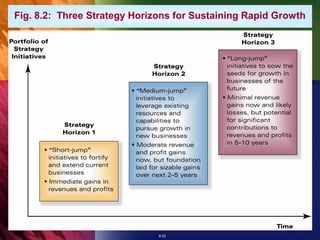
Fig. 8.2: Three Strategy Horizons for Sustaining Rapid Growth


                              8-22
Risks of Pursuing
            Multiple Strategy Horizons
 Firm should not pursue all options
  to avoid stretching itself too thin

 Pursuit   of medium- and long-jump
  initiatives may cause firm to stray
  too far from its core competencies

 Competitive advantage may be difficult to achieve
  in medium- and long-jump businesses that do not
  mesh well with firm’s present resource strengths

 Payoffs   of long-jump initiatives may prove elusive
                            8-23
Strategies Based on a
         Company’s Market Position

 Industry   leaders


 Runner-up    firms


 Weak   or crisis-ridden firms
                       8-24
Industry Leaders:
        The Defining Characteristics

 Strong   to powerful market position


 Well-known    reputation


 Proven   strategy


    strategic concern – How to sustain
 Key
 dominant leadership position
                             8-25
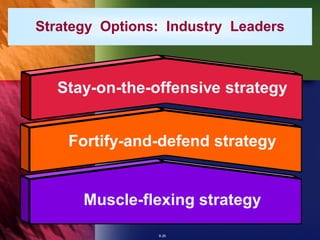
Strategy Options: Industry Leaders


  Stay-on-the-offensive strategy


    Fortify-and-defend strategy


      Muscle-flexing strategy

                8-26
Stay-on-the-Offensive Strategies

 Be   a first-mover, leading industry change
 Best   defense is a good offense
 Concentrate on achieving a competitive advantage
  and then widening the advantage over time
 Relentlessly pursue continuous improvement
  and innovation, being first to market with
      Technological improvements
      New or better products
      More attractive performance features
      Customer service improvements
                                8-27
Stay-on-the-Offensive Strategies (continued)

   Aggressively seek out ways to
     Cut operating costs
     Establish competitive capabilities rivals cannot match
     Make it easier for potential customers to switch their purchases from
      other firms to the leader’s own products
 Aggressively attack profit sanctuaries of important rivals
 Launch fresh initiatives to expand overall industry
  demand
       Spur creation of new families of products
       Make product more suitable for consumers
        in emerging-country markets
       Discover new uses for product
       Attract new users of product
       Promote more frequent use
   Grow faster than industry, taking market share from rivals
                                     8-28
Fortify-and-Defend Strategy

                      Objectives

 Make  it harder for new firms to enter and for
  challengers to gain ground

 Hold   onto present market share

 Strengthen   current market position

 Protect   competitive advantage

                           8-29
Fortify-and-Defend Strategy:
               Strategic Options
 Increase  advertising and R&D
 Provide higher levels of customer service
 Introduce more brands to match attributes of rivals
 Add personalized services to boost buyer loyalty
 Keep prices reasonable and quality attractive
 Build new capacity ahead of market demand
 Invest enough to remain cost competitive
 Patent feasible alternative technologies
 Sign exclusive contracts with best suppliers and
  distributors
                           8-30
Muscle-Flexing Strategy

                      Objectives

 Play  competitive hardball with smaller
  rivals that threaten leader’s position

 Signal  smaller rivals that moves to cut
  into leader’s business will be hard fought

 Convince   rivals they are better off playing
  “follow-the-leader” or else attacking each
  other rather the industry leader
                            8-31
Muscle-Flexing Strategy:
                Strategic Options
 Be   quick to meet price cuts of rivals
 Counter  with large-scale promotional campaigns if
  rivals boost advertising
 Offer   better deals to rivals’ major customers
 Dissuade    distributors from carrying rivals’ products
 Provide
        salespersons with documentation about
  weaknesses of competing products
 Make    attractive offers to key executives of rivals
 Use arm-twisting tactics to pressure present
  customers not to use rivals’ products
                             8-32
Muscle-Flexing Strategy

                          Risks

 Running    afoul of antitrust laws


 Alienating   customers with bullying tactics


 Arousing   adverse public opinion


                             8-33
Types of Runner-up Firms

 Market    challengers
     Use offensive strategies to gain market share

 Focusers                                              I’m
                                                      trying!
     Concentrate on serving a
      limited portion of market

 Perennial     runners-up
     Lack competitive strength to do
      more than continue in trailing position
                                  8-34
Obstacles Runner-Up
               Firms Must Overcome

 When   big size is a competitive asset, firms
 with small market share face obstacles
 in trying to strengthen their positions

     Less access to economies of scale

     Difficulty in gaining customer recognition

     Inability to afford mass media advertising

     Difficulty in funding capital requirements
                                8-35
Strategic Options
                for Runner-Up Firms

 Whenbig size provides larger rivals with a cost
 advantage, runner-up firms have two options

     Build market share

         Lower costs and prices to grow sales or

         Out-differentiate rivals in ways to grow sales


     Withdraw from market

                                8-36
Offensive Strategies for Runner-Up Firms:
          Building Market Share
   Acquire smaller rivals to expand company’s market reach
    and presence
   Find innovative ways to drive down costs
    to win customers from higher-priced rivals
   Craft an attractive differentiation strategy
   Pioneer a leapfrog technological breakthrough
   Be first-to-market with new or better products and build
    reputation for product leadership
   Outmaneuver slow-to-change market leaders in adapting
    to evolving market conditions and customer needs
   Forge strategic alliances with key distributors, dealers, or
    marketers of complementary products
                                 8-37
Strategic Approaches for Runner-Up Firms


1. Vacant niche strategy

2. Specialist strategy

3. Superior product strategy

4. Distinctive image strategy

5. Content follower strategy

                           8-38
Vacant Niche Strategy
                for Runner-Up Firms
 Focus  strategy concentrated on end-use
  applications market leaders have neglected

 Characteristics      of an ideal vacant niche

     Sufficient size to be profitable

     Growth potential

     Well-suited to a firm’s capabilities

     Hard for leaders to serve

                                  8-39
Specialist Strategy for Runner-Up Firms

 Strategy concentrated on
 being a leader based on

     Specific technology

     Product uniqueness

     Expertise in

         Special-purpose products

         Specialized know-how

         Delivering distinctive customer services

                                     8-40
Superior Product Strategy
              for Runner-Up Firms
 Differentiation-based        focused strategy based on
     Superior product quality or
     Unique product attributes

 Approaches

     Fine craftsmanship
     Prestige quality
     Frequent product innovations
     Close contact with customers to
      gain input for better quality product
                                  8-41
Distinctive Image Strategy
                 for Runner-Up Firms
 Strategy  concentrated on ways to
    stand out from rivals
   Approaches
       Reputation for charging lowest price
       Prestige quality at a good price
       Superior customer service
       Unique product attributes
       New product introductions
       Unusually creative advertising
                                    8-42
Content Follower Strategy
              for Runner-Up Firms
 Strategy   involves avoiding
     Trend-setting moves and
     Aggressive moves to steal
      customers from leaders
 Approaches
     Do not provoke competitive retaliation
     React and respond
     Defense rather than offense
     Keep same price as leaders
     Attempt to maintain market position
                                8-43
Weak Businesses: Strategic Options


 Launch  an offensive turnaround strategy
 (if resources permit)

 Employ  a fortify-and-defend strategy
 (to the extent resources permit)

 Pursue   a fast-exit strategy

 Adopt a harvest strategy
 (a slow-exit type of end-game strategy)

                           8-44
Achieving a Turnaround:
              The Strategic Options

 Sell   off assets to generate cash and/or reduce debt

 Revise    existing strategy

 Launch    efforts to boost revenues

 Cut    costs

 Combination     of efforts
                                8-45
What Is a Harvest Strategy?

 Steers  middle course between status quo and
  exiting quickly

 Involves  gradually sacrificing market position
  in return for bigger near-term cash flow/profit

 Objectives

     Short-term - Generate largest
      feasible cash flow

     Long-term - Exit market
                                8-46
Types of Harvest Options

 Reduce    operating expenses to rock-bottom

 Hold   reinvestment to minimum

 Place   little priority on new capital investments

 Emphasize    stringent internal cost controls

 Trim   advertising and promotion expenses

 Do   not replace employees who leave

 Shave   equipment maintenance
                             8-47
When Should a Harvest
             Strategy Be Considered?
 Industry’s   long-term prospects are unattractive
 Building   up business would be too costly
 Market   share is increasingly costly to maintain
 Reduced levels of competitive effort will not trigger
  immediate fall-off in sales
 Firm  can re-deploy freed-up resources
  in higher opportunity areas
 Business   is not a major component of
  diversified firm’s portfolio of businesses
                             8-48

Business strategy chapter (8)

  • 1.
    Published by www.iiuc28a9.com 8 Tailoring Strategy Chapter Title to Fit Specific Industry and Company Situations Md. Tarikul Islam Lecturer in Marketing 16/e PPT IIUC, DC Cell: 01716 388990 E-mail: russelmkg@yahoo.com . .
  • 2.
    Matching Strategy to a Company’s Situation Nature of industry and competitive Most important conditions drivers shaping a firm’s strategic options fall into Firm’s competitive two categories capabilities, market position, best opportunities 8-2
  • 3.
    Features of anEmerging Industry  New and unproven market  Proprietary technology  Lack of consensus regarding which of several competing technologies will win out  Low entry barriers  Experience curve effects may permit cost reductions as volume builds  Buyers are first-time users and marketing involves inducing initial purchase and overcoming customer concerns  First-generation products are expected to be rapidly improved so buyers delay purchase until technology matures  Possible difficulties in securing raw materials  Firms struggle to fund R&D, operations and build resource capabilities for rapid growth 8-3
  • 4.
    Strategy Options forCompeting in Emerging Industries  Win early race for industry leadership by employing a bold, creative strategy  Push hard to perfect technology, improve product quality, and develop attractive performance features  Consider merging with or acquiring another firm to  Gain added expertise  Pool resource strengths  When technological uncertainty clears and a dominant technology emerges, try to capture any first-mover advantages by moving quickly  Form strategic alliances with  Companies having related technological expertise or  Key suppliers 8-4
  • 5.
    Strategy Options forCompeting in Emerging Industries (continued)  Pursue new customers and user applications  Enter new geographical areas  Makeit easy and cheap for first-time buyers to try product  Focus advertising emphasis on  Increasing frequency of use  Creating brand loyalty  Use price cuts to attract price-sensitive buyers 8-5
  • 6.
    Strategic Hurdles forCompanies in Emerging Industries  Raising capital to finance initial operations until  Sales and revenues take off  Profits appear  Cash flows turn positive  Developing a strategy to ride the wave of industry growth  What market segments to pursue  What competitive advantages to go after  Managing the rapid expansion of facilities and sales to position a company to contend for industry leadership  Defending against competitors trying to horn in on the company’s success 8-6
  • 7.
    What Is theKey to Success for Competing in Rapidly Growing Markets? A company needs a strategy predicated on growing faster than the market average so it  Can boost its market share and  Improve its competitive standing vis-à-vis rivals 8-7
  • 8.
    Strategy Options forCompeting in Rapidly Growing Markets  Drivedown costs per unit to enable price reductions that attract droves of new customers  Pursue rapid product innovation to  Set a company’s product offering apart from rivals  Incorporate attributes to appeal to growing numbers of customers  Gain access to additional distribution channels and sales outlets  Expand a company’s geographic coverage  Expand product line to add models/styles to appeal to a wider range of buyers 8-8
  • 9.
    Industry Maturity: TheStandout Features  Slowing demand breeds stiffer competition  More sophisticated buyers demand bargains  Greater emphasis on cost and service  “Topping out” problem in adding production capacity  Product innovation and new end uses harder to come by  International competition increases  Industry profitability falls  Mergers and acquisitions reduce number of rivals 8-9
  • 10.
    Strategy Options forCompeting in a Mature Industry  cut back marginal products and models  Emphasize innovation in the value chain  Strong focus on cost reduction  Increase sales to present customers  Purchase rivals at bargain prices  Expand internationally  Build new, more flexible competitive capabilities 8-10
  • 11.
    Strategic Pitfalls ina Maturing Industry  Employing a ho-hum strategy with no distinctive features thus leaving firm “stuck in the middle”  Being slow to mount a defense against stiffening competitive pressures  Concentrating on short-term profits rather than strengthening long-term competitiveness  Being slow to respond to price-cutting  Having too much excess capacity  Overspending on marketing  Failing to aggressively pursue cost reductions 8-11
  • 12.
    Stagnant or DecliningIndustries: The Standout Features  Demand grows more slowly than economy as whole (or even declines)  Advancing technology gives rise to better- performing substitute products  Customer group shrinks  Changing lifestyles and buyer tastes  Rising costs of complementary products  Competitivebattle ensues among industry members for the available business 8-12
  • 13.
    Strategy Options forCompeting in a Stagnant or Declining Industry  Pursue focus strategy aimed at fastest growing market segments  Stress differentiation based on quality improvement or product innovation  Work diligently to drive costs down  Cut marginal activities from value chain  Use outsourcing  Redesign internal processes to exploit e-commerce  Consolidate under-utilized production facilities  Add more distribution channels  Close low-volume, high-cost distribution outlets  Prune marginal products 8-13
  • 14.
    End-Game Strategies for Declining Industries  An end-game strategy can take either of two paths  Slow-exit strategy involving  Gradual phasing down of operations  Getting the most cash flow from the business  Fast-exit strategy involving  Disengaging from an industry during early stages of decline  Quick recovery of as much of a company’s investment as possible 8-14
  • 15.
    Features of High-VelocityMarkets  Rapid-fire technological change  Short product life-cycles  Entry of important new rivals  Frequentlaunches of new competitive moves  Rapidlyevolving customer expectations 8-15
  • 16.
    Fig. 8.1: Meetingthe Challenge of High-Velocity Change 8-16
  • 17.
    Strategy Options forCompeting in High-Velocity Markets  Invest aggressively in R&D  Initiate fresh actions every few months  Develop quick response capabilities  Shift resources  Adapt competencies  Create new competitive capabilities  Speed new products to market  Use strategic partnerships to develop specialized expertise and capabilities  Keep products/services fresh and exciting 8-17
  • 18.
    Keys to Successin Competing in High Velocity Markets  Cutting-edge expertise  Speed in responding to new developments  Collaboration with others  Agility  Innovativeness  Opportunism  Resource flexibility  First-to-market capabilities 8-18
  • 19.
    Competitive Features of a Fragmented Industry  Absence of market leaders with large market shares or widespread buyer recognition  Product/service is delivered to neighborhood locations to be convenient to local residents  Buyer demand is so diverse that many firms are required to satisfy buyer needs  Low entry barriers  Absence of scale economies  Market for industry’s product/service may be globalizing, thus putting many companies across the world in same market arena  Exploding technologies force firms to specialize just to keep up in their area of expertise  Industry is young and crowded with aspiring contenders, with no firm having yet developed recognition to command a large market share 8-19
  • 20.
    Examples of FragmentedIndustries Book publishing Landscaping and plant nurseries Auto repair Restaurant industry Public accounting Women’s dresses Meat packing Paperboard boxes Hotels and motels Furniture 8-20
  • 21.
    Competing in aFragmented Industry: The Strategy Options  Construct and operate “formula” facilities  Become a low-cost operator  Specialize by product type  Specialize by customer type  Focus on limited geographic area 8-21
  • 22.
    Fig. 8.2: ThreeStrategy Horizons for Sustaining Rapid Growth 8-22
  • 23.
    Risks of Pursuing Multiple Strategy Horizons  Firm should not pursue all options to avoid stretching itself too thin  Pursuit of medium- and long-jump initiatives may cause firm to stray too far from its core competencies  Competitive advantage may be difficult to achieve in medium- and long-jump businesses that do not mesh well with firm’s present resource strengths  Payoffs of long-jump initiatives may prove elusive 8-23
  • 24.
    Strategies Based ona Company’s Market Position  Industry leaders  Runner-up firms  Weak or crisis-ridden firms 8-24
  • 25.
    Industry Leaders: The Defining Characteristics  Strong to powerful market position  Well-known reputation  Proven strategy strategic concern – How to sustain  Key dominant leadership position 8-25
  • 26.
    Strategy Options: IndustryLeaders Stay-on-the-offensive strategy Fortify-and-defend strategy Muscle-flexing strategy 8-26
  • 27.
    Stay-on-the-Offensive Strategies  Be a first-mover, leading industry change  Best defense is a good offense  Concentrate on achieving a competitive advantage and then widening the advantage over time  Relentlessly pursue continuous improvement and innovation, being first to market with  Technological improvements  New or better products  More attractive performance features  Customer service improvements 8-27
  • 28.
    Stay-on-the-Offensive Strategies (continued)  Aggressively seek out ways to  Cut operating costs  Establish competitive capabilities rivals cannot match  Make it easier for potential customers to switch their purchases from other firms to the leader’s own products  Aggressively attack profit sanctuaries of important rivals  Launch fresh initiatives to expand overall industry demand  Spur creation of new families of products  Make product more suitable for consumers in emerging-country markets  Discover new uses for product  Attract new users of product  Promote more frequent use  Grow faster than industry, taking market share from rivals 8-28
  • 29.
    Fortify-and-Defend Strategy Objectives  Make it harder for new firms to enter and for challengers to gain ground  Hold onto present market share  Strengthen current market position  Protect competitive advantage 8-29
  • 30.
    Fortify-and-Defend Strategy: Strategic Options  Increase advertising and R&D  Provide higher levels of customer service  Introduce more brands to match attributes of rivals  Add personalized services to boost buyer loyalty  Keep prices reasonable and quality attractive  Build new capacity ahead of market demand  Invest enough to remain cost competitive  Patent feasible alternative technologies  Sign exclusive contracts with best suppliers and distributors 8-30
  • 31.
    Muscle-Flexing Strategy Objectives  Play competitive hardball with smaller rivals that threaten leader’s position  Signal smaller rivals that moves to cut into leader’s business will be hard fought  Convince rivals they are better off playing “follow-the-leader” or else attacking each other rather the industry leader 8-31
  • 32.
    Muscle-Flexing Strategy: Strategic Options  Be quick to meet price cuts of rivals  Counter with large-scale promotional campaigns if rivals boost advertising  Offer better deals to rivals’ major customers  Dissuade distributors from carrying rivals’ products  Provide salespersons with documentation about weaknesses of competing products  Make attractive offers to key executives of rivals  Use arm-twisting tactics to pressure present customers not to use rivals’ products 8-32
  • 33.
    Muscle-Flexing Strategy Risks  Running afoul of antitrust laws  Alienating customers with bullying tactics  Arousing adverse public opinion 8-33
  • 34.
    Types of Runner-upFirms  Market challengers  Use offensive strategies to gain market share  Focusers I’m trying!  Concentrate on serving a limited portion of market  Perennial runners-up  Lack competitive strength to do more than continue in trailing position 8-34
  • 35.
    Obstacles Runner-Up Firms Must Overcome  When big size is a competitive asset, firms with small market share face obstacles in trying to strengthen their positions  Less access to economies of scale  Difficulty in gaining customer recognition  Inability to afford mass media advertising  Difficulty in funding capital requirements 8-35
  • 36.
    Strategic Options for Runner-Up Firms  Whenbig size provides larger rivals with a cost advantage, runner-up firms have two options  Build market share  Lower costs and prices to grow sales or  Out-differentiate rivals in ways to grow sales  Withdraw from market 8-36
  • 37.
    Offensive Strategies forRunner-Up Firms: Building Market Share  Acquire smaller rivals to expand company’s market reach and presence  Find innovative ways to drive down costs to win customers from higher-priced rivals  Craft an attractive differentiation strategy  Pioneer a leapfrog technological breakthrough  Be first-to-market with new or better products and build reputation for product leadership  Outmaneuver slow-to-change market leaders in adapting to evolving market conditions and customer needs  Forge strategic alliances with key distributors, dealers, or marketers of complementary products 8-37
  • 38.
    Strategic Approaches forRunner-Up Firms 1. Vacant niche strategy 2. Specialist strategy 3. Superior product strategy 4. Distinctive image strategy 5. Content follower strategy 8-38
  • 39.
    Vacant Niche Strategy for Runner-Up Firms  Focus strategy concentrated on end-use applications market leaders have neglected  Characteristics of an ideal vacant niche  Sufficient size to be profitable  Growth potential  Well-suited to a firm’s capabilities  Hard for leaders to serve 8-39
  • 40.
    Specialist Strategy forRunner-Up Firms  Strategy concentrated on being a leader based on  Specific technology  Product uniqueness  Expertise in  Special-purpose products  Specialized know-how  Delivering distinctive customer services 8-40
  • 41.
    Superior Product Strategy for Runner-Up Firms  Differentiation-based focused strategy based on  Superior product quality or  Unique product attributes  Approaches  Fine craftsmanship  Prestige quality  Frequent product innovations  Close contact with customers to gain input for better quality product 8-41
  • 42.
    Distinctive Image Strategy for Runner-Up Firms  Strategy concentrated on ways to stand out from rivals  Approaches  Reputation for charging lowest price  Prestige quality at a good price  Superior customer service  Unique product attributes  New product introductions  Unusually creative advertising 8-42
  • 43.
    Content Follower Strategy for Runner-Up Firms  Strategy involves avoiding  Trend-setting moves and  Aggressive moves to steal customers from leaders  Approaches  Do not provoke competitive retaliation  React and respond  Defense rather than offense  Keep same price as leaders  Attempt to maintain market position 8-43
  • 44.
    Weak Businesses: StrategicOptions  Launch an offensive turnaround strategy (if resources permit)  Employ a fortify-and-defend strategy (to the extent resources permit)  Pursue a fast-exit strategy  Adopt a harvest strategy (a slow-exit type of end-game strategy) 8-44
  • 45.
    Achieving a Turnaround: The Strategic Options  Sell off assets to generate cash and/or reduce debt  Revise existing strategy  Launch efforts to boost revenues  Cut costs  Combination of efforts 8-45
  • 46.
    What Is aHarvest Strategy?  Steers middle course between status quo and exiting quickly  Involves gradually sacrificing market position in return for bigger near-term cash flow/profit  Objectives  Short-term - Generate largest feasible cash flow  Long-term - Exit market 8-46
  • 47.
    Types of HarvestOptions  Reduce operating expenses to rock-bottom  Hold reinvestment to minimum  Place little priority on new capital investments  Emphasize stringent internal cost controls  Trim advertising and promotion expenses  Do not replace employees who leave  Shave equipment maintenance 8-47
  • 48.
    When Should aHarvest Strategy Be Considered?  Industry’s long-term prospects are unattractive  Building up business would be too costly  Market share is increasingly costly to maintain  Reduced levels of competitive effort will not trigger immediate fall-off in sales  Firm can re-deploy freed-up resources in higher opportunity areas  Business is not a major component of diversified firm’s portfolio of businesses 8-48