
{
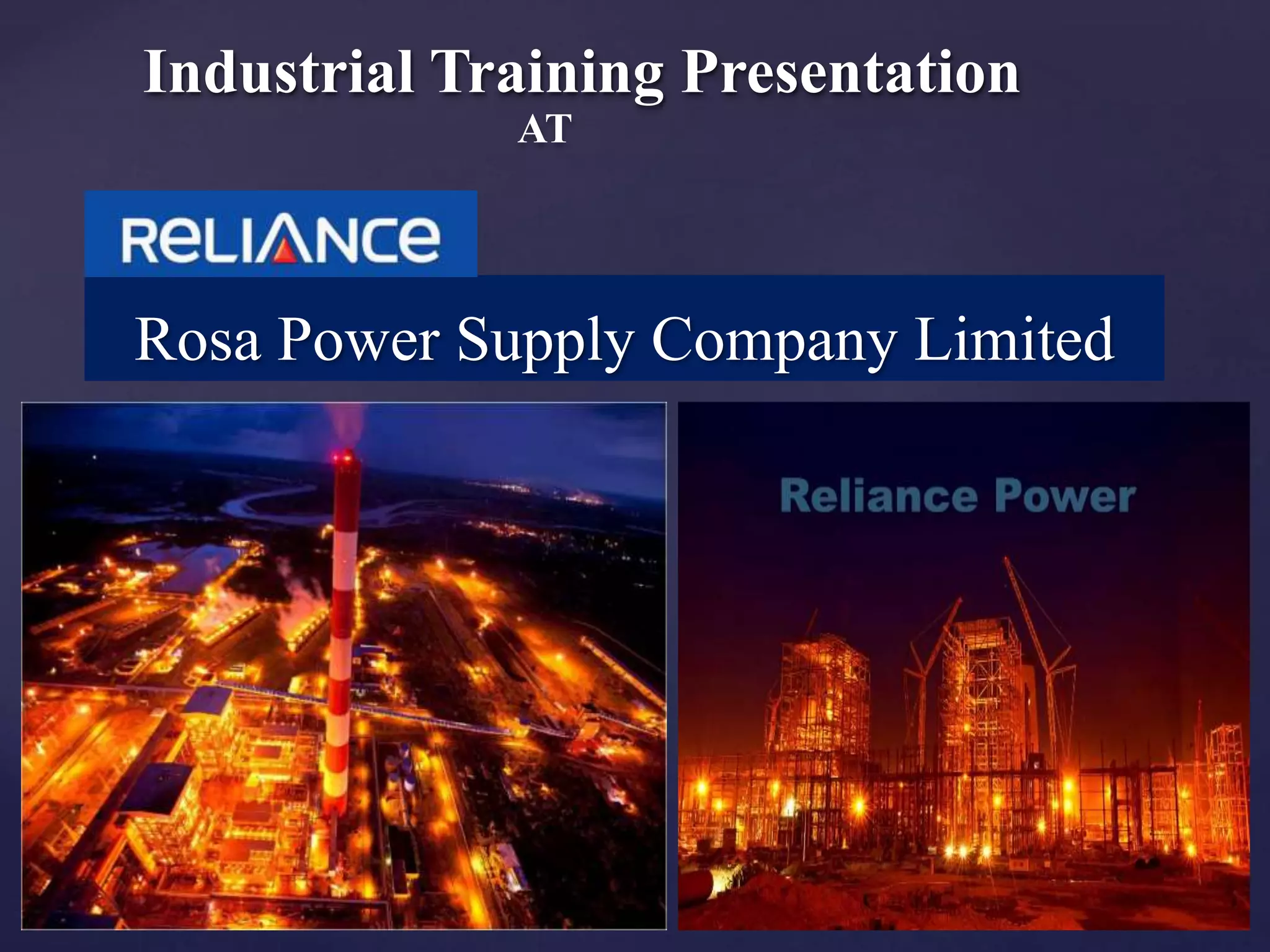
Rosa Power Supply Company Limited
Industrial Training Presentation
AT
Acknowledgement
• I would like to thank Mr Narendra Balkishan Soni (Head
of Department, Department of Electrical and Power
Engineering, UPES) for meticulously planning academic
curriculum in such a way that students are not only
academically sound but also industry ready by including
such industrial training patterns.
• I would also like to thanks Mr Ram Mohan Sharma
(Group In-charge) for the positive attitude he showed for
my work, always allowing me to question him and giving
prompt replies for my uncertainties.
• Finally, I would also like to thanks Mr. Chandra Shekhar
(Head-Simulator & Training), Mr. B.S. Prasad (Station
Head) for giving us this opportunity and guiding during the
course of the training.
Company Background
• Rosa Power Plant is a 1200 MW (3*400 MW) of coal based
generation capacity at Rosa village in Shahjahanpur, Uttar
Pradesh.
• Rosa Power Supply Company Limited (RPSCL), the holding
company of Rosa Power Plant was incorporated on September 1,
1994 as a subsidiary of Aditya Birla Power Company.
• It was later transferred to Reliance Power on November 1, 2006
and is now fully owned subsidiary of Reliance Power. It is a
project that has received a considerable support from the Uttar
Pradesh government with it being designated a ‘Priority project’.
• The Entire power generated will be sold to Uttar Pradesh Power
Corporation Limited (UPPCL).
About Reliance Power Ltd.
• Reliance Power Limited is part of the Reliance Anil Dhirubhai
Ambani Group.
• It was established to develop, construct and operate power projects in
the domestic and international markets.
• Reliance Energy Limited, an Indian private sector power utility
company along with the Anil Dhirubhai Ambani Group promotes
Reliance Power.
• Along with its subsidiaries, it is presently developing 13 medium and
large-sized power projects with a combined planned installed capacity
of 33,480 MW.
• Reliance Natural Resources merged with Reliance Power in 2010,
shortly after its initial public offering.
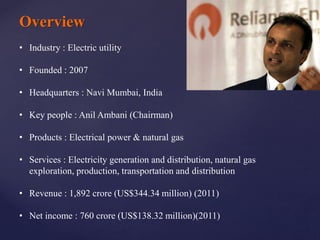
Overview
• Industry : Electric utility
• Founded : 2007
• Headquarters : Navi Mumbai, India
• Key people : Anil Ambani (Chairman)
• Products : Electrical power & natural gas
• Services : Electricity generation and distribution, natural gas
exploration, production, transportation and distribution
• Revenue : 1,892 crore (US$344.34 million) (2011)
• Net income : 760 crore (US$138.32 million)(2011)
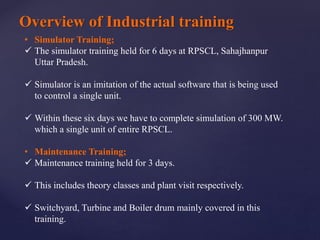
Overview of Industrial training
• Simulator Training;
 The simulator training held for 6 days at RPSCL, Sahajhanpur
Uttar Pradesh.
 Simulator is an imitation of the actual software that is being used
to control a single unit.
 Within these six days we have to complete simulation of 300 MW.
which a single unit of entire RPSCL.
• Maintenance Training;
 Maintenance training held for 3 days.
 This includes theory classes and plant visit respectively.
 Switchyard, Turbine and Boiler drum mainly covered in this
training.
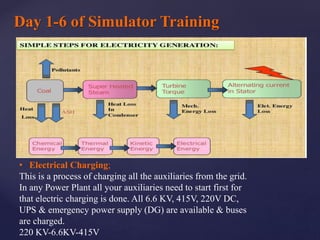
Day 1-6 of Simulator Training
• Electrical Charging;
This is a process of charging all the auxiliaries from the grid.
In any Power Plant all your auxiliaries need to start first for
that electric charging is done. All 6.6 KV, 415V, 220V DC,
UPS & emergency power supply (DG) are available & buses
are charged.
220 KV-6.6KV-415V
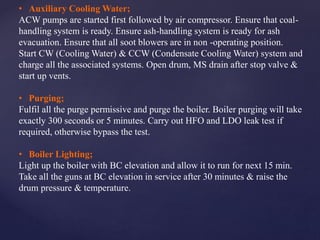
• Auxiliary Cooling Water;
ACW pumps are started first followed by air compressor. Ensure that coal-
handling system is ready. Ensure ash-handling system is ready for ash
evacuation. Ensure that all soot blowers are in non -operating position.
Start CW (Cooling Water) & CCW (Condensate Cooling Water) system and
charge all the associated systems. Open drum, MS drain after stop valve &
start up vents.
• Purging;
Fulfil all the purge permissive and purge the boiler. Boiler purging will take
exactly 300 seconds or 5 minutes. Carry out HFO and LDO leak test if
required, otherwise bypass the test.
• Boiler Lighting;
Light up the boiler with BC elevation and allow it to run for next 15 min.
Take all the guns at BC elevation in service after 30 minutes & raise the
drum pressure & temperature.
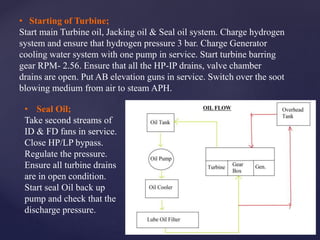
• Starting of Turbine;
Start main Turbine oil, Jacking oil & Seal oil system. Charge hydrogen
system and ensure that hydrogen pressure 3 bar. Charge Generator
cooling water system with one pump in service. Start turbine barring
gear RPM- 2.56. Ensure that all the HP-IP drains, valve chamber
drains are open. Put AB elevation guns in service. Switch over the soot
blowing medium from air to steam APH.
• Seal Oil;
Take second streams of
ID & FD fans in service.
Close HP/LP bypass.
Regulate the pressure.
Ensure all turbine drains
are in open condition.
Start seal Oil back up
pump and check that the
discharge pressure.
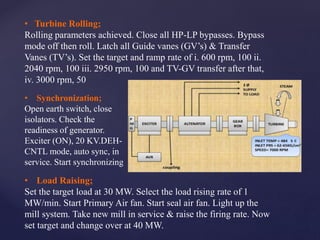
• Turbine Rolling;
Rolling parameters achieved. Close all HP-LP bypasses. Bypass
mode off then roll. Latch all Guide vanes (GV’s) & Transfer
Vanes (TV’s). Set the target and ramp rate of i. 600 rpm, 100 ii.
2040 rpm, 100 iii. 2950 rpm, 100 and TV-GV transfer after that,
iv. 3000 rpm, 50
• Load Raising;
Set the target load at 30 MW. Select the load rising rate of 1
MW/min. Start Primary Air fan. Start seal air fan. Light up the
mill system. Take new mill in service & raise the firing rate. Now
set target and change over at 40 MW.
• Synchronization;
Open earth switch, close
isolators. Check the
readiness of generator.
Exciter (ON), 20 KV.DEH-
CNTL mode, auto sync, in
service. Start synchronizing
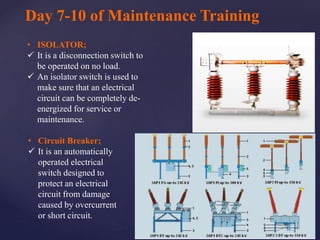
• ISOLATOR;
 It is a disconnection switch to
be operated on no load.
 An isolator switch is used to
make sure that an electrical
circuit can be completely de-
energized for service or
maintenance.
• Circuit Breaker;
 It is an automatically
operated electrical
switch designed to
protect an electrical
circuit from damage
caused by overcurrent
or short circuit.
Day 7-10 of Maintenance Training
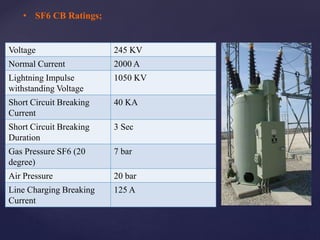
Voltage 245 KV
Normal Current 2000 A
Lightning Impulse
withstanding Voltage
1050 KV
Short Circuit Breaking
Current
40 KA
Short Circuit Breaking
Duration
3 Sec
Gas Pressure SF6 (20
degree)
7 bar
Air Pressure 20 bar
Line Charging Breaking
Current
125 A
• SF6 CB Ratings;
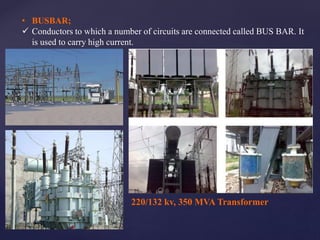
• BUSBAR;
 Conductors to which a number of circuits are connected called BUS BAR. It
is used to carry high current.
220/132 kv, 350 MVA Transformer
Conclusion
• Industrial training has exposed the real working environment as an
engineer.
• Industrial training has developed/improved student creative and
critical thinking as well as problem solving ability.
• Industrial training has exposed student with not only engineering
related of works, but also management of works.
• Through practical training, I have gain a great learning to systematic
work coordination in an environment that is conducive coupled with
friendly staff that is always there to help.
Submitted By;-
SASHIKANT TIWARI (66)- 500041217

Industrial training presentation

  • 1.
    { Rosa Power SupplyCompany Limited Industrial Training Presentation AT
  • 2.
    Acknowledgement • I wouldlike to thank Mr Narendra Balkishan Soni (Head of Department, Department of Electrical and Power Engineering, UPES) for meticulously planning academic curriculum in such a way that students are not only academically sound but also industry ready by including such industrial training patterns. • I would also like to thanks Mr Ram Mohan Sharma (Group In-charge) for the positive attitude he showed for my work, always allowing me to question him and giving prompt replies for my uncertainties. • Finally, I would also like to thanks Mr. Chandra Shekhar (Head-Simulator & Training), Mr. B.S. Prasad (Station Head) for giving us this opportunity and guiding during the course of the training.
  • 3.
    Company Background • RosaPower Plant is a 1200 MW (3*400 MW) of coal based generation capacity at Rosa village in Shahjahanpur, Uttar Pradesh. • Rosa Power Supply Company Limited (RPSCL), the holding company of Rosa Power Plant was incorporated on September 1, 1994 as a subsidiary of Aditya Birla Power Company. • It was later transferred to Reliance Power on November 1, 2006 and is now fully owned subsidiary of Reliance Power. It is a project that has received a considerable support from the Uttar Pradesh government with it being designated a ‘Priority project’. • The Entire power generated will be sold to Uttar Pradesh Power Corporation Limited (UPPCL).
  • 4.
    About Reliance PowerLtd. • Reliance Power Limited is part of the Reliance Anil Dhirubhai Ambani Group. • It was established to develop, construct and operate power projects in the domestic and international markets. • Reliance Energy Limited, an Indian private sector power utility company along with the Anil Dhirubhai Ambani Group promotes Reliance Power. • Along with its subsidiaries, it is presently developing 13 medium and large-sized power projects with a combined planned installed capacity of 33,480 MW. • Reliance Natural Resources merged with Reliance Power in 2010, shortly after its initial public offering.
  • 5.
    Overview • Industry :Electric utility • Founded : 2007 • Headquarters : Navi Mumbai, India • Key people : Anil Ambani (Chairman) • Products : Electrical power & natural gas • Services : Electricity generation and distribution, natural gas exploration, production, transportation and distribution • Revenue : 1,892 crore (US$344.34 million) (2011) • Net income : 760 crore (US$138.32 million)(2011)
  • 6.
    Overview of Industrialtraining • Simulator Training;  The simulator training held for 6 days at RPSCL, Sahajhanpur Uttar Pradesh.  Simulator is an imitation of the actual software that is being used to control a single unit.  Within these six days we have to complete simulation of 300 MW. which a single unit of entire RPSCL. • Maintenance Training;  Maintenance training held for 3 days.  This includes theory classes and plant visit respectively.  Switchyard, Turbine and Boiler drum mainly covered in this training.
  • 7.
    Day 1-6 ofSimulator Training • Electrical Charging; This is a process of charging all the auxiliaries from the grid. In any Power Plant all your auxiliaries need to start first for that electric charging is done. All 6.6 KV, 415V, 220V DC, UPS & emergency power supply (DG) are available & buses are charged. 220 KV-6.6KV-415V
  • 8.
    • Auxiliary CoolingWater; ACW pumps are started first followed by air compressor. Ensure that coal- handling system is ready. Ensure ash-handling system is ready for ash evacuation. Ensure that all soot blowers are in non -operating position. Start CW (Cooling Water) & CCW (Condensate Cooling Water) system and charge all the associated systems. Open drum, MS drain after stop valve & start up vents. • Purging; Fulfil all the purge permissive and purge the boiler. Boiler purging will take exactly 300 seconds or 5 minutes. Carry out HFO and LDO leak test if required, otherwise bypass the test. • Boiler Lighting; Light up the boiler with BC elevation and allow it to run for next 15 min. Take all the guns at BC elevation in service after 30 minutes & raise the drum pressure & temperature.
  • 9.
    • Starting ofTurbine; Start main Turbine oil, Jacking oil & Seal oil system. Charge hydrogen system and ensure that hydrogen pressure 3 bar. Charge Generator cooling water system with one pump in service. Start turbine barring gear RPM- 2.56. Ensure that all the HP-IP drains, valve chamber drains are open. Put AB elevation guns in service. Switch over the soot blowing medium from air to steam APH. • Seal Oil; Take second streams of ID & FD fans in service. Close HP/LP bypass. Regulate the pressure. Ensure all turbine drains are in open condition. Start seal Oil back up pump and check that the discharge pressure.
  • 10.
    • Turbine Rolling; Rollingparameters achieved. Close all HP-LP bypasses. Bypass mode off then roll. Latch all Guide vanes (GV’s) & Transfer Vanes (TV’s). Set the target and ramp rate of i. 600 rpm, 100 ii. 2040 rpm, 100 iii. 2950 rpm, 100 and TV-GV transfer after that, iv. 3000 rpm, 50 • Load Raising; Set the target load at 30 MW. Select the load rising rate of 1 MW/min. Start Primary Air fan. Start seal air fan. Light up the mill system. Take new mill in service & raise the firing rate. Now set target and change over at 40 MW. • Synchronization; Open earth switch, close isolators. Check the readiness of generator. Exciter (ON), 20 KV.DEH- CNTL mode, auto sync, in service. Start synchronizing
  • 11.
    • ISOLATOR;  Itis a disconnection switch to be operated on no load.  An isolator switch is used to make sure that an electrical circuit can be completely de- energized for service or maintenance. • Circuit Breaker;  It is an automatically operated electrical switch designed to protect an electrical circuit from damage caused by overcurrent or short circuit. Day 7-10 of Maintenance Training
  • 12.
    Voltage 245 KV NormalCurrent 2000 A Lightning Impulse withstanding Voltage 1050 KV Short Circuit Breaking Current 40 KA Short Circuit Breaking Duration 3 Sec Gas Pressure SF6 (20 degree) 7 bar Air Pressure 20 bar Line Charging Breaking Current 125 A • SF6 CB Ratings;
  • 13.
    • BUSBAR;  Conductorsto which a number of circuits are connected called BUS BAR. It is used to carry high current. 220/132 kv, 350 MVA Transformer
  • 14.
    Conclusion • Industrial traininghas exposed the real working environment as an engineer. • Industrial training has developed/improved student creative and critical thinking as well as problem solving ability. • Industrial training has exposed student with not only engineering related of works, but also management of works. • Through practical training, I have gain a great learning to systematic work coordination in an environment that is conducive coupled with friendly staff that is always there to help.
  • 15.