Introduction to
Robotics
Robotics is concerned with the
generation of computer- controlled
motions of physical objects in a wide
variety of settings
Reference:
Halperin, D., Kavraki, L., & Latombe, J. C. (1997). Robotics. In In Discrete and
Computational.
Terminology
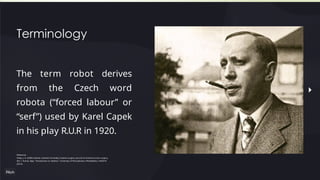
The term robot derives
from the Czech word
robota (“forced labour” or
“serf”) used by Karel Capek
in his play R.U.R in 1920.
Reference:
Palep, J. H. (2009). Robotic assisted minimally invasive surgery. Journal of minimal access surgery,
5(1), 1. Kumar, Vijay. "Introduction to robotics." University of Pennsylvania, Philadelphia, USA2014
(2014).
Robots
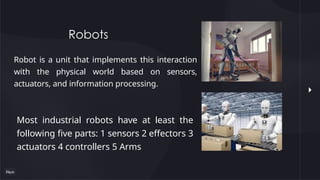
Robot is a unit that implements this interaction
with the physical world based on sensors,
actuators, and information processing.
Most industrial robots have at least the
following five parts: 1 sensors 2 effectors 3
actuators 4 controllers 5 Arms
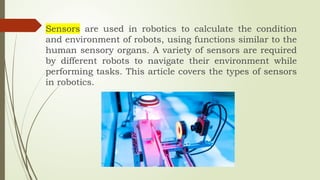
Sensors are used in robotics to calculate the condition
and environment of robots, using functions similar to the
human sensory organs. A variety of sensors are required
by different robots to navigate their environment while
performing tasks. This article covers the types of sensors
in robotics.
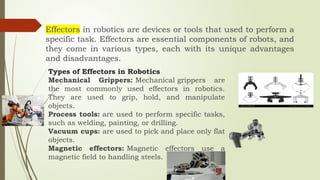
Effectors in robotics are devices or tools that used to perform a
specific task. Effectors are essential components of robots, and
they come in various types, each with its unique advantages
and disadvantages.
Types of Effectors in Robotics
Mechanical Grippers: Mechanical grippers are
the most commonly used effectors in robotics.
They are used to grip, hold, and manipulate
objects.
Process tools: are used to perform specific tasks,
such as welding, painting, or drilling.
Vacuum cups: are used to pick and place only flat
objects.
Magnetic effectors: Magnetic effectors use a
magnetic field to handling steels.
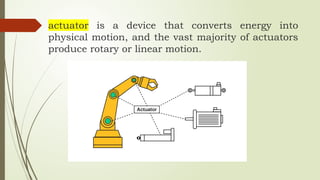
actuator is a device that converts energy into
physical motion, and the vast majority of actuators
produce rotary or linear motion.
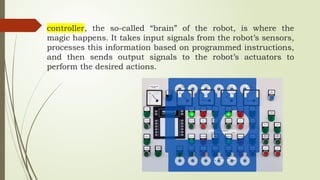
controller, the so-called “brain” of the robot, is where the
magic happens. It takes input signals from the robot’s sensors,
processes this information based on programmed instructions,
and then sends output signals to the robot’s actuators to
perform the desired actions.
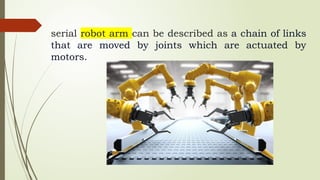
serial robot arm can be described as a chain of links
that are moved by joints which are actuated by
motors.
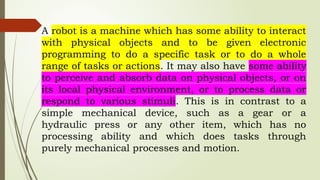
A robot is a machine which has some ability to interact
with physical objects and to be given electronic
programming to do a specific task or to do a whole
range of tasks or actions. It may also have some ability
to perceive and absorb data on physical objects, or on
its local physical environment, or to process data or
respond to various stimuli. This is in contrast to a
simple mechanical device, such as a gear or a
hydraulic press or any other item, which has no
processing ability and which does tasks through
purely mechanical processes and motion.
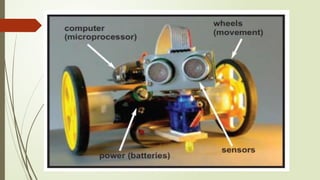
Robots can include these parts:
• effectors (simulating arms, hands, legs and feet)
• sensors (simulating senses that detect objects or
things like heat and light and convert the objects’
information into symbols that computers
understand)
• computer (simulates the brain that controls the
robot)
• equipment (includes tools and mechanical
fixtures)
• power source (such as batteries or solar cells)
Not All Machines are classified as Robots
In order to be classified as one, a robot should have
the following:
1. Sensing – its ability to sense its environment. The
use of sensors makes the robot aware of its
surroundings.
2. Movement – it has an ability to move
3. Energy – should have a power source
4. Intelligence – the robot needs to be smart to
perform its task and it is being done by its
programmer.
Robots and human beings
Robots can take any form but many of them
have given the human appearance.
The robots which have taken the form of
human appearance may likely to have the
walk like humans, speech, cognition and most
importantly all the things a human can do.
Most of the robots of today are inspired by
nature and are known as bio-inspired robots.
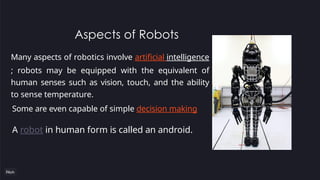
Many aspects of robotics involve artificial intelligence
; robots may be equipped with the equivalent of
human senses such as vision, touch, and the ability
to sense temperature.
Some are even capable of simple decision making
A robot in human form is called an android.
Aspects of Robots
Artificial intelligence in Robots
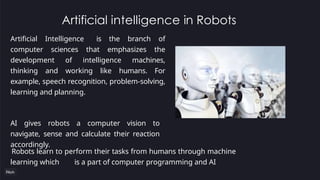
Artificial Intelligence is the branch of
computer sciences that emphasizes the
development of intelligence machines,
thinking and working like humans. For
example, speech recognition, problem-solving,
learning and planning.
AI gives robots a computer vision to
navigate, sense and calculate their reaction
accordingly.
Robots learn to perform their tasks from humans through machine
learning which is a part of computer programming and AI
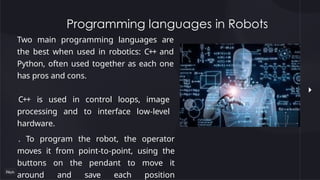
Programming languages in Robots
Two main programming languages are
the best when used in robotics: C++ and
Python, often used together as each one
has pros and cons.
C++ is used in control loops, image
processing and to interface low-level
hardware.
. To program the robot, the operator
moves it from point-to-point, using the
buttons on the pendant to move it
around and save each position
History of Robotics
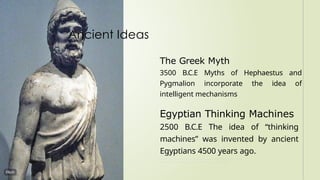
The Greek Myth
3500 B.C.E Myths of Hephaestus and
Pygmalion incorporate the idea of
intelligent mechanisms
Egyptian Thinking Machines
2500 B.C.E The idea of “thinking
machines” was invented by ancient
Egyptians 4500 years ago.
Ancient Ideas
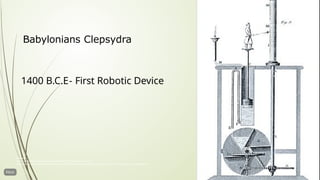
Babylonians Clepsydra
1400 B.C.E- First Robotic Device
References:
Rees, A. (1970). Rees’s Clocks, Watches and Chronometers, 1819-20. David & Charles
Neugebauer, O. (1947). Studies in Ancient Astronomy. VIII. The Water Clock in Babylonian Astronomy. ISIS, 1/2, 37–43. https://doi.org/10.1086/347965
Al-Jazari's Invention
1206 A.D Arabic engineer Al-
Jazari described in detail fifty
devices, including this
elephant clock which rang
every half an hour
Reference:
Elices, J. (2020). Ismail al-Jazari, the Muslim inventor whom some call “Father of Robotics.” National Geographic History
Magazine.
1206 A.D. Al-Jazari's
Automated Girl
References:
Al-Jazari, I. (2012). The Book of Knowledge of Ingenious Mechanical Devices (P
. Hill, Trans.). Springer Science & Business
Media.
Modern
Robotics
Unimate — The First Industrial
Robot
In 1954, George C. Devol invented and
patented a reprogrammable manipulator
Standford's Shakey Robot
In 1958, Charles Rosen led a
research team in developing a
robot called "Shakey."
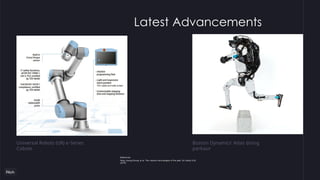
Universal Robots (UR) e-Series
Cobots
Boston Dynamics’ Atlas doing
parkour
Latest Advancements
References:
Yang, Guang-Zhong, et al. "Ten robotics technologies of the year
." Sci. Robot 4.26
(2019)
Robotic
Technology
Robotic Technology
Robotics involves design, construction, operation, and use of
robots.
Reference:
https://en.wikipedia.org/wiki/Robotics
Manipulator or Rover
Main body of robot (Links, Joints, other
structural element of the robot.
End Effecter
The part that is connected to the last
joint hand of a manipulator
Reference:
http://seminarprojects.kreview.com/item.php?id=1
33
Robot Components
Robot Components
Actuators
Muscles of the manipulators (servomotor, stepper motor, pneumatic and
hydraulic cylinder)
Sensors
To collect information about the internal state of the robot or To
communicate with the outside environment
Actuators Sensors
Robot Components
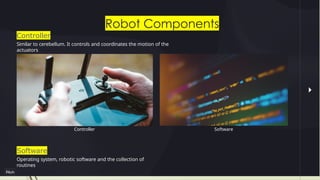
Controller
Similar to cerebellum. It controls and coordinates the motion of the
actuators
Controller Software
Software
Operating system, robotic software and the collection of
routines
Robot Components
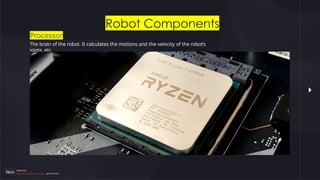
Processor
The brain of the robot. It calculates the motions and the velocity of the robot’s
joints, etc
Reference:
http://www.globalrobots.com/robot- applications.htm
Laws of
Robotics
First Law
A robot may not injure a human
being or
, through inaction, allow a
human being to come to harm
Second Law
A robot must obey the orders
given it by human beings except
where such orders would conflict
with the First Law
Third Law
A robot must protect its own
existence as long as such
protection does not conflict with
the First or Second Law
Reference:
Clarke, R. (1994). Asimov's laws of robotics: Implications for information technology. 2. Computer, 27(1),
57-66.
Types & Applications of
Robots
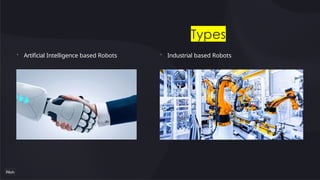
Types
• Industrial based Robots
• Artificial Intelligence based Robots
Artificial Intelligence based Robots
These Robots required Artificial Intelligence for their working. They work like humans
and use AI as their brain. AI contains information about their tasks and these robots are
manufactured to do that work.
Artificial Intelligence based Robots
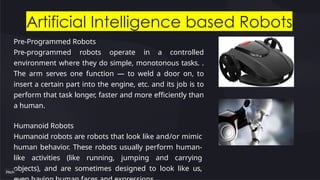
Pre-Programmed Robots
Pre-programmed robots operate in a controlled
environment where they do simple, monotonous tasks. .
The arm serves one function — to weld a door on, to
insert a certain part into the engine, etc. and its job is to
perform that task longer, faster and more efficiently than
a human.
Humanoid Robots
Humanoid robots are robots that look like and/or mimic
human behavior. These robots usually perform human-
like activities (like running, jumping and carrying
objects), and are sometimes designed to look like us,
Autonomous Robots
Autonomous robots operate independently of human
operators. These robots are usually designed to carry
out tasks in open environments that do not require
human supervision.
Teleoperated Robots
Teleoperated robots are mechanical bots
controlled by humans. These robots usually work
in extreme geographical conditions, weather,
circumstances, etc.
Augmenting Robots
Augmenting robots either enhance current human
capabilities or replace the capabilities a human may
have lost.
Artificial Intelligence
based Robots
Application
· Security and Surveillance in
crimes
· Surgical Assistance These are
most tele-manipulators.
· Defense
· Research & Development
· Education in terms of
experiments and practice
· Cleaning
Industrial based Robots
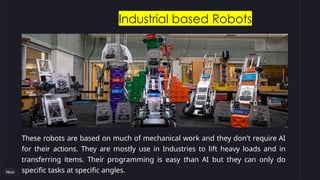
These robots are based on much of mechanical work and they don't require AI
for their actions. They are mostly use in Industries to lift heavy loads and in
transferring items. Their programming is easy than AI but they can only do
specific tasks at specific angles.
Industrial based Robots
Articulated Robots
An articulated robot is the type of robot that comes to mind
when most people think about robots. Much like CNC mills,
articulated robots are classified by the number of points of
rotation or axes they have. Flexibility, dexterity, and reach make
articulated robots ideally suited for tasks that span non-parallel
planes, such as machine tending.
SCARA Robots
A Selective Compliance Articulated Robot Arm (SCARA) is a good
— and cost-effective — choice for performing operations
between two parallel planes. SCARA robots are lightweight and
have small footprints, making them ideal for applications in
crowded spaces. They are also capable of very fast cycle times.
Industrial based Robots
Delta Robots
Delta robots, also referred to as “spider
robots,” use three base-mounted motors to
actuate control arms that position the wrist. A
delta robot’s arm is very lightweight so it
works fast with light loads.
Cartesian Robots
Cartesian robots typically consist of three or
more linear actuators assembled to fit a
particular application.
Positioned above a workspace, cartesian
robots can be elevated to maximize floor
space and accommodate a wide range of
workpiece sizes.
Industrial based
Robots
Cylindrical Robots
The robot has at least one rotary joint at the
base and at least one prismatic joint to connect
the links. The rotary joint uses a rotational
motion along the joint axis, while the prismatic
joint moves in a linear motion. Cylindrical
robots operate within a cylindrical-shaped work
envelope.
Polar Robots
Also called spherical robots, in this
configuration the arm is connected to the base
with a twisting joint and a combination of two
rotary joints and one linear joint. The axes form
a polar coordinate system and create a
spherical-shaped work envelope.
Industrial based Robots
Applications
· Arc Welding
· Spot Welding
· Materials Handling
· Machine Tending
· Painting
· Picking, Packing and
Palletizing
Advantages and
Disadvantages
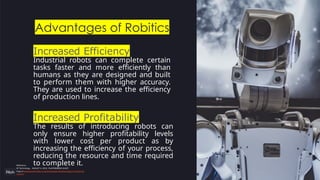
Increased Efficiency
Industrial robots can complete certain
tasks faster and more efficiently than
humans as they are designed and built
to perform them with higher accuracy.
They are used to increase the efficiency
of production lines.
Advantages of Robitics
Increased Profitability
The results of introducing robots can
only ensure higher profitability levels
with lower cost per product as by
increasing the efficiency of your process,
reducing the resource and time required
to complete it.
Reference:
SP Technology , AUGUST 3, 2018 , PLASTIKMEDIA GUEST
https://www.plastikmedia.co.uk/advantages-disadvantages-of-industrial-
robots/
Advantages of Robitics
Reference:
Advantages and disadvantages of using robots in our life, PUBLISHED MAY 20, 2016
https://www.online-sciences.com/robotics/advantages-and-disadvantages-of-using-robots-in-our-life/
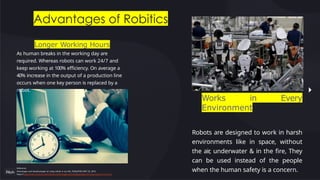
Longer Working Hours
As human breaks in the working day are
required. Whereas robots can work 24/7 and
keep working at 100% efficiency. On average a
40% increase in the output of a production line
occurs when one key person is replaced by a
robot.
Works in Every
Environment
Robots are designed to work in harsh
environments like in space, without
the air
, underwater & in the fire, They
can be used instead of the people
when the human safety is a concern.
Reference:
SP Technology , AUGUST 3, 2018 , PLASTIKMEDIA GUEST
https://www.plastikmedia.co.uk/advantages-disadvantages-of-industrial-
robots/
Improved working environment
Some tasks are too dangerous or
laborious and repetitive for humans to
carry out and so robots can perform
these tasks instead. Working conditions
can be vastly improved.
Improved Quality
Given their higher levels of accuracy,
robots can be used to produce higher
quality products which result in the
reduction of time required for quality
control and ensures that standards of
quality are adhered to.
Disadvantages of Robotics
Huge Investments
It costs a lot of money to make or buy
robots. The software and the equipment
that you need to use with the robot cost
much money. In case of breakdown, the
cost of repair may be very high.
Proper Maintenance
Robots need maintenance to keep
them running. The programs needs
to be updated to suit the changing
requirements. The procedure to
restore lost code or data may be
time-consuming & costly.
Reference:
Advantages and disadvantages of using robots in our life, PUBLISHED MAY 20, 2016
https://www.online-sciences.com/robotics/advantages-and-disadvantages-of-using-robots-in-our-life/
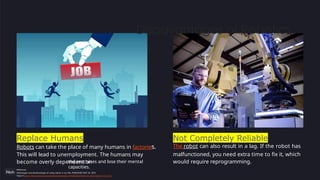
Replace Humans
Robots can take the place of many humans in factories.
This will lead to unemployment. The humans may
become overly dependent on
the machines and lose their mental
capacities.
Not Completely Reliable
The robot can also result in a lag. If the robot has
malfunctioned, you need extra time to fix it, which
would require reprogramming.
Disadvantages of Robotics
Reference:
Advantages and disadvantages of using robots in our life, PUBLISHED MAY 20, 2016
https://www.online-sciences.com/robotics/advantages-and-disadvantages-of-using-robots-in-our-life/
Reference:
Advantages and disadvantages of using robots in our life, PUBLISHED MAY 20, 2016
https://www.online-sciences.com/robotics/advantages-and-disadvantages-of-using-robots-in-our-life/
Deficit in Self Learning
Robots are not intelligent or sentient. They can never improve the results of their jobs
outside of their predefined programming. This limits how the robots can help & interact
with people. They can perform repetitive tasks for a long time but they do not get
better with experience such as the humans do.
Future of
Robotics
Predictions of Tomomichi
Sugihara & Shuuji Kajita
Super-Human Robots expected to
appear in 2050
Reference:
Kajita, S., & Sugihara, T. (2009). Humanoid robots in the future. Advanced Robotics, 23(11), 1527-
1531.
Better Health Facilities
• Global Market will Reaches
$12.4b by 2024
• Over-aged population
double by 2050 as in 2000
• Fill the shortage of 14
million Health Workers by
2030 in England Alone
Reference:
Russell, J. (2017, November 24). The future of medical robotics | ITProPortal. ITProPortal;
ITProPortal. https://www.itproportal.com/features/the-future-of-medical-robotics/
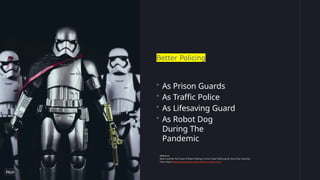
Better Policing
• As Prison Guards
• As Traffic Police
• As Lifesaving Guard
• As Robot Dog
During The
Pandemic
Reference:
What Could Be The Future Of Robot Policing In Smart Cities? (2020, July 8). Smart City; SmartCity
Press. https://www.smartcity.press/robot-policing-in-smart-cities/
Dubai planning to recruit enough robots to make up 25% of its police force by 2030
Reference:
Page, T. (2017, May 22). The inevitable rise of the robocops - CNN. CNN; CNN. https://edition.cnn.com/2017/05/22/tech/robot-police-o
cer-future-dubai/index.html
Assistants
• In shopping malls
• In Education
• In Agriculture
• In Hospitals/Nursing
Homes
• Public Places
• For Aircraft Inspectors
• For Elderly People
• For Children
• For Everyone & Everywhere
Reference:
The Kiplinger Washington Editors. (2013, March 19). 6 Fields Where Robots Are Taking Charge | Kiplinger. Kiplinger;
Kiplinger. https://www.kiplinger.com/slideshow/business/t057-s005-robots-taking-charge/index.html
•Scientists say that it is possible that a
robot brain will exist by 2019 .
•Vernor Vinge has suggested that a
moment may come when computers and
robots are smarter than humans.
•In 2009, some robots acquired various
forms of semi-autonomy, including being
able to find power sources on their own.
•The Association for the Advancement of
Artificial Intelligence has researched on
this problem.
Conclusion
The robotics field is quite promising but to make a really intelligent robot takes
supreme effort. The ultimate goal of robotics is a super human system that
embodies all the skills (such as intelligence, touch and sensitivity) of humans
without of any their limitations (such as strength, ageing).
Today we find most robots working for people in industries, factories,
warehouses, and laboratories. Robots are useful in many ways. For instance, it
boosts economy because businesses need to be efficient to keep up with the
industry competition.
Therefore, having robots helps business owners to be competitive, because robots
can do jobs better and faster than humans can, e.g. robot can built, assemble a car.
Yet robots cannot perform every job, today robots roles include assisting research
and industry. Finally,as the technology improves, there will be new ways to use
robots which will bring new hopes and new potentials.

robotics presentation as to the basic components -week 1.pptx

  • 1.
    Introduction to Robotics Robotics isconcerned with the generation of computer- controlled motions of physical objects in a wide variety of settings Reference: Halperin, D., Kavraki, L., & Latombe, J. C. (1997). Robotics. In In Discrete and Computational.
  • 2.
    Terminology The term robotderives from the Czech word robota (“forced labour” or “serf”) used by Karel Capek in his play R.U.R in 1920. Reference: Palep, J. H. (2009). Robotic assisted minimally invasive surgery. Journal of minimal access surgery, 5(1), 1. Kumar, Vijay. "Introduction to robotics." University of Pennsylvania, Philadelphia, USA2014 (2014).
  • 3.
    Robots Robot is aunit that implements this interaction with the physical world based on sensors, actuators, and information processing. Most industrial robots have at least the following five parts: 1 sensors 2 effectors 3 actuators 4 controllers 5 Arms
  • 4.
    Sensors are usedin robotics to calculate the condition and environment of robots, using functions similar to the human sensory organs. A variety of sensors are required by different robots to navigate their environment while performing tasks. This article covers the types of sensors in robotics.
  • 5.
    Effectors in roboticsare devices or tools that used to perform a specific task. Effectors are essential components of robots, and they come in various types, each with its unique advantages and disadvantages. Types of Effectors in Robotics Mechanical Grippers: Mechanical grippers are the most commonly used effectors in robotics. They are used to grip, hold, and manipulate objects. Process tools: are used to perform specific tasks, such as welding, painting, or drilling. Vacuum cups: are used to pick and place only flat objects. Magnetic effectors: Magnetic effectors use a magnetic field to handling steels.
  • 6.
    actuator is adevice that converts energy into physical motion, and the vast majority of actuators produce rotary or linear motion.
  • 7.
    controller, the so-called“brain” of the robot, is where the magic happens. It takes input signals from the robot’s sensors, processes this information based on programmed instructions, and then sends output signals to the robot’s actuators to perform the desired actions.
  • 8.
    serial robot armcan be described as a chain of links that are moved by joints which are actuated by motors.
  • 9.
    A robot isa machine which has some ability to interact with physical objects and to be given electronic programming to do a specific task or to do a whole range of tasks or actions. It may also have some ability to perceive and absorb data on physical objects, or on its local physical environment, or to process data or respond to various stimuli. This is in contrast to a simple mechanical device, such as a gear or a hydraulic press or any other item, which has no processing ability and which does tasks through purely mechanical processes and motion.
  • 10.
    Robots can includethese parts: • effectors (simulating arms, hands, legs and feet) • sensors (simulating senses that detect objects or things like heat and light and convert the objects’ information into symbols that computers understand) • computer (simulates the brain that controls the robot) • equipment (includes tools and mechanical fixtures) • power source (such as batteries or solar cells)
  • 12.
    Not All Machinesare classified as Robots In order to be classified as one, a robot should have the following: 1. Sensing – its ability to sense its environment. The use of sensors makes the robot aware of its surroundings. 2. Movement – it has an ability to move 3. Energy – should have a power source 4. Intelligence – the robot needs to be smart to perform its task and it is being done by its programmer.
  • 13.
    Robots and humanbeings Robots can take any form but many of them have given the human appearance. The robots which have taken the form of human appearance may likely to have the walk like humans, speech, cognition and most importantly all the things a human can do. Most of the robots of today are inspired by nature and are known as bio-inspired robots.
  • 14.
    Many aspects ofrobotics involve artificial intelligence ; robots may be equipped with the equivalent of human senses such as vision, touch, and the ability to sense temperature. Some are even capable of simple decision making A robot in human form is called an android. Aspects of Robots
  • 15.
    Artificial intelligence inRobots Artificial Intelligence is the branch of computer sciences that emphasizes the development of intelligence machines, thinking and working like humans. For example, speech recognition, problem-solving, learning and planning. AI gives robots a computer vision to navigate, sense and calculate their reaction accordingly. Robots learn to perform their tasks from humans through machine learning which is a part of computer programming and AI
  • 16.
    Programming languages inRobots Two main programming languages are the best when used in robotics: C++ and Python, often used together as each one has pros and cons. C++ is used in control loops, image processing and to interface low-level hardware. . To program the robot, the operator moves it from point-to-point, using the buttons on the pendant to move it around and save each position
  • 17.
  • 18.
    The Greek Myth 3500B.C.E Myths of Hephaestus and Pygmalion incorporate the idea of intelligent mechanisms Egyptian Thinking Machines 2500 B.C.E The idea of “thinking machines” was invented by ancient Egyptians 4500 years ago. Ancient Ideas
  • 19.
    Babylonians Clepsydra 1400 B.C.E-First Robotic Device References: Rees, A. (1970). Rees’s Clocks, Watches and Chronometers, 1819-20. David & Charles Neugebauer, O. (1947). Studies in Ancient Astronomy. VIII. The Water Clock in Babylonian Astronomy. ISIS, 1/2, 37–43. https://doi.org/10.1086/347965
  • 20.
    Al-Jazari's Invention 1206 A.DArabic engineer Al- Jazari described in detail fifty devices, including this elephant clock which rang every half an hour Reference: Elices, J. (2020). Ismail al-Jazari, the Muslim inventor whom some call “Father of Robotics.” National Geographic History Magazine.
  • 21.
    1206 A.D. Al-Jazari's AutomatedGirl References: Al-Jazari, I. (2012). The Book of Knowledge of Ingenious Mechanical Devices (P . Hill, Trans.). Springer Science & Business Media.
  • 22.
    Modern Robotics Unimate — TheFirst Industrial Robot In 1954, George C. Devol invented and patented a reprogrammable manipulator Standford's Shakey Robot In 1958, Charles Rosen led a research team in developing a robot called "Shakey."
  • 23.
    Universal Robots (UR)e-Series Cobots Boston Dynamics’ Atlas doing parkour Latest Advancements References: Yang, Guang-Zhong, et al. "Ten robotics technologies of the year ." Sci. Robot 4.26 (2019)
  • 24.
  • 25.
    Robotic Technology Robotics involvesdesign, construction, operation, and use of robots. Reference: https://en.wikipedia.org/wiki/Robotics
  • 26.
    Manipulator or Rover Mainbody of robot (Links, Joints, other structural element of the robot. End Effecter The part that is connected to the last joint hand of a manipulator Reference: http://seminarprojects.kreview.com/item.php?id=1 33 Robot Components
  • 27.
    Robot Components Actuators Muscles ofthe manipulators (servomotor, stepper motor, pneumatic and hydraulic cylinder) Sensors To collect information about the internal state of the robot or To communicate with the outside environment Actuators Sensors
  • 28.
    Robot Components Controller Similar tocerebellum. It controls and coordinates the motion of the actuators Controller Software Software Operating system, robotic software and the collection of routines
  • 29.
    Robot Components Processor The brainof the robot. It calculates the motions and the velocity of the robot’s joints, etc Reference: http://www.globalrobots.com/robot- applications.htm
  • 30.
    Laws of Robotics First Law Arobot may not injure a human being or , through inaction, allow a human being to come to harm Second Law A robot must obey the orders given it by human beings except where such orders would conflict with the First Law Third Law A robot must protect its own existence as long as such protection does not conflict with the First or Second Law Reference: Clarke, R. (1994). Asimov's laws of robotics: Implications for information technology. 2. Computer, 27(1), 57-66.
  • 31.
  • 32.
    Types • Industrial basedRobots • Artificial Intelligence based Robots
  • 33.
    Artificial Intelligence basedRobots These Robots required Artificial Intelligence for their working. They work like humans and use AI as their brain. AI contains information about their tasks and these robots are manufactured to do that work.
  • 34.
    Artificial Intelligence basedRobots Pre-Programmed Robots Pre-programmed robots operate in a controlled environment where they do simple, monotonous tasks. . The arm serves one function — to weld a door on, to insert a certain part into the engine, etc. and its job is to perform that task longer, faster and more efficiently than a human. Humanoid Robots Humanoid robots are robots that look like and/or mimic human behavior. These robots usually perform human- like activities (like running, jumping and carrying objects), and are sometimes designed to look like us,
  • 35.
    Autonomous Robots Autonomous robotsoperate independently of human operators. These robots are usually designed to carry out tasks in open environments that do not require human supervision. Teleoperated Robots Teleoperated robots are mechanical bots controlled by humans. These robots usually work in extreme geographical conditions, weather, circumstances, etc. Augmenting Robots Augmenting robots either enhance current human capabilities or replace the capabilities a human may have lost.
  • 36.
    Artificial Intelligence based Robots Application ·Security and Surveillance in crimes · Surgical Assistance These are most tele-manipulators. · Defense · Research & Development · Education in terms of experiments and practice · Cleaning
  • 37.
    Industrial based Robots Theserobots are based on much of mechanical work and they don't require AI for their actions. They are mostly use in Industries to lift heavy loads and in transferring items. Their programming is easy than AI but they can only do specific tasks at specific angles.
  • 38.
    Industrial based Robots ArticulatedRobots An articulated robot is the type of robot that comes to mind when most people think about robots. Much like CNC mills, articulated robots are classified by the number of points of rotation or axes they have. Flexibility, dexterity, and reach make articulated robots ideally suited for tasks that span non-parallel planes, such as machine tending. SCARA Robots A Selective Compliance Articulated Robot Arm (SCARA) is a good — and cost-effective — choice for performing operations between two parallel planes. SCARA robots are lightweight and have small footprints, making them ideal for applications in crowded spaces. They are also capable of very fast cycle times.
  • 39.
    Industrial based Robots DeltaRobots Delta robots, also referred to as “spider robots,” use three base-mounted motors to actuate control arms that position the wrist. A delta robot’s arm is very lightweight so it works fast with light loads. Cartesian Robots Cartesian robots typically consist of three or more linear actuators assembled to fit a particular application. Positioned above a workspace, cartesian robots can be elevated to maximize floor space and accommodate a wide range of workpiece sizes.
  • 40.
    Industrial based Robots Cylindrical Robots Therobot has at least one rotary joint at the base and at least one prismatic joint to connect the links. The rotary joint uses a rotational motion along the joint axis, while the prismatic joint moves in a linear motion. Cylindrical robots operate within a cylindrical-shaped work envelope. Polar Robots Also called spherical robots, in this configuration the arm is connected to the base with a twisting joint and a combination of two rotary joints and one linear joint. The axes form a polar coordinate system and create a spherical-shaped work envelope.
  • 41.
    Industrial based Robots Applications ·Arc Welding · Spot Welding · Materials Handling · Machine Tending · Painting · Picking, Packing and Palletizing
  • 42.
  • 43.
    Increased Efficiency Industrial robotscan complete certain tasks faster and more efficiently than humans as they are designed and built to perform them with higher accuracy. They are used to increase the efficiency of production lines. Advantages of Robitics Increased Profitability The results of introducing robots can only ensure higher profitability levels with lower cost per product as by increasing the efficiency of your process, reducing the resource and time required to complete it. Reference: SP Technology , AUGUST 3, 2018 , PLASTIKMEDIA GUEST https://www.plastikmedia.co.uk/advantages-disadvantages-of-industrial- robots/
  • 44.
    Advantages of Robitics Reference: Advantagesand disadvantages of using robots in our life, PUBLISHED MAY 20, 2016 https://www.online-sciences.com/robotics/advantages-and-disadvantages-of-using-robots-in-our-life/ Longer Working Hours As human breaks in the working day are required. Whereas robots can work 24/7 and keep working at 100% efficiency. On average a 40% increase in the output of a production line occurs when one key person is replaced by a robot. Works in Every Environment Robots are designed to work in harsh environments like in space, without the air , underwater & in the fire, They can be used instead of the people when the human safety is a concern.
  • 45.
    Reference: SP Technology ,AUGUST 3, 2018 , PLASTIKMEDIA GUEST https://www.plastikmedia.co.uk/advantages-disadvantages-of-industrial- robots/ Improved working environment Some tasks are too dangerous or laborious and repetitive for humans to carry out and so robots can perform these tasks instead. Working conditions can be vastly improved. Improved Quality Given their higher levels of accuracy, robots can be used to produce higher quality products which result in the reduction of time required for quality control and ensures that standards of quality are adhered to.
  • 46.
    Disadvantages of Robotics HugeInvestments It costs a lot of money to make or buy robots. The software and the equipment that you need to use with the robot cost much money. In case of breakdown, the cost of repair may be very high. Proper Maintenance Robots need maintenance to keep them running. The programs needs to be updated to suit the changing requirements. The procedure to restore lost code or data may be time-consuming & costly. Reference: Advantages and disadvantages of using robots in our life, PUBLISHED MAY 20, 2016 https://www.online-sciences.com/robotics/advantages-and-disadvantages-of-using-robots-in-our-life/
  • 47.
    Replace Humans Robots cantake the place of many humans in factories. This will lead to unemployment. The humans may become overly dependent on the machines and lose their mental capacities. Not Completely Reliable The robot can also result in a lag. If the robot has malfunctioned, you need extra time to fix it, which would require reprogramming. Disadvantages of Robotics Reference: Advantages and disadvantages of using robots in our life, PUBLISHED MAY 20, 2016 https://www.online-sciences.com/robotics/advantages-and-disadvantages-of-using-robots-in-our-life/
  • 48.
    Reference: Advantages and disadvantagesof using robots in our life, PUBLISHED MAY 20, 2016 https://www.online-sciences.com/robotics/advantages-and-disadvantages-of-using-robots-in-our-life/ Deficit in Self Learning Robots are not intelligent or sentient. They can never improve the results of their jobs outside of their predefined programming. This limits how the robots can help & interact with people. They can perform repetitive tasks for a long time but they do not get better with experience such as the humans do.
  • 49.
  • 50.
    Predictions of Tomomichi Sugihara& Shuuji Kajita Super-Human Robots expected to appear in 2050 Reference: Kajita, S., & Sugihara, T. (2009). Humanoid robots in the future. Advanced Robotics, 23(11), 1527- 1531.
  • 51.
    Better Health Facilities •Global Market will Reaches $12.4b by 2024 • Over-aged population double by 2050 as in 2000 • Fill the shortage of 14 million Health Workers by 2030 in England Alone Reference: Russell, J. (2017, November 24). The future of medical robotics | ITProPortal. ITProPortal; ITProPortal. https://www.itproportal.com/features/the-future-of-medical-robotics/
  • 52.
    Better Policing • AsPrison Guards • As Traffic Police • As Lifesaving Guard • As Robot Dog During The Pandemic Reference: What Could Be The Future Of Robot Policing In Smart Cities? (2020, July 8). Smart City; SmartCity Press. https://www.smartcity.press/robot-policing-in-smart-cities/
  • 53.
    Dubai planning torecruit enough robots to make up 25% of its police force by 2030 Reference: Page, T. (2017, May 22). The inevitable rise of the robocops - CNN. CNN; CNN. https://edition.cnn.com/2017/05/22/tech/robot-police-o cer-future-dubai/index.html
  • 54.
    Assistants • In shoppingmalls • In Education • In Agriculture • In Hospitals/Nursing Homes • Public Places • For Aircraft Inspectors • For Elderly People • For Children • For Everyone & Everywhere Reference: The Kiplinger Washington Editors. (2013, March 19). 6 Fields Where Robots Are Taking Charge | Kiplinger. Kiplinger; Kiplinger. https://www.kiplinger.com/slideshow/business/t057-s005-robots-taking-charge/index.html
  • 55.
    •Scientists say thatit is possible that a robot brain will exist by 2019 . •Vernor Vinge has suggested that a moment may come when computers and robots are smarter than humans. •In 2009, some robots acquired various forms of semi-autonomy, including being able to find power sources on their own. •The Association for the Advancement of Artificial Intelligence has researched on this problem.
  • 56.
    Conclusion The robotics fieldis quite promising but to make a really intelligent robot takes supreme effort. The ultimate goal of robotics is a super human system that embodies all the skills (such as intelligence, touch and sensitivity) of humans without of any their limitations (such as strength, ageing). Today we find most robots working for people in industries, factories, warehouses, and laboratories. Robots are useful in many ways. For instance, it boosts economy because businesses need to be efficient to keep up with the industry competition. Therefore, having robots helps business owners to be competitive, because robots can do jobs better and faster than humans can, e.g. robot can built, assemble a car. Yet robots cannot perform every job, today robots roles include assisting research and industry. Finally,as the technology improves, there will be new ways to use robots which will bring new hopes and new potentials.

Editor's Notes