Induction Motors
- Mr. V. S. Wadkar
- Assistant Professor,
- Department of Electrical Engineering,
- SITCOE
INTRODUCTION
 Three-phase induction motors are the most
common and frequently encountered machines in
industry
 simple design, rugged, low-price, easy maintenance
 wide range of power ratings: fractional horsepower to 10
MW
 run essentially as constant speed from zero to full load
 speed is power source frequency dependent
 not easy to have variable speed control
 requires a variable-frequency power-electronic drive for
optimal speed control
CONSTRUCTION
 An induction motor has two main parts
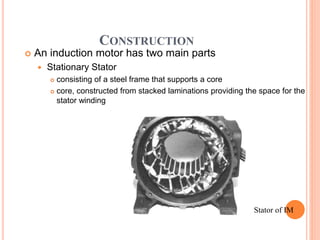
 Stationary Stator
 consisting of a steel frame that supports a core
 core, constructed from stacked laminations providing the space for the
stator winding
Stator of IM
CONSTRUCTION
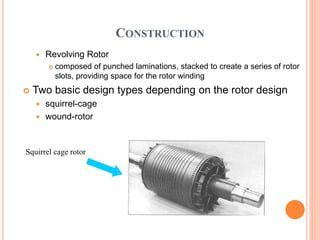
 Revolving Rotor
 composed of punched laminations, stacked to create a series of rotor
slots, providing space for the rotor winding
 Two basic design types depending on the rotor design
 squirrel-cage
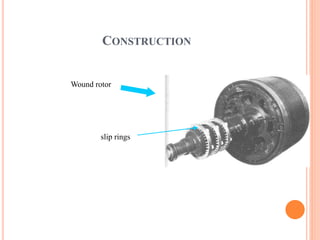
 wound-rotor
Squirrel cage rotor
CONSTRUCTION
Wound rotor
slip rings
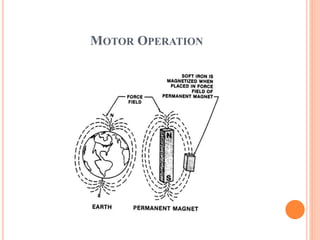
MOTOR OPERATION
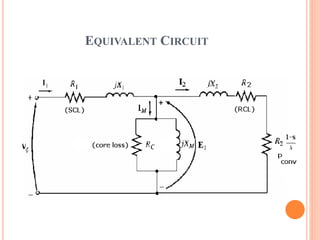
EQUIVALENT CIRCUIT
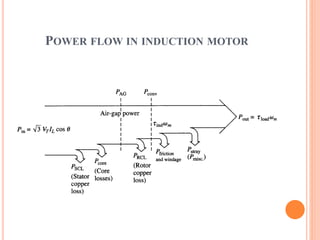
POWER FLOW IN INDUCTION MOTOR
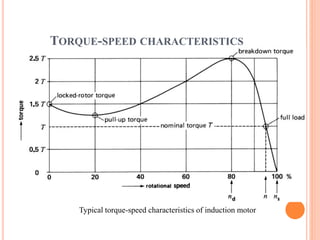
TORQUE-SPEED CHARACTERISTICS
Typical torque-speed characteristics of induction motor
MAXIMUM TORQUE
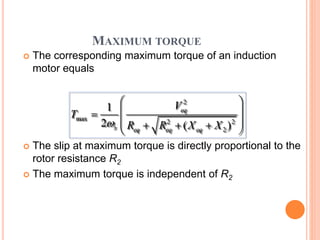
 The corresponding maximum torque of an induction
motor equals
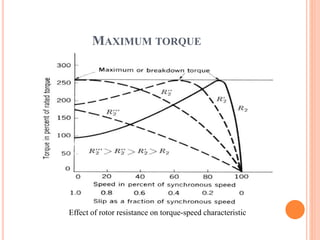
 The slip at maximum torque is directly proportional to the
rotor resistance R2
 The maximum torque is independent of R2
2
max 2 2
2
1
2 ( )
eq
s eq eq eq
V
T
R R X X
 
 
    
MAXIMUM TORQUE
Effect of rotor resistance on torque-speed characteristic

Induction motors

  • 1.
    Induction Motors - Mr.V. S. Wadkar - Assistant Professor, - Department of Electrical Engineering, - SITCOE
  • 2.
    INTRODUCTION  Three-phase inductionmotors are the most common and frequently encountered machines in industry  simple design, rugged, low-price, easy maintenance  wide range of power ratings: fractional horsepower to 10 MW  run essentially as constant speed from zero to full load  speed is power source frequency dependent  not easy to have variable speed control  requires a variable-frequency power-electronic drive for optimal speed control
  • 3.
    CONSTRUCTION  An inductionmotor has two main parts  Stationary Stator  consisting of a steel frame that supports a core  core, constructed from stacked laminations providing the space for the stator winding Stator of IM
  • 4.
    CONSTRUCTION  Revolving Rotor composed of punched laminations, stacked to create a series of rotor slots, providing space for the rotor winding  Two basic design types depending on the rotor design  squirrel-cage  wound-rotor Squirrel cage rotor
  • 5.
  • 6.
  • 7.
  • 8.
    POWER FLOW ININDUCTION MOTOR
  • 9.
    TORQUE-SPEED CHARACTERISTICS Typical torque-speedcharacteristics of induction motor
  • 10.
    MAXIMUM TORQUE  Thecorresponding maximum torque of an induction motor equals  The slip at maximum torque is directly proportional to the rotor resistance R2  The maximum torque is independent of R2 2 max 2 2 2 1 2 ( ) eq s eq eq eq V T R R X X         
  • 11.
    MAXIMUM TORQUE Effect ofrotor resistance on torque-speed characteristic